Buyer Fit Snapshot
| Best fit | Branded Kraft Paper Labels MOQ projects where brand print, material claims, artwork control, MOQ, and repeat-order consistency need to be specified before quoting. |
|---|---|
| Quote inputs | Share finished size, material target, print colors, finish, packing count, annual reorder estimate, ship-to region, and any compliance wording. |
| Proofing check | Approve dieline scale, logo placement, barcode or warning zones, color tolerance, closure strength, and carton packing before bulk production. |
| Main risk | Vague material claims, crowded artwork, missing packing details, or unclear freight terms can make a low unit price expensive after revisions. |
Fast answer: Branded Kraft Paper Labels MOQ: Pricing, Specs & Lead Times should be specified like a repeatable production item. The safest quote records material, print method, finish, artwork proof, packing count, and reorder notes in one written spec.
Production checks before approval
Compare the actual filled-product size with the drawing, then confirm tolerance on folds, seals, hang holes, label areas, and retail display edges. Reserve space for logos, QR codes, warning copy, and material claims before decorative graphics fill the panel.
Quote comparison points
Review material grade, print process, finish, sampling route, tooling charges, carton quantity, and freight assumptions side by side. A quote is only useful when the supplier can repeat the same color, closure quality, and packing count on the next order.
Branded Kraft Paper Labels MOQ: Pricing, Specs & Lead Times is never just a line item on a quote. For a packaging buyer, it is the point where brand intent, manufacturing reality, and landed cost all collide in a very practical way. A team may love the warm kraft texture on a shelf sample, yet branded Kraft Paper Labels MOQ is the question that decides whether the run stays affordable, whether the schedule holds, and whether the spec needs a quiet adjustment before production begins.
That question matters more than many teams expect. In eco-focused categories, kraft often wins because the texture signals honesty and craft long before a customer reads the back panel. For brands sourcing through Custom Logo Things, branded kraft paper labels MOQ usually turns into a conversation about setup, die-cutting, press width, adhesive behavior, and trim waste, not simply the number printed on the purchase order.
"The lowest quote can be the most expensive choice once the project needs a reprint, a redesign, or a rushed second run. A better order starts with the right build for the launch volume."
Branded kraft paper labels MOQ: what buyers miss
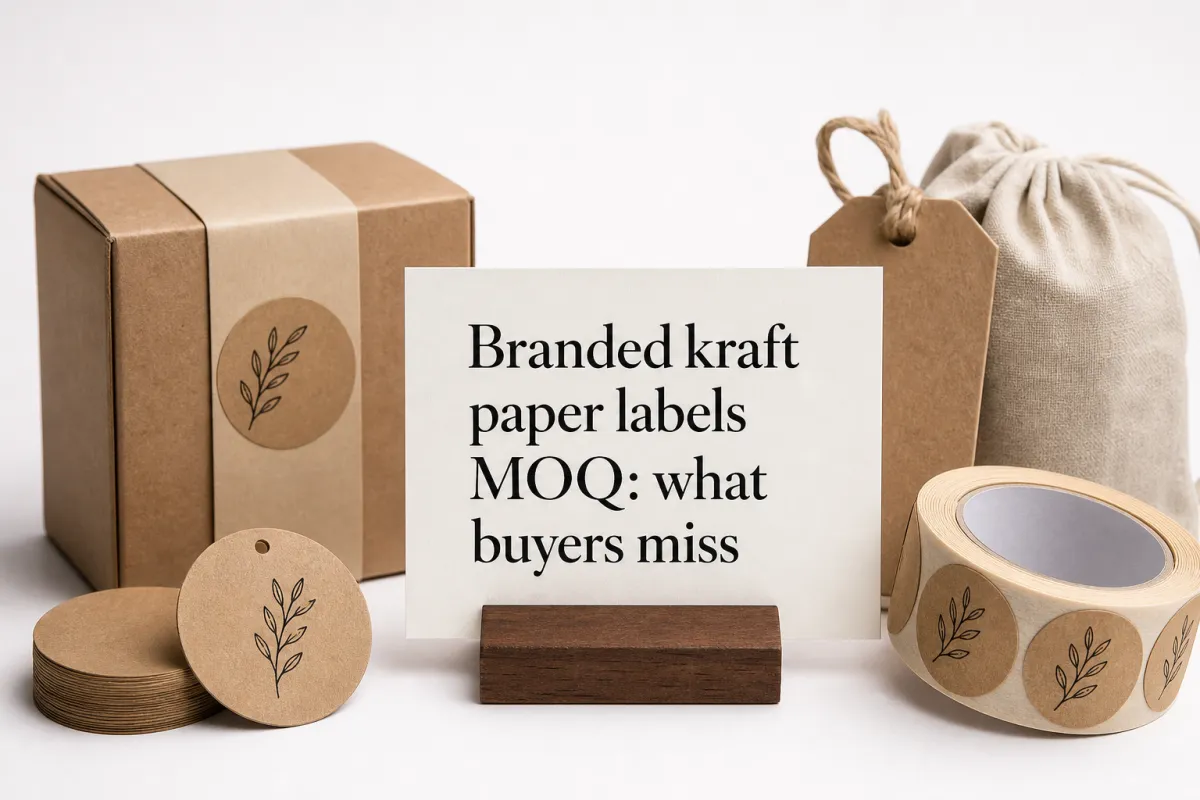
Style is usually the first thing buyers notice. Production math deserves that attention first. Branded kraft paper labels MOQ is shaped by the fixed work behind the scenes: art preparation, plate or digital setup, die-cutting, rewind planning, and trim waste. If a supplier needs a new shape, a new press lane, or a new material stack, the minimum order exists to spread those fixed costs across enough labels to keep the run viable.
That is why branded kraft paper labels MOQ can feel a little counterintuitive at first glance. A simple round or square label may qualify for a lower threshold than a complex custom shape, even if both look equally polished on a jar. Standardizing size, shape, and adhesive usually gives a buyer more room on pricing than requesting three finishes, two stock types, and a custom silhouette on the first order.
There is also a shelf effect that gets overlooked. Kraft paper communicates handmade, natural, and small-batch almost immediately. On wellness jars, specialty teas, coffee tins, and dry-goods cartons, the substrate itself carries a strong part of the brand story. That means a label system can stay visually restrained and still perform well. In that sense, branded kraft paper labels MOQ is not only about finding the cheapest run; it is about finding the smallest build that still does the job on shelf and in hand.
From a buyer's point of view, the cleanest approach is simple: standardize what can be standardized, then keep custom touches for the elements that actually move sales. A slightly different border shape rarely changes consumer behavior. A readable logo, a balanced color palette, and a label size that sits cleanly on the package usually matter much more.
One practical point deserves attention early. If the label is going onto corrugated cardboard, mailers, or a rough paperboard carton, the adhesive choice matters as much as the artwork. Branded kraft paper labels MOQ may rise when the application surface is inconsistent, because the supplier may need a stronger adhesive, a wider web, or a different finishing method to keep the label reliable in transit and on shelf.
Product details: what branded kraft paper labels are made of
At a construction level, branded kraft paper labels are straightforward: a kraft paper face stock, a pressure-sensitive adhesive, and a liner that supports release and application. The simplicity can be misleading. Each layer affects print quality, dispensing, and how the label behaves once it reaches the package. A buyer who understands those layers usually gets a better quote and fewer surprises during production.
Natural brown kraft is the finish most people picture first. It brings an earthy, recycled feel and works well when the substrate is meant to be part of the message. Bleached kraft behaves differently. The fiber texture remains, but the lighter tone gives stronger contrast for logos, copy, and barcode elements. Recycled kraft can be appealing for brands that want to signal recycled materials or a higher post-consumer waste content, though fiber variation often shows more clearly. That is not a flaw. It is part of the material's character.
Matte kraft paper remains a favorite because it avoids glare that can flatten a label in product photography. It photographs cleanly, feels less industrial, and supports a handmade impression without demanding a heavy design system. On jars, cartons, and mailers, that matters. A well-placed logo on matte kraft can look deliberate even when the rest of the packaging stays minimal. I've seen plenty of projects where the label looked a bit plain on screen, then came alive the moment it was wrapped around a real package.
The tradeoffs are real. Moisture resistance is lower than many film labels, very dark solid coverage can appear a little muted, and edge detail can soften if the die or print line is not well controlled. For food, beverage, and wellness brands, that may still be the right trade. For freezer use, condensation, or humid storage, the adhesive and liner need a closer look before branded kraft paper labels MOQ is approved.
- Natural brown kraft suits rustic, earthy, and direct-to-consumer packaging.
- Bleached kraft supports stronger contrast and a cleaner premium look.
- Recycled kraft helps signal recycled content when the full pack supports the claim.
- Pressure-sensitive construction usually allows faster application than glue-applied labels.
- Roll format is common for semi-automatic and automatic application lines.
For brands building a biodegradable packaging story, a careful note is necessary. A kraft face stock by itself does not make the entire package biodegradable. The adhesive, liner, inks, and final substrate all matter. If the goal is a credible sustainability message, the full pack structure should be checked rather than only the visible finish. FSC certification can matter too, especially when paper sourcing is part of the brand promise. For reference, you can review FSC certification information and compare it with the supplier's material declaration.
As a product family, branded kraft paper labels work best where the package already carries a natural cue: kraft mailers, recycled cartons, paperboard sleeves, glass jars, and bottles with a secondary carton. They also fit seasonal lines, test launches, and short runs where the buyer wants the pack to feel thoughtful without committing to a high-volume film label.
Specifications that shape branded kraft paper labels MOQ
Branded kraft paper labels MOQ changes when the spec changes. That sounds obvious, yet many buyers still treat MOQ as if it is fixed by category. It is not. The real drivers are size, shape, press method, adhesive, liner, finish, and how efficiently the material runs through the equipment.
Start with the basics. A 2 x 3 inch rectangle is usually easier to run than a custom die-cut shape with tight radii and internal cutouts. Roll format often suits application speed, while sheeted format can make sense for hand-applied projects or smaller promotional packs. Core diameter, unwind direction, and label pitch matter too, especially if the labels need to fit a specific applicator.
Artwork complexity matters more than many teams expect. A one-color logo on kraft is easier to manage than a full-coverage design with multiple spot colors, fine type, metallic accents, and a barcode that must scan cleanly on the first read. If the job calls for specialty inks or a tighter registration tolerance, branded kraft paper labels MOQ may climb because setup time and reject allowance both increase.
Surface conditions should be checked early. Glass, plastic tubs, textured paperboard, and corrugated cardboard all behave differently. A label that sticks cleanly to a smooth jar may struggle on a slightly dusty mailer flap or a recycled carton with a rough surface. That is why good suppliers ask about storage, handling, and final use before they quote. If a package will see refrigeration, freezer storage, or shipping abrasion, the adhesive should be tested against the real use case rather than assumed.
A fast way to avoid delay is to request a dieline and a digital proof before the order moves into production. That gives the buyer a chance to verify size, copy fit, barcode placement, and the distance from the edge to the trim line. Once the proof is signed, branded kraft paper labels MOQ can move more predictably because there are fewer last-minute changes.
"The best spec sheet answers the production questions before the production team has to ask them."
If the supplier offers packaging testing, ask whether the labels have been checked for adhesion, rub resistance, and transport stress. For shipping packs, the logic should borrow from real distribution rather than guesswork. The ISTA test standards are useful as a reference point for how pack components are expected to perform under handling and transit stress. That does not mean every label needs a full lab program. It does mean the buyer should confirm that the label build matches the roughness of the journey.
One practical rule holds up well: confirm substrate compatibility before the order is locked. If the labels will be applied to glass, corrugated cardboard, coated cartons, or plastic containers, the adhesive should be selected for the exact surface. That one choice can shift branded kraft paper labels MOQ more than a color change ever will.
Pricing and MOQ for branded kraft paper labels
Pricing becomes much easier to read once the quote is split into parts. A label estimate usually includes material, print setup, die-cut tooling if needed, finishing, packaging, freight, and any sample or proof charges. Branded kraft paper labels MOQ is tied to those fixed costs because the smaller the run, the more each label has to carry in overhead.
That is why the unit cost drops as quantity rises. A 1,000-piece order may be acceptable for a launch test, but the per-label price is often materially higher than a 5,000-piece run. The setup cost is similar either way. The difference is how many labels absorb it. This is also why two 2,500-piece orders usually cost more than one 5,000-piece order, even when the total label count is the same. The press gets set up twice, the proof loop happens twice, and the waste allowance repeats.
Here is a practical way to think about it. For a common 2 x 3 inch branded kraft paper label with moderate ink coverage, buyers often see pricing bands roughly like these, depending on finish and adhesive performance:
| Quantity tier | Typical unit cost range | What usually drives the price | MOQ takeaway |
|---|---|---|---|
| 500-1,000 labels | $0.22-$0.45 each | Setup spread across a small run, higher waste allowance | Good for sample packs, but branded kraft paper labels MOQ is tight |
| 2,500 labels | $0.13-$0.28 each | Better efficiency, still some setup pressure | A common launch point for new SKUs |
| 5,000 labels | $0.08-$0.18 each | Setup is spread more effectively, press time is used better | Often the sweet spot for branded kraft paper labels MOQ |
| 10,000+ labels | $0.05-$0.12 each | Greater material efficiency and lower relative overhead | Best if demand is steady and design is locked |
Those numbers are not a promise. They are a practical range, and the exact quote will move with ink coverage, size, roll format, adhesive, and delivery destination. Still, they show the structure clearly: branded kraft paper labels MOQ is not just about getting a vendor to say yes. It is about finding the threshold where the order starts to make economic sense.
Three choices usually move the quote most:
- Label size - larger labels use more material and often need more careful trim control.
- Print coverage - heavy ink, white underprint, or specialty colors increase production load.
- Application format - roll-fed labels for automation usually cost differently than sheeted runs.
If you want cleaner pricing, ask for tiered quotes at three or four quantities. A useful request might be 1,000, 2,500, 5,000, and 10,000 pieces. That exposes the break point where the unit cost falls enough to justify a slightly higher order. It also helps the buyer compare branded kraft paper labels MOQ across launch scenarios instead of guessing.
For more format context, see our Custom Labels & Tags page. If you are still comparing basic ordering questions, our FAQ covers common setup and proof topics in a simpler format.
Process and timeline: from proof to shipment
The fastest projects are usually the ones where the buyer gives clean input on day one. A typical production path for branded kraft paper labels is straightforward: inquiry, specification review, artwork check, digital proof, approval, printing, finishing, quality inspection, and shipment. Every step matters because one missing detail can push the whole run back by several business days.
Simple repeat orders often move faster than first-time jobs. The reason is plain: the supplier already has the die, the material record, and the previous spec file. In those cases, branded kraft paper labels MOQ can be easier to accommodate and the schedule can tighten noticeably. New sizes, custom shapes, or specialty adhesives take longer because the setup needs more checking.
As a practical guide, many straightforward runs land in the 8-15 business day range after proof approval. More complex orders can take longer, especially if the art is not final, the dieline has to be built from scratch, or the adhesive needs a special test. Rush requests are possible in some cases, though they usually come with a higher unit cost or a narrower production window.
The biggest delays are usually ordinary, not dramatic. Missing artwork dimensions. Unclear quantity targets. Barcode files sent at the wrong resolution. A buyer deciding after proof approval that the label should be 5 mm larger. Those are the issues that slow branded kraft paper labels MOQ far more often than actual press problems.
Here is the simplest way to keep the schedule moving:
- Send final artwork in a print-ready vector format, ideally AI, EPS, or a clean PDF.
- Confirm the label dimensions, finish, and adhesive before the proof is issued.
- Review the proof the same day if possible.
- Lock the spec sheet once the proof is approved.
- Keep the shipping address and delivery contact current.
That approval loop matters more than many teams realize. If the buyer responds quickly, branded kraft paper labels MOQ can move straight into the queue instead of sitting in a pending folder. If the buyer waits three days to answer a proof question, the schedule usually slips by more than those three days because the production slot has already moved on.
For brands using labels on shipping cartons or consumer mailers, the timing should also account for downstream packing. A label that arrives on time but does not match the carton layout can stop fulfillment just as effectively as a missed delivery. In practice, the best projects are the ones where the label, the box, and the application method are planned together. That is especially true for corrugated cardboard packouts, where the label size has to sit correctly across folds, seams, and handling points.
If your order includes repeat SKUs, preserve the file history. The saved dieline, the proof notes, and the substrate callout can shave meaningful time off the next branded kraft paper labels MOQ order. It is one of the easiest ways to protect launch speed without giving up production control.
Why choose us for branded kraft paper labels MOQ
Buyers rarely need more adjectives. They need a supplier that can quote clearly, produce consistently, and keep the order aligned with the actual use case. That is the standard we aim for at Custom Logo Things. When a brand asks about branded kraft paper labels MOQ, the useful answer is not a sales flourish. It is a spec-driven conversation about what can be delivered reliably and what should be adjusted before production starts.
Clear quoting matters. A good estimate should show where the money goes: material, setup, finishing, and shipping. If a quote is vague, the buyer cannot compare options or understand what changes the unit cost. Transparent pricing is especially helpful for brands testing multiple pack formats, because branded kraft paper labels MOQ can shift when the shape, print coverage, or adhesive changes. The more visible the cost stack, the easier it is to make a sensible decision.
Consistency matters too. If a label will sit on a premium jar, a kraft mailer, or a secondary carton, the finish has to look intentional across the full run, not just on the proof. That means stable color, clean trim, and a surface that supports the logo instead of competing with it. Our Case Studies page shows how brands use consistent label specs across different packaging components without overcomplicating the design.
We also pay attention to sustainability claims in a practical way. If the material spec calls for FSC certified paper or recycled materials, that needs to be supported in the build record, not just in the artwork brief. If a buyer wants a pack story tied to post-consumer waste content or biodegradable packaging language, the label construction should be checked carefully so the claim is accurate. That kind of discipline protects both brand trust and procurement confidence.
- Sample support helps buyers compare texture, color, and adhesion before committing.
- Proof review catches barcode, trim, and layout issues early.
- Saved specs make repeat branded kraft paper labels MOQ orders easier to place.
- Low-MOQ options help new launches without forcing excess inventory.
There is a simple business reason this approach works. Lower waste usually improves the real economics of the packaging program. A brand that orders the right quantity, avoids reprints, and stores a clean spec file often spends less over time than one chasing the lowest headline quote. That is especially true for branded kraft paper labels MOQ, where the price difference between a small test order and a more efficient run can be large.
To be frank, the best supplier relationship is the one that lets a buyer ask uncomfortable questions without slowing down the project. Will the label stick to textured paperboard? Does the brown kraft face still read clearly under warm lighting? Can the order be repeated in the same spec without re-approval? Those questions are not objections. They are how a brand keeps production honest.
Next steps for branded kraft paper labels MOQ
If you are ready to move, keep the request tight. The best starting point for branded kraft paper labels MOQ is a concise brief with the label dimensions, quantity target, artwork file, substrate type, application surface, and delivery deadline. Once those details are locked, the quote gets sharper and the production risk drops.
It is smart to compare at least two quantity tiers before you approve the order. A 2,500-piece run may look attractive until you see how close the 5,000-piece unit cost comes to it. A high MOQ can also be the wrong move if the product is still being tested. The right answer is usually somewhere in the middle, and the break point shows up only when the numbers are placed side by side.
Ask for a spec-driven quote, not a generic estimate. Branded kraft paper labels MOQ depends on the exact build, and the exact build includes more than artwork. It includes stock, adhesive, finish, and how the label will be applied in the real line. Once the proof is approved, keep the spec sheet unchanged so the production run stays clean and the timeline stays controlled.
In the final review, check five things before you release the order: size, finish, adhesive, proof approval, and shipment details. Those five items catch most of the problems that lead to reprints or delays. If the brief is still fuzzy, pause and tighten it now rather than trying to rescue it after the press is already scheduled. That little bit of discipline saves a lot of headaches later.
For a quick reference on common ordering questions, use our FAQ. If you need to compare label formats first, the Custom Labels & Tags page is a practical place to start. Then lock the proof, confirm the finish, and move the job into production. That is how branded kraft paper labels MOQ stops being a guess and becomes a controlled packaging decision.
branded kraft paper labels MOQ is ultimately about matching the label to the business plan, not chasing the smallest number on the quote. When the spec is disciplined and the quantity tier is chosen with care, branded kraft paper labels MOQ can support launch speed, protect unit cost, and keep the packaging story credible from the first shipment onward. If you are looking at a launch right now, the best move is to confirm the surface, lock the quantity tier, and send final artwork together so the production quote reflects the real job instead of a rough guess.
What is the usual MOQ for branded kraft paper labels?
MOQ depends on size, shape, print colors, finish, and whether the labels are supplied on rolls or sheets. Standard shapes and common sizes usually allow lower minimums because tooling and setup are easier to reuse. Custom Die Cuts, specialty adhesives, or heavy ink coverage usually raise the minimum order or the unit price.
Can I mix sizes in one branded kraft paper labels MOQ order?
Sometimes, but only if the sizes share the same material, print setup, and production method. Mixed sizes may still require separate dies or separate press runs, which can reduce the savings you expected. Ask for a combined-volume quote so you can compare one mixed order against two separate standard runs.
How much do branded kraft paper labels cost per 1,000 units?
The exact price changes with label dimensions, print coverage, adhesive choice, finish, and freight. Smaller runs usually carry a higher per-1,000 cost because setup is spread across fewer labels. Request tiered pricing at multiple quantities so you can see where the best unit-cost break point lands.
What artwork files do you need for branded kraft paper labels?
Vector files in AI, EPS, or print-ready PDF are usually best because they hold edge detail cleanly. Provide dielines, Pantone references, copy, barcode data, and any varnish or finish callouts. If the artwork is not final, ask for a proof template first so the layout can be checked before production.
How long does production take after proof approval?
Simple repeat orders usually move faster because the die and spec record already exist. New sizes, custom shapes, or specialty materials can add time because they require additional setup and inspection. The fastest way to avoid delay is to approve the proof quickly and keep the spec sheet unchanged once production starts.