Buyer Fit Snapshot
| Best fit | Custom Sustainable Labels MOQ projects where brand print, material claims, artwork control, MOQ, and repeat-order consistency need to be specified before quoting. |
|---|---|
| Quote inputs | Share finished size, material target, print colors, finish, packing count, annual reorder estimate, ship-to region, and any compliance wording. |
| Proofing check | Approve dieline scale, logo placement, barcode or warning zones, color tolerance, closure strength, and carton packing before bulk production. |
| Main risk | Vague material claims, crowded artwork, missing packing details, or unclear freight terms can make a low unit price expensive after revisions. |
Fast answer: Custom Sustainable Labels MOQ: Pricing, Specs, Process should be specified like a repeatable production item. The safest quote records material, print method, finish, artwork proof, packing count, and reorder notes in one written spec.
Production checks before approval
Compare the actual filled-product size with the drawing, then confirm tolerance on folds, seals, hang holes, label areas, and retail display edges. Reserve space for logos, QR codes, warning copy, and material claims before decorative graphics fill the panel.
Quote comparison points
Review material grade, print process, finish, sampling route, tooling charges, carton quantity, and freight assumptions side by side. A quote is only useful when the supplier can repeat the same color, closure quality, and packing count on the next order.
Custom Sustainable Labels MOQ: Pricing, Specs, Process
custom sustainable labels MOQ is not a throwaway line on a quote sheet; it is the number that decides whether your label program stays nimble or starts tying up cash in boxes you do not need yet. If you are ordering labels for a launch, you are gonna care about that number pretty quickly. The first run sets the tone for the whole project, and the right quantity often matters more than the prettiest sustainability claim. A buyer who watches waste, setup time, and storage space usually gets a better result than one who only chases the lowest material price.
Recycled Paper Labels, FSC-certified stocks, compostable options, and recyclable films all have a place, but the greenest-looking choice is not always the smartest launch choice. Recycled paper labels or FSC paper often make more sense at a practical custom sustainable labels MOQ because they tend to convert more simply, waste less on press, and hold their cost down during testing. That difference shows up fast once a project moves out of the presentation stage and into actual production.
Most brands do not lose money on labels because the material itself is expensive. The losses usually come from ordering the wrong run size, choosing a finish that does not fit the package, or sitting on inventory after the artwork has already changed. I have seen more label budgets get squeezed by those three things than by raw material costs. This piece is meant to help you choose a sustainable label format that fits shelf life, shipping, reorder timing, and budget. If you need a wider packaging mix, the Custom Labels & Tags page is a practical starting point, and it works well alongside broader Custom Packaging Products when the label has to coordinate with cartons or inserts.
That is the real value of planning custom sustainable labels MOQ carefully. Not a slogan. Not a badge. Just a first order that keeps cash available, keeps inventory moving, and still gives the packaging a clean retail finish.
Custom sustainable labels MOQ: why the first order matters
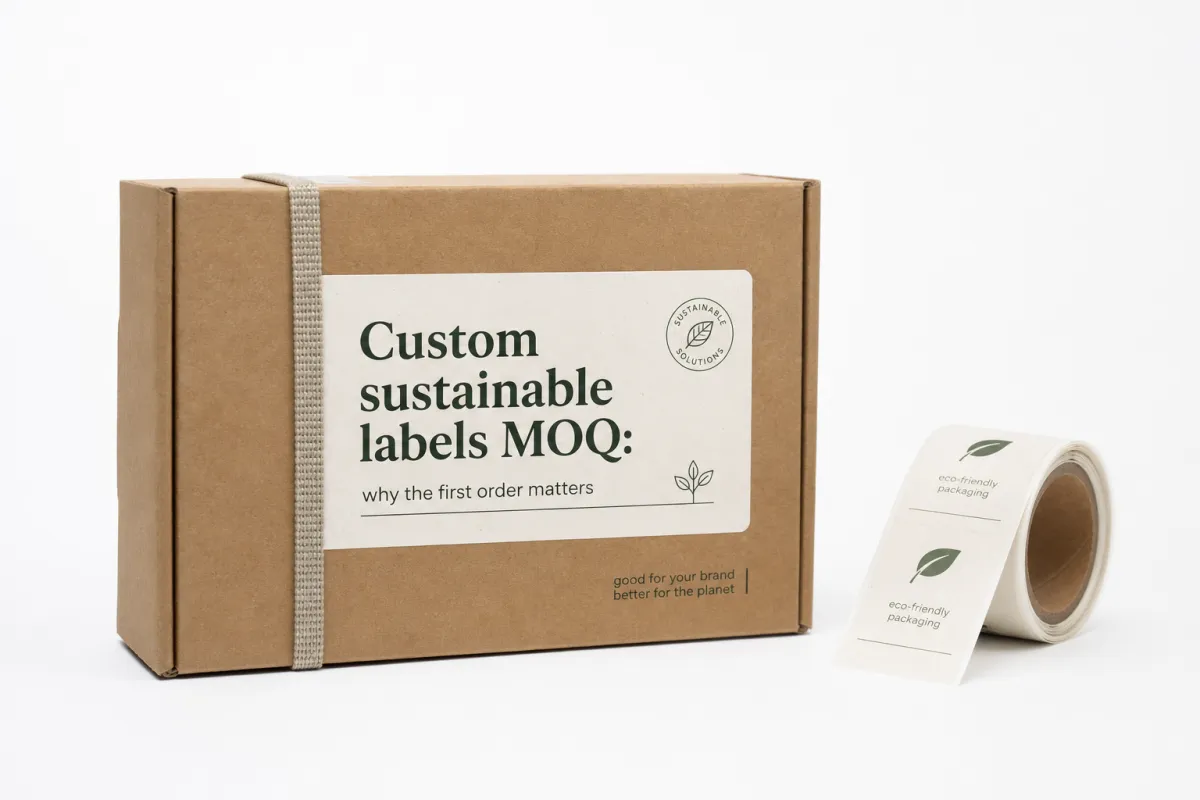
For most buyers, the first order decides how the whole label program behaves. A sensible custom sustainable labels MOQ gives enough pieces to test shelf impact, confirm adhesion, and see the print under real retail lighting without forcing a larger buy than the business can absorb. That becomes especially useful on launches, rebrands, and seasonal products, where the artwork may change before the second run is even due.
Practical experience usually beats the pitch deck. In my own review work, the surprises almost always come from adhesive behavior and finish choice, not from the face stock alone. A recycled paper label or FSC-certified paper often launches more comfortably than a specialty eco film that sounds impressive in a meeting but adds handling complexity on press. Simpler converting, cleaner die-cutting, and less waste can make those paper options easier to produce at a workable custom sustainable labels MOQ than a material that needs more careful process control.
The real problem is often not the stock. It is the gap between what was ordered and what the business actually uses. Order too much and cash gets trapped in inventory. Order too little and setup charges keep showing up again and again. Both paths push the unit cost upward. A good custom sustainable labels MOQ tries to balance those pressures instead of pretending one number works for every brand and every launch.
Shelf life, storage space, and reorder speed should guide the decision long before the marketing wording does. A label on a dry soap carton is a very different job from one on a chilled yogurt cup or a refill pouch that moves through temperature swings. If the label is going onto a chilled bottle, you are gonna need a very different adhesive than you would for a dry carton. That is why the smartest custom sustainable labels MOQ is the one tied to real usage, not the one that merely looks cheaper in the spreadsheet. A smaller test run is often the calmer move when the packaging is still changing.
"The cheapest order is the one that does not leave you with dead stock." That line does not sound glamorous, but it keeps label budgets honest.
Product details: what counts as a sustainable label
Eco is not a single material family. When a supplier talks about "sustainable" as if every option behaves the same way, they are skipping the part buyers actually need. A useful custom sustainable labels MOQ discussion starts with the face stock, then moves to adhesive, finish, and how the label will sit on the package once it enters the real world.
The main material options usually fall into five groups:
- Recycled paper - often the easiest starting point for launches, especially for dry goods, jars, cartons, and shipping labels.
- FSC-certified paper - a common choice for retail packaging that needs a documented chain of responsible sourcing. You can verify certification language through fsc.org.
- Compostable paper - useful for specific disposal streams, though not automatically the right fit for moisture, freezer, or long shelf-life applications.
- Bio-based film - a film option with a portion of renewable content, often used when the pack needs more conformability than paper can provide.
- Recyclable film - chosen when water resistance, clarity, or durability matters more than a paper look.
Adhesive choice matters just as much as the face stock, and in some applications it matters even more. A label that lifts on a curved bottle is not a sustainable success story; it is a waste problem with a nicer name. Common adhesive types include permanent, removable, freezer-grade, wash-off, and aggressive adhesives for hard-to-stick surfaces. A well-planned custom sustainable labels MOQ should define the adhesive before anyone sends artwork to print.
Finish affects both performance and perception. Matte gives a restrained, natural look. Soft-touch feels premium, although it can add cost and sometimes complicate recycling goals. Gloss helps color pop, which is useful in retail packaging, while uncoated stocks give a more grounded, natural aesthetic. Clear windows can help when the product itself should remain visible, but they do not belong on every label just because they are available.
Use case matters more than trend-chasing. Dry food, cosmetics, cold-chain food, refill pouches, shipping labels, and premium retail jars all ask for different combinations of stock and adhesive. A label on a carton is one thing; a label on a chilled bottle sitting in a wet case is something else entirely. If the label also needs to match custom printed boxes or other package branding pieces, bring that up early. Packaging design gets messy quickly when the label feels like an afterthought.
For buyers who want a quick comparison, here is the short version:
| Label Type | Typical MOQ Range | Best Use | Relative Cost | Practical Note |
|---|---|---|---|---|
| Recycled paper | 500-2,000 rolls or sheets | Dry goods, jars, cartons | Low to moderate | Good starting point for a test custom sustainable labels MOQ |
| FSC paper | 500-2,500 rolls or sheets | Retail packaging, branded packaging | Low to moderate | Usually an easy approval path for sustainability messaging |
| Compostable paper | 1,000-5,000 pieces | Special disposal programs, eco-forward launches | Moderate to higher | Check moisture exposure before committing to a full run |
| Bio-based film | 1,000-5,000 pieces | Flexible packs, curved containers | Moderate to higher | Better conformability, but the spec needs tighter review |
| Recyclable film | 1,000-5,000 pieces | Cold chain, high-durability product packaging | Moderate | Often the safer call for moisture and handling resistance |
One more point deserves a careful check: if a label claim needs a certification mark, ingredient panel, or compliance language, verify it before the order is released. FSC marks, recycling language, and region-specific claims all need proper handling, and those rules are not identical everywhere. For transport and shipping durability, the standards published by ISTA are useful when labels are part of a package that has to survive rough distribution. A label that looks good but fails in transit is just expensive confetti.
Specifications that change custom sustainable labels MOQ
Specs move MOQ more than most buyers expect. A simple rectangle with one or two colors is straightforward. Add a custom die-cut shape, several SKUs, metallic ink, or tight registration on a tiny label, and the custom sustainable labels MOQ can climb quickly. That is not a sales trick. It is the reality of setup time, handling, and waste in production.
Unusual die-cut shapes are a classic MOQ driver. Very small labels can be just as demanding, since handling gets harder and scrap rises. Larger labels use more material, yes, but awkward little labels can cost more per piece because they slow down the press and increase waste. A smart custom sustainable labels MOQ spec does not stop at "small and eco." It asks for a size that can actually run efficiently.
Color count matters as well. One-color black on natural paper usually costs less than a five-color print with special effects. Spot colors, metallics, and white ink on film add more complexity. If the product comes in several flavors, scents, or variants, keeping the base design identical and changing only one panel often helps custom sustainable labels MOQ planning stay cleaner and lowers setup risk across the line.
Format affects usability just as much as cost. Roll labels are usually the better fit for automatic application and higher volumes. Sheet labels can work for hand application, short runs, or office use, though they are not the right answer for every packaging operation. Core size, unwind direction, and roll count all matter if your team uses an applicator or label machine. A label that arrives on the wrong core is not slightly awkward; it is dead on arrival.
Proofing deserves more attention than it often gets. Sustainability claims, barcodes, ingredient panels, and certification marks need verification before production starts. If the barcode does not scan, the pack is not retail-ready. If the claim language is vague or unsupported, compliance becomes a problem. If the label is meant for product packaging that travels through a rough supply chain, the artwork and the construction need to match the actual conditions, not the ideal version of them.
Here is the practical order of importance when tightening specs for a custom sustainable labels MOQ:
- Choose the label material and adhesive first.
- Confirm the size and shape against the package surface.
- Limit the number of colors and special finishes.
- Keep SKUs grouped into one family where possible.
- Approve the proof only after barcode and text checks.
That sequence saves more money than chasing the lowest headline quote.
Custom sustainable labels MOQ and pricing: what actually drives the quote
Pricing looks simple on paper and becomes messy once the order details are real. The basic rule still holds: as custom sustainable labels MOQ rises, the unit price tends to fall. The lowest per-label quote is not always the least expensive order, though, if you have to store it, insure it, or write off unsold stock later. Cash flow matters. Floor space matters. Reorder speed matters too.
The main pricing levers are material choice, print method, color count, finish, shape complexity, and quantity. A recycled paper label with one or two colors is usually easier on the budget than a compostable film with a complex die-cut and special finish. A slightly higher custom sustainable labels MOQ can also reduce unit cost enough to offset a reasonable storage burden, especially when the label supports a stable SKU that will be used for months.
Small brands often make the same mistake: they order too little and keep paying setup fees over and over. That looks cautious until the math starts to pile up. If a setup fee is spread across 1,000 labels, the unit cost stings. Spread across 5,000 labels, the numbers look calmer. Sometimes a higher custom sustainable labels MOQ is the more disciplined buy, not the riskier one.
Ask for a quote that separates the numbers. You want to see the die charge, any plate or setup fee, proofing cost, shipping, and repeat-order pricing. If a vendor only gives you one all-in number, it is hard to compare properly. The landed cost is what matters, not the headline. That is especially true for branded packaging programs where labels need to coordinate with cartons, inserts, and other retail packaging assets.
Typical pricing ranges vary by size and finish, but these figures are realistic enough to plan around:
- Recycled paper labels: about $0.04-$0.09 per label at 5,000 pieces, depending on size and color count.
- FSC-certified paper labels: about $0.05-$0.10 per label at 5,000 pieces, depending on finish and shape.
- Compostable paper labels: about $0.07-$0.14 per label at 5,000 pieces, depending on adhesive and print coverage.
- Recyclable film labels: about $0.06-$0.12 per label at 5,000 pieces, depending on durability and application method.
Those numbers move with size, ink coverage, and roll format. A tiny shipping label and a large jar label do not live in the same cost universe. The same goes for simple black print versus a full-color branded packaging design. If your order includes multiple versions, ask whether the MOQ applies per artwork or across the whole job. That one question can save a lot of frustration.
Here is a simple way to compare the tradeoffs:
| Buying Choice | Upfront Spend | Unit Cost | Inventory Risk | Best Fit |
|---|---|---|---|---|
| Lower MOQ, more reorders | Lower | Higher | Lower | Test launches, seasonal products, fast-changing artwork |
| Mid-range MOQ | Moderate | Balanced | Moderate | Stable SKUs, small brands scaling retail |
| Higher MOQ | Higher | Lower | Higher | Established products with predictable sell-through |
If the numbers are still unclear, request two quotes: one at the minimum viable custom sustainable labels MOQ and one at the preferred reorder quantity. Compare the unit cost, storage impact, and expected reorder timing. That approach usually gives a more honest answer than staring at a cheap quote that ignores the hidden pieces.
Process and timeline for custom sustainable labels MOQ orders
The production flow is straightforward when the brief is clear. A typical custom sustainable labels MOQ order moves through request, material confirmation, artwork review, proof approval, production, inspection, packing, and shipping. If any of those steps is vague, the schedule slips. Artwork is usually the first place that happens. Sustainability claims can slow things down too. So can a late change to the finish after the proof is already in motion.
Simple repeat orders can move quickly, often in 7-10 business days after proof approval. First-time custom jobs take longer because new materials, new dies, or structural changes need attention before the press starts running. A more realistic window for a custom custom sustainable labels MOQ order is often 12-15 business days from final approval, and 15-20 business days if the job involves cold-chain use, strict compliance text, or multiple SKUs.
Delays usually show up in a few predictable places:
- Artwork arrives without dieline-ready dimensions.
- Barcode data is missing or untested.
- Sustainability claims change after the proof is started.
- The finish is changed after color approval.
- The order has multiple versions but only one version was briefed properly.
If speed matters, send a clean brief on day one. Include the label dimensions, application method, final copy, quantity target, material preference, and delivery date. If the label needs to be machine applied, say so. If it will be hand applied to curved containers, say that as well. Those details affect the right custom sustainable labels MOQ and the right format.
For shipping and distribution, it helps to think beyond the label itself. If the package is going into rough freight lanes, weak adhesives or flimsy stock can fail even when the design looks fine on screen. The tests and handling principles outlined by ISTA are worth reviewing for products that need more than a gentle handoff. A label should survive the trip, not just the proof.
You can also save time by using a simple approvals checklist. Confirm the stock, adhesive, finish, quantity, artwork, and ship method before production starts. If the broader product packaging is still being finalized, or if the label has to match other packaging design assets, use the same approval logic for the whole package family. It is cleaner, faster, and less expensive than correcting each piece in isolation.
What to expect from a custom sustainable labels MOQ partner
What matters most is not a dramatic promise. It is whether the order comes back right, on time, and within the budget you expected. For custom sustainable labels MOQ orders, the useful advantages are the quiet ones: clear material sourcing, consistent color, repeatable spec control, and less waste on reorders. That is what protects a launch when the rest of the packaging program is already moving.
The quoting process should stay practical. You need a direct read on material, adhesive, finish, and run size so you can decide whether the job should be paper, film, or a hybrid approach. That matters for brands building retail packaging, branded packaging, and product packaging that needs to look coordinated from the carton to the label. If you are also ordering custom printed boxes, the whole system should read as one brand, not three unrelated purchases.
Manufacturing discipline saves money. Clear specs, documented approvals, and print checks reduce the mistakes that usually show up on the first run. That includes incorrect barcode size, off-brand color, poor adhesion, and label stock that cannot stand up to use. A well-managed custom sustainable labels MOQ order gives a small brand room to test before committing to a larger run, then creates a cleaner path to scale once the label has proven itself.
Buyers also care about the support around the order. File checks should be simple. Quote revisions should be easy to read. Advice should be direct. If a recycled paper stock is the right answer, say so. If a film label is the better choice because the product sits in moisture or cold storage, say that too. A vendor who acts as if every project belongs in the same bucket is not helping; they are just forcing the wrong answer into place.
Good label work is not dramatic. It is consistent, repeatable, and quiet enough that nobody has to fix it twice.
If you want broader support across the packaging line, use FAQ for quick answers, then pair the label plan with the rest of your package branding. That is where the small decisions add up. A label that matches your box panel, your insert language, and your shelf presentation does more for the brand than another round of vague "eco" claims.
Next steps to order custom sustainable labels MOQ
If you want the right order the first time, do not begin with price. Start with the package. Pick the container, confirm the label size, choose a sustainable stock, and decide whether the first run is a test or a full launch order. That is the fastest path to a realistic custom sustainable labels MOQ instead of guessing and hoping the numbers work out later.
Send these details in your first message:
- Artwork file or current design file.
- Label dimensions and shape.
- Material preference, if you have one.
- Quantity target and acceptable MOQ range.
- Adhesive need, especially for cold, curved, or textured surfaces.
- Application method: hand applied or machine applied.
A sensible buying sequence is simple. Request one quote at the minimum viable custom sustainable labels MOQ, then a second quote at the preferred reorder quantity. Compare unit cost, setup fees, and storage cost. If the higher quantity saves enough to matter and the design is stable, take it. If the design is still moving, keep the run smaller and avoid tying up money in dead stock.
That last point matters more than people like to admit. Sustainable packaging is not only about the material note on the spec sheet. It is also about using the right amount, avoiding waste, and choosing a format that actually fits the product lifecycle. If you want the best custom sustainable labels MOQ for your product, compare specs first, then price. That is the cleanest way to keep the order practical and the label program easy to manage.
What is the typical custom sustainable labels MOQ for small brands?
It usually depends on material and print method, not just order size. Paper labels often allow lower MOQs than specialty films or complex finishes. The cleanest answer is a quote by spec, because die-cut shape and color count can move the minimum fast. For a first run, a smaller custom sustainable labels MOQ is often the safer way to test the market.
How do I lower the MOQ for custom sustainable labels without wrecking quality?
Use a standard shape and keep the number of SKUs low on the first run. Choose a common sustainable stock and a simple finish instead of a custom special effect. Send final artwork early so proof corrections do not force a new setup. In practice, that is how a custom sustainable labels MOQ stays manageable without turning the label into a compromise.
Are compostable labels always the best choice for sustainable packaging?
No. Compostable is not automatically better if the label needs cold storage, moisture resistance, or long shelf life. Recycled paper or recyclable film can be the smarter choice depending on the package and disposal stream. The right answer comes from matching the label to the packaging, not from chasing one buzzword. A smart custom sustainable labels MOQ plan starts with use conditions, not marketing language.
What affects the price of custom sustainable labels MOQ the most?
Material choice, print method, shape complexity, and quantity are the biggest drivers. Adhesive type and finish can also move pricing more than buyers expect. Artwork complexity matters too, especially when barcode accuracy and compliance text are involved. If you want better control over custom sustainable labels MOQ pricing, simplify the spec before you chase a lower headline number.
How long does a custom sustainable labels MOQ order usually take?
Simple repeat orders move faster than first-time custom jobs. New materials, custom dies, or artwork revisions add proofing time before production starts. The fastest path is to send specs, final copy, and target quantity in one clean brief. That gives the team enough detail to quote and schedule a custom sustainable labels MOQ order without playing email ping-pong.
Actionable takeaway: define the package first, then lock the label stock, adhesive, finish, and dimensions before you ask for pricing. Compare one quote at the minimum viable custom sustainable labels MOQ and one at the quantity you could realistically reorder, then choose the run size that protects cash flow without creating dead stock.

