Buyer Fit Snapshot
| Best fit | Custom Die Cut Carton Inserts projects where brand print, material claims, artwork control, MOQ, and repeat-order consistency need to be specified before quoting. |
|---|---|
| Quote inputs | Share finished size, material target, print colors, finish, packing count, annual reorder estimate, ship-to region, and any compliance wording. |
| Proofing check | Approve dieline scale, logo placement, barcode or warning zones, color tolerance, closure strength, and carton packing before bulk production. |
| Main risk | Vague material claims, crowded artwork, missing packing details, or unclear freight terms can make a low unit price expensive after revisions. |
Fast answer: Custom Die Cut Carton Inserts: Design, Cost, and Use should be specified like a repeatable production item. The safest quote records material, print method, finish, artwork proof, packing count, and reorder notes in one written spec.
Production checks before approval
Compare the actual filled-product size with the drawing, then confirm tolerance on folds, seals, hang holes, label areas, and retail display edges. Reserve space for logos, QR codes, warning copy, and material claims before decorative graphics fill the panel.
Quote comparison points
Review material grade, print process, finish, sampling route, tooling charges, carton quantity, and freight assumptions side by side. A quote is only useful when the supplier can repeat the same color, closure quality, and packing count on the next order.
Custom Die Cut Carton Inserts: Design, Cost, and Use
Custom die cut carton inserts are one of those packaging details that quietly decide whether a shipment feels carefully built or just barely held together. A product can arrive intact inside a carton, but the insert is often what kept it centered, cushioned, and visually tidy through the bumps, drops, and pressure changes that happen between pack-out and delivery. For fragile goods, premium kits, and multi-part shipments, custom die cut carton inserts do more than protect; they help the whole unboxing feel deliberate, which matters in branded packaging, retail packaging, and product packaging alike.
People usually underestimate custom die cut carton inserts until a box opens with a scratched finish, a loose accessory, or a product that has shifted hard against a wall. That is usually the moment the conversation changes from “Do we really need an insert?” to “How quickly can we get one that fits properly?”
What Custom Die Cut Carton Inserts Really Do
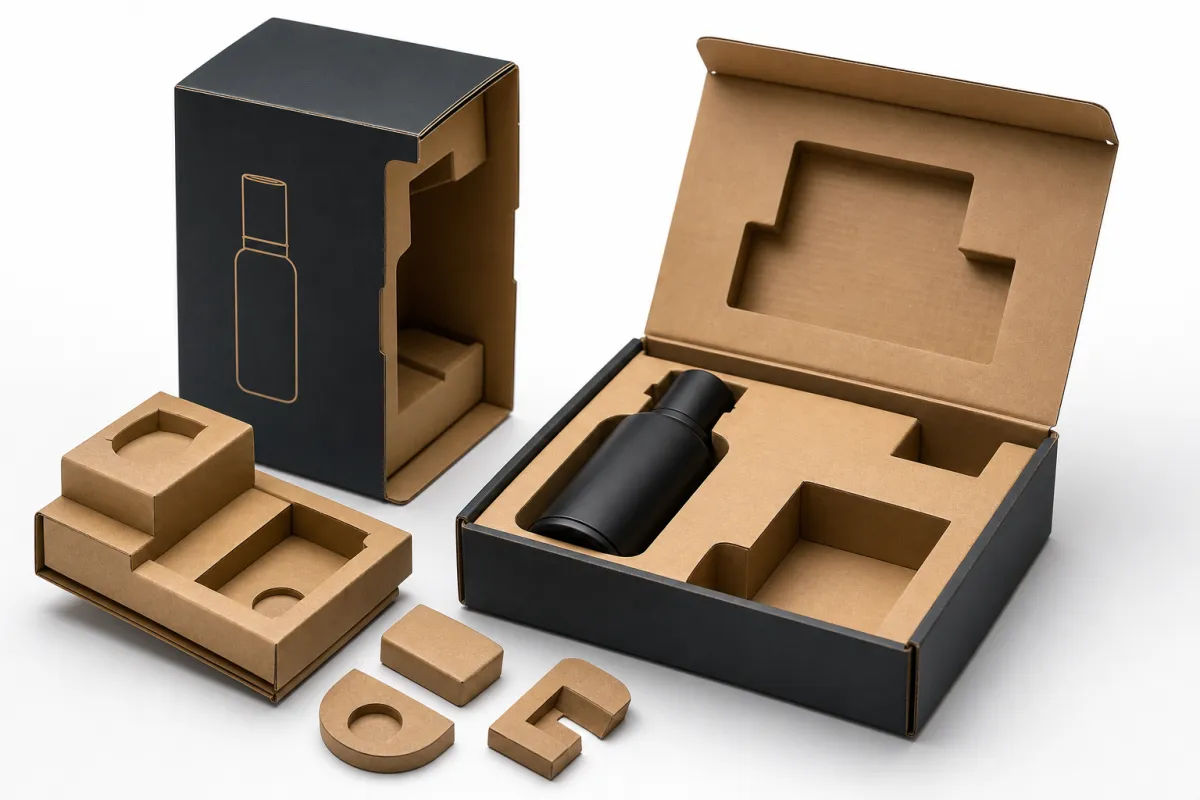
At the simplest level, custom die cut carton inserts are shaped internal components placed inside a carton to hold a product, accessory, or product set in position. They are cut to a specific outline, scored or folded where needed, and engineered so the item does not rattle around in transit. In practice, that means the insert is doing three jobs at once: controlling movement, protecting surfaces, and presenting the product cleanly when the box is opened.
The difference between a simple void-fill solution and a purpose-built insert is bigger than many buyers expect. Void fill can stop a package from sloshing around, but it rarely centers the product, supports weak points, or creates a finished presentation. Custom die cut carton inserts are built around the product itself, so the fit is intentional. That fit matters whether the package is a subscription item, a retail kit, a replacement part, or a consumer product that needs a polished reveal.
From a packaging buyer's point of view, the real value is not just damage prevention. A carton insert can simplify packing, reduce mistakes at the line, and make the brand feel more thoughtful the moment the customer lifts the lid. That is why custom die cut carton inserts show up so often in custom printed boxes and other package branding programs. The insert becomes part of the product story, not just a shipping accessory.
Most teams start looking at inserts only after one of three things happens: a fragile item gets damaged, a multi-piece kit arrives mixed up, or the unboxing looks messy enough that the brand experience feels cheap. Honestly, that is a costly way to learn. A good insert should make the pack-out easier, not harder, while still giving the product enough structure to survive real shipping conditions.
I have seen more than one well-made product lose perceived value because it wandered around inside the carton like it did not belong there. That kind of thing is kinda hard to unsee once you notice it.
A good insert should disappear in the right way: the customer notices the product, not the struggle that kept it in place.
When the design is right, custom die cut carton inserts can reduce the need for bubble wrap, loose paper, or oversized cartons. That can trim pack-out time and improve consistency, especially when the same item is shipped thousands of times. For some brands, the insert also creates a premium feel that supports higher perceived value without changing the product itself.
How Custom Die Cut Carton Inserts Are Made
The production path usually starts with measurements, and not just the product dimensions. A good spec includes the product’s widest, tallest, and deepest points, any protrusions, the carton’s internal dimensions, and the way the item will actually be loaded. That matters because custom die cut carton inserts need to work with real packaging behavior, not just a neat drawing on a screen.
After the initial measurements, the packaging engineer or supplier creates a dieline. That file maps the cut lines, scores, slots, tabs, folds, and retention points that will hold the product in place. For many custom die cut carton inserts, the first prototype is where the team discovers whether a pocket needs to be deeper, a corner needs relief, or an accessory needs its own cavity. A small change in a tab location can be the difference between a secure fit and a box that fights the packing line.
There are two common production approaches at a high level. Die cutting is efficient for repeat runs and more standardized shapes, especially when the design will be used at volume. Digital cutting works well for shorter runs, faster prototype cycles, or projects with frequent revisions and unusual geometry. Either method can produce excellent custom die cut carton inserts; the right choice depends on quantity, complexity, lead time, and how many changes you expect before approval.
Slots, folds, and nested pockets are where the engineering gets interesting. A well-designed insert does not just “fill space.” It supports load-bearing zones, keeps surfaces off carton walls, and leaves enough clearance for the packer to work without forcing parts into place. In other words, the insert must protect the product and still be practical on the line. If a packer has to wrestle with every carton, the design is not production-friendly.
Material and carton compatibility matter throughout the build. A 32 ECT corrugated wall behaves differently than a heavier board, and a lightweight paperboard insert may need different support geometry than a layered corrugated tray. Custom die cut carton inserts should be designed with the carton wall thickness, product weight, and handling method in mind. A design that looks perfect in isolation can fail once it meets the real box, the real product, and the real packing speed.
For broader sourcing and packaging structure decisions, many teams compare insert development with other Custom Packaging Products so the internal architecture and outer carton work together instead of competing for space.
Shipping validation belongs in the conversation too. If a product is fragile or high value, teams often look at the general approach used in ISTA testing programs, which focus on vibration, drop, and distribution stress. You can see the standards framework at ISTA. That kind of reference keeps custom die cut carton inserts grounded in real transit conditions rather than only bench-top assumptions.
Key Factors That Affect Fit, Protection, and Cost
Fit, protection, and cost are connected, and the tradeoffs show up quickly once the design gets real. The first variable is product geometry. A smooth rectangular item is easier to hold than a product with handles, knobs, cords, or irregular edges. The second variable is weight. Heavier products need more support at stress points and more attention to crush resistance, especially if the carton may be stacked during distribution. Custom die cut carton inserts become more effective when these details are captured early, because the insert can be tuned to the actual load path rather than guessed at from the outside shape.
Fragility is the next major factor. A ceramic surface, glass component, printed panel, or polished metal finish may need a buffer zone between the product and the carton wall, along with retention points that prevent motion without scuffing. A sturdy consumer product may not need much cushion at all; it may only need positional control and a clean presentation. That is why custom die cut carton inserts are not one-size-fits-all. The best design is rarely the most padded one. It is the one that uses just enough material in the right places.
Material choice has a direct effect on performance and price. Corrugated board is a strong middle ground for many applications because it offers structure, decent stack resistance, and good recyclability. Paperboard is often chosen when presentation matters more than heavy cushioning, especially in lighter retail packaging. Foam can add substantial protection, though it may raise recycling questions depending on the facility. Molded fiber offers a more natural look and can work well for molded cavities, but it may require different tooling and longer lead times. Layered combinations are also common when a single material cannot do everything.
There is a real tradeoff between tighter tolerances and production speed. A snug insert keeps a product from moving, but if the fit is too tight, packers slow down, parts snag, or finishes get rubbed during insertion. A looser design is easier to pack, yet it can reduce protection and make the box feel less premium. Custom die cut carton inserts sit in that narrow middle ground where the product is secure without becoming difficult to assemble.
Carton style matters too. A mailer-style box, a tuck-top carton, and a rigid setup all behave differently. Wall thickness, flap geometry, and how the carton is opened can change the insert’s retention strategy. A good design understands the carton as a system, which is why packaging design teams often review the insert and the outer carton together rather than separately.
Shipping method matters as well. A local hand-delivery program does not stress a package the same way as parcel shipping across multiple hubs. If the item will move through automated sortation, custom die cut carton inserts may need better restraint than a direct-to-consumer carton that stays mostly upright. For materials that will be recycled, the EPA’s general recycling guidance is worth reviewing at EPA recycling guidance, especially if your brand wants to keep product packaging aligned with current sustainability expectations.
Here is a practical way to think about common insert options:
| Material | Typical Strength | Best Use Case | Relative Cost |
|---|---|---|---|
| Corrugated board | Moderate to high | General protection, stack resistance, efficient shipping | Low to medium |
| Paperboard | Light to moderate | Retail presentation, lighter products, branded packaging | Low |
| Molded fiber | Moderate | Eco-focused builds, shaped cavities, natural appearance | Medium |
| Foam | High cushioning | Fragile components, high surface protection, precision fit | Medium to high |
That table is only a starting point, of course. The right answer depends on drop risk, presentation needs, product finish, and how much labor you can tolerate on the pack line. Still, it gives buyers a practical framework for comparing custom die cut carton inserts against the broader product packaging budget.
Cost and Pricing for Custom Die Cut Carton Inserts
Pricing for custom die cut carton inserts usually depends on six main drivers: material grade, sheet size, tooling or setup, cutting complexity, print requirements, and order quantity. The more complicated the geometry, the more setup attention it usually needs. A simple rectangular cradle is cheaper to make than a multi-pocket insert with locking tabs, finger cutouts, and several depth changes.
Volume changes the math in a major way. Short runs carry more setup cost per unit because the fixed work is spread across fewer pieces. At higher volumes, unit pricing generally improves because the machine time, die cost, and prepress work get absorbed more efficiently. That said, quantity is not the only factor. A cleanly designed insert with fewer folds and fewer revisions can outperform a more basic-looking design that is hard to produce. With custom die cut carton inserts, production simplicity often saves more than the first quote suggests.
For practical budgeting, many buyers see rough ranges like these in the market, though actual pricing varies a lot by region, board grade, and design complexity:
- Simple paperboard insert for a small run: often around $0.20 to $0.45 per unit.
- Corrugated insert with moderate die work: often around $0.35 to $0.85 per unit.
- Complex multi-pocket or foam hybrid insert: often around $0.75 to $2.00+ per unit.
- Prototype or sample builds: sometimes $50 to $250+ depending on revisions and tooling approach.
Those numbers are not promises, just the kind of ranges that help a buyer ask better questions. If a quote seems too low, it may be leaving out finishing, assembly, or freight. If it seems too high, it may be covering a truly custom geometry that will save money later by reducing damage and returns. That is the hard truth with custom die cut carton inserts: cheap is not always cheap once you count the hidden costs.
Hidden cost factors are where projects often get messy. A product dimension changes after the sample has been built. The artwork arrives late. The insert needs a coating or print detail. The pack-out process requires more labor than expected because the item has to be oriented in a very specific way. Each of those changes can push cost upward. In some cases, the real expense is not the board itself but the time needed to refine the design until the insert works on the line.
When comparing vendors, ask them to break the quote into tooling, materials, production, assembly, and freight. That separation makes it easier to compare apples to apples and to see where the money is going. It also helps you judge whether a supplier is recommending a sound packaging design or just a low initial number. If you are sourcing other components alongside the insert, it can be useful to compare the package with more custom packaging options so the full system stays cost-checked.
One thing I tell buyers often is that custom die cut carton inserts can pay for themselves in ways that are easy to miss on a spreadsheet. Lower damage rates, fewer returns, less repacking labor, and a cleaner unboxing all have value. For some brands, the insert also supports package branding so strongly that it helps the product command a better shelf or online perception. That matters in retail packaging, where the customer sees the build quality before they feel the product.
Step-by-Step Process and Timeline for Custom Die Cut Carton Inserts
The cleanest projects follow a pretty predictable path. First comes the product audit: exact dimensions, weight, any accessory pieces, and a look at how the product should sit in the carton. Then comes the carton measurement, because custom die cut carton inserts have to fit both the item and the box. After that, the designer drafts the dieline and sends a sample or prototype for review. Once the sample is approved, production begins, followed by packing, inspection, and delivery.
The biggest delays usually have nothing to do with the cutting machine. They happen when dimensions are incomplete, artwork is late, sample feedback is vague, or nobody has agreed on the acceptable tolerance. A product with a glossy coating may also behave differently than a plain unit in the sample phase, so teams should test with actual production units whenever possible. If your custom die cut carton inserts are designed around a prototype that is slightly smaller than the final product, the fit can feel perfect in review and too tight in live use.
A realistic timeline depends on complexity. Simple insert builds with clear dimensions can move through prototype review and production fairly quickly, often in the range of 10 to 15 business days after proof approval. More complex projects, especially those with repeated revisions or multiple pocket sizes, can stretch to 3 to 5 weeks or more. The schedule is less about how fast the cutter runs and more about how quickly the team can lock the geometry. In packaging, revisions are usually the thing that slows custom die cut carton inserts down.
Here is a planning checklist that saves time early:
- Product dimensions, including protrusions, accessories, and bundled parts.
- Carton internal dimensions and wall structure.
- Target order quantity and expected reorder volume.
- Shipping method, such as parcel, freight, or direct-to-consumer.
- Any presentation goals tied to branded packaging or custom printed boxes.
- Photos of the product in its current packaging, if available.
- Any testing requirements, including drop or vibration expectations.
That list sounds simple, but it prevents a surprising amount of back-and-forth. The more complete the starting information, the more likely the first sample will be close enough to approve. From a factory-floor standpoint, good input is what keeps custom die cut carton inserts from becoming a week of corrections instead of a straightforward build.
Ask for a prototype review before you commit to a full run. A good prototype exposes issues with finger access, insert stiffness, and how the product settles after insertion. If the team catches the problem there, it costs far less to change than after production tooling is set.
Common Mistakes When Specifying Custom Die Cut Carton Inserts
The most common mistake is measuring only the product and forgetting the rest of the real-world package. Accessories, cords, caps, closures, labels, coatings, and even tiny protrusions can change how the insert needs to be built. If the item has to travel with a charging cable or a second component, the insert must account for that space from the start. Custom die cut carton inserts fail when they are designed around the main product alone and not the full shipment.
Another frequent problem is choosing the wrong board caliper or cushion style. Too light, and the product rattles or the corners crush. Too heavy, and the pack-out becomes awkward, more expensive, or both. Some buyers also assume that more padding automatically means more protection. In reality, excess material can shift pressure to the wrong points and create a worse result than a leaner, better-placed structure. That is why custom die cut carton inserts should be evaluated by load path, not just thickness.
Designing for the sample on the bench instead of the production line is a classic trap. A single test unit handled by a designer is not the same as a line operator working through hundreds of cartons under time pressure. If the insert needs two hands, awkward angling, or careful alignment every time, the design may look elegant and still be impractical. Real pack-out conditions matter, and custom die cut carton inserts should be tested with the people and the speed that will actually use them.
Another mistake is rushing approval before the team has reviewed the tolerance stack. If the carton varies slightly, the product varies slightly, and the insert is cut too tightly, the result can be a jammed pack-out or scuffed product. Once tooling is approved, corrections become more expensive. A rushed sign-off can lock in a problem that would have been easy to adjust with one more round of proofing.
Sometimes the issue is aesthetic rather than structural. A brand may want the product to look dramatic on opening, but the insert ends up hiding too much or forcing the product too deep into the tray. Other times, the opposite happens: the insert is too open and leaves the product looking loose, which weakens the premium feel that package branding is meant to create. The best custom die cut carton inserts give the product a stage, not just a hole to sit in.
If you want to avoid expensive rework, test the actual item, not a placeholder, and run at least one pack-out trial with the final carton. That small step catches a lot of problems before they become returns, complaints, or damaged customer trust.
Expert Tips and Next Steps for Custom Die Cut Carton Inserts
My first tip is simple: build in a little tolerance, but only where it helps. Fragile items often benefit from slight clearance at the entry point and stronger support at the load-bearing surfaces. That keeps the packer from fighting the insert while still giving the product a stable home once it is seated. Custom die cut carton inserts work best when they are forgiving during insertion and firm during transit.
Second, test with actual product fills, not a best-case sample. Use the same finishing, the same accessories, and the same carton grade that will be used in production. Then run drop tests, vibration checks, and a few pack-out trials. Even a small mock shipment can reveal whether the insert shifts, bows, or slows the line. For critical launches, I would rather see three honest test cartons than a hundred assumptions.
Third, ask for a dieline review and a packaging audit before the final build. That review should cover carton dimensions, product clearance, support points, and any secondary items that need retention. It is also a good time to check whether the insert should support merchandising goals, not just shipping goals. In retail packaging, the structure and the presentation are part of the same job. That is especially true when custom die cut carton inserts are part of a larger branded packaging system.
Fourth, think about sustainability and recycling early, not after the design is locked. If your brand wants paper-based packaging, ask whether the material can be sourced responsibly and how it will be handled after use. Organizations like FSC provide a useful reference point for responsible sourcing discussions, and many buyers now expect that kind of clarity before approving a final specification. When custom die cut carton inserts are built with the end of life in mind, the packaging story is cleaner for everyone involved.
If you are starting from scratch, gather the following before you request samples: product dimensions, carton specs, quantity targets, photos, shipping method, and any protection concerns tied to the product finish. Then ask for a prototype review and compare the sample against the real pack-out workflow. That is the quickest path to a design that protects the product and respects the line.
For brands focused on custom logo packaging, custom die cut carton inserts can be a smart move when the goal is to combine fit, protection, and presentation in one build. The right insert lowers damage risk, supports package branding, and gives custom printed boxes a more finished feel. If you handle the design carefully, custom die cut carton inserts are not just a shipping accessory; they become part of the product experience from the moment the carton is opened to the moment the item is lifted out.
The practical takeaway is straightforward: measure the real product, review the carton and insert together, prototype before committing, and test with the actual pack-out workflow. That sequence keeps the design honest and usually saves a lot of backtracking later.
Frequently Asked Questions
What materials work best for custom die cut carton inserts?
Corrugated board is a strong choice for moderate protection and efficient shipping. Paperboard works well when presentation matters and the product is lighter. Foam or molded fiber may be better when the item is fragile, oddly shaped, or needs higher cushioning. The best material depends on how much movement must be controlled and how the carton will travel through distribution. In some builds, a hybrid structure is the smartest answer rather than forcing one material to do everything.
How do I measure products for custom die cut carton inserts?
Measure the product at its widest, tallest, and deepest points, including any protrusions. Include accessories, cords, caps, or bundled parts that must travel with the main item. Share carton internal dimensions too, because the insert has to fit both the product and the box. If two units ship together, measure the full set as a system rather than as separate parts. I always recommend taking photos next to a ruler or caliper so the dimensional notes are easier to verify later.
How long do custom die cut carton inserts usually take?
Simple designs can move quickly if dimensions are clear and no major revisions are needed. Complex layouts or repeated sample changes usually extend the timeline. The fastest projects are the ones with complete specs, fast approvals, and minimal back-and-forth. In many cases, the review cycle affects timing more than the actual cutting. If you are on a tight launch schedule, getting the prototype right the first time matters more than shaving a day or two off production.
Are custom die cut carton inserts worth the cost for small runs?
Yes, when product damage, returns, or brand presentation are expensive to ignore. Small runs may cost more per unit, but they can still be worthwhile if they reduce waste and improve pack-out. A good way to decide is to compare insert cost against avoided damage, labor, and replacement expenses. For premium products, even a small run can protect margin if the insert prevents one or two bad shipments. That math is often easier to see once you include customer service time and repacking labor.
Can custom die cut carton inserts be recycled?
Many paperboard and corrugated inserts can be recycled if they are clean and free of heavy coatings or mixed materials. Foam and composite constructions may have different recycling limits depending on local facilities. The best answer depends on the exact material build, so it is worth confirming before production. If sustainability is a major goal, ask for a material spec that matches both performance and end-of-life expectations. A clear material plan makes the packaging story easier to explain and easier to dispose of responsibly.

