Buyer Fit Snapshot
| Best fit | branded packaging for social media unboxing buyer review for packaging buyers comparing material specs, print proof, MOQ, unit cost, freight, and repeat-order risk where brand print, material, artwork control, and repeat-order consistency matter. |
|---|---|
| Quote inputs | Share finished size, material target, print colors, finish, packing count, annual reorder estimate, and delivery region. |
| Proofing check | Approve dieline scale, logo placement, barcode or warning zones, color tolerance, and any recyclable or compostable wording before bulk production. |
| Main risk | Vague material claims, crowded artwork, or missing packing details can create delays even when the unit price looks attractive. |
Fast answer: Branded Packaging for Social Media Unboxing Buyer Review: Dieline, Finish, Proof, and Buyer Review should be specified like a repeatable production item. The safest quote includes material, print method, finish, artwork proof, carton packing, and reorder notes in one written spec.
What to confirm before approving the packaging proof
Check the product dimensions against the actual filled item, not only the sales mockup. Ask for tolerance on folds, seals, hang holes, label areas, and retail display edges. If the package carries a logo, QR code, warning copy, or legal claim, reserve that space before decorative graphics fill the panel.
How to compare quotes without losing quality
Compare board or film grade, print process, finish, sampling route, tooling charges, carton quantity, and freight assumptions side by side. A lower quote is only useful if the supplier can repeat the same color, closure quality, and packing count on the next order.
Branded packaging for social media unboxing is not a stickered-up shipping box with a selfie problem. It is part protection, part presentation, part first impression, and yes, part performance. The package shows up before the product does. If that moment feels thoughtful, the customer notices. If it feels generic, the whole thing lands flat. No amount of “premium” copy can fix a box that looks like it was assembled by committee.
I have seen brands spend a serious amount of money on the product itself, then ship it in packaging that looks borrowed from a warehouse clearance aisle. That mismatch is brutal. The item may be excellent, but the opening experience tells a different story. Branded packaging for social media unboxing closes that gap by making the reveal feel deliberate from the first touch through the final layer.
The customer usually decides whether the experience feels good in a few seconds. Not after a deep inspection. Not after a brand strategy retreat. Just a quick open, a glance at the interior, and a tiny emotional verdict: this feels nice, or this feels cheap. So the outer shipper, the tear strip, the insert, the tissue, the print, and the fit all matter. A smart package gives the reveal a rhythm. A sloppy one just makes noise.
Done well, branded packaging for social media unboxing can make an ordinary order feel considered, and that matters for direct-to-consumer brands, creator seeding, launch kits, and premium gifts. It can also make a product easier to film, easier to share, and easier to remember. The trick is balance. It still has to protect the item in transit. Pretty packaging that arrives damaged is not premium. It is just expensive failure.
Why Branded Packaging for Social Media Unboxing Matters
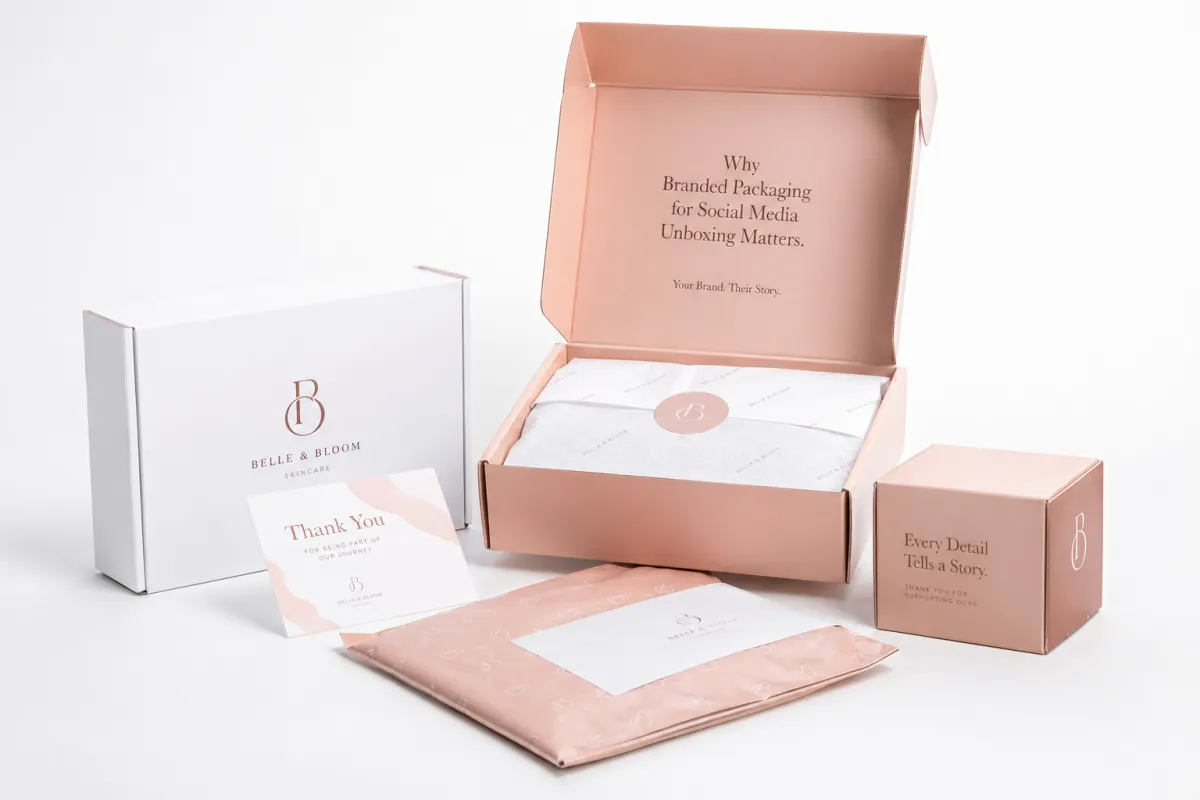
Branded packaging for social media unboxing matters because it is often the first public-facing interaction a customer has with the brand. They may never post the package itself, but they will absolutely clock whether the opening feels polished, awkward, or rushed. People are weirdly fast judges of cardboard. Fair? Maybe not. Real? Definitely.
A plain mailer and branded packaging for social media unboxing are not doing the same job. The plain mailer protects the item. The branded version protects the item too, but it also creates a moment. That moment can carry brand voice, product quality, and even a little emotional lift all at once. It gives the customer a reason to slow down instead of tearing through the shipment like a raccoon on a deadline.
That emotional lift is not fluff. It affects perceived value. If the exterior closes cleanly, the interior feels intentional, and the product sits exactly where it should, the package makes the item feel more expensive than the material cost would suggest. I have watched a modest product look twice as premium just because the fit was tight and the opening sequence was clean. Same product. Different story.
There is also a practical side. Shareable packaging works because it is easy to understand on camera. A good unboxing package gives the viewer a clear path: outer surface, first reveal, product moment, done. No confusion. No clutter. No search party for the brand logo. Branded packaging for social media unboxing is different from old shelf packaging because the audience is not standing six feet away in a store. They are watching through a phone, usually while multitasking. That means the structure has to read fast.
It is not all theater, though. The package still needs to survive shipping. A beautiful sample that crushes in transit is not a win. It is a liability wearing nice ink. That is why branded packaging for social media unboxing has to be designed around distribution realities first, then dressed up for the camera after the structure is sound.
Buyer’s truth: if the opening sequence feels clumsy, the package can look expensive in the wrong way. If the sequence feels clean, the same budget can look higher than it really is.
That is the real value here. Branded packaging for social media unboxing brings protection, presentation, and repeatability into one system. It should pack the same way every time, ship safely, and still give the customer something worth sharing without slowing the fulfillment line to a crawl.
If you are mapping out formats, review the available Custom Packaging Products and compare how mailers, folding cartons, inserts, and rigid structures support different goals. A skincare set does not need the same build as a fragile tech launch. A small apparel drop does not need the same finish level as a gift-style premium kit. Obvious? Sure. Still ignored all the time.
How Does Branded Packaging for Social Media Unboxing Work?
Branded packaging for social media unboxing works because it turns opening into a sequence instead of a single action. The customer sees the outer surface first, then the entry point, then the first interior layer, then the product itself. Each step should reveal a little more of the brand without turning the package into a parade of graphic noise.
Visual hierarchy does most of the heavy lifting. A logo on the outer shipper tells the viewer whose package this is. An interior panel or a printed insert shows the brand cared enough to continue the experience inside. Tissue wrap, a custom printed box, or a card can frame the product without stealing attention from it. That is why branded packaging for social media unboxing reads so well on camera when it is built correctly.
Contrast helps too. Light tissue against a dark carton. Matte board with a gloss accent. A white insert inside a saturated box. Those pairings give the eye a clean place to land, which matters even more when the footage is compressed through a phone screen. In branded packaging for social media unboxing, contrast often beats decoration. Every time.
The tactile side matters just as much as the graphics. A lid with the right amount of resistance, paper that feels soft instead of waxy, a printed insert that stays flat, and fitments that hold the item in place all contribute to the experience. Packaging is engineering wearing a brand coat. If the lid pops open too hard or the insert fights the product, the whole thing feels off. Customers may not name the issue, but they feel it.
For launch kits and creator seeding, the sequence should be obvious to someone who has never seen the product before. Tear strips, lift tabs, and magnetic flaps can help, but only if they fit the product and the budget. The package should guide the hand. It should not make people hunt for the opening like they are defusing something.
When the sequence is right, the camera has an easy job. The logo appears, the first layer opens, the product emerges, and the whole thing reads as one clean motion. No awkward pause. No visual clutter. No guesswork. That is usually the difference between packaging people notice and packaging people post.
For teams that need proof beyond the camera lens, transit testing and material sourcing should be part of the same conversation. The ISTA test methods help show whether branded packaging for social media unboxing can survive distribution without collapsing or scuffing. FSC certification can support paper-based sourcing claims when sustainability is part of the story. Those claims should match the build. If they do not, customers figure that out pretty fast.
The balance is the test. Branded packaging for social media unboxing should feel ready for the feed, but it still has to work like real packaging. If it looks great and the item arrives damaged, the whole idea falls apart. If it protects well but opens like a wrestling match with cardboard, the social value disappears. The strongest concepts handle both jobs at once.
Key Factors That Shape Share-Worthy Packaging
Product fit comes first. If the item moves around in the box, the package starts looking sloppy before the customer even gets to the reveal. Branded packaging for social media unboxing only works when the product stays centered, supported, and easy to remove. A tight fit also reduces scuffing and keeps the opening experience controlled on camera.
Material choice comes next. Corrugated board usually carries the shipping load, while folding cartons and rigid board often handle presentation or premium gift-style packaging. Soft-touch lamination, matte aqueous coating, foil, spot UV, and embossing all change how the package reads, but the right choice depends on the product and the brand story. Branded packaging for social media unboxing does not need every finish in the catalog. It needs the ones that actually pull their weight.
Brand identity has to stay visible without crowding the product. Some logos look strong on the outside and then become too loud when repeated on tissue, insert, and inner panel. That is where packaging goes sideways. Good branded packaging for social media unboxing leaves the product room to breathe. It does not shout over it.
There are a few practical questions worth answering early:
- How much void fill is actually needed to protect the item?
- Will the packout be handled by hand or by a fulfillment partner with limited time per unit?
- Does the package need to move through parcel, LTL, or retail channels later?
- Which surfaces show up on camera, and which surfaces only serve structure?
- Can the design be repeated at scale without sloppy folding or misalignment?
Those questions are basic on purpose. Branded packaging for social media unboxing often fails when the visual direction gets set before the shipping realities do. The smarter move is to lock in fit and function first, then build the visual language around that structure. Fancy art cannot rescue a bad box shape. I wish it could. It cannot.
Sustainability belongs in the conversation too, but the claim has to match the build. Recyclable paperboard, responsibly sourced fiber, reduced plastic use, and right-sized packaging can all support a cleaner message. The catch is simple: if the material stack does not match the claim, people notice. Fast. That is true in branded packaging for social media unboxing, and it is true everywhere else too.
If you are comparing shapes, inserts, and finishes, our custom printed boxes and packaging formats can help narrow the structure before you move into artwork. It is usually easier to Choose the Right build first than to try fixing the wrong one with more decoration later.
Branded Packaging for Social Media Unboxing Costs and Pricing
Cost usually starts with the board, the print coverage, and the structure. A simple custom mailer with one-color print and minimal finishing lands at a very different price than a rigid box with insert trays, foil stamping, and a multi-step reveal. Branded packaging for social media unboxing can be done on a sane budget, but the budget has to match the experience the brand wants to create.
At mid-volume, the visible surfaces matter most. If the camera sees the lid, the inside panel, and the first insert, those areas deserve the strongest spend. Hidden flaps and non-visible surfaces can usually stay simpler. That is a practical way to keep branded packaging for social media unboxing costs under control without making the package feel cheap where it counts.
Here is a working comparison of common options. These are planning ranges, not quotes. Quantity, print coverage, and finish choices will move the numbers around.
| Packaging option | Typical mid-volume unit range | Best use | Cost drivers |
|---|---|---|---|
| Printed corrugated mailer | $0.55-$1.20 | Light to medium products that ship direct | Board grade, print coverage, size, and die complexity |
| Folding carton with insert | $0.40-$0.95 | Smaller retail packaging and presentation boxes | Carton stock, coating, insert style, and artwork coverage |
| Rigid box with wrapped lid | $1.80-$4.75 | Premium product launches and gift-style reveals | Board thickness, wrap material, magnet closure, and finishing |
| Corrugated shipper with custom insert | $1.10-$3.25 | Fragile products that need both strength and presentation | Insert construction, protective fit, and outer print area |
The price changes quickly once extras enter the build. Foil stamping, embossing, soft-touch lamination, or a printed inside panel will raise the cost, but those same details can also lift perceived value in the first three seconds of the reveal. That is the core tradeoff in branded packaging for social media unboxing: spend where the customer can actually see the benefit.
Labor cost is easy to overlook, and it can wreck a budget faster than a stack of fancy stock. A package that needs six motions, three inserts, and perfect hand placement can be expensive even if the material line looks modest. Simpler structures with smarter graphics can outperform a more ornate build when the fulfillment line is moving fast. Branded packaging for social media unboxing is partly a cost question and partly an operations question. A little boring on the spreadsheet, maybe. Very exciting when the line is backed up, which is not the exciting anyone wants.
Full-chain value matters too. Better protection can reduce damage claims. Faster packout can cut labor. A cleaner reveal can increase content value. A well-built system can support product packaging and package branding in one move. Those downstream effects are real, even if they do not show up neatly on the estimate.
For brands that want to compare options before they commit, the Case Studies page can help because it shows how structure, print, and budget were balanced in different shipping and presentation scenarios. It is a quick way to separate expensive extras from features that actually earn their keep.
Process and Timeline for Branded Packaging for Social Media Unboxing
Most projects start with discovery. The team defines the product size, shipping method, launch date, and visual goals, then turns those into a packaging brief. From there, the dieline gets built or selected, artwork is adapted, and sampling starts. For branded packaging for social media unboxing, that early alignment saves a surprising amount of time later.
A typical workflow looks like this:
- Gather product dimensions, weight, and breakage risk.
- Choose the base structure and protection method.
- Build or confirm dielines and production specs.
- Set artwork with bleed, safe areas, and print notes.
- Review digital proofs and order a sample or prototype.
- Test the package with the actual product, not a placeholder.
- Approve final adjustments and move to production.
That last step is where a lot of teams either save the project or create a headache. Real product testing exposes fit issues that CAD renders hide. A bottle may rattle. A garment may slide. A device may sit too deep for the camera to catch the logo on the first reveal. Branded packaging for social media unboxing improves fast once the team watches a phone video of the actual opening instead of staring at a mockup that only looks good on a desk.
Delays usually show up in one of three places: structure changes, finish changes, or artwork approvals. If the lid depth changes after sampling, the insert may need a rebuild. If a matte coating suddenly becomes soft-touch, the schedule can stretch. If copy on the inside panel gets debated for too long, the whole run slips. The cleanest way to protect branded packaging for social media unboxing timelines is to lock the core decisions early and stop reopening them every time somebody has a new opinion. A very human problem, unfortunately.
For planning, many custom packaging jobs move in roughly 12-15 business days after proof approval if the structure is already defined and the artwork is ready. More complex builds, special finishes, or inserted components can add time. A new shape or a new material stack can take longer still, especially if a second prototype round is needed.
Seasonal drops and creator seeding campaigns need extra cushion. If the package has to arrive before a launch moment, the schedule should include room for sampling, transit, and one more revision than anyone expects to need. Branded packaging for social media unboxing is easier to manage when the packaging calendar sits ahead of the marketing calendar instead of chasing it from behind.
Documentation helps too. A clear photo sheet or assembly guide keeps the line consistent, and consistency matters more than teams usually think when branded packaging for social media unboxing is being packed by several hands across a busy shift. The customer should get the same opening experience from box one to box ten thousand.
Common Mistakes That Undercut the Unboxing Effect
Overbranding is the easiest mistake to spot. Too many logos. Too many messages. Too much print on every surface. The result feels busy, and busy packages are harder to film well. Branded packaging for social media unboxing should guide the eye, not wrestle it. If the customer has to stop and decode the package, the reveal loses momentum.
Weak structure causes a different kind of damage. Flimsy corners, loose inserts, or oversized void fill can make the package feel careless before the product is even visible. That is especially risky with Custom Printed Boxes and premium product packaging, where the buyer expects the outside to match the promise. If the box bows, sags, or opens unevenly, the perception drops right away.
Finish choices can work against the camera too. High-gloss coatings may glare under phone lighting. Low-contrast graphics can disappear against a neutral background. Thin line art may look elegant in a proof and vanish once the recording starts. Branded packaging for social media unboxing should be checked under ordinary room light, not just ideal studio conditions.
Fulfillment reality is another trap. A concept that looks beautiful in a sample room can become slow, expensive, or inconsistent at scale. Too many hand motions raise labor costs. A finicky insert drives errors. A hard-to-close carton slows the line. Branded packaging for social media unboxing has to survive the packing table, not just the design review.
Sustainability also gets turned into a slogan far too often. A box is not eco-friendly just because the marketing page says so. The materials, inks, coatings, and construction need to support the claim. It is better to keep the message accurate, use right-sized packaging, and choose materials that match the end-of-life path. Buyers notice the difference, and so do retailers.
Here are a few warning signs worth watching during review:
- The product slides or rattles inside the package.
- The first reveal requires awkward pulling or peeling.
- The inner print competes with the product instead of framing it.
- The finish causes glare in common indoor lighting.
- The packout instructions are too detailed for busy fulfillment teams.
Strong branded packaging for social media unboxing usually does the opposite. It feels calm, clear, and easy to follow. The customer should not need to study the box to understand what to do next. The product should appear exactly where it belongs, and the package should look built to earn attention without shouting for it.
Expert Tips and Next Steps for Branded Packaging for Social Media Unboxing
The best projects start with a photo-first spec. That means deciding which surfaces the camera sees first, which message lands in the opening moment, and which product detail deserves the final reveal. Branded packaging for social media unboxing gets stronger fast when the team defines that order before the artwork starts spreading into every blank corner.
One practical move is to record a phone video before full production. Not a polished studio shoot. Just a normal unboxing with a real person, normal lighting, and the actual item inside the package. That quick test often shows whether branded packaging for social media unboxing opens too slowly, hides the logo too long, or needs a better first layer. I still recommend this even for teams that are sure the sample “looks fine.” Fine on a mock table is not the same thing as fine on camera.
A smaller pilot run is worth the trouble too. A limited batch gives the brand room to gather creator feedback, customer reactions, and fulfillment notes without locking into a huge quantity. The feedback might show that the inner insert needs a stronger message, that the box should open from a different side, or that the color reads too dark on camera. Catching that early saves real money.
For teams looking for a clean priority order, I usually suggest this sequence:
- Confirm the product fit and protection.
- Decide the reveal sequence and camera-facing surfaces.
- Choose one or two finishes that support the brand voice.
- Test the packout speed with the fulfillment team.
- Review the package on a phone screen, not just in a design file.
That sequence keeps branded packaging for social media unboxing grounded in the real world. It also keeps spending focused where it matters. A clean box shape, a well-placed insert, and a strong opening moment often do more than a pile of expensive effects that only show up after the product is already out.
If you want to see how structure and presentation can work together, our Custom Packaging Products and Case Studies are useful starting points. They can help you compare builds, finishes, and packout styles before you lock the final spec.
The last step is tying the package back to the brand promise. If the brand is calm and premium, the opening should feel calm and premium. If the brand is playful, the reveal should have energy without turning into a mess. If the brand promises craftsmanship, the package should show precision in the folds, print, and insert alignment. That is what makes branded packaging for social media unboxing feel real instead of decorative.
Branded packaging for social media unboxing works best when it is treated as part of the product experience, not an afterthought. Start with fit, protect the shipment, shape the reveal, test the camera view, and refine the packout until the sequence feels natural. Do that well, and the package stops being just packaging. It becomes a moment people actually want to share.
What should branded packaging for social media unboxing include first?
Start with product protection and fit, because the package has to survive shipping before it can perform on camera. Then add one clear reveal moment, such as printed tissue, a branded insert, or a clean first layer that opens well in a phone video. Make sure the most visible surfaces carry the brand identity without crowding the product itself.
How much does branded packaging for social media unboxing usually add per order?
The cost depends on board grade, print coverage, finish level, insert complexity, and order quantity, so there is no single fixed number. Simple branded upgrades are often driven more by structure and printing than by luxury finishes. The best way to control cost is to spend where the customer sees the package most and simplify hidden surfaces.
How long does it take to produce unboxing-ready packaging?
Timeline usually includes concepting, dieline setup, artwork approval, sampling, and production, so planning ahead matters. Custom structures or finish changes can add time, especially if revisions happen after sample review. A good schedule leaves room for real-product testing before the packaging is needed for launch or creator seeding.
Which materials photograph best for social media unboxing videos?
Rigid board, well-printed corrugated, and clean folding cartons all photograph well when the finish matches the brand and lighting conditions. Matte or soft-touch surfaces often reduce glare, while strong color contrast helps details read clearly on a phone screen. Material choice should also support shipping strength, not just appearance.
How do you test whether branded packaging for social media unboxing will work?
Record a quick unboxing with a phone, not just a studio mockup, because the real camera angle reveals problems faster than renderings do. Watch for awkward opening steps, hidden branding, messy fill, weak structure, or details that disappear once the product is in frame. Use those notes to refine the sequence, the print layout, and the packout instructions before final production.


