Buyer Fit Snapshot
| Best fit | Branded Paper Shopping Bags Wholesale projects where brand print, material claims, artwork control, MOQ, and repeat-order consistency need to be specified before quoting. |
|---|---|
| Quote inputs | Share finished size, material target, print colors, finish, packing count, annual reorder estimate, ship-to region, and any compliance wording. |
| Proofing check | Approve dieline scale, logo placement, barcode or warning zones, color tolerance, closure strength, and carton packing before bulk production. |
| Main risk | Vague material claims, crowded artwork, missing packing details, or unclear freight terms can make a low unit price expensive after revisions. |
Fast answer: Branded Paper Shopping Bags Wholesale: Specs and Prices should be specified like a repeatable production item. The safest quote records material, print method, finish, artwork proof, packing count, and reorder notes in one written spec.
Production checks before approval
Compare the actual filled-product size with the drawing, then confirm tolerance on folds, seals, hang holes, label areas, and retail display edges. Reserve space for logos, QR codes, warning copy, and material claims before decorative graphics fill the panel.
Quote comparison points
Review material grade, print process, finish, sampling route, tooling charges, carton quantity, and freight assumptions side by side. A quote is only useful when the supplier can repeat the same color, closure quality, and packing count on the next order.
Branded Paper Shopping Bags wholesale looks simple on a spreadsheet. It is not. The bag leaves the counter, rides in a car, gets dragged through a subway station, and often sits in a customer’s office or home long after the sale. That extra exposure is the whole point. A good bag keeps advertising without asking for another budget line. That is why branded Paper Shopping Bags Wholesale can beat cheaper carry-out packaging on brand value alone.
For buyers, branded Paper Shopping Bags wholesale solves another problem that gets ignored until it hurts: consistency. One approved spec means one cost structure, one visual standard, and one less excuse for last-minute scrambling. Stores stop improvising with random packaging. The checkout line stops looking patched together. A bad bag on a busy day can create delays, repacking, and a very avoidable headache for staff. Nobody needs that kind of drama at the register.
The right bag does more than carry merchandise. It supports the perceived value of the item, protects the contents, and turns packaging into something the customer actually notices. Branded paper shopping bags wholesale belongs in the same conversation as merchandising and store presentation. Supply item? Sure. But it is also a brand touchpoint, and a very visible one.
A shopping bag is not throwaway packaging. It is a moving ad, a carrying tool, and a small test of how much a brand cares about the customer experience.
Why branded paper shopping bags wholesale work at retail scale
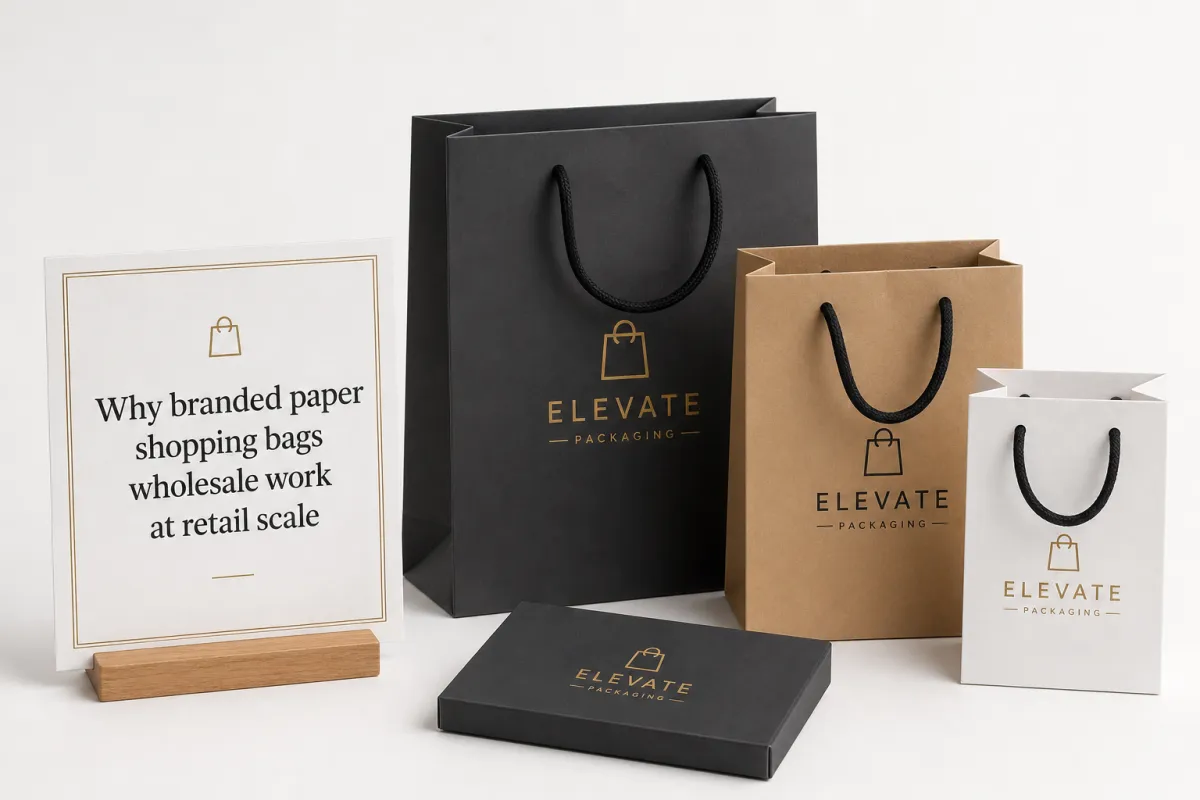
Retail packaging has to justify its place. Branded paper shopping bags wholesale does that because it combines utility, presentation, and easy reordering in one item. Customers reuse the bag. Often more than once. That means the logo keeps showing up after the purchase is over. A bag in a lobby or on a train does more for brand visibility than a dozen polite impressions on a screen.
The economics are practical, not glamorous. Branded paper shopping bags wholesale usually reduces unit cost because the production run is larger, the print setup gets spread across more pieces, and packing cartons can be filled more efficiently. A retailer ordering 1,000 or 5,000 bags can plan ahead instead of paying panic pricing when a promotion blows through the inventory. That difference is easy to dismiss until the store is out of bags during a holiday rush and the team starts getting creative in all the wrong ways.
Price per bag is only part of the story. A thin bag that tears at the handle or caves in at the base costs more than it looks like on paper. It creates repacking, extra labor, and annoyed customers. Better branded paper shopping bags wholesale reduces that friction. Better stock. Better glue. A gusset That Actually Works. Small things, but they change how the checkout feels.
Paper also fits a cleaner sustainability story than a lot of alternatives. Unlaminated kraft stock with water-based inks is often easier to position as recyclable, though local rules still matter and should be checked. Brands trying to avoid the visual baggage that comes with plastic usually find branded paper shopping bags wholesale to be the easier sell. The bags print cleanly, stack neatly, and look like they belong in a retail environment that cares how it is perceived.
The wholesale model helps with operations too. The same bag can go to stores, events, and fulfillment points without forcing every location to invent its own packaging logic. Six stores using six different bags is not flexibility. It is a mess. Standardization keeps the brand story from drifting. I have seen brands lose time every week just because nobody wanted to make the final call on bag specs. That kind of indecision gets expensive fast.
For retailers that want a practical packaging baseline, branded paper shopping bags wholesale can sit inside a larger purchasing plan. The same logic behind Wholesale Programs applies here: choose the bag once, approve the spec, and keep the reorder path simple before demand spikes.
Branded paper shopping bags wholesale works because the result is visible, repeatable, and easy to measure. A solid bag earns quiet confidence. A bad one gets noticed immediately. Customers are very good at spotting both.
Product details: sizes, handles, and print options
Once a buyer starts comparing branded paper shopping bags wholesale options, the details stop being optional. Format comes first. SOS shopping bags, twisted-handle retail bags, flat-handle bags, and Premium Paper Bags with reinforced tops all serve different jobs. SOS bags are efficient and stack well. Twisted-handle bags look more polished. Flat-handle bags keep costs down. Premium versions make sense for boutiques, gift retail, and higher-ticket purchases where the packaging has to feel like part of the sale.
Handle style changes the whole experience. Twisted paper handles are the workhorse choice for branded paper shopping bags wholesale because they hit a good balance between cost and presentation. Flat handles are usually the budget pick, which makes them useful for high-volume retail or food-adjacent carry-out. Rope handles, ribbon handles, and die-cut options push the package toward a more elevated feel. That extra polish can matter for jewelry, cosmetics, fashion accessories, and event kits where the bag is expected to do more than simply survive the walk to the car.
Print method is the next decision that actually matters. A one-color logo on kraft stock is usually the most economical route. It keeps branded paper shopping bags wholesale efficient while still making the brand easy to spot. Two-color printing adds depth without turning the project into a circus. Full-surface printing creates a strong campaign look, but it also increases setup time and cost. The real question is blunt: is the logo supposed to identify the bag or own it? That answer changes the spec fast.
Finish options move the bag from basic retail into presentation territory. Matte lamination softens the look. Gloss makes colors pop harder. Spot UV draws attention to specific areas. Hot stamping adds metallic detail that reads as premium. Embossing and debossing add texture without depending on ink alone. Natural kraft sends a different signal entirely. Less polish. More restraint. None of these choices is automatically better. They just fit different brand personalities and different price points.
The right combination depends on what the bag carries. A boutique selling folded apparel does not need the same construction as a gift shop carrying boxed ceramics. A trade show bag has to handle catalogs, samples, and whatever else people shove into it on the floor. Food-retail bags may need a different coating or handle attachment depending on the contents. Branded paper shopping bags wholesale should match the actual use, not the mood board somebody made on a Friday afternoon.
There is a simple rule here. The more the bag will be seen, touched, and reused, the more careful the spec should be. That is why branded paper shopping bags wholesale should be ordered around the retail channel, not as a generic stock decision.
If your team is comparing visual direction as well as function, match the bag spec against existing retail touchpoints and review prior packaging decisions in our Case Studies. The right format usually becomes obvious once you compare it against what is already working.
Common format choices at a glance
| Bag style | Typical use | Indicative wholesale price per unit | Notes |
|---|---|---|---|
| SOS kraft bag | Low-weight retail, events, food-adjacent carry-out | $0.18-$0.32 | Simple build, efficient packing, limited premium feel |
| Twisted-handle retail bag | Apparel, gift shops, general retail | $0.28-$0.55 | Best all-around balance of cost and presentation |
| Flat-handle bag | High-volume budget programs | $0.16-$0.29 | Lower cost, practical for large replenishment orders |
| Premium bag with finish | Boutiques, luxury-adjacent retail, events | $0.55-$1.40 | Lamination, foil, embossing, or special handles raise value and cost |
Those ranges are a starting point, not a promise. Size, paper weight, artwork coverage, and shipping can move the final cost quickly. Even so, the table makes the main point clear: branded paper shopping bags wholesale is not one fixed product. It is a set of options with different economics, and the differences are real.
Specifications that matter before you place an order
Missing measurements create most of the trouble. Buyers send a logo first, then realize the bag is too narrow, too shallow, or too short for the actual product mix. For branded paper shopping bags wholesale, the big dimensions are width, gusset, height, and handle drop. Those four numbers decide whether the bag fits cleanly and carries without making the customer regret the purchase.
Paper weight matters too, just not in a fuzzy marketing way. Lighter stock cuts cost and works well for small retail items, tissue-wrapped products, and lighter loads. Heavier stock improves rigidity, resists wrinkling, and holds up better under repeated use. Most retail buyers land somewhere in the middle for branded paper shopping bags wholesale because that is where strength and spend tend to meet. If the bag needs to carry boxed goods, glass, or heavier apparel sets, stronger paper and a reinforced base are usually worth it.
Reinforcement details often decide whether a bag survives the floor or collapses by the register. Top turns help the opening hold its shape. Base inserts add stiffness under load. Glued side seams improve reliability. Handle attachment matters more than people think because the handle usually takes the hardest pull. A bag that looks sharp and fails at the handle is not a bargain. It is a mistake with nice print on it.
Artwork requirements also deserve attention early. Vector files are the safest starting point. Pantone references keep brand color drift under control on repeat runs. Safe margins and exact placement notes protect the design from cropping or wandering around the gusset. If the logo sits close to the edge or wraps around the side, the proof needs a careful review. Branded paper shopping bags wholesale moves fast when the print spec is clean from the beginning.
Sustainability should be asked about in plain language. Request recycled content, FSC-certified paper, water-based inks, and confirmation of any lamination. If easier recyclability matters, avoid mixed-material builds unless the visual or durability payoff is worth it. For certification and paper sourcing, the FSC certification standards are a useful reference. For end-of-life recycling basics, the EPA recycling guidance helps teams understand what local systems usually accept.
Transport performance gets overlooked all the time. If the bags will ship in cartons to multiple sites, the spec should support stackability and carton efficiency. Transit testing standards from groups such as ISTA are worth reviewing for sensitive or multi-leg distribution programs. A bag can look perfect in a proof and still arrive crushed, bent, or distorted if the carton build is sloppy.
That is the part buyers remember after the first reorder. Branded paper shopping bags wholesale is a specification exercise as much as a print job. Better specs mean fewer surprises. Fancy concept, I know.
Branded paper shopping bags wholesale pricing and MOQ explained
Pricing for branded paper shopping bags wholesale depends on a few variables, and the quote starts making sense once those are separated. Size is first. Bigger bags use more paper and often need more reinforcement. Paper weight comes next. Then handle type, print coverage, finishing, and shipping lane. Each one moves the unit price, sometimes more than buyers expect, especially when the order includes custom sizing or heavy ink coverage.
MOQ, or minimum order quantity, matters just as much. Standard stock sizes with a one-color logo may start around 500 to 1,000 pieces. Custom dimensions, specialty finishes, or full-bleed artwork often push minimums higher because setup is more involved and production waste has to be controlled. For branded paper shopping bags wholesale, the useful move is to ask for tiered pricing at 500, 1,000, and 2,500 units so the cost curve is visible before anyone signs off.
Hidden costs deserve direct attention. Plate or setup fees can make smaller orders more expensive. Samples may be billed separately. Freight can matter as much as the bags themselves on lower-value runs. Rush handling adds another layer. A quote that looks sharp at the unit level can turn into an expensive line item once everything is added up. That is how good-looking prices become bad decisions.
One reason branded paper shopping bags wholesale buyers get frustrated is that they compare a plain kraft bag to a premium printed bag as if the two were interchangeable. They are not. A single-color imprint on a basic bag is a different procurement profile from a bag with lamination, foil, and ribbon handles. The smarter question is not “Which one is cheapest?” It is “Which one supports the retail experience at the lowest total cost?”
The table below gives a practical way to think about the most common options. Exact numbers shift with size and print coverage, but the pattern stays the same.
| Option | Typical MOQ | Best fit | What drives price up |
|---|---|---|---|
| Plain kraft with logo | 500-1,000 | Budget-conscious retail and replenishment | Bag size, paper weight, shipping distance |
| Twisted-handle printed bag | 1,000-2,500 | Standard retail and multi-store programs | Multiple colors, larger artwork, stronger paper stock |
| Premium finished bag | 2,500+ | Boutiques, seasonal campaigns, gift packaging | Lamination, foil, embossing, specialty handles |
| Custom size with full coverage | 2,500+ | Brand launches and high-visibility retail | New tooling, ink coverage, sampling, tighter QC |
There is a buyer habit worth keeping: compare landed cost, not factory price alone. A slightly higher quote for branded paper shopping bags wholesale can still be the better deal if it lowers damage, improves repeat use, and cuts the chance of emergency reorders. That matters even more for stores with seasonal spikes or multiple locations.
The best quote shows how quantity changes price at the breakpoints that matter to your business. If a supplier cannot explain the jump between 1,000 and 2,500 units, the quote is not ready for approval. Simple as that.
From artwork to delivery: process and timeline
Good branded paper shopping bags wholesale orders follow the same basic sequence. Specification review. Quotation. Artwork submission and proofing. Sampling if needed. Approval. Production. Packing. Freight booking. None of that is complicated on paper. Delays start when one step is vague or incomplete and everyone pretends it will sort itself out later. It usually does not.
The fastest orders happen when the buyer sends complete information right away. Dimensions, quantity, logo files, color references, handle choice, and delivery date should all be in the first message. Leave out those details and the project turns into a question stack. Each answer adds time. Branded paper shopping bags wholesale moves faster when the brief is clear enough to work from without guesswork.
Timing depends on complexity. A repeat order with no design changes may move through proofing in a few days and into production soon after approval. A new custom bag with special finishes or custom dimensions usually takes longer because the factory has to verify structure, print placement, and finishing details before the run is locked. Production often takes a few weeks, not a few days, and shipping is its own schedule.
Delays usually come from the same tired sources. Artwork is low resolution or not vector. Size requirements change after the proof. Color expectations are not aligned. The sample gets approved late. Each issue is manageable on its own, but together they can push a launch into the wrong sales window. That is why branded paper shopping bags wholesale should be ordered with a cushion when the bags support a campaign, holiday period, or event calendar.
Customers often judge the bag before they register the print method. If it arrives crushed or the handles are crooked, the brand looks careless. Packaging quality control matters here. Dimensional checks, handle pull testing, and carton packing standards protect the final presentation. In procurement terms, those are not small details. They are the difference between a bag that supports the sale and one that undermines it.
If you want a smoother turnaround, ask for a proof checklist before anything is released to production. Confirm dimensions, handle style, ink colors, finish, and delivery expectations. A buyer who approves quickly usually gets a better result because the process has fewer places to drift.
For retailers comparing suppliers, it also helps to study how similar programs were handled. Our Case Studies page shows the kinds of format decisions that tend to separate a rushed order from a controlled one.
The real point is simple. Branded paper shopping bags wholesale succeeds when the process is treated like a sequence, not a one-step purchase.
Why choose branded paper shopping bags wholesale from us
Buyers do not need a supplier who only repeats that the bag is eco-friendly. They need someone who can turn a retail use case into a spec that actually works. That is the real benefit of ordering branded paper shopping bags wholesale from Custom Logo Things. The focus stays on repeatable specs, straightforward quoting, and a bag that fits the product load, the customer journey, and the budget without turning every reorder into a fresh problem.
Consistency is where the value shows up. A retail chain, pop-up operator, or multi-location brand cannot afford packaging that shifts too much from one order to the next. Branded paper shopping bags wholesale should look and perform the same every time. Dimensional checks, print alignment review, and packaging inspection reduce the odds of a bad batch. That matters more than a shiny promise on a landing page.
Pre-order guidance helps too. Many buyers know what they want visually, but not which spec fits the actual inventory. A proper review can prevent common mistakes like undersized gussets, weak handle construction, or a finish that looks premium but complicates recyclability. From a procurement angle, that kind of support saves money because it cuts rework and lowers the odds of a second order just to fix the first one.
Sustainability options should be specific, not hand-wavy. Recycled paper can be requested. FSC-certified stock can be specified. Water-based inks can be used for many applications. In some programs, a natural kraft finish gives the right look without adding extra coating. Branded paper shopping bags wholesale works best when the sustainability goal is tied to a real production choice instead of a slogan that sounds good in a meeting.
Service quality shows up in the quote too. Clear pricing, fewer revisions, and simple reorder support save time. That matters for seasonal launches, promotional calendars, and event-driven demand, where the packaging order has to land on schedule or the whole campaign feels off. A supplier that understands that pressure is worth more than a low first quote with weak follow-through.
Most buyers want three things: a bag that holds up, a logo that looks right, and a reorder path that does not create extra work. That is the standard branded paper shopping bags wholesale should meet.
If your team is comparing packaging options across programs, start with our Wholesale Programs overview. It is a useful way to see how volume, decoration, and timing affect the final cost structure.
There is no mystery here. Branded paper shopping bags wholesale is a purchasing decision, a brand decision, and an operations decision all at once. The supplier should be able to handle all three without making it sound heroic.
Next steps: what to send for a fast quote
Fast quotes usually come from complete requests, not from endless back-and-forth. The best first message includes quantity, target budget, logo file, product dimensions, preferred paper type, handle style, and delivery deadline. If something is unknown, say that plainly. A good supplier can still help. The more precise the brief, the faster the answer.
Measure the product first. Then choose the bag around the product mix, not around a guess. A box of cosmetics needs different clearance than a folded tee. A set with tissue and inserts needs more room than the product alone. For branded paper shopping bags wholesale, the bag should fit the workflow on the sales floor, not just the math on a spreadsheet.
It also helps to compare a few routes side by side. Ask for standard kraft, a printed mid-range version, and a heavier-duty option if the retail mix is still being refined. That comparison usually makes the trade-offs obvious. One option may save cents per unit and create repacking pain later. Another may cost more up front and look far better in the hand, which is often the thing customers actually remember.
Before production starts, confirm four things in writing: dimensions, finish, print placement, and sample approval. That checklist sounds plain, but it prevents a surprising number of problems. Branded paper shopping bags wholesale orders are easier to manage when everyone signs off on the same version of the bag.
If the deadline is tight, say so early. A rushed order can still succeed, but only if the supplier knows the real target. Late changes to print art, paper grade, or handle style are what usually break schedules. The earlier the buyer locks the spec, the easier it is to keep the timeline intact.
If you are building a broader packaging plan, treat the bag as part of the commercial mix, not a side purchase. The right branded paper shopping bags wholesale order can carry the brand through busy weeks, heavy promotions, and routine retail service without turning into a recurring headache.
Send the details, compare the options, and let the quote do its job. Branded paper shopping bags wholesale works best when the order is right the first time.
What is the usual MOQ for branded paper shopping bags wholesale?
Common minimums often start around 500 to 1,000 bags for standard sizes and simple print setups. Custom dimensions, premium finishes, or full-coverage artwork can push the MOQ higher. For branded paper shopping bags wholesale, it makes sense to ask for tiered pricing at 500, 1,000, and 2,500 units so you can see the best value point before committing.
How do I choose the right size for branded paper shopping bags wholesale orders?
Measure the product you are packing, then add clearance for tissue, boxes, or inserts. Check width, gusset, and height together, because one dimension by itself does not tell you whether the bag will fit. If you sell multiple SKUs, choose the size that covers the most common order profile first, then build from there.
Which paper weight is best for wholesale branded paper shopping bags?
Lighter paper works for small, low-weight retail items and keeps the unit cost down. Heavier stock is better for apparel, gift sets, or anything that needs a more rigid carry feel. Reinforced bottoms and stronger handles matter as much as paper weight when the bag will carry real weight, so branded paper shopping bags wholesale should be specified as a full build, not just a paper number.
How long does production take for branded paper shopping bags wholesale?
Artwork proofing can take a few days if files are complete and the specifications are clear. Production usually takes a few weeks, depending on quantity, print complexity, and finishing choices. Shipping time is separate, so confirm the total lead time from approval to delivery before you place the order.
Are branded paper shopping bags wholesale orders recyclable?
Many unlaminated paper bags are recyclable where local facilities accept paper packaging. Water-based inks and recycled or FSC-certified paper can support a lower-impact packaging program. Lamination, mixed materials, and handle construction can affect recyclability, so confirm the exact spec before ordering.
Branded paper shopping bags wholesale is worth doing well because the bag does more than carry a product. It affects presentation, repeat exposure, and the ease of replenishment across locations. If you want the order to hold up in real retail use, keep the specs clear, keep the artwork clean, and compare landed cost instead of chasing the lowest unit rate. Start with the product dimensions, choose the simplest bag that can do the job, and lock the proof before production. That is how branded paper shopping bags wholesale becomes a useful brand asset instead of just another supply line.

