Buyer Fit Snapshot
| Best fit | low waste subscription box fillers work for packaging buyers comparing material specs, print proof, MOQ, unit cost, freight, and repeat-order risk where brand print, material, artwork control, and repeat-order consistency matter. |
|---|---|
| Quote inputs | Share finished size, material target, print colors, finish, packing count, annual reorder estimate, and delivery region. |
| Proofing check | Approve dieline scale, logo placement, barcode or warning zones, color tolerance, and any recyclable or compostable wording before bulk production. |
| Main risk | Vague material claims, crowded artwork, or missing packing details can create delays even when the unit price looks attractive. |
Fast answer: Low Waste Subscription Box Fillers Work: Dieline, Finish, Proof, and Buyer Review should be specified like a repeatable production item. The safest quote includes material, print method, finish, artwork proof, carton packing, and reorder notes in one written spec.
What to confirm before approving the packaging proof
Check the product dimensions against the actual filled item, not only the sales mockup. Ask for tolerance on folds, seals, hang holes, label areas, and retail display edges. If the package carries a logo, QR code, warning copy, or legal claim, reserve that space before decorative graphics fill the panel.
How to compare quotes without losing quality
Compare board or film grade, print process, finish, sampling route, tooling charges, carton quantity, and freight assumptions side by side. A lower quote is only useful if the supplier can repeat the same color, closure quality, and packing count on the next order.
Blunt version: the best top low waste subscription box fillers are the ones that protect product, pack fast, and do not turn into trash the moment the lid comes off. A box can look premium in a product shoot and still arrive rattling around like spare bolts in a toolbox if the filler is wrong. I have seen that mistake more times than I should have. Brands chase a sustainability badge, ignore labor, then wonder why the “eco” option quietly costs more than the old one.
Top low waste subscription box fillers are not about looking righteous on a materials chart. They are about fit, protection, presentation, and the annoying little details that decide whether a subscription program feels polished or sloppy. The cheapest filler on paper often gets expensive once you count damaged product, cleanup, slower packing, and customer complaints about excess waste. That part never makes the sales deck. Convenient.
If you sell recurring boxes, gift sets, beauty kits, snacks, apparel, or small electronics, the right filler usually lands in one of a few buckets: molded pulp, shredded recycled paper, corrugated inserts, honeycomb paper, tissue, compostable loose fill, or reusable wraps. Each one has a place. None of them is magic. The real move is matching the filler to the product and the shipping lane instead of pretending one material solves everything.
For Custom Logo Things, the point is simple. Packaging does three jobs at once: it protects, it sells the brand, and it keeps operations from spiraling. A filler that looks clever but slows the warehouse will get hated. A filler that is fast but arrives looking like a hamster cage will get hated by customers. The sweet spot sits in the middle, and that is where the top low waste subscription box fillers earn their keep. Pretty is nice. Packable is better.
What Are the Top Low Waste Subscription Box Fillers That Actually Work?
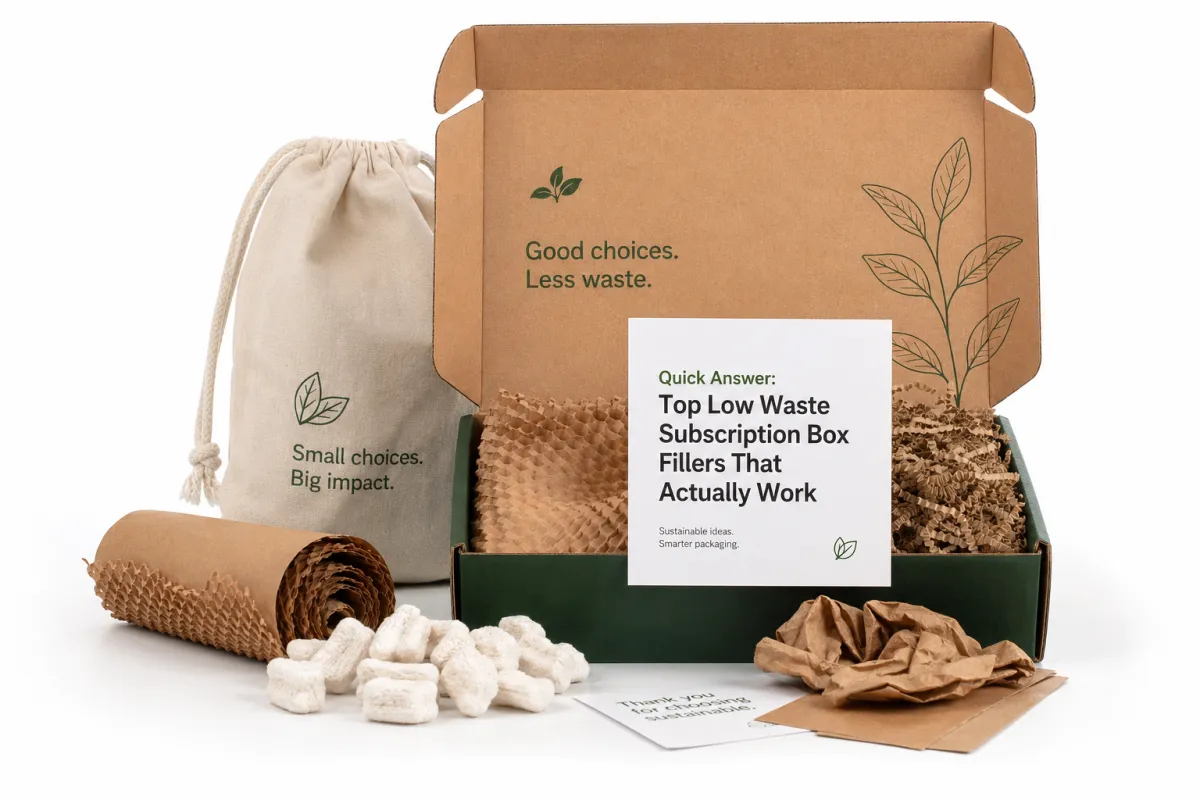
The short answer: start with molded pulp for fragile items, corrugated inserts for repeatable product shapes, honeycomb paper for premium presentation, and shredded recycled paper for low-cost void fill. Those are the top low waste subscription box fillers I would put on a real shortlist. They solve actual problems without creating extra mess, extra weight, or extra guilt theater.
My rule is dead simple. Protect the product first. Reduce waste second. Keep the unboxing clean third. Worry about the cheapest unit price after that. Reverse the order and you get broken jars, dented tins, or a carton full of loose scraps that customers immediately recycle, compost, or resent. Sometimes all three.
The part that surprises a lot of brands is this: the lowest-cost filler can become the most expensive choice once labor enters the chat. If a filler takes eight extra seconds per box and you ship 10,000 boxes a month, the wage bill gets real fast. Add a 1% reduction in damage from a better insert and the “expensive” option starts looking sensible. That is why I push buyers to compare total landed cost, not just the quote sitting in an email thread.
For fragile products, molded pulp and corrugated inserts usually win because they stop movement instead of trying to cushion it after the fact. For premium subscription programs, honeycomb paper is often the nicer visual choice because it feels intentional instead of filler-y. For budget-sensitive brands, shredded recycled paper still deserves a spot among the top low waste subscription box fillers if you can keep the amount consistent and the cleanup under control.
There is also a less glamorous truth: some “green” fillers are only low waste in theory. If your customers cannot compost them locally, if they shed dust everywhere, or if they need a long disposal explanation, the sustainability story gets muddy fast. That is why I prefer materials with straightforward end-of-life behavior. Recycled paper is easy to explain. Molded pulp is easy to recycle in many markets. Fancy claims that depend on a perfect waste stream are less useful in real life.
“If the filler looks premium but adds three seconds per box, labor will eat the margin. Pretty is nice. Packable is better.”
One more practical point: run shipping tests before you commit. A filler that looks fine on a desk can fail under vibration, compression, or humidity. ISTA test methods exist for a reason. If you want a broader packaging sustainability lens, the EPA recycling guidance and ISTA both give useful context for waste reduction and transit performance.
Top Options Compared: Top Low Waste Subscription Box Fillers at a Glance
Before the deep dive, here is a straightforward comparison of the top low waste subscription box fillers by function. This is not a beauty pageant. It is a practical scorecard for brands that need the box to arrive intact, open well, and stay efficient on the packing line.
Molded pulp is the workhorse for fragile SKUs. It holds shape, separates products, and keeps movement under control. Shredded recycled paper is the cheapest easy-fill option, but it can shed, shift, and look messy if overused. Corrugated inserts are the best fit for repeatable product sizes and a more structured feel. Honeycomb paper gives a more elevated unboxing experience than plain shred, which is why it keeps showing up in gift boxes and beauty subscriptions. Tissue is light, low cost, and good for cosmetics or soft goods, but it does almost nothing for protection on its own. Compostable peanuts can fill voids, though they are not always the cleanest or easiest solution. Reusable wraps work best for higher-ticket programs where the box itself is part of the product story.
One thing I tell buyers constantly: low waste does not mean “best for every box.” That mistake gets expensive. A filler that works for apparel can be useless for glass vials. A rigid insert that protects jars beautifully may be overkill for socks. This is where the top low waste subscription box fillers need to be judged by use case, not trendiness.
| Filler Type | Protection | Visual Appeal | Packing Speed | Waste Profile | Typical Cost Range |
|---|---|---|---|---|---|
| Molded pulp | High for fixed shapes | Clean, natural | Fast once tooled | Usually recyclable | $0.22-$0.85 per unit, depending on size and MOQ |
| Shredded recycled paper | Low to medium | Casual, can look messy | Fast but inconsistent | Recyclable in many markets | $0.03-$0.12 per box equivalent |
| Corrugated inserts | High | Structured, premium | Very fast at scale | Widely recyclable | $0.18-$0.70 per unit, depending on print and complexity |
| Honeycomb paper | Medium | Strong presentation | Moderate | Paper-based, easy to explain | $0.10-$0.30 per box equivalent |
| Tissue | Low | Light, elegant | Very fast | Low material weight | $0.02-$0.08 per box equivalent |
| Compostable peanuts | Low to medium | Functional, not fancy | Fast but messy | Depends on local composting access | $0.08-$0.20 per box equivalent |
| Reusable wraps | Medium to high | Premium, gift-like | Slower | Only low waste if reused | $0.35-$1.25 per unit |
That table gives a useful snapshot, but the real answer lives in the details. Some fillers win on price and lose on freight because they are bulky. Some win on appearance and create handling headaches because they curl, tear, or shed in humid storage. The best top low waste subscription box fillers do a decent job across the board, not a spectacular job in one category while failing the others.
For fragile items, I would rank molded pulp and corrugated inserts at the top. For premium presentation, honeycomb paper and well-printed corrugated components stand out. For speed, tissue and pre-cut inserts are hard to beat. For the lowest budget, shredded recycled paper still deserves a seat at the table, provided you can live with a less polished look.
Detailed Reviews of the Top Low Waste Subscription Box Fillers
Now for the part That Actually Helps you buy something without regretting it later. I am separating the top low waste subscription box fillers by how they behave in real packaging conditions: impact resistance, dust, humidity, visual quality, and how much the packing team will complain about them. That last one matters more than some people want to admit. If the line staff hates a filler, it is gonna show up in your KPIs sooner or later.
Molded pulp
Molded pulp is one of the safest choices for fragile products because it controls movement instead of just stuffing space. It performs well with glass jars, small bottles, candles, and electronics accessories. The finish is plain, but plain is not the enemy. A clean molded insert usually looks intentional, especially if the box print and product labels carry the brand personality.
Its strengths are protection and repeatability. Once the tool is right, product placement becomes easy and pack-out is consistent. Its weakness is flexibility. If your SKUs change every month, Custom Molded Pulp can become annoying quickly. Tooling costs also mean this is not the first pick for a tiny test run unless the damage rate is already hurting you.
I have also seen molded pulp save brands from a lot of customer-service mess. One beauty client switched from loose shred to a pulp tray and cut broken glass complaints almost immediately. That was not magic. It was just better geometry.
Best for: fragile products, fixed-size kits, and programs where the insert can be reused across many shipments.
Shredded recycled paper
Shredded recycled paper remains one of the most approachable top low waste subscription box fillers because it is simple, cheap, and easy to source. It gives a natural look and works fine for lightweight products, sampler packs, and lifestyle boxes that do not need serious crush protection. It also packs quickly at first glance, which is why it keeps showing up in subscription work.
There are tradeoffs. It can shed little bits into the carton, cling to tape, and make the box look untidy if overfilled. In humid storage, it can lose loft and compress unevenly. That is not a disaster, but it means the final presentation depends on the team handling it with some discipline. If the warehouse tosses it in like confetti, the box will look like a party nobody asked for.
That said, shredded paper gets unfairly dismissed sometimes. For the right box, especially a lower-price seasonal kit, it is fine. You just need to keep the fill level consistent and avoid the temptation to overstuff it until it looks like a craft project.
Best for: budget-conscious brands, light products, and boxes where a casual, recyclable look is acceptable.
Corrugated inserts
Corrugated inserts are a strong answer for structured product kits. They are one of the most useful top low waste subscription box fillers because they create compartments, reduce movement, and make the box feel engineered rather than stuffed. For subscription programs with repeatable sets, corrugated often beats loose fill simply because it is faster to place and easier to standardize across subscriptions.
They also photograph well. That matters more than some operators admit. A neat insert makes the box appear more expensive, even when the actual material cost is moderate. The downside is that complicated dielines and heavy print can raise the price. If you have a simple kit, keep the structure simple. Fancy diecuts can become a vanity expense.
Corrugated is also one of the easiest materials to explain to customers. Recycled paperboard insert, curbside recyclable in many areas, done. No long explanation, no weird sourcing language, no awkward footnote. That kind of clarity helps trust.
Best for: beauty kits, premium gifts, food-and-drink assortments, and any recurring box with stable dimensions.
Honeycomb paper
Honeycomb paper is one of the nicer-looking options in the top low waste subscription box fillers category. It has texture, movement, and a more polished feel than plain shredded paper. It wraps products well, gives a sense of care, and avoids the “cheap confetti” vibe that some filler materials create. For premium subscription brands, that matters.
Its performance sits in the middle. It is not as protective as a custom insert, but it cushions better than tissue and usually looks cleaner than loose shred. It works especially well for soft goods, beauty items, candles, and boxed accessories. The compromise is packing speed. Honeycomb paper can slow the line if staff have to shape it manually every time.
If the brand wants a tactile unboxing moment without jumping straight into a custom tray, honeycomb paper is a smart middle ground. It feels deliberate. That counts.
Best for: premium presentation, moderate protection, and brands that care about the unboxing photo as much as the shipping label.
Tissue
Tissue is the lightest-touch option here. It is one of the top low waste subscription box fillers only if your goal is presentation rather than real cushioning. It creates a finished look, keeps dust off products, and helps apparel or cosmetic kits feel curated. The material cost is tiny, and the pack-out is fast.
Its limits are obvious. Tissue does not stop hard impacts. It does not keep glass from smashing around. It does not save a poorly designed box. So I treat it as a layer, not a protective system. Use it to elevate appearance, not to pretend you solved shipping physics.
In practice, tissue works best as the first impression, not the safety net. Pair it with a rigid insert or a snug carton fit if the product can move. Otherwise you are just dressing up a problem.
Best for: apparel, soft goods, and low-risk products that need a neat reveal.
Compostable loose fill
Compostable peanuts and similar fillers can work, but they need context. They are among the top low waste subscription box fillers only when the receiving customer actually has access to the disposal path the material expects. Otherwise, the environmental promise becomes a little too optimistic. Local compost infrastructure is uneven. That is the polite version.
They fill voids well and can cushion light products, but they are messy in the packing area and sometimes annoying for customers to handle. If the box is opened on carpet, you already know how that story ends. They are better for larger void spaces and rougher products than for premium displays.
I would not pick compostable loose fill just because the word compostable sounds nice in a deck. I would pick it only if the whole system supports it: product weight, lane length, and customer disposal behavior. Otherwise it is kind of a marketing costume.
Best for: void fill in shipments that need light cushioning and can tolerate a more utilitarian look.
Reusable wraps
Reusable wraps only make sense if the box program supports reuse or the wrap itself becomes part of the product. They are one of the top low waste subscription box fillers in a narrow but real lane: premium gifting, special editions, and higher-margin kits where the customer might keep the wrap. Think fabric wraps, drawstring pouches, or structured reusable sleeves.
The downside is obvious. They cost more, take longer to pack, and rely on customer behavior you do not fully control. If the wrap gets thrown away after one use, the low-waste claim shrinks fast. Still, for the right brand, they can Create a Memorable first impression and reduce the need for disposable filler altogether.
Reusable options also force a more honest conversation about value. If the wrap is beautiful enough to keep, the packaging has become part of the product. If it is not, you are just adding expense. There is no elegant way around that.
Best for: premium gift programs, limited editions, and brands that can justify the added cost.
If I had to make a clean shortlist, I would pick molded pulp, corrugated inserts, honeycomb paper, shredded recycled paper, and tissue as the most practical top low waste subscription box fillers. Compostable peanuts and reusable wraps still have a place, but they need a tighter use case. That is the part people skip when they are trying to sound sustainable.
Price Comparison: What Low Waste Subscription Box Fillers Really Cost
Money deserves a real conversation, not a fake one where the cheapest quote gets crowned winner. The top low waste subscription box fillers vary a lot in per-unit cost, but the real number depends on case size, freight, storage, pack-out speed, and how often the filler fails to do its job. Unit price is only one slice of the pie.
For low volumes, shredded recycled paper and tissue are usually the lowest upfront spend. At scale, custom corrugated and molded pulp can become more cost-efficient because they cut labor and reduce damage. That is the annoying truth: a better designed insert can cost more to buy and less in the month-end P&L. Packaging does that. It likes being inconvenient.
This is the kind of comparison I give buyers before they decide on the top low waste subscription box fillers:
| Filler | Low-Volume Cost | Bulk Cost | Storage / Freight | Labor Impact | Cost Risk |
|---|---|---|---|---|---|
| Molded pulp | $0.45-$1.20 each | $0.22-$0.65 each | Moderate, shape-based | Low once approved | Tooling and MOQ |
| Shredded recycled paper | $0.08-$0.18 per box | $0.03-$0.10 per box | High bulk, light weight | Medium due to mess | Cleanup and inconsistency |
| Corrugated inserts | $0.30-$0.90 each | $0.18-$0.50 each | Flat-pack friendly | Low if diecut is simple | Design changes |
| Honeycomb paper | $0.15-$0.40 per box | $0.10-$0.25 per box | Moderate | Medium | Manual shaping |
| Tissue | $0.03-$0.10 per box | $0.02-$0.06 per box | Very low | Very low | Poor protection |
| Compostable peanuts | $0.10-$0.22 per box | $0.08-$0.16 per box | Bulky, lightweight | Medium to high | Mess and disposal confusion |
| Reusable wraps | $0.60-$1.50 each | $0.35-$1.00 each | Moderate | High | Customer reuse assumption |
Those ranges move with print coverage, material thickness, MOQ, and whether the vendor is quoting ex-works or landed. Freight can wipe out a paper savings story faster than people expect, especially on bulky fillers with low density. If your warehouse is remote, storage footprint matters too. A material that takes up half a pallet more than another can quietly drain efficiency over a full season.
The hidden costs usually sit in four places. First, damaged product. Even a tiny drop in breakage can justify a more expensive insert. Second, pack-out time. A filler that needs hand fluffing or constant adjustment turns into wage expense. Third, cleanup. Loose material creates mess, and mess slows everyone down. Fourth, customer support. Customers notice when a box arrives with too much waste or not enough protection. That complaint is not free.
That is why smart buyers treat top low waste subscription box fillers as a system choice, not a line item. If a molded insert saves one damaged unit every few hundred boxes, it can pay for itself. If honeycomb paper reduces waste complaints and improves perceived value, that has commercial value too. Packaging buyers who ignore those effects are basically volunteering to pay twice.
Process and Timeline: Sampling, Testing, and Launching Low Waste Fillers
Sampling comes first, because guessing is expensive. The normal path for the top low waste subscription box fillers starts with sample requests, then fit checks, then shipping tests, then production approval. Skip a step and you may get a surprise later. Packaging loves surprise the way a dentist loves a root canal.
For stock materials like tissue or shredded recycled paper, samples can arrive quickly, sometimes within a few days if the supplier is local and has inventory. For Custom Corrugated Inserts or molded pulp, expect a longer cycle. A prototype might take one to three weeks depending on complexity, and final production can run from two to six weeks after approval. If tooling is involved, the timeline stretches further. That is normal.
The first tests should be boring and practical. Does the filler fit inside the carton without forcing the lid up? Does the product move when the box is shaken? Does the filler hold up under humidity or cold storage? Can the team pack 50 boxes without slowing down? Those questions matter more than a pretty sample on a desk. If the answer to any of them is messy, fix it before launch.
For premium programs, I like to test the unboxing sequence too. Open the box. Look at the first layer. Pull the product out. Check whether the filler leaves dust, tears, or awkward scraps behind. If the customer has to clean anything before enjoying the product, the experience takes a hit. A lot of the top low waste subscription box fillers behave fine on a spec sheet and awkwardly in the hand, so real handling matters.
Order timing matters as well. Subscription brands often wait until a launch is almost locked before asking for inserts, then everyone rushes. That is how artwork gets approved late, dielines need rework, and recycled-content paperwork becomes a bottleneck. If your program has seasonal spikes, place the order early enough to cover demand plus a cushion. A short delay can cascade into missed ship dates, and no amount of sustainability language will calm a late customer.
For brands worried about compliance or claims, ask for documentation. FSC certification can matter if you want a paper sourcing story that is easier to explain. Recycled content documentation helps too. If you want to get more technical, standards and test methods from groups like ISTA are a good way to make sure the filler does not fail during transport. That is not marketing fluff. That is how you keep refunds from eating your margin.
As a rough planning range, I would budget at least 2-4 weeks for stock filler decisions, 3-6 weeks for simple custom corrugated or molded pulp, and longer if you need print changes or tooling. The brands that get into trouble are the ones that wait for the final box art before thinking about the insert. By then, the calendar is already laughing at them.
How to Choose the Right Filler for Your Subscription Box Program
Choosing among the top low waste subscription box fillers gets easier when you stop thinking in abstract eco language and start thinking in product reality. What are you shipping? How far is it going? How often do the contents change? What do customers expect at that price point? Those questions drive the decision more than any sustainability slogan.
I use a simple decision order. First, protect the product. Second, reduce waste. Third, improve presentation. Fourth, reduce cost. Reverse that order and you usually end up with something flimsy that looks green in a presentation but fails the moment it hits a conveyor line. That is not a savings. That is an invoice waiting to happen.
For fragile products, choose rigid support before loose fill. Molded pulp and corrugated inserts make the most sense because they stop movement. For apparel or soft goods, you can often get away with tissue, honeycomb paper, or a slim corrugated sleeve because the product itself is more forgiving. For mixed kits with multiple sizes, a modular corrugated system usually beats one giant bag of filler because it is easier to standardize across subscriptions.
Ship distance changes the equation too. Short regional shipping lanes can tolerate lighter fillers and fewer layers of protection. Cross-country shipping usually needs more structure. International shipments are even less forgiving, because handling is rougher and transit time is longer. The more touchpoints the box has, the more likely a loose filler becomes a weak point. That is why the best top low waste subscription box fillers are not just sustainable, but stable.
There are a few common mistakes worth avoiding:
- Choosing compostable material without checking whether customers can actually compost it locally.
- Using loose fill for a product that should have a fixed insert.
- Overbuilding protection for soft goods and paying for structure you do not need.
- Picking a filler that clogs the packing station or creates cleanup work.
- Ignoring humidity, storage density, and freight volume.
One more trap: brands sometimes buy a filler because it looks clean in a design deck, then discover it is terrible in the warehouse. The team hates it. Packing slows down. The visual standard drops because people improvise around the problem. That is how a nice idea turns into a recurring headache. The top low waste subscription box fillers should make the team’s job easier, not more theatrical.
If your subscription box is gift-driven, presentation matters more and a honeycomb or tissue-forward system may be enough. If it is a replenishment program for fragile product, protection and repeatability matter most. If the box is seasonal, you might justify a slightly more premium filler for limited runs. If the box is recurring and high volume, durability and labor efficiency should carry more weight. That is the practical balance.
Our Recommendation: Where Top Low Waste Subscription Box Fillers Make the Most Sense
If I had to narrow the field, I would recommend molded pulp for fragile fixed shapes, corrugated inserts for structured kits, honeycomb paper for premium presentation, and shredded recycled paper for tighter budgets. Those are the top low waste subscription box fillers that consistently solve real problems without creating a second problem at the customer end.
For fragile items, molded pulp and corrugated inserts are usually the safest bets. For premium unboxing, honeycomb paper or a neat tissue-plus-insert combination works better than a random pile of loose fill. For the lowest cost, shredded recycled paper still does the job if the product is light and the box does not need heavy protection. For fast pack-out, pre-cut inserts and tissue beat anything that requires hand shaping.
Here is the action plan I would use:
- Audit your current damage rate and customer complaints.
- Request two or three samples of the filler types that fit your product.
- Run a packing trial with the real team, not just a desk test.
- Measure pack-out time per box and compare labor cost.
- Ship a short pilot run before switching the full program.
That pilot step is boring, but it saves money. A 200-box test can reveal whether the insert causes delays, whether the filler shifts in transit, and whether the box still feels worth opening. If the program has multiple SKUs, test the hardest-to-fit product first. If that one works, the rest are usually easier. If it fails, you have not spent a quarter’s worth of inventory learning the hard way.
For brands trying to sound responsible without losing margin, this is the honest answer: the best top low waste subscription box fillers are the ones that reduce waste, protect the product, and keep the unboxing feeling deliberate. That is the whole point. Not virtue signaling. Not landfill guilt. Just packaging that does the job and does not embarrass the brand.
What are the best low waste subscription box fillers for fragile products?
Molded pulp and Custom Corrugated Inserts usually protect best when the product can sit in a fixed position inside the carton. Honeycomb paper works well for light to medium protection when presentation matters too. Loose fill is only worth it if the product is light and the box does not travel a long way.
Which top low waste subscription box fillers cost the least at scale?
Recycled shredded paper and simple tissue are usually the cheapest on unit price. Custom inserts can cost more up front, but they often save money by reducing damage and pack-out time. Always compare freight, storage, and labor before calling anything cheap.
Are compostable fillers better than recycled paper fillers?
Not automatically. Compostable sounds good, but local disposal rules matter more than the label. Recycled paper is often easier for customers to understand and recycle correctly, which is why it remains one of the most practical top low waste subscription box fillers for everyday programs.
How much lead time do low waste subscription box fillers need?
Stock fillers can be quick, but custom inserts or branded solutions usually need more planning time. Give yourself enough time for samples, testing, approval, and production before a launch. Build extra buffer if your box sizes change often or your subscription volume spikes seasonally.
How do I keep top low waste subscription box fillers from slowing down packing?
Pick a filler that drops in cleanly and does not need a lot of hand shaping or cleanup. Test packing speed with real staff, not just a sample on a desk. If the team hates using it, it will quietly become expensive no matter how sustainable it looks on paper. That is why the best top low waste subscription box fillers are the ones people can actually pack without cursing the box.


