Buyer Fit Snapshot
| Best fit | Buy Wholesale Paper Shopping Bags for Retail Packaging projects where brand print, material claims, artwork control, MOQ, and repeat-order consistency need to be specified before quoting. |
|---|---|
| Quote inputs | Share finished size, material target, print colors, finish, packing count, annual reorder estimate, ship-to region, and any compliance wording. |
| Proofing check | Approve dieline scale, logo placement, barcode or warning zones, color tolerance, closure strength, and carton packing before bulk production. |
| Main risk | Vague material claims, crowded artwork, missing packing details, or unclear freight terms can make a low unit price expensive after revisions. |
Fast answer: Buy Wholesale Paper Shopping Bags for Retail Packaging should be specified like a repeatable production item. The safest quote records material, print method, finish, artwork proof, packing count, and reorder notes in one written spec.
Production checks before approval
Compare the actual filled-product size with the drawing, then confirm tolerance on folds, seals, hang holes, label areas, and retail display edges. Reserve space for logos, QR codes, warning copy, and material claims before decorative graphics fill the panel.
Quote comparison points
Review material grade, print process, finish, sampling route, tooling charges, carton quantity, and freight assumptions side by side. A quote is only useful when the supplier can repeat the same color, closure quality, and packing count on the next order.
Buy wholesale Paper Shopping Bags when packaging has to do more than hold a purchase. A good bag protects the product, keeps per-unit spending predictable, and puts your logo into the hands of every customer who walks out the door, leaves a venue, or grabs an order from the counter.
One mistake keeps showing up in bag programs that underperform: the weak point is usually handle glue, gusset width, and bottom reinforcement, not paper weight alone. A bag can look sturdy on a spec sheet and still split under pressure if the handles pull away, the sides cave in, or the base bows under a boxed item. I have seen that happen with supposedly "premium" bags that felt fine in a showroom and failed the moment they met real merchandise. Businesses that buy wholesale Paper Shopping Bags save money when they choose for the actual carry situation first and the unit price second.
From a packaging buyer's point of view, paper shopping bags are unusual. They move through public space with your brand on them. A customer carries them past cars, elevators, transit stops, office lobbies, and sidewalks. A boutique bag, a bakery bag, and a trade show bag all do the same basic job, yet the signal each one sends is different. That blend of usefulness and visibility is why serious teams buy wholesale paper shopping bags in volume instead of treating bags as leftovers from a broader packaging order.
Why Businesses Buy Wholesale Paper Shopping Bags
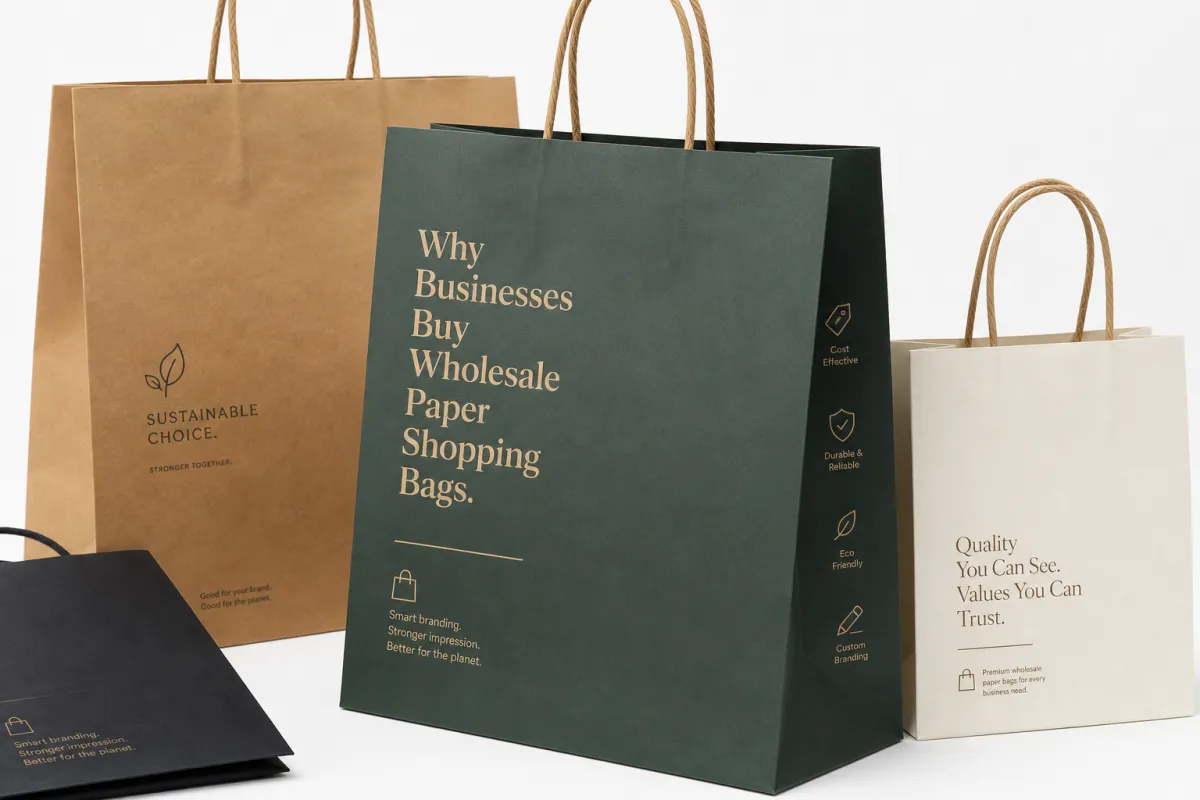
Retailers buy wholesale paper shopping bags for a practical reason: the bag becomes part of the sale. It is packaging, yes, but it also acts like a walking advertisement. A shopper carrying a well-sized, well-printed bag gives the brand a second glance long after the register closes. That kind of visibility is hard to match with a plain carrier or an unbranded mailer.
Retail, boutiques, food service, events, and trade shows remain the strongest use cases. Apparel stores want bags that fold around garments without looking flimsy. Cosmetics buyers care about a premium feel because the bag helps shape the unboxing moment. Restaurants and cafes need carriers that resist grease, hold clamshell containers, and stay upright on a pickup counter. Event teams want enough print area to place a sponsor or logo in front of a crowded room. In each case, businesses buy wholesale paper shopping bags because the bag has to support the product and the brand at the same time.
The commercial logic is straightforward. Wholesale volume lowers the unit cost, spreads artwork setup across more pieces, and keeps the bag design consistent from one location to the next. That consistency matters more than many buyers expect. A customer who shops at two branches should receive the same bag width, the same handle feel, and the same print finish. When the bag changes from store to store, the brand starts to look less controlled.
Generic retail bags can appear cheaper on day one, but they often create hidden costs later. A bag that is too small causes rebagging. A weak handle leads to complaints. A print job with poor registration can make a premium product look discounted. Businesses that buy wholesale paper shopping bags cut down those problems by locking in a spec that fits the actual goods, not a rough guess.
That is why the buying criteria should stay locked on durability, print quality, size range, and lead time. Price matters, yet price by itself does not tell you whether the order will save money or trigger a second purchase to fix the first one. If the bag works in transit and looks right at checkout, it earns its place. If it fails either test, the savings vanish quickly.
Common reality check: a bag with a slightly lower paper weight can outperform a heavier one if the handle attachment is stronger and the gusset is wider. That is the kind of detail buyers should inspect before they buy wholesale paper shopping bags.
Paper Shopping Bag Product Details That Matter
The paper shopping bag category looks simple from a distance. Up close, the differences are substantial. Kraft paper, coated paper, matte paper, and textured stocks all create a different feel in the hand. If you buy wholesale paper shopping bags for a fashion label, the tactile impression can matter as much as the logo. If the bags are for carryout food, structural reliability usually matters more than a soft-touch finish.
Kraft versus coated stock: kraft remains the workhorse choice for most volume orders because it is durable, recyclable, and cost-effective. Coated paper can sharpen full-bleed graphics or high-contrast logos, but it often raises cost and may not be the right fit for grease-prone or moisture-prone use. When buyers buy wholesale paper shopping bags, the stock should match the product mix. A bakery has different needs from a jewelry store.
Handle style: twisted paper handles are common on retail sacks because they are economical and usually comfortable in the hand. Flat handles work well for takeaway food or lighter retail loads. Rope handles, while less common in basic paper bags, can raise perceived value when the bag carries premium goods. The right choice depends on how the bag will be used, how far it will travel, and what your customers expect from the brand.
Bottom construction: a reinforced bottom panel can improve real-world performance more than a simple increase in paper thickness. This is where many teams buy wholesale paper shopping bags with the wrong emphasis. A thicker sheet does not solve a weak base. For boxed cosmetics, canned goods, or multiple folded garments, the bottom panel and glue bond deserve the same attention as the front print.
Here is a useful comparison for buyers who want to buy wholesale paper shopping bags with the right format for the job:
| Bag Type | Best For | Typical Features | Approx. Unit Price |
|---|---|---|---|
| Standard kraft retail bag | Apparel, general merchandise, promotions | Twisted paper handles, side gussets, printable front panel | $0.18-$0.32 at 1,000-5,000 pieces |
| Premium boutique bag | Cosmetics, gifts, specialty retail | Heavier paper, cleaner finish, stronger handle reinforcement | $0.35-$0.70 depending on print and finish |
| Takeaway or carryout bag | Food service, cafes, prepared meals | Wide gusset, upright base, grease-resistant options | $0.22-$0.45 based on size and coating |
| Custom full-bleed presentation bag | Events, launches, high-visibility branding | Large print area, multiple colors, upgraded stock | $0.45-$0.95 and higher for smaller runs |
That price spread explains why businesses buy wholesale paper shopping bags with a spec sheet in front of them. A clean one-color logo can keep costs under control. Full-coverage graphics, foil accents, and soft-touch finishes lift the perceived value, yet they also add production steps and risk. In plain terms, the bag can look more expensive because it is more expensive.
Material texture matters too. A natural kraft look tells a different story than a smooth white bag with a sharp logo. If your brand wants earthy, handmade, or sustainable cues, kraft paper is often the right baseline. If the bag has to feel like a luxury accessory, a smoother surface may be worth the higher price. Buyers who buy wholesale paper shopping bags should match that visual cue to the product, not to a passing trend.
Two practical references are worth keeping nearby. For material claims and certified fiber language, the FSC labels page is a useful starting point. If you are testing shipping performance or outer-carton transit, the ISTA site is a good reminder that transit stress is measurable, not theoretical. Buyers who buy wholesale paper shopping bags for fulfillment or kit assembly should think that way too.
What should you check before you buy wholesale paper shopping bags?
Before You Buy wholesale paper shopping bags, gather the specs that actually determine fit and performance. The most important ones are width, gusset depth, height, paper thickness, handle type, and load capacity. A bag that looks generous on paper can be too narrow for rigid product boxes. A bag that looks tall can still fail if the gusset cannot open enough to accept the contents without tearing the seam.
Internal dimensions matter more than outside measurements. That sounds basic, yet it is one of the most common ordering mistakes. A folded shirt, a rigid perfume carton, and a stack of brochures all occupy space in different ways. If you buy wholesale paper shopping bags by outside size alone, you may discover that the bag is technically the right height but too tight at the fold line. The result is wrinkled merchandise, slower packing, and stressed handles.
Print-safe area should also be confirmed before approval. Logos placed too close to a fold, a handle anchor, or a glued seam can distort once the bag is filled. Buyers who buy wholesale paper shopping bags for multi-location retail often ask for a proof that shows both the artwork and the fold lines. That small step saves a lot of awkward repacks later.
Sample testing is not optional if the bag will hold glass, books, jars, or boxed food. Put the real item inside. Lift it by the handles. Set it down. Carry it across a room. Then look for bottom bowing, handle peel, sidewall collapse, and seam distortion. Those are the failures that matter. A paper spec alone will not tell you everything, and that is where a lot of teams get tripped up.
Here is the kind of checklist that helps teams buy wholesale paper shopping bags with less friction:
- Dimensions: confirm internal width, gusset depth, and height for the actual product footprint.
- Paper weight: confirm the stock thickness or basis weight, but do not rely on that number alone.
- Handle design: twisted paper, flat paper, rope, or die-cut, depending on the use case.
- Print area: verify front, back, and side panel placement before proof approval.
- Load test: check how the bag behaves at real carrying weight, not a theoretical number.
- Compliance notes: ask about recycled content, food-contact suitability, and any required documentation.
If your business has sustainability requirements, ask whether the paper source can support FSC-certified claims, recycled content targets, or local recycling guidance. The EPA recycling resources are a useful reference for general recycling behavior, but local rules still matter. Buyers who buy wholesale paper shopping bags should be careful not to overstate environmental benefits. Claims need to match the paper source and the end-market reality.
A bag spec is not just a line item. It is a fit problem, a brand problem, and a transit problem wrapped into one decision.
That is why experienced buyers buy wholesale paper shopping bags with sample fills, not just artwork mockups. A mockup proves the print. A sample proves the handling. Both are necessary, and one does not replace the other.
If you want a fast internal starting point, our Wholesale Programs page is the best place to compare volume options before you request a formal quote. Buyers who buy wholesale paper shopping bags repeatedly usually standardize on a small set of sizes, then reorder those sizes instead of re-specifying every job from scratch.
Pricing and MOQ for Wholesale Paper Shopping Bags
Price usually falls as quantity rises, but the full cost picture is more complicated than a headline unit rate. When businesses buy wholesale paper shopping bags, the final number depends on paper stock, handle style, print colors, finishing, freight, tooling, and whether the order ships from stock or through a custom production run. A low unit price can become a mediocre deal if freight is high or if the bag needs a second setup charge for a small artwork change.
In typical wholesale buying, a standard kraft bag with a simple logo might land around $0.18 to $0.32 per unit at moderate quantities. Custom one-color printing, upgraded paper, or stronger handles can lift that into the $0.26 to $0.48 range. Premium boutique bags with more coverage, heavier paper, or specialty finishes can climb well above that. Those numbers are not fixed, but they are realistic enough to help buyers compare proposals with a clear head. Teams that buy wholesale paper shopping bags should always ask whether the quote includes proofing, cartons, and inner packing details.
MOQ matters. Smaller businesses often focus on the minimum order quantity because it protects cash flow, and that is fair. The trade-off is storage. If a buyer orders too much, the savings on unit cost can disappear into warehousing, slow-moving inventory, or the risk of design changes that make part of the stock obsolete. If you buy wholesale paper shopping bags in a size that only fits one narrow product line, the minimum may be too much. If the same size works for several product categories, a larger run can make more sense.
One of the smartest quote comparisons is landed cost per bag, not factory price per bag. That means freight, import handling if relevant, carton packaging, and any extra fees get folded into the real number. A supplier who looks 8% cheaper on paper may not be cheaper once shipping is added. That is especially true when the order is heavy, bulky, or headed to multiple store locations. Buyers who buy wholesale paper shopping bags for distribution should ask whether split shipments are possible and how that affects freight.
| Purchase Tier | Typical Use | Pricing Behavior | Buyer Risk |
|---|---|---|---|
| Low minimum run | Launches, seasonal campaigns, test orders | Higher per-unit cost, fewer storage demands | Running out sooner if sales spike |
| Mid-volume order | Single-store or regional retail use | Better balance of cost and inventory | Needs disciplined reorder tracking |
| Large wholesale run | Multi-location chains, recurring promotions | Lowest unit cost, best setup efficiency | Inventory carrying cost and spec lock-in |
The best repeat savings usually come from consistency. When a business buys wholesale paper shopping bags with the same size, same artwork layout, and same handle choice every time, pricing tends to improve because setup becomes predictable. Change the paper, alter the print coverage, or tweak the bag dimensions on every reorder, and the supplier has to rebuild the job. That costs time and money. Stable specs make reorders easier to approve and easier to forecast.
For procurement teams, the real question is not "what is the cheapest bag?" It is "what is the cheapest bag that still performs correctly, looks right, and arrives on schedule?" That is a better filter for anyone who plans to buy wholesale paper shopping bags in more than one round.
Process and Timeline From Quote to Delivery
The path to buy wholesale paper shopping bags is usually simple, but delays cluster in the same places every time. It starts with a quote request, then size and quantity confirmation, then artwork submission, proof review, sample or virtual mockup approval, production, and finally delivery. The process is not complicated. The mistakes happen when one of those steps gets rushed.
Artwork approval is the step that causes the most preventable delay. If a logo is sent as a low-resolution file, if colors are not defined, or if the print area is unclear, the proof cycle stretches. That is why buyers who buy wholesale paper shopping bags on a calendar deadline should gather brand files before asking for a quote. Vector logos, Pantone references, and clear placement notes speed everything up.
Production timing depends on three big variables: print complexity, paper availability, and shipping distance. A simple one-color bag may move faster than a multi-color bag with special finishes. A standard paper stock may be quicker to source than a custom or premium sheet. And a bag moving to one domestic warehouse will not follow the same timeline as a split shipment crossing multiple regions. Buyers who buy wholesale paper shopping bags for events or product launches should build in a buffer, because the calendar has a way of compressing right before go-live.
Typical checkpoints include:
- Request quote with size, quantity, print count, and target delivery date.
- Confirm the bag spec and the print-safe layout.
- Submit artwork and color references.
- Review the proof for dimensions, spelling, placement, and fold alignment.
- Approve sample or virtual mockup.
- Move into production and packaging.
- Verify carton count and shipping details before release.
Quality control is more than a final glance at the logo. The useful checks are print alignment, handle adhesion, count verification, and carton packing. If a carton is overfilled, the bag edges can crease during transit. If handles are not seated correctly, the first customer to carry the bag will notice. Businesses that buy wholesale paper shopping bags at scale should ask how the supplier checks those points before shipment.
There is also a transit question that gets missed. If bags are going into outer cartons for retail distribution or kit assembly, the packaging needs to survive handling before it ever reaches a customer. That is where ISTA testing language becomes relevant. You do not need a lab for every order, but you do need a shipping plan that respects the actual route. Buyers who buy wholesale paper shopping bags for resale or fulfillment should treat transit as part of the spec, not an afterthought.
For planned launches, backing up from the final in-store date and adding extra days for artwork corrections is the safer move. Most delays happen before production starts, not on the press line. That distinction matters. If your team wants a holiday rollout, a store opening, or a trade show handout, buy wholesale paper shopping bags early enough that proofing can move without pressure.
Why Choose Us for Wholesale Paper Shopping Bags
The difference between an average supplier and a better one usually comes down to manufacturing control. When you buy wholesale paper shopping bags from a team that understands packaging, you get more than a printed shell. You get help with paper selection, repeatable print output, handle reinforcement, and finishing choices that hold up in the hand.
That matters because many buyers do not need the most expensive bag. They need the right bag. A knowledgeable supplier should be able to explain why a 120 gsm paper with a reinforced bottom may outperform a heavier but poorly constructed option. They should also be able to show where a one-color logo is enough and where a more complex print pattern is actually worth the spend. That is the kind of guidance procurement teams value when they buy wholesale paper shopping bags for recurring use.
We also focus on sizing support. A lot of buyers know what they want to carry, but they do not want to gamble on exact dimensions. That is normal. Apparel folds differently than boxed candles. A food container behaves differently than a gift set. Our job is to help match the bag to the product mix so customers do not end up with bags that are too narrow, too tall, or too loose. If you buy wholesale paper shopping bags without that fit check, you usually pay for it later in reprints or replacements.
What procurement teams care about:
- Clear proofs with readable dimensions and artwork placement.
- Repeat orders that match the original spec without drift.
- Predictable lead times that can be planned against promotions.
- Freight transparency so landed cost stays visible.
- Consistent bag strength across every carton and every reorder.
We take the same view on branding. A paper shopping bag should help the product, not fight it. If the design is too busy, it can make the brand feel noisy. If the stock is too thin, it can make even a strong product look cheap. If the handle attachment is poor, the customer notices it before they notice the logo. That is why businesses buy wholesale paper shopping bags from a supplier that treats the bag as a packaging component, not just a print job.
Our Wholesale Programs page is designed for buyers who want to compare tiers without chasing a fresh quote for every idea. If your team needs the same bag every month across multiple stores, the goal is repeatability. If you only need a seasonal run, the goal is a practical minimum with a clean print and dependable freight.
There is another trust point worth mentioning. Packaging buyers do not want hidden surprises. They want the unit price, the quantity break, the artwork requirements, the carton pack, and the expected ship window in plain language. That is the standard we aim for when businesses buy wholesale paper shopping bags through Custom Logo Things.
Next Steps to Buy Wholesale Paper Shopping Bags
The fastest path to a clean order is to prepare before you request pricing. Measure the products you plan to bag, then choose two or three sizes that cover the full range rather than trying to force every product into one format. A single "good enough" bag sounds efficient until the first oversized box or awkward bundle shows up at packing.
Gather the files that save time: logo artwork, preferred colors, any Pantone reference, and any compliance notes for food, recycled content, or regional requirements. Buyers who buy wholesale paper shopping bags with complete information usually get better comparisons because the quotes are actually comparable. When one supplier is pricing a paper sack and another is pricing a premium stock with more finishing, the numbers cannot be trusted.
Ask for a sample or spec sheet and test it with real products. Put the actual item in the bag. Check the lift. Check the print placement. Check how the handles feel after a short carry. That small field test is worth more than a clean rendering on a screen. Businesses that buy wholesale paper shopping bags often discover that one size handles merchandise perfectly while another size, though close on paper, feels clumsy in the hand.
Ask for pricing at more than one quantity tier. That tells you where the best value sits, and it shows whether the savings at a larger volume are worth the added inventory. If your usage is seasonal, be even more careful. A three-month promotion can justify a larger run. A one-off event probably should not. The right answer depends on how often you need to buy wholesale paper shopping bags again.
Set a reorder trigger now. One month of stock remaining is a practical rule for many teams. It keeps you from placing a rush order under pressure, which is where costs and mistakes tend to rise together. Businesses that buy wholesale paper shopping bags on a controlled reorder cycle usually get better results than teams that wait until the last carton is gone.
For teams that want a straightforward buying process, the next move is to compare sizes, review print options, and confirm the quantities that fit your usage pattern. Then buy wholesale paper shopping bags with a spec that your staff can reuse, reorder, and trust. That is how you protect margin, keep branding consistent, and avoid the expensive scramble that starts when bags run out too soon.
The clearest takeaway is simple: measure the product, test the bag with the real load, compare landed cost, and lock the spec before the first order goes out. If you do those four things, buying wholesale paper shopping bags stops being a guess and starts being a repeatable part of operations.
Frequently Asked Questions
What size should I buy wholesale paper shopping bags in for apparel?
Match the bag to the folded item width plus a little gusset room so the contents do not bunch or wrinkle. If you sell mixed apparel sizes, choose one medium and one large format rather than forcing every order into a single bag. Ask for sample fills with your actual products before placing a full order.
How do I compare wholesale paper shopping bag prices accurately?
Compare landed cost per bag, not just the factory price, because freight and setup can shift the real total. Check whether quotes include printing, proofing, and carton packaging. Use the same size, paper stock, and handle style when comparing suppliers so the numbers stay meaningful.
What is a typical MOQ when I buy wholesale paper shopping bags?
MOQs vary by size, print complexity, and whether the bags are stock or custom made. Smaller runs may cost more per bag, but they can reduce cash tied up in inventory. Ask whether the supplier offers tiered pricing so you can see the break points clearly.
Can wholesale paper shopping bags be customized with my logo?
Yes, most suppliers can add a logo, brand colors, or a full design depending on the bag style. Simple one-color prints usually cost less and move faster than detailed multi-color artwork. Send vector artwork when possible to speed proofing and improve print accuracy.
How long does it take to receive custom wholesale paper shopping bags?
Timing depends on artwork approval, quantity, and whether the order is in stock or made to order. Proofing and sample approval often determine whether production stays on schedule. Build in extra time before a store launch, holiday rush, or event date.

