Buyer Fit Snapshot
| Best fit | Branded Paper Shred Void Fill projects where brand print, material claims, artwork control, MOQ, and repeat-order consistency need to be specified before quoting. |
|---|---|
| Quote inputs | Share finished size, material target, print colors, finish, packing count, annual reorder estimate, ship-to region, and any compliance wording. |
| Proofing check | Approve dieline scale, logo placement, barcode or warning zones, color tolerance, closure strength, and carton packing before bulk production. |
| Main risk | Vague material claims, crowded artwork, missing packing details, or unclear freight terms can make a low unit price expensive after revisions. |
Fast answer: Branded Paper Shred Void Fill: Design, Cost, and Results should be specified like a repeatable production item. The safest quote records material, print method, finish, artwork proof, packing count, and reorder notes in one written spec.
Production checks before approval
Compare the actual filled-product size with the drawing, then confirm tolerance on folds, seals, hang holes, label areas, and retail display edges. Reserve space for logos, QR codes, warning copy, and material claims before decorative graphics fill the panel.
Quote comparison points
Review material grade, print process, finish, sampling route, tooling charges, carton quantity, and freight assumptions side by side. A quote is only useful when the supplier can repeat the same color, closure quality, and packing count on the next order.
Two orders hit the same doorstep on the same afternoon. Same category. Similar price. Both arrive intact. One feels routine; the other feels staged, almost ceremonial, because branded paper shred void fill frames the product, limits movement, and signals intent before a hand ever touches the item. That emotional gap opens in seconds. Those seconds quietly shape repeat purchase behavior more than many teams budget for.
At first reveal, protective material usually occupies the largest visible surface area in the box. Not the product. Not the insert. The fill. Through a packaging buyer’s lens, void fill sits at the intersection of brand expression, transit protection, and unit economics.
Custom Logo Things readers are usually balancing practical constraints, not theory. So this guide stays grounded: where branded paper shred void fill performs, where it fails, how pricing actually behaves, and what implementation looks like when you cannot pause operations for six months. I will flag trade-offs, call out SKU-dependent variables, and show where branded fill earns margin instead of draining it.
Branded Paper Shred Void Fill: What It Is and Why It Changes Unboxing
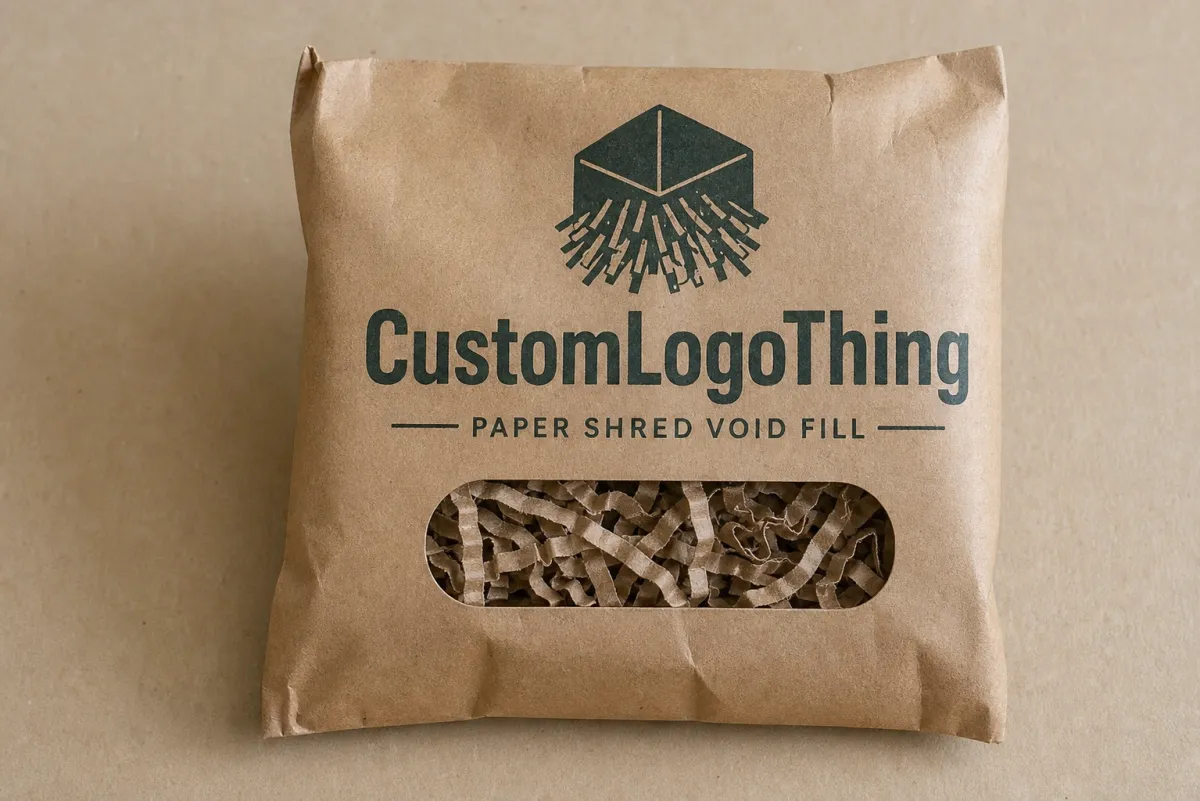
Branded paper shred void fill is shredded paper designed to occupy empty carton space, reduce internal product migration, and soften low-level shock while carrying brand identity through color, print, texture, or fiber profile. Put simply: it keeps products from rattling and makes the interior look deliberate rather than accidental.
Generic crinkle paper cushions. Bubble wrap cushions. Air pillows cushion. The customer still reads each one differently. Branded fill reads “curated.” Air pillows read “utility.” Bubble wrap reads “serious protection,” yet rarely communicates “premium gift moment.” Same function family, very different narrative.
Why perception changes so quickly
Unboxing psychology is less mysterious than it sounds. The brain prioritizes contrast, structure, and color before fine detail. A product nested inside cohesive branded fill signals order and value immediately. That same product inside random low-density filler often feels lower tier, even when technical protection is acceptable.
A useful benchmark from DTC shipments: in beauty, candles, accessories, and premium snacks, fill often occupies 35% to 70% of the open-box visual field at first glance. That is not a minor embellishment. It is the stage set.
Where branded fill performs best
- Lightweight to medium-weight shipments, frequently under 1.8 kg total shipped weight.
- Gift-oriented SKUs where presentation quality carries equal weight with protection.
- Subscription formats with repeated social exposure and recurring visual expectations.
- Influencer kits requiring consistent appearance under mixed camera and lighting conditions.
- Fragile accessories that benefit from soft nesting, especially coated or scratch-prone surfaces.
Limits matter. Branded paper shred void fill is not universal protection for heavy electronics, edge-sensitive glass, or products that fail under concentrated impact. Those loads need structure first: corrugated inserts, molded pulp forms, die-cut partitions, or puncture-resistant wraps.
A practical framing helps: use branded fill for migration control and presentation, not as the sole defense against harsh drops. If your handling profile includes repeated 30- to 36-inch events with dense products, engineer the structure first, then add fill as a secondary protective layer plus brand signal.
Callout: Packaging reviews that only ask “does it look premium?” miss half the job. Ask “does it still look premium after parcel handling, and did the product stay protected?”
For examples of brands that balanced visual identity with shipping performance, review these Case Studies and compare how presentation decisions map to measurable operational outcomes.
How Branded Paper Shred Void Fill Works Inside the Box
Branded paper shred void fill works through three mechanics: volume occupation, friction generation, and distributed contact. Shreds occupy air gaps, resist side-to-side movement, and absorb low-level vibration through many small touchpoints instead of one rigid interface.
Think mechanics first, aesthetics second. In an underfilled box, a product can migrate 10-40 mm during routine handling. Raise fill density and migration often drops sharply, often by half or better for lighter items. Less migration means fewer scuffs, fewer edge abrasions, and fewer “arrived messy” complaints.
Compression behavior and pack-out reality
Paper shreds compress under static load and repeated motion. A box packed perfectly at station time may settle in line haul. That is why initial fill volume needs a compression allowance, often 10% to 25% based on cut width, fiber stiffness, and product mass.
Teams that overlook settlement usually compensate later by overfilling. A stronger method is simple: document a target fill geometry (for example, 45 mm base nest plus 20 mm top layer), then verify after shake testing and a basic transit simulation.
Presentation logic drives perceived quality
Placement changes everything. A “nest” style with a visible perimeter creates depth and centers the reveal. Loose scatter reads casual and can undermine premium positioning. Camera-facing shipments benefit most from consistent nest geometry because the product appears framed, stable, and intentional in user-generated content.
Branded paper shred void fill also controls reveal sequence. If the first visual is your signature color and the second is product silhouette, customers read higher intent. The effect may sound subjective, yet it surfaces in review language repeatedly: “thoughtful,” “beautifully packed,” “felt special.”
Protection limits you should define early
Use branded fill confidently for minor shock damping and scuff reduction. Treat concentrated corner impacts, high-mass products, and brittle protrusions with caution. When force concentrates at one point, structural protection should carry the load first.
Material variables influence outcomes:
- Cut width: narrower cuts can interlock and hold placement better, though very soft fiber may settle faster.
- Basis weight: heavier paper often improves spring-back and perceived richness; 60-90 gsm is common in retail use cases.
- Fiber blend: recycled blends can perform well, though some generate more dust; test around sensitive products.
- Color saturation: deeper tones increase visual density and can mask minor compression variability.
Sustainability claims now get closer scrutiny from buyers and end customers alike. Claims should be specific and verifiable. If your branded paper shred void fill uses recycled fiber, state the percentage. If material is curbside recyclable where mixed paper is accepted, explain disposal clearly and avoid broad promises. Useful references include EPA recycling guidance and certification frameworks from FSC.
Key Factors to Choose the Right Branded Paper Shred Void Fill
Teams that choose branded paper shred void fill on color alone usually pay for that shortcut later. Correct specification is a fit decision across product physics, brand intent, labor flow, and shipping stress.
1) Product profile first
Weight, fragility, edge geometry, and orientation sensitivity belong at the top of the brief. A 120 g ceramic accessory behaves nothing like a 900 g glass jar. The first might need 35-50 mm of nesting fill. The second may need inserts plus fill. Products with scuff-prone surfaces often perform better with softer-contact grades and less abrasive cut styles.
2) Brand expression decisions
Choose early between exact PMS matching and tonal family alignment. Exact matching can add approval cycles and tighter tolerance controls. Tonal matching is usually faster and lower cost while still reading clearly on-brand. Some brands see better perceived sophistication with restrained cream or kraft plus low-contrast accents than with dense, loud print.
Branded paper shred void fill can be dyed, printed, or both. Printed variants increase message visibility, though complexity rises with artwork density and registration demands. If recognition at first glance is the main objective, a strong single color often captures most of the effect with less operational friction.
3) Operational fit at pack stations
Material performance means little if fulfillment slows. Measure handling time per order before and after trial. A 6-10 second increase per parcel scales quickly. At 1,200 daily orders, 8 extra seconds equals roughly 2.7 labor hours each day.
Operator feedback catches realities spreadsheets miss: static cling, dispense inconsistency, dust behavior, and station fatigue. Strong programs convert this feedback into clear SOPs with fill-depth markers and photo references by box size.
4) Shipping channel stress and seasonality
Carrier handoffs, zone distance, and peak throughput all shift handling intensity. Pack-outs that pass in calm periods can fail during peak congestion. Design for rough conditions, not ideal handling.
5) Compliance and customer expectations
Food-adjacent or fragrance-sensitive products should be tested for odor transfer and particulate behavior. Customers prioritizing recyclability need plain disposal guidance on inserts or product pages. Claims on PDPs should match actual material specs and regional recovery realities.
6) Define your measurement framework before buying
Set explicit targets: damage rate, unboxing sentiment, fill grams per order, pack time, and reorder lift. This shifts branded paper shred void fill from aesthetic debate to performance decision. Teams needing internal alignment can pull examples from these Case Studies and map outcomes against their own KPI baseline.
Production Steps, Process, Timeline, and Lead Time Planning
Most delays tied to branded paper shred void fill happen before conversion begins. Artwork approvals stretch. Color sign-off stalls. Pilot testing starts late. Launch calendars then slip, and emergency substitutions creep in.
End-to-end process map
- Concept brief: define goals, SKU scope, cost ceiling, sustainability claims, and performance thresholds.
- Material selection: choose basis weight, fiber mix, cut profile, color strategy, and delivery format (loose, bale, dispenser-ready).
- Color proofing: review physical drawdowns or strike-offs under multiple lighting conditions.
- Print/finish approval: for printed variants, confirm readability and consistency at expected viewing distances.
- Pilot run: execute limited production for line trial and transit evaluation.
- Transit validation: run ISTA-aligned simulation plus real-zone shipment checks.
- Scaled rollout: phase by SKU volume, monitor variance, and lock reorder rules.
What usually drives lead time
Custom shade matching and print complexity are common bottlenecks. Supplier queue and machine setup also influence schedule. Shred conversion itself is often fast once approvals are complete. First orders often land in roughly 12-20 business days after final sign-off, while repeat orders can compress to 7-12 business days depending on queue and volume.
Those ranges are directional, not guarantees. Tight shade tolerances, multi-ink patterns, or peak-season congestion can push timelines outward.
Sampling strategy that avoids false confidence
Approve two sample classes:
- Visual samples: verify color, texture, and brand fit in hand.
- Packed-drop samples: verify protection after compression and handling.
Why split the process? Material that looks excellent in a loose sample can underperform once compacted around a moving product. That mismatch appears regularly in first-time branded-fill projects.
Production checkpoints worth documenting
- Incoming paper verification for basis weight and moisture range.
- Color consistency checks at run start, midpoint, and completion.
- Cut-width tolerance monitoring for cushioning and texture consistency.
- Packing density standards to keep yield predictable per carton or bale.
- Batch labeling for traceability if complaint patterns surface later.
Teams that create a one-page PO acceptance checklist usually avoid subjective back-and-forth and speed up decisions across procurement, creative, and operations.
As rollout expands from hero SKUs to long-tail assortments, keep weekly review loops during month one. Track pack-time variance by shift. Watch reorder timing against campaign calendars. Integrate fixes quickly. That operating discipline is where branded paper shred void fill stops being “nice packaging” and starts performing like a controlled asset.
Cost, Pricing, MOQ, and Unit Cost of Branded Paper Shred Void Fill
Pricing for branded paper shred void fill looks straightforward until full delivered cost is modeled. The cheapest line item can become the most expensive decision if it drives more damage, longer pack time, or larger shipping cube.
Cost stack you should model
- Raw paper grade and recycled-content percentage.
- Dye or print customization intensity.
- Conversion yield and trim loss.
- Packing density and usable yield per carton.
- Freight, including dimensional effects of lower-density formats.
- Pack labor seconds per order and station consistency.
Directional market pricing often falls around $2.10-$4.80 per kg depending on material and customization. That figure alone can mislead. Effective cost per shipped order is the right metric. A fill that costs 18% more per kg may still reduce total fulfillment cost if usage drops, protection improves, or labor stabilizes.
MOQ logic and trade-offs
MOQs are typically tied to setup economics: color runs, print prep, and changeover time. Lower MOQ programs exist, though unit pricing may rise 15%-40%. For newer brands, paying that premium can make sense if it avoids dead stock and shade obsolescence after identity updates.
| Option | Typical MOQ Range | Indicative Cost Signal | Pros | Risks |
|---|---|---|---|---|
| Generic crinkle paper | Low (often immediate availability) | Low material cost per kg | Fast replenishment, simple sourcing | Weak brand differentiation, variable unboxing feel |
| Solid-color branded paper shred void fill | Medium | Moderate cost premium | Strong visual identity, easier than print | Color approval cycles, inventory planning required |
| Custom printed paper shred fill | Medium to high | Higher premium | Maximum message visibility and campaign tie-in | Higher complexity, tighter QA requirements |
Storage and labor economics are often underestimated
Compressed bale formats can cut storage footprint by 20%-50% versus loose-fill cartons, depending on supplier density. Station behavior still matters: if fluffing is inconsistent, labor time can climb. Test storage and dispensing in real pack conditions before committing to annual volumes.
Small labor deltas scale quickly. Add 5 seconds per order across 3,000 monthly shipments and you absorb about 4.2 extra labor hours. At 20,000 monthly shipments, the same variance turns into a material operating expense.
Quote-read checklist for apples-to-apples comparisons
- Basis weight and fiber composition.
- Recycled-content percentage and certification basis.
- Color tolerance or print-variation allowances.
- Moisture specifications and storage guidance.
- Usable yield per carton or bale in real pack conditions.
- Freight assumptions and lead-time commitments.
Ask each supplier to normalize quotes by expected grams per order across the same SKU mix. Then compare delivered economics side by side. That one step removes most procurement confusion around branded paper shred void fill.
Need evidence that premium packaging shifts behavior? Review before-and-after programs in these Case Studies, especially where repeat orders were tracked alongside complaint rates and return friction.
Step-by-Step Implementation Guide: From Test Orders to Full Rollout
Reliable rollout of branded paper shred void fill depends less on creative flair and more on disciplined trial design. Teams that treat this as a controlled operations project usually get better outcomes faster.
Step 1: Define success before purchase
Set hard thresholds up front. Example: damage rate below 1.2%, unboxing sentiment up at least 15%, material cost cap at $0.22 per order, and no more than 4 seconds added pack time. Without this, final selection drifts into subjective preference.
Step 2: Shortlist 2-3 specs and run controlled shipments
Choose candidates with meaningful differences in cut width, basis weight, and color strategy. Run A/B or A/B/C tests across representative SKUs, shipping zones, and basket sizes. Sample size should be large enough to reduce noise; many teams start near 150-300 parcels per variant.
Step 3: Build SOPs that people can actually follow
Station instructions should specify fill depth, product placement, and top-layer target in concrete terms. Add photo references by box size and define acceptable variance bands. A concise SOP card outperforms a long procedural manual in almost every fulfillment environment.
Step 4: Collect field data quickly
Track carrier exceptions, customer comments, return reasons, and station pack times daily during the first two weeks. Tag feedback consistently: “looked premium,” “item shifted,” “too much filler,” “messy opening.” This separates emotional wins from protection gaps.
Step 5: Use weighted scoring, not single-metric picks
A practical weighting model:
- Protection performance: 35%
- Brand impact/unboxing sentiment: 25%
- Cost per packed order: 20%
- Labor and operational fit: 20%
Score each candidate on a 1-10 scale against identical criteria. Winners are rarely the cheapest sample and rarely the prettiest one. Most of the time, the best-performing option is the one with the most stable balance across all four dimensions.
Step 6: Launch in phases and lock backup rules
Start with top-volume SKUs, review outcomes weekly, then expand. Define reorder triggers (for example, four weeks of cover) and pre-approve a neutral backup spec for supply interruptions. Emergency substitutions without rules usually create visible quality drift and customer confusion.
During rollout, treat branded paper shred void fill like any controlled packaging component: versioned specifications, QA checkpoints, and clear ownership across procurement, creative, and fulfillment.
Common Mistakes, Expert Fixes, and Your Next 30-Day Action Plan
Most weak programs do not fail because the concept is flawed. Execution drift is the usual culprit. Branded paper shred void fill performs best with simple controls that teams actually use.
Mistake 1: Treating fill as decoration only
Fix: Tie aesthetic goals to transit criteria from day one. Define acceptable movement after shake testing and acceptable damage rates after pilot shipments.
Mistake 2: Overfilling to look premium
Fix: Calibrate depth to product mass and box cube. Excess fill can raise freight cost and frustrate customers. Clean closure with stable product beats dramatic overfill.
Mistake 3: Approving color in one lighting condition
Fix: Review under warehouse LED, daylight, and camera lighting. A shade that looks perfect on a bench can shift noticeably on social video and create brand inconsistency.
Mistake 4: Skipping operator training
Fix: Use visual SOP cards, short onboarding clips, and quick audits. Even strong material specs fail under inconsistent pack-out behavior.
Mistake 5: No backup spec during stock pressure
Fix: Pre-approve a neutral contingency grade with documented substitution rules. Continuity during promotion spikes depends on this more than most teams expect.
Expert tips that pay back fast
- Use premium printed variants for campaigns and keep solid-color branded paper shred void fill as the operational baseline.
- Align reorder points to campaign calendars, not just trailing average consumption.
- Track reorder lift and complaint rate together each month; either metric alone can mislead.
- Audit fill usage by shift to catch “handful creep” before cost drift compounds.
- Review sustainability claims quarterly against current supplier documentation.
A practical 30-day plan:
- Select three representative SKUs and capture baseline metrics from recent shipments.
- Request comparative quotes using identical yield assumptions and shared carton profiles.
- Run a two-week controlled pilot with documented SOPs and daily data capture.
- Score results with weighted criteria and issue a written go/no-go decision.
- If go, phase launch by volume tier and schedule weekly QA checks for month one.
Most teams overinvest in color debates and underinvest in measurement. That imbalance is expensive. The strongest branded paper shred void fill program is not the loudest design. It is the one that looks consistent, protects consistently, and still matches expected unit economics after three months of real operations.
FAQ
How much branded paper shred void fill should I use per box size?
Tie target fill depth to product weight and empty cube, then validate through transit testing. Many teams standardize by grams per order or by controlled handful count per carton size in SOPs. After sealing and a gentle shake, migration should be minimal. Adjust in small increments instead of doubling material, and track usage for two weeks to spot overfill drift between shifts.
Is custom printed paper shred void fill better than plain colored shred?
Printed variants can improve message retention and campaign visibility, while plain color often delivers most of the premium effect with lower complexity. Pick printed where reveal messaging is central to brand experience. Pick solid color where speed, MOQ flexibility, and cost control lead. Run both against customer feedback and repeat-purchase behavior before full scaling.
What is the typical lead time for branded crinkle paper void fill orders?
Lead time is usually driven by color matching, print method, and queue depth more than shredding itself. First runs take longer because proofing and approvals add steps. Repeat runs are often faster once specs are locked. Build schedule buffer for exact shade work, and keep a pre-approved backup spec to protect fulfillment during demand spikes.
Can branded paper void fill reduce damage rates on fragile items?
It can reduce movement and cosmetic scuffing for light-to-medium fragility items, especially where presentation quality matters. It does not replace structural protection for heavy breakables or edge-sensitive products. Pair with inserts, partitions, or wraps for concentrated impact risk, then validate with controlled drop and vibration testing.
How do I compare pricing quotes for branded paper shred packaging fairly?
Normalize quotes to effective cost per packed order rather than cost per kilogram alone. Compare basis weight, cut width, recycled content, usable yield, and freight assumptions side by side. Include labor time and storage footprint in total cost modeling because dispensing format can materially shift operating expense.
If one point sticks, let it be this: branded paper shred void fill should be specified like a performance component, not treated as decorative residue. Build the brief around protection, brand impact, and operating economics at the same time, and your branded paper shred void fill strategy will produce more consistent unboxing, stronger customer confidence, and better long-run unit economics.