Buyer Fit Snapshot
| Best fit | Branded Product Boxes with Embossing for Premium Appeal projects where brand print, material claims, artwork control, MOQ, and repeat-order consistency need to be specified before quoting. |
|---|---|
| Quote inputs | Share finished size, material target, print colors, finish, packing count, annual reorder estimate, ship-to region, and any compliance wording. |
| Proofing check | Approve dieline scale, logo placement, barcode or warning zones, color tolerance, closure strength, and carton packing before bulk production. |
| Main risk | Vague material claims, crowded artwork, missing packing details, or unclear freight terms can make a low unit price expensive after revisions. |
Fast answer: Branded Product Boxes with Embossing for Premium Appeal should be specified like a repeatable production item. The safest quote records material, print method, finish, artwork proof, packing count, and reorder notes in one written spec.
Production checks before approval
Compare the actual filled-product size with the drawing, then confirm tolerance on folds, seals, hang holes, label areas, and retail display edges. Reserve space for logos, QR codes, warning copy, and material claims before decorative graphics fill the panel.
Quote comparison points
Review material grade, print process, finish, sampling route, tooling charges, carton quantity, and freight assumptions side by side. A quote is only useful when the supplier can repeat the same color, closure quality, and packing count on the next order.
Branded Product Boxes with Embossing for Premium Appeal
Branded product boxes with embossing change the first impression before a customer reads a single line of copy, and that tactile shift carries real weight for premium packaging. A raised mark can suggest care, restraint, and quality without loading the carton with extra ink, busy graphics, or heavy decorative layers. The result feels considered rather than loud, which is often exactly what a premium package needs.
What Are Branded Product Boxes with Embossing?
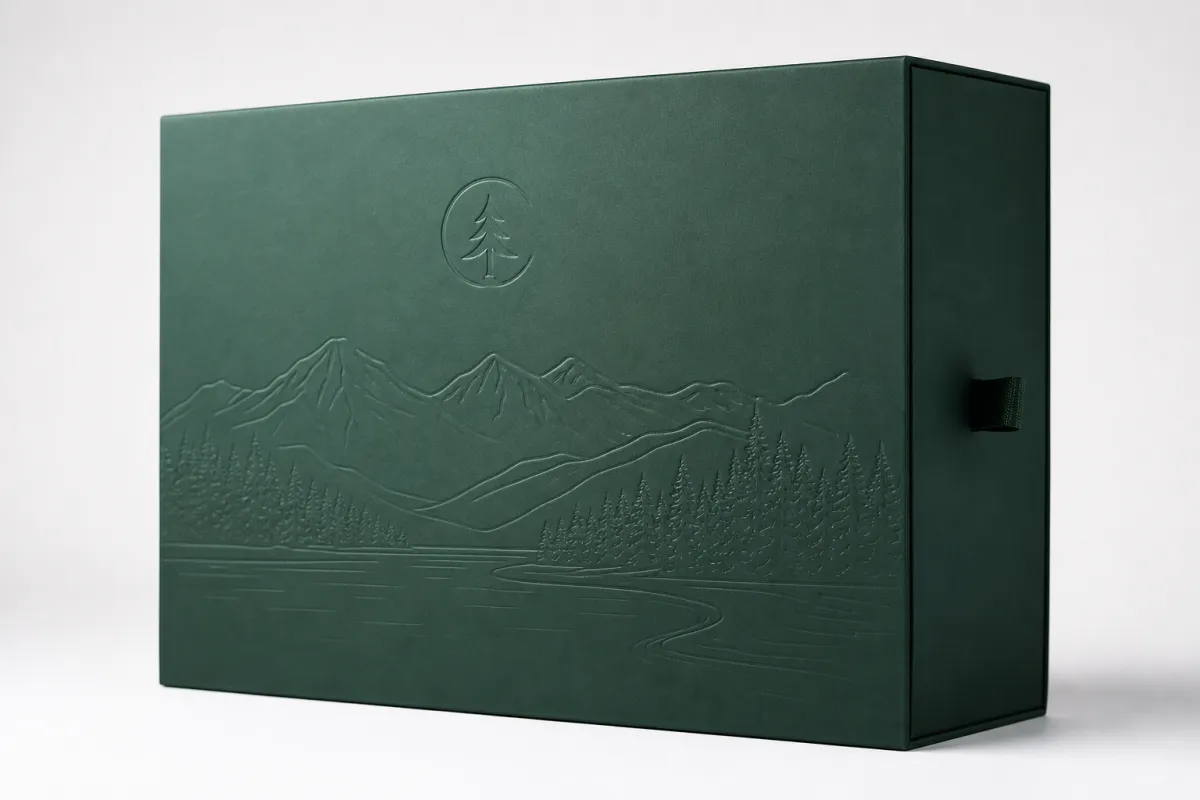
Branded product boxes with embossing are paperboard or rigid cartons shaped under pressure so part of the design rises above the surface. That raised logo, border, monogram, or pattern gives the box a tactile detail you can feel with your fingertips, which is one reason branded product boxes with embossing often read as more expensive even when the printed coverage stays restrained. The effect is quiet, and that quietness is part of the appeal in premium packaging.
The process uses a matched pair of dies that press the board and lift the selected artwork area into relief. No extra ink is needed for the shape itself, and that makes branded product boxes with embossing appealing to brands that want a refined look without adding visual clutter. A carton can stay clean on shelf and still leave a strong impression in hand.
That physical detail also supports a more honest materials story. Many teams choose branded product boxes with embossing because the look comes from board, pressure, and structure rather than a stack of coatings hiding the substrate. If the packaging brief calls for reduced decoration and a clearer link to the material beneath the print, embossing fits naturally.
A raised mark catches light differently, throws a subtle shadow, and invites touch, which is why branded product boxes with embossing often perform well during unboxing and at retail. Texture stays in memory. Color alone can fade from recollection, but a well-made carton has a way of lingering because the hand notices what the eye might miss.
Different embossing styles serve different design goals:
- Blind embossing raises the design without ink or foil, letting texture carry the message.
- Registered embossing aligns the raised area with printed artwork so logos and icons stay crisp.
- Combined print-plus-emboss designs pair embossing with foil stamping, spot UV, or selective varnish for sharper contrast.
For packaging buyers, the choice is not only visual. Branded product boxes with embossing often make a product feel more deliberate, more giftable, and more carefully finished, even when the layout is minimal. That can matter a great deal for cosmetics, specialty foods, wellness items, apparel accessories, and other products where the package helps justify the price point.
A raised logo often carries more authority than another layer of ink. If the structure is right, branded product boxes with embossing can deliver the premium signal on their own.
How Branded Product Boxes with Embossing Are Made
Branded product boxes with embossing are produced through a pressing method that uses a male and female die to shape the board from both sides. The die set matches the artwork, and the press applies controlled pressure so the chosen area rises cleanly without crushing the surrounding panel. When the setup is calibrated well, the result feels crisp and purposeful instead of overworked.
The artwork stage carries more influence than many teams expect. Files intended for embossing need clean vector lines, sensible spacing, and shapes that respect the physical limits of the paperboard. Tiny serif strokes, crowded monograms, and hairline borders can be risky because branded product boxes with embossing depend on fiber strength and board memory. If the detail is too fine, the image can soften, distort, or disappear under pressure.
Board selection changes the outcome as much as the artwork does. A thin stock may not hold a raised form properly, while a board that is too rigid can resist the die and crack at the edges. For branded product boxes with embossing, common options include SBS, CCNB, kraft, recycled board, and heavier rigid constructions, depending on whether the package is a folding carton or a premium set-up box. The right substrate supports the depth without fighting it.
The order of printing and finishing matters too. Some branded product boxes with embossing are printed first and then embossed; others are embossed before a coating step, especially when foil stamping, varnish, or spot UV is part of the build. The converter has to manage the sequence carefully because coatings change how pressure behaves, and foil can affect where the die lands. Small sequencing mistakes can flatten detail or create registration problems that are expensive to correct.
Sampling is where the theory meets the real carton. A digital proof may show the logo shape, but it will not tell you how branded product boxes with embossing feel under the thumb, how the board reacts to grain direction, or whether the raised area looks too sharp under bright retail lighting. Physical samples answer those questions. A good sample run often prevents a full production order from missing the mark.
Humidity and storage conditions deserve attention as well. Paper fibers shift with moisture, even when the movement seems modest, and that movement changes how branded product boxes with embossing hold their form. If a run sits in a damp environment too long or the sheet direction is ignored during die layout, the final texture can look less precise than intended. Packaging is a materials business as much as it is a print business.
On press checks, I have seen a logo go from elegant to mushy just because the board was a little too soft for the chosen depth. That is the kind of detail a mockup will not warn you about, so it pays to test early and honestly.
For brands that want to study real-world examples of structural and finishing decisions, our Case Studies page is a useful place to see how different packaging choices translate into finished cartons.
Key Design Factors for Sustainable Embossed Boxes
Designing branded product boxes with embossing for sustainability starts with the board, because the substrate does most of the work. FSC-certified paperboard, recycled-content sheets, kraft looks, and uncoated stocks all affect how the final package feels and how it fits into a recycling stream. If the brand story centers on less waste and more material honesty, the substrate should support that story from the beginning. You can review chain-of-custody concepts through FSC, which helps when sourcing materials with responsibility in mind.
Depth comes next, and it needs to match the structure. A dramatic emboss can look striking on a rigid presentation box, yet the same depth may distort a lightweight folding carton or weaken a narrow panel. For branded product boxes with embossing, a moderate lift is often the stronger choice because it protects corners and keeps the design from appearing swollen or over-pressed. Strong design is not always the deepest design.
Readability matters just as much as texture. A raised mark can look beautiful in the sample room and still become hard to read on a crowded shelf if the form is too subtle or the lighting is unforgiving. That is why branded product boxes with embossing need a balance between tactile detail and legibility, especially on smaller formats where logo space is limited. Good packaging should work in a retail aisle, inside a shipping carton, and in a customer’s hands.
Finish compatibility deserves real scrutiny. Water-based coatings, light varnishes, and minimal decoration often keep the structure cleaner and make branded product boxes with embossing easier to recycle than packages wrapped in multiple films and specialty finishes. Lamination can still be the right answer in some cases, especially where abrasion resistance matters, but it should be chosen deliberately instead of automatically. Each added layer should earn its place.
Structure and closure style influence emboss behavior too. Tuck flaps, sleeves, rigid two-piece boxes, and drawer-style cartons respond differently to pressure. A sleeve can carry a strong front-panel emboss, while a hinged rigid box can support larger area detail. Branded product boxes with embossing need to respect those structural limits. Die cutting, score depth, and glue panel placement all interact with the raised design, so the package should be engineered as a system rather than treated as separate artwork and structure files.
Secondary decoration raises another practical question. Foil stamping can be elegant, and spot UV can add useful contrast, but every effect should justify its cost and footprint. A restrained approach often works better for branded product boxes with embossing because it keeps the tactile moment clear and reduces waste in the finishing process. If the board texture and form already communicate enough, that is usually the better answer.
For brands comparing materials and formats, our Custom Packaging Products page can help narrow the structure before artwork begins.
Brands sometimes try to make packaging feel premium by stacking finish after finish. In many cases, branded product boxes with embossing feel more confident when the design stays quiet and the material quality carries the message.
According to the EPA’s recycling guidance, package design choices influence how efficiently a material moves through recovery systems, so it pays to think about coatings, adhesives, and inserts together instead of in isolation. For general recycling context, see EPA recycling resources. That kind of practical review helps when you are building branded product boxes with embossing that need to look premium and still make sense at end of life.
Cost and Pricing Factors for Branded Product Boxes with Embossing
Cost is where many projects get misunderstood, because branded product boxes with embossing are not priced from a single number. Tooling, die creation, press setup, board weight, print coverage, and the complexity of the embossed area all influence the final cost. For a realistic quote, ask for pricing that separates tooling from unit cost and structure from finishing. That gives you a far clearer picture of where the budget is going.
Smaller runs usually carry a higher per-unit cost because setup work is spread across fewer cartons. A simple blind emboss on a standard folding carton may be relatively modest, while branded product boxes with embossing plus foil stamping, spot UV, or specialty coatings can rise quickly as the finishing steps multiply. Volume often helps, but only if the artwork and board specification stay stable enough to avoid repeated proof cycles.
Here is a practical way to think about the market, based on common production patterns rather than a fixed quote:
| Option | Typical Use | Relative Cost | Practical Notes |
|---|---|---|---|
| Blind emboss only | Minimal premium cartons, logos, seals | Lower | Cleaner recyclability and simpler setup |
| Emboss + print | Retail cartons, branded sleeves | Moderate | Good balance of image and tactile value |
| Emboss + foil stamping | Giftable or luxury packaging | Higher | Stronger shelf impact, more tooling and setup |
| Emboss + spot UV or varnish | Modern retail and beauty packaging | Moderate to higher | Useful contrast, but finish alignment must be tight |
| Multi-finish rigid box | High-end presentation sets | Highest | Best for premium launches, least forgiving on cost |
As a working reference, some simple branded product boxes with embossing can fall in a range such as $0.18-$0.28 per unit at 5,000 pieces for straightforward folding carton work, while more complex presentation boxes can move well above that once foil, rigid board, specialty coatings, or heavy print coverage are added. Those numbers are directional only, because board selection and emboss depth can change the result quickly. Still, they give buyers a realistic frame before comparing quotes.
Sustainability choices can shift price too. Recycled board may have different availability or caliper consistency, FSC-certified materials may require sourcing coordination, and low-impact coatings can affect press time. Branded product boxes with embossing can still be cost-effective, but the quote should reflect the actual build rather than a generic box estimate. Itemized pricing makes it easier to compare board, finishing, and tooling without chasing the lowest unit number and hoping the details work themselves out.
Sample rounds can add cost, yet they often protect the budget. A corrected die line or a better pressure setting costs less than reprinting a full order. That matters especially for branded product boxes with embossing, where a small artwork adjustment can determine whether the logo reads cleanly or looks faint on the finished carton. In packaging, the cheapest mistake is usually the one you catch before production begins.
Production Process and Timeline for Embossed Boxes
The production flow for branded product boxes with embossing usually begins with concept and dieline review, then moves into artwork prep, tooling approval, sampling, press setup, production, and final inspection. That sequence sounds straightforward, but each stage carries its own decisions. A box can look beautiful in a mockup and still need adjustment once board thickness, fold behavior, and emboss depth are tested in a real run.
Timeline risk usually comes from revisions rather than from embossing itself. If the artwork changes after the die is already made, or if the brand asks for a deeper raise after proof approval, the schedule can slide by days or even weeks. Branded product boxes with embossing benefit from clear sign-off stages because every correction affects another part of the process, from die cutting to coating and final folding.
Complex finishes extend lead time more than many teams expect. If the project includes foil stamping, spot UV, multi-pass print, or a specialty varnish, the finishing order has to be managed with care. Branded product boxes with embossing often require test sheets to confirm registration, and those tests are not wasted time; they are the reason the final carton looks intentional instead of forced. A clean press sheet usually comes from good planning, not luck.
Sampling should happen under real lighting whenever possible. A raised logo can appear bold under a bright proof lamp and softer in a normal retail setting. That is why branded product boxes with embossing should be reviewed in the kind of light where customers will actually see them. Treat the sample as a working object rather than a presentation piece.
As for timing, many straightforward projects can move in roughly 12-15 business days from proof approval once the tooling is ready, while more complex runs can take longer depending on queue, board sourcing, and finishing load. That range is not a promise; it is a realistic planning window. In this category, branded product boxes with embossing reward brands that leave cushion in the schedule instead of treating the timeline like a guess.
Communication keeps the schedule healthy. When artwork, engineering, and production teams stay aligned, branded product boxes with embossing move through the system with fewer surprises. Questions about grain direction, press pressure, and coating order should be settled early. A good converter will raise those questions before the order is locked because that is when small choices become expensive.
For a look at how different production decisions play out in actual packaging programs, browse the examples in our Case Studies archive and compare structure, finish, and timing patterns across different builds.
Packaging schedules are usually lost in revisions, not in the actual press run. Once branded product boxes with embossing are approved properly, the physical process tends to be more predictable than the paperwork around it.
Common Mistakes to Avoid with Embossed Product Boxes
One of the biggest mistakes with branded product boxes with embossing is trying to emboss artwork that is too fine, too crowded, or too close to the edge. Embossing needs room to breathe. A thin line can disappear, a dense pattern can look muddy, and an aggressive detail near a fold can distort when the board is scored. If the layout ignores those realities, the finish will look weaker than the mockup suggested.
Another common problem is choosing the wrong stock. A board that is too soft can flatten the detail, while a board that is too brittle can crack under pressure. Branded product boxes with embossing depend on the relationship between caliper, fiber direction, and press force. The carton should feel intentional in the hand, not stressed. If the raised area shows stress whitening or a crushed halo, the material specification needs another look.
Mixing too many finishes can dilute the brand message. It happens often: embossing gets paired with heavy lamination, foil stamping, spot UV, and bright print all at once, and the result feels busy rather than premium. Branded product boxes with embossing work best when the tactile element has a clear role. If every square inch is trying to speak, nothing stands out.
Skipping physical samples is another expensive habit. Digital proofs are useful for layout and color intent, but they do not show texture depth, pressure behavior, or how the carton opens and closes after finishing. Branded product boxes with embossing should always be reviewed as physical objects before the full run is approved. That sample stage is where a brand learns whether the raised mark is elegant or merely visible.
Sustainability claims need the same discipline. A box may use recyclable board and still become harder to recover if it carries a heavy plastic lamination or an incompatible adhesive system. Branded product boxes with embossing can support a cleaner package story, but only if the full construction is considered. Ask about inks, coatings, inserts, and glue choice. The whole package matters.
There is also a brand-risk issue: using embossing only because it feels premium on paper. If the product does not need a luxury cue, or if the price point is intentionally accessible, a simpler carton may communicate better. Branded product boxes with embossing should solve a real positioning problem, not just fill empty white space. Good packaging is never decoration for its own sake.
Transit stress deserves attention too. A carton that looks perfect on a table can arrive dented if the structure is weak. Depending on the distribution path, it may be wise to test against realistic shipping conditions or ask for transit guidance in line with standards such as ISTA methods. You can review those testing principles at ISTA. Branded product boxes with embossing should still survive the journey, not just the photo shoot.
Expert Tips for Branded Product Boxes with Embossing
If you want branded product boxes with embossing to feel truly premium, start with one strong embossed element instead of three or four competing ones. A logo mark, seal, or short brand line usually carries more authority than a crowded surface. I have seen this repeatedly: the best results come from restraint, not from trying to prove how many effects the box can hold.
Use the board texture to your advantage. Kraft and uncoated papers often make branded product boxes with embossing feel warmer and more grounded, while smoother boards give a crisper, more formal effect. That choice changes the emotional tone of the package. A natural stock can feel handcrafted and honest; a smoother sheet can feel more engineered and luxurious. Neither is automatically better. The right one depends on the product and the customer.
Test the package where it will actually live. Shelf lighting, shipping vibration, warehouse stacking, and the first unboxing moment all influence how branded product boxes with embossing are experienced. A package that looks rich in a studio can lose some character if the emboss is too shallow or the coating is too reflective. In real use, practical details win.
Keep the finish strategy simple when sustainability is part of the brief. A single raised mark with good structure often looks more confident than a carton loaded with effects. Branded product boxes with embossing can carry a premium story on their own if the typography is chosen carefully and the surface is respected. If contrast is needed, spot UV or foil stamping can be added with care, but they should support the design rather than distract from it.
Think about the customer’s hands, not just their eyes. A premium package is not only seen; it is lifted, turned, opened, and sometimes kept. Branded product boxes with embossing invite that extra second of attention. That second matters. In many categories, it is the moment when the product shifts from “another item on the shelf” to “something worth remembering.”
Here is a practical rule I use often: if the emboss reads clearly in a sample, in normal room lighting, and after a short shipping test, the design is probably ready. If any one of those fails, adjust the board, reduce the depth, or simplify the artwork. That is the value of working with branded product boxes with embossing in a disciplined way. The finish becomes a tool, not a gamble.
From a buying standpoint, pilot runs make sense. Order a small quantity, inspect the pressure, compare the tactile feel, and then scale up only once the structure, cost, and appearance all line up. That is the cleanest way to develop branded product boxes with embossing that match the product and the budget without surprises at launch.
My practical advice is simple: choose one hero detail, let the board do some of the storytelling, and give the sample enough scrutiny before you commit to the full run.
FAQ
Are branded product boxes with embossing recyclable?
Usually yes, if the box is made from recyclable paperboard and does not rely on harder-to-recycle extras like plastic lamination, metalized film, or mixed-material add-ons. Blind embossing on uncoated or lightly coated board is often one of the cleaner decorative choices. Recyclability still depends on the full build, so check inks, adhesives, coatings, and inserts before assuming branded product boxes with embossing will pass through the system without issue. Local recycling rules can vary, so a package that works in one market may need a different finish choice in another.
How much do branded product boxes with embossing usually cost?
Pricing depends on tooling, quantity, board choice, print coverage, and whether embossing is used alone or paired with foil stamping, coating, or other decoration. The die cost is usually an upfront line item, while the per-unit cost improves as volume rises. A simple blind emboss on standard paperboard is generally more affordable than deeply textured branded product boxes with embossing that also use specialty finishes. If you are comparing quotes, ask for tooling, setup, and unit pricing separately so the numbers are easier to read.
How long does production take for embossed branded product boxes?
Production usually includes artwork setup, tool creation, sampling, approval, press time, and shipping, so the schedule is longer than the actual embossing step itself. Simple projects move faster, while revisions and complex finishes extend the timeline. For branded product boxes with embossing, the sample approval stage is often the most important because that is where the depth and placement are finalized before the full run. A small delay there can save a much bigger delay later.
What materials work best for branded product boxes with embossing?
Paperboards with enough body to hold detail, such as SBS, CCNB, kraft, or recycled board, are common choices. Smooth sheets usually show crisp detail, while natural stocks give branded product boxes with embossing a softer tactile character. If sustainability matters, ask for recycled content and FSC-certified options that still support the emboss depth you need. A good converter will also look at grain direction and caliper, because those details matter just as much as the paper name on the spec sheet.
Should embossing be combined with other finishes on product boxes?
It can be, but every extra finish changes cost, lead time, and sometimes recyclability. Combine finishes only when they support the brand story and keep the embossed element easy to see and feel. In many cases, a single well-placed emboss gives branded product boxes with embossing a cleaner and more confident look than a carton crowded with effects. If you do add foil or varnish, keep the hierarchy clear so the emboss still feels like the main event.
Branded product boxes with embossing work best when the structure, material, and finish strategy all point in the same direction. The practical takeaway is straightforward: pick one hero detail, choose a board that can hold it, insist on a physical sample, and check the package under the lighting and handling conditions it will actually face. If those four steps are in place, the final box is far more likely to feel premium without feeling overdone, and that balance usually tells the product’s story better than a pile of extra effects ever could.


