Branded shipping envelopes for startups solve a very specific problem: how to ship flat, light products without paying for packaging you do not need. They cut down on assembly time, take less storage space than cartons, and create a cleaner first impression than a plain off-the-shelf mailer. For teams shipping apparel, inserts, kits, or documents, they can improve both the economics and the look of fulfillment in one move.
The appeal is practical, not sentimental. A startup rarely has spare labor, extra shelf space, or a packaging budget that can absorb waste. A good envelope helps on all three fronts. It protects a shipment, supports the brand, and keeps the process fast enough for small teams to handle without turning packing into a bottleneck.
That only works if the spec matches the product. A thin envelope can fail in transit, a large one can make the order look sloppy, and a heavy premium print can burn cash where a clean one-color design would have done the job. The useful question is not whether branded packaging looks better. It does. The real question is whether the format fits the shipment, the route, and the budget.
For teams comparing packaging categories, Custom Packaging Products covers the broader landscape, but the mailer format is usually the most efficient starting point for launch batches and repeat ecommerce orders.
A mailer that tears on the first delivery is not a low-cost choice. It is a refund, a complaint, and a replacement order waiting to happen.
What Branded Shipping Envelopes for Startups Actually Are
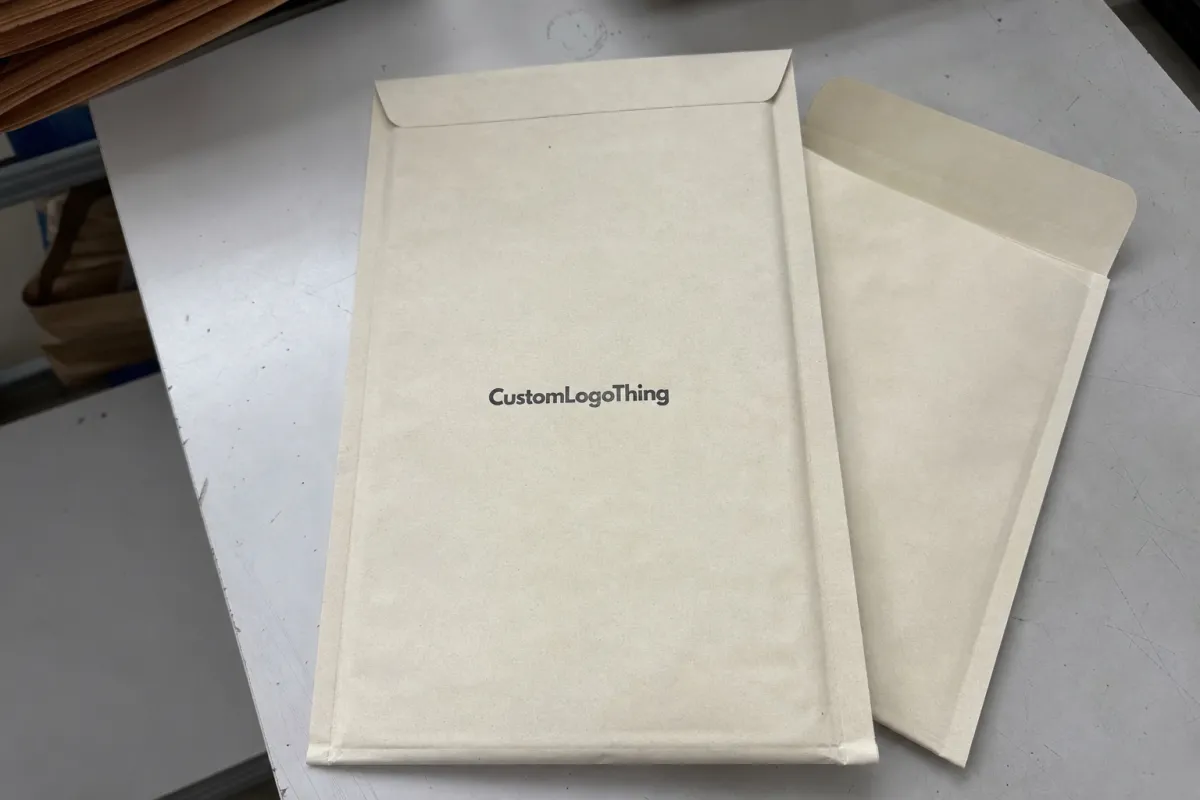
At the simplest level, these are printed transit envelopes designed for flat or low-profile products. Most are made from polyethylene film, often co-extruded for strength and puncture resistance, though paper-based versions are increasingly common for teams that want a more tactile feel or a lower-plastic profile. The structure may look ordinary from a distance, but the intent is different from a plain bag. A branded shipping envelope is part protection, part presentation, part operational tool.
That makes the format a strong fit for t-shirts, lightweight apparel, sample packs, catalogs, letters, replacement parts, and document kits. These are products that do not need the crush resistance of a corrugated box, yet still benefit from a secure outer layer. If the product is rigid, fragile, or especially valuable, a box may still be the better choice. Packaging should follow the product, not the other way around.
In startup fulfillment, the best mailer is the one that disappears into the workflow. The packer can load the item, close the seal, apply a label, and move on. No tape gun. No void fill. No box assembly line. That is not glamorous, but it is exactly why this category keeps showing up in lean ecommerce setups. Time saved per order looks small until it compounds across a month of shipments.
There is also a brand advantage that gets overlooked. A printed envelope replaces the blank transit shell with something that looks considered. If the artwork is clean and the dimensions are right, even a low-cost format can look intentional. A sloppy package does the opposite. It makes the whole operation feel improvised, even if the product is excellent.
That is why the right envelope is not just a cheaper substitute. It is a different packaging strategy. The envelope is supposed to be light, fast, and legible. A box is supposed to offer structure and extra protection. Using the right tool makes the brand look more mature than spending more on the wrong one.
How They Work in a Startup Fulfillment Flow
A standard shipping envelope usually includes a printed exterior, a closure strip, and a film structure that gives it enough body to survive transit handling. Some versions add a tear strip or dual-adhesive system for returns. Others use paper laminates or reinforced seams. The details matter because fulfillment is less about appearance and more about whether the package stays closed, resists punctures, and arrives without obvious damage.
In the warehouse, the benefit is speed. Envelopes reduce the number of actions required per order, which matters even more for small teams where one person may be doing packing, labeling, and inventory checks. The difference between assembling a carton and closing an envelope can look trivial on paper. In practice, it changes labor cost, throughput, and how often the line gets backed up during a launch or promotion.
The brand effect is part of the equation too, especially for DTC products that are photographed, filmed, or shared before they are even opened. A strong logo lockup, enough empty space to keep the design readable, and a color palette that prints accurately can do more for recognition than a crowded layout packed with slogans. Startups often try to say too much on the outside of the pack. A better answer is usually one clear brand mark, one support color, and a short web address if needed.
For products that travel flat, branded shipping envelopes for startups are often the most rational package format. They help with package protection, reduce dimensional waste, and store better than cartons in tight back rooms. That storage point seems minor until you have a few thousand units on hand and every square foot matters.
There is also a reason buyers keep asking for this category in launch planning: it is one of the few packaging choices where lower material use and a stronger brand presentation can happen at the same time. That combination is rare. Most packaging improvements trade one goal for another.
Key Specs That Change Performance and Feel
Film thickness is usually the first number worth checking. Thinner mailers cost less and use less material, but they are more likely to stretch, wrinkle, or puncture under rough handling. Heavier gauges feel firmer and hold up better on conveyor systems and in mixed freight. For many startup programs, the useful range sits around 60 to 100 microns for standard poly mailers, with thicker builds reserved for heavier contents or harsher transit conditions.
Size is just as important. Oversized envelopes let the contents move around and create a package that looks underfilled. Undersized envelopes make packing slower and stress the seal area. The best fit is not the smallest possible envelope; it is the one that fits the packed product with enough clearance to insert it quickly, but not so much slack that the result looks wasteful. Measure the item in its packed state, not just as a loose product.
Print method changes both appearance and price. One-color or two-color branding on stock film is usually the cleanest route for an early-stage company. Full coverage, metallic accents, and elaborate artwork add setup cost and often raise MOQ requirements. If the goal is recognition rather than spectacle, simple layouts usually win. Crisp typography and high contrast often outperform overdesigned panels that are hard to read from arm's length.
Closure quality matters more than many buyers expect. A weak adhesive strip can open during a rough sort, while a strong one can survive being handled, dropped, and stacked. Some envelopes use tamper-evident closure features, which can be useful for higher-value or return-sensitive shipments. Matte finishes tend to photograph better and hide scuffs. Gloss can look brighter, but it also shows handling marks faster.
Material choice deserves equal attention. Poly film is common because it is light, tough, and inexpensive at scale. Paper mailers can fit better with brands that want a more natural feel or a recycling story that is easier for customers to understand at a glance. Recycled-content options may help if sourcing matters to your audience, but the tradeoff is usually cost, print consistency, or both. The right answer depends on route conditions, product weight, and the look you want the package to carry.
For transit standards, the testing guidance from ISTA is useful because it focuses on real handling, not just shelf appearance. If paper-based stock is part of the plan, the FSC system is worth understanding, especially if your team wants cleaner sourcing language without overclaiming anything.
Here is the short version: specs that matter are the ones that change how the envelope survives handling, sealing, and shipping. Everything else is decoration.
| Option | Typical MOQ | Indicative Unit Cost | Best For | Tradeoff |
|---|---|---|---|---|
| Standard-size poly mailer, one-color print | 1,000-3,000 pcs | $0.18-$0.32 | Launch orders, apparel, inserts | Simple look, limited print impact |
| Custom-size poly mailer, one- to two-color print | 3,000-5,000 pcs | $0.24-$0.42 | Better fit, repeatable ecommerce shipping | More setup, higher MOQ pressure |
| Premium film with full-coverage print | 5,000+ pcs | $0.32-$0.58 | Brand-led launches, higher perceived value | More expensive, longer proof cycle |
Cost, Pricing, MOQ, and Unit Cost
Packaging quotes are easy to misread because the number on the page does not tell the full story. Size, film thickness, print coverage, number of colors, and any special construction all change the price. So does whether the envelope is a stock format or a custom build. A standard printed mailer can be relatively economical. A custom-size envelope with special print treatment is a different purchase entirely.
Unit cost usually improves as volume rises, but startup teams should not treat the biggest run as the smartest run by default. The supplier has to pay for setup, plate work, proofing, or tooling before the first unit ships. That is why the first order often looks expensive. The second or third order may price better once the spec is locked. The real question is whether the lower unit cost is worth the cash tied up in inventory.
That tradeoff matters more than people admit. If your product line is still changing, or if a rebrand is likely in the next quarter, carrying a large inventory of printed mailers can become a quiet liability. A slight discount per unit does not help much if the artwork changes before the stock is used up.
Hidden costs deserve equal attention. Freight can erase a low quote if the order is bulky or split across multiple cartons. Proofing can add both time and expense. A rush order can force compromises on print method or material choices. And if the supplier is overseas, lead time needs to include production, transit, customs, and receiving time, not just the press run itself.
For a useful buyer check, compare options in this order:
- Does the size fit the packed product without excess slack?
- Does the film survive rough handling and hold the seal under pressure?
- Does the print make the brand easier to recognize rather than just more expensive to produce?
- Do freight, proofing, and inventory carrying costs still leave enough margin?
If you are deciding between envelopes and cartons for a specific SKU, compare the total shipping math against Custom Poly Mailers and Custom Shipping Boxes. Boxes usually win on rigid protection. Mailers usually win on weight, speed, and storage. That is a normal trade, not a sign that one format is universally better.
Process and Timeline From Quote to Delivery
The production path is fairly predictable. First comes the brief: size, material, print method, closure style, and quantity. Then the artwork setup, proofing, manufacturing, quality review, packing, and freight booking. If a supplier asks focused questions early, that is usually a good sign. It means they are checking the points that affect the final run rather than pretending everything will sort itself out later.
Timeline depends on how clean the input is. A standard size with a finished logo can move much faster than a fully custom format with open decisions. Poor resolution artwork, missing dieline notes, and vague color targets all slow things down. So do repeated quantity changes after proof approval. The fastest jobs are often the most boring ones, which is exactly why they tend to arrive on schedule.
For startup teams, buffer time is not optional. Leave room for sample review, fit testing, and one round of corrections if needed. If the packaging is tied to a launch, do not leave it until the end of the timeline. That is how a temporary-looking package becomes the face of a real product for the next six months.
Typical production windows vary by region and supplier, but a clean run often lands in the 12 to 20 business day range after proof approval, with freight added on top. Some rush jobs can move faster, but they usually narrow your material and print choices and push the price upward. Faster may help a launch date. Better protects the order after it ships.
The most common delays are usually easy to predict:
- Missing size details or unclear seal placement
- Low-resolution logos or artwork with too many fine details
- Color assumptions made without a reference target
- Last-minute quantity changes after proof approval
That is why branded shipping envelopes for startups should be treated as a production purchase, not a branding exercise. The package has to function in a warehouse and survive a delivery route. It also has to look good on a screen, because customers will photograph it sooner than anyone in procurement expects.
Step-by-Step Buying Plan for Startup Teams
Start with the product, not the print. List what you are shipping, how often you are shipping it, and how much package protection it actually needs. A soft apparel pack is a different problem from a sample bundle or a document set. If the item is flat and not fragile, an envelope is likely enough. If the item needs rigidity, you may be choosing the wrong format altogether.
Next, quote the same spec across every supplier. Use the same size, thickness, print count, closure type, and MOQ so you are comparing like with like. A stripped-down quote and a premium quote are not substitutes for one another. Ask for tiered pricing too. The break at 3,000, 5,000, or 10,000 units can help you decide whether the inventory risk is worth taking.
Then request samples or a proof run. Check three things: fit, seal, and brand read. Fit tells you whether the packed product goes in easily. Seal tells you whether the envelope stays closed through handling. Brand read tells you whether the package still looks deliberate from a few feet away and on camera. That last check matters more than many teams expect because packaging now lives on storefront tables, in social posts, and in unboxing videos long before it is discarded.
Once the format is approved, build a reorder system before the first batch runs low. Keep the final dieline, artwork file, size spec, and color reference together. If different people on the team can reorder without rebuilding the whole project, mistakes drop fast. That is one of the simplest ways to keep packaging consistent as the business grows.
If your launch includes more than one format, keep the family of packaging aligned. A startup might use branded envelopes for flat shipments, insert cards for presentation, and a box format for fragile orders. The goal is not to force one material to do every job. It is to make the whole shipment feel like one system.
Common Mistakes That Make Packaging Look Cheap
Size errors are the most visible mistake. An oversized envelope creates wrinkles and excess movement, which makes the pack look like a leftover solution rather than a considered one. A tight envelope slows packing and puts stress on the seal. Both problems are avoidable, and both show up immediately to anyone who handles the order.
Overdesign is another common misstep. More ink does not automatically create more brand value. Sometimes it just creates a busy front panel and a higher print bill. A simple logo, enough negative space, and one or two strong colors often read better than a crowded layout with too many competing elements. The package is not there to entertain the design team. It is there to get the shipment out cleanly and make the brand memorable for the right reasons.
Durability checks get skipped more often than they should. If the closure fails, the envelope has already lost the argument. If the film scuffs or tears in transit, the customer sees a package that looks cheap even if the product inside is fine. The mockup can look polished while the actual mailer performs badly. That gap is where packaging complaints usually start.
Another mistake is buying too little. Small test runs are fine, but if the product is moving and the packaging is working, under-ordering can force expensive reorders right when consistency starts to matter. Customers notice packaging changes even when they do not mention them directly. Consistency builds trust. Randomness creates friction.
Most bad packaging is not really a creative failure. It is a planning failure.
A useful rule for startup teams is simple: choose the smallest practical size, select a film that survives the route, keep the print clean, and avoid changing the spec unless there is a real reason.
Expert Checks and Next Steps Before You Order
Before placing the order, run a small set of checks. First, pack the product and confirm the envelope closes without strain. Second, test the seal by opening and resealing samples, then inspecting whether the closure still holds after handling. Third, view the brand from a distance, on screen, and in hand. If the design fails any of those three tests, the spec needs adjustment before production starts.
Ask the supplier for production details too: film type, print method, carton count, pack orientation, and freight format. Those details tell you how the order will arrive and how easy it will be to receive. They also reveal whether the supplier is organized enough to support repeat runs without rebuilding the quote from scratch every time.
This is also the point to decide whether the launch batch needs a standard mailer, a higher-barrier version, or a lighter-weight option for the first release. That decision is easier to make before artwork is finalized. Otherwise teams end up designing for a package they have not really bought yet.
A practical final check is to compare the packaging spec against your reorder rhythm. A low-cost mailer that must be changed every quarter is not necessarily a savings. A slightly more durable spec that can be repeated with minimal changes may be the better financial choice over time.
My practical advice is straightforward: confirm the size, lock the artwork, compare MOQ tiers, and sample the envelope before scaling the order. That keeps the project grounded in how the package will actually perform. It also keeps you from paying twice for preventable mistakes.
Done well, branded shipping envelopes for startups reduce packing time, keep material use under control, and create a first impression that looks deliberate rather than improvised. Done badly, they wrinkle, split, or waste money in places that are easy to miss until the order is already on the road. Start with the shipment, match the material to the job, and the decision usually gets easier.
Are branded shipping envelopes for startups cheaper than boxes?
Usually yes for flat, lightweight products because envelopes use less material and take up less space in storage and freight. Boxes win when the product is fragile, bulky, or needs rigid crush protection. The smarter comparison is total landed cost, not the packaging line item alone.
What size should a startup choose for branded shipping envelopes?
Measure the product in its final packed state, not just as a loose item. Leave enough clearance for easy insertion, but not so much that the envelope looks oversized or loose. If you are stuck between two sizes, sample both before ordering in volume.
What MOQ is normal for custom shipping envelopes?
MOQ depends on the film, print method, and whether the envelope is a stock size or fully custom. Lower MOQ usually means higher unit cost, so plan around your launch volume and likely reorder pattern. Ask for tiered pricing so you can see where the next break starts.
How long does production usually take for startup shipping envelopes?
A clean order moves faster than a custom one with repeated artwork changes. Proofing, manufacturing, and freight all add time, so leave a buffer before launch or seasonal spikes. Rush timelines are sometimes possible, but they usually cost more and limit your options.
What artwork works best on custom shipping envelopes?
Use a strong logo, high contrast, and a simple layout that reads instantly when the package lands on a doorstep. Keep copy short unless the packaging needs legal or handling instructions. Always request a proof to check color, legibility, and placement before production starts.

