Buyer Fit Snapshot
| Best fit | Branded Shipping Stickers Bulk projects where brand print, material claims, artwork control, MOQ, and repeat-order consistency need to be specified before quoting. |
|---|---|
| Quote inputs | Share finished size, material target, print colors, finish, packing count, annual reorder estimate, ship-to region, and any compliance wording. |
| Proofing check | Approve dieline scale, logo placement, barcode or warning zones, color tolerance, closure strength, and carton packing before bulk production. |
| Main risk | Vague material claims, crowded artwork, missing packing details, or unclear freight terms can make a low unit price expensive after revisions. |
Fast answer: Branded Shipping Stickers Bulk: Pricing, Specs & Orders should be specified like a repeatable production item. The safest quote records material, print method, finish, artwork proof, packing count, and reorder notes in one written spec.
Production checks before approval
Compare the actual filled-product size with the drawing, then confirm tolerance on folds, seals, hang holes, label areas, and retail display edges. Reserve space for logos, QR codes, warning copy, and material claims before decorative graphics fill the panel.
Quote comparison points
Review material grade, print process, finish, sampling route, tooling charges, carton quantity, and freight assumptions side by side. A quote is only useful when the supplier can repeat the same color, closure quality, and packing count on the next order.
Branded Shipping Stickers Bulk: Pricing, Specs & Orders
Branded shipping stickers bulk do more than dress up a carton. On most ecommerce parcels, the sticker is the first branded surface a customer sees. Sometimes it is the only one visible before the box opens. That makes branded shipping stickers bulk one of the cheapest ways to standardize fulfillment without changing cartons, mailers, or tape.
From a packaging buyer’s point of view, the math is clean. You get recognition, a better perceived value, and intact package protection without paying for a full custom box program. A sticker does not change dimensional weight. It does not force a new box size. It just needs the right face stock, adhesive, size, and print setup. Get those four things right, and branded shipping stickers bulk pull real weight in transit packaging.
Teams shipping seasonal promos, subscription boxes, marketplace orders, or outbound samples feel the payoff fast. A small flat format applies in seconds, which matters when packing labor is tight. Buyers often compare stickers against Custom Poly Mailers and Custom Shipping Boxes. The better question is simpler: which branding layer gives the best return per shipment without slowing the line?
And yes, a sticker program can look tiny on a spreadsheet. That is usually the trap. A little branding surface, applied consistently, can make a plain shipper feel intentional instead of generic. That matters more than a lot of teams want to admit.
Why branded shipping stickers bulk outperform plain labels
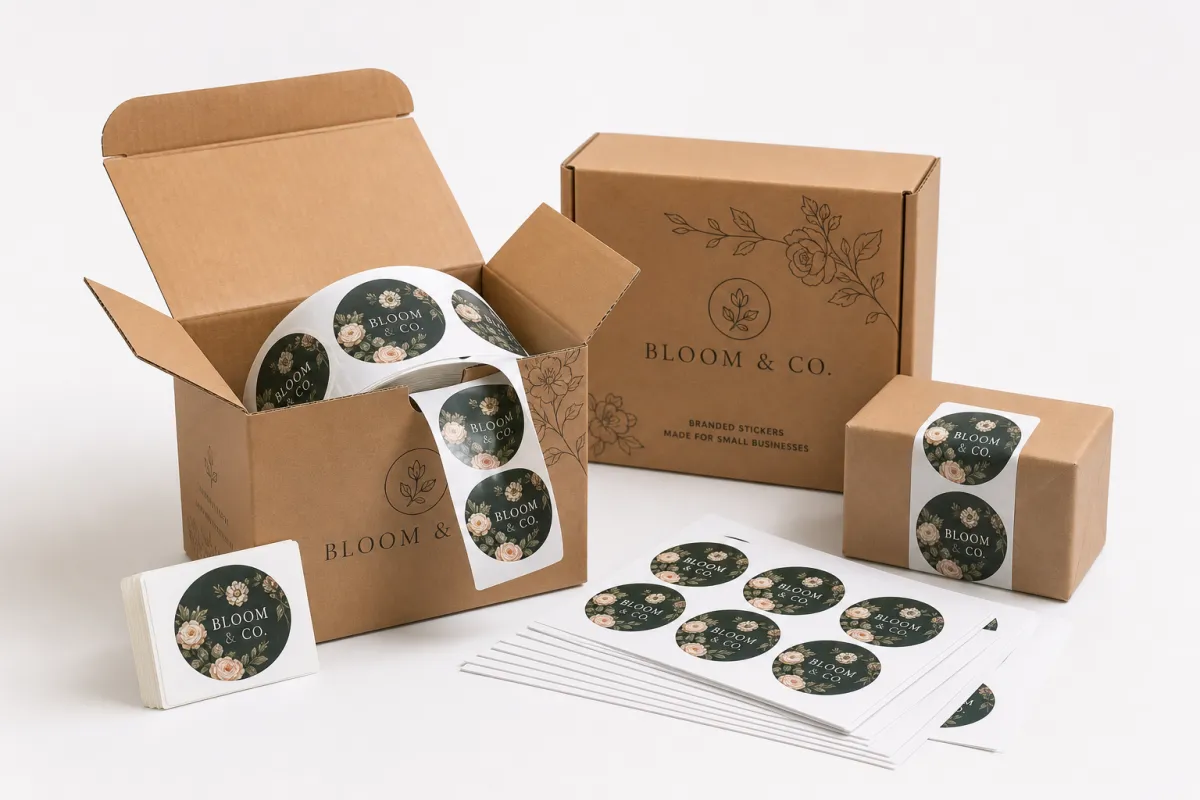
Plain labels identify the shipment. Branded shipping stickers bulk do that too, then keep working after the parcel leaves the warehouse. They turn an anonymous carton or mailer into a branded touchpoint. The first visual impression usually happens on the doorstep, not on your website. That makes the shipping label area less like dead space and more like inventory that should earn its keep.
The bulk part changes the economics. Once a design is standardized across thousands of parcels, setup cost gets spread out and the per-unit price drops. That is why branded shipping stickers bulk usually beat small one-off print runs for growing brands. Ship 2,000 orders a month. Ship 5,000. Ship 20,000. The logic stays the same. Every box leaves with the same logo, the same color, and the same finish. No drift from hand-written marks, mixed tape rolls, or last-minute substitute materials.
There is also an operational angle that gets ignored too often. Sticker application is fast. A trained packer can apply a sticker in seconds. That matters when labor budgets are tight and fulfillment windows are short. If the line is moving fast, you are gonna care about that speed.
The payoff is strongest for:
- Seasonal promotions where packaging has to change fast without reprinting cartons.
- Subscription boxes where the unboxing moment depends on repeatable branding.
- Marketplace orders where the outer package may be plain, but the brand still needs a presence.
- Sample shipments where a small branded surface can make a test order feel more deliberate.
Plenty of teams underspend here because stickers look small on a quote sheet. That is a mistake. They can carry more brand weight per dollar than bigger transit packaging changes. A sticker program also stays flexible. Want to test a new logo version, seasonal message, or promo seal? You are not signing up for a full box redesign. That matters for brands still sorting out their shipping materials strategy.
A sticker is one of the few packaging components that can improve first impressions, support fulfillment, and leave dimensional weight untouched.
If you are choosing between branding on the carton, the mailer, or the closure point, compare the systems side by side. Some programs work better with Custom Packaging Products as a broader mix. Others get where they need to go with branded shipping stickers bulk and nothing fancy. Cleaner look. Less rebuild. Fewer headaches.
There is a reason buyers come back to branded shipping stickers bulk after trying more complicated options. They are easy to stock, easy to apply, and easy to reorder. That combination is hard to beat when volume grows faster than the packaging department can redesign every format.
One more practical point: stickers are not magic. A bad adhesive on a dusty recycled carton is still a bad adhesive. A great logo on the wrong face stock is still a problem. The value comes from matching the sticker to the package, not from the sticker itself.
Branded shipping stickers bulk: materials, finishes, and adhesives
Material choice drives both performance and cost. For branded shipping stickers bulk, the main face-stock options are matte paper, gloss paper, and synthetic film. Each one behaves differently once it meets corrugate, poly film, cold storage, or rough handling. Dry warehouse shipping can use a lower-cost paper stock. A route with moisture, condensation, or abrasion usually needs a tougher substrate.
Matte paper is the practical starting point. It reads cleanly, prints well, and avoids glare under warehouse lights. It is usually the most cost-efficient option for high-volume programs where the parcel travels in normal indoor conditions. Gloss paper gives brighter color and a sharper retail look, but it can reflect light and show scuffing faster. Synthetic films cost more, yet they hold up better on refrigerated shipments, damp routes, and parcels that rub against other shipping materials in transit.
Adhesive choice matters just as much as face stock. A sticker that looks perfect on the proof can fail fast if the adhesive does not match the shipment surface. Rough corrugate, recycled cartons, poly mailers, and chilled packaging all behave differently. A permanent adhesive on clean corrugate may be enough for standard ecommerce shipping, but a cold-temperature adhesive fits better when the package moves through refrigerated storage or condensation-prone environments. On rough or heavily textured surfaces, higher-tack adhesive usually performs better because it can bite into the surface and stay put.
That last piece matters more than most people think. In cold-chain programs, a box can look dry at pack-out and then sweat once it leaves the dock. That is a nasty little surprise for a weak adhesive. If the package is going into a chilled lane, test it on the real substrate, not a cute sample sheet on a desk.
Finish changes readability and perceived value. Matte is easier to scan visually and usually shows fewer fingerprints. Gloss gives stronger color saturation. Soft-touch creates a premium feel, though it is less common for pure shipping programs because it adds cost and makes more sense for retail presentation. If your stickers include barcodes, QR codes, or small legal copy, readability should win over decorative effects every time.
For teams that want an industry benchmark for transit abuse, it helps to review ISTA testing methods. ISTA does not tell you which sticker to buy, but it does frame how parcels should survive vibration, compression, and drops. That matters when your sticker needs to remain legible and attached after the package has moved through multiple handling points.
| Material | Best fit | Typical bulk price impact | Strengths | Watchouts |
|---|---|---|---|---|
| Matte paper | Dry cartons, standard mailers, indoor fulfillment | Baseline cost | Low glare, easy to read, efficient for high volume | Less resistant to scuffs and moisture |
| Gloss paper | Retail-forward shipping, bright brand colors | Usually 5% to 15% above matte paper | Rich color, sharper shine, polished appearance | Can reflect light and show handling marks |
| Synthetic film | Cold chain, damp routes, rough handling | Often 20% to 60% above paper stocks | Moisture resistance, stronger durability, better abrasion performance | Higher cost, recycling profile depends on construction |
For paper-based programs, sourcing and sustainability claims matter too. If your procurement team asks about responsible fiber, FSC certification belongs in the discussion. The standard itself is worth reviewing at FSC, especially if your brand is trying to balance shipping materials cost with documented sourcing expectations.
There is no single best finish for branded shipping stickers bulk. There is only the best fit for the route, the surface, and the brand promise. A premium finish on the wrong substrate is waste. A simple matte stock with the right adhesive can outperform a pricier option if it survives the trip and applies quickly on the line. That is the standard buyers should use.
Specifications to lock in before you order
Before you place branded shipping stickers bulk, lock in the operational specs. This is where buyers either protect the budget or create avoidable friction. Size, shape, backing format, roll direction, and core size all affect how fast the sticker can be applied. A product that looks inexpensive on paper can become expensive if it slows the packing line.
Start with size. A sticker that is too large may crowd shipping information or force packers to rotate the parcel to find space. A sticker that is too small can disappear on a larger mailer or box, which weakens the brand impression. For many ecommerce shipping programs, common sizes sit in the 2 inch by 2 inch to 3 inch by 4 inch range, but the right size depends on panel space and how much logo detail you need to show. If the design includes small type, do not shrink it just to save material. Tiny logos fail at the exact moment they should be doing visible work.
Shape matters more than people expect. A square sticker is efficient and easy to stack. A circle can feel more playful. A custom die-cut shape can make the brand look more tailored, but it can also raise setup cost and lead time. The same is true for backing format. Rolls are often better for higher-volume hand application and dispensers. Sheets can be ideal for lower-volume packing areas or teams that want simple peel-and-stick use. If the team is moving quickly, roll direction and core size should be chosen with the applicator in mind, not just the designer’s preference.
File setup deserves attention too. A print-ready file should include bleed, a safe area, and a correct dieline. The logo needs enough contrast at final size to stay visible on corrugate, kraft mailers, or darker substrates. If the sticker carries a QR code, that code should be tested at actual output size, not just on screen. A design that looks fine in a PDF can fail when printed at 2 inches wide. Proof review is not a formality. It is a control point.
Here is the short spec list I would want before approving branded shipping stickers bulk:
- Finished size and shape, with a tolerance range if needed.
- Stock type, including matte paper, gloss paper, or synthetic film.
- Adhesive type matched to carton, mailer, or cold-chain use.
- Format on rolls or sheets, plus core size if roll-fed.
- Artwork file with bleed, safe area, and final color targets.
- Application method, whether by hand, dispenser, or line-assist.
That last point is the one most buyers skip. If your warehouse team applies stickers by hand, a very small label may be fine. If you need faster throughput, a slightly larger format may actually be cheaper overall because it reduces placement errors. In other words, the best branded shipping stickers bulk spec is not the lowest print price. It is the spec that keeps the packing team moving.
For buyers building a broader system, it helps to review real packaging examples. The Case Studies page can help teams think about how branding behaves across labels, boxes, and mailers. Useful stuff, especially when you are trying to line up the sticker with the rest of the transit packaging program.
Branded shipping stickers bulk pricing, MOQ, and unit math
Pricing for branded shipping stickers bulk is not one number. It is a stack of variables. Material, print coverage, finish, size, quantity, and shipping method all affect the quote. Buyers who compare only the headline price often miss the real cost drivers. A low per-unit number can be offset by higher setup charges, expensive freight, or a minimum order quantity that is too large for the replenishment cycle.
In bulk, unit cost usually drops hard once the run reaches a comfortable production size. For standard paper stickers, a common planning range for branded runs may sit somewhere around $0.03 to $0.10 per piece depending on quantity and coverage. Synthetic versions and specialty finishes can move higher. That is not a universal quote, and it should not be treated as one, but it is close enough to help a buyer compare options intelligently. A 1,000-piece run and a 10,000-piece run are not the same buying problem.
MOQ varies by print method. Digital programs often start lower because they avoid some setup overhead. Specialty die cuts, metallic effects, or premium films can push the minimum higher. If a supplier is quoting branded shipping stickers bulk for a smaller run, ask whether the MOQ is based on material waste, machine setup, or labor time. That answer matters because it tells you whether the supplier is flexible or simply quoting the only economical run size available.
Unit math should be calculated on real shipment volume, not only on sticker count. Take the total order cost, then divide it by the number of packages you expect to ship before the next reorder. If the order costs $620 and covers 8,000 shipments, the branding cost is about $0.0775 per parcel before you even consider the presentation lift. That is the number that belongs in a budget review because it reflects actual fulfillment impact instead of a sticker count in isolation.
Here is a simple way to compare branded shipping stickers bulk quotes:
- Material: paper versus synthetic.
- Print complexity: one color, full color, or special coating.
- Quantity: look for the threshold where unit price drops meaningfully.
- Finish: matte, gloss, soft-touch, or flood coating.
- Shipping: standard transit, rush freight, or split shipments to multiple locations.
People often ask whether the sticker should be treated as a branding expense or a packaging expense. I would argue it is both. It touches brand perception, and it also lives inside shipping materials planning. If the sticker eliminates the need for a more expensive carton print run, or lets you keep a plain box while still delivering a branded unboxing moment, the math improves fast.
The best comparison is not sticker versus no sticker. It is branded shipping stickers bulk versus the next-lowest-cost way to make the parcel look intentional. Sometimes that is a mailer print. Sometimes it is a box print. Sometimes it is a label and a strong closure sticker. The right answer depends on annual volume, labor time, and how much visual identity the shipment needs to carry.
One honest caveat: pricing examples are planning ranges, not promises. A supplier can quote the same size and still end up with different numbers because of coverage, tooling, or freight. Anyone claiming one magic price for every run is selling you a fairy tale with a barcode.
Order process and timeline for branded shipping stickers bulk
The order path for branded shipping stickers bulk is straightforward when the buyer is prepared. First comes the quote request. Then the supplier confirms size, substrate, adhesive, quantity, and artwork requirements. After that, proofing begins. Once the proof is approved, production starts, and the finished stickers move to packing and delivery. Simple enough. Still, a surprising number of delays happen before the proof is even opened.
The fastest programs usually arrive with three decisions already made: print-ready artwork, target size, and monthly volume. If those are still open questions, the quote becomes a moving target. Clear specs let the supplier match the right production method to the run. That matters because a simple repeat order and a custom die-cut order do not belong on the same timeline. If the brand is still testing creative, it may be smarter to place a smaller pilot run first and then scale into branded shipping stickers bulk once the approved design is locked.
Timelines vary, but a practical planning range is often 7 to 10 business days after proof approval for straightforward repeat orders, and 12 to 15 business days for custom shapes or more complex finishing. Specialty adhesives, flood coating, or tight color matching can stretch that further. Add transit time, and the real lead time is not just production time. It is production plus shipping plus the buffer needed to keep the warehouse from running dry. That buffer matters more than buyers like to admit.
To keep the process moving, make sure the internal approval chain is tight. One decision-maker on the buyer side can save days. A design team, a procurement team, and an operations manager can all have valid opinions, but the sticker does not move until someone signs off. The same is true on the artwork side. If the file is not print-ready, the proofing cycle gets longer and the launch date slips.
The main timeline risks are predictable:
- Late artwork changes after the proof is already in review.
- Specialty construction that requires additional setup or tooling.
- Color matching concerns on brand-critical logos or spot colors.
- Underestimated volume that leads to a rush reorder before the next replenishment cycle.
A good planning rule is to order branded shipping stickers bulk early enough that your warehouse always has one full cycle of safety stock. That is especially true for ecommerce shipping teams that see unpredictable surges from promotions, marketplaces, or seasonal demand. The sticker is small. The disruption from running out of it is not.
Also, keep in mind that branded shipping stickers bulk work best when the application method is tested before approval. If the warehouse applies labels by hand, a specific roll width or sheet count may be ideal. If the team uses dispensers, the core size and roll direction need to fit the equipment. Skip that step, and the final product can be technically correct and operationally awkward. Bad trade.
One thing I have seen over and over: the timeline rarely breaks because of print. It breaks because someone changes the artwork after approval or discovers the sticker was sized for the mockup, not the box. That is a very avoidable way to lose a week.
Why buyers source branded shipping stickers bulk from us
Buyers usually come back to branded shipping stickers bulk for one reason: reliability. A sticker program only works if every reorder looks the same, sticks the same, and ships on the same schedule. If the color drifts or the adhesive changes from batch to batch, the brand starts to look less controlled. That is not a design problem. It is a production problem.
Custom Logo Things is built for buyers who want packaging that behaves predictably. That means clear spec communication, consistent reorders, and realistic guidance on what can be done within budget and timing. It also means treating packaging as a working part of the supply chain, not just a visual layer. A sticker must survive handling, apply fast, and stay readable when the parcel reaches the customer. If it cannot do that, it is decoration, not packaging.
We also understand that branded shipping stickers bulk rarely live alone. They usually sit alongside boxes, mailers, inserts, and outer labels. That is why buyers often pair them with Custom Labels & Tags or broader programs such as Custom Packaging Products. The goal is a coherent system, not a one-off print order. When the packaging pieces align, the brand feels intentional from warehouse to doorstep.
Here is what that support looks like in practice:
- Proof help so size, contrast, and bleed are checked before production starts.
- Format guidance on rolls, sheets, core size, and application speed.
- Spec consistency so reorders match the original run without guesswork.
- Budget clarity so buyers can compare material and finish options without hidden surprises.
There is also value in seeing how different formats behave across projects. The Case Studies page gives a practical reference point for how branding choices carry through shipping and fulfillment. That kind of comparison matters because a sticker spec that works on one carton program may not be right for a poly mailer or a fragile product box.
From an authority standpoint, buyers should always ask how the packaging will be tested and where the sourcing comes from. If a sticker will ride through long transit lanes or rough parcel handling, it should be selected with the same care you would give any other transit packaging component. That is especially true when the outer package is part of the brand story. Branded shipping stickers bulk are small, but they are still part of a real shipping system.
What most people get wrong is thinking that the cheapest sticker is the best sticker. It is not. The best option is the one that applies fast, holds through shipping, matches the brand, and lands inside the budget once the full shipment volume is counted. That is the standard we use when we quote branded shipping stickers bulk.
And if the buyer wants the honest version instead of the polished one: yes, a sticker can save money, but only if the specs are chosen with the actual box, mailer, and labor flow in mind. Skip that, and the savings disappear pretty quickly.
Next steps to order branded shipping stickers bulk
If you are ready to move, start with the three things that make a quote accurate: artwork, target size, and monthly order volume. Those details shorten the back-and-forth and let the supplier recommend the right substrate and adhesive. With branded shipping stickers bulk, clarity up front usually saves more time than any rush fee can recover later.
Then compare two or three spec options. Do not compare only price. Compare durability, appearance, and application speed. A slightly higher unit price can be the better deal if it reduces waste, improves package protection, or speeds up packing. That is the kind of trade-off that shows up in labor and rework, even if it does not show up on the first quote line.
Before final approval, confirm the warehouse application method. Hand application, manual dispensers, and automated setups each favor different sizes and formats. If the sticker is too small to grab quickly or too large to place cleanly, you lose the labor advantage you were trying to gain. Branded shipping stickers bulk should make the line easier to run, not harder.
It also helps to think one replenishment cycle ahead. If your average monthly usage is 6,000 stickers, do not order only 6,000. Build in safety stock so a promo spike does not stop fulfillment. That buffer is cheap insurance compared with the cost of pausing outbound shipments or switching to a temporary substitute that breaks brand consistency.
So the next move is simple: request a quote, review the proof, and place branded shipping stickers bulk before the current inventory hits the warning line. For teams balancing budget, speed, and presentation, that is still one of the cleanest packaging buys available. Branded shipping stickers bulk give ecommerce shipping programs a visible brand cue, practical order fulfillment support, and a cost structure that scales with volume instead of fighting it.
The practical takeaway is boring, which is usually a good sign. Pick the right surface first, then lock size and adhesive to the actual carton or mailer, then order enough to cover one replenishment cycle plus a cushion. Do that, and the sticker does its job without drama. Which is exactly what you want from packaging.
FAQ
What is the typical MOQ for branded shipping stickers bulk?
MOQ depends on print method, size, and whether the stickers are supplied on rolls or sheets. Standard digital runs often start lower than specialty or custom-cut orders. Asking for the MOQ up front helps you compare true unit cost across suppliers and avoid a quote that looks cheap only because the quantity is too small to be useful.
Which material is best for branded shipping stickers bulk on mailers and boxes?
Paper stocks are usually the most cost-efficient for dry, indoor shipping. Synthetic films hold up better on moisture-prone routes, cold storage, or rough handling. Match the adhesive to the surface first, then choose the face stock and finish. That sequence usually produces the best balance of cost and performance.
How long does production take for branded shipping stickers bulk?
Timelines vary by quantity, proof approval speed, and finishing requirements. Simple repeat orders can move faster than new artwork or custom shapes. Build in extra time for transit and keep a buffer so fulfillment does not stop if demand spikes or a reorder is needed earlier than planned.
Can branded shipping stickers bulk be custom sized and shaped?
Yes, most programs can be customized to fit cartons, mailers, or product packaging. Custom shapes may increase tooling or setup time, so they should be planned early. Size should support both brand visibility and fast application on the packing line, which is the real test in a busy warehouse.
How do I estimate cost per sticker for branded shipping stickers bulk?
Divide the total order cost by the number of stickers to get a direct unit price. Include shipping, finishing, and any setup charges when comparing quotes. Then use shipment volume to judge whether a larger bulk run lowers your long-term packaging cost and supports a cleaner replenishment plan.

