Buyer Fit Snapshot
| Best fit | Branded Subscription Mailers Price projects where brand print, material claims, artwork control, MOQ, and repeat-order consistency need to be specified before quoting. |
|---|---|
| Quote inputs | Share finished size, material target, print colors, finish, packing count, annual reorder estimate, ship-to region, and any compliance wording. |
| Proofing check | Approve dieline scale, logo placement, barcode or warning zones, color tolerance, closure strength, and carton packing before bulk production. |
| Main risk | Vague material claims, crowded artwork, missing packing details, or unclear freight terms can make a low unit price expensive after revisions. |
Fast answer: Branded Subscription Mailers Price: Film, Print, MOQ, and Carton Packing should be specified like a repeatable production item. The safest quote records material, print method, finish, artwork proof, packing count, and reorder notes in one written spec.
Production checks before approval
Compare the actual filled-product size with the drawing, then confirm tolerance on folds, seals, hang holes, label areas, and retail display edges. Reserve space for logos, QR codes, warning copy, and material claims before decorative graphics fill the panel.
Quote comparison points
Review material grade, print process, finish, sampling route, tooling charges, carton quantity, and freight assumptions side by side. A quote is only useful when the supplier can repeat the same color, closure quality, and packing count on the next order.
Branded Subscription Mailers Price: What You Pay For
Branded subscription mailers price looks tidy until the real spec lands on the table. Then the numbers start acting like they have opinions. Inserts. Print coverage. Assembly. Freight. A quote that looked modest at first can turn into a real packaging budget pretty fast. Comparing a blank mailer to a fully branded subscription kit is not a fair comparison. One is a shell. The other is a customer-facing product experience.
From a packaging buyer’s point of view, the price is driven by structure, print method, and volume long before the outer box gets to be the main character. A subscription mailer has to protect the contents, survive transit, and still look intentional when it lands on a doorstep. That takes more than a logo and optimism. The box has to do the job every single month.
At Custom Logo Things, the better question is not, “What is the cheapest box?” It is, “What spec actually fits the shipment, and what does branded subscription mailers price look like once the package performs the way it should?” That keeps the quote honest and the scope clear.
Branded Subscription Mailers Price: What Drives the First Quote
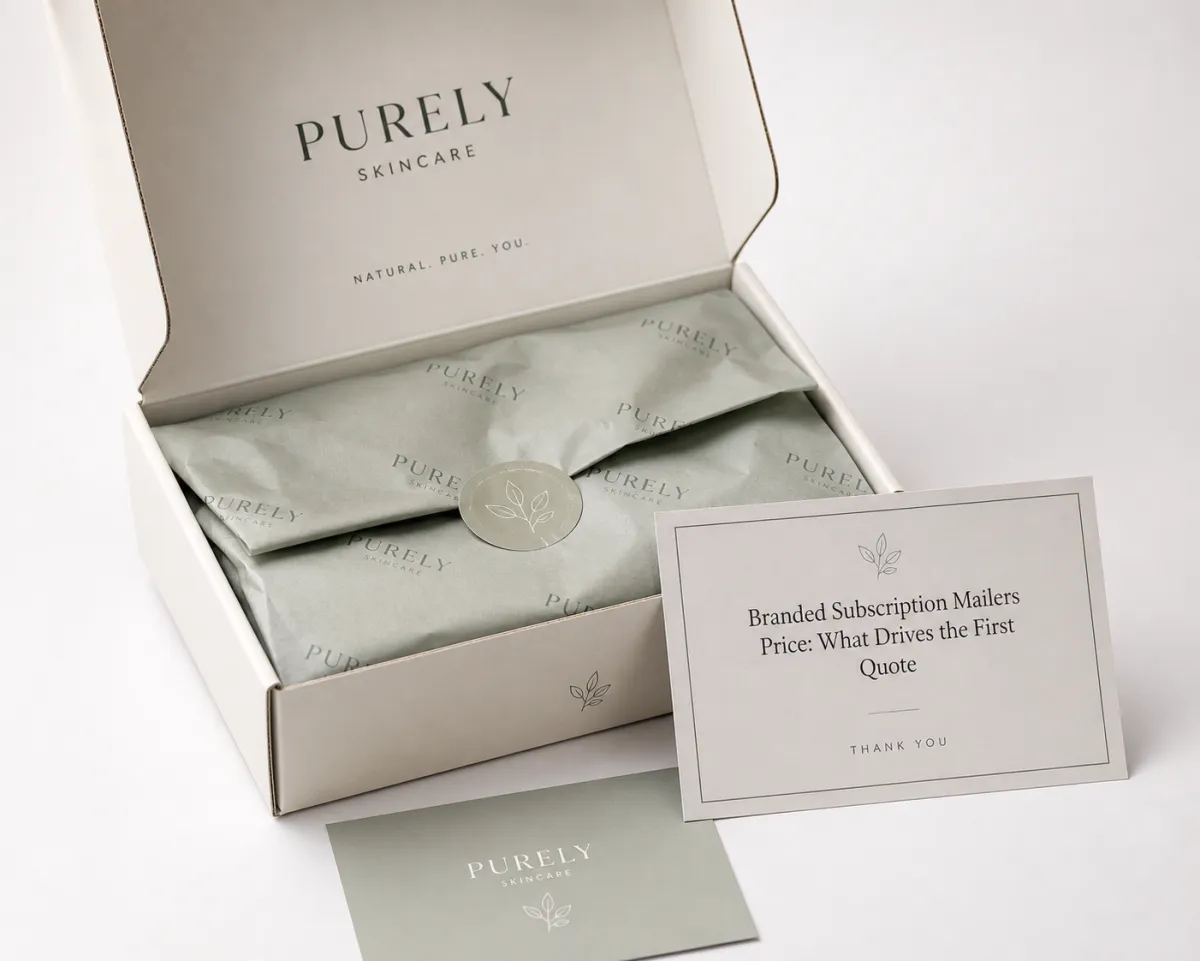
The first quote usually tells you whether the spec is solid or still fuzzy. Branded subscription mailers price changes the moment the package gets defined in real terms. A plain brown mailer with a one-color logo lives in a different world from a fully printed box with inside print, custom insert, and kitting labor. Same category. Not even close on cost.
The outer shell is only part of the story. Print coverage, board strength, insert design, labor, and freight density all affect the final number. A skincare subscription with light items and neat placement has different needs from an apparel box packed with tissue, cards, and a rigid tray. That is why one brand can call it “just a box” and another sees it as an operational system.
I’ve watched teams compare a blank mailer to a fully branded kit like the difference is a rounding error. It is not. If one quote includes artwork setup, die cutting, digital proofing, custom inserts, and packing labor while another is only a stock box, the lower number is missing half the job. Cheap-looking quotes are easy. Useful quotes take a little more discipline.
Subscription brands care about more than shipping, too. The box is part of retention. It shapes perceived value, product protection, and the consistency of the monthly reveal. A customer who opens a clean, fitted mailer every month sees control. A customer who gets a crushed, loose, or badly printed box sees shortcuts. That difference is subtle. It still matters.
I see teams chase the wrong savings all the time. They trim pennies from branded subscription mailers price and ignore damage claims, replacement shipments, and the cost of a weak unboxing experience. A box that fits properly, prints cleanly, and holds up in transit usually pays for itself faster than the cheap option that falls apart after a bad route. Not glamorous. Still true.
For brands building a subscription program, the first quote should spell out these pieces clearly:
- Size and internal fit, not just outside dimensions.
- Board type and thickness, such as E-flute corrugated or heavier folding carton stock.
- Print method, color count, and whether the inside is printed too.
- Insert needs, from simple dividers to custom-fitted trays.
- Quantity, because branded subscription mailers price changes fast across volume tiers.
That is the real starting point. Not a vague “How much for a subscription box?” message. A usable quote needs dimensions, product weight, decoration level, and target run size. Without that, the number is basically a guess in a blazer.
Value Proposition: Why Subscription Mailers Earn Their Keep
There’s a reason subscription brands keep ordering better mailers even after they learn branded subscription mailers price is higher than a plain shipper. The packaging is doing three jobs at once. It protects the product, sells the brand, and keeps the monthly delivery from feeling like another cardboard box. That third job carries more weight than most buyers want to admit.
A branded mailer can lift perceived value without making the box bigger or the campaign louder. A clean print layout, a structured insert, and a box that closes the way it should make the shipment feel curated. Beauty, wellness, snack, apparel, and creator boxes all benefit from that. In those categories, presentation is part of the product. Not decoration. Part of the product.
Retention is the other payoff that gets ignored. A subscriber sees the same consistent unboxing experience every month and starts trusting the brand in small, useful ways. A plain shipper can do the job, sure. It often feels like a fulfillment container, not a brand moment. If the box is part of the customer journey, then branded subscription mailers price is tied to revenue protection, not just freight.
Here is where the premium usually earns its keep:
- Beauty brands that need product separation and a clean presentation.
- Wellness kits that combine bottles, cards, and sample items.
- Snack boxes that need interior graphics and basic crush resistance.
- Apparel programs that want less wrinkling and better presentation.
- Creator boxes that depend on unboxing value for audience sharing.
Compare that with a plain shipper. A stock mailer can be fine for non-branded fulfillment or a budget-sensitive launch. The second the box becomes part of the positioning, the math changes. Fewer damage claims and stronger recall can offset a meaningful part of branded subscription mailers price. Not always. Often enough to matter.
There is also the unglamorous operational side. A repeatable packaging spec keeps the line moving without confusion. That matters when shipments go out every month and the box has to look the same from one batch to the next. Consistency lowers warehouse issues. Consistency also makes reorders easier. That saves money.
For a real-world comparison, our Case Studies page shows how different packaging goals change the spec. If you are still sorting through formats, our Custom Packaging Products page gives a broader view of what can be built around a subscription model.
Product Details: Materials, Finishes, and Insert Options
Material choice has a bigger effect on branded subscription mailers price than most buyers expect. A subscription package can be built from corrugated mailers, folding carton styles, or heavier premium stocks, and each one behaves differently in production and transit. The right option depends on the product, shipping method, and how much abuse the box will take before it reaches the customer.
Corrugated mailers are the workhorse. They hold shape, print well, and offer decent crush protection, which is why they show up so often in subscription programs. E-flute is a practical middle ground for many retail and DTC shipments. If the product is heavier or the route is rough, a sturdier board usually makes more sense than spending on decorative extras.
Folding carton styles work best when the contents are lighter and the presentation matters more than structural resistance. They can look sharp, especially with strong print and finishing, but they are not the answer for every subscription category. Again, branded subscription mailers price should match the job the box is actually doing.
Finishes change both feel and cost. Matte gives a quieter, premium look. Gloss makes color pop harder. Soft-touch adds a velvety finish that customers notice right away. Foil, embossing, and spot UV add visibility, but they also add setup complexity and cost. A little foil can sharpen a logo. Too much starts to look like the brand is trying a bit too hard. That happens more than people want to admit.
Insert options are where the practical side shows up. A molded pulp insert protects well and can be the right answer for fragile items. Cardboard dividers are often enough for multi-item kits. Tissue and paper wrap help presentation, but they do not replace real retention. A custom product lock keeps items from shifting, which improves shipping protection and the unboxing sequence. Decorative fluff by itself is not enough.
The best spec is not the fanciest one. It is the one that survives transit, fits the product, and stays inside budget. If a finish adds little value but pushes branded subscription mailers price up by a meaningful amount, skip it. Put the money into board strength, better insert design, or a cleaner print layout.
A box that looks expensive in a mockup is not automatically a smart buy. If it dents, shifts, or opens badly in transit, the “premium” just became a complaint.
Good packaging buyers ask one simple question at this stage: does the material improve the product experience, or does it just make the render prettier? That question cuts through a lot of unnecessary spend.
For brands needing a different shipper format, our Custom Poly Mailers page is a useful comparison point. Poly is not a replacement for every subscription box, but it helps some teams understand the cost and performance tradeoffs better.
Branded Subscription Mailers Price: Specs That Change the Number
Spec changes are why branded subscription mailers price can jump faster than expected. Size, board thickness, print sides, color count, finish, and custom insert complexity all affect the final number. A small change in internal dimensions can force a new dieline, more board usage, and a different production setup. That is not a tiny detail. That is the quote.
Size matters in three ways. More board means more material. Larger boxes cost more to ship and can hurt freight efficiency. A bigger footprint also needs more storage and more assembly time. If the box is oversized for the product, you are paying for air. That mistake has been around forever, and it still shows up in packaging buying.
Print coverage matters just as much. A one-color logo on a single panel is not the same thing as full-bleed graphics with inside print. Exterior-only branding might be enough for a simpler program. Full coverage makes sense when the brand wants a stronger reveal. Branded subscription mailers price should reflect that difference. If it does not, the scope is muddy.
Finish layers look small on paper and large on the invoice. Matte lamination, soft-touch coating, foil, and spot UV each come with their own setup and application costs. A buyer who stacks all of them onto one box is asking for a premium result and a premium price. That is fine if the business case holds up.
Custom insert complexity is another big driver. A flat cardboard divider is simple. A multi-part lock, a molded insert, or a tightly cut tray needs more tooling, more setup, and sometimes more handwork. Tight tolerances can also raise rework risk if the product dimensions are not stable. That risk shows up in branded subscription mailers price whether the quote spells it out or not.
Here is a rule that saves money: every added decoration or structure should solve a real problem. If it does not protect the product, improve the experience, or reduce labor, it is probably not worth the spend. Packaging gets decorative fast. Useful packaging keeps the ego out of the room.
Transit testing is not decoration either. If you are shipping fragile or high-value items, ask whether the package should be checked against ISTA transit protocols or aligned with ASTM test methods. For fiber sourcing, FSC certification can matter if your brand makes environmental claims. Reference points like ISTA and FSC help buyers separate real packaging performance from vague marketing language.
Branded subscription mailers price also rises when a design creates hidden complexity. Tight corner folds, specialty coatings, extra glue points, and awkward assembly steps can all raise labor costs. A good spec is one the factory can make repeatedly without drama. That sounds boring because it is. Boring is fine when the packaging has to show up every month and work every time.
Pricing and MOQ: Where Branded Subscription Mailers Price Actually Lands
MOQ means minimum order quantity. Plain English version: it is the point where the supplier can spread setup, material waste, and press time across enough units to make the run work. That is why branded subscription mailers price changes so sharply across different volumes. Low-volume runs usually carry a higher unit cost. Larger runs usually lower the per-piece number. No mystery there.
There is no universal price card, but there are practical ranges buyers can use to sanity-check a quote. For a simple branded subscription mailer with moderate print coverage, a low-MOQ run of 500 to 1,000 units might land around $1.40 to $3.20 per unit, depending on structure and finish. At 3,000 to 5,000 units, that same style might fall into the $0.85 to $1.90 range. At 10,000 units and above, simpler builds can sometimes land in the $0.55 to $1.25 range. Add inserts, specialty finishes, or custom assembly, and the number climbs. Fast.
That is why branded subscription mailers price should always be compared on the same spec sheet. Same board. Same print coverage. Same insert count. Same destination. Same packing assumption. If one supplier includes kit assembly and another excludes it, the lower quote is fake cheap. It will show up later in the bill.
Use a volume ladder when you request pricing. Ask for two or three quantities so you can see where the breakpoint sits. Sometimes the jump from 1,000 to 3,000 units cuts the unit cost enough to justify the inventory. Sometimes it does not. You need the numbers before you commit. Guessing is expensive.
Here is a useful comparison view for branded subscription mailers price:
| Option | Typical Use | Common Price Range | What Moves Cost |
|---|---|---|---|
| Blank or lightly branded mailer | Basic shipping, early-stage launch | $0.35 to $0.90 per unit at scale | Board thickness, quantity, and freight |
| Printed subscription mailer | Core branded monthly shipment | $0.85 to $1.90 per unit | Print sides, color count, and size |
| Premium branded kit with insert | Beauty, wellness, gifting, creator boxes | $1.60 to $4.00 per unit | Finish layers, insert complexity, assembly labor |
| High-touch presentation build | Luxury or high-value subscriptions | $3.00 to $6.50+ per unit | Foil, embossing, molded components, tight tolerances |
Those ranges are not a promise. They are a buying frame. The real branded subscription mailers price depends on your spec, your quantities, and the labor involved. If a quote lands far outside those ranges, there is usually a reason. Sometimes the reason is valid. Sometimes the spec was padded. Ask the awkward question. It saves money.
Also watch the total landed cost. Freight, warehousing, and assembly can matter just as much as the box price if the design is bulky or labor-heavy. A low unit cost that needs extra handling is not automatically the better deal. The cheapest quote can become the most expensive order after shipping and labor are counted.
Process and Timeline: From Dieline to Delivery
The production path is straightforward when the buyer stays organized. It usually starts with a quote, moves into spec review, then dieline approval, artwork setup, sample or proof approval, production, finishing, packing, and shipping. If any of those steps wobble, branded subscription mailers price can change, and the schedule can slide with it.
Most delays are avoidable. Late artwork is one of the biggest. Unclear dimensions are another. Last-minute insert changes are almost always trouble because they force the package to be reworked after the structure was already planned. Approval delays can be just as painful. A plant cannot run a job that is stuck in someone’s inbox.
A simple mailer without heavy finishing can move faster than a custom build with inserts and special coatings. A realistic range for a straightforward printed mailer is often 12 to 18 business days after proof approval, depending on the queue and the print method. A more complex package with custom inserts, lamination, foil, or hand assembly can stretch to 20 to 35 business days. That is normal. Not ideal, but normal.
Buyers should confirm a few checkpoints before production starts:
- Final dimensions and product fit.
- Board and finish selections.
- Artwork placement and color count.
- Insert details, including material and retention method.
- Quantity and reprint policy if something changes.
Those five items cut revision cycles and keep the quote stable. A clean spec sheet saves money because it reduces the back-and-forth that turns a simple order into a slow one. It also makes branded subscription mailers price easier to compare because the scope stays fixed.
Another practical point: ask whether the supplier will provide a sample or a production proof. A flat proof catches artwork issues. A physical sample catches structural problems. If the product is heavy, fragile, or oddly shaped, a sample is worth far more than a polished mockup image. Images do not crush in transit. Boxes do.
If the program repeats every month, think beyond the first order. A good repeatable spec makes reorders easier and lowers the chance of surprise changes later. That matters for brands shipping on a schedule. The box should behave like part of operations, not a fresh project every time.
Why Choose Us and What to Do Next
At Custom Logo Things, the practical goal is simple: give buyers clear pricing, useful spec guidance, dependable lead times, and packaging that ships well instead of just photographing well. That matters because branded subscription mailers price is only useful if the quote matches the box the customer actually receives.
If you want an accurate number, send the essentials. Box dimensions. Product weight. Insert needs. Print requirements. Quantity target. Destination zip or shipping region. If the package has multiple SKUs, list them clearly. If the box needs to fit a specific product lineup, say that up front. A clean brief gets you a cleaner quote. Every time.
It also helps to request a costed option set. That means a good, better, best route instead of one guess. One option might keep the structure simple. Another might add a premium finish. A third might include a custom insert system. That comparison makes branded subscription mailers price easier to judge because you can see what each upgrade actually buys.
For buyers comparing packaging families, the range matters more than the slogan. A practical subscription mailer can be built lean and still feel branded. A premium version can bring more visual punch and stronger retention value. The point is not to spend for the sake of spending. The point is to choose the spec that matches the shipment and the brand promise.
Before you request a quote, here is the shortest useful checklist:
- Confirm the product dimensions and weight.
- Decide how much print coverage the customer actually sees.
- Choose whether the insert must protect the product or just hold it in place.
- Set a target quantity and ask for breakpoints above and below it.
- Compare total landed cost, not just the box price.
That last point saves a lot of regret. Branded subscription mailers price only looks simple until freight, assembly, and finish costs are all on the table. Then the cheap option may not be cheap at all.
The clearest next move is to build a quote request that locks the spec before anyone starts talking numbers. Once the dimensions, insert needs, print coverage, and quantity are fixed, branded subscription mailers price becomes a real decision tool instead of a moving target. That is the difference between a packaging plan and a headache.
What affects branded subscription mailers price the most?
Size, board thickness, print coverage, finish, and insert complexity usually move the price more than the logo itself. Higher volume lowers unit cost, while specialty finishes and tight tolerances push it up. Freight and assembly can matter just as much as the box price if the design is bulky or labor-heavy.
What is a normal MOQ for branded subscription mailers?
MOQ depends on the print method, box structure, and finishing, so there is no single universal number. Lower-volume runs are possible, but the unit price is usually higher because setup costs are spread across fewer boxes. Ask for pricing at multiple quantities so you can see the breakpoints clearly.
How long does production take for custom subscription mailers?
Simple mailers move faster than fully custom structures with inserts, coatings, or special finishes. Timeline depends on artwork approval, sample sign-off, and production queue, not just the manufacturing step. Build in extra time if the design needs dieline changes or multiple proof rounds.
Are inserts included in branded subscription mailers price?
Not always; inserts are often priced separately depending on material, cut complexity, and whether they need hand assembly. A basic cardboard divider is very different from a molded or tightly fitted insert system. Always ask whether the quote includes the insert, assembly, and packing labor.
How can I lower branded subscription mailers price without hurting quality?
Reduce unnecessary finish layers, simplify the structure, and avoid oversized dimensions that waste board and freight. Keep branding focused where customers actually see it, instead of printing every surface for the sake of it. Choose a spec that protects the product first, then trim decorative extras that do not improve performance.


