Bucket hats wholesale pricing is driven by more than the base style. Fabric, decoration, trim, packing, certification requirements, and order quantity all affect the quote, and buyers get cleaner numbers when the spec is defined before the factory prices it. For a standard cotton-twill program at 500 pieces, a realistic quote often lands around $2.50-$4.00 per unit before freight, depending on embroidery size, label package, and carton packing.
The lowest sample price is not always the best landed cost. A style that is easier to inspect, pack, and reorder can be the better purchase even if the first quote is higher. For this category, the spec sheet matters as much as the price sheet. If the brief calls for organic cotton, recycled polyester, or skin-contact assurance, ask whether the mill or fabric lot is supported by GOTS, GRS, or OEKO-TEX Standard 100 documentation before sampling starts.
Why bucket hats win in bulk programs
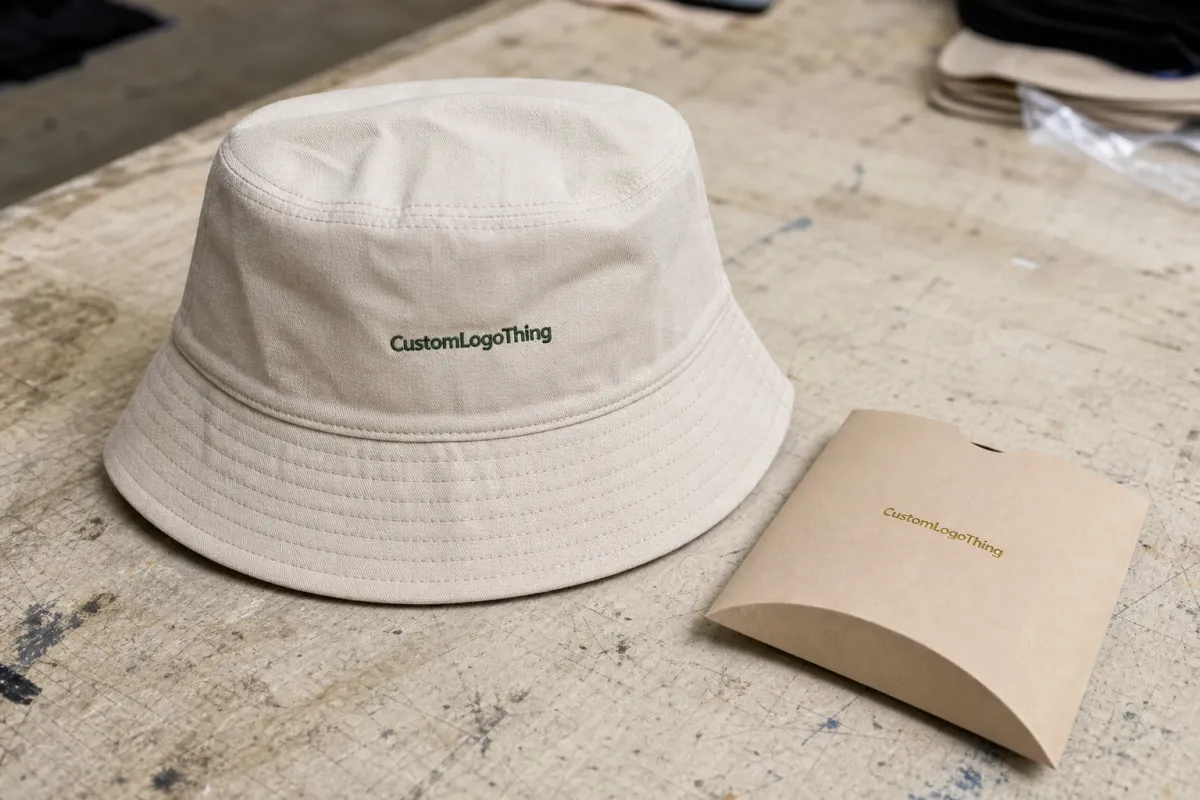
Bucket hats work well in bulk because they are easy to brand and easy to repeat. The crown gives logos and patches room to read, while the brim keeps the style useful across retail, promotion, and staff programs. Compared with more structured caps, they often feel less seasonal and less restrictive. In production, the style is also efficient because it can often be cut on an automatic fabric spreader and stitched on standard single-needle, overlock, and coverstitch machines without highly specialized tooling.
That repeatability helps when one style needs to support more than one channel. A resort order, an outdoor event, and a private-label drop may all use the same base shape with only small changes in fabric or trim. Reusing the same build lowers the risk of variation between runs and makes replenishment simpler. For a repeat order, the factory can usually keep the same panel pattern, thread ticket, and embroidery program, which avoids re-digitizing and reduces setup time.
For wholesale buyers, that matters because a style that can be made again with the same result is easier to quote, easier to inspect, and easier to defend internally. If the program may reorder, favor reproducibility over novelty. A stable build also makes it simpler to set a realistic lead time, which for a standard run is often 18-22 business days after sample approval, with longer timing if custom dyes, special trims, or third-party testing are required.
Practical takeaway: a repeatable core style usually beats a more elaborate one when restocks matter more than one-time launch impact.
For buyers managing several SKUs at once, Wholesale Programs can help keep the conversation centered on replenishment, packout, and repeat pricing instead of only on a first-run estimate.
Fabric, trim, and crown shape that change sell-through
Fabric affects both feel and cost. Cotton twill is the most common retail option because it holds shape well and accepts embroidery or print cleanly. Washed cotton creates a softer, more relaxed look. Nylon and polyester are lighter, dry faster, and work better for travel or outdoor use. Common mill specs include 100% cotton twill at 240-280 gsm for a structured look, 100% brushed cotton at 180-220 gsm for a softer hand, and 75D-150D polyester or recycled polyester for lighter, packable styles.
Channel fit matters more than raw material cost. A washed cotton hat may suit a streetwear program, while a nylon version may sell better for summer events or packable retail. Buyers should compare fabric by end use, not only by yard price. If sustainability is part of the brief, recycled polyester styles should be checked for GRS documentation, and organic cotton should be paired with GOTS-certified yarn or fabric where applicable.
Trim can change the quote just as much. Brim width changes the visual weight of the hat, crown height changes how the front panel carries a logo, and stitch density affects how finished the style looks. Sweatbands, linings, eyelets, and chin cords add comfort or utility, but each one adds labor. A stitched cotton sweatband usually adds less cost than a fully taped internal band with custom branding, while a woven label package can add more than a simple heat-transfer label once folding, sewing, and QC are counted.
Color affects sell-through in a quieter way. Black, navy, stone, khaki, and olive tend to move because they fit more wardrobes. Bright colors can work, but they usually need a clearer reason to exist: an event, a team, a seasonal launch, or a fashion-led assortment. Neutral shades are also easier to reorder because matching is less fragile. For dyed styles, ask whether the fabric lot is tested for colorfastness to rubbing and perspiration before bulk approval.
Shape matters too. A firmer brim usually photographs better and presents more cleanly on shelf, while a softer brim can look casual but may collapse in transit. The sample should answer that before the order does. A brim with inserted nonwoven or fusible interlining will typically hold a cleaner curve than a single-layer brim, but it may also add a small cost increase and more pressing time during production.
| Build option | Typical use | Common wholesale range | Notes |
|---|---|---|---|
| Cotton twill, embroidered logo | Retail, lifestyle merch | $2.50-$4.00 per unit at 500 MOQ | Reliable everyday feel; 6,000-9,000 stitch embroidery can push cost upward. |
| Washed cotton, woven patch | Streetwear, brand drops | $2.90-$5.40 per unit | More premium appearance; patch size, merrow edge, and placement affect pricing. |
| Nylon or polyester, printed detail | Events, outdoor programs | $2.10-$4.20 per unit | Lighter hand feel; heat transfer, screen print, and reflective inks change the quote. |
| Fully custom build with special trims | Private label, higher ASP | $4.25-$7.80+ per unit | Best only if the design can support a higher selling price. |
Those ranges are directional. Factory location, decoration complexity, labor intensity, certification requirements, and quantity break all move the number. Buyers comparing offers should read the spec line by line instead of treating every bucket hat as the same product with different branding. If a supplier claims compliance, ask for current documents for the relevant scope, such as WRAP or BSCI for social compliance and OEKO-TEX Standard 100 for product safety claims on the finished fabric package.
Construction details buyers should confirm before quoting
Before quotes are compared, the construction has to be defined clearly. Ask for panel count, seam structure, eyelets, topstitching, brim edge finish, and any internal support used to hold the shape. These details change how the factory builds the hat and how much labor the order uses. A typical bucket hat may use a 4-panel, 6-panel, or 8-panel crown, stitched with a single-needle lockstitch and overlocked seam allowance; a more structured version may add fusible interfacing to the crown or brim.
Decoration needs the same clarity. Front embroidery, side placement, brim print, and all-over artwork behave differently on a curved surface. A logo that looks fine on a flat proof may need resizing once it wraps the crown. Why guess at pricing when a one-line artwork note can prevent a costly revision later? If that adjustment is not discussed early, the price can change after approval and the sample can no longer match the quote.
Simple beats clever here.
Labels and compliance marks deserve separate approval. Some buyers want a woven main label, a size tab, a care label, and a country-of-origin mark; others want a cleaner private-label finish with less internal branding. Each choice changes sewing time and placement checks. If the order includes a certification claim, the artwork and hangtag language should match the scope document exactly, or the factory may have to reprint material during pre-production.
Testing can be useful before mass production. Colorfastness, dimensional stability, seam strength, and odor checks are common for more demanding programs. For childrenswear or skin-contact-sensitive styles, buyers may also request additional safety verification. Why approve a sample that hides a downstream problem? A small testing fee is often cheaper than correcting a warehouse rejection later.
Bucket hats wholesale pricing, MOQ, and quote drivers
MOQ is usually tied to fabric efficiency and decoration setup. Standard custom bucket hats often start around 300-500 pieces per color, though some factories will quote lower if they already stock the base fabric or can combine variants. At very small volume, each hat carries a larger share of setup, cutting, embroidery, and QC cost, so the unit price rises quickly.
Higher quantity usually improves the number, but only up to a point. Once the order reaches a comfortable cut-and-sew run, the savings become smaller, while packaging, freight, and storage begin to matter more. If a buyer is deciding between a single 2,000-piece colorway and four 500-piece colorways, the cheaper unit price may not produce the better total cost. A clean inventory plan often saves more than a tiny unit discount.
Pricing also shifts with the country of origin and the factory's specialization. A supplier that already makes hats every day may be more consistent than a general apparel factory entering the category, even if the quote is not the lowest. Labor skill shows up in seam balance, embroidery placement, and brim symmetry. Those details are easy to miss on a quote sheet and hard to fix after production starts.
Certification adds cost when it is real and current. If the order needs GOTS, GRS, OEKO-TEX Standard 100, WRAP, or BSCI, the factory may need a particular mill, a controlled material lot, or extra paperwork. That is normal. What matters is that the document matches the claim and the timeline includes the verification step.
Sampling, proofing, and approvals that prevent rework
Sampling is where expensive mistakes usually get caught. A good first sample should confirm fit, hand feel, brim shape, logo placement, color, and labeling. It should also show how the hat sits when packed flat or nested, because a style that looks great on a table may arrive crushed in a carton. Ask for physical photos before shipment so obvious issues can be caught early.
Proofing should not stop at artwork. Thread color, patch border, print scale, and label language all need a final check. A factory may show the correct logo but the wrong placement, or the right color but the wrong trim ratio. The approval file should record every choice, because the production team will use it as the build reference once the order is released.
One sample is rarely enough for tricky programs. If the first version only proves construction, a second pre-production sample can confirm the final decoration and packing. That extra round is slower, but it also reduces rework, which is the most expensive delay in the whole process. For large or branded programs, the factory should confirm whether the final sample was signed off against a digital proof, a physical swatch, or both.
Inspection should be planned before the line starts, not after it ends. A typical QC pass checks measurements, stitch quality, logo alignment, loose threads, odor, and packaging count. Some buyers also request an in-line audit or a pre-shipment inspection from a third party. That can be worth it when the order is large, the selling window is short, or the margin depends on exact presentation.
Production steps, lead time, and factory milestones
Once approval is final, the factory moves into bulk material booking, cutting, stitching, decoration, finishing, and packing. Each step depends on the one before it, so the schedule is only as fast as the slowest input. If fabric is delayed, the whole order waits. If artwork changes late, the line may need to rework finished goods.
Lead time should be measured from the point when every key detail is locked. That means approved sample, approved artwork, confirmed packaging, and confirmed labels. For a standard program, 18-22 business days after approval is a reasonable planning window, but complex dyeing, special trims, or extra testing can extend that timeline. Buyers who want a date should ask for the factory's critical path, not just the optimistic estimate.
Progress updates help more than vague reassurance. A good supplier can share cutting status, in-line stitching status, decoration completion, and packing completion. Those milestones make it easier to catch slippage before it becomes a shipping problem. If the factory cannot describe the current stage clearly, that is a signal to ask more questions.
At the end of the run, a final count should match the order record exactly. Shortage, overage, and mix issues need to be resolved before cartons leave the site. This is the point where a good inspection process pays for itself. It is also where a clear pack plan keeps the shipment from turning into a scramble.
Packing, carton counts, and freight planning for resale
Packing affects both damage risk and landed cost. Bucket hats are often nested or polybagged in inner packs, then arranged in cartons by color and size. The goal is simple: protect the shape without wasting space. Too much compression can crease the brim, while too much empty space increases freight cost and carton crush risk.
Carton count should be matched to the selling plan. Retail orders may need clean unit presentation, while promotional orders may need speed and volume. If the style includes a structured brim, the packing method should protect that structure during transit. A hat that arrives bent can still be sold, but the extra handling eats margin fast.
Freight planning should be part of the quote conversation. Air shipping makes sense for urgent replenishment or small test runs, but ocean freight usually works better for larger wholesale orders. The right choice depends on timing, value per unit, and how much inventory a buyer can hold. A cheap unit price can disappear once the shipment is delayed or re-handled several times.
Documentation matters here too. Commercial invoice, packing list, carton dimensions, and net/gross weights should all be ready before pickup. The more accurate the shipping data, the less likely the buyer is to face a surprise at the warehouse door.
Next steps: send the specs for a faster quote
If you want a quote that is actually usable, send the factory a complete brief. Include fabric, crown shape, brim width, decoration method, labels, carton count, target quantity, and any certification requirements. That is the fastest way to turn a vague price into a production-ready one.
Photos help. A reference image, a hand sketch, or a labeled tech pack can prevent a lot of back-and-forth. The clearer the brief, the less time the supplier spends guessing and the less time you spend revising. A good quote should read like a build plan, not a placeholder.
One-sentence takeaway: send the spec first, and the price will usually make more sense.
If the order will repeat, say so early. Reorder potential affects how the factory chooses materials, how it records the build, and how it prices setup. That one note can improve consistency from the first run to the third.
FAQ
What is a normal MOQ for custom bucket hats? Many factories start at 300-500 pieces per color, although the exact number depends on fabric availability, decoration, and whether the supplier already runs the style.
How much do custom bucket hats cost wholesale? A standard cotton-twill style often lands around $2.50-$4.00 per unit at 500 pieces, while more complex builds, premium trims, or special certifications can push the quote higher.
Which certifications matter most? For product safety and material claims, buyers often ask for OEKO-TEX Standard 100, GOTS, or GRS; for factory social compliance, WRAP or BSCI is common.
How long does production take? After sample approval, a standard run often takes 18-22 business days, but custom dyeing, extra testing, or complex packing can extend the schedule.
What slows quoting down most? Missing details do. If the factory does not know the fabric, decoration, label package, or carton plan, the first price is usually only a rough placeholder.


