Cheap Custom Clothing Labels can look sharp, feel comfortable, and hold up through repeated washing. They can also drag down an otherwise good garment if the material is scratchy, the type is too small, or the finish fights the fabric. The price tag is only one part of the equation. A label that costs a few cents less but curls, frays, or prints poorly is not actually cheap once returns and rework enter the picture.
That is why the best buyers judge labels the way production teams do: by fit, durability, and consistency. A good label should feel like part of the garment, not a separate component stapled on at the end. For tees, socks, hoodies, and basics, the sweet spot is usually a standard construction with simple artwork and a finish that suits the fabric. That combination keeps cost under control without making the product feel stripped down.
The label may be small, but customers touch it. They notice whether it scratches the neck, whether the logo is crisp, and whether the label survives the first wash. That matters more than a mockup suggests. In apparel, tiny details change the whole impression.
Why cheap custom clothing labels can still look premium
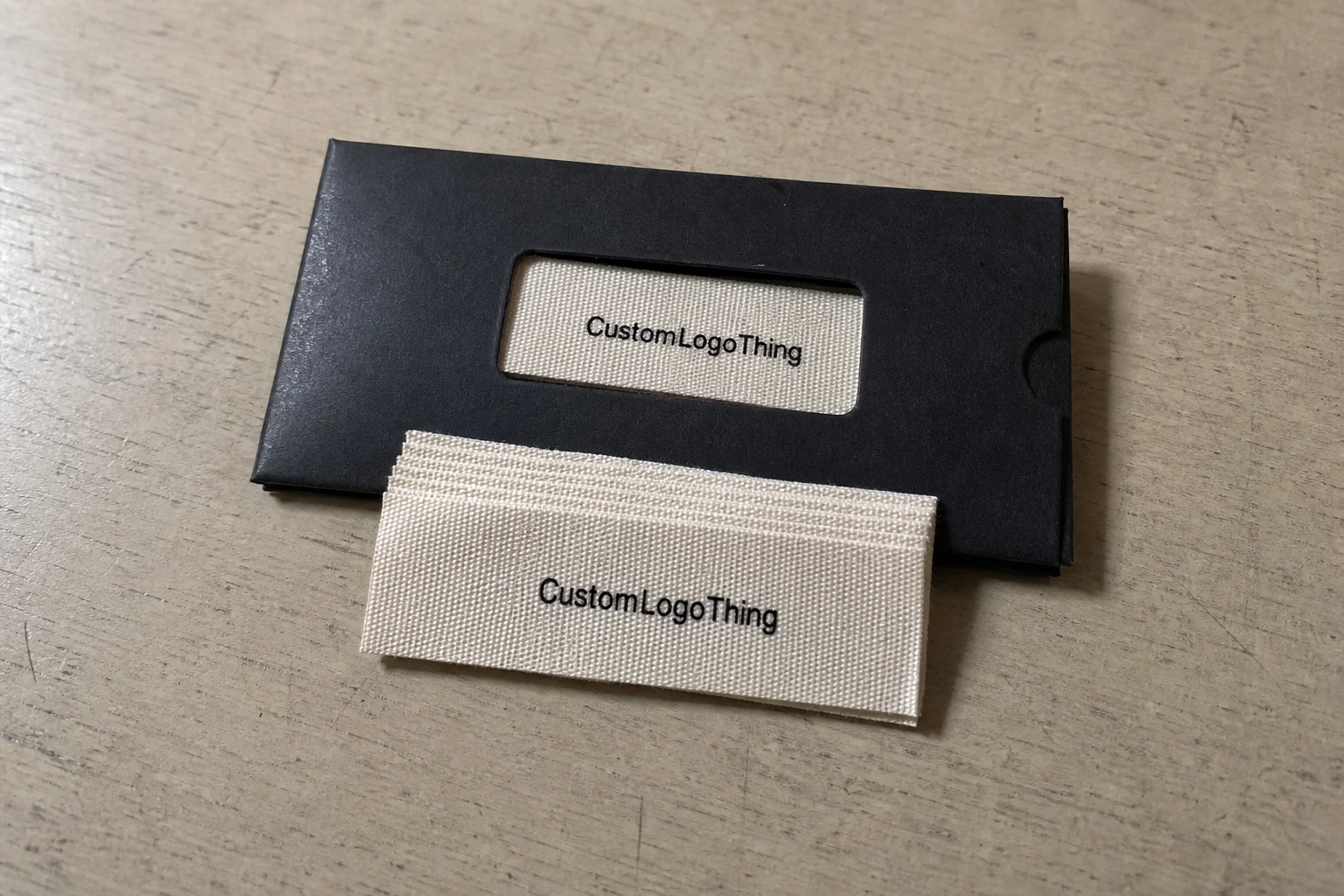
A label is one of the first things a buyer feels, and one of the last things a brand can quietly get wrong. On a T-shirt, the neck label can change how the garment is perceived before anyone checks the fabric weight. On socks or fleece, it can make a product look retail-ready instead of bulk-packaged.
The mistake many brands make is assuming that a low unit cost automatically means a low-end result. That is not how it works. A label can be inexpensive and still look premium if the construction is clean, the text is readable, and the edges do not irritate skin. The opposite is also true: a label can be expensive and still feel off if the material is too shiny, too stiff, or too busy for the garment.
In practical terms, cheap Custom Clothing Labels work best when the design is modest and the spec matches the product. A startup launching 300 cotton tees does not need the same label construction as a workwear line built for repeated abrasion. Buyers who choose based on use case usually get a better result than those who chase the lowest quote line by line.
There is also a branding side that gets overlooked. The label should sit comfortably alongside hang tags, mailers, inserts, and the rest of the package branding system. If the box looks premium but the neck label feels harsh, the customer senses a mismatch. They may not name the problem, but they feel it immediately.
Practical rule: start with the garment, then choose the label. Soft tees usually call for a softer interior finish. Heavier outerwear can handle tougher constructions. The cheapest label that works is usually the one nobody notices after it is sewn in.
Pick the label material and finish that match the garment
Material choice affects price, feel, and how the label ages. There is no universal best option. A label that works beautifully for a heavyweight hoodie can feel wrong on a lightweight tee.
Woven labels are the standard choice when buyers want durability and sharper detail. They are common for logos, brand names, and small text because the weave holds up well across repeated washing. Within woven labels, the most common constructions are damask, taffeta, and satin. Damask is usually the most detailed and the smoothest to the touch. Taffeta is generally the lower-cost woven option, though it can feel rougher. Satin gives a softer, smoother surface and often suits garments that touch the skin more directly.
Printed satin labels are popular for softer interior branding. They are useful when comfort matters more than texture and when the artwork is simple enough to print cleanly. They usually cost less than more detailed woven options, especially when the design avoids tiny text and dense graphics. The tradeoff is that printed labels can feel flatter and may not have the same long-term structure as woven constructions.
Cotton labels create a natural, textured look that works well for heritage styling, boutique lines, and some eco-oriented brands. They can add character, but they are not always the lowest-cost or most durable option. Cotton can wrinkle, and depending on the weave and finish, edges may soften or fray sooner than synthetic alternatives. For a fashion label that wants a softer, handmade impression, that may be fine. For sportswear or kids’ basics, it may not be ideal.
Heat-transfer labels remove the sewn-in tag entirely. They are often used when comfort is the priority, especially on tees, activewear, and children’s garments. A clean heat-transfer label can feel almost invisible, which customers tend to appreciate. The catch is that it depends heavily on both the garment surface and the application process. If the fabric is unsuitable, the print can wear unevenly, crack, or look thin after laundering.
Finish matters nearly as much as material. Matte surfaces tend to read cleaner and more modern, while glossy finishes can feel slick but sometimes cross the line into looking plastic. Edge softness matters too. If a label rubs the neck or folds awkwardly inside the garment, buyers notice immediately. That small irritation can shape the perceived quality of the entire product.
For lines that also use cartons, inserts, or other printed packaging, the label should sit in the same visual family as the rest of the product presentation. A premium box paired with a scratchy label creates a strange disconnect. Even if the garment itself is good, the whole experience feels less considered.
For packaging teams comparing material options across categories, guidance from groups like the EPA packaging guidance and the FSC can help when labels are part of a broader carton or insert strategy.
| Label type | Best use | Typical feel | Common tradeoff |
|---|---|---|---|
| Woven damask | Premium apparel, logos, repeat wash wear | Smooth, detailed, durable | Usually higher cost than basic printed options |
| Printed satin | T-shirts, softer interior labels | Soft and low-bulk | Less texture and structure than woven |
| Cotton | Natural or heritage-style garments | Natural, textured | Can wrinkle or fray sooner than synthetic options |
| Heat-transfer | Comfort-first neck labels, activewear | No sewn-in tag feel | Needs the right garment and application process |
Size, fold style, and artwork specs that keep costs down
Most pricing problems start in the spec sheet, not the factory. Size, fold style, and artwork complexity affect cost more than many first-time buyers expect. Get those three under control and the order usually becomes easier to quote, easier to produce, and easier to reorder.
Standard sizes are usually cheaper because they fit common production settings and reduce waste. A label cut to a familiar width and height is easier to run, easier to sew, and easier to repeat later. Unusual dimensions are not forbidden, but they often add cost because they create more material waste or require extra setup.
Fold style changes both the look and the production logic. A center fold is common for neck labels because it sits neatly in the seam. End folds are useful when the label sits in a side seam or shows externally. Straight cut labels are typical when the edges will be fully enclosed during sewing. Each style has a purpose, and each one can shift the price a little depending on how the label is finished and attached.
Artwork is where small labels get crowded quickly. Tiny logos, multiple fonts, a slogan, care details, and border rules all packed into a 20 mm label tend to produce poor readability. The label may look sharp at full screen size and still fail in production. A clean file with fewer thread colors or fewer printed elements usually lowers the risk of proof revisions and makes the final result more legible.
Common mistakes are easy to spot once you have seen enough samples. Borders that disappear after folding. Type that becomes unreadable at actual size. Artwork that depends on fine gradients or thin strokes. Designs that look polished on a screen but muddy in thread or print. The fix is not glamorous: simplify the layout until it still reads clearly at the smallest practical size.
Brands ordering Custom Labels & Tags alongside other line items should treat the label as part of the full production spec, not a side project. The same thinking applies to Custom Packaging Products. Standard structures usually behave better, cost less to repeat, and create fewer surprises during replenishment.
Tip: if a label needs both branding and care information, decide which message must be most prominent. Trying to force too much text into one small label is one of the fastest ways to make the entire piece harder to read.
Cost, pricing, MOQ, and unit cost explained
Pricing for cheap custom clothing labels usually comes down to a handful of variables: material, size, color count, fold or cut style, finishing, quantity, and attachment method. That is the real pricing stack. Everything else tends to be secondary.
As quantity rises, unit price usually falls. A run of 500 labels will not price like a run of 5,000 because setup costs and production overhead are spread across fewer units. The lower unit price at higher quantity is real, but so is inventory risk. The cheapest label on paper is not the smartest choice if half the order sits unused for months.
That is why experienced buyers do not ask only, “What is the cheapest unit price?” They ask whether the label will sell through, how long the design will stay current, and whether the spec is stable enough to reorder without changes. A label that saves two cents but drives avoidable returns is not really inexpensive.
| Quantity | Typical unit cost range | What usually happens |
|---|---|---|
| 500 pcs | $0.28-$0.65 | Higher setup impact, useful for testing |
| 1,000 pcs | $0.18-$0.42 | Better balance for small brands |
| 5,000 pcs | $0.07-$0.22 | Stronger unit economics, more inventory risk |
| 10,000+ pcs | $0.04-$0.16 | Best pricing, least flexible if specs change |
Those numbers are directional, not fixed quotes. Material choice, stitch style, color count, backing, and special finishing can push pricing up or down. Even so, they reflect the range many buyers see when they keep the spec simple and avoid unnecessary extras.
MOQ matters more than new buyers often expect. A supplier may offer a sharp-looking unit price, but if the minimum quantity is too high, the total spend can overshoot the launch budget. Some brands intentionally order slightly above MOQ when the design is stable and the forecast is confident, because the better rate offsets the extra inventory. That makes sense only if the label is unlikely to change soon.
If labels are part of a broader branded packaging budget, the total system matters more than any single line item. Labels, hang tags, poly mailers, boxes, and inserts all compete for the same dollars. A simpler label spec can free room for better packaging elsewhere, which often improves the customer experience more than a slightly fancier interior tag would.
Process, turnaround, and lead time from proof to shipment
The ordering process is straightforward when the buyer sends complete information. It usually follows the same sequence: request specs, receive a quote, review artwork, approve a proof, produce, inspect, and ship. The process only gets messy when the dimensions are missing, the fold style is unclear, or the artwork file keeps changing.
That is where time disappears. Revisions, color questions, vague placement instructions, and “one more tweak” rounds all add friction. Cheap custom clothing labels stay cheap partly because the order stays controlled. Every extra loop tends to add both time and cost.
Standard constructions usually move faster than unusual ones. A common woven label with a standard fold and simple artwork is often quicker to produce than a custom shape with multiple finishes. That is basic production math. The fewer unusual steps involved, the easier it is for the factory to run the Order Without Delays.
A realistic production window for many label orders is around 10-15 business days after proof approval, though workload, construction, and quantity can move that range. Rush production may be possible, but it usually raises cost. Shipping time is separate from production time, which matters if the garment launch date is fixed. Too many brands treat those as the same thing and then wonder why a finished order still has to travel.
Clean information speeds everything up. Final artwork, quantity, dimensions, and attachment method should be ready before the quote request goes out. If the buyer is still deciding whether the label needs brand only, brand plus care text, or a compliance line, the quote will usually take longer and the proof cycle will stretch.
“The cleanest order is the one with fewer surprises. When the spec is complete, the proof cycle is shorter, the quote is clearer, and the final label usually lands closer to what the brand actually wanted.”
The same logic applies across product packaging and retail packaging. Clear specs reduce mistakes. Vague specs invite revisions. Revisions cost time, and time costs margin.
Why repeat buyers stay on the same label spec
Repeat buyers care about consistency because consistency keeps production predictable. Once a label fits the garment, survives washing, and feels right on skin, changing it just to save a small amount can create downstream problems that outweigh the savings. That is especially true for brands selling seasonally or across multiple channels.
Reorders move faster when the artwork, size, and fold style stay locked. A brand that keeps one master spec can approve reprints quickly and avoid the common “why does this new run feel different?” problem. That question is expensive in both time and trust.
Consistency also simplifies inventory planning. If a brand uses one label version for direct-to-consumer sales, another for wholesale, and a third for bundles, stock becomes harder to track and harder to replenish. One stable spec is easier to manage and usually produces cleaner results across the full line.
There is also a subtle presentation benefit. Reliable labels support stable package branding and help the product feel intentional. That effect carries over when garments ship in custom printed boxes or other branded packaging materials. Customers may not analyze the details, but they notice when the entire presentation feels coherent.
What repeat buyers usually do well:
- Keep one master artwork file.
- Lock the fold style and size.
- Reorder before stock gets tight.
- Treat the label as part of the product spec, not a last-minute add-on.
None of that is flashy. It is just how brands avoid preventable problems.
What to finalize before you request a quote
Before requesting pricing, lock down the basics: label size, material, fold style, quantity, artwork, and where the label will be sewn or applied. If those details are vague, the quote will be vague too. That usually leads to extra emails, slower approvals, and avoidable revisions.
Decide whether the label needs brand only, brand plus care instructions, or a compliance line. If care information is required, keep the copy short and readable. A separate size tab or back label can be more efficient than cramming everything into one small field. That choice often improves both cost control and legibility.
Check the garment type and wash conditions before choosing the finish. A label for lightweight tees should not be selected the same way as one for heavy fleece or kids’ basics that will be washed often. Comfort, friction, and durability all matter. If the back of the label touches skin, softness matters even more.
For packaging work around the garment, compare the label against the rest of the line: hang tags, mailers, box inserts, and other custom packaging products. That keeps the label from feeling disconnected from the product or the shipping experience. The best packaging systems are usually quiet, consistent, and easy to repeat.
Best next step: compare two or three spec options, then ask for pricing on the strongest fit instead of requesting every possible version at once. That usually produces a cleaner quote and a faster decision. Cheap custom clothing labels are only genuinely cheap when the spec, the price, and the production timeline all fit the launch plan.
FAQ
How cheap can custom clothing labels get without looking low-end?
Pricing drops fastest when the label size is standard, the artwork is simple, and the quantity is high enough to spread setup costs. A label can still look premium if the material is soft, the text is readable, and the fold or cut suits the garment. The lowest-cost option is not the best if it scratches, curls, or washes poorly.
What is the best material for cheap clothing labels on T-shirts?
Printed satin or soft woven labels are common choices because they stay readable and feel better against skin. For lightweight tees, rough materials can make the neckline feel bulky or scratchy. If comfort matters more than texture, a printed option usually makes more sense.
What MOQ should I expect for budget custom clothing labels?
MOQ varies by construction, but lower-cost runs usually come with a minimum quantity requirement. Ordering more than the minimum can improve unit cost enough to justify the extra stock. If you are testing a new product, compare the smallest quantity with a stepped-up quantity to see whether the price break is worth it.
How long does production usually take for cheap custom clothing labels?
Lead time depends on artwork approval, material choice, and order size. Standard label orders move faster when the proof is approved quickly and the specs are complete. Shipping time is separate from production time, so both need to be built into the launch schedule.
Can I put care instructions on custom clothing labels and still keep the price low?
Yes, but extra text can increase size, reduce legibility, or require a different layout. Keeping the copy short and the artwork clean helps control cost. If care information is mandatory, a back label or separate size tab may be more efficient than forcing everything into one label.