Buyer Fit Snapshot
| Best fit | Buy Compostable Garment Mailers projects where brand print, material claims, artwork control, MOQ, and repeat-order consistency need to be specified before quoting. |
|---|---|
| Quote inputs | Share finished size, material target, print colors, finish, packing count, annual reorder estimate, ship-to region, and any compliance wording. |
| Proofing check | Approve dieline scale, logo placement, barcode or warning zones, color tolerance, closure strength, and carton packing before bulk production. |
| Main risk | Vague material claims, crowded artwork, missing packing details, or unclear freight terms can make a low unit price expensive after revisions. |
Fast answer: Buy Compostable Garment Mailers: Sizes, Pricing & MOQ should be specified like a repeatable production item. The safest quote records material, print method, finish, artwork proof, packing count, and reorder notes in one written spec.
Production checks before approval
Compare the actual filled-product size with the drawing, then confirm tolerance on folds, seals, hang holes, label areas, and retail display edges. Reserve space for logos, QR codes, warning copy, and material claims before decorative graphics fill the panel.
Quote comparison points
Review material grade, print process, finish, sampling route, tooling charges, carton quantity, and freight assumptions side by side. A quote is only useful when the supplier can repeat the same color, closure quality, and packing count on the next order.
Buy Compostable Garment Mailers: Sizes, Pricing & MOQ
For apparel brands, packaging is not background noise. It is the first physical thing a customer handles after checkout, and that makes the decision to buy compostable garment mailers a real business move, not a brand vanity project. A folded tee inside a clean, well-sized compostable mailer feels intentional. The same order shoved into a wrinkled plastic bag feels cheaper before the customer even opens it. That difference lands fast, because packaging shapes repeat purchases, social posts, and the sentence your sales team uses when someone asks what you ship in.
There is a practical reason more teams choose to buy compostable garment mailers: the switch is easy to explain and easy to see. It cuts visible plastic, fits into an eco-friendly packaging plan, and gives the brand a cleaner unboxing without forcing a full carton conversion. That matters for DTC apparel, replacement shipments, subscription boxes, limited drops, and light soft goods that do not need a rigid shipper. If the cost is close to what you already spend, the question gets blunt: why keep sending products in packaging customers now notice, compare, and quietly judge?
Packaging buying is not a morality play. It is a logistics decision with branding attached. You are balancing handling speed, shipping weight, shelf impression, and customer perception. A compostable mailer usually weighs less than a carton, can reduce cubic waste in transit, and often looks cleaner on the packing line. That is why brands that buy compostable garment mailers tend to use them for soft, folded, stable products: tees, leggings, socks, swimwear, scarves, and other compact items that do not need crush protection.
The bigger point is simple: packaging is part of the product experience whether the team planned for it or not. A mailer can quietly support a circular economy message, lower the perceived carbon footprint, and reinforce green packaging claims with something customers can actually touch. Or it can work against the brand by looking generic, flimsy, or inconsistent. The best reason to buy compostable garment mailers is not hype. It is that they give apparel brands a lower-friction way to align shipping with the rest of the customer experience.
Packaging buyers usually ask one question first: does this material make the order easier to ship and better to receive? If the answer is yes, the brand message gets stronger without creating extra mess.
Buy Compostable Garment Mailers: The Business Case
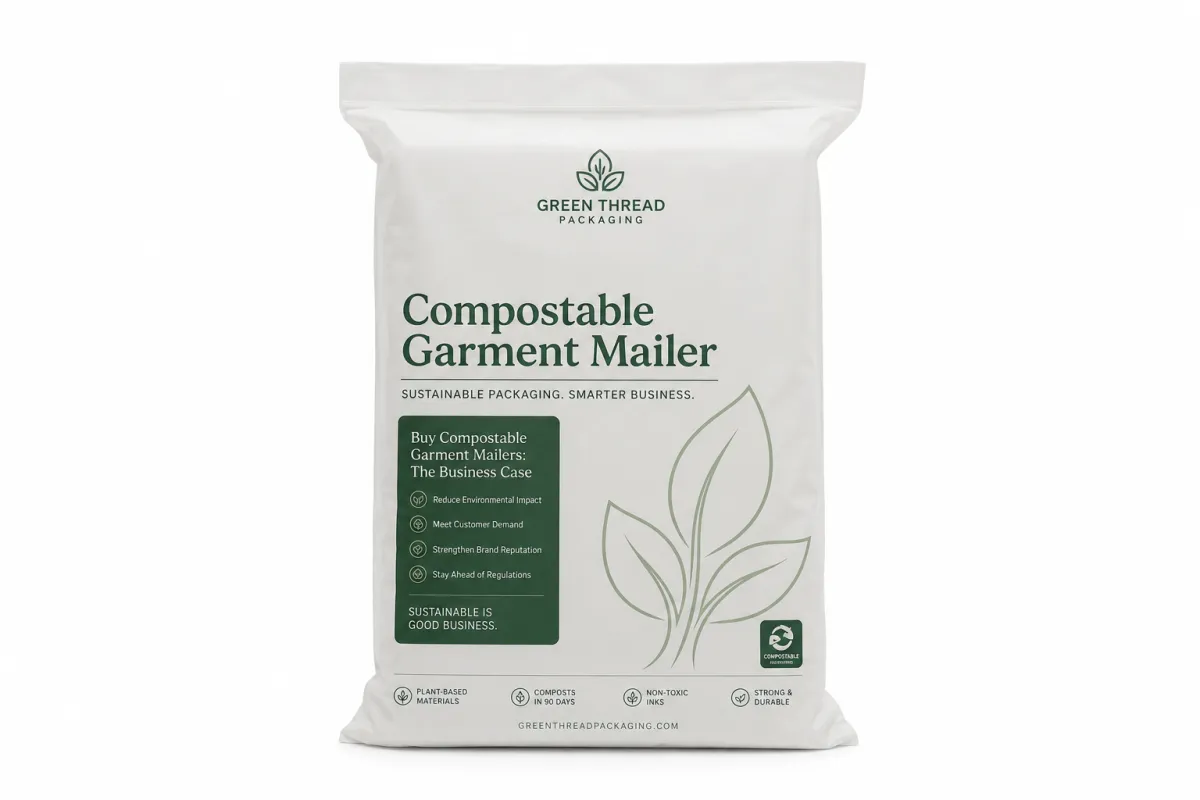
In apparel shipping, packaging often does more branding work than the garment tag. That sounds harsh because it is true. A tag gets read for a second. A mailer gets handled, stacked, scanned, and opened. If you buy compostable garment mailers, you are not only choosing a material. You are choosing the first tactile impression your customer has of your operation.
The business case gets stronger when the shipment is light, flat, and repeatable. A DTC T-shirt brand can get more value from a clean mailer than from an overbuilt carton that adds weight and padding nobody asked for. The same logic applies to replacement shipments and limited drops. When a customer receives a corrected order in a neat compostable mailer, the experience reads as organized. When a warehouse ships 5,000 orders a month, tiny gains in packing speed and weight consistency start to matter more than vague sustainability slogans.
Here is where a lot of buyers stall out: they compare compostable mailers to plastic mailers only on material cost. That is too narrow. The real comparison includes how the packaging looks in transit, how it holds up in handling, how much it weighs, and how well the brand story travels with it. If you buy compostable garment mailers for a DTC brand, you are also buying a cleaner unboxing, a simpler sustainability message, and usually a better fit for customer expectations around compostable and zero waste packaging.
From the sales side, the pitch is easy. From procurement, the math still has to work. The strongest projects usually start with a narrow use case: soft goods under a specific folded thickness, a defined annual volume, and a shipping profile that does not need rigid edge protection. Once the team sees that the mailer fits the job, it becomes easier to buy compostable garment mailers without blowing up the packaging budget or turning fulfillment into a puzzle.
If the mailer is doing its job, it should disappear into the shipment flow without adding new training steps. It should pack fast, seal cleanly, and survive standard parcel handling. For a lot of brands, that is better than an expensive showpiece. You are not paying for theater. You are paying for a useful piece of eco-friendly packaging that supports the brand and respects the shipping lane.
I have watched packaging teams overthink this part and then get surprised by the fix. The mailer was not the problem. The SKU mix was. Once they sorted by product type, the right answer usually became obvious. Kind of annoying, but useful.
Where compostable mailers fit best
They fit well for DTC apparel, subscription boxes, seasonal promos, return replacements, and lightweight accessories. They fit less well for bulky knitwear, sharp-edged components, or any order that needs crush resistance. That is why brands that buy compostable garment mailers should start with the product profile, not the marketing mood board.
How they compare to common alternatives
Against standard poly mailers, compostable versions usually win on brand perception and sustainability messaging, but the final call still depends on price, seal behavior, and print requirements. Against a carton, they usually win on shipping weight and packing speed. Against paper envelopes, they can win on moisture resistance. That mix is why more apparel teams are willing to buy compostable garment mailers for the right SKU and keep other formats for heavier orders.
Product Details: What You Get When You Buy Compostable Garment Mailers
When you buy compostable garment mailers, the product usually falls into one of two broad structures: a compostable film mailer or a paper-based mailer with a barrier or closure system suited to apparel shipping. The exact build changes from supplier to supplier, but the useful question stays the same: does the structure protect folded garments, keep the package closed, and support your branding without creating wasteful overpackaging?
Size matters more than many first-time buyers expect. A 9 x 12 inch mailer may work for socks or a single lightweight tee. A 10 x 13 or 12 x 15 inch format often fits folded shirts and lighter tops. A 14 x 19 or 16 x 20 inch option suits hoodies, layered outfits, or thicker soft goods. If you buy compostable garment mailers in the wrong size, the problem shows up fast: too small and packing slows down; too large and the shipment looks underfilled and less polished.
Buyers should also pay attention to finish. Plain white gives a cleaner retail feel. Kraft-look finishes lean into natural-material cues and fit a more visible green packaging story. Branded printing gives more control over the customer experience, especially for brands that want the mailer to carry logo placement, reorder instructions, or a QR code that points back to the store. If you plan to buy compostable garment mailers for multiple channels, the finish should match the channel: retail handoff, ecommerce fulfillment, or promotional sends.
Practical details matter more than label claims. Tear resistance affects warehouse efficiency. Water resistance matters if shipments pass through damp loading docks or weather swings. Opening-strip design changes the unboxing. Adhesive performance matters in cold storage and hot summer freight. These are not small details. They decide whether the choice to buy compostable garment mailers leads to a smoother receiving experience or a pile of complaints about split seams and weak seals.
Custom printing is where the mailer starts pulling more weight for the brand. You can add a logo, size mark, product family label, packing instructions, return guidance, or a short message that nudges repeat orders. Some buyers use a panel for SKU codes or warehouse identifiers, which reduces picking mistakes and keeps fulfillment teams moving. That is one reason mid-sized brands often buy compostable garment mailers as a packaging system, not just a shipping envelope.
Customization features worth asking for
- Logo placement: front panel, flap, or repeat print pattern.
- Operational text: return instructions, order ID area, or packing notes.
- QR codes: product care, reordering, or sustainability information.
- Warehouse markings: size codes, SKU zones, or color-block identifiers.
One last point on structure: compostable does not automatically mean right for every product. A lightweight tee and a heavy knit sweater are not the same packing problem. If your line includes oversized fleece, hard accessories, or sharp hardware, it may make sense to use a different format for those SKUs. A smart buyer does not force every item into the same packaging because the material is trendy. A smart buyer chooses where to buy compostable garment mailers because the fit is right.
Specifications to Check Before You Buy Compostable Garment Mailers
If you want to buy compostable garment mailers without headaches, start with the spec sheet. Not the sales sheet. The spec sheet. Dimensions, thickness, seal strength, print method, and pack-out tolerances tell you far more than a nice product photo. For apparel packaging, a few millimeters can change how fast a folded garment slides in and whether the adhesive closes without tension.
The first checkpoint is dimensional accuracy. A buyer should confirm the usable internal space, not just the outer size. Ask how much tolerance the supplier allows on length and width, and whether the stated dimensions include the closure flap. That matters if your folding standard is tight. If a hoodie takes half an inch more height than expected, the right order can turn into the wrong order. That is why teams that buy compostable garment mailers for multiple SKUs should test the largest fold in the range, not the easiest sample.
Next, ask about thickness and seal strength. A thicker structure may resist punctures better, but it can also feel stiffer during packing. Seal strength should be high enough to survive parcel handling without opening under pressure, especially in mixed-sortation networks. If you want a benchmark for rough transit conditions, it is worth reviewing established parcel testing frameworks such as ISTA, which many packaging teams use as a reference point for distribution testing.
Compostability claims deserve a clear answer, not a vague one. Ask which standard the mailer is tested against, whether that is ASTM D6400, EN 13432, or another recognized certification path. Then ask what disposal route the claim assumes. Many compostable packaging claims depend on commercial composting infrastructure, not backyard conditions. The U.S. Environmental Protection Agency explains composting basics and collection realities at epa.gov, which is useful context before you buy compostable garment mailers for a national audience.
Durability tests should be tied to real use, not lab theater. Check puncture resistance, edge sealing, opening-strip behavior, and how the mailer performs when stacked, compressed, or exposed to humidity. A sample that looks fine on a desk can fail at a sorting center if the material is too thin or the closure is inconsistent. For that reason, brands that buy compostable garment mailers should always ask for sample units and pack them with actual folded garments, not paper inserts.
One thing I tell teams all the time: test the worst case, not the prettiest case. Put the bulkiest folded SKU in the sample. Add the insert card. Add the swing tag if it changes the profile. That is the version that will save you later.
Technical checks to confirm before ordering
- Dimensions: internal and external measurements, plus flap allowance.
- Thickness: material gauge or basis weight, depending on structure.
- Seal strength: closure reliability under normal parcel handling.
- Print method: flexo, digital, or another process tied to artwork limits.
- Pack-out tolerance: how much fill variation the mailer can handle.
- Storage guidance: temperature and humidity conditions before use.
There is also a limit buyers should hear upfront: compostable mailers are not always the right answer for heavy or sharply contoured items. They can be a strong fit for lightweight apparel and soft accessories, but they are not a shortcut around physics. Heat sensitivity can matter in storage. Moisture exposure can matter in long freight cycles. If the line includes bulky knitwear, it may still make sense to buy compostable garment mailers for some SKUs and use another format for others.
If your package needs paper-based content, look for third-party forest certification where appropriate, and verify any paper claim separately from the compostability claim. That distinction matters. A buyer who separates those issues makes better decisions, reduces returns, and avoids overpromising in marketing. The goal is not to look sustainable. The goal is to ship correctly. That is the real reason experienced teams buy compostable garment mailers after they test the basics.
Buy Compostable Garment Mailers With Clear Pricing and MOQ
Cost is where the conversation gets honest. If you want to buy compostable garment mailers with confidence, you need to know what pushes unit price up and what keeps it under control. Material type is one factor. Print coverage is another. Dimensions, custom tooling, and destination freight all move the number. A quote that looks cheap on paper can get expensive once you add setup, sample charges, and shipping to the warehouse.
MOQ should be treated as an operational planning tool, not a nuisance. Smaller runs make sense for product testing, seasonal launches, or limited-edition drops. Mid-size runs fit core apparel programs with known demand. Larger buys improve unit cost, but only if the size and structure are already proven. If you buy compostable garment mailers too early in the wrong volume, you can end up with inventory that is technically usable but operationally awkward.
A fair comparison starts with landed cost, not just quoted unit cost. Ask for the per-thousand price, setup fees, plate or print charges if relevant, sample costs, freight, and any rush surcharge. Then factor in the cost of mistakes. A mailer that is too small slows packing. A weak closure creates rework. A poor print result hurts brand presentation. The buyer who wants to buy compostable garment mailers intelligently should compare the full package, not the headline price alone.
| Option | Typical Unit Cost | Common MOQ | Best For | Buyer Notes |
|---|---|---|---|---|
| Stock compostable mailer | $0.16-$0.24 | 500-1,000 pieces | Fast launch, small tests | Lowest setup, limited branding, quickest path to order |
| Printed compostable mailer | $0.22-$0.38 | 2,000-5,000 pieces | DTC apparel, branded fulfillment | Better identity, more artwork control, may add print setup fees |
| Custom size + print | $0.28-$0.52 | 5,000-10,000 pieces | Stable SKUs, seasonal volume | Best fit for repeat demand, but requires tighter spec approval |
| High-coverage branded run | $0.34-$0.60 | 10,000+ pieces | Strong retail presentation | More artwork, more QA, and usually the highest setup discipline |
The table gives a working range, not a promise. A 9 x 12 mailer with a single-color logo will not price the same as a larger format with full-panel print. Shipping destination matters too, especially for buyers outside the production region. Still, the pattern holds: if you buy compostable garment mailers with simple artwork and a known size, you usually get better economics than if you start with a custom structure from scratch.
Price per thousand helps. Landed cost per order helps more. That is the number your finance team will actually feel. If two options differ by only a few cents per unit, the better one may be the larger mailer that reduces rework, or the one with a stronger closure that cuts down on damaged returns. Brands often find that the cheapest mailer is not the cheapest once labor enters the picture. That is why experienced teams buy compostable garment mailers with a full cost model instead of a unit-price fantasy.
One more practical tip: ask how the supplier handles repeat orders. A good packaging partner should be able to quote reorders without rebuilding the job from zero every time. That matters for seasonal apparel brands and for any operation with steady SKU volume. If your team plans to buy compostable garment mailers more than once, the reorder workflow can matter as much as the first quote.
Process and Timeline for Compostable Garment Mailers Orders
Most packaging delays are not caused by production. They are caused by unclear inputs. A clean order path helps you buy compostable garment mailers without spending a week chasing revisions. The usual sequence is straightforward: request quote, confirm specs, approve artwork, review sample, lock production, and schedule freight. The more complete the brief, the less friction in each step.
Lead time depends on the order type. Stock mailers can move quickly because the structure already exists. Printed stock usually takes a bit longer because artwork and print scheduling still need to line up. Fully custom runs take the longest because the size, print, and production plan all need sign-off. If you buy compostable garment mailers for a launch date, do not wait until the last minute to define the fold size or the print panel.
The slowest points in the process are predictable: missing artwork files, vague sizing notes, delayed proof approval, and late changes to certification language or disposal claims. A packaging team that wants to move faster should lock those items early. A warehouse that receives a bad run because the spec changed late pays twice: once in time and once in rework. That is another reason brands that buy compostable garment mailers benefit from a written spec sheet.
Planning around launch windows matters too. If you are resetting inventory for a seasonal collection, leave room for sample review and freight. If you are shipping into a warehouse with strict receiving windows, confirm delivery timing before production starts. Rush orders usually cost more, and they are rarely worth it unless a campaign date is fixed in stone. The best buyers buy compostable garment mailers with a buffer, not with hope.
A practical order checklist
- Send folded product dimensions and target quantity.
- Choose the mailer style, finish, and print coverage.
- Confirm compostability standard and any label text required.
- Review the sample with real garments packed inside.
- Approve artwork only after the proof matches the final spec.
- Reserve freight time and warehouse receiving capacity.
If your team already works with other packaging formats, the comparison can help. For some apparel businesses, a compostable mailer sits alongside branded cartons or other shipping materials from Custom Packaging Products. For others, it becomes the new default for soft goods while heavier categories stay on another structure such as Custom Poly Mailers. The right answer is usually category-specific, not universal. That is why the decision to buy compostable garment mailers should be tied to SKU behavior, not just brand positioning.
Why Choose Us for Compostable Garment Mailers
Buyers do not need more packaging jargon. They need a supplier that can help them buy compostable garment mailers with fewer surprises. That starts with responsive quoting, clear spec guidance, and honest advice about what the mailer can and cannot do. If a size is too tight for a folded hoodie, that should be said early. If a printed run will need more time because of artwork coverage, that should be explained before the PO is signed.
For apparel workflows, speed only helps if the packaging still fits the product. The job is to reduce risk before production starts: help you Choose the Right dimensions, confirm the closure format, and line up the print setup so the finished mailer matches the way your team actually packs. Buyers who buy compostable garment mailers after that kind of review tend to see fewer packing errors and fewer ugly reorder mistakes.
Procurement teams also care about consistency. They want a repeatable reorder path, clear communication, and sample support that feels useful rather than decorative. That means a quote should answer the questions that matter: what size works, what the MOQ is, what the lead time looks like, and what information is still missing. If you want to buy compostable garment mailers for a stable SKU, the process should feel predictable from one season to the next.
There is a commercial advantage in being specific. Send the product dimensions, quantity target, artwork files, and any certification needs, and the quote will be sharper. That is better for the buyer and better for the launch timeline. It also makes it easier to compare your options across the rest of the packaging line, whether you are reviewing other shipping formats or planning a wider move toward eco-friendly packaging and lower waste.
From a brand standpoint, the final decision should be simple: does the mailer help the shipment look cleaner, ship correctly, and tell a credible sustainability story? If yes, it earns its place. If not, it is just decoration with a conscience. That is why the strongest packaging programs treat compostable shipping as a practical tool, not a slogan. And that is why many apparel teams continue to buy compostable garment mailers after the first test run works.
Next step: send your folded garment dimensions, target quantity, logo files, and any certification requirements. With that information, you can get a quote, approve a sample, and move forward with confidence if you are ready to buy compostable garment mailers for your next shipment run.
FAQ
What should I check before I buy compostable garment mailers?
Confirm the internal dimensions, closure type, and thickness against the actual folded garment size. Request the compostability standard or certification and verify the disposal conditions it assumes. Ask for samples so you can test sealing strength, print quality, and shipping durability before you buy compostable garment mailers in volume.
Can I buy compostable garment mailers with custom printing?
Yes. Most custom runs can include logos, brand copy, QR codes, return instructions, and size markers. Ask how many print colors are supported, whether artwork setup affects MOQ or lead time, and confirm ink compatibility with the compostable substrate before you buy compostable garment mailers with branded graphics.
What MOQ applies when buying compostable garment mailers?
MOQ depends on whether you are ordering stock, printed stock, or a fully custom build. Smaller test runs are often available, but the best unit pricing usually appears at higher volumes. Use MOQ to plan by SKU or seasonal drop instead of ordering one oversized batch blindly when you buy compostable garment mailers.
How do compostable garment mailers perform in shipping?
They should hold up to normal parcel handling if the thickness, seal, and size are matched correctly. Moisture resistance and puncture resistance matter more than marketing claims, so test with real packed garments. For heavy or sharp-edged products, ask whether a different structure is safer before you buy compostable garment mailers.
How long does it take to receive compostable garment mailers after approval?
Timing depends on whether the order is stock or custom and how quickly artwork is approved. Sampling, proofing, and freight can all affect the final delivery date, so build in a buffer. Ask for a written production schedule before you commit to a launch or inventory reset if you plan to buy compostable garment mailers on a deadline.
If you are comparing formats, sizes, or pricing bands, the smartest move is still the same: confirm the spec sheet, approve the sample, and then place the order. That is the safest way to buy compostable garment mailers that fit the product, support the brand, and keep fulfillment moving without avoidable surprises.


