ceramic pvc garment bags Bulk Order Planning looks simple until the first quote comes back with missing dimensions, vague thickness notes, and a closure that does not match the garment. Then the math gets ugly. A bag that is too short, too thin, or packed the wrong way can erase the savings from a low unit price in one shipment.
For buyers, the real job is not just to buy a cover. It is to lock the fit, protect the garment, and keep freight under control before the order is approved. That matters for retail display, uniform storage, event wardrobes, and longer-term garment protection. The cleanest orders start with a spec sheet that functions like a contract, not a suggestion.
A cheap quote is useful only if the size, thickness, closure, and packing plan are right. Miss one of those and the order starts leaking money through rework, replacements, and damaged goods. That is the whole game.
Ceramic PVC garment bags bulk order planning for buyers starts with the spec, not the price
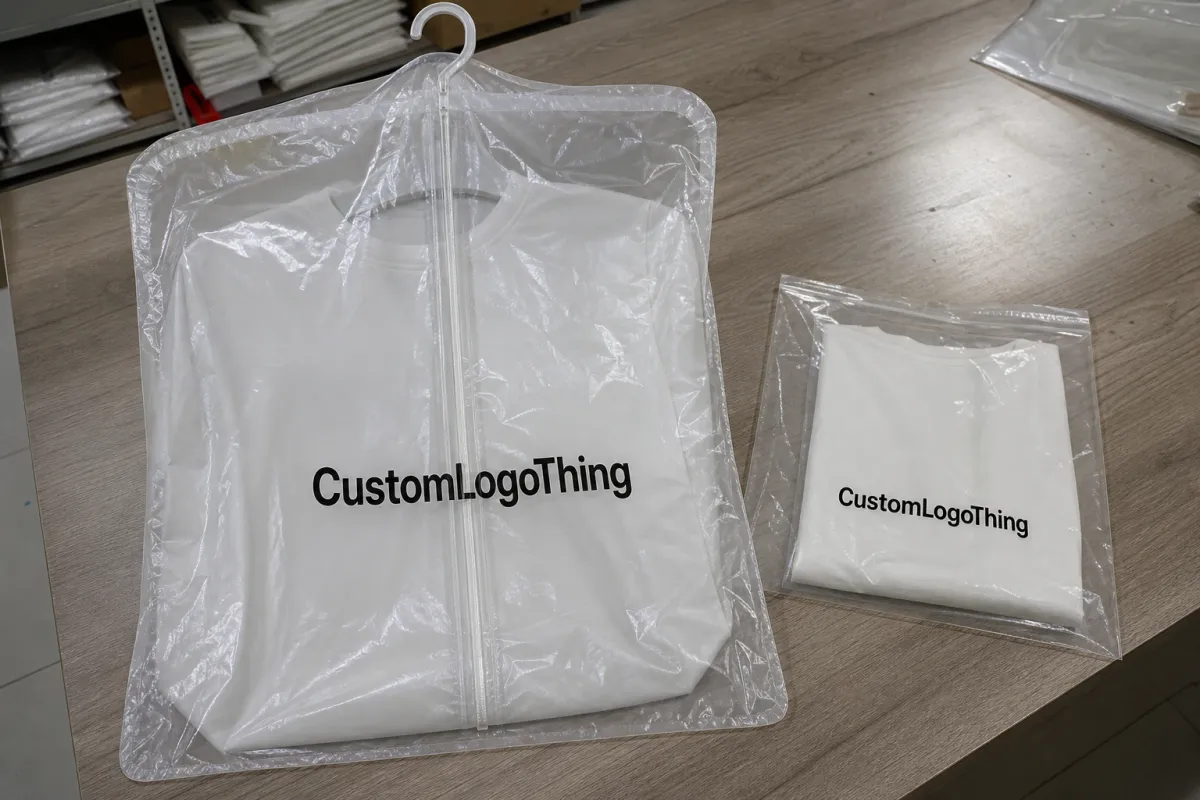
Most bulk mistakes come from spec drift, not from the material itself. One buyer says “clear garment bag,” another says “for coats,” and the supplier fills in the blanks. That is how a quote looks attractive on paper and wrong in the warehouse.
Planning well keeps three things aligned before the price is locked: fit, protection, and freight. Fit keeps the garment from bunching or rubbing. Protection keeps dust, moisture, and handling damage down. Freight matters because a bag that ships flat, nests well, and packs efficiently can save more than a tiny change in unit cost ever will.
The use case should drive the spec. Retail buyers need a bag that presents well on the rack. Uniform programs need repeatable sizing and easy labeling. Event teams often need fast sorting and easy access. Storage programs care most about dust resistance and consistent sealing.
If the supplier has to guess the garment length, closure type, or finish, you are not buying a bag. You are buying a problem with a unit price.
Good planning also makes supplier comparisons fair. Without a locked spec, one factory quotes a thin bag, another quotes a heavier version, and both look “cheap” until you compare apples to apples. That is where buyers get burned.
Pick the right bag style, closure, and finish for the job
The bag structure should follow the garment, not the other way around. A flat bag is fine for slim pieces and short-term protection. A gusseted bag gives the garment more breathing room, which matters for coats, jackets, uniforms, and bulky retail items. If you force a thick coat into a flat bag, the seams work harder and the bag looks cramped from day one.
Closure choice changes the whole user experience. Zippers are common for storage and retail because they feel secure. Snap closures are useful when speed matters and the bag opens often. Flap or fold-over closures can work for lighter programs, but they are not the answer for every order just because they are cheaper.
- Flat bags: better for slim garments and tighter packing.
- Gusseted bags: better for coats, suits, and heavier fabrics.
- Zipper closure: stronger seal, better for storage and retail presentation.
- Snap or flap closure: simpler opening, useful for frequent access programs.
- Clear finish: best when the garment needs to be seen quickly.
- Frosted finish: better when you want a softer premium look and less fingerprint visibility.
Thickness is where buyers either save money or make a false economy. Light display use may only need about 0.15-0.20 mm PVC, while heavier coats and repeated handling often need 0.22-0.30 mm or more. The right level depends on garment weight, shipping method, and how often the bag will be opened.
Print placement matters more than people think. A logo near the upper front panel reads well on the rack. A logo that sits too low disappears behind the garment. Handles, hang holes, and hanger access cutouts also change how the bag performs during packing and in transit. Those details are functional, not decorative.
Specs that decide fit, strength, and print quality
The quote should not start until the core fields are locked. If any of these are loose, the factory fills in its own version, and the order drifts:
- Finished dimensions: width, length, and gusset depth if used.
- Material thickness: stated in mm or microns, but pick one unit and stay with it.
- Seam style: heat-sealed, stitched, bound edge, or reinforced corners.
- Closure type: zipper, snap, flap, or custom opening.
- Color and transparency: clear, frosted, tinted, or fully branded.
- Print method and coverage: one-color logo, full-panel print, or spot branding.
Fit tolerance deserves attention. Garments vary by hanger shape, shoulder width, and fabric bulk, so a bag that looks right on a flat drawing can still fail in use. Ask what cut tolerance the supplier holds on the finished size, and whether the sample is made with the same production method as the mass order. A difference of 5-10 mm may sound small until the zipper is tight on a coat sleeve or the hem drags at the bottom.
Quality markers show up in the little things. Seam reinforcement keeps stress from tearing the corners. Edge trimming keeps the bag from feeling ragged. Zipper alignment matters because a crooked zipper looks sloppy and can snag. Scratch resistance matters too, especially on clear or glossy PVC where scuffs are visible fast.
Artwork files should be clean and simple. A crisp vector logo prints better than a low-resolution image. Keep the branding where it will read clearly on the packed bag, not just on a mockup. If the order is for premium retail, the finish should support that look. If it is for storage or back-of-house use, do not pay for a presentation finish that nobody will see.
If you want a faster quote, send the same information every time and keep it consistent with the format in our FAQ. That reduces back-and-forth and cuts the chance of a wrong assumption.
Pricing, MOQ, and quote variables that change the landed cost
MOQ is where many buyers get caught. A lower MOQ often costs more per unit because setup time, cutting, printing, and packing are spread across fewer pieces. A higher MOQ lowers the unit price, but only if the quantity fits real demand. Extra stock is not a bargain if it sits for months and eats warehouse space.
For ceramic PVC Garment Bags, price usually moves with bag size, thickness, print complexity, closure hardware, packing method, and shipping terms. A plain clear bag with a simple cut is one thing. A printed gusseted bag with a zipper, reinforced seams, and retail-ready packing is another.
| Build option | Typical MOQ | Typical ex-factory unit price | Best use | Main tradeoff |
|---|---|---|---|---|
| Flat clear PVC, no print | 500-2,000 pcs | $0.85-$1.40 | Light storage, uniforms, basic protection | Less structure and fewer presentation features |
| Gusseted clear or frosted PVC, zipper closure | 1,000-3,000 pcs | $1.50-$2.90 | Suits, coats, retail display | Higher material use and slower production |
| Printed logo, hanger opening, reinforced seams | 2,000-5,000 pcs | $2.20-$4.20 | Branded retail programs | Artwork prep and closer quality control |
| Heavy-duty coat bag with special hardware | 3,000+ pcs | $3.50-$6.00 | Premium outerwear and long-term storage | Highest freight pressure and inventory risk |
Those numbers are a working range, not a promise. Freight, duty, and domestic delivery can add a lot, especially on bulky or low-density cartons. If you are quoting landed cost, ask for the unit price, carton count, carton size, gross weight, and shipping term in the same line. EXW, FOB, and DDP are not interchangeable.
Here is the quote checklist worth sending in one thread:
- Exact finished dimensions and closure type.
- PVC thickness and whether it is clear or frosted.
- Print method, logo size, and number of colors.
- Packing method, pieces per carton, and carton dimensions.
- MOQ at 2-3 quantity tiers so the price break is visible.
- Shipping term and destination zip or port.
Where can you save without hurting function? Usually on print coverage, overbuilt hardware, and unnecessary premium finish. Where should you not cut corners? Size, seam strength, and closure quality. Those are the parts customers actually touch.
Process and lead time from sample approval to final shipment
The cleanest production flow is straightforward: inquiry, spec review, sample, approval, mass production, packing, and dispatch. The trouble usually starts when the artwork arrives late or the sample gets revised three times because the buyer never locked the dimensions. That is how a 2-week job turns into a 5-week scramble.
- Inquiry and spec review: 1-2 business days if the buyer sends complete details.
- Sampling: often 5-10 business days, depending on tooling and print setup.
- Approval and production slot booking: can move fast if the sample is final.
- Mass production: commonly 10-20 business days for standard custom runs.
- Packing and dispatch: 2-5 business days before freight pickup.
Custom printing, special hardware, or tighter packing requirements extend that timeline. So does peak-season congestion. If the supplier already has a queue, your job sits behind it. Buyers who need the order for a launch, store opening, or uniform rollout should build in buffer time instead of assuming the best-case schedule will happen.
For transit testing, ask whether the packed cartons are checked against ISTA distribution standards. That matters if the bags are traveling far, stacking high, or moving through rough handling points. If the outer cartons or inserts use paperboard, ask for FSC-certified materials where it fits your procurement policy.
The more precise the spec and the cleaner the approvals, the less schedule padding you need. Vague specs create guesswork. Guesswork creates extra samples. Extra samples create delays.
What to check before you trust a supplier with the full run
The supplier proof that matters is not a glossy brochure. It is consistency. Ask for a sample that matches the quoted spec, then compare that sample against the written sheet. If the sample and the sheet disagree, fix it before you place the full run.
The common failure points are predictable: weak seals, off-size production, inconsistent transparency, sloppy packing, and zipper placement that wanders from piece to piece. One bad part can ruin the perception of the whole batch. Buyers can usually forgive a minor cosmetic issue. They do not forgive a garment bag that tears or arrives wrong-sized.
Communication is the real stress test. If the supplier answers quickly, repeats the spec back correctly, and flags a risk before production starts, that is useful. If they only promise that “it will be fine,” keep your hand near the brakes. A boring supplier who documents everything is usually safer than a charming one who improvises.
Ask for these service details before approval:
- Pre-shipment photos: to verify the final packing state.
- Carton labels: size, quantity, lot number, and destination.
- Defect-handling policy: what counts as a replacement or credit.
- Sample retention: one approved piece kept as the production reference.
- Material control: confirmation that the run uses the agreed PVC thickness and closure type.
If you need repeat purchasing or a broader sourcing structure, our Wholesale Programs page shows how larger orders are typically handled. That is usually where buyers get a better view of tiered pricing and repeat-run planning.
The best supplier is not the one with the loudest promise. It is the one who can repeat the same spec, piece after piece, without improvising.
Next steps to place a ceramic PVC garment bags bulk order
If you want a clean quote, send the supplier the information that actually matters. Not a vague note. A real package of details. That is how planning stays efficient and avoids the back-and-forth that burns days.
- Send the finished dimensions, including gusset depth if needed.
- State the quantity and any target quantity tiers for comparison.
- Choose the closure type, thickness target, and finish.
- Attach logo files in vector format if print is required.
- Specify the delivery address, shipping method, and deadline.
- Ask for a sample or spec proof before approving the full run.
Also confirm the one thing that gets overlooked too often: whether the quote includes packing details. Pieces per carton, carton size, and shipping term change the real cost more than a lot of buyers expect. A unit price that looks good can still be the wrong deal if the cartons are oversized or the freight class is poor.
Before you sign off, compare three numbers side by side: MOQ, unit cost breaks, and production slot. If one supplier is cheaper but pushes the slot out by three weeks, that cost is not really cheaper for a launch or seasonal program. Time has a price.
ceramic pvc garment bags Bulk Order Planning works best when the buyer locks specs first and chases price second. Do that, and the order usually lands cleaner, packs faster, and creates fewer surprises for everyone who handles it after the invoice is paid.
FAQ
How do I plan a ceramic PVC garment bag bulk order without overbuying?
Start with actual garment counts by size and use case, not a rough guess. Add a small overage only for damage, returns, or replacement stock. Then ask the supplier to price the same spec at two or three quantity tiers so you can see whether the savings justify the extra inventory.
What specs should I finalize before requesting a ceramic PVC garment bags quote?
Lock the bag dimensions, PVC thickness, closure type, and whether the bag is clear or frosted. Confirm print requirements, logo placement, and added features like handles or hanger openings. Share packing and shipping needs so the quote reflects the full landed cost, not just the unit price.
What MOQ should I expect for ceramic PVC garment bags bulk pricing?
MOQ varies by size, thickness, and printing complexity, so there is no honest one-size answer. Higher MOQ usually lowers unit cost, but only if the quantity matches your actual demand. If the factory gives several tiers, compare the price drop against the inventory risk.
How long does production usually take after sample approval?
Lead time depends on customization level, order size, and the factory queue. Simple unprinted orders usually move faster than printed or hardware-heavy versions. Ask for a written schedule with sample approval, production start, and shipment windows so everyone is working from the same timeline.
Can ceramic PVC garment bags be adjusted for longer coats or bulky items?
Yes, but longer or bulkier garments usually need revised dimensions or gusseted construction. Tell the supplier the longest item height and the widest shoulder point, not just the hanger length. A fit-check sample is the easiest way to avoid a run of bags that looks right and fits wrong.

