Buyer Fit Snapshot
| Best fit | Plastic Envelope Supplier projects where brand print, material claims, artwork control, MOQ, and repeat-order consistency need to be specified before quoting. |
|---|---|
| Quote inputs | Share finished size, material target, print colors, finish, packing count, annual reorder estimate, ship-to region, and any compliance wording. |
| Proofing check | Approve dieline scale, logo placement, barcode or warning zones, color tolerance, closure strength, and carton packing before bulk production. |
| Main risk | Vague material claims, crowded artwork, missing packing details, or unclear freight terms can make a low unit price expensive after revisions. |
Fast answer: Plastic Envelope Supplier: Material, Print, Proofing, and Reorder Risk should be specified like a repeatable production item. The safest quote records material, print method, finish, artwork proof, packing count, and reorder notes in one written spec.
Production checks before approval
Compare the actual filled-product size with the drawing, then confirm tolerance on folds, seals, hang holes, label areas, and retail display edges. Reserve space for logos, QR codes, warning copy, and material claims before decorative graphics fill the panel.
Quote comparison points
Review material grade, print process, finish, sampling route, tooling charges, carton quantity, and freight assumptions side by side. A quote is only useful when the supplier can repeat the same color, closure quality, and packing count on the next order.
A lightweight order can still show up with a bent corner, a scuffed finish, or a wet label if the packaging is wrong. That is why a plastic envelope supplier matters early in the packaging decision. The right mailer is not just a pouch that holds a product. It is the barrier that keeps the item clean, dry, and presentable from the packing bench to the customer’s hands.
What a Plastic Envelope Supplier Does
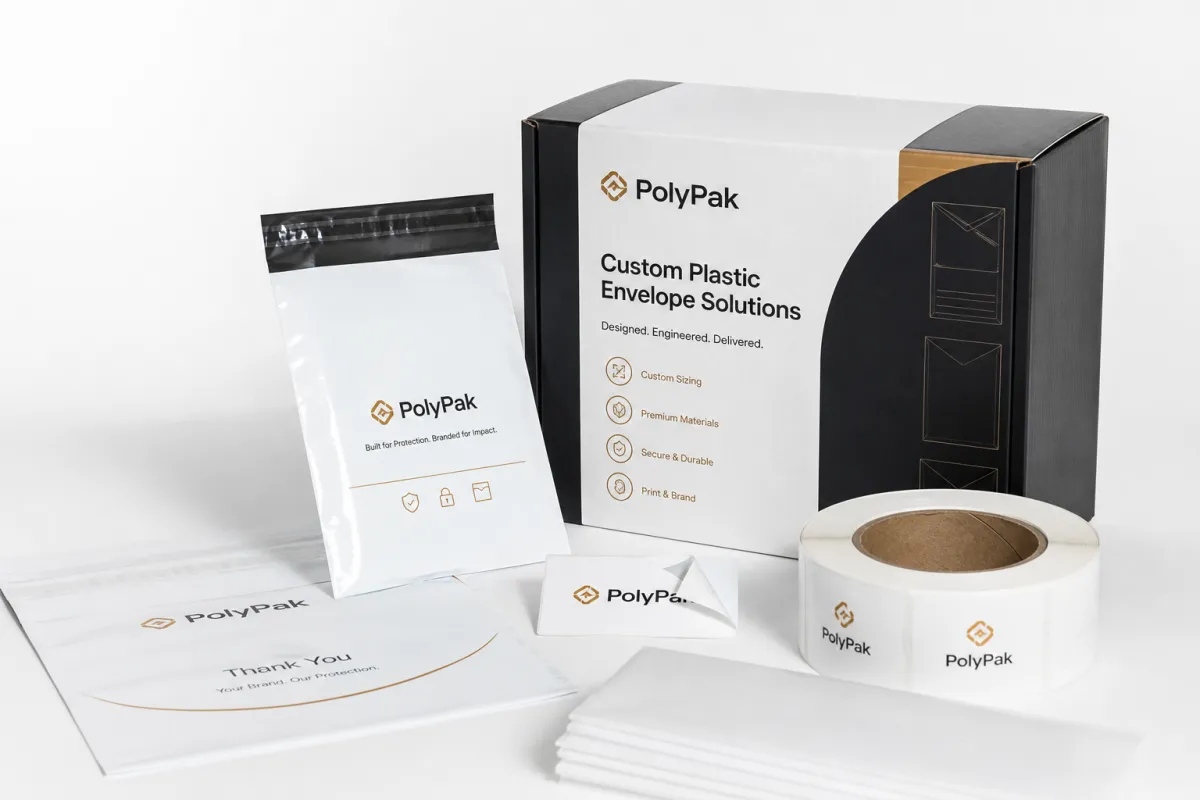
A good plastic envelope supplier does more than quote a size and disappear. The real job is to match film structure, thickness, seal style, and print method to what is actually being shipped. A soft apparel order and a box of spare parts do not behave the same way inside a mailer. One may need privacy and a polished retail look. The other may need puncture resistance, stronger sealing, and extra slack for awkward edges.
From a packaging buyer’s point of view, the supplier should help answer practical questions fast. Is the film low-density polyethylene, high-density polyethylene, or a layered blend? Is the closure a simple pressure seal, a tamper-evident strip, or a stronger adhesive flap? Does the bag need to be opaque, clear, recycled-content, or coextruded for better toughness? A plastic envelope supplier that understands those choices can save a team from ordering the wrong format just because the dimensions looked close on paper.
The difference between stock and custom matters too. Plain stock poly mailers are usually the fastest path for standard apparel, small accessories, and internal transfers. Custom or specialty envelopes can add brand color, logo placement, printed warnings, return instructions, tamper evidence, or finishes that make the package feel intentional instead of generic. The best plastic envelope supplier will walk you through those options without pushing features you do not need.
Good suppliers also fit into the broader packaging workflow. That means reviewing samples, confirming fit, checking seal performance, approving artwork, and planning reorders before inventory gets tight. If a team ships 500 parcels a day, even a small change in film stiffness or bag width can affect packing speed. The supplier should think about operator comfort as well as product protection. Shipping is not a vibe-based activity. It is a fit-and-repeat process, and the details matter.
As a simple rule, a supplier should be able to answer the following without hesitation:
- Material composition and whether the film is mono-layer or coextruded
- Thickness range, often stated in mil or microns
- Seal reliability and whether the closure is suited to the shipping route
- Load limits and puncture resistance
- Whether the envelope is better for retail, e-commerce, or internal distribution
That is the difference between a vendor and a useful plastic envelope supplier.
How a Plastic Envelope Supplier Handles Process and Timeline
The order path is usually straightforward, but it helps to know where delays show up. A buyer sends a request, a plastic envelope supplier reviews the product details, and the spec gets narrowed down before production begins. The cleaner the starting information, the less back-and-forth later. If the product is 9 inches by 12 inches but arrives with a folded edge card or a sewn garment label, that detail changes the mailer choice more than many people expect.
At the inquiry stage, the supplier should ask for dimensions, weight, shipping method, print needs, quantity, and any performance concerns such as puncture, moisture, tampering, or stretch. Those details matter because a mailer that works for a light textile may fail for a boxed accessory with hard edges. A practical plastic envelope supplier will also ask about packing speed, because a mailer that protects well but slows the line may not be the right fit for a high-volume operation.
Sample and proof stages are where expensive mistakes get caught early. Physical samples reveal fit issues that screenshots can hide. A 12 x 15 bag might look fine in a quote, but once the item is inserted, the seal flap could be too short or the material could be too glossy for clean branding. Print proofs matter too because ink density, white underprint, and surface sheen can change how readable the logo looks on the finished bag. A solid plastic envelope supplier will welcome that review rather than rushing it.
Lead time depends on what is being ordered. Stock products can move quickly, often within a few business days if inventory is available. Custom Printed Mailers, special colors, recycled blends, or nonstandard construction usually need more time for setup, press work, and drying or curing. In many programs, a realistic custom timeline is 12-20 business days after proof approval, and freight can add more depending on origin and destination. That timeline is not a flaw. It is simply how a good plastic envelope supplier manages production properly.
Handoff details also affect delivery. Carton counts, pallet pattern, labeling, and freight method all change the way a shipment lands at the warehouse. If a buyer is planning a promotion or seasonal surge, it helps to leave room for proof revisions and transit time. The suppliers I trust most put those details in writing early, because a plastic envelope supplier that is clear about logistics usually prevents a lot of last-minute stress later.
For teams that want a baseline for packaging testing, the ISTA standards are a useful reference point. They are not a substitute for a real pack-out trial, but they do give structure to drop, vibration, and transit checks. A supplier does not need to turn every project into a lab exercise, yet a dependable plastic envelope supplier should be comfortable discussing how the mailer will behave under shipping stress.
Key Factors That Shape Material, Size, and Performance
Material choice is usually the first technical decision, and it deserves more attention than it gets. Polyethylene is the base material for most mailers, but the grade and structure change the behavior a lot. Low-density polyethylene tends to feel softer and more flexible, while high-density polyethylene is stiffer and often gives better puncture resistance for its weight. Many suppliers use coextruded film, which layers materials together so the envelope can balance toughness, print quality, and seal performance. A thoughtful plastic envelope supplier should be able to explain those tradeoffs in plain language.
Size should be based on the packaged product, not just the bare item. Leave space for insertion, product thickness, and a clean seal allowance. If the envelope is too small, operators force the product in, the seal gets stressed, and the final package looks wrinkled or distorted. If it is too large, the item slides around and the package feels sloppy. That is why a good plastic envelope supplier usually recommends testing at least one sample with the actual product, not a flat mock-up.
Thickness matters, but thicker is not automatically better. A 2.5 mil film may be right for a soft shirt, while a 4 mil or heavier structure may be more suitable for a sharp-edged kit, sample pack, or item that travels through rougher freight handling. More thickness raises material cost and can slow packing if the mailer feels stiff, so the right answer is the one that protects the product without overbuilding it. That balance is something a practical plastic envelope supplier should help you tune.
Other performance details show up only after the package enters the real workflow. Puncture resistance matters for corners and hardware. Tear behavior matters if the envelope is opened and resealed internally. Moisture barrier matters for outdoor handoff, rainy docks, and delivery systems where parcels sit on wet surfaces. Opacity matters if the contents should stay private or if the branding needs a cleaner visual field. Some programs also ask for static control, especially for sensitive electronics, though that is a more specialized use case. A reliable plastic envelope supplier should know where the boundary is between a general mailer and a more technical protective envelope.
Branding deserves its own thought. Clear film can show the product through the package, which is useful for certain retail programs, but it can also make minor product imperfections more visible. Glossy film can make colors pop, while matte surfaces often reduce glare and improve logo readability under warehouse lighting. Ink adhesion, surface treatment, and color density all affect the final look. If branding is central to the shipment, the plastic envelope supplier should talk through how the print will hold up during handling, stacking, and transit.
"The cheapest mailer is rarely the cheapest outcome if it slows the line, tears in transit, or makes the brand look careless at the doorstep."
That is one reason suppliers who understand packaging operations are valuable. They help match the material to the job instead of selling the heaviest film by default.
Plastic Envelope Supplier Pricing: What Drives Cost
Pricing is usually where buyers focus first, but the quote only makes sense if the spec is consistent. A plastic envelope supplier will price the job based on thickness, raw material type, print coverage, color count, size, order volume, and any special features like tamper evidence or stronger adhesive. Those are the levers that move the number up or down. A one-color logo on a standard white mailer is a very different job from a full-coverage custom print on a thicker coextruded film.
Volume matters a lot. Smaller runs almost always cost more per unit because setup, tool adjustment, press time, and waste are spread over fewer pieces. Larger orders usually bring the unit price down, but only if the buyer can use the inventory without tying up cash or storage space for too long. A practical plastic envelope supplier will help estimate the sweet spot instead of steering every customer into the biggest possible order.
Quote price and landed cost are not the same thing. Freight, palletization, carton configuration, warehousing, and any secondary packaging all affect what the mailer really costs once it reaches the dock. A low unit price can look attractive, then disappear once transport and handling are added. That is why a buyer should ask every plastic envelope supplier to quote the same size, the same thickness, the same print spec, and the same delivery terms before making a decision.
| Option | Typical Use | Indicative Unit Range | Lead Time | What Drives the Cost |
|---|---|---|---|---|
| Stock plain poly mailer | Basic e-commerce or internal shipping | $0.06-$0.14 | 2-7 business days | Inventory availability, size, thickness |
| Custom printed mailer | Retail branding and customer-facing shipments | $0.10-$0.28 | 12-20 business days | Artwork coverage, color count, setup time |
| Heavier-duty coextruded mailer | Sharper edges, more transit abuse | $0.12-$0.30 | 10-18 business days | Film layering, puncture resistance, material grade |
| Tamper-evident envelope | Security-sensitive shipments | $0.14-$0.34 | 12-22 business days | Closure design, security features, print complexity |
| Recycled-content mailer | Brand and sustainability programs | $0.11-$0.32 | 12-24 business days | Feedstock availability, film consistency, testing |
The table above is only a working range, not a promise. Still, it helps a buyer see why one plastic envelope supplier quote may look lower on paper while the real cost ends up higher in shipping or handling. A mailer that fails in packing can create returns, rework, and damage claims, which is where the “cheap” option becomes expensive fast.
For teams managing sustainability claims, the EPA recycling guidance is a useful starting point for understanding disposal and recycling language. A supplier should never overstate environmental claims, and buyers should ask for clarity on recycled content, resin type, and end-of-life instructions. A careful plastic envelope supplier will help keep those claims accurate and defensible. If someone starts tossing around broad green claims without backing, that is a red flag, plain and simple.
Step-by-Step: Choosing the Right Poly Mailer Spec
The cleanest way to choose a mailer is to start with the shipment, not the packaging catalog. What is the item, how fragile is it, and is it going to a customer, a retail store, or another facility? A plastic envelope supplier can only narrow the field well if the product use case is clear. A soft garment, for example, tolerates a lighter and more flexible bag than a boxed accessory with edges that can press through thin film.
Next, measure the product in its packed form. That means accounting for folds, inserts, tags, and anything else that changes the final footprint. Add room for insertion and a secure seal, but do not leave so much extra space that the package balloons or slides around. This is a place where sample testing matters, because a plastic envelope supplier can recommend a nominal size, but only the actual pack-out shows whether the fit is comfortable for the operator and protective for the item.
After that, choose the material profile. Flexible film often works well for apparel and light goods because it packs quickly and keeps material cost sensible. Tougher film is better for sharper edges or more challenging freight handling. Higher-opacity film can hide the contents and make the brand presentation look cleaner. If the mailer needs a logo, decide on the print zone, ink color, and whether the design should run on one side or both. A strong plastic envelope supplier will confirm that those choices remain consistent at the order volume you need.
Closure style comes next. A standard peel-and-seal flap works well for many e-commerce programs, but tamper-evident closure is better when security matters. Some operations also want a second adhesive strip for returns or internal reuse. The point is not to add features just because they exist; it is to align the bag with how the package will actually move through the business. That is where a thoughtful plastic envelope supplier earns its keep.
Finally, test the spec in the real workflow. Have the packing team use the sample at production speed. Stack a few finished units. Put them through the same mail stream that the final order will see. If the package still looks clean after handling, the spec is probably close. If it wrinkles badly, opens too easily, or feels awkward to pack, revise it before the full run. A disciplined plastic envelope supplier should be comfortable with that kind of validation because it protects both sides of the order.
My honest view is that this step-by-step process saves more money than chasing a tiny unit-price reduction. A mailer that fits, seals, prints well, and packs quickly is worth more than one that only looks good in a quote.
Common Mistakes When Working With a Plastic Envelope Supplier
The first mistake is choosing on price alone. A low quote can hide weak film, poor adhesive performance, or print that does not hold up in handling. Once the packing team starts fighting the bags, the labor cost climbs and the savings disappear. A good plastic envelope supplier should be evaluated on total performance, not just the headline number.
The second mistake is ordering a size that is too tight. An undersized mailer strains seals, creates a wrinkled appearance, and slows the line because operators must push the product into place. That also raises the chance of split seams and returns. A more experienced plastic envelope supplier will usually recommend testing one size up if the product is soft, bulky, or inconsistent in shape.
The third mistake is vague specifications. If thickness, opacity, adhesive strength, artwork placement, or finish are not written clearly, the quote may still look fine while the delivered product misses the mark. “Looks similar” is not a reliable packaging spec. A strong plastic envelope supplier will ask for exact details because a few missing words can change the production outcome completely.
The fourth mistake is skipping sample testing. Paper specs are useful, but they do not tell you how the bag behaves when a packed item slides into it, how the seal sounds when it closes, or whether the print smears under normal warehouse handling. I have seen many teams assume a mailer will work because the numbers looked right, then discover the fit issue only after cartons arrive. That is a frustrating and avoidable problem with the wrong plastic envelope supplier.
The fifth mistake is ignoring lead time until the last minute. Promotions, seasonal peaks, and product launches compress the schedule quickly. If proof approval is delayed or artwork needs correction, the order can slip past the window. A reliable plastic envelope supplier should give a timeline that includes proofing, production, and freight, not just the manufacturing portion.
Here is the part people sometimes miss: packaging mistakes are often slow leaks, not dramatic failures. The package does not collapse every time. It just creates a little more labor, a little more waste, and a little less confidence with every shipment. That is why working carefully with a plastic envelope supplier pays off long after the first order ships.
Expert Tips for Better Orders and Cleaner Packaging
One of the simplest ways to improve repeat orders is to keep a spec sheet for every mailer size. List the finished dimensions, material, thickness, closure type, print file name, carton count, and the approved sample reference. That document saves time every time you reorder, especially if more than one person touches purchasing. A well-organized plastic envelope supplier will appreciate it too, because it reduces the chance of a production mismatch.
Ask for three kinds of samples whenever the mailer will represent the brand directly: a material sample, a production sample, and a print proof. Material samples show feel and stiffness. Production samples show how the bag is made under real manufacturing conditions. Print proofs show color, placement, and legibility. A responsive plastic envelope supplier should be able to guide you through all three without making the process feel heavier than it needs to be.
Talk about operating conditions, not just product dimensions. Packing speed, warehouse temperature, dust, humidity, and freight handling can all affect the result. A film that performs fine in a controlled room may feel different in a cold dock area or during summer transit. If your team ships on multiple shifts, say so. A good plastic envelope supplier can often recommend a closure and film style that behaves more predictably across those conditions.
Service depth matters more than a fast quote. Anyone can send a number quickly, but the real value is in spotting issues before production starts. If the artwork bleed is wrong, the adhesive seems too weak for the route, or the bag size is slightly off, a practical plastic envelope supplier will say so early. That kind of feedback often prevents costly reprints and rework.
Ordering a little earlier is usually cheaper than rushing. The extra time makes it easier to fine-tune sizing, approve artwork carefully, and avoid freight surcharges. Even a few days of buffer can turn a stressful order into a clean one. Honestly, that is one of the easiest habits to build with a plastic envelope supplier: give the process enough room to be done properly.
Here are a few quick habits that help teams get cleaner results:
- Keep one reference sample for every approved spec
- Measure products in packed form, not loose form
- Ask for the same quote basis from every plastic envelope supplier
- Confirm freight terms before approving the order
- Test the mailer at real packing speed, not just on a desk
The best packaging programs usually look boring from the outside because all the hard decisions were made before the order hit production. That is a good sign. Boring, in this case, means controlled.
Next Steps: Shortlist and Request Samples
Start by building a shortlist of suppliers that can quote the same exact spec clearly and explain their timeline without guesswork. If one plastic envelope supplier gives a vague answer and another can describe material, thickness, closure, and print method in plain language, the second one is usually the safer place to start. Clear communication is often the best early signal that the production order will go smoothly.
Then request samples that match the real use case. A display sample can look nice, but it may not reveal how the mailer behaves with your actual product. Use the product, the same packing team, and the same shipping method you plan to use in production. If the sample fails, that is useful information, not a setback. A good plastic envelope supplier will treat it that way.
Compare quotes on the same basis. Same size. Same thickness. Same print coverage. Same quantity. Same freight method. Once those variables are aligned, the real differences become visible: fit, consistency, durability, and service depth. That is how a buyer sees whether a plastic envelope supplier is merely inexpensive or truly valuable.
After the spec is approved, document everything. Keep one master reference sample, the approved artwork file, and the reorder point that tells you when to buy again. That small habit reduces emergency buys and helps the next order land on time. It also makes life easier for anyone else on the team who needs to place the purchase later with the same plastic envelope supplier.
The takeaway is simple: choose a supplier that can prove the mailer works in your operation before you commit to volume. A polished quote is nice, but a mailer that packs cleanly, protects the item, and arrives looking right is what really matters. If you want a practical filter, ask for the same spec, the same sample test, and the same freight terms from every plastic envelope supplier you compare. That way, you are judging the packaging, not the sales pitch.
FAQ
What should I ask a plastic envelope supplier before getting a quote?
Ask for material type, thickness, size options, closure style, and whether the mailer is stock or custom. Confirm minimum order quantity, lead time, freight method, and sample availability. If you want to compare a plastic envelope supplier fairly, request each quote on the same exact spec so the numbers mean the same thing.
How do I know which poly mailer size to choose?
Measure the product in its packed form, not just the bare item. Leave room for easy insertion and a secure seal without excessive empty space. If the item is soft, irregular, or prone to shifting, test it with samples before you settle on the final size. A good plastic envelope supplier should be comfortable helping you validate that fit.
Is thicker film always better from a plastic envelope supplier?
Not always. Thicker film costs more and can be harder to pack quickly. Choose thickness based on puncture risk, product weight, and shipping conditions, then balance protection with usability. A practical plastic envelope supplier will usually recommend the lightest structure that still performs properly.
How long does it usually take to produce custom poly mailers?
Stock items are usually faster than custom printed orders. Custom artwork, special colors, and unique material specs add setup and production time, and freight time still has to be included. Ask the plastic envelope supplier for a timeline that covers proof approval, manufacturing, and transit so you can plan with fewer surprises.
How can I compare plastic envelope supplier pricing more accurately?
Make sure every quote is based on the same size, thickness, print coverage, and quantity. Include freight, palletization, and any packaging or handling charges in the comparison. The best way to judge a plastic envelope supplier is to compare value, not just unit price, by factoring in quality, damage reduction, and reorder reliability.
Related packaging resources
Use these related guides to compare specs, costs, quality checks, and buyer decisions before making the final call.


