Buy Custom Woven Size Labels: Specs, Costs, and Timing
custom woven size labels look small on a tech pack, but they do real work. A label that scratches, curls, or reads badly can create complaints faster than a misaligned print on a hangtag. A label that is too large can irritate the wearer or distort a clean neckline. And a label that gets the size wrong can create the oldest kind of inventory problem: product that is physically fine and commercially awkward.
That is why buyers usually stop treating size labels as a last-minute trim item after the first production mistake. Woven construction gives the size mark a firmer, more durable structure than a printed tag, and that matters on garments that go through repeated wash cycles. It also gives the brand a more finished look. A plain size marker can still feel deliberate if the weave, edge finish, and placement are specified correctly.
The catch is that the spec is doing more work than most people expect. Fabric type, garment stretch, fold style, size system, weave density, and order quantity all affect the final result. A label that works on a heavyweight tee can feel too stiff in a soft knit. A label that reads cleanly in a proof can look crowded once it is woven in thread. The devil is not in the concept. It is in the thread count, the edge treatment, and the usable space inside the garment.
What Custom Woven Size Labels Do on Garments
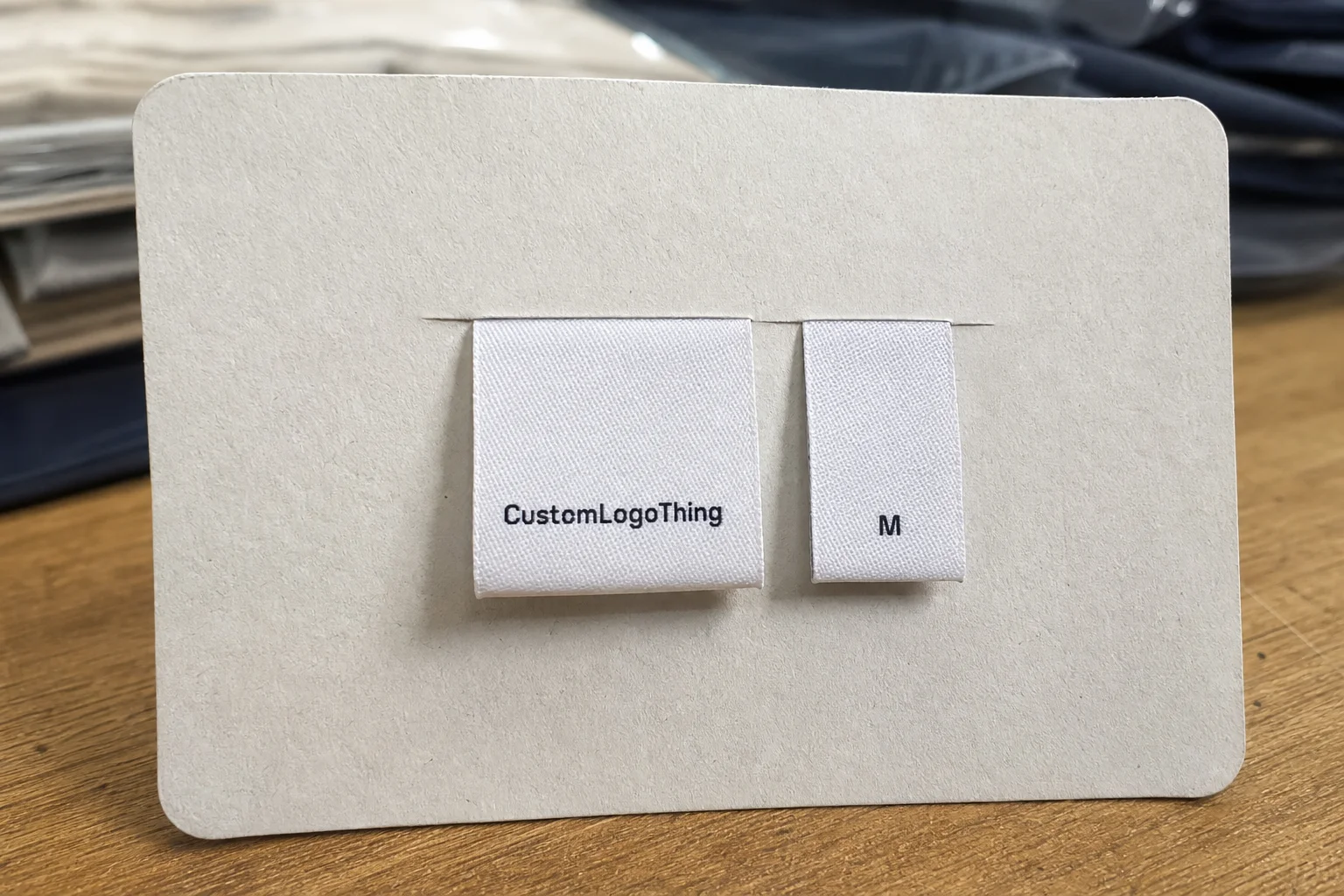
A size label has three jobs. It identifies fit. It supports the garment’s presentation. It reduces confusion after purchase. Those are simple functions, but they matter more than many teams realize because the size label is one of the few product elements every customer touches and reads directly.
On premium basics, children’s clothing, sportswear, and repeated-wash garments, woven labels usually hold up better than printed alternatives. The woven structure resists fading and keeps its shape longer, which helps if the product is meant to survive a season or two instead of a few wear cycles. Printed labels can still make sense for soft hand-feel priorities or short runs, but they are more vulnerable to wear and wash friction.
Buyer behavior is uneven here. Some brands obsess over packaging and ignore the label hidden inside the collar. Others spend too much on decorative trim and then under-spec the size marker. Both approaches are backwards. The size label is not a brand flourish. It is a functional component that customers rely on, and a bad one is noticed immediately.
“A logo can be forgiven. A size cue cannot. If the size marker is unclear or uncomfortable, the customer notices before they notice anything else.”
In practice, the best label is the one that disappears into the wearing experience without disappearing from view. It should be readable in normal lighting, soft enough for the garment class, and durable enough to survive the wash test. Some brands standardize size labels across an entire line to keep production simple. Others use separate specs for men’s, women’s, youth, and performance products. The right choice depends less on design theory than on how the assortment actually sells.
How Woven Size Labels Are Built and Attached
Woven size labels are made by weaving yarn into the label pattern rather than printing ink onto a flat substrate. That difference changes the final feel immediately. The edges are usually cut or folded after weaving, and the label is then sewn into the garment or applied as part of a trim system. If the order includes branded neck labels, care labels, and size markers together, the whole set should be planned as one system rather than three separate purchases.
Attachment method matters as much as the label construction. Sew-in labels are the default for most apparel because they are reliable and durable. Side-seam placement is common when brands want a cleaner neck area. Neckline placement is typical on tops, while kids’ wear and activewear often need a softer hand and a smaller footprint to reduce irritation. A good placement on a rigid knit can become a poor placement on a stretch fabric, so the garment substrate needs to be part of the decision.
Weave density controls how much detail the label can hold. Tighter weaves support smaller text and cleaner numerals, but they may feel a little firmer. Looser constructions can feel softer, though they limit how much information remains sharp at small scale. That tradeoff is easy to miss if the buyer only reviews a digital proof. On screen, the layout looks crisp. In thread, the spacing, contrast, and density determine whether the size reads instantly or turns into visual clutter.
Woven labels are not the only viable option. Printed satin labels can work for delicate garments, and heat-applied versions reduce sewing steps in some production lines. Still, woven construction tends to win where abrasion resistance and a more polished finish matter. For brands trying to keep the trim system consistent across apparel, bags, and accessories, that consistency often justifies the extra specification work.
If the label is part of a broader trim program, it helps to think beyond a single order and keep it aligned with the full Custom Labels & Tags range. That keeps the sizing, branding, and production logic consistent across the line instead of drifting from one style to the next.
Cost, Pricing, and MOQ for Custom Woven Size Labels
Price is shaped by a handful of variables: order quantity, weave complexity, number of colors, fold style, backing, and whether the label is ordered alone or bundled into a broader trim package. Setup cost matters a lot on small runs. If a supplier has to program a custom weave for 500 pieces, the fixed cost gets spread thinly and the unit price rises fast. At larger quantities, the same setup cost is diluted, which is why the price drops as volume climbs.
For small runs, buyers often see prices around $0.10 to $0.30 per label, depending on size and finishing. At higher quantities, simple labels can move lower than that. MOQ is usually the real constraint. Some manufacturers are comfortable quoting at 5,000 or 10,000 pieces. Others will support a test run in the 500 to 1,000 piece range, but the unit cost will be higher. That is not a trick. It reflects the economics of loom setup, thread handling, and labor.
| Order Type | Typical Unit Cost | Common MOQ | Best Fit |
|---|---|---|---|
| Short-run woven size labels | $0.18-$0.30 | 500-1,000 pcs | Seasonal launches, test styles, small brands |
| Standard production run | $0.08-$0.16 | 3,000-5,000 pcs | Core products and repeat orders |
| High-volume program | $0.04-$0.10 | 10,000+ pcs | Established lines with predictable sell-through |
Always compare quotes on the same basis. Setup fees, sample charges, artwork revisions, shipping, and rush fees can change the real cost more than the quoted unit price. Ask whether one proof is included or whether each revision creates a charge. Ask whether the supplier treats a fold change as a new item. Those details are usually where a budget slips.
If the size labels are only one part of the order, bundling them with other trim or packaging pieces can reduce coordination overhead. That is useful when the same production window also includes hangtags, care labels, or other branded components. It is less about saving pennies and more about reducing the chance that one item arrives late and blocks the rest of the line.
For teams that also manage paper packaging, material standards like the FSC framework are worth knowing, and the Packaging School offers useful training for broader packaging systems. Neither sets woven label pricing, but both help teams think more clearly about materials, sustainability claims, and production workflows.
A practical rule works better than a slogan here: short-lived capsule? Keep commitment low and avoid overbuying. Core collection? Pay more attention to unit economics and reorder efficiency. The label strategy should follow the product strategy, not the other way around.
Production Steps, Timeline, and Lead Time
The usual sequence is straightforward: submit specs, approve artwork, review the proof, begin weaving, finish edges, inspect, pack, and ship. That sounds routine because it is. Routine is useful. Most production failures happen when a buyer rushes the proof or changes something after the order has already entered the queue.
Lead time depends on how clean the artwork is and how quickly approval moves. A simple woven size label on a standard order can often be completed in about 12 to 15 business days after approval. More detailed labels, unusual folds, or larger quantities can stretch the timeline to 3 or 4 weeks. Shipping time sits on top of that, and international freight can erase the benefit of a fast production slot if nobody planned for transit.
Three things cause most delays: incomplete artwork, unclear size information, and late changes to quantity or fold style. Another common problem is slow proof review. A label proof is tiny and easy to skim, but that is the wrong way to check it. If the artwork goes out with the wrong size designation, the mistake propagates through cutting, packing, and fulfillment.
Before sending payment, confirm when proofing starts, how many revision rounds are included, and whether production begins only after final approval. That sequence matters because some suppliers start the clock on file receipt, while others wait for approval. If the labels are tied to a garment production window, that distinction can decide whether the line ships on time.
Distribution logic matters here too. Standards organizations such as ISTA focus on packaging and transit stress because products often fail in shipping, not in theory. Labels have a similar reality: they are only useful if they arrive before the garment needs them.
Specs That Change Fit, Readability, and Durability
Width and height come first. A 1 inch by 1 inch label may be enough for a simple size marker, but a longer format may be necessary if branding and size live on the same piece. Fold style matters too. End fold, center fold, and loop fold all change how the label sits in the garment and how much edge material ends up against the skin.
Size formatting deserves more attention than it usually gets. Numeric sizing, letter sizing, youth sizing, and multi-size runs all create different layout demands. A clean “M” can work well in one collection and look wrong in another if the assortment uses numbers everywhere else. The label has to match the rest of the size system. If the product line is mixed, the label format should be deliberate rather than copied from the last order.
Durability depends on wash frequency, abrasion, skin contact, and the fabric around the label. Heavy cotton can tolerate a firmer label. Stretch knits and activewear often need a softer construction and a smaller footprint. Children’s apparel adds another layer of scrutiny because comfort complaints appear quickly, and parents notice a rough label the first time it rubs.
Readability is not just a font issue. It is a contrast issue and a spacing issue. Tiny numerals can disappear if the thread colors are too close together or the weave is too loose. A proof should be checked under daylight and indoor lighting, not just on a bright monitor. If the size is hard to read in normal light, the label is not ready.
Performance wear, childrenswear, and premium knits often need different label specs even if the size designation is identical. A label for a compression top should not be specified the same way as one for a heavyweight sweatshirt. The fabric behaves differently. The wearer feels the difference immediately.
| Garment Type | Recommended Label Approach | Why It Works |
|---|---|---|
| Performance wear | Smaller footprint, soft fold, high-contrast weave | Reduces abrasion and keeps sizing easy to read |
| Children’s apparel | Soft hand, clear numeral sizing, low-profile edges | Improves comfort and reduces parent complaints |
| Premium knits | Fine weave, balanced contrast, polished edge finish | Supports a cleaner presentation on elevated garments |
One more detail matters more than buyers expect: the label should be reviewed in the garment, not just as a standalone item. A label can meet the artwork spec and still fail once it is sewn into a narrow seam allowance or placed next to a stretch zone. The object in context is what matters.
Step-by-Step Guide to Ordering the Right Label
Start with the garment. Where does the label sit? How much abrasion will it see? How often will the item be washed? Does the product need a soft hand, or can it tolerate a firmer edge? Those answers cut the option set down quickly.
Next, build the brief. Confirm the size system, quantity, fold type, color palette, fabric style, and any branding elements that must stay consistent across the collection. If the same size label will appear across multiple styles, standardize the dimensions wherever the garment family allows it. That reduces future rework and makes reordering much easier.
Artwork should be restrained. Small labels do not have room for decorative extras. The most important element is the size itself, so the layout should protect that first. If a brand mark is included, it should not compete with the size marker. This is one of those cases where less information usually performs better than more information.
Request a proof and compare it against the garment mockup, not just the artwork file. A label can look balanced on a screen and still be too wide for the available seam area. Placement in context matters. This same discipline is used with custom printed boxes and other packaging pieces: the file can be correct while the physical object is wrong.
Do not approve until the size information is exact. Brand details matter, but the size cue is what customers depend on every day. If the label is part of a core line, archive the proof and the final spec sheet in one place. Future reorders run faster when the original decisions are easy to retrieve.
Common Mistakes and Expert Tips Before You Reorder
The most common mistake is specifying a weave that is too fine for the text. Buyers often want detail that thread cannot hold at the size they selected. The second mistake is underestimating MOQ and then discovering that the attractive unit price only applied at a volume the brand cannot use. The third is approving a layout without checking scale on the actual garment.
Another frequent error is treating every fabric the same. A label that sits neatly in a structured tee can feel rough or awkward inside a knit, especially after laundering. Seam placement matters. So does the fabric’s surface and stretch. A good label on the wrong garment is still the wrong label.
Three habits reduce waste and rework:
- Keep one master size chart across the line.
- Standardize label dimensions where the garment family allows it.
- Store approved proofs and final specs in one place for future production.
Color contrast deserves a final review under both daylight and indoor lighting. A size mark that looks obvious on a monitor can vanish once it is woven in thread. If there is any doubt, ask for a physical sample or a close production proof. One extra check is usually cheaper than one mislabeled run.
Buyers also need to match quantity to sell-through velocity. A brand that refreshes product lines every few months should not buy labels like a stable basics program. That is inventory discipline, not design theory. If the line is experimental, keep the order small and the spec flexible. If the style is core, tighten the spec and reduce unit cost through volume.
Next Steps Before You Place the Order
Before requesting a quote, confirm the size range, final quantity, fold style, placement, and delivery date. Prepare one clean artwork file and one garment mockup. A supplier can validate function and appearance much faster when both are available up front.
Run the label against the product spec sheet. Check that the label, the hangtag, and the size chart all use the same size logic. That sounds tedious, but mismatch errors are expensive because they spread across production, fulfillment, and customer service. One wrong number can create several different problems.
If the label is new, order a sample or short run first. Wash test it. Check softness. Review readability after laundering. Then scale up only if the result still looks right in real use. That one step filters out a surprising number of bad decisions before they become expensive.
custom woven size labels carry more operational weight than their size suggests. Get the weave, size, fold, and timing right, and the label supports the garment instead of fighting it. Get them wrong, and the issue shows up in the customer’s hand, often before the product has earned a second wear.
How much do custom woven size labels usually cost?
Pricing depends on quantity, weave detail, number of colors, fold style, and any added finishing. Small orders usually cost more per label because setup is spread across fewer units. Ask for a quote that separates unit price, setup fees, sample cost, and shipping so you can compare suppliers on the same basis.
What information should be on woven size labels for clothing?
At minimum, include the size designation in a format that matches your size chart. If the label also carries branding, keep the size the most legible element. The layout should stay simple enough to read after weaving and repeated washing.
What is the typical turnaround for custom woven size labels?
Turnaround depends on proof approval speed, order size, and the production queue. Simple artwork and standard quantities usually move faster than highly detailed or unusually sized labels. Confirm whether production begins after final approval so the timeline is clear before you place the order.
What MOQ should I expect for woven size labels?
MOQ varies by manufacturer and by how complex the label is to produce. Higher quantities usually lower the unit cost, while very small runs carry a premium. Use MOQ as a planning tool so you do not overbuy labels for a short-run collection.
How do I check if custom woven size labels will fit my garment?
Measure the available seam or neck area before ordering. Compare the label dimensions to a garment mockup, not just the artwork file. If the garment is delicate or stretchy, prioritize softer construction and a smaller footprint.


