A well-made garment can still feel unfinished if the inside details are careless. Scratchy edges, fuzzy lettering, or inconsistent sizing markers are small failures, but they are visible failures. Custom woven size labels sit in that awkward space where the customer may barely notice them when they are right, yet feels them immediately when they are wrong.
Size labels do more than state S, M, L, or a numeric fit. They help sort inventory, speed up warehouse picking, reduce packing mistakes, and keep a collection visually consistent from line to line. In retail, that operational clarity matters as much as presentation. A label that is easy to read and comfortable to wear supports the garment long after the hangtag is gone.
Woven construction has a practical advantage over many printed alternatives. The design is built into the fabric structure instead of sitting on top of it, so the label usually handles laundering and abrasion better. For brands that care about trim quality, the size label is not an accessory to the garment. It is part of the product spec.
There is also a branding side that buyers often underestimate. A polished inner finish makes the whole item feel more deliberate, especially when it is paired with coordinated neck labels, care labels, hang tags, and packaging. One sloppy label can break that impression faster than most people expect.
Why custom woven size labels matter more than most brands think
Picture a premium hoodie with strong ribbing, even topstitching, and a carefully finished neckline. Now imagine the size tag is stiff, slightly warped, and hard to read under normal light. That one detail changes the feel of the garment. The cut may still be excellent, but the product no longer reads as fully finished.
Custom woven size labels support both presentation and operations. In a warehouse, clear sizing helps teams sort garments faster and with fewer errors. In retail, it helps staff and customers identify the right piece at a glance. In a return or restock workflow, that speed matters even more. A label that reads cleanly can save time at every touchpoint.
The tactile side matters too. Buyers often notice whether a label feels soft, smooth, or irritating before they consciously register its design. That is why apparel categories worn close to the skin—children’s clothing, loungewear, basics, and activewear—put more pressure on label comfort than outerwear does. The same construction does not work equally well across all garments.
Brand systems benefit from consistency. If the collection already includes Woven Neck Labels, printed care content, Custom Hang Tags, and retail packaging, the size label should match that level of finish. Even though it is small, it is still part of the brand language.
“A size label has three jobs at once: identify, inform, and disappear into the garment without becoming a nuisance.”
That last part is the hardest. A label needs to be visible enough to do its job, but subtle enough that the wearer does not keep thinking about it.
How woven size labels are made and finished
The process begins with yarns being threaded through a loom and woven into the label structure itself. The size marking is formed as part of the textile, not printed after the fact. That distinction matters, because woven labels tend to hold detail better over time and usually keep their appearance after repeated washing.
Three weave types come up most often in apparel sourcing discussions: damask, satin, and taffeta. Damask is usually the most detailed and the softest in hand feel, which is why it is commonly used for better apparel. Satin gives a smoother, slightly more polished surface. Taffeta is the more economical option and can work well for simple size markings, though it is not always the best choice if the label needs tiny, high-contrast text.
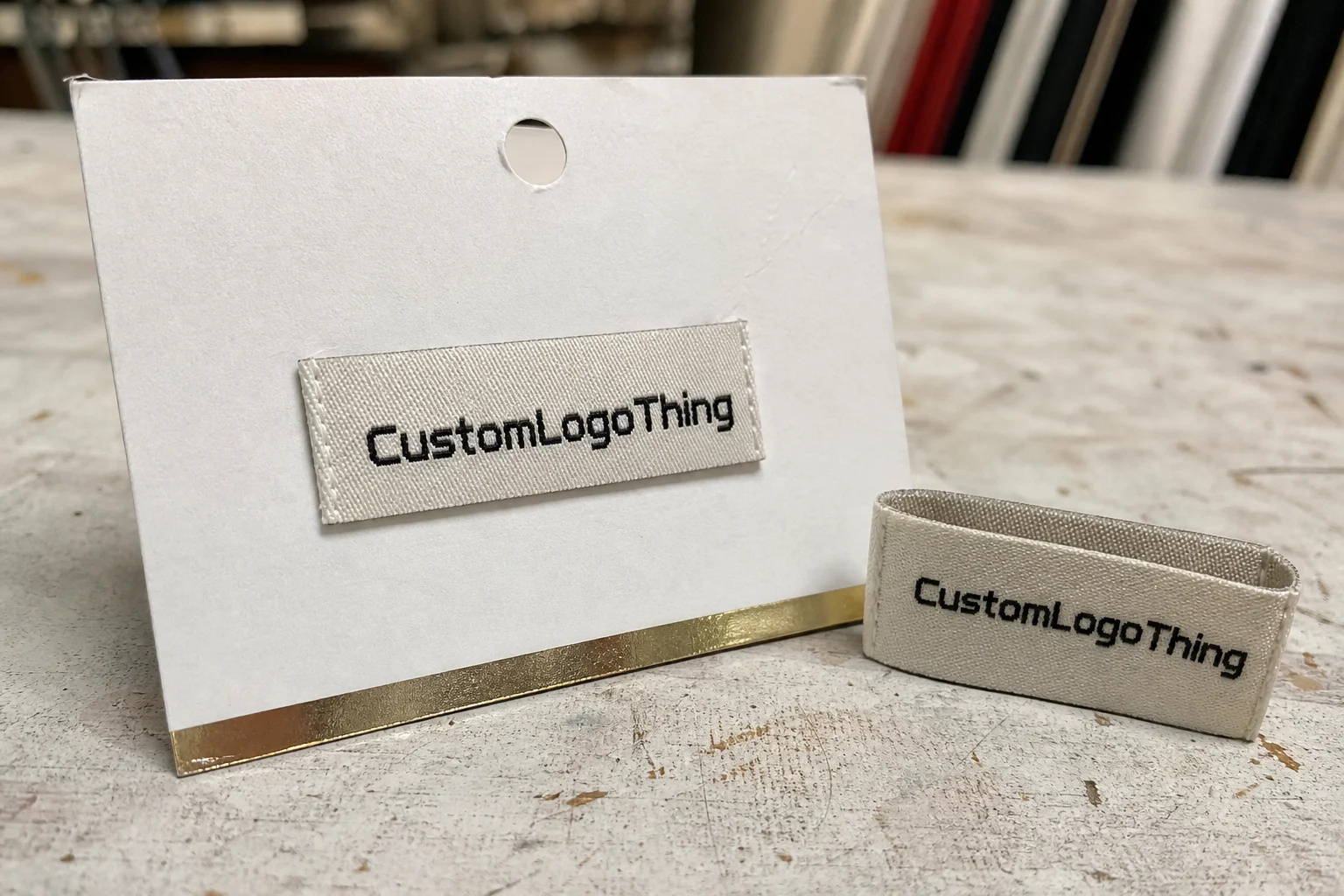
Finishing changes both the look and the way the label is sewn into the garment. Common options include straight cut, center fold, end fold, and heat-cut edges. A fold style affects seam placement, visible label area, and how much bulk ends up inside the garment. On a heavy sweatshirt, a thicker label may be acceptable. On a lightweight tee, that same structure can feel bulky or irritating.
Most apparel labels are sewn in rather than attached with adhesive. Sewing gives better long-term attachment and is the standard for garments that will be worn and washed repeatedly. The real quality checks happen at the end of production: cut accuracy, edge stability, consistency in fold direction, and whether the label shrinks or distorts after finishing.
Readability depends on more than the artwork file. Weave density, contrast, label dimensions, and the amount of text all matter. Tiny size marks can become muddy if the weave count is too low or the design is too crowded. A label that looks fine in a mockup can lose clarity once it is folded and stitched into a seam. That is one reason experienced buyers ask for a proof or sample before approving a full run.
Key specs that affect quality, comfort, and branding
Most first-time buyers focus only on the size mark itself. That is not enough. Width, height, fold style, thread color, weave density, and edge finish all affect how the label performs once it reaches the garment floor.
Comfort should be treated as a spec, not a preference. A woven label that works well inside denim may feel too abrasive in a lightweight jersey tee. Children’s apparel, intimate apparel, and activewear usually need softer construction and cleaner edges because the wearer is more likely to notice any roughness.
Contrast is another operational issue that gets overlooked. If the size marking blends too much into the background, production teams lose speed and accuracy during sorting. A clear contrast between text and ground is often more useful than a decorative color choice. In other words, the most attractive label is not always the most functional one.
Placement changes the technical requirements. A side seam label may allow a different size and fold than a neckline or waistband label. Neck applications often need slimmer dimensions to reduce bulk, while side seams can sometimes tolerate a slightly larger format. For brands running several garment categories, standardizing one label family and adjusting only where necessary usually keeps production simpler.
That consistency should extend to the rest of the trim program. If the line uses coordinated neck labels, custom printed boxes, and refined hang tags, the size label should not feel like a cheaper afterthought. Buyers notice mismatched quality faster than they admit.
| Label style | Typical use | Best for | Practical notes |
|---|---|---|---|
| Damask woven | Premium apparel | Fine detail and softer feel | Usually the strongest option when clarity and comfort both matter |
| Satin woven | Dressier garments | Smooth finish | Good appearance, but very small text may need extra review |
| Taffeta woven | Value-driven lines | Simple size markings | More economical, though less refined than damask |
| Folded label | Seam insertion | Clean application | Useful when the size needs to sit neatly inside a garment edge |
For brands ordering multiple trims and packaging items together, it helps to treat the whole system as one production plan. The label does not need to match the box exactly, but the finish, clarity, and tone should belong to the same collection. That is where quality starts to feel intentional instead of assembled from parts.
Process and timeline: from artwork to finished labels
The usual workflow is simple on paper: artwork or size list, spec review, digital proof, weaving, finishing, inspection, and packing. The delays usually happen before production starts, not during weaving. A buyer who checks dimensions, fold direction, color references, and size breakdowns early usually avoids the kind of rework that pushes a launch off schedule.
A clean spec sheet saves time. The most useful quote requests include exact size text, dimensions, placement, quantity by size, preferred fold, and any comfort requirements. If the label has to work across several garments, say that up front. A neck label, waistband label, and side seam label do not always want the same construction, even when the design looks similar on screen.
These are the checkpoints that tend to matter most:
- Artwork review — confirm fonts, symbols, size markings, and any secondary language.
- Proof check — verify fold orientation, dimensions, and color placement.
- Sampling or pre-production approval — useful when the line is new or the label will be used broadly.
- Weaving and finishing — where density, cut accuracy, and edge quality are controlled.
- Final inspection — check counts, packing format, and consistency before shipment.
Timeline depends on complexity and quantity. A simple woven size label order may be ready in roughly 10 to 15 business days after proof approval. More colors, finer detail, special folds, or custom sorting can extend that. Rush orders are possible in some production schedules, but they usually narrow the room for error and can increase cost.
Production discipline is what keeps small jobs from becoming expensive delays. Good suppliers confirm stitch orientation, label width tolerance, and thread color references before weaving begins. On the buyer side, internal approvals need to happen quickly. Even a two-day delay at proof stage can ripple through a launch calendar, especially when labels are tied to garment packing dates.
If packaging and handling are part of the broader plan, industry references like ISTA and the Institute of Packaging Professionals can offer useful context for distribution, presentation, and product handling, even though woven labels themselves are only one component of the finished item.
Custom woven size labels: cost, MOQ, and quote factors
Pricing usually depends on quantity, size, weave detail, number of colors, finishing method, and the amount of setup required. Small runs cost more per label because loom setup, color matching, and finishing time are spread across fewer pieces. Larger runs lower the unit price, although the savings flatten once production reaches a more efficient plant range.
For rough planning, woven size labels in modest quantities often land somewhere around $0.05 to $0.18 per label, depending on complexity and order size. That is not a fixed market rate. A simple single-color size tab will usually price below a refined damask label with a custom fold and tighter finish. Still, the range is useful for budget conversations before a quote comes back.
MOQ exists because woven production has real setup steps. Threading, color setup, loom programming, finishing, and inspection all take time regardless of order size. The practical question is not only “What is the minimum?” but also “What MOQ makes sense for my forecast and storage space?” A low MOQ reduces inventory risk, but it usually raises the cost per piece.
Multiple sizes in one order can change the economics. If the label family stays the same and only the size text changes, the quote often stays efficient. If every size needs a different construction, width, or finishing style, costs rise quickly. That is one reason many apparel brands standardize a single label system across an entire collection and vary only the size marking itself.
Here is a simple comparison:
| Order type | Pros | Potential drawback | Typical buyer fit |
|---|---|---|---|
| Low quantity | Lower inventory risk, easier testing | Higher unit cost | New launches, small brands, limited drops |
| Mid quantity | Balanced cost and flexibility | Needs better forecasting | Growing apparel lines |
| High quantity | Better unit pricing | More stock on hand | Established collections with repeat styles |
The cheapest label is not automatically the best buy. A slightly better woven construction can improve how the garment is perceived and reduce complaints about comfort or readability later. That matters whether the product is sold direct-to-consumer, through wholesale, or packaged with other branded materials.
Common ordering mistakes that create avoidable delays
One common mistake is mixing sizing systems without planning the market first. A simple S/M/L system may work in one region, while another sales channel expects numeric sizes or a different convention. If the customer profile is not settled early, the label can be technically correct and commercially awkward.
Another problem is crowding too much information into a small label. Woven labels have real physical limits. If the text is too dense, the size marking loses clarity, especially after folding and stitching. The label should carry only what it can present cleanly. A simpler layout often performs better than a crowded one.
Fold direction causes more mistakes than it should. If artwork is approved without confirming whether the label will be center folded, end folded, or straight cut, the sewing team may receive a spec that does not sit properly in the garment. That can lead to rework or a label that technically fits but looks clumsy once sewn in.
Color mismatch is easy to prevent and surprisingly common. Vague instructions like “dark blue” or “light gray” create room for interpretation. Pantone references or clear thread direction reduce that risk. Thread and weave can also shift slightly under different lighting, so the more precise the brief, the closer the result usually comes.
Counts and packing instructions also get overlooked. If labels need to be bundled by size, packed by style, or delivered in a specific sequence for garment assembly, that needs to be spelled out before production starts. A good order is not just about the woven label itself; it is about the workflow around it.
Expert tips for better label results on your apparel line
The best label is the one that does its job quietly. It should be readable, soft enough for the garment, and visually in step with the rest of the line. That usually means resisting the urge to make the label too small just to hide it. If the size cannot be found quickly, the label has stopped serving its purpose.
For lines that use more than one fabric type, sample approval is worth the effort. A fleece hoodie, a cotton jersey tee, and a technical knit do not behave the same way in the seam. A label can look right on screen and still feel wrong once stitched in. Testing one garment before full production is cheaper than discovering a comfort issue after the run has already shipped.
High-contrast thread choices are usually the safest option for warehouse use. They help packers and retail teams identify sizes without squinting at the seam. That sounds minor, but on large replenishment orders, small time savings add up fast.
If the garment is lightweight or sensitive, softer weave and cleaner edge finishing can make a real difference to the wearer. That matters especially for babywear, intimate apparel, and athleisure pieces worn close to the skin. The label should support the garment, not distract from it.
Packaging and trim should speak the same design language. If the brand uses FSC-certified paper for hang tags or recyclable materials in outer packaging, the label should not feel disconnected from that level of thought. The FSC standard is worth understanding if responsible sourcing is part of the brand’s material story.
One more practical observation: simple specs usually produce better results. Buyers sometimes try to pack every idea into one label revision, then wonder why the proof becomes hard to read. A cleaner brief gives the production team room to make the label crisp, durable, and consistent.
Next steps for ordering labels that fit your production plan
Start with the essentials: define the size range, choose the placement, confirm the woven style, and gather brand color references. Those few decisions create a workable foundation for a quote request without triggering unnecessary back-and-forth.
A simple spec sheet is usually enough to move things forward. Include dimensions, fold style, quantity by size, thread color guidance, and preferred finish. If possible, add garment type and application location. That helps the supplier recommend a structure that fits the product rather than forcing one label format across unrelated styles.
Set an internal approval deadline before you request the proof. That one habit prevents the classic stall where artwork is ready, but sign-off drags on long enough to disrupt the production calendar. In apparel, timing is a chain reaction; a delay at the beginning can affect cutting, sewing, packing, and shipment.
Before placing the full order, ask for a sample, a timeline estimate, and a unit price breakdown. That gives a clearer picture of how quantity affects cost and whether the label spec actually fits the budget. If the quoted difference between a basic woven label and a more refined run is small, the better build may be worth it. If the gap is large, the simpler option may be the smarter choice for that product tier.
The goal is straightforward. The label should be comfortable, easy to read, and aligned with the garment line. Done properly, custom woven size labels become a small but dependable part of the product experience, helping the line look organized from production floor to customer delivery.
FAQs
What are custom woven size labels used for in clothing?
They identify garment size clearly for retail, packing, and everyday use. They also help the inside of the garment look more finished and intentional. Woven construction supports durability through wear and laundering.
Are woven size labels better than printed size labels?
Woven labels usually look more premium and tend to hold up better over time. Printed labels can work for some low-cost or very simple applications. If presentation and durability matter, woven is usually the stronger option.
What affects the price of custom woven size labels the most?
Quantity is one of the biggest price drivers. Weave complexity, label size, fold style, and color count also influence cost. Lower MOQ orders typically carry a higher unit price because setup costs are spread across fewer labels.
How long does it take to produce woven size labels?
Timing depends on artwork approval, weave detail, and order size. Simple orders can move in roughly 10 to 15 business days after proof approval, while more complex labels take longer. Slow proof approvals can extend the schedule even when production itself is straightforward.
What information should I send for an accurate quote?
Provide label dimensions, size text, fold style, quantity, placement, and preferred thread colors. Include artwork files and any comfort requirements. If the labels will be used on different garment types, mention that as well so the construction can be matched correctly.