Buyer Fit Snapshot
| Best fit | Buy Heavy Duty Pallet Boxes projects where brand print, material claims, artwork control, MOQ, and repeat-order consistency need to be specified before quoting. |
|---|---|
| Quote inputs | Share finished size, material target, print colors, finish, packing count, annual reorder estimate, ship-to region, and any compliance wording. |
| Proofing check | Approve dieline scale, logo placement, barcode or warning zones, color tolerance, closure strength, and carton packing before bulk production. |
| Main risk | Vague material claims, crowded artwork, missing packing details, or unclear freight terms can make a low unit price expensive after revisions. |
Fast answer: Buy Heavy Duty Pallet Boxes: Specs, Pricing & Lead Times should be specified like a repeatable production item. The safest quote records material, print method, finish, artwork proof, packing count, and reorder notes in one written spec.
Production checks before approval
Compare the actual filled-product size with the drawing, then confirm tolerance on folds, seals, hang holes, label areas, and retail display edges. Reserve space for logos, QR codes, warning copy, and material claims before decorative graphics fill the panel.
Quote comparison points
Review material grade, print process, finish, sampling route, tooling charges, carton quantity, and freight assumptions side by side. A quote is only useful when the supplier can repeat the same color, closure quality, and packing count on the next order.
Custom Logo Things
Buy Heavy Duty Pallet Boxes: Specs, Pricing & Lead Times
If you need to Buy Heavy Duty pallet boxes, the carton line on the quote is rarely the number that decides the shipment. The real cost shows up later, usually on a dock in Chicago, Savannah, or Rotterdam, when a corner crushes, a pallet shifts in transit, and the receiving team spends half a shift rebuilding what should have arrived intact. I still remember one export run where the box price was only $2.80 a unit, the freight bill came in at $1,940, and the claim paperwork plus dock labor turned the whole thing into a $280 headache before lunch. That is a frustrating way to start a Tuesday, especially when the original problem was a corrugated pallet box that looked fine on a sample table in Foshan.
That is why I treat the decision to buy heavy duty pallet boxes as a risk decision before it is a packaging decision. Loads with serious density, tall stacks, or frequent handoffs need more than a carton that looks strong in a catalog photo or a 3D render with perfect lighting. At Custom Logo Things, the first conversation usually starts with pallet footprint, product weight, moisture exposure, and transport route, whether the box is going from Dongguan to Los Angeles or from Qingdao to Hamburg. Print, decoration, and branding can wait until the load itself is understood, because a pretty box that fails in transit is still a failure, just with better typography. For export packaging and industrial freight, the structure matters first and the artwork comes second.
Buy Heavy Duty Pallet Boxes: Why Buyers Choose Them First
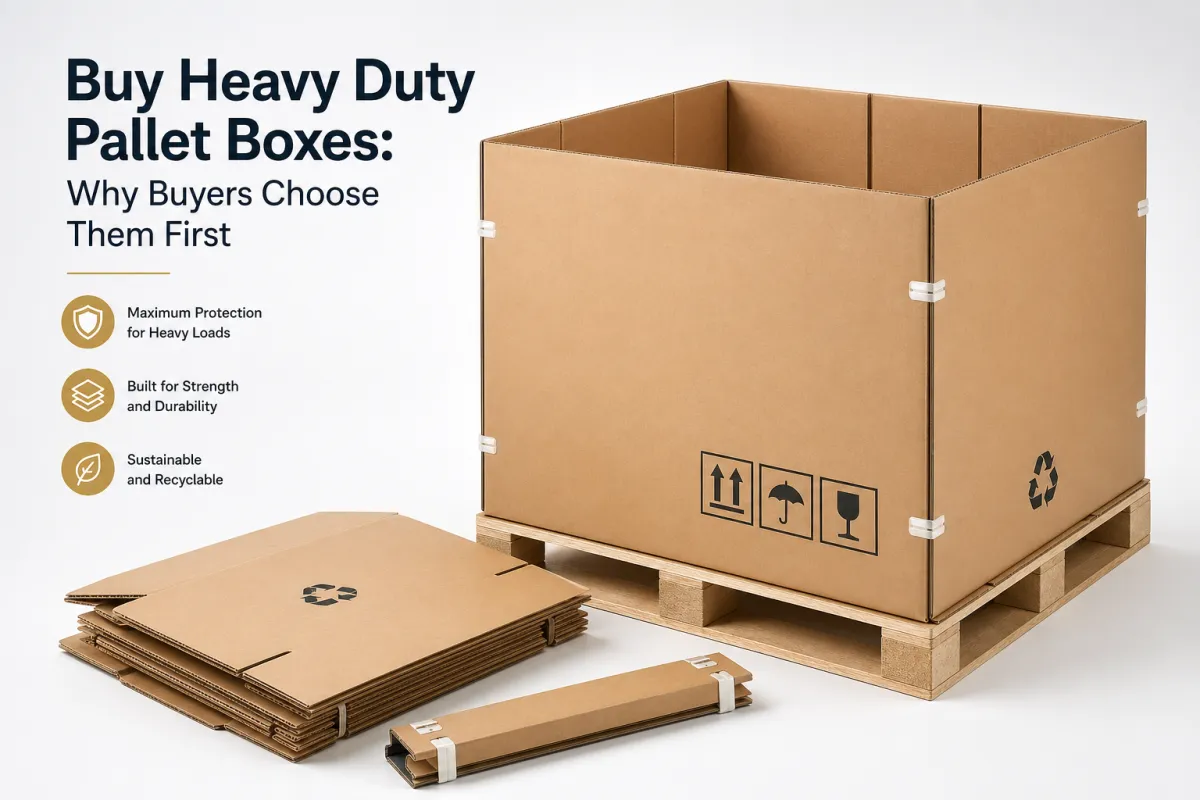
Most buyers buy heavy duty pallet boxes after a failure, not after a polished sales presentation. I remember one operations manager in a Dallas warehouse laying a crushed corner panel on a conference table and saying the carton itself had cost less than the lunch beside it. The carton was cheap. The damage was not. The expensive part was the 11,400 km freight run, the dock labor needed to rebuild the pallet, and the credit note that followed a 2.3 percent damage rate on a 4,800-piece shipment. Once those numbers sat in the same spreadsheet, the decision changed quickly.
Buying a stronger box is really a margin-protection move, and the math gets sharper when the load weighs 180 kg, 240 kg, or more. That matters most with bottled goods, machine components, bagged powders, and mixed-SKU replenishment that has to survive real warehouse handling in places like Rotterdam, Monterrey, or Jeddah. Standard pallet cartons can do fine for light and uniform freight, but once the stack climbs beyond about 1.4 m or the load passes 200 kg, compression loss and edge failure stop being theoretical. A better box keeps the pallet square from bottom to top, which is the kind of failure that creates claims, repicks, and late deliveries.
Slip-sheet programs come up often in procurement meetings because the math looks elegant on paper. They reduce pallet weight and can work well in controlled export lanes, yet they depend on equipment, training, and disciplined handling. If the product needs solid sidewalls, dust protection, or repeated transfer points, I would rather buy heavy duty pallet boxes than trust a platform that assumes every handler does the right thing. Standard pallet cartons sit between the two approaches, but the lane should decide the format, not habit or convenience. I have watched a clean slip-sheet plan fall apart because somebody on the receiving end in a regional depot had never seen the handling process before, and that kind of surprise is expensive in both labor and patience.
Four repeat situations usually push buyers toward stronger packaging. Export freight is one, since container movement tests corners and stack compression in a way domestic truck lanes often do not. Warehouse transfers are another, especially in high-bay storage where pallets are lifted, set down, and rotated by different crews. E-commerce replenishment can justify the upgrade when the box needs to protect several SKUs at once. Industrial parts distribution is the last common one, because steel castings, dense spares, and rough-edged components punish weak board almost immediately. Those are the cases where people usually buy heavy duty pallet boxes first, and then feel relieved they did after the first clean delivery.
The sales pitch should stay simple: stronger board, more compression resistance, fewer claims, less rework. Decorative print can matter in retail programs, though industrial freight cares more about whether the load holds its shape after a long lane and a rough dock in places like Atlanta, Felixstowe, or Busan. If you buy heavy duty pallet boxes for the wrong reason, you spend too much. If you buy them for stack integrity and route risk, the first shipment cycle often pays back the difference. That tradeoff is one of the cleaner calls in packaging once the load data is on the table.
Product Details: What Heavy Duty Pallet Boxes Are Built To Do
The construction is not complicated, but the details are where the performance lives. To buy heavy duty pallet boxes that actually earn their place, I look for reinforced corrugated board, the right flute profile, and dimensions that match the pallet footprint instead of fighting it. Double-wall BC flute is a common choice for mid-weight industrial loads, especially around 180 to 320 kg. Triple-wall board starts to matter when the stack gets tall, the freight lane gets rougher, or the shipment needs to survive several transfer points before it reaches the customer. The box should hold the product and help the pallet stay square under pressure.
Several formats deserve a look before you buy heavy duty pallet boxes. Full-depth pallet boxes are the standard workhorse for tall, dense freight. Knock-down bulk boxes save storage space before use, which helps when dock space is tight in a 20,000-square-foot warehouse or on a shared factory floor in Ningbo. Telescoping styles add flexibility for mixed heights or awkward items. I have seen all three work well, but the load profile chooses the winner. A carton with a 1,000 mm internal height and a tight 1,200 x 1,000 mm footprint behaves very differently from a loose-fit carton with 15 mm of side play. That little bit of slack can turn into a lot of wobble once the truck starts doing its best impression of a washing machine.
The use cases tell the story clearly. Fragile mixed merchandise needs inserts or dividers so the contents do not collide. Machine parts need enough edge strength to survive contact with metal surfaces. Bottled goods need liners and top pads to reduce puncture risk and cap scuffing. Bagged materials need top pressure control so the stack does not barrel in the middle. Oversized returnable items often need a telescoping lid, because open tops invite dust, crush, and rough handling. That is why buyers buy heavy duty pallet boxes after reviewing the product, not before, and why a supplier in Foshan will often ask for a full load map before quoting a single unit.
What separates these boxes from ordinary shipping cartons is not one magic feature. It is the whole package: stronger edge crush performance, better compression resistance, cleaner glue lines, and a pallet load that stays together under transport stress. I once stood on a factory floor in Dongguan where a carton line was running smoothly at low stacks, then began to bulge at only 9 layers because the board grade had been stepped down by one level. The cartons still looked acceptable from a distance. On the pallet, they were a problem. That is the gap buyers close when they buy heavy duty pallet boxes. You can see the difference with your eyes once you know what you are looking for, and after enough bad shipments, you start spotting trouble from across the warehouse.
Accessories matter too. If the route runs through humid climates, I ask about moisture-resistant coatings or a kraft liner that can hold stiffness after short exposure. If the goods need dust control, a fitted lid and inner liner help more than fancy print. If several SKUs travel inside one outer box, inserts stop migration and reduce abrasion. For branded programs, a 350gsm C1S artboard wrap or handling card can be added to the carton set, and at 5,000 pieces that printed component might add about $0.15 per unit. The real question is not whether the box can be customized. The useful question is which custom details reduce damage enough to justify the spend when you buy heavy duty pallet boxes. I like boring Packaging That Works every time; glamorous failure is still failure.
Specifications You Need Before You Buy Heavy Duty Pallet Boxes
If you want to buy heavy duty pallet boxes without guessing, start with the dimensions that govern the load. Internal length, width, and height matter more than the outer carton size because the product still has to fit once inserts, liners, and clearance are in place. For pallet compatibility, I always check the footprint against the lane standard: 1,200 x 1,000 mm in many export programs or 48 x 40 in North American distribution. A base that overhangs by even 10 to 15 mm can weaken stack safety faster than most buyers expect, and then everyone acts surprised when the corner crushes like it was built from cracker crumbs.
Performance specs work best in plain language. Board grade tells you how much the corrugated structure resists bending and crushing. Edge crush test, or ECT, is one of the quickest ways to estimate whether a box can survive pallet stacking. Compression limits matter because the top layers are only as strong as the box below them. Burst strength still has its place, though pallet freight usually lives or dies on compression and edge performance. If a supplier cannot explain those numbers clearly, I would hesitate to buy heavy duty pallet boxes from them. Clear specs save more time than any glossy brochure ever will.
Load behavior matters just as much as paper science. A box rated for 600 kg can still fail if the load is uneven, the stack is top-heavy, or the pallet deck has damage. I have seen a 450 kg shipment hold perfectly in a clean warehouse in Suzhou and fail in transit because one corner sat on a warped deck board. Stack height, center of gravity, and load uniformity belong on the spec sheet. If you buy heavy duty pallet boxes for export, add humidity assumptions and handling conditions to the brief as well. The ocean is not gentle, and neither is a forklift operator trying to move too fast before coffee at 7:30 a.m.
Material and print choices should be settled early. Plain kraft is usually the easiest option for industrial freight. White outer liners can help when a box needs cleaner branding or retail visibility, and a 350gsm C1S artboard sleeve is common for handling instructions or a branded belly band. Water-based coatings can improve resistance to short moisture exposure, and custom handling marks speed receiving when the dock is busy. For food-adjacent goods, packaging should match internal SOPs and local rules, which is not always the same thing as the marketing brief. For buyers who want deeper testing context, I often point them to the methods and guidance at ISTA and the responsible sourcing standards at FSC.
Compliance sits at the end, though it is rarely the least important piece. Export programs often ask for stacking tests, moisture checks, or route-specific documentation. Industrial buyers may need the box to match an internal receiving SOP, especially if the pallet moves through racking in a high-bay warehouse. Regulated goods need paperwork that reflects board type, closure method, and any liners or inserts. That is the difference between a neat quote and a usable quote when you buy heavy duty pallet boxes. A tidy spreadsheet is nice; a pallet that actually survives the trip is nicer.
Pricing & MOQ: What It Costs To Buy Heavy Duty Pallet Boxes
Pricing looks straightforward until the quote arrives. To buy heavy duty pallet boxes at a sensible cost, You Need to Know the variables under your control: size, board grade, print coverage, inserts, quantity, and delivery destination. A small size change can shift board consumption by 8 to 12 percent. Switching from double-wall to triple-wall can push the unit price up quickly. The same design can also price differently if the freight lane changes from factory pickup in Foshan to doorstep delivery in Toronto. I have seen buyers focus on the carton price so hard that they miss the freight line, and then everyone has to pretend that was the plan all along.
Volume helps, though not in a perfectly smooth curve. When buyers buy heavy duty pallet boxes at 500 units, setup and waste are spread across a smaller run, so the per-unit cost looks higher. At 5,000 units, the board buy, die setup, and press time usually create a better break. Tooling, sampling, and freight can still matter more than the carton itself in the final landed cost. For example, a plain unprinted double-wall pallet box might drop to roughly $1.78 to $2.35 at 5,000 pieces from a corrugator in Dongguan, while a branded sleeve printed on 350gsm C1S artboard can add about $0.15 per unit. I have seen a buyer save $0.14 a unit on paper and lose more than that in a poor palletizing charge and a missed shipping window.
The MOQ picture depends on the format. Stock pallet boxes can sometimes start at a few hundred units if the size already exists. Custom sizes often begin around 1,000 to 2,000 units, and custom printed runs may need more depending on ink coverage and tooling. If you are testing a new SKU, ask whether a pilot order of 300 to 500 units is possible before you buy heavy duty pallet boxes in full production volume. A smaller test is cheaper than finding a fit problem after the first full container lands, and it spares everyone from that quiet, miserable feeling when the first sample is wrong by a few millimeters.
Comparing quotes fairly is where buyers keep real money in-house. Ask whether the price includes samples, palletizing, edge protectors, packing labor, and freight. A quote that appears 8 percent lower may leave out the pallet base or the destination charge. I tell procurement teams to compare landed cost per usable box, not just ex-factory price. That approach matters because the cost of a damaged carton is not the carton. It is the replacement shipment, the labor to reset the load, and the customer service time spent explaining the delay when you buy heavy duty pallet boxes. I would rather have a slightly higher number and sleep at night than save pennies and spend the next week apologizing.
| Option | Typical MOQ | Indicative Unit Price | Lead Time | Best For |
|---|---|---|---|---|
| Stock heavy duty pallet box | 200-500 units | $1.85-$3.20 | 5-8 business days | Urgent replenishment, size matches an existing format |
| Custom unprinted pallet box | 1,000-2,000 units | $2.10-$4.10 | 12-15 business days after proof approval | New product fit, moderate volume, controlled freight lanes |
| Custom printed heavy duty pallet box | 2,000-5,000 units | $2.45-$4.90 | 15-20 business days after proof approval | Brand visibility, handling marks, distribution programs |
| Triple-wall export box | 1,000+ units | $3.60-$6.80 | 15-25 business days | Long-haul export, high stack loads, moisture-sensitive freight |
| Slip-sheet style solution | Project-based | $0.40-$1.20 plus handling equipment | Depends on program | Low pallet-weight programs with controlled handling |
The numbers above are typical factory ranges, not a promise, because board markets and freight rates move. Even so, they show the pattern buyers need to see. If your shipping lane damages cartons at the dock, a slightly higher unit price can pay for itself within one or two cycles. That is the total cost of ownership view I use when clients ask whether to buy heavy duty pallet boxes or stay with a lighter format. Fewer claims, fewer repicks, and cleaner receiving usually beat a bargain carton that fails once. I am firmly on the side of the carton that gets the job done without drama.
How Do You Buy Heavy Duty Pallet Boxes Without Overpaying?
The easiest way to buy heavy duty pallet boxes without overspending is to compare every quote on the same load profile. Keep the pallet size, board grade, closure method, print requirement, and destination lane identical, then ask each supplier to price the same corrugated pallet box or export packaging format. Once the inputs match, the differences in board efficiency, glue quality, and converting discipline become easier to spot.
I also recommend asking for landed cost rather than carton price alone. A low ex-factory number can hide palletizing charges, edge protectors, freight surcharges, or extra handling labor. If you are evaluating bulk corrugated boxes for industrial freight, the better number is the one that gets a clean pallet to the receiving dock without damage or repacking. That is the point where buyers who buy heavy duty pallet boxes usually see the real value of a stronger spec.
One more filter helps: ask for the failure mode. A good supplier can explain whether a box is designed for compression resistance, moisture control, or repeated transfer points. If the answer is vague, the box may be fine for light use but weak for export shipping or warehouse movement. The best sourcing decisions usually come from that kind of plain-language comparison, not from the loudest quote. I have learned to trust the supplier who can tell me what the board will do under load and what it will not do; that honesty saves everyone time.
Process & Timeline: How Orders Move From Quote To Delivery
The ordering process should stay predictable if you want to buy heavy duty pallet boxes without delays. It starts with inquiry, then spec review, then quote, sample approval, production, quality check, and shipment booking. Each step has its own failure point. The most common issue is incomplete input: someone sends outer dimensions but leaves out fill weight, or sends a product sketch without the pallet footprint. A good supplier should ask for those details before pricing, not after the first sample is already on the bench in a factory near Guangzhou or Xiamen.
Lead time depends on whether the box is stock or custom. Stock items can move in under a week if the warehouse has inventory. Custom boxes usually need a sample review window, especially if the board grade, print layout, or closure style changes. If you want to buy heavy duty pallet boxes for a promotion or export booking, leave enough room for proof approval and freight booking. I have seen a 3-day artwork delay push a shipment back by 9 days because the production slot was missed, and nobody enjoys explaining that kind of math to a launch team.
Delays usually come from four places. The first is missing dimensions, which forces a redraw and a new board calculation. The second is unclear weight targets, which can trigger a spec revision. The third is late artwork approval, often because the handling marks are still under review. The fourth is freight booking changes, especially when the destination port or truck slot shifts at the last minute. When buyers buy heavy duty pallet boxes, packaging lead time is only one part of the schedule; the logistics handoff matters just as much.
I like to split timeline expectations into three buckets. Fast-track orders are stock sizes with no print and clear delivery data. Standard orders are custom sizes with one sample cycle and a straightforward board spec. Project-based orders include export testing, custom inserts, liners, or unusual stack requirements. If a supplier cannot tell you which bucket your order belongs in, the timeline is a guess. That is not acceptable if you need to buy heavy duty pallet boxes for a fixed freight slot or warehouse launch. I have been in enough planning meetings to know that "we should be fine" is not a production schedule.
One supplier negotiation in Ningbo still stays with me. The buyer wanted a lower unit price, but the real bottleneck was not cost; it was a missing pallet spec on the receiving form. We corrected the footprint from 1,180 mm to 1,200 mm, removed a 6 mm overhang, and the box stopped failing corner compression. The buyer did not just save cartons. He saved a week of warehouse rework. That is the practical value of a well-run process when you buy heavy duty pallet boxes. Small details can save big headaches, which is about as close as packaging gets to magic.
Why Choose Us When You Buy Heavy Duty Pallet Boxes
When buyers buy heavy duty pallet boxes, the supplier should reduce uncertainty, not add it. I look for three things first: packaging knowledge, response speed, and a willingness to test the spec against freight reality. If a supplier only asks for artwork and quantity, half the job is still missing. A stronger partner asks about fill weight, pallet type, storage conditions, destination climate, and whether the pallet will be moved by forklift, hand truck, or racking system. Those questions matter whether the job is running out of Foshan, Shenzhen, or a bonded warehouse near Qingdao.
At Custom Logo Things, the right conversation usually starts with a load profile, not a sales pitch. I want to know whether the shipment is 75 kg or 750 kg, whether the stack sits in a dry warehouse or a humid container, and whether the client needs plain kraft or branded outer walls. That is the difference between commodity sourcing and useful packaging support. It is also why buyers come back when they buy heavy duty pallet boxes through a supplier who can translate operating details into board grade and closure style. The board does not care about a nice presentation deck; it cares about the actual load, and so do I.
Proof matters. I trust suppliers who can show quality checks, sample support, and repeat production that stays consistent. A single good sample does not help much if the next batch drifts by 5 mm or the glue line changes from one side to the other. In one factory-floor review in Dongguan, I watched a team inspect compression samples at a fixed 250 kg load point and log the result against the ECT target, then repeat the same test on a second lot from a different paper batch. That kind of discipline reduces surprise. If you buy heavy duty pallet boxes from a partner who measures, documents, and communicates, your procurement team spends less time chasing corrections.
Service also matters in ways that are easy to miss during sourcing. Clear cost breakdowns, realistic timelines, and sample notes save hours later. A supplier who explains why a triple-wall export box costs more than a double-wall industrial carton is doing the buyer a favor. So is the supplier who warns that a moisture coating adds protection but may affect recycling or print adhesion. Those are the conversations I want before clients buy heavy duty pallet boxes, because they lower the chance of a spec mismatch once production starts. I have no patience for vendors who hide behind vague language and then act shocked when the pallet arrives underperforming.
"The cheapest quote was not the cheapest shipment. Once we counted the damaged units and the labor to rebuild the pallet, the lower price was an illusion."
That line came from a procurement manager after a warehouse transfer failed at the third handling point. He had been trying to save $0.22 per unit and ended up losing far more in claims and labor. It is a familiar pattern. If you want to buy heavy duty pallet boxes as a procurement win, the supplier has to be part of the solution, not just a source of board and glue. I respect suppliers who tell the truth early, even when the answer is not the cheapest one.
Next Steps To Order The Right Heavy Duty Pallet Box
The fastest way to buy heavy duty pallet boxes well is to prepare a short internal brief before you request quotes. Include product dimensions, fill weight, pallet type, shipping route, and whether the load needs moisture or dust protection. Add stack height, handling method, and any internal receiving rules. With those six or seven details, a supplier can usually tell you whether a double-wall box, a triple-wall box, or a custom insert package makes sense. If you send that information up front, you save yourself three rounds of back-and-forth and a lot of unnecessary guesswork.
After that, shortlist two or three styles based on the load profile. Compare them against compression strength, cube efficiency, and freight fit. A taller box may use less product packaging material, but if it reduces stack stability by 15 percent, the space gain is not worth it. I tell buyers to buy heavy duty pallet boxes only after they compare options on the same inputs. That means the same pallet size, the same destination, the same weight, and the same handling assumptions. Anything else is just apples-to-oranges with better stationery.
Request quotes from each supplier using identical data. That sounds obvious, yet I still see mismatched briefs: one vendor gets the internal load size, another gets the outer carton size, and a third gets a rough sketch with no weight. Naturally, the quotes are not comparable. If you want a fair read, ask for MOQ, lead time, board grade, sample cost, and freight cost in the same line-item structure. Then compare landed cost, not just carton price, before you buy heavy duty pallet boxes. The simplest checklist is often the one that saves the most money.
If the shipment is high value, request a sample or prototype review before production. A one-unit sample can reveal fit problems that a spreadsheet never will. I also recommend confirming artwork, pallet count, delivery window, and receiving requirements before the order is released. Those details are mundane until they are not. If the first shipment arrives with the wrong pallet count, the receiving team loses time and patience very quickly. The better path is simple: plan well, approve the spec, and only then buy heavy duty pallet boxes in volume. If you want a broader starting point, our Custom Packaging Products page shows the other formats we can match to the same load profile.
For teams that need a quick internal checklist, I usually recommend three final checks: confirm the board grade against the load, confirm the pallet footprint against the receiving lane, and confirm the lead time against the freight booking. If all three line up, you are in a good position to buy heavy duty pallet boxes without last-minute corrections. If any one of them is fuzzy, pause and fix it first. That pause costs far less than a failed pallet at destination.
If you are ready to buy heavy duty pallet boxes for export freight, warehouse transfer, or industrial distribution, send the load data first and the artwork second. That order saves time, reduces error, and usually produces a cleaner quote. It is the closest thing to a straight line in packaging procurement, and it is the one I trust after too many dock-side surprises. For teams building a full packaging program, our Custom Packaging Products range can cover the rest of the shipper mix too.
Where can I buy heavy duty pallet boxes in bulk?
Look for a manufacturer that can quote stock and custom sizes side by side so you can compare availability, MOQ, and landed cost. If you need to buy heavy duty pallet boxes in bulk, ask whether the price includes palletizing, freight, and sample approval. A quote that hides those charges is not useful for procurement, even if the carton price looks low. I would rather see every cost on one page than chase a "cheap" quote across four email threads, especially when the cartons are coming out of a factory in Foshan or Ningbo.
How do I choose the right size when I buy heavy duty pallet boxes?
Start with the internal load dimensions, then add space for inserts, liners, and handling tolerance. Match the base footprint to the pallet size you actually use, not the one that looks convenient on paper. If the load is 1,200 x 1,000 mm on the pallet, do not let the box overhang unless the route has been tested for it. That is a small detail with a large failure cost. I have watched a tiny overhang turn into a crooked stack, and nobody was thrilled about that outcome after a 14-hour truck run.
What is the usual MOQ for heavy duty pallet boxes?
MOQ depends on whether the box is stock, custom size, or custom printed. Stock sizes can start in the low hundreds, while custom production often begins around 1,000 to 2,000 units. If you are testing a new SKU and want to buy heavy duty pallet boxes cautiously, ask for a pilot run or sample batch before you commit to a full production order. A small test is a lot cheaper than finding out the pallet spec was wrong after the whole run is already printed and packed in a warehouse in Dongguan.
How long does it take to receive heavy duty pallet boxes after ordering?
Stock items move faster because there is no new tooling or approval cycle. Custom orders usually take longer because sample review, production, and freight booking all affect the schedule. In practical terms, I see stock programs move in 5 to 8 business days, while custom programs often land in the 12 to 20 business day range after approval, with 12 to 15 business days being common for a clean proof sign-off. If you need to buy heavy duty pallet boxes for a fixed ship date, build in buffer time for artwork and freight booking. The calendar always seems shorter once the truck booking gets involved.
Are heavy duty pallet boxes suitable for export shipments?
Yes, if the board grade, stacking strength, and moisture protection match the route and handling conditions. Export loads often need a stronger board spec, tighter closure control, and sometimes liners or coatings for humidity exposure. I have seen export programs fail because the supplier treated them like domestic freight. That is usually the point where buyers decide to buy heavy duty pallet boxes with export testing rather than gamble on a lighter carton. Export shipping has a way of exposing every weak spot all at once, which is rude but useful.


