Buyer Fit Snapshot
| Best fit | Price of Recycled Paper Tubes projects where brand print, material claims, artwork control, MOQ, and repeat-order consistency need to be specified before quoting. |
|---|---|
| Quote inputs | Share finished size, material target, print colors, finish, packing count, annual reorder estimate, ship-to region, and any compliance wording. |
| Proofing check | Approve dieline scale, logo placement, barcode or warning zones, color tolerance, closure strength, and carton packing before bulk production. |
| Main risk | Vague material claims, crowded artwork, missing packing details, or unclear freight terms can make a low unit price expensive after revisions. |
Fast answer: Price of Recycled Paper Tubes: Specs, MOQ, and Lead Times should be specified like a repeatable production item. The safest quote records material, print method, finish, artwork proof, packing count, and reorder notes in one written spec.
Production checks before approval
Compare the actual filled-product size with the drawing, then confirm tolerance on folds, seals, hang holes, label areas, and retail display edges. Reserve space for logos, QR codes, warning copy, and material claims before decorative graphics fill the panel.
Quote comparison points
Review material grade, print process, finish, sampling route, tooling charges, carton quantity, and freight assumptions side by side. A quote is only useful when the supplier can repeat the same color, closure quality, and packing count on the next order.
Why the Price of Recycled Paper Tubes Is a Profit Lever, Not a Line Item
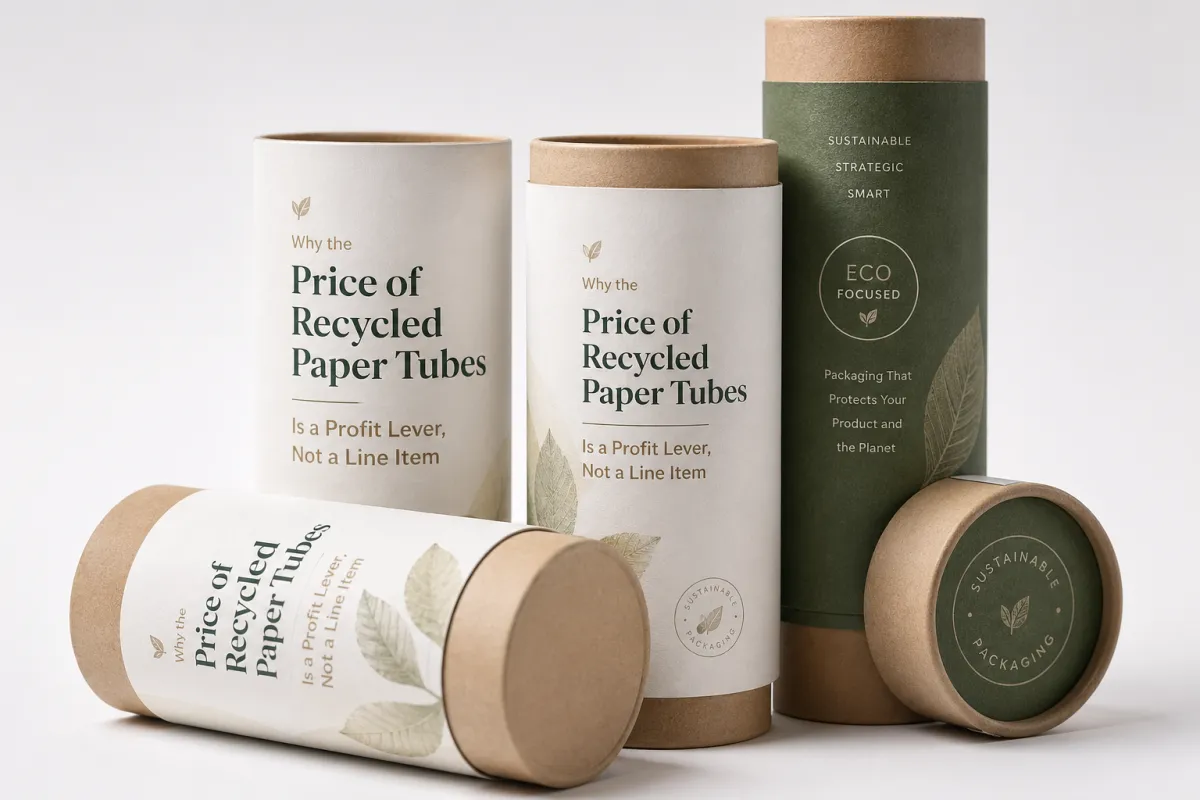
I watched two beauty brands order near-identical 65mm diameter paper tubes in the same quarter, and the landed-cost gap hit 14.8% even though board cost moved less than 2.1%; the difference came from freight class assumptions, metal versus paper closures, and scrap yield during color changeovers, which is exactly why the Price of Recycled paper tubes should be treated as a margin-control decision across procurement, operations, and brand management.
Here is the part most teams underestimate: packaging often sits between 6% and 11% of COGS for many DTC personal-care SKUs, around 3% to 7% for mass retail replenishment lines, and 2% to 5% for industrial sample kits, yet tube decisions can shift contribution margin by 80 to 240 basis points on a $12 to $28 retail unit. I have seen a $0.07 per unit reduction on a 500,000-unit annual program create a $35,000 gross margin lift before freight, and closer to $52,000 after cube optimization.
Rigid cartons can look premium, but a 1.8mm rigid setup board with wrapped shoulder often costs 18% to 34% more than a well-specified recycled tube for comparable shelf presence in cosmetics. Plastic canisters, especially PET with custom tint and injection cap, can beat paper in moisture-critical scenarios, yet they frequently lose on sustainability narrative credibility in buyer audits. Virgin-fiber tubes print beautifully at high line screens, but recycled-content tubes with the right outer wrap can now hit Delta E targets under 2.5 on spot-color critical branding in many runs above 20,000 units.
I am not pitching a green fantasy. This is a cost-and-risk discussion grounded in defect rates, test thresholds, and purchasing structure. Honestly, I think most companies pay a “confusion tax” of 5% to 12% on tubes because they compare quotes with different assumptions on tolerance, closure fit, and overrun policy.
What buyers usually miss in first quote rounds
First miss: tooling assumptions. One supplier prices with a shared mandrel family, another assumes new tooling at $450 to $1,200, and a third rolls setup into unit cost with a 12,000-piece minimum. I sat in a client meeting in Chicago where three bids looked close, then spread by $0.09 per tube after we normalized mandrel and cap tooling terms over 4 production batches.
Second miss: artwork complexity. A matte 4-color CMYK wrap with 52% average ink coverage behaves very differently from a 2-color PMS design with 18% coverage; print setup minutes, cleanup solvent use, and startup waste all change the price of recycled paper tubes. If you request soft-touch plus foil substitute plus micro-emboss, expect longer press setup and more first-article rejections.
Third miss: test requirements. If your tube needs ISTA 3A parcel simulation and ASTM D642 compression validation, that can add 3 to 6 business days and several hundred dollars in sample and lab handling. Teams that skip this early often pay later through returns, dents, and emergency reprints. For standards references, I suggest reviewing ISTA transit test protocols before final RFQ release.
Product Details: What You’re Actually Buying in a Recycled Paper Tube
A recycled paper tube is not one part; it is a layered system with at least 6 functional elements: body wall, inner liner, outer wrap, closure set, adhesive stack, and optional barrier. In most commercial builds I audit, body walls run from 1.2mm to 2.5mm, with spiral-wound construction dominating runs above 10,000 units because cycle speed is higher and diameter consistency is easier to hold at ±0.3mm to ±0.5mm.
The liner matters more than buyers expect. A white kraft liner at 120gsm often improves interior appearance for cosmetics and apparel accessories, while unbleached recycled liners can reduce material spend by 4% to 9% on large runs. Outer wraps frequently use 157gsm art paper or 200gsm specialty stock, and your finish stack—matte varnish, aqueous coat, or lamination—changes both perceived value and defect pattern during transport.
Closures drive both user experience and the price of recycled paper tubes. Friction-fit paper caps are economical and usually the easiest to source at MOQs around 3,000 to 5,000 pieces per size family. Metal lids add premium feel but can push unit cost up by $0.10 to $0.35 depending on diameter and finish. Plug styles, shoulder depth, and pull-force targets (often 10N to 22N) should be specified early, not left to assumptions.
Recycled content grade also changes performance. Post-consumer blends can carry more variability in fiber length and particulate contamination versus post-industrial streams, and that shows up in compression consistency. I visited a converter in Shenzhen that switched from a 90% post-consumer blend to a 70/30 post-consumer/post-industrial mix and cut wall-crush complaints from 2.4% to 0.9% in 60 days, while the per-unit delta stayed under $0.02 at 100,000 units.
End use defines design pressure points. Cosmetics demand stronger print fidelity and scuff resistance, food-adjacent dry goods need odor and migration consideration, candles need stable wall geometry for snug inserts, apparel accessories prioritize visual presentation, and industrial sample kits prioritize drop resilience over decorative finish. A single template never works across all five categories.
Documentation is also part of the product. Serious buyers ask for recycled content declarations, material safety statements, and chain-of-custody evidence for fiber claims. If FSC sourcing matters for your program, request certificate visibility and scope details; the official framework is available through FSC.
When a lower recycled percentage can be the smarter buy
Here is what most people get wrong: maximum recycled percentage is not automatically maximum value. For a 73mm tube shipped through parcel networks with average 6 to 9 handling touches, a 60% to 80% recycled structure can outperform a 100% recycled spec if it improves crush resistance by even 10% and cuts transit damage by 1.2 points. I have modeled programs where the material premium of $0.015 was recovered by avoiding $0.11 in replacement and reship cost per failed unit.
Print yield can improve too. Cleaner fiber blends can hold tighter registration at 0.2mm to 0.3mm variance on longer runs, lowering reject rates from 4% to 2.5% in multi-color jobs. The effective price of recycled paper tubes then drops even if nominal unit price rises slightly, because accepted yield improves and freight per sellable unit falls.
Specifications That Move Cost and Performance
Specs are where margin is won or lost. The baseline matrix should include inner diameter (ID), outer diameter (OD), wall thickness, finished height tolerance, compression strength, and burst or crush behavior under load. If your RFQ lacks any one of these six, supplier assumptions fill the gap, and quote variance can exceed 20%.
Dimensional choices directly affect logistics. A shift from 80mm to 76mm OD might look minor, yet on a 1200mm x 1000mm pallet, it can change packing geometry enough to fit 8% to 12% more units per layer. Over a 20-foot container, that often reduces freight cost per thousand units by $18 to $45 depending on route and fuel factor.
Wall thickness is a classic trade-off. Moving from 2.0mm to 1.6mm can cut material cost by roughly 7% to 11% on some diameters, but if damage rate climbs from 0.7% to 2.1%, replacement costs can erase savings fast. I recommend matching wall decisions to real drop and compression outcomes, not intuition from visual thickness alone.
Print architecture is another strong multiplier of the price of recycled paper tubes. Color count, registration tolerance, ink coverage, and artwork complexity all matter. A 1-color design with broad solids behaves differently from a 5-color, high-contrast, fine-text layout requiring tighter control under 6-point typography. Every added color can mean more setup minutes, more makeready waste, and slower stable output on press.
Compliance checkpoints should be explicit for sensitive categories. For food-adjacent uses, teams often request odor checks, migration review based on local requirements, and moisture behavior validation after 24-hour and 72-hour conditioning at defined RH bands. For beauty and wellness programs, fragrance interaction and liner compatibility need early confirmation to avoid late-stage failures.
In my experience, the most expensive tube errors happen before PO, not after. A missing ±0.5mm height tolerance can force rework in automated filling lines. An undefined closure pull-force range can trigger customer complaints about loose caps. Tiny omissions turn into big invoices.
Spec simplification checklist
- Standardize 2 to 3 diameter families (for example, 50mm, 65mm, 76mm) across multiple SKUs to lower tooling spread.
- Set one acceptable wall range per use case, such as 1.5mm to 1.8mm for light cosmetics and 1.8mm to 2.2mm for heavier inserts.
- Limit print architecture to practical tiers: 1-2 colors for core SKUs, 3-4 colors for premium SKUs with ROI support.
- Define cap style and fit force numerically, such as 12N to 18N pull-force, to avoid interpretation gaps.
- Specify test package once: ISTA sequence, compression thresholds, and visual AQL target, then keep it consistent across suppliers.
Price of Recycled Paper Tubes: Pricing Tiers, MOQ, and Hidden Cost Drivers
Buyers need a transactional framework, not vague ranges. I usually segment the price of recycled paper tubes into three bands: prototype/sampling, pilot run, and scale production. Prototype pieces can run from $1.20 to $4.50 each depending on manual setup and short-run inefficiency. Pilot runs around 1,000 to 5,000 pieces often land between $0.45 and $1.20. Scale production above 20,000 units can move into $0.18 to $0.68 for many common formats, excluding freight and tooling amortization.
MOQ logic is mechanical, not arbitrary. Production method, diameter family, print setup, and closure type dictate thresholds. Standard diameters with simple friction caps can start around 3,000 to 5,000 pieces. Fully custom diameters with decorative closure stacks may require 10,000 to 30,000 to make setup economics viable. A quote that looks “cheap” at 50,000 pieces is irrelevant if your real demand is 4,000 quarterly.
Landed cost has at least seven parts: unit price, tooling amortization, print setup, overrun policy, freight mode, duty exposure, and warehouse handling. I have seen teams celebrate a $0.03 unit reduction while ignoring a shift from +3% to +10% overrun policy that erased savings on annualized volume. Another frequent surprise is warehouse touch cost: an extra $6 to $14 per pallet for special handling can distort total program economics.
Hidden cost drivers are often controllable. Excessive SKU fragmentation increases setup resets. Unnecessary finish complexity raises defect risk. Frequent color changeovers consume press time and generate waste. If you reduce twelve seasonal artworks to six modular templates with variable labels, the price of recycled paper tubes usually drops without sacrificing shelf impact.
Negotiation works best with operational levers. Forecast visibility across 90 to 180 days helps suppliers plan board and cap capacity. Blanket POs reduce administrative churn and can justify better setup allocation. Spec harmonization across related SKUs lowers tooling sprawl. Consolidated shipment windows reduce freight volatility. These are facts vendors can execute against, not abstract pressure tactics.
Cost scenario modeling
| Scenario | Typical Volume | Spec Profile | Estimated Unit Range | Primary Cost Risks | Best Control Lever |
|---|---|---|---|---|---|
| Low-volume premium SKU | 2,500-8,000 units | 70mm ID, 2.0mm wall, 4-color wrap, soft-touch finish, custom cap | $0.62-$1.10 | High setup burden, finish rejects, longer approvals | Reduce finish stack and reuse diameter tooling |
| Mid-volume growth SKU | 10,000-30,000 units | 65mm ID, 1.8mm wall, 2-color PMS, standard paper cap | $0.28-$0.58 | Artwork revisions, cap fit inconsistency | Lock print files and pull-force specs early |
| High-volume core SKU | 50,000-200,000 units | 50mm ID, 1.6mm wall, 1-2 color design, standard closure | $0.18-$0.36 | Freight cube inefficiency, overrun accumulation | Pallet optimization and overrun cap enforcement |
I negotiated a three-SKU program in Dongguan where the buyer wanted luxury finishes on every variant. We modeled two paths: all-premium versus hybrid premium-core. The hybrid path cut weighted average unit cost by $0.11 at 120,000 units, lowered reject risk by 1.6 points, and preserved premium look on the top 20% of revenue SKUs. That is how you protect brand and margin together.
If you are benchmarking alternatives, compare recycled tubes against rigid cartons and plastic canisters on delivered cost per protected unit, not simple unit price. The real price of recycled paper tubes is the total cost to deliver intact, on-brand packaging at target cycle time.
Process and Timeline: From RFQ to Delivered Tubes
The full workflow usually runs through eight gates: discovery, spec confirmation, sampling, testing and approval, production slotting, in-process QA, final packing validation, and dispatch. A typical standard program can move from clean RFQ to shipment in 18 to 32 business days, while complex custom builds can stretch to 35 to 55 business days depending on tooling and finish stack.
Discovery should take 2 to 4 business days if your team submits complete inputs: dimensions, use case, target volume, and closure preference. Spec confirmation often takes another 2 to 5 days, especially if compression targets or odor requirements need refinement. I have seen teams lose 10 days simply because artwork files arrived as low-resolution exports rather than editable vector format.
Sampling timelines vary by complexity. A standard diameter with basic print can produce first samples in 4 to 7 days. Custom diameter plus premium finish may require 8 to 14 days. Approval cycles are the silent delay factor: each extra review round can add 2 to 3 days, which directly affects launch calendars and the effective price of recycled paper tubes.
Testing and approval gates are where disciplined teams win. Dieline sign-off, color proof acceptance, compression thresholds, and final pack-out spec validation prevent expensive stop-start production. If your acceptance criterion is “looks good,” expect conflict later. If your criterion is “Delta E under 2.5, no crush after defined load test, and closure pull-force 12N to 18N,” the process moves cleaner.
Risk controls should be planned, not improvised. Buffer stock for core SKUs, dual-source raw input options for board and caps, and milestone-based communication every 3 to 5 business days reduce surprises. In one launch I advised, a dual-source liner arrangement prevented a 17-day delay after one mill missed allocation.
Early design choices reduce timeline volatility. Standardized diameters, simplified print architecture, and realistic finish stacks compress replenishment lead times. Once base tooling and quality history are established, repeat POs can sometimes ship in 12 to 18 business days for stable SKUs.
Fast-track path
Urgent launch? It is possible, with controlled compromises. Use an existing diameter family, keep print to 1-2 colors, choose standard caps, and skip non-essential decorative effects on first production. In several rush projects under 21 days, this approach protected launch dates while keeping visual quality acceptable for market entry.
Fast-track plans still require discipline: approve dielines within 24 hours, return color comments in one round, and set a single decision owner. No ownership, no speed. With strong coordination, the price of recycled paper tubes stays predictable even under compressed schedules.
Why Choose Custom Logo Things for Recycled Paper Tubes
Custom Logo Things stands out where buyers feel pain first: quote clarity, spec translation, defect prevention, and repeat-order consistency. I have worked with enough converters to know the difference between a quote that looks cheap and a quote that is operationally honest; the latter usually wins by avoiding rework, emergency freight, and avoidable scrap.
The consultative value is practical. Many teams arrive with a mood board and rough dimensions. A strong partner converts that into manufacturable specs—ID/OD, wall range, fit force, print profile, and pack-out requirements—so revision loops shrink from 4 rounds to 2, and the price of recycled paper tubes remains stable across reorder cycles.
Quality systems matter because small misses scale quickly at 50,000 units. Buyers should expect incoming material checks, in-process inspection points, and final release routines aligned to AQL targets. A 1.5 AQL for critical defects and clear visual standards for print and scuff control are common baselines for premium programs.
Sustainability claims need evidence, not slogans. Reliable suppliers provide recycled-content transparency, discuss design-for-recyclability trade-offs, and explain where barriers or specialty finishes may reduce downstream recyclability. This level of honesty protects procurement teams during retailer and compliance audits.
Commercial reliability is visible in response speed, documentation rigor, and planning support. If a supplier can return a structured quote with assumptions in 24 to 72 hours, track approvals by milestone, and forecast capacity for 90-day windows, scaling gets easier and risk gets smaller.
What a strong supplier handoff packet includes
- Final dielines with revision control and dimension callouts (for example, ID 65mm ±0.3mm, height 120mm ±0.5mm).
- Tolerance sheet covering closure fit, wall thickness range, and visual acceptance criteria.
- Packing specification with master carton count, carton dimensions, and pallet pattern details.
- Test summaries including compression outcome, transit simulation notes, and any odor or migration checks requested.
- Commercial appendix separating unit cost, setup/tooling, freight basis, and overrun terms.
“Your team didn’t just lower unit cost by $0.08; you removed three approval loops and got us shipping 9 days earlier.” — Procurement manager, personal care brand, 68,000-unit program
Next Steps to Lock the Right Price of Recycled Paper Tubes
If you want accurate numbers quickly, send a complete sourcing packet on day one. Include exact dimensions (ID, OD, height), expected load, print files, finish priorities, volume by SKU, and target delivery windows. Incomplete RFQs can widen quote spread by 15% to 30%, and that delay compounds across launch planning.
Your RFQ package should include: vector artwork files, color references, closure preferences, wall target, tolerance requirements, and intended channel (retail shelf, parcel ship, or industrial kit). Add acceptance criteria for compression and appearance. The clearer the brief, the cleaner the first-pass price of recycled paper tubes.
Use a side-by-side comparison template. Normalize MOQ basis (per SKU or per size family), setup fees, overrun policy, assumed lead time, freight basis (EXW, FOB, or DDP), and payment terms. I have seen “lowest” quotes become highest landed cost after this normalization in 2 out of 5 competitive bid sets.
Then run a pilot order with measurable gates. Define sample validation criteria, set go/no-go thresholds, and confirm decision owners before mass production. A pilot of 1,000 to 3,000 units with transit simulation and pack-out checks often pays for itself by preventing one failed launch batch.
30-day implementation roadmap
- Days 1-3: Finalize dimensional specs, closure options, and artwork package; submit unified RFQ to shortlisted suppliers.
- Days 4-7: Review assumptions line by line; normalize MOQ, setup, and overrun terms into one comparison sheet.
- Days 8-12: Approve sample plan and test criteria, including compression threshold and visual acceptance standards.
- Days 13-18: Evaluate samples against fit, finish, and transit behavior; issue one consolidated feedback round.
- Days 19-24: Confirm pilot PO, milestone dates, and contingency plan for raw material or scheduling disruption.
- Days 25-30: Complete pilot review, lock production spec, and release scale PO with forecast window.
I will keep this direct: first send dimensions and use case, second approve dieline plus test thresholds, third measure delivered defect rate and freight per thousand units. Follow that order and the price of recycled paper tubes stops being a guessing game and starts acting like a controllable profit lever.
What is a realistic starting MOQ when evaluating the price of recycled paper tubes?
MOQ depends on diameter family, print setup complexity, and closure type; standard builds often start around 3,000 to 5,000 pieces, while fully custom formats can require 10,000 to 30,000 pieces. Ask for tiered MOQ options tied to unit-cost breakpoints so you can compare pilot economics versus scale economics. Also confirm whether MOQ applies per SKU, per artwork, or per size family, because that detail can change total commitment by 2x or more.
How can I reduce the price of recycled paper tubes without hurting quality?
Simplify specs before squeezing suppliers: harmonize diameters, trim finish complexity, and minimize avoidable color changes. Validate wall thickness with actual transit data instead of defaulting to heavier structures, because overbuild can add $0.03 to $0.12 per unit without reducing failure rates. Forecast-backed blanket POs and consolidated shipping windows often improve scheduling efficiency and lower effective setup burden.
Which specifications impact the price of recycled paper tubes the most?
The strongest drivers are diameter, wall thickness, height tolerance, print coverage, and closure construction. Freight density and packing configuration also change landed cost, especially on larger diameters above 76mm where cube utilization drops fast. Testing requirements, including compression and transit validation, can add cost upfront but reduce downstream replacement expense and service failures.
How long does it take from quote approval to delivery for recycled paper tubes?
Typical flow includes spec finalization, sampling, approval, production, QA, and shipping, often totaling 18 to 32 business days for standard formats and 35 to 55 for more custom builds. Fast-track paths are possible if you use standard diameters, simple print architecture, and quick decision cycles. Request milestone dates at PO confirmation so delays are visible early, not at dispatch week.
What should I include in an RFQ to get an accurate recycled paper tube price?
Include exact dimensions, target volume by SKU, product use case, editable print files, finish requirements, and closure preferences. State numeric acceptance criteria for compression, appearance, and packing method to remove assumptions. Ask suppliers to separate unit price, setup/tooling, freight basis, and overrun policy so your team can compare offers on an apples-to-apples basis and secure the right price of recycled paper tubes.
Related packaging resources
Use these related guides to compare specs, costs, quality checks, and buyer decisions before making the final call.


