Buyer Fit Snapshot
| Best fit | Price of Sugarcane Packaging projects where brand print, material claims, artwork control, MOQ, and repeat-order consistency need to be specified before quoting. |
|---|---|
| Quote inputs | Share finished size, material target, print colors, finish, packing count, annual reorder estimate, ship-to region, and any compliance wording. |
| Proofing check | Approve dieline scale, logo placement, barcode or warning zones, color tolerance, closure strength, and carton packing before bulk production. |
| Main risk | Vague material claims, crowded artwork, missing packing details, or unclear freight terms can make a low unit price expensive after revisions. |
Fast answer: Price of Sugarcane Packaging: Costs, Specs, and MOQ should be specified like a repeatable production item. The safest quote records material, print method, finish, artwork proof, packing count, and reorder notes in one written spec.
Production checks before approval
Compare the actual filled-product size with the drawing, then confirm tolerance on folds, seals, hang holes, label areas, and retail display edges. Reserve space for logos, QR codes, warning copy, and material claims before decorative graphics fill the panel.
Quote comparison points
Review material grade, print process, finish, sampling route, tooling charges, carton quantity, and freight assumptions side by side. A quote is only useful when the supplier can repeat the same color, closure quality, and packing count on the next order.
I have watched the price of sugarcane packaging stop a buyer cold on the first quote more times than I can count, usually right after someone says, "Wait, foam is cheaper." A 9-inch bagasse clamshell might come in at $0.11 to $0.15 per unit on a 5,000-piece order from a factory in Dongguan or Foshan, while a basic foam clamshell can land lower on paper, but then freight, damage, and replacement rates show up with their own opinions. I remember one procurement call where the room went silent after we added a 2% broken-unit allowance, because the so-called cheap option no longer looked cheap at all. That is why I treat the price of sugarcane packaging as a landed-cost decision, not a sticker-price comparison.
On a factory floor visit in Shenzhen, a buyer kept comparing a $0.12 molded fiber bowl with a $0.09 foam option, both quoted on the same 20,000-piece run. The real gap showed up after we counted 480 units per export carton instead of 600, upgraded the master carton to a 5-ply export box, and accounted for lower loss during hot-hold delivery at 70 to 80 C. By the end of the discussion, the price of sugarcane packaging was still higher on a unit basis, yet the full order landed within 4% of the foam program, while the presentation on shelf and at pickup looked far better. Honestly, I think that is the part people forget when they are staring at a spreadsheet at 6:30 p.m. and cursing their inbox.
That pattern shows up constantly in branded packaging and product packaging. A buyer sees one unit quote and assumes that number tells the whole story, but procurement should be asking about carton count, pallet density, grease resistance, food-contact paperwork, and whether the item can support package branding or a cleaner retail display. The price of sugarcane packaging only makes sense once those details sit in the same spreadsheet, especially when the program also includes a 350gsm C1S artboard sleeve or a printed insert for a club-store bundle. I have had teams argue for twenty minutes over a two-cent difference and then spend three times that much fixing a bad pack-out later, which is never the fun part of the week.
I have negotiated with suppliers who wanted to lead with the cheapest molded fiber number and then fold print plates, embossing, and special inserts into the second email. That is where first-time buyers get burned. If your team needs Custom Printed Boxes, a matching tray, or a retail-ready set that fits under a sleeve, the quote structure shifts quickly, and the price of sugarcane packaging should be reviewed against the exact spec instead of a generic catalog image. A vague quote is usually a polite way of saying, "We will talk about the real cost later," which is exactly why I ask for dielines, wall thickness, and carton counts on day one.
Below, I am breaking this down the way I would in a supplier meeting in Guangzhou, Ningbo, or Xiamen: product details, specifications, cost drivers, MOQ, sampling, and the practical steps I would expect before placing an order. If you are comparing Custom Packaging Products, the goal stays simple: understand where the money goes, what the factory is actually building, and how to keep the price of sugarcane packaging aligned with the market you are serving, whether the order is 3,000 pieces or 30,000.
Why Can the Price of Sugarcane Packaging Look Misleading?
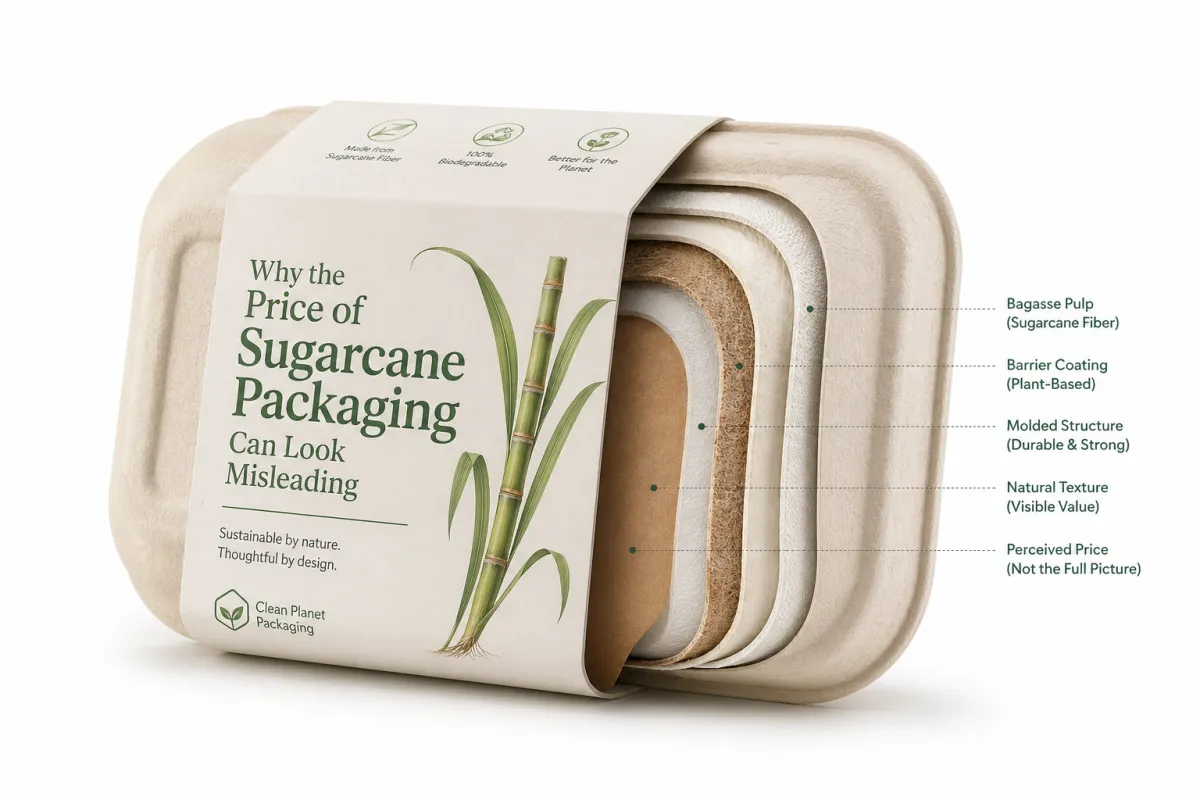
The first mistake I see is treating the price of sugarcane packaging like a commodity quote with no context. A bagasse clamshell may cost 2 to 6 cents more than a basic foam container, yet that spread can shrink once you count damage rates, customer perception, and disposal fees. In a takeaway program moving 20,000 units a month, a 3-cent difference is $600, and if the cheaper option creates 2% more spoilage or replacement claims, the math changes right away. I have had buyers think they were saving money and then discover they were basically buying extra headaches in bulk.
Carton count and pallet density get overlooked too often. On one negotiation in Suzhou, a restaurant group wanted to save $0.01 per piece, but the foam option packed 720 units per pallet while the molded fiber alternative packed 540 because the walls were thicker and the crush resistance was better. The freight difference did not look dramatic on one shipment, yet over 12 monthly orders it erased nearly all of the apparent savings. That is why the price of sugarcane packaging should never be read in isolation. If you only look at unit cost, you are basically shopping with one eye closed.
Another trap is assuming every sugarcane package is built the same way. It is not. A plain stock plate, a deep burger clamshell, and a custom branded tray with embossing can come from different tooling paths, different drying cycles, and different finishing steps in factories across Guangdong and Jiangsu. The price of sugarcane packaging moves with wall thickness, grease resistance, print method, and whether the factory is pulling from stock molds or creating a custom shape. I remember a buyer pointing to two trays that looked "pretty much identical" on a screen; in the factory, they were living in completely different cost buckets.
Presentation matters more than procurement teams sometimes admit. Retail packaging and foodservice packaging do not play by the same rules. A catering client once chose the lowest-cost uncoated bowl, then found that a tomato-heavy salad left visible darkening after 20 minutes at 65 C. We switched to a slightly treated version, and the price of sugarcane packaging rose by 8%, but complaints dropped to zero during the next test run. That is the kind of trade-off I can live with any day.
That is the practical view: sugarcane packaging is not always the cheapest line item, and I would not claim that it is. What it can be is the stronger value choice when you need food-safe performance, a better retail story, and a package that supports compliance goals without forcing your team to redesign the whole launch. The price of sugarcane packaging looks high until you compare the full operating cost, including breakage, returns, and the extra labor tied to repacking 1,000 units at a time. A quote sheet alone cannot tell you whether the choice is smart.
Sugarcane Packaging Product Details Buyers Ask About
Bagasse is molded fiber made from sugarcane pulp byproduct, and buyers usually source it in clamshells, plates, bowls, trays, cups, and lids. The core appeal is straightforward: heat tolerance, stackability, and a natural fiber look that fits modern retail packaging and foodservice programs. When people ask me about the price of sugarcane packaging, I usually start by asking which format they are actually buying, because a 9-inch plate and a 3-compartment tray are not priced the same way. One of those will make your ops team happy; the other might make them mutter at the dock in a warehouse on the outskirts of Foshan.
Clamshells tend to work for burgers, sandwiches, and combo meals with heat and steam inside the container. Bowls fit noodles, rice, salads, and hot soups better, though they need more care around grease and lid fit. Trays work for meal kits and bakery assortments, where product visibility matters. In my experience, the price of sugarcane packaging is easiest to control when the format matches the food instead of forcing the food to fit a standard shell, especially on lines running 18 to 22 cartons per hour. I have seen teams try to force a square solution onto a round menu, and the packaging never forgives that kind of optimism.
Buyers often ask whether the product can handle hot, cold, dry, or lightly sauced foods. The answer depends on wall thickness, forming quality, and any barrier treatment. I have seen a 2.5 mm wall bowl survive hot rice at 85 C without distortion, while a thinner batch curled after the same hold time because the fiber blend was less uniform and the moisture content was off by a few points. That kind of difference affects the price of sugarcane packaging more than many teams expect. A millimeter on paper looks tiny; on the production floor, it can be the difference between "fine" and "why is half the shipment acting weird?"
Coated versus uncoated matters as well. Uncoated bagasse is often suitable for dry items and short hold times, while coated or treated versions improve grease and moisture resistance. That treatment can add several cents per unit, but it may save a brand from leakage complaints or failed shelf tests after 15 minutes on a warmer tray. If your team is comparing the price of sugarcane packaging across suppliers, make sure everyone is quoting the same barrier level, the same carton quantity, and the same destination port. Otherwise you are comparing apples to oranges, except the oranges are soaking through the carton.
Stock items are the fastest path. Custom shapes take longer, and brand-specific details such as embossing, debossing, lid snaps, or a unique compartment layout add setup work. On a supplier call last quarter, a factory in South China quoted a stock clamshell at a low entry price, then added a mold charge for the requested corner radius change and a trim adjustment in the second round of sampling. The price of sugarcane packaging doubled on the first order, then settled back down once the tooling was absorbed. That is not a trick, exactly, but it does feel a little like the invoice is clearing its throat.
If you are building a broader packaging program, it helps to see sugarcane items alongside your custom packaging catalog. I have seen food brands combine molded fiber with sleeves, inserts, and branded packaging elements to keep the whole kit consistent, often pairing a molded tray with a 350gsm C1S artboard belly band and a one-color logo on the lid. That approach does not always lower the price of sugarcane packaging, but it often improves the value of the full product packaging system by reducing the need for extra decoration elsewhere. And yes, sometimes the simplest-looking package takes the most planning, which is a very packaging-industry thing to happen.
Key Specifications That Affect Fit, Strength, and Safety
The first spec I check is dimensions. Length, width, depth, and closure style determine whether the package fits the food without crushing it or leaving too much empty space. A 9 x 9 x 3 inch clamshell is not interchangeable with a 9 x 6 x 2.5 inch format, even if both look similar in a photo. That is why the price of sugarcane packaging should always be compared against a written dimensional sheet. I have had buyers say, "It looked close enough," and that phrase has caused more rework than any machine ever did.
Wall thickness matters next. Thicker walls usually improve crush resistance and stackability, especially for export cartons and high-speed foodservice use. In one factory test in Dongguan, moving from a 1.8 mm wall to a 2.4 mm wall reduced corner collapse by about 30% under load, but it also raised the unit cost and reduced carton count by 14%. Those are the trade-offs that shape the price of sugarcane packaging more than any sales pitch. I like clean numbers, but I also like packages that do not fold under pressure the moment somebody stacks two cases too high.
Food-contact and compliance details are not optional. Buyers should ask for food-contact status, compostability claims, PFAS-free declarations where applicable, and any region-specific documentation required by the destination market in the US, EU, or Australia. For transport performance, I also like to see references to the type of testing used; the standards published by ISTA are useful for pack-out and distribution validation. If a supplier cannot show paperwork, the price of sugarcane packaging may be low for the wrong reason. Cheap is great until compliance starts asking awkward questions.
Print and branding specifications deserve the same attention. Embossing, debossing, logo placement, and ink coverage all affect setup and yield. A simple one-color logo on a flat lid is much easier than a wraparound decorative treatment on a deep tray, and a sleeve printed on 350gsm C1S artboard in Shenzhen will price differently than a matte kraft insert produced in Ningbo. I have sat in supplier meetings where a buyer wanted a premium retail finish but sent a file with no clear emboss depth, no Pantone target, and no tolerance range. The price of sugarcane packaging climbed for reasons that could have been avoided with a one-page spec sheet. I was tempted, more than once, to hand someone a pencil and say, "Please, just draw the thing properly first."
That is the document I recommend every team build before requesting quotes. Include one product sketch, exact dimensions, target weight or wall thickness, print area, finish requirements, and any compliance notes. When I reviewed procurement files for a meal-kit launch in Singapore and Kuala Lumpur, the buyers who used a one-page spec sheet got quotes that were 18% more consistent across vendors. Their price of sugarcane packaging comparison was faster, cleaner, and much easier to defend internally. The boring paperwork is often what keeps the money under control.
| Option | Typical MOQ | Indicative Unit Price | Best Fit | What Moves the Price |
|---|---|---|---|---|
| Stock clamshell | 3,000-5,000 pcs | $0.08-$0.15 | Burgers, sandwiches, hot takeaway | Wall thickness, carton count, freight |
| Semi-custom bowl or tray | 8,000-12,000 pcs | $0.14-$0.24 | Meal kits, salads, rice, bakery | Barrier coating, print, lid fit, tooling split |
| Fully custom branded set | 15,000-30,000 pcs | $0.22-$0.42 | Retail launch, private label, premium foodservice | Mold cost, embossing, artwork, quality checks |
That table is not a promise; it is the shape of the market I usually see in Guangdong, Zhejiang, and East China. The price of sugarcane packaging shifts with region, mold age, freight lane, and whether the order includes sleeves or inserts, but the structure above is a realistic starting point for procurement conversations. If a quote lands far outside it, I want to know why before anybody signs anything.
Price of Sugarcane Packaging: What Drives the Quote
Every quote breaks into the same buckets, even if the supplier does not label them clearly. Raw material, labor, tooling, printing, finishing, packaging, and freight all sit inside the final number. I like to ask for those elements separately because the price of sugarcane packaging can look 12% apart on two quotes that are actually built from the same base mold but different freight assumptions from Xiamen versus Shenzhen. A clean breakdown saves everyone from that weird, squinty spreadsheet meeting where nobody wants to say what they really think.
MOQ is one of the biggest levers. A mold setup that costs $900 spread over 3,000 units adds $0.30 per piece before material and labor even enter the calculation. Spread that same setup over 30,000 pieces, and the burden drops to $0.03. That is why the price of sugarcane packaging usually falls sharply as volume climbs, provided the factory can hold yield and maintain the same quality standard. Volume is the quiet hero here, though procurement teams rarely give it enough credit.
Tooling changes the picture again. Stock catalog items may have no tooling charge at all, while custom molds can add a meaningful first-order cost. I have seen a buyer negotiate a $1,500 mold fee down to $300 because the factory in Foshan expected a follow-on order within 90 days and wanted the business. In that case, the long-run price of sugarcane packaging looked better than the initial invoice suggested. Sometimes the best negotiation is not about winning a point; it is about setting up the next order so it does not sting.
Printing and finishing are easy to underestimate. Extra colors, embossing, special coatings, and private labeling can all add labor and reject risk. A simple logo on one lid corner is not the same as a full-wrap branded package with texture and tight placement tolerances, and a 350gsm C1S artboard sleeve with spot UV will cost differently than a plain kraft band. If the quote does not separate those items, the price of sugarcane packaging may be hiding part of the cost inside an unhelpful bundle. I am always suspicious when the "all-in" number sounds too neat; neat numbers tend to hide messy assumptions.
Lead time also changes cost. Faster production windows can trigger overtime, priority scheduling, or premium freight. I have watched a supplier add 6% to a quote because the buyer wanted the goods shipped in 14 days instead of 28, and that was before the port cut-off in Yantian added another day of pressure. That is not a penalty; it is capacity pricing. Still, it matters, because the price of sugarcane packaging should reflect the schedule you are actually asking the factory to hit. If your timeline is tight, the invoice will usually know before you do.
Here is the part most first-time buyers miss: inspection and packaging can be real cost centers. Double-wall export cartons, inner liners, pallet wraps, and third-party quality checks all improve consistency, but they add to the total. On a retail packaging program I reviewed, better carton protection reduced breakage by 1.7%, which more than covered the extra packing expense on a 14,000-piece shipment. The price of sugarcane packaging can rise for a good reason when the order is protected correctly. Spending a little more to stop breakage from turning your warehouse into a comedy of errors is usually money well spent.
If you need proof that transport testing matters, look at the way ISTA frames distribution testing, and compare that to your own damage history from the last three shipments. The same logic applies to sustainability claims and regional disposal guidance; I often ask teams to verify claims against the EPA's sustainable materials guidance before printing anything on the carton. That discipline keeps the price of sugarcane packaging from being distorted by avoidable rework, returns, or claim corrections. Nobody enjoys reprinting cartons because somebody guessed at a claim and guessed wrong.
There is another hidden driver: supplier familiarity. A factory that already runs a 2-compartment fiber lid with your exact artwork can quote faster and cheaper than a factory starting from a rough sketch. In a recent negotiation, the second supplier came in 9% higher because they needed more sample cycles and a different trim line. That does not mean the first quote was automatically better; it means the price of sugarcane packaging depends on capability, not just labor rates. I would rather pay for a factory that knows what it is doing than save pennies and babysit every pallet.
MOQ, Sampling, and Production Timeline Buyers Should Expect
The cleanest buying process follows five steps: inquiry, sample approval, final artwork sign-off, mass production, and shipment. If the supplier skips one of those steps, the order often pays for it later. I have seen projects delayed by 11 days because the buyer approved the sample but forgot to confirm the sleeve dimensions, and that changed the cartoning plan. The price of sugarcane packaging is only one part of the purchase; timing carries cost too, and timing has a habit of slipping when nobody is paying close attention.
Sampling usually takes 7 to 14 days if the mold exists and the print is simple. If tooling is needed, allow 12 to 18 business days for mold development, test molding, and dimensional checks. For a brand launch I helped coordinate in Shanghai, the sample was approved in 9 days, but the print proof took another 4 because the artwork file had no bleed and no vector logo. That delay did not change the material cost, but it affected the real-world price of sugarcane packaging by pushing freight into a more expensive window. Tiny file mistakes can somehow become very expensive very fast.
MOQ varies by product type. Standard clamshells are usually easier to source in lower quantities than deep trays, tight-fitting lids, or multi-compartment formats. If a supplier quotes an unusually low MOQ, ask whether it is a stock mold, a shared production run, or a simplified finish. Lower MOQ often means the price of sugarcane packaging rises because setup and inspection are spread across fewer units. There is no free lunch here, just different ways of paying for the same reality.
Sampling should include four checks at minimum: fit, heat, grease, and stackability. I like to see a hot meal held for 20 to 30 minutes, then a lid lift test, then a carton drop simulation from roughly 75 cm onto a hard surface. If the package fails on the third test, the unit price stops mattering. The price of sugarcane packaging is worthless if the product arrives warped or leaks in the first 500-mile shipment from the factory to the port. A pretty sample that fails in transit is just expensive optimism.
Lead times for mass production are usually 2 to 4 weeks after approval, plus freight. That is the normal band I see for standard items in factories around Guangzhou, Dongguan, and Ningbo, though custom tooling can stretch the schedule. Buyers often assume the factory is the only bottleneck, but in practice artwork approval and payment release are the two most common pauses. A clean launch plan keeps the price of sugarcane packaging from being inflated by avoidable rush fees. I have watched a perfectly good production slot slip away because someone was waiting on one signature from someone on holiday, which naturally nobody remembered to check.
Before you place the order, build a launch checklist with six items: exact dimensions, quantity, print file, target delivery date, compliance documents, and freight destination. Add the payment terms and whether tooling is refundable, amortized, or charged separately. That checklist sounds basic, but it saves real money. I have seen a chain save $2,400 simply by locking the artwork one week earlier, which kept them out of expedited shipping from Shenzhen to Los Angeles. In that case, the price of sugarcane packaging was less important than the discipline around the schedule.
Why Choose Us for Sugarcane Packaging Sourcing
What buyers usually want is not another sustainability slogan. They want a supplier who gives a clear quote, answers fast, and ships a product that matches the sample within a tight tolerance. That is where Custom Logo Things earns trust. We focus on transparent pricing, careful spec confirmation, and practical support that keeps the price of sugarcane packaging understandable before you commit. I have learned the hard way that "should be fine" is not a sourcing strategy, especially when a 20,000-piece launch is on the line.
I have spent enough time on factory floors in Dongguan and Quanzhou to know that consistency beats noise. A good supplier holds wall thickness within a narrow range, keeps print placement clean, and controls breakage before it reaches your receiving dock. On one shipment review, a tighter packing method cut damage claims from 1.9% to 0.4% across 18 pallets. That kind of control matters because the price of sugarcane packaging should not get wiped out by avoidable loss. A cheap carton that arrives as confetti is not a savings; it is a training exercise for your warehouse team.
We also know that sourcing is not just about the product itself. It involves export paperwork, food-contact questions, repeat-order consistency, and post-shipment follow-up. I have had buyers call six weeks after delivery because a lid fit changed by a fraction of a millimeter and their line speed suffered by 8 cartons per hour. A responsive partner catches that earlier. The real value is not a low number on a quote sheet; it is a supply chain that protects margin, brand presentation, and customer satisfaction. That is the part people remember when the pressure is on.
If you are comparing options across molded fiber, paperboard, and other product packaging formats, it helps to look at the full program, not only the container. Our Custom Packaging Products selection gives teams a way to compare structures, finishes, and branding paths side by side. That makes the price of sugarcane packaging easier to judge against the rest of the launch, especially if your project includes sleeves, inserts, or other branded packaging components. I like that approach because it keeps the conversation honest instead of theatrical.
Honestly, I think buyers do best when they ask for the middle ground That Actually Works: not the cheapest quote, not the flashiest pitch, but the version that hits your spec, your shelf, and your schedule without drama. In supplier negotiations, that is usually the order that repeats, whether the factory is in Foshan, Xiamen, or Wuxi. And repeat business is where the price of sugarcane packaging becomes a strategic advantage instead of a one-time purchase headache.
Next Steps Before You Request a Quote
Before you ask for pricing, gather the exact product type, dimensions, quantity, print needs, and compliance requirements. If you can send the target food type too, such as hot rice, oily noodles, bakery items, or chilled salads, the supplier can quote more accurately on wall thickness and barrier treatment. The better the input, the cleaner the price of sugarcane packaging response will be. A vague brief almost always breeds a vague quote, and vague quotes are where budgets go to hide.
I recommend requesting three scenarios every time: stock item, semi-custom, and fully custom. That comparison shows where the economics change and helps your team decide whether the extra tooling or brand detail is worth it. On one account, the stock version was 18% cheaper, but the semi-custom option reduced leakage complaints enough to justify the move after a 6-week pilot in Chicago. Seeing the price of sugarcane packaging across tiers makes the decision easier. It also keeps the internal debate from turning into a philosophical argument about cents, which I have seen happen more often than I would like.
Samples are worth the small delay. Test them for heat, grease, stacking, and transport durability before you commit to a production volume. If your route includes long-haul freight, ask for carton drop testing and a palletization review. I have watched a sample look perfect on a desk and fail after a 90-minute delivery simulation from a warehouse in Ningbo to a distribution center outside Hangzhou. The price of sugarcane packaging is never the full story if the package does not survive the route. A nice-looking lid that explodes under pressure is not a design win.
Ask detailed questions about lead time, payment terms, freight options, and tooling ownership. If a mold fee is being charged, clarify whether it is refundable, amortized into the first order, or retained by the factory. That one question can change the economics by thousands of dollars. It also keeps the price of sugarcane packaging honest from the start. I cannot tell you how many awkward follow-up calls begin with, "Oh, we thought that fee was included."
Then compare on landed cost. Include the unit price, freight, inspection, expected loss rate, and any post-order adjustments you may need. I have seen teams save less by choosing the lowest quote than by choosing the most reliable one, because reliable supply reduces rework and downtime by entire shifts. That is the practical way to read the price of sugarcane packaging: not as a single number, but as a full purchase decision. Procurement gets much easier once everyone stops pretending the invoice is the whole picture.
My final advice is simple: build one clean spec sheet, ask for stock, semi-custom, and custom pricing, and test the sample under real heat, grease, and transit conditions before you lock the order. If your launch depends on clean presentation, accurate fit, and a stable supply chain, do not judge the price of sugarcane packaging by the first number in the email. Judge it by the spec sheet, the test sample, the freight plan, and the buyer confidence it creates. That is the difference between a quote and a working packaging program. And if you have ever had to explain a crushed shipment to finance, you already know why that difference matters.
What is the average price of sugarcane packaging per piece?
The unit price depends on size, wall thickness, print needs, and volume, so small orders usually cost more per piece than larger runs. For common stock items, I often see a range around $0.08 to $0.15 on 3,000 to 5,000 pieces, while custom printed or deeper formats can move into the $0.22 to $0.42 range on 15,000-piece runs. The best way to judge the price of sugarcane packaging is to request pricing at several MOQ tiers and compare the break points. If one quote looks dramatically lower, I always ask what got left out.
Does the price of sugarcane packaging include printing and tooling?
Not always. Many suppliers separate base product pricing from tooling, print plates, embossing, packaging, and freight. Ask for a written quote that states exactly what is included, because that keeps the price of sugarcane packaging comparable across vendors. If tooling is required, confirm whether it is a one-time charge, amortized into the order, or refundable later. A tidy quote is nice; a complete one is better.
What MOQ should I expect for custom sugarcane packaging?
Common MOQs are often in the low-thousands to mid-thousands, but the exact level depends on the shape, mold complexity, and print method. Standard clamshells usually have easier entry points than lids, deep trays, or specialized multi-compartment products. Lower MOQs are possible, but they usually come with a higher price of sugarcane packaging because setup costs are spread across fewer pieces. That is the trade-off, plain and simple.
How long does sugarcane packaging take from sample to delivery?
Sampling can take about one to two weeks depending on customization and whether tooling is already available. Production often takes two to four weeks after sample approval, with additional time needed for shipping and customs if applicable. Artwork changes and spec revisions are the most common reasons a timeline slips, and those delays can also push up the price of sugarcane packaging if you need expedited freight. A tidy approval path usually saves more money than people expect.
Is sugarcane packaging more cost-effective than plastic or molded fiber?
Compare total landed cost, not just the base unit price, because shipping weight, compliance, and disposal expectations can change the result. Sugarcane packaging can be very competitive when branding, food-contact requirements, and sustainability targets are part of the buying decision. Some plastic or molded fiber options may still win on raw price, but lose on presentation, regulations, or customer preference, which is why the price of sugarcane packaging should be read alongside the whole launch plan. I would rather make the right choice once than make the cheap choice twice.


