Buyer Fit Snapshot
| Best fit | Buy Patterned Poly Mailers Bulk for Branded Shipping projects where brand print, material claims, artwork control, MOQ, and repeat-order consistency need to be specified before quoting. |
|---|---|
| Quote inputs | Share finished size, material target, print colors, finish, packing count, annual reorder estimate, ship-to region, and any compliance wording. |
| Proofing check | Approve dieline scale, logo placement, barcode or warning zones, color tolerance, closure strength, and carton packing before bulk production. |
| Main risk | Vague material claims, crowded artwork, missing packing details, or unclear freight terms can make a low unit price expensive after revisions. |
Fast answer: Buy Patterned Poly Mailers Bulk for Branded Shipping should be specified like a repeatable production item. The safest quote records material, print method, finish, artwork proof, packing count, and reorder notes in one written spec.
Production checks before approval
Compare the actual filled-product size with the drawing, then confirm tolerance on folds, seals, hang holes, label areas, and retail display edges. Reserve space for logos, QR codes, warning copy, and material claims before decorative graphics fill the panel.
Quote comparison points
Review material grade, print process, finish, sampling route, tooling charges, carton quantity, and freight assumptions side by side. A quote is only useful when the supplier can repeat the same color, closure quality, and packing count on the next order.
The first thing many customers touch is not the product. It is the bag. If you want to buy patterned Poly Mailers Bulk, that outer layer has to earn its place fast, because it sets the tone before the item is scanned, opened, or photographed. I have watched buyers spend weeks perfecting the product and then send it out in packaging that says almost nothing. That mismatch is a little painful. A patterned mailer can make a $12 apparel order feel intentional, organized, and on-brand without pushing you into the cost structure of a printed carton.
From a packaging buyer's point of view, that matters. The outer shipper is the one surface that survives the full journey: pick, pack, parcel belt, courier truck, doorstep, and unboxing. A repeat pattern does not just decorate the shipment. It helps a brand look deliberate, and that can shift how customers judge quality, especially in categories where presentation carries real commercial weight. One weak bag can make a whole order feel cheaper than it is. One clean, well-made mailer can do the opposite.
For teams that want a practical upgrade instead of a vanity spend, patterned mailers sit in a useful middle ground. They are more expressive than plain gray or white poly bags, but they are far cheaper and faster to deploy than rigid packaging systems. That is why Custom Packaging Products often starts with the mailer conversation: low setup friction, visible branding, and a real impact on how the order lands with the customer. Not every business needs a fancy carton. Some just need the shipper to stop looking like an afterthought.
Pattern does not have to be loud to work. It has to be recognizable, repeatable, and tough enough to survive actual shipping conditions.
Buy Patterned Poly Mailers Bulk: Why the Outer Package Matters
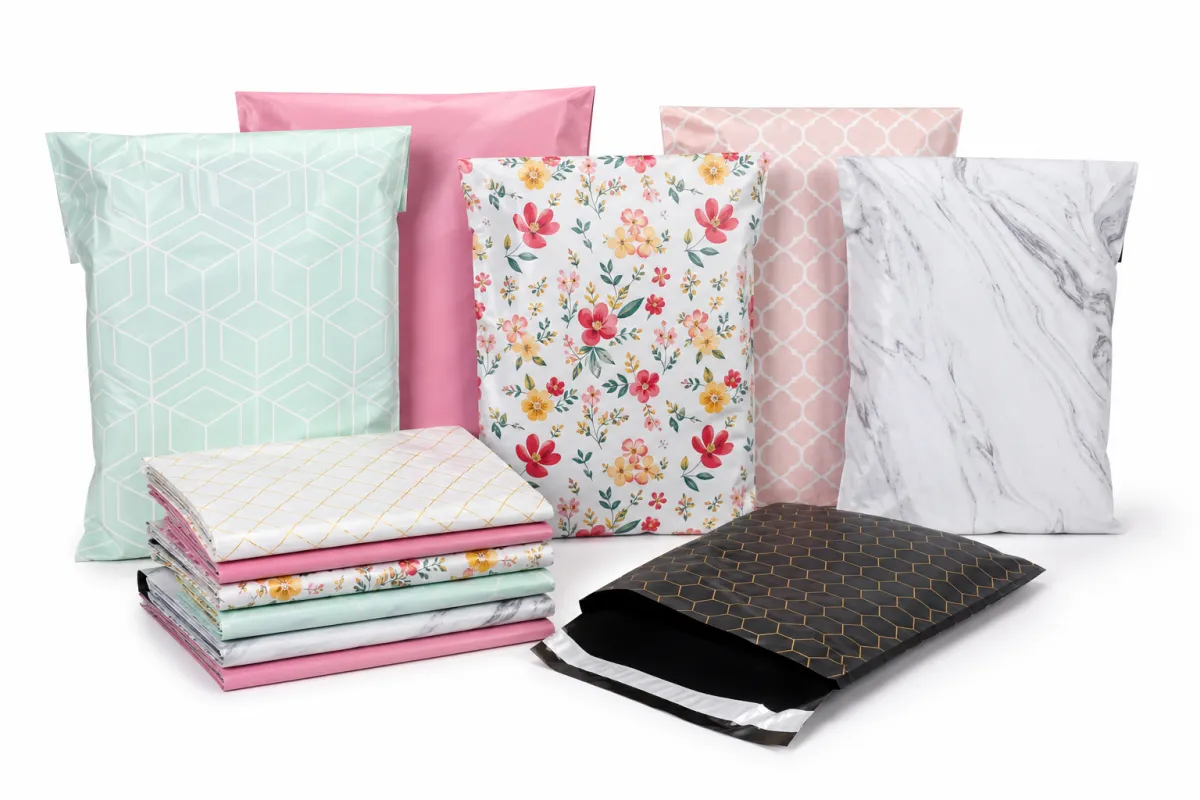
When buyers decide to buy patterned Poly Mailers Bulk, they are usually looking for a better perception trade-off, not a dramatic reinvention of the shipping process. That is the real appeal. The outer package becomes a branded surface the customer actually handles, and unlike inserts or tissue, it is seen before the item is revealed. For apparel brands, accessory sellers, gift boxes, and subscription programs, that first contact is often the only physical branding moment that reaches the customer intact.
Picture a low-cost shipment that arrives in a plain gray bag. It works, but it says almost nothing. Now compare that with a patterned poly mailer carrying a repeat motif, a subtle logo treatment, or a seasonal graphic that photographs cleanly on a porch or kitchen counter. The product inside may be identical, but the packaging tells a different story. It suggests intent, organization, and a business that pays attention to detail. That matters when your average order value is modest and every touchpoint has to earn its keep.
There is also a practical business case. A printed carton may be the right answer for fragile products, but it is not always necessary for soft goods or lightweight items. Patterned mailers give you a visible branding layer without the board stock, fold complexity, or dimensional freight penalties that come with rigid packaging. Many ecommerce teams use them to create a more polished shipping experience while keeping outbound weight and cubic volume in check. If you need a brand system that scales across repeat shipments, a patterned mailer is usually easier to run than a box program. That simplicity matters more than people admit.
That is why brands in apparel, beauty accessories, handmade goods, and gift sets tend to respond well when they buy patterned poly mailers bulk. The package is thin, light, and efficient, yet it still carries enough visual identity to make the shipment feel deliberate. In practice, that can be a better fit than overbuilding the outer pack. Customers rarely reward excess material. They do notice clarity, neatness, and consistency.
It also helps that the mailer surface is simple to standardize. Once the artwork, size, and film spec are locked, reorders become easier to predict. Many teams use the same patterned design across a season or across several SKU families, which means the packaging supports the brand without needing a separate artwork decision for every product line. If you are buying for multiple product categories, it can be useful to compare the mailer to your broader Custom Poly Mailers strategy so the branding, thickness, and closure style stay aligned.
One more point gets overlooked a lot: a patterned mailer can narrow the visual gap between a small seller and a bigger label. That does not mean pretending to be something you are not. It means creating a consistent customer-facing system. A tidy, well-printed poly mailer is often enough to make the brand feel established, even when the operation is lean.
For that reason, the decision to buy patterned poly mailers bulk is less about decoration and more about packaging discipline. You are buying control over the first impression, and control is valuable because it is repeatable.
Pattern Options, Materials, and Print Methods
If you want to buy patterned poly mailers bulk intelligently, start by separating pattern style from film construction. Those are related, but they are not the same decision. Pattern style is the visual language. Film construction is the physical base. A good purchase balances both.
The most common pattern styles are straightforward: repeat prints, seasonal motifs, brand-led graphics, and subtle texture-based designs. Repeat prints work well because they stay consistent from one side of the mailer to the other and photograph cleanly under store lighting or on social media. Seasonal motifs can be useful for campaigns, but they should be planned carefully so leftover inventory does not become obsolete too quickly. Brand-led graphics are usually the best fit for steady reorder programs because they can be recognized instantly without relying on trend timing. Texture-style patterns, such as faux weave, linework, or soft geometric fills, are especially useful when the brand wants visual interest without a busy layout.
Material choice matters just as much. Most buyers will see co-extruded poly film in one of several thickness ranges, often expressed in mil or micron. A lighter film can work for soft apparel, flat accessories, or low-risk orders. A heavier film is better when the contents have corners, zippers, hardware, or a higher replacement cost. Glossy finishes tend to print with more visual punch, while matte finishes can feel quieter and more premium in the hand. Neither is automatically better. The right answer depends on the product category and the brand voice. I have seen matte bags look incredibly expensive on a clean tabletop photo and then underperform in a high-sheen retail display. Context changes everything.
Print method drives what is possible. Flexographic printing is common for repeat patterns and scaled production because it handles efficient runs well and supports consistent color placement. Gravure can deliver strong ink laydown for larger volumes, though tooling and setup expectations are different. Some buyers ask for digital workflows on short runs, which can be useful when a design is still being tested, but digital is not always the best fit for very long, cost-sensitive replenishment orders. If you are trying to buy patterned poly mailers bulk for a stable program, the print process should match the forecast, not just the artwork.
Color limits are another real-world issue. A 1-color or 2-color pattern is usually easier to keep sharp and cost-efficient than a complex multicolor illustration with gradients or tiny registration details. Edge clarity matters because soft film and high-speed production can make delicate lines look less crisp than they do on a monitor. Pattern alignment across the run also deserves attention. A design may look fine in a proof and still drift if the repeat panel or seam positioning was not defined clearly. That is why buyers who want to buy patterned poly mailers bulk should ask how the repeat is built, where the safe area sits, and how the artwork wraps around the finished bag.
There is a useful rule of thumb here: if the design has to do a lot of visual heavy lifting, keep the structure simple. If the structure is straightforward, you have more room to experiment with pattern density and color contrast. Buyers often discover that a restrained repeat with good contrast photographs better than a crowded graphic. That is especially true for ecommerce listings where the packaging appears in customer-generated images. No one likes a mailer that looks clever in a design file and muddy on a real doorstep.
Stock patterns versus custom artwork is the final split to understand. Stock patterns are faster to source and usually come with less setup complexity, which makes them attractive when lead time matters more than exact brand control. Custom artwork gives you a stronger identity match and a better path for repeat programs, but it usually requires tighter file preparation and more approval steps. If you need a quicker launch, a stock pattern may be the practical answer. If the mailer is part of a long-term brand system, custom artwork often wins.
From a buyer's perspective, the smartest move is to define the visual goal first, then choose the film, print process, and pattern style that can actually deliver it. That is how you buy patterned poly mailers bulk without buying avoidable complexity.
Size, Thickness, and Shipping Specifications
Before you buy patterned poly mailers bulk, size has to be confirmed in terms of what actually ships, not just the label you wish the package could carry. Usable interior dimensions matter more than the nominal outer measurement. So do flap length, seal zone, and whether the contents will be folded once, folded twice, or shipped with a protective insert. A mailer that is technically the right length can still be wrong if the opening is too tight or the seam eats into the usable space.
Buyers often make the mistake of measuring the item itself and stopping there. That is not enough. A folded garment may need room for the fold depth, a return label, and a little tolerance so the product does not bunch against the adhesive strip. Flat goods such as printed cards or small accessories need less depth, but they still need enough width to prevent the package from bowing. When teams buy patterned poly mailers bulk without checking these practical dimensions, they end up with either overstretched bags or unnecessary air in every shipment.
Thickness is the next decision. In plain language, a thinner film is lighter and usually less expensive, while a thicker film adds puncture resistance and stiffness. For soft apparel, lighter specifications may be sufficient if the shipment is not being abused by sharp corners or heavy inserts. For items with hardware, rigid edges, or higher replacement costs, moving up in thickness is usually worth the extra spend. The point is not to buy the heaviest mailer available. The point is to match the film to the product risk. That is how buyers keep packaging spend under control while still protecting the shipment.
Typical practical ranges are easy to remember. A lighter mailer may sit around 2.5 to 3 mil or a comparable micron range, which is often fine for low-risk goods. A stronger option may sit around 4 to 6 mil, especially when the product has corners, a heavier weight, or a longer shipping path. That stronger film usually feels stiffer in the hand and resists tears better at stress points. If you are trying to buy patterned poly mailers bulk for apparel, accessories, or gifts, the best spec depends on the value of the item and the probability of scuffing, not on a generic notion of quality.
Adhesive strip quality deserves the same scrutiny. A weak seal can create returns that have nothing to do with the product. Buyers should ask how the closure behaves under pressure, whether the liner peels cleanly, and whether the adhesive keeps its tack in warmer or colder conditions during transit. Tear behavior also matters. Some mailers separate cleanly without shredding the edges, while others split awkwardly and make the customer feel like the package was overworked. If the mailer is a branded surface, that failure becomes part of the brand story. Nobody wants that kind of surprise.
For more formal evaluation, it can help to refer to recognized testing standards. Many packaging teams look at ISTA transit test protocols to simulate shipping stress, and film buyers may reference ASTM methods such as tensile or impact testing when comparing material claims. That does not mean every bulk order needs a lab report. It does mean the spec conversation should be based on something firmer than a marketing description. If a supplier cannot discuss film strength, closure performance, or transit testing in concrete terms, the buyer is taking on more risk than necessary.
Here is a simple comparison that helps teams decide how to buy patterned poly mailers bulk by matching spec to product value:
| Mailer Type | Typical Thickness | Best For | Typical Strength Profile | Practical Notes |
|---|---|---|---|---|
| Lightweight patterned mailer | 2.5-3 mil | Soft apparel, flat accessories, low-risk items | Good for routine shipping, lighter puncture resistance | Lower cost, lower weight, best when contents have no sharp edges |
| Standard patterned mailer | 3.5-4 mil | Everyday ecommerce fulfillment | Balanced protection and cost | Most flexible option for repeat orders and mixed product types |
| Heavy-duty patterned mailer | 5-6 mil | Higher-value goods, items with corners, longer transit lanes | Better puncture resistance and stiffness | Costs more, but reduces damage risk when the product is less forgiving |
If your operation ships several SKU families, it can also help to map mailer size to packing behavior. One size may suit single-unit orders. Another may be better for bundles, gift sets, or returns. The best buyers do not just ask whether a mailer fits. They ask whether it fits efficiently, consistently, and without forcing the packer to rework every order.
This is one reason wholesalers and recurring brands often use Wholesale Programs to lock in a few core sizes and thicknesses instead of ordering a new format every time the assortment changes. That approach keeps the packaging system simpler, which usually saves money in the warehouse as well as on the invoice. Simpler systems are easier to train, easier to replenish, and far less likely to cause packing mistakes at 4:45 p.m. on a busy Friday.
In short, if you want to buy patterned poly mailers bulk with confidence, specify the usable dimensions, the film thickness, the adhesive behavior, and the expected product risk. Those four details tell you more than a glossy product photo ever will.
Buy Patterned Poly Mailers Bulk: Pricing and MOQ
The real cost to buy patterned poly mailers bulk is not the unit price alone. It is the sum of material grade, print complexity, order volume, setup charges, freight, proofing, and the cost of carrying inventory. Buyers who compare only the per-piece number usually miss the part that changes the economics most: volume tiering. A quote can look attractive at first glance and still be the more expensive choice once all the extras are added.
Pricing drivers are straightforward, but they interact. A larger bag uses more film, so material cost rises. A design with multiple colors or tighter registration takes more work, so print cost rises. A thicker film or stronger adhesive can improve performance, but it also increases the bill. Order volume then pushes the other direction. As the quantity increases, the unit price usually falls because setup is spread across more pieces. That is why a buyer should compare quotes using the same size, same film, same print method, and same delivery terms before deciding where to place the order.
MOQ, or minimum order quantity, depends on how the mailer is produced. Stock-pattern programs often allow lower minimums because the design is already prepared. Custom artwork usually requires more volume to justify the setup. In practice, many suppliers quote in tiers such as 3,000 pieces, 5,000 pieces, or 10,000 pieces, with the best pricing appearing at the higher tier. That does not mean you should always order the largest quantity. It means the reorder cadence should match actual demand. If a design turns over slowly, excess inventory is just cash sitting on a shelf.
Sample costs and setup fees are another source of confusion. Some suppliers charge a small fee for physical samples, especially if they need to pull stock or create a proof. Custom projects may involve plate charges, cylinder costs, or art setup charges that can range widely depending on print method and complexity. Those charges are not automatically a bad sign. They are simply part of the process. What matters is whether the buyer sees them early. A transparent quote is much easier to manage than one that hides freight until the final step.
For an order comparison, the table below gives a realistic way to evaluate what happens when you buy patterned poly mailers bulk across different formats:
| Order Type | Typical MOQ | Indicative Unit Price | Setup / Proofing | Best Fit |
|---|---|---|---|---|
| Stock pattern, standard size | 3,000-5,000 pcs | $0.10-$0.18 each | Low or none, depending on sample request | Fast launch, lower setup burden, simpler replenishment |
| Semi-custom pattern with limited colors | 5,000-8,000 pcs | $0.14-$0.24 each | Moderate proofing and art preparation | Brands that want visible identity without heavy complexity |
| Fully custom repeat print | 8,000-20,000 pcs | $0.18-$0.32 each | Plate or cylinder charges, more complete file review | Established brands, recurring campaigns, higher forecast certainty |
Those numbers are not promises. They are planning ranges, useful for budgeting and early sourcing conversations. Final pricing depends on size, thickness, print coverage, color count, and market conditions at the time of purchase. Freight can move the total quite a bit, especially if the shipment is large or if the destination requires special handling. That is why the smartest way to buy patterned poly mailers bulk is to ask for a landed-cost comparison, not a sticker-price comparison.
There is also a difference between a low quote and a useful quote. A useful quote identifies the exact size, film gauge, pattern style, print colors, finish, sample policy, lead time, and shipping terms. It tells you whether the price includes proofing, whether the freight is prepaid or collect, and whether the supplier can hold the spec stable across reorders. If those details are missing, the order is harder to manage than it should be.
When evaluating value, look at the number of reorder cycles rather than one purchase. If you place a 10,000-piece order and use it across four months, the cost per shipped order is often more meaningful than the cost per bag. That is especially true for brands with predictable volume. A slightly higher unit price can be justified if the supplier delivers stable quality, reliable reorders, and fewer packing exceptions.
Another practical tip: ask whether the quote reflects the same artwork placement and print coverage from end to end. A supplier can sometimes quote a light pattern that uses less ink than a richer branded design. Those two bags may look similar in a thumbnail and feel very different in real use. Buyers who want to buy patterned poly mailers bulk should compare like with like, or the pricing discussion becomes misleading fast.
The most useful buying question is simple: what is the total landed cost for the quantity you will actually consume before the next reorder? That answer is far better than chasing the lowest headline number. If you know your shipping volume, the right buy size becomes easier to see, and the business case becomes much clearer.
Production Process and Delivery Timeline
Production quality improves when the order flow is disciplined. When buyers buy patterned poly mailers bulk, the typical process should be easy to understand: artwork review, proof approval, sample confirmation if needed, production, packing, and shipment booking. That sounds basic, but small gaps at any stage can add days or even weeks to the schedule. The fastest orders are not always the ones with the shortest production run. They are the ones with the cleanest input files and the fewest unresolved questions.
Artwork review is the first checkpoint. The supplier should verify size, bleed, safe area, line thickness, font legibility, and repeat alignment before anything goes to press. If the design depends on a specific color tone, the proof should show how that tone is being interpreted on the chosen film. A buyer who wants to buy patterned poly mailers bulk should not approve artwork until those basics are clear. Once a file is approved, changes become more expensive and slower.
The next delay risk is usually revision churn. Small edits look harmless, but they can reset the proof cycle. A changed logo size, an altered repeat distance, or a new background color may require another round of confirmation. Missing dimensions cause the same problem. If the supplier does not know whether the item is being folded in half or three times, the mailer may be built around the wrong use case. That is why the buyer should send complete specs up front, not piecemeal notes.
Timelines also vary by whether the design is already production-ready. Stock-pattern mailers often move faster because the core artwork and process are already established. A custom pattern with new files, special color matching, or unusual layout requirements takes longer. In many cases, stocked items may move in roughly 7-12 business days after approval, while custom patterned runs may sit closer to 12-20 business days, depending on quantity and print complexity. Those are planning ranges, not guarantees, but they are useful when coordinating warehouse intake.
For buyers that need tighter shipping windows, the best defense is earlier replenishment. If demand is rising, wait times become harder to manage and rush charges become more likely. It is better to place the order before the last carton is opened than after stock has already run dry. That simple shift usually saves both money and stress. It also helps the supplier allocate production time more predictably, which can improve service on future orders.
Packaging teams that monitor replenishment cycles often avoid the most expensive mistake: ordering too late. A few weeks of lead-time buffer can prevent emergency freight, expedited proofs, and rushed revisions. If the design is stable, the supplier can often repeat the same spec with less administrative overhead on the next round. That is one of the hidden advantages when you buy patterned poly mailers bulk from a partner that keeps records cleanly.
From a process perspective, there are a few specific things that keep the schedule on track:
- Send final dimensions and file formats together.
- Confirm whether the pattern repeats across both sides or only the front.
- Approve the proof promptly once the layout is correct.
- Decide on sample acceptance before production starts.
- Book inventory space before the shipment arrives.
That list looks simple because it is. Most delays come from missing information, not from the manufacturing line itself. If the order is defined properly, the production team can move with far less friction. Buyers who buy patterned poly mailers bulk repeatedly tend to learn this quickly: the schedule is usually won or lost before the press runs.
One last point on quality control. The supplier should pack the mailers so the corners stay protected, the film does not crease excessively, and the printed surface does not rub against rough packing materials. That sounds minor, but damaged outer packaging creates avoidable disputes. For a branded shipper, the outer pack is part of the product experience. It should arrive looking like it was meant to be handled by customers, not by a freight dock.
Why Choose Us for Patterned Poly Mailers in Bulk
Not every supplier communicates with the same level of specificity. The better ones make it easy to buy patterned poly mailers bulk because they talk in clear specifications, not vague assurances. That means quoted dimensions, known thickness ranges, defined print methods, transparent minimums, and realistic lead times. It also means the supplier can explain what is possible before the job is approved, instead of discovering problems after the order is already in motion.
That matters more than many buyers think. A well-run packaging partner should be able to review your files, flag weak line weights, confirm the film construction, and recommend the right pattern style for the product category. If you are shipping apparel, a lighter, cleaner design may be enough. If you are shipping higher-value accessories, a thicker film or more secure adhesive may be the better fit. A supplier that can explain those trade-offs clearly is usually easier to work with over time.
At Custom Logo Things, the value is not in hype. It is in repeatability. Buyers need patterns that print consistently, seals that hold, and reorders that do not require a full relearning process every time. That consistency is especially useful for brands that place recurring orders through Custom Poly Mailers programs because the packaging has to stay aligned with the brand from one shipment cycle to the next.
Pre-production support is another practical advantage. The best outcomes usually come from a file check before press time, not from fixing mistakes afterward. That check should cover artwork bleed, pattern repeat, color count, and any text that could be too small to hold up on film. If the design is seasonal, the buyer should know whether unused inventory will still make sense later in the year. That kind of discussion saves money because it prevents avoidable dead stock.
Operationally, buyers should look for suppliers who can hold stable minimums and maintain clear packing standards. Reorders should not vary wildly from the first run. If the first shipment arrives cleanly packed, the second should do the same. If the proof process was straightforward once, it should not become a guessing game later. Those are the kinds of signals that indicate a supplier can support a real replenishment program rather than just a one-off purchase.
A good partner also helps buyers avoid the common problems that create complaints in the field: faded pattern edges, weak seals, mismatched sizing, poor opacity, and transit scuffing. Those issues are not cosmetic in a sales context. They can affect customer trust, repeat purchase behavior, and internal fulfillment efficiency. If the outer package looks off, the brand feels less controlled.
If you are comparing vendors, ask direct questions. How many colors are in the print? What is the actual film thickness? Is the closure adhesive tested for real shipping conditions? Can the supplier support the same spec on a reorder without redesigning the file? Suppliers that answer those questions cleanly are easier to trust. Suppliers that avoid them usually create more work later.
For buyers managing multiple packaging categories, it can also help to keep all sourced items under one program so the shipping visuals stay consistent. That is where the broader Custom Packaging Products lineup becomes useful: mailers, inserts, labels, and supporting materials can be coordinated without turning every order into a separate project. The result is not just prettier packaging. It is a more controlled operation.
So if your goal is to buy patterned poly mailers bulk with fewer surprises, choose a supplier that talks about specs, timing, and repeatability in the same sentence. That is a much better signal than polished sales language alone.
Next Steps Before You Place the Order
Before you buy patterned poly mailers bulk, slow down long enough to confirm the basics. Request samples. Measure the product as it will actually ship. Decide on thickness based on weight, edges, and transit risk. Approve artwork only after the repeat, colors, and closure area are clear. Then check the MOQ against your forecast so the order supports operations instead of creating excess inventory.
It helps to compare at least two quotes on the same basis. The price needs to reflect the same size, same film gauge, same print coverage, and same freight assumptions. If one quote includes proofing and the other does not, the comparison is not real. If one supplier is quoting stocked patterns and another is quoting custom artwork, the numbers will not tell you much. Buying smart means comparing the same thing twice, not comparing a full spec against a headline price.
That is also why order history matters. Pull the last few shipping cycles and look at volume by SKU, seasonality, and any spikes around promotions. Those numbers help you choose a quantity that fits your actual consumption rate. A better forecast usually means a better purchase. It also reduces the chance of emergency reorders, which are almost always more expensive than planned replenishment.
If you are building a broader sourcing plan, consider how the mailer fits with other packaging elements. A branded inner label, tissue sheet, or insert can support the same visual system, but the outer bag still carries the heaviest visibility load. That is why the decision to buy patterned poly mailers bulk should be treated as part of the packaging architecture, not a side purchase.
The cleanest path is simple: lock the spec, approve the proof, and schedule production while your inventory window is still healthy. If the order details are solid, the rest becomes much easier. And if you are ready to buy patterned poly mailers bulk for a repeat shipping program, do it with the same discipline you would apply to any core supply: defined dimensions, tested thickness, clear print expectations, and a replenishment plan that matches reality.
What Should You Check Before You Buy Patterned Poly Mailers Bulk?
Before you buy patterned poly mailers bulk, check four things: usable dimensions, film thickness, adhesive seal, and pattern repeat. Then match the finish and print method to your brand’s ecommerce packaging. If you are comparing branded mailers, ask for samples and confirm the quote includes freight, proofing, and the exact artwork placement. That simple checklist usually separates a useful order from an expensive redo.
Start with the item itself, then add the real-world variables. A folded garment, for example, needs room for the fold depth and closure strip, while flat accessories need enough width to avoid bowing. If you are planning to buy patterned poly mailers bulk for multiple SKU families, confirm whether one size can handle all of them or whether you need two core formats. That decision affects both warehouse speed and reorder predictability.
Next, compare the pattern against the brand’s visibility goals. A loud print can work for playful retail brands, but many teams do better with a restrained repeat that looks sharp in transit photos and customer-generated content. The goal is not to fill the surface with ink. The goal is to create a mailing format that feels intentional every time it ships. That is the real value of a patterned poly bag in bulk.
There is also a human side to this decision that gets skipped far too often. The people packing orders all day are the ones who notice whether a mailer opens cleanly, seals quickly, and stacks well on a cart. I have seen fulfillment leads reject a technically attractive bag because it slowed the line by a few seconds per order. That kind of friction adds up fast. It is not glamorous, but it is real.
And if your brand is still testing the market, keep the order modest enough to learn from. A mailer that performs well in one season may not be the right answer forever. A seasonal pattern that feels clever in March can look tired by November. Good packaging buyers stay honest about that. They do not marry the first design that performs well. They watch the data and adjust, which is usually the smarter move.
FAQ
Can I buy patterned poly mailers bulk with custom sizes?
Yes, most suppliers can quote custom dimensions if you provide the product size, fold depth, and whether the item needs extra room for inserts or return labels. Custom sizing usually affects MOQ, tooling, and lead time, so buyers should confirm those details before approving artwork.
What is the typical MOQ for patterned poly mailers bulk orders?
MOQ varies by print method, number of colors, and whether the design is stock or fully custom. Higher-volume orders usually reduce unit cost, but buyers should compare the MOQ against reorder frequency to avoid excess inventory.
How do I know which thickness is right for my mailers?
Match thickness to product weight, sharp edges, and shipping distance rather than choosing the heaviest option automatically. If the contents are soft apparel, a lighter spec may be enough; if the product has corners or higher value, choose a stronger film.
How long does it take to produce patterned poly mailers in bulk?
Timelines depend on artwork approval, sample confirmation, and whether the design is already set up for production. Ready-to-run patterns move faster than new custom artwork, so having files complete at the start shortens the schedule.
Can patterned poly mailers support branding for small businesses?
Yes, patterned mailers are often a cost-effective way to create a branded shipping experience without investing in custom cartons. They work especially well for apparel, handmade goods, and subscription products where the outer packaging is highly visible.