Buyer Fit Snapshot
| Best fit | Price per Unit Custom Poly Mailers Bulk Pricing projects where brand print, material claims, artwork control, MOQ, and repeat-order consistency need to be specified before quoting. |
|---|---|
| Quote inputs | Share finished size, material target, print colors, finish, packing count, annual reorder estimate, ship-to region, and any compliance wording. |
| Proofing check | Approve dieline scale, logo placement, barcode or warning zones, color tolerance, closure strength, and carton packing before bulk production. |
| Main risk | Vague material claims, crowded artwork, missing packing details, or unclear freight terms can make a low unit price expensive after revisions. |
Fast answer: Price per Unit Custom Poly Mailers Bulk Pricing: Film, Print, MOQ, and Carton Packing should be specified like a repeatable production item. The safest quote records material, print method, finish, artwork proof, packing count, and reorder notes in one written spec.
Production checks before approval
Compare the actual filled-product size with the drawing, then confirm tolerance on folds, seals, hang holes, label areas, and retail display edges. Reserve space for logos, QR codes, warning copy, and material claims before decorative graphics fill the panel.
Quote comparison points
Review material grade, print process, finish, sampling route, tooling charges, carton quantity, and freight assumptions side by side. A quote is only useful when the supplier can repeat the same color, closure quality, and packing count on the next order.
Price Per Unit Custom Poly Mailers Bulk Pricing Guide
When buyers ask me for price per unit Custom Poly Mailers bulk, I start with a question that sounds simple and turns out to be doing a lot of heavy lifting: what product is going inside, what is the finished fold size, and what kind of abuse will the package take between the warehouse and the porch? I have seen a 12 x 15 mailer quote come in higher than a 14 x 19 quote for reasons that made perfect sense once the spec sheet was on the table. The smaller bag needed heavier 3.0 mil film, a second print color, and a wider seal. Resin went up, setup went up, packing weight went up. The larger bag looked pricier at first glance, but the factory math said otherwise, which is annoyingly common and exactly why a real quote needs line-item detail.
That is why price per unit Custom Poly Mailers bulk never behaves like a single number lifted from a spreadsheet and left alone. Film, printing, converting, packing, freight, plate charges, sample approval, and waste allowance all live inside the final figure. I have stood beside a slitter in a packaging plant in Dongguan while a purchasing manager argued about half a mil of thickness; the quote changed once we priced the shipment end to end instead of staring at the bag cost in isolation. On another order from Ningbo, a 5,000-piece run moved from $0.19 to $0.16 per unit after the artwork was simplified from four colors to one and the carton pack was adjusted for better pallet density. That is the real work behind price per unit custom poly mailers bulk, and first-time buyers often miss it because nobody hands them a neat cheat sheet for packaging math.
Why price per unit custom poly mailers bulk quotes can surprise buyers
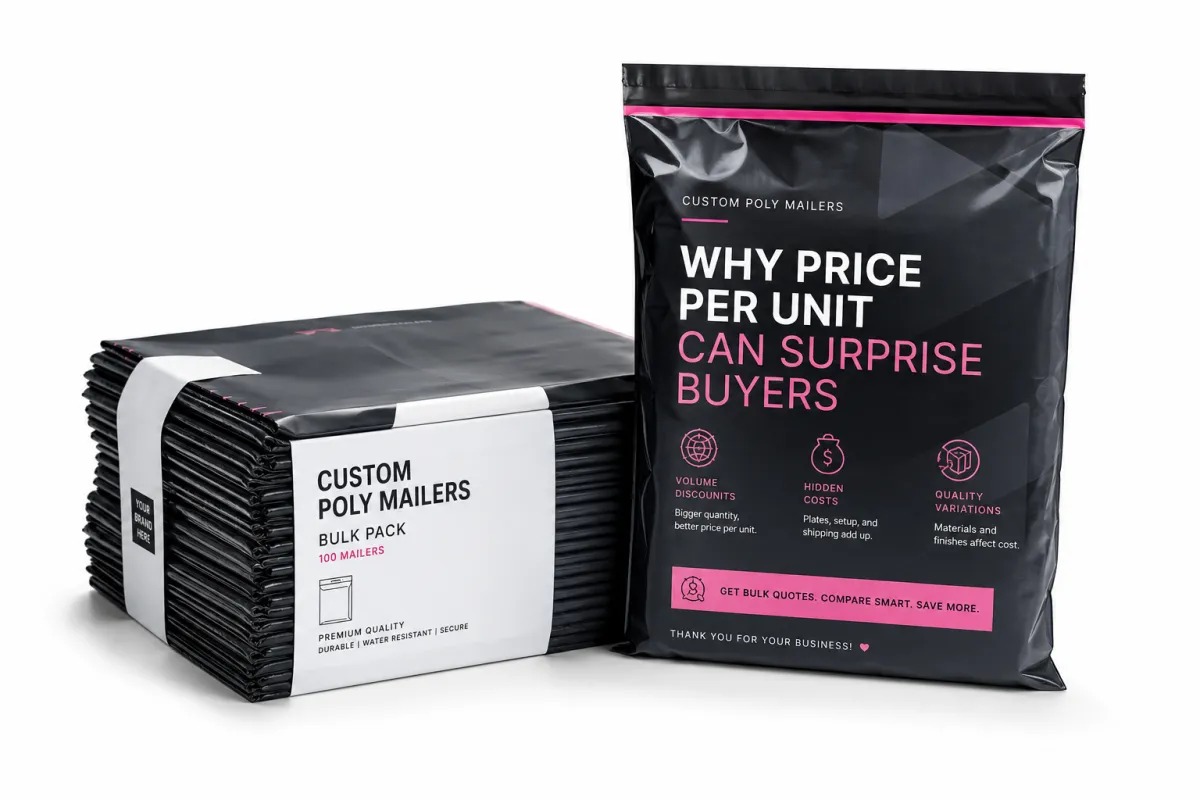
I still remember a denim buyer who arrived with a 5,000-piece order and one fixed belief: a 14 x 19 mailer had to cost more than a 12 x 15. The bag was larger, so the logic felt obvious. After we tightened the flat size by 2 inches, switched from full-flood print to a one-color side print, and changed packing from 50-count cartons to 100-count cartons, the price per unit custom poly mailers bulk quote dropped enough to alter freight class and shave receiving time at the warehouse. That kind of surprise is the good kind because it comes from process changes, not sales theater. On a Tuesday in Atlanta, I watched a brand owner grin at a quote reduction of $0.03 per unit because the bag spec had been the real problem all along.
The lowest price per unit custom poly mailers bulk quote is not always the strongest value if it ignores seal strength, print coverage, overage, or carton packing. On a dock in Los Angeles, I watched a fulfillment team reject a cheaper 2.0 mil bag because the tear rate climbed on day two of packing. They had saved $0.01 per unit and lost several times that in labor. I still think about that one because it was such a perfect little disaster: the savings looked noble on paper and completely ridiculous in motion. A proper comparison includes film resin, printing plates, converting labor, QC checks, carton packing, and delivery. If a supplier does not separate those pieces, the quote is not ready for comparison.
I push procurement teams to ask for landed numbers instead of ex-works numbers. The right price per unit custom poly mailers bulk conversation starts with the bag spec, then moves to shipping ZIP, pallet count, and any overage policy. One beauty brand in Dallas sent me three quotes that looked wildly different until we spotted the missing details. One quote included 3% overage, another included 5% overage, and the third left overage out completely. The “cheap” option stopped being cheap the moment we priced the missing pieces. It was incomplete, not competitive, and I have zero patience for that kind of half-quote because it wastes everyone’s afternoon.
"We thought we were saving money on the bag, but the real savings came from cutting one print color and locking the flat size to the product's 11-inch width," a retail operations manager told me after her first reorder from a plant in Foshan.
That is the mindset I want buyers to bring to price per unit custom poly mailers bulk. Judge the total package, not the sticker on a single mailer. If you are comparing Custom Poly Mailers against other Custom Packaging Products, keep the shipment profile in view too. A 2.5 mil mailer with a wider peel-and-seal strip may cost more than a thin stock bag, yet it can cut rework, returns, and damaged-product claims enough to pay for itself in the first few thousand units. That is not marketing fluff; that is the boring arithmetic of fewer headaches, especially when fulfillment is running 8,000 orders a week.
What custom poly mailers do best for shipping brands
Custom poly mailers do their best work when the product is soft, flat, or easy to compress. Apparel, leggings, light outerwear, scarves, phone accessories, books, and subscription bundles all fit that profile. The package stays light, the fulfillment line keeps moving, and the brand gets a visible outer shell. A well-specified price per unit custom poly mailers bulk order tends to deliver three gains together: lower shipping weight, faster packing, and tighter package branding. That is why many fashion labels in New York, Los Angeles, and Toronto use custom Printed Poly Mailers as the outer layer even when the product travels inside folded tissue or a printed insert card. I have watched the same brand go from “just a mailer” to “wait, this thing actually looks expensive” once the print and film were dialed in.
They also create a cleaner first impression than a plain kraft mailer. A two-color logo on white or gray film carries enough visual force for branded packaging without turning the bag into a billboard that chews through margin. I have sat in meetings where marketing wanted full-coverage art and operations wanted a one-color print to control the price per unit custom poly mailers bulk. The compromise usually made sense: place the logo, URL, and a short campaign line on one side, then use the inside or back side for a repeat pattern only when the order volume justified the extra press time. On a 10,000-piece run from Shenzhen, that change added only about $0.012 per unit, but it lifted perceived value enough that the brand could justify a higher shipping threshold. Simple often wins here, even when the room is full of people pretending they have a vision.
Flat mailers, gusseted mailers, and tamper-evident styles solve different problems. Flat mailers suit predictable, low-profile items such as tees, socks, and small accessories where the carton footprint needs to stay tight. Gusseted versions handle thicker bundles, two- or three-piece apparel sets, or any stack that grows past 1 inch when folded. Tamper-evident options, with an irreversible seal strip or security tape, fit return-sensitive categories and higher-value retail packaging. Comparing price per unit custom poly mailers bulk across these styles only works if the structure is the same. One style cannot quietly replace another without changing fit, labor, or return handling. A 14 x 20 gusseted bag with a 2-inch bottom gusset is not the same product as a flat 14 x 20 sleeve, and the price difference often reflects that reality, not supplier mood.
There are times when a poly mailer is the wrong tool. Sharp-edged products, fragile goods, and premium items that need rigid corner protection should not be squeezed into soft film just to chase a lower unit cost. I learned that after a customer tried mailing metal drinkware in a 2.0 mil bag; three out of 40 test pieces came back scuffed, and the savings vanished. In that case, a corrugated solution or even a hybrid system with Custom Printed Boxes made more sense for the product packaging plan, even though the bag quote looked better on paper. Good price per unit custom poly mailers bulk planning means knowing when not to use the product. That sounds simple, but simple decisions are often the hardest ones to make when everyone is staring at a spreadsheet and hoping it will do the thinking for them.
Materials, sizes, and print specs that change performance
Most buyers start with the material, and that is the right instinct. LDPE film and co-extruded film are the common choices, and each brings different stretch, puncture resistance, and surface feel. LDPE stays familiar, flexible, and economical for many price per unit custom poly mailers bulk programs. Co-extruded structures can offer a better balance of toughness and print surface when the shipper wants a slightly more premium finish. Thickness matters too: 2.0 mil, 2.5 mil, and 3.0 mil are common targets, though a lighter 1.5 mil bag can work for soft products if the route is short and handling stays controlled. I ask what the package must survive, not just what it must carry. That one question saves a lot of guesswork.
Size changes cost in more ways than buyers usually expect. A bag that is 2 inches too wide uses more film, widens the web on press, and often increases freight because every carton is carrying more dead air. A bag that is too tight can stress seams or force the packer to fight the seal every 15 seconds, which slows the line and raises labor. On one apparel line I visited in Indianapolis, a 13 x 18 bag with a 2-inch bottom seal worked better than a 14 x 18 with a 1-inch seal because the usable interior space matched the folded garment stack more cleanly. That adjustment lowered the price per unit custom poly mailers bulk quote only a little, but the labor savings showed up right away in throughput. I still remember the warehouse lead saying, “Finally, something that doesn’t make my team hate me.” Fair point.
Print specs matter just as much. One-color printing keeps setup lower and usually gives the cleanest result on high-volume reorders. Multi-color work adds plates, registration checks, and more press time. Inside print can create a stronger unboxing moment, but it also adds handling steps and usually pushes the price per unit custom poly mailers bulk upward. White ink underlay helps on dark film when the color needs to pop, yet it adds another pass and a narrower color-control window. Flexographic printing remains the workhorse for this category because it repeats well at scale, especially on runs of 5,000 pieces or more, but it needs crisp artwork and a proof that reflects real ink spread, not a screen render. A four-color process print on black film from a plant in Huizhou will not behave like a mockup on a laptop, and buyers who know that early save themselves a lot of irritation later.
Finishing details are where the real-world work happens. A 1.5-inch peel-and-seal strip gives better closure security than a narrow 1-inch strip on heavier contents, and a tear strip can improve openability for the customer by shaving a few seconds off package opening in a busy fulfillment center. Matte film looks softer and hides scuffs better, while gloss film tends to show color more vividly under retail lights. If you are building a price per unit custom poly mailers bulk quote, put the small items on the spec sheet: seal width, adhesive style, tear strip, matte or gloss finish, and whether you need a return seal. Those details shift both performance and the final number. They also explain why a bag quoted at $0.14 per unit can become $0.17 once the client adds a double adhesive strip and a custom tear notch.
Teams that care about transit abuse standards should also look at the testing language used by organizations such as ISTA. Parcel testing tells you more about real-world performance than a glossy mockup ever will. If sustainability reporting is part of the packaging brief, the EPA recycling resources are useful for end-of-life questions, especially when the program includes paper inserts or outer cartons alongside the mailer. I am not here to pretend every brand is solving the entire environmental puzzle overnight, but I do think honest testing beats wishful thinking every single time. A 2.5 mil co-extruded mailer with recycled content can be the better choice than a thinner virgin-resin bag if the product survives fewer returns and fewer replacements.
| Quantity | Example Spec | One-Time Setup | Typical Unit Price | What It Means For Buyers |
|---|---|---|---|---|
| 2,500 pcs | 10 x 13, 2.5 mil LDPE, 1-color print | $180-$320 | $0.24-$0.34 | Good for a launch test, but the price per unit custom poly mailers bulk is usually higher because setup spreads over fewer bags. |
| 5,000 pcs | 10 x 13, 2.5 mil co-extruded, 1-color print | $180-$320 | $0.15-$0.21 | A common MOQ where the price per unit custom poly mailers bulk starts to look efficient for a steady reorder, especially for 6,000 to 8,000 monthly shipments. |
| 10,000 pcs | 10 x 13, 2.5 mil co-extruded, 2-color print | $220-$380 | $0.11-$0.17 | Better for brands with predictable monthly volume and a 60-day forecast. |
| 20,000 pcs | 10 x 13, 3.0 mil, 2-color print, tear strip | $220-$380 | $0.09-$0.14 | The unit price improves, but only if you can store the inventory and keep artwork frozen. |
Those figures are illustrative, not a promise, but they show the pattern I see every week: the price per unit custom poly mailers bulk drops as setup is spread across more bags, and the drop is strongest when the spec stays simple. I have watched buyers save more by removing a second ink color than by bargaining over one cent on resin, because the color change cut plate cost, proofing time, and press make-ready. If you are comparing suppliers, ask each one to quote the same flat size, the same mil thickness, the same print count, and the same delivery terms. That is the only way the quote tells the truth. Everything else is packaging-shaped guesswork, and guesswork has a habit of showing up later as a budget overrun.
Price per unit custom poly mailers bulk: pricing, MOQ, and volume breaks
Here is the plain version: price per unit custom poly mailers bulk depends on resin cost, bag size, gauge, print colors, setup, packing configuration, and freight destination. If the film width changes by even 1 inch, you may change the way the roll is slit, the way the press runs, and the amount of scrap left at the end of the roll. I have seen a supplier lose margin on a quote because the customer changed the artwork after proof approval. The extra round of plates and reproofing cost more than the bag line itself. Good quoting is math, but it is also discipline. And sometimes a bit of emotional control, which seems to be in short supply whenever deadlines are involved.
MOQ matters because a small run can be useful for testing, though it rarely gives the best price per unit custom poly mailers bulk. A 2,500-piece order may run $0.08 to $0.12 more per unit than a 5,000-piece order before freight, simply because the setup is being paid by half as many bags. Many factories start around 5,000 to 10,000 pieces for Custom Printed Mailers, although simpler stock-color runs or digital mockup programs can go lower. If the SKU is selling 800 bags a week, the better move is often to order the larger volume once and skip two rounds of setup and two freight bills. I know it feels safer to test a little first, but a tiny test run can turn into an expensive detour if the product is already proven.
Volume breaks work when the business can store inventory and keep the artwork fixed. I once sat through a supplier negotiation where a brand wanted 7,000 bags, but the pricing step at 10,000 pieces only added 3,000 more units and cut the unit cost by nearly 18%. The buyer moved up in quantity because the extra inventory was cheaper than paying the smaller-run premium twice over the season. That is how price per unit custom poly mailers bulk planning should behave. The break point should match real usage, warehouse space, and reorder rhythm, not just the lowest carton count. I have a soft spot for brands that treat packaging like a planned system instead of a panic purchase.
One-time costs and recurring costs need to stay separate on the quote. Setup, prepress, art cleanup, and plates are usually one-time or semi-one-time. Film, printing, converting, packing, and freight recur on every order. When a supplier blends those lines together, your price per unit custom poly mailers bulk becomes hard to compare with another supplier’s quote. I prefer to see line items for tooling, sample fee, unit manufacturing, overage, and shipping carton count. That makes it obvious whether the first order is expensive because the package is complicated or because the vendor padded margin into setup. It also keeps everyone honest, which is a refreshing change in a field that can get foggy on simple questions.
There are a few hidden price traps I warn buyers about every month. Vague specs are the biggest one. “About 2 mil” is not the same as 2.25 mil, and “full color” is not the same as four-color process with a white underlay. Color matching changes can add a proof cycle, a plate correction, and a day or two of delay. Rush production can also push the price per unit custom poly mailers bulk upward quickly, especially if it forces a factory to reroute a press slot or ship by air instead of truck. If the team wants accurate numbers, the quote must freeze the size, print count, thickness, and destination ZIP before the plant starts working. Otherwise everyone ends up chasing a moving target, which is my least favorite kind of project.
For brands managing broader Wholesale Programs, the same logic applies across the packaging line: the cleaner the spec, the cleaner the landed cost. I have seen teams save more by standardizing three mailer sizes across their packaging program than by chasing tiny savings on one isolated SKU. That is why I treat price per unit custom poly mailers bulk as a planning exercise, not just a buying exercise. It is part accounting, part logistics, and part the quiet art of not making your future self miserable.
How can buyers lower the price per unit custom poly mailers bulk?
The shortest path is usually the least dramatic one: lock the flat size, keep the print to one or two colors, and choose the lightest film that still survives the route. That combination improves bulk custom mailer pricing because it reduces plate cost, setup time, and waste before the first carton ships. If you can group orders into a steady MOQ instead of placing emergency reorders, the landed cost usually drops again on the second run.
I also tell brands to compare custom Printed Poly Mailers on the same spec sheet every time. Same mil thickness, same seal width, same packing count, same destination ZIP. Once those variables are frozen, the price per unit custom poly mailers bulk becomes easier to negotiate, and the quote tells a cleaner story than a spreadsheet full of half-matched assumptions. Honestly, this is where buyers can save real money without doing anything flashy. The boring version is often the right version.
If a team wants a sharper price break, the easiest wins are usually these: reduce print colors, simplify artwork, avoid unnecessary inside printing, and confirm carton counts that fit the pallet plan. None of that sounds glamorous. It works, though. A one-color run with a predictable pack-out is much easier to price than a four-color bag with shifting specs and a last-minute shipping change.
Proofing, production, and delivery timeline for bulk orders
A clean order flow usually moves through six steps: specification review, artwork intake, prepress proof, sample or digital mockup, production, inspection, and ship-out. If the artwork is ready and the dimensions are locked, proofing can take 1 to 2 business days. If the file needs cleanup, a missing font fix, or a color correction, add another 1 to 3 days before anything reaches the press. That belongs in the price per unit custom poly mailers bulk conversation because delays can turn a low unit price into a missed launch, and a missed launch is far more expensive than a one-cent spread. I have watched a “cheap” order become very expensive the moment someone discovered the campaign email had already gone out for a Black Friday drop in Austin.
Production time depends on where the work sits in the plant. Film may be sourced or extruded first, then the print plates are prepared, then the press runs, then the bags cure if the ink system needs it, then the film is slit, folded, sealed, counted, packed, and palletized. On a busy line, I have seen a 10,000-piece run of 2.5 mil mailers move quickly once the plates were ready. I have also seen a 5,000-piece order stall for 48 hours because the customer wanted a last-minute change from matte to gloss. That sort of shift changes the price per unit custom poly mailers bulk only slightly, but it can move the ship date enough to matter. The best-case production window is typically 12 to 15 business days from proof approval for a standard one-color order in Shenzhen or Dongguan, and 15 to 20 business days is more realistic when the spec includes two colors, a tear strip, and custom carton labeling.
Shipping has its own variables. A truckload shipment is not the same as parcel freight, and a warehouse appointment in New Jersey is not the same as a dock drop in Texas. Holiday congestion, port delays, and regional weather can add 2 to 7 days even when the bags are finished on time. If the launch date is fixed, build the schedule backward from the in-hands date, not from the factory completion date. I tell clients that the best price per unit custom poly mailers bulk is the one that arrives when the warehouse is ready to receive it, because a cheap quote sitting on a delayed truck helps nobody. A shipment leaving a port near Yantian may clear in time in March and miss by a week in November; seasonality matters, and schedules do not care about optimism.
The fastest orders arrive with clean files and a final decision on the exact spec. Send the flat width, the finished length, the thickness target, the print count, and the ship-to ZIP in the first email. If the team also includes product dimensions, packing expectations, and whether the order is for retail packaging or fulfillment-only use, the production team can avoid 2 or 3 back-and-forth cycles. That usually saves days on the schedule and keeps the price per unit custom poly mailers bulk from climbing because of repeated proofing. I have a lot of respect for buyers who get this right on the first pass; they make the whole process feel less like a scavenger hunt and more like a controlled handoff.
Why choose our factory for custom poly mailers
Our approach is straightforward: keep more of the process under one roof so the spec stays stable from the first sample to the repeat order. In a well-run facility, film selection, flexographic printing, bag conversion, and final packing should all be coordinated by the same team, because each handoff adds risk to the price per unit custom poly mailers bulk and to the final print quality. I have seen factories outsource the film, outsource the print, then blame each other when the seal width wandered by 2 millimeters. That is avoidable when one plant owns the process from start to finish. I say that with some feeling, because I have also seen the same problem repeated three meetings in a row like nobody was taking notes.
Quality control is not a slogan on a wall; it is a stack of checks that happen before the product leaves the floor. We look at seal integrity, print registration, color consistency, thickness tolerance, and count accuracy. If a run is supposed to be 10,000 pieces at 2.5 mil, the gauge needs to stay within a tight tolerance band and the cartons need to match the packing plan exactly. That discipline protects the price per unit custom poly mailers bulk because rework is expensive, and rework on a 20,000-piece order can erase a lot of savings in one afternoon. I have a low tolerance for “close enough” when the shipment count is supposed to be exact, especially when the order is bound for a distribution center in Chicago or Atlanta with receiving windows measured in 15-minute slots.
I also believe honest packaging guidance matters more than pushing the heaviest spec available. A lot of buyers overbuild the mailer because they are nervous about damage, then they pay for a 3.0 mil bag when a 2.25 mil bag would have held up just fine. The better answer is to match thickness to actual product weight, route, and seal style. That holds whether you are building branded packaging for a startup drop or a multi-SKU rollout tied to custom printed boxes inside the same shipping program. The right recommendation often lowers the price per unit custom poly mailers bulk without reducing protection. That is the kind of savings I actually trust.
One reason clients stay with us is that they want dependable reorders and clear paperwork. Procurement managers need spec sheets, fulfillment teams need consistent carton counts, and brand teams want a print that does not drift from one run to the next. I have negotiated with suppliers who could make a cheap bag once, but could not hold the same shade of gray on the second reorder from a plant in Huizhou. That inconsistency costs money in the background, even if the first price per unit custom poly mailers bulk looked attractive. A stable supplier should protect your line, your schedule, and your brand presentation at the same time. Anything less gets expensive in the hidden places.
Next steps to lock in your price and place an order
If you want an accurate quote, gather the exact flat size, the material preference, the thickness target, the print colors, the quantity, and the shipping ZIP before you ask for pricing. Add the product dimensions too, because a bag that fits a 10-inch folded tee is not the same as a bag that needs to swallow a 14-inch hoodie. If you send logo files, a reference image, and any special requirements such as a tear strip, frosted film, or a return seal, the pricing team can nail the spec on the first pass. That is the fastest route to a reliable price per unit custom poly mailers bulk. It also saves you from the classic “we thought you meant something else” email, which is everyone’s least favorite sequel.
Once the spec sheet is reviewed, the order should move in a clear sequence: confirm the proof, approve any sample, freeze the artwork, and verify the ship date before production begins. I have seen too many delays come from one missing approval note or one email that said “small change” when the actual change affected plate count and press time. If the buyer confirms everything up front, the price per unit custom poly mailers bulk holds steady and the schedule stays realistic. If the buyer changes the spec after approval, the cost usually rises and the lead time stretches by several business days. That part is not mysterious; it is just logistics doing what logistics always does, especially on 10,000-piece orders moving through Guangdong or Zhejiang in peak season.
For buyers building a larger packaging program, the same discipline helps across the board. Whether you are ordering mailers, tissue, labels, or inserts, the smartest move is to lock the structure early and keep the packaging design stable long enough to buy efficiently. I have seen brands move from one-off purchases to structured replenishment plans, and the savings usually show up in freight, labor, and fewer emergency orders. That is where the price per unit custom poly mailers bulk becomes truly useful: it stops being a guess and becomes a controlled purchasing decision. I would rather help a brand buy calmly once than help them panic-buy three times.
If you are ready to move, send the spec and ask for a landed quote that shows setup, unit manufacturing, overage, and freight as separate lines. That way you can compare the numbers against other suppliers without wondering what is buried in the total. The quickest path to the right price per unit custom poly mailers bulk is not haggling over a mystery quote; it is locking the spec early, approving the proof quickly, and ordering at a quantity that matches your real monthly demand. It is not glamorous. It does work.
How is the price per unit for custom poly mailers bulk calculated?
It is based on size, film thickness, print complexity, quantity, and freight destination. One-time setup items such as plates, prepress, and samples can also affect the first order, and larger runs usually reduce the price per unit custom poly mailers bulk because those setup costs are spread across more bags. On a 5,000-piece order with one-color printing and 2.5 mil co-extruded film, a quote of $0.15 per unit can be realistic, while a 2,500-piece order with the same spec might sit closer to $0.24 because the setup load is heavier. I like to think of it as a stack of small decisions pretending to be one big number.
What MOQ is typical for price per unit custom poly mailers bulk orders?
Many custom runs start around 5,000 to 10,000 pieces, depending on the spec and print method. Simpler stock colors or digital setups may allow lower minimums, while complex printed mailers may need higher volume, and a higher MOQ often lowers the price per unit custom poly mailers bulk enough to offset the added inventory. If the item is already selling steadily at 700 to 1,000 units per week, going too small is often just paying a premium to feel cautious.
How long does production take after approval for bulk custom poly mailers?
Proofing can take 1 to 2 business days if artwork is ready and the specs are clear. Most bulk production windows fall in the 12 to 15 business day range after final approval for standard one-color mailers, and 15 to 20 business days is more common for multi-color jobs, tear-strip builds, or special cartons. Freight time is separate, so the delivery date depends on both manufacturing and shipping distance. The fastest jobs are usually the boring ones, which is probably the least glamorous truth in packaging.
Can I get a sample before I commit to a bulk order?
Yes, plain samples or pre-production samples are often available so you can check fit and seal performance. A physical sample is useful when the product is heavy, sharp-edged, or sensitive to color and finish, and sampling can add 3 to 5 business days while helping avoid costly sizing or print mistakes on the full order. I always prefer a sample over a hopeful guess, because hope is not a measurement and 40 test pieces can reveal a lot more than one pretty rendering.
What should I send to get the most accurate quote?
Send the flat dimensions, desired thickness, print colors, quantity, and ship-to ZIP code. Include your logo files and any special requirements such as tear strips, frosted film, or return seals, and if you have a target delivery window, share it early so the quote reflects the right production schedule and the right price per unit custom poly mailers bulk. The more exact the brief, the fewer unpleasant surprises later, especially if the bags are being made in Dongguan, Foshan, or Shenzhen for a warehouse in California or New Jersey.