Why VRChat Custom Stickers Matter Beyond the Screen
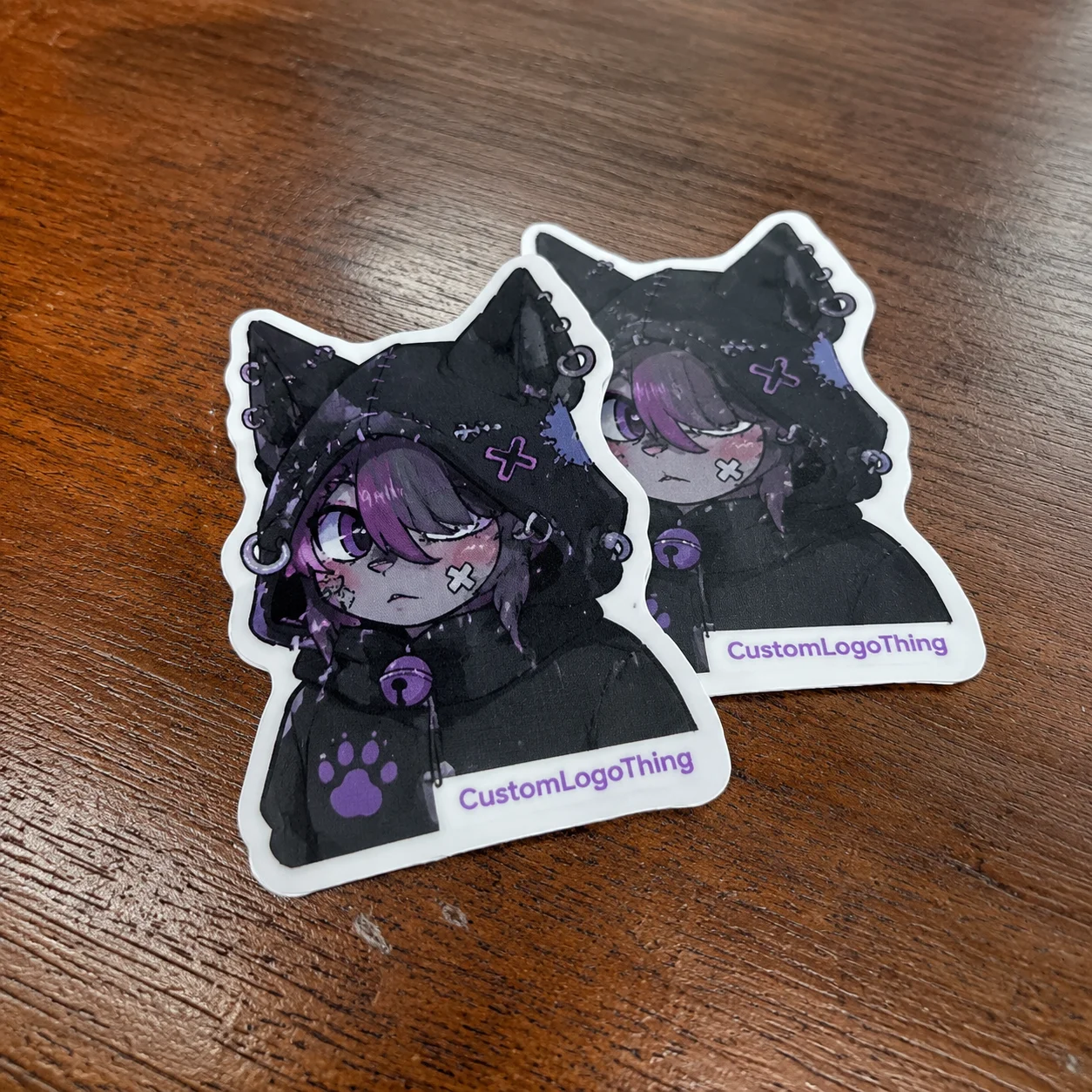
A sticker glimpsed for three seconds during a virtual hangout can become a merch item someone keeps on a laptop for three years. That is the odd commercial power behind vrchat custom stickers: they pull avatar identity, group jokes, event graphics, creator branding, and small community signals out of a digital social space and make them physical.
For creators, avatar artists, streamers, event hosts, and small merch sellers, stickers are rarely just decoration. They can act as fan badges, convention handouts, Patreon rewards, package inserts, booth freebies, limited-run products, or low-cost test items before a larger merch drop. A clean 3-inch die-cut avatar sticker in a mailer says, “This creator planned the details,” faster than a long thank-you note.
There are two related products that often get mixed together. One is the digital sticker-style asset: Discord graphics, emoji packs, stream overlays, community badges, and promotional art. The other is the physical sticker: printed, cut, packed, shipped, traded, or sold. They may start from the same character art. They should not be prepared the same way.
The production trap is simple. Screen art is backlit. Stickers are not. VRChat scenes lean heavily on neon lighting, bloom, shadows, transparency, shaders, and color shifts that look dramatic on a monitor but can print too dark, too soft, or too busy. The job is not to shrink the avatar render. The job is to translate it.
Production rule: a good sticker is a small manufactured product, not a screenshot with adhesive. File specs, material choice, cutting tolerance, adhesive behavior, finish, and packing all affect the result.
That translation is where buyer decisions start to matter. A pastel avatar may need a thicker white border. A cyberpunk avatar may look excellent on holographic stock but lose tiny lettering. A full-body character with six accessories may work better as a bust crop. Good sticker production is partly art direction, partly print control, and partly restraint.
How Virtual Art Becomes a Physical Sticker Product
The workflow looks tidy on paper: artwork, cleanup, print-ready layout, material selection, proof, printing, cutting, finishing, quality check, packing, and shipping. Most problems appear before ink ever touches vinyl.
VRChat avatar designs are often dense. Hair strands, ears, horns, visors, tails, layered outfits, tiny props, glowing eyes, UI-style text, and particle effects may all compete inside a 2.5-inch or 3-inch shape. A design that reads clearly at full-screen size can turn into visual noise at pocket size. Cleanup may mean simplifying shadows, strengthening outlines, adjusting highlights, removing background effects, or adding a border that separates the character from the surface below.
Common product formats include die-cut stickers, which follow the outline of a character or logo; kiss-cut sticker sheets, where multiple designs peel from one backing sheet; holographic stickers, often suited to cyber, rave, sci-fi, and neon aesthetics; clear stickers, useful for simple logos and silhouettes; and matte or glossy vinyl stickers, the reliable workhorses for merch tables, mailers, and online orders.
A digital asset only has to look good on Discord, Twitch, X, or a community page. A production file has to survive trimming, lamination, color conversion, and adhesive application. That means clean edges, sufficient resolution, a defined cut line, and artwork that still works after a 1.5 mm to 3 mm border is added. If the sticker will ship with Custom Labels & Tags, mailers, backing cards, or other branded packaging, it also needs to fit the broader visual system.
Stickers end up in more places than first-time buyers expect: convention swag bags, creator reward shipments, booth baskets, product inserts, retail bundles, thank-you cards, giveaway envelopes, and limited drops paired with pins or apparel. A durable, cleanly cut sticker makes a small launch feel intentional. A fuzzy edge or peeling corner makes the same launch feel improvised.
Specs That Decide Whether Your Sticker Looks Sharp
Start with the file. Vector artwork such as AI, EPS, or SVG is best for logos, text, icons, and clean graphic shapes because it scales without blurring. Character art can work well as a high-resolution PNG, PSD, or PDF, especially with a transparent background and crisp edges. Screenshots are risky. Social media downloads are worse. Compression artifacts around hair, ears, tails, and glow effects become more obvious in print.
The standard target is 300 DPI at final print size. A 3-inch sticker should generally have artwork at least 900 pixels across in the printed direction, and more is safer for detailed art. If the file comes from a 600-pixel compressed preview, no printer can restore the missing information. Upscaling may make the file larger, but it does not recreate clean linework.
Color needs translation. Most screen artwork is built in RGB, while many print workflows use CMYK or expanded ink sets depending on equipment. Saturated blues, purples, greens, and pinks can shift. Glows can flatten. A dark avatar on a dark background may lose its edge once it is no longer backlit. A proof should catch obvious risks, but buyers still need realistic expectations: neon on a monitor is not the same as ink or toner on vinyl.
Bleed, safe zones, and cut lines sound more technical than they are. Bleed extends artwork beyond the trim area so there is no accidental white sliver. The safe zone keeps important details away from the edge. The cut line tells the cutter where the shape should be. If a social handle, QR code, tiny symbol, or character detail sits too close to the trim, it may be clipped or look cramped.
- Small stickers: 1.5 to 2 inches work for mini icons, logos, and bonus inserts, but not dense full-body avatars.
- Standard merch size: 2.5 to 3 inches suits most avatar busts, heads, expressions, mascots, and group marks.
- Large giveaways: 4 to 5 inches feel more premium at booths, but cost more and may require larger mailers.
- Sticker sheets: 4 x 6 inches or 5 x 7 inches can hold expressions, emotes, logos, small props, and accessory art.
Durability depends on material and finish. Waterproof vinyl with scratch-resistant lamination is usually the safer choice for laptops, bottles, notebooks, cases, helmets, and outdoor-adjacent use. Matte lamination reduces glare and gives a softer look. Gloss lamination increases color punch. UV-resistant finishes help if the stickers may see sunlight. Paper stickers can be fine for envelope seals, packaging inserts, or short-term event use, but they are not the same product as laminated vinyl.
Readability gets underestimated. QR codes should be tested at final printed size. Social handles need enough contrast and letter height, usually no smaller than about 6 pt to 7 pt for basic legibility, and larger if the font is stylized. Thin neon text on holographic film may look impressive in a mockup and nearly disappear in hand. If the group name cannot be read from arm’s length, it probably should not be on the sticker.
Cut complexity also matters. A simple rounded logo is fast to cut. A full-body avatar with separate strands, tiny tail spikes, floating accessories, and narrow gaps can slow production, increase waste, and create fragile points that peel or tear. Many strong avatar stickers use a simplified silhouette with a consistent border for that reason. The shape supports the art instead of fighting it.
Cost, Pricing, and MOQ Factors for Creator Stickers
Sticker pricing is shaped by quantity, size, material, finish, cut complexity, number of designs, proofing needs, packing requirements, and shipping destination. Buyers often focus on unit price first. Production teams tend to look at landed cost: product, setup, revisions, packing, freight, damage risk, and the time cost of correcting mistakes.
Minimum order quantity matters because setup and production time have to be spread across the run. A 50-piece test batch may be sensible for a new design, but the unit price will be higher than a 500-piece order. A rough market range for standard 3-inch white vinyl stickers might be about $0.35 to $0.90 per piece at moderate quantities, depending on finish, cut complexity, and supplier model. Smaller batches can exceed $1.00 per sticker. Larger runs can fall lower, especially with simple shapes and repeated artwork. Treat those as planning ranges, not guaranteed quotes.
| Sticker option | Typical use | Cost impact | Production note |
|---|---|---|---|
| White vinyl, matte or gloss | Creator merch, laptops, bottles, event handouts | Baseline | Reliable choice for most VRChat avatar stickers |
| Holographic vinyl | Cyber, neon, rave, sci-fi, and music-event designs | Medium to high | Strong visual effect, but tiny text can lose contrast |
| Clear vinyl | Logos, silhouettes, window decals, minimalist marks | Medium | Needs strong contrast or white ink support |
| Sticker sheets | Expression packs, avatar poses, group bundles | Medium to high | Requires more layout and cut-path planning |
| Individually packed stickers | Retail sets, rewards, premium mailers | High | Adds labor, bags, backing cards, labels, and inspection steps |
Specialty materials drive cost quickly. Holographic film, metallic finishes, clear vinyl with white ink, soft-touch laminates, intricate die-cut paths, and multi-design sheets add time, material waste, or both. Individual packing changes the economics even more. Once each sticker needs a backing card, bag, barcode, bundle sort, or SKU label, the job is no longer just sticker printing. It is light assembly.
Cheap can be expensive. A low-price sticker that peels after a week, prints too dark, arrives late for a convention, or makes the avatar look muddy has already failed. For a merch seller, the useful formula is practical: landed unit cost plus marketplace fees, packing materials, shipping labor, transaction fees, damaged-order allowance, and enough margin to fund the next drop.
Before requesting a quote for vrchat custom stickers, gather the basics: quantity, finished size, material preference, finish, number of designs, deadline, shipping location, and whether packing is needed. If stickers are part of a larger packaging plan with Custom Printed Boxes, mailers, labels, or inserts, quote those pieces together where possible. Coordination reduces surprises, especially when colors, launch dates, or bundled sets need to match.
Process and Timeline From Artwork to Delivery
A typical order moves through artwork preparation, quote request, proof creation, proof approval, printing, cutting, quality control, packing, and shipping. The path sounds linear. Proof approval is the hidden bottleneck.
If the buyer is still deciding border thickness, spelling, social handles, QR placement, color expectations, or final dimensions, production cannot move efficiently. A one-day proof delay can become a three-day schedule slip if the print queue fills, a specialty material is waiting, or the order needs hand packing.
For straightforward vinyl orders with clean files, production may often take about 5 to 10 business days after proof approval, plus shipping. Specialty finishes, multi-design sticker sheets, larger quantities, or custom packing can push that to 10 to 15 business days or more. International freight, customs, holidays, and convention-season congestion add uncertainty. Supplier capacity and shipping method decide the real schedule, so treat any timeline as an estimate until confirmed.
Creators planning conventions, VRChat meetups, community events, online drops, or reward shipments should work backward from the date the stickers must be in hand, not the date the order is placed. If a booth opens on Friday, receiving the stickers Thursday afternoon is not a plan. It is a risk.
- Finalize artwork and usage rights before quoting.
- Allow 1 to 3 business days for quote and proofing on simple jobs.
- Review the proof carefully and reply with one clear set of changes.
- Build at least one week of buffer for event-related orders.
- Add more buffer for holographic, clear, metallic, sheeted, or individually packed sets.
Quality control should be concrete, not vague. Useful checks include print clarity, color consistency across sheets, lamination adhesion, scratch resistance, cut alignment, border consistency, peel behavior, backing paper condition, count accuracy, and packing protection. For QR stickers, scan samples from the finished batch. For social handles, check that punctuation and capitalization match the creator’s actual profile.
A good manufacturer should provide practical artwork checks, material guidance, digital proofs, production updates, and clear delivery expectations. If the stickers will be bundled with Custom Packaging Products such as mailers, labels, or inserts, the schedule should include those parts too. Stickers are small, but they can hold up an entire launch.
Standards can help frame the discussion, though they do not replace product-specific testing. ISTA protocols are commonly referenced in transport packaging, while sticker durability usually depends more on material testing, adhesive performance, lamination quality, and supplier-specific inspection. For sustainability claims, be precise. The FSC system applies to responsibly sourced paper and forest-based materials, not every vinyl or film sticker by default.
Common Mistakes That Make Avatar Stickers Disappoint
The most common failure is predictable: using a low-resolution screenshot or heavily compressed image instead of a clean source file. It may look fine on a phone. Then the proof arrives, the edges look crunchy, and the tiny accessories have turned into pixels. Printing exposes weak files.
Over-detailing is the second problem. VRChat avatars carry layers of identity: clothing, ears, tails, props, textures, shaders, emotes, and lighting. On a 2-inch sticker, those layers can fight each other. Simplification is not disrespectful to the art. It is product design discipline. The sticker has one job: be recognized quickly.
Contrast causes quieter failures. Dark-on-dark palettes can look stylish on screen but flatten on white vinyl. Transparent effects may disappear on clear material. Holographic stock can make a design exciting, but it also competes with small type, thin outlines, and subtle gradients. If the finish is loud, the artwork needs to be bolder.
Skipping proof review is an expensive shortcut. Check spelling, social handles, QR codes, cut lines, borders, size, finish, orientation, and color expectations. Print the proof at actual size on office paper if possible. Hold it at arm’s length. If the avatar expression, group name, or joke does not read, lamination will not fix it.
Material mismatch is just as common. Paper stickers may be fine for thank-you inserts, envelope seals, short-term labels, or indoor packaging. They are not the best pick for water bottles, laptops, helmets, phone cases, or outdoor surfaces. For those uses, laminated vinyl is usually worth the extra cost.
Order quantity can backfire in both directions. Over-ordering before testing demand ties up cash and creates storage clutter. Under-ordering for an event can be worse because reprints may not arrive in time. For a new creator drop, a pilot run of 50 to 100 pieces per design can provide useful demand data before scaling to 300, 500, or 1,000 units.
Rights matter too. Creators should confirm they have permission to use avatar art, commissioned illustrations, logos, fonts, group marks, bases, textures, and character elements before selling merchandise. Personal-use licenses often do not cover commercial sticker sales. Written permission is cleaner than assumptions, especially when multiple artists contributed to one avatar.
What to Prepare Before Requesting a Quote
Before asking for a quote, prepare the details a supplier actually needs. Choose the final designs. Decide the approximate sticker size. Pick a material preference, even if you are open to advice. Estimate quantity by design. Confirm the deadline. Gather print-ready files or the best source files available. If the sticker will go into a merch kit, mailer, or retail packaging set, mention that early.
A practical starter lineup might include one hero avatar design, one logo or group mark, one meme or expression sticker, and one bonus mini design for bundles. That gives fans variety without turning the first order into a complicated twelve-design run. For many creators, four strong designs beat ten average ones.
Samples or pilot runs make sense for specialty finishes. Holographic, clear, metallic, and unusual laminates can change the artwork dramatically. A finish that suits a neon club avatar may not suit a soft pastel character. If the sticker will be sold rather than given away, the sample step has extra value because buyers notice material quality quickly.
Think about packaging before production starts. Backing cards, branded envelopes, thank-you inserts, QR codes, protective mailers, and product labels can turn a sticker into a small retail experience. The difference between a loose sticker in a plain envelope and a protected sticker set with consistent packaging is not subtle. It affects perceived value and reduces damage complaints.
Proof review should be slow and boring. That is good. Check the finished size, border, cut path, color expectations, text legibility, finish, and whether the design still reads from arm’s length. Ask one practical question: if someone has never seen this avatar before, can they understand the design in two seconds?
If yes, the file is probably close. If not, simplify. Strengthen the outline. Increase contrast. Remove tiny text. Make the sticker behave like a product, not a screenshot. Preparing files, quantities, material preferences, and timing before ordering vrchat custom stickers gives the manufacturer fewer chances to guess and gives the finished piece a better chance of feeling intentional.
FAQ
What files do I need for custom VRChat stickers?
Use vector files such as AI, EPS, or SVG when available, especially for logos, text, and simple marks. For character artwork, high-resolution PNG, PSD, or PDF files can work well if the edges are clean and the background is transparent where needed. Avoid screenshots, social media downloads, and compressed previews because they often print blurry or show artifacts around avatar details. Include preferred size, finish, brand colors, and notes about which areas should be cut, bordered, or left clear.
How much do VRChat avatar stickers usually cost to make?
Pricing depends on quantity, size, material, finish, cut shape, number of designs, packaging, and shipping distance. Small batches have a higher unit cost because proofing, setup, and production time are spread across fewer stickers. Standard white vinyl is usually more economical than holographic, clear vinyl, metallic effects, custom sticker sheets, or individually packed sets.
Can I sell stickers based on my VRChat avatar?
You can usually sell stickers if you own or have commercial rights to the avatar design, artwork, logo, fonts, and any commissioned elements used in the sticker. Check avatar creator licenses, artist agreements, group branding rules, and platform-related restrictions before producing merch. If the design includes another creator’s character, copyrighted brand, or fan art, get written permission before selling it.
What is the best material for VRChat-themed sticker merch?
White vinyl with matte or gloss lamination is the most reliable general choice for durable laptop, bottle, notebook, and convention stickers. Holographic vinyl works well for cyber, rave, sci-fi, and neon avatar aesthetics, but it can reduce readability if the art has tiny text or delicate lines. Clear vinyl is useful for clean logos and simple silhouettes, although dark or low-contrast artwork may disappear on tinted surfaces.
How long does it take to produce VRChat custom sticker orders?
Timeline depends on artwork readiness, proof approval speed, quantity, finish, packaging requirements, and shipping method. Simple standard vinyl orders with approved files move faster than multi-design sticker sheets or specialty materials. For events or merch drops, build in extra buffer for revisions, sample checks, freight delays, and final packing before announcing a launch date.