Buyer Fit Snapshot
| Best fit | Buy Wholesale Packaging Sample Kits for Orders projects where brand print, material claims, artwork control, MOQ, and repeat-order consistency need to be specified before quoting. |
|---|---|
| Quote inputs | Share finished size, material target, print colors, finish, packing count, annual reorder estimate, ship-to region, and any compliance wording. |
| Proofing check | Approve dieline scale, logo placement, barcode or warning zones, color tolerance, closure strength, and carton packing before bulk production. |
| Main risk | Vague material claims, crowded artwork, missing packing details, or unclear freight terms can make a low unit price expensive after revisions. |
Fast answer: Buy Wholesale Packaging Sample Kits for Orders: Material, Print, Proofing, and Reorder Risk should be specified like a repeatable production item. The safest quote records material, print method, finish, artwork proof, packing count, and reorder notes in one written spec.
Production checks before approval
Compare the actual filled-product size with the drawing, then confirm tolerance on folds, seals, hang holes, label areas, and retail display edges. Reserve space for logos, QR codes, warning copy, and material claims before decorative graphics fill the panel.
Quote comparison points
Review material grade, print process, finish, sampling route, tooling charges, carton quantity, and freight assumptions side by side. A quote is only useful when the supplier can repeat the same color, closure quality, and packing count on the next order.
If you want fewer surprises in custom packaging, the safest move is usually to buy wholesale packaging sample kits before you approve production. A sample is not decoration. It is evidence. It tells you whether the dieline fits, whether the print reads cleanly, whether the coating behaves under light, and whether the structure survives more than a hopeful glance from ten feet away. I have seen a 2 mm insert change turn a polished cosmetic set into a carton that rattled like loose hardware, and I have seen a buyer catch that mistake only because the sample was on the table before the PO was signed.
That is why I keep coming back to the same advice: buy wholesale packaging sample kits early, compare them side by side, and treat the result like a technical review, not a branding exercise. The gap between a render and a real package is where budgets go to bleed. A screen can hide weak board stock, a soft-touch finish can disguise poor color density, and a polished mockup can mask a closure that fails after five openings. Samples strip away the theater. They force the conversation back to fit, finish, print quality, and shipping durability. That is a much healthier place to spend your attention.
I also like the discipline that sample kits create. Instead of arguing in circles about what the packaging "feels like," teams can inspect actual paperboard GSM, chipboard thickness, lamination, foil registration, and glue lines. That makes procurement happier, operations calmer, and finance less likely to discover a costly mistake after the invoice has already been paid. When a buyer decides to buy wholesale packaging sample kits, they are buying clarity. They are also buying time, because it is faster to adjust a sample than to fix 8,000 cartons after launch. And if you have ever had a launch week blow up over a crooked insert, you already know why that matters.
Why I Tell Buyers to Buy Wholesale Packaging Sample Kits First
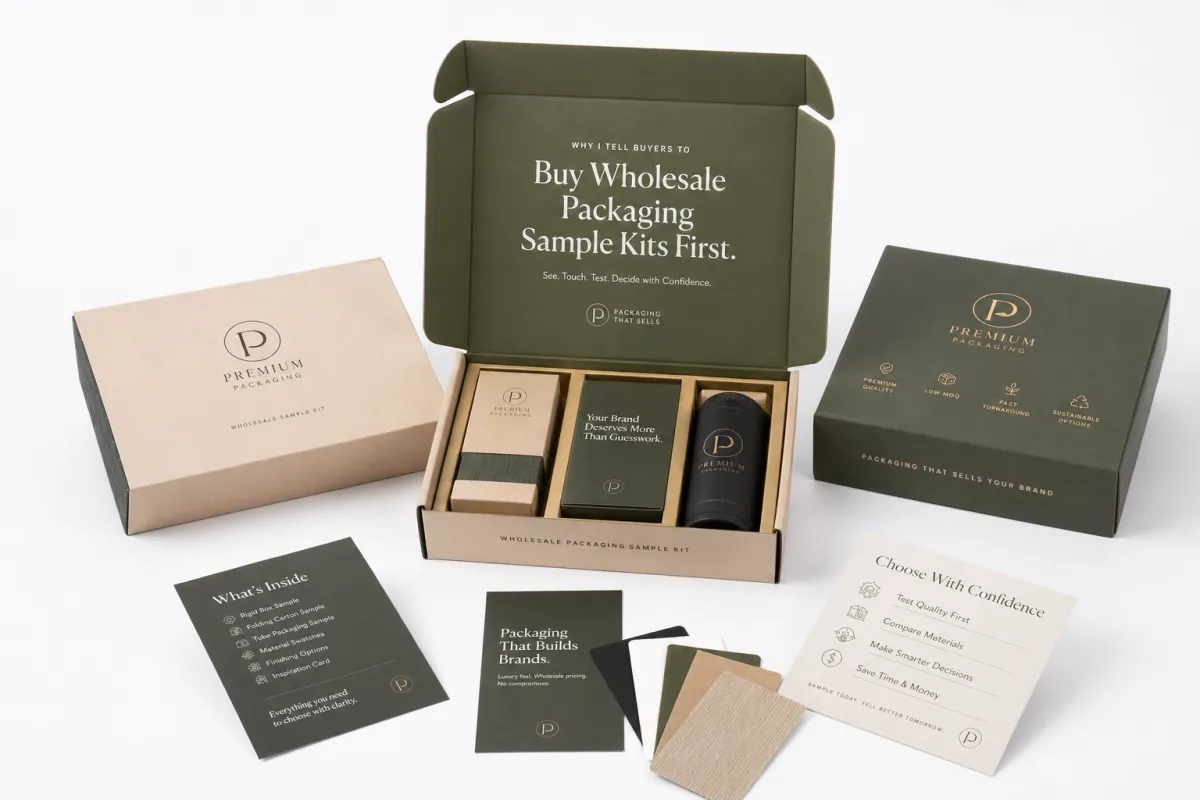
I learned the hard way that the fastest way to miss a packaging problem is to trust a digital proof too early. On a factory floor in Shenzhen's Bao'an District, a small insert adjustment turned into a much larger lesson. The box looked fine on screen. In hand, it moved, slipped, and clicked in all the wrong places. That tiny gap would have multiplied across thousands of cartons, and nobody wants to explain a preventable packaging error after the freight has already been booked and the payment terms are set. If you plan to buy wholesale packaging sample kits, that is exactly the sort of issue you want to catch before it spreads.
Samples answer questions renderings cannot. Does the lid close properly on a rigid box with 1.5 mm chipboard? Does 350gsm C1S artboard scuff after a courier run from Hangzhou to London? Does matte lamination hold up under retail lighting, or does it flatten the ink and make the brand look tired? Those are not theoretical concerns. They are commercial concerns. Packaging spends a lot of time pretending to be simple, then reveals its temperament the moment it leaves the studio and enters a warehouse, a truck, or a retail shelf with unforgiving LEDs overhead.
The real value of sample kits is that they let you verify fit, print quality, coating, and assembly before production money is committed. Skip that step and the mistake usually shows up in the least elegant place possible: a pallet, a customer unboxing video, or a rework charge that starts at $250 and keeps growing. I have watched a "small" correction become a line item with a life of its own. That tends to happen after a booking from Dongguan or Ningbo is already confirmed and everyone assumes the next shipment is safe. It is not glamorous, but it is the difference between a controlled launch and a mess.
I see sample kits as a buying tool, not a shelf object. Some teams treat them like a pretty object for marketing and then ignore the carton that arrives with weak locking tabs or a foil stamp shifted 1.5 mm off center. That is how branded packaging becomes a headache. If you are launching a new SKU, reworking product packaging, or switching suppliers, buy wholesale packaging sample kits and compare vendors on the same terms. No guessing. No romance. Just evidence, ideally with a caliper, a steel ruler, and a desk lamp that exposes every flaw.
"The sample fee felt annoying until we caught the insert issue. That saved us from a nine-thousand-unit mistake." - a beauty buyer I worked with after a late-night factory review in Dongguan
Order early enough that you still have room to change something if the numbers fail. That may mean rejecting a glossy mockup, asking for a new dieline, or switching from spot UV to a cleaner aqueous coat because the artwork reads better on press. It is not glamorous. It is profitable. And if you have ever watched a press crew wait while someone debates color by committee, you know why I say that with feeling. A 12-15 business day proof-to-sample cycle is far easier to manage than a correction across 12,000 units after launch. The calendar has no patience for regret, and neither do retailers.
What Comes in Buy Wholesale Packaging Sample Kits
When people buy wholesale packaging sample kits, they usually want one thing: a physical answer. The contents vary by category and supplier, but a solid kit may include folding cartons, rigid boxes, mailers, sleeves, inserts, trays, tissue, or printed inserts. The point is not to collect pretty objects. The point is to give operations, marketing, and procurement the same item to inspect instead of three separate assumptions in a spreadsheet. I have sat through enough cross-functional meetings to know that a spreadsheet can start a debate faster than a broken coffee machine in a Shanghai office at 9:00 a.m.
A basic kit can be unprinted and structural, which helps when you are still checking dimensions or product fit. A printed mockup matters more when Pantone matching, foil stamping, emboss depth, or a soft-touch finish is on the table. Then there is the production-grade sample, the version I prefer for serious buyers who want to buy wholesale packaging sample kits and compare the real thing, not a showroom piece with polished edges and hidden shortcuts. A pretty sample that lies about production is just expensive theater, especially if the final run is due out of a factory in Foshan or Suzhou.
The right kit depends on the product category. Cosmetics teams usually need Custom Printed Boxes, insert trays, and finish checks because a pale pink carton with a poor white underprint looks cheap fast. Food brands care more about barrier coatings, grease resistance, and closure strength, especially for bakery boxes packed in Guangzhou or Yiwu. E-commerce brands should test mailers, void fill, and shipping durability. Subscription box buyers need to see how all the components stack, because one awkward sleeve can flatten the whole packaging story. I once saw a subscription set look gorgeous until the last sleeve blocked the magnetic flap. Beautiful problem. Still a problem.
Here is the checklist I use when a kit lands on my desk:
- Measure the outer and inner dimensions with calipers, not guesses.
- Check closure strength and whether flaps spring back after repeated opening.
- Confirm board weight, flute profile, or chipboard thickness against the quote.
- Inspect print alignment, color density, and edge-to-edge trimming.
- Test product fit with the actual SKU, not a placeholder sample.
- Look for glue squeeze-out, corner crush, and scuffing under bright light.
The best kits let one buyer evaluate retail packaging while another checks warehousing and shipping. That matters. I once sat with a beverage client in Xiamen who loved the branding on a sample but had no room in the shipper for the printed insert. Operations caught it in ten minutes. Marketing would have caught it after launch, which is a much more expensive lesson. If you plan to buy wholesale packaging sample kits, make sure every team can inspect the same physical object on the same day. Otherwise, each department ends up arguing from a different angle, and nobody sees the whole box.
For broader options, I often send teams to review Custom Packaging Products and then compare those ideas against what arrives in the kit. If the supplier also supports Wholesale Programs, even better, because that usually means clearer production pathways and less guesswork later. In my experience, the better the supplier documents the sample, the fewer awkward surprises show up after the PO lands, especially on repeat orders above 3,000 units. You want that paper trail tidy before money moves.
What Should You Check Before You Buy Wholesale Packaging Sample Kits?
Before you buy wholesale packaging sample kits, decide what the sample is supposed to prove. Are you checking size, print fidelity, shipping strength, or all three? That answer changes the way you inspect the kit. A structural sample is useful for fit and closure. A printed mockup is more useful for color, finish, and brand presentation. A production-grade sample should look and behave like the final run. If the sample cannot answer the question you are asking, it is just a box with good manners.
I recommend a fixed review order. Start with dimensions. Then check the substrate. Then inspect print alignment, edge trimming, glue lines, and finish quality. Then load the actual product into the package and test it again under the conditions it will face in real life. If the box needs to survive courier handling, pack it the way the warehouse will pack it, not the way a photo shoot would prefer it. That distinction sounds obvious until the first 500 units arrive with dented corners because nobody tested stack pressure.
There is also a human side to the inspection. Different teams notice different failures. Marketing notices brand color drift. Operations notices weak closures and insert movement. Procurement notices whether the quoted sample matches the promised material. Finance notices whether the supplier slipped in freight, artwork, or plate charges. If you want to buy wholesale packaging sample kits wisely, make sure everyone who touches the project gets the same sample and the same checklist. Otherwise, the discussion becomes a contest of instincts, and instincts do not always scale well.
When I work through this stage, I keep the notes blunt:
- Does the product fit without pressure?
- Does the closure hold after repeated use?
- Does the print look accurate under daylight and warm light?
- Does the finish scuff when rubbed gently?
- Does the package survive a basic drop and shake test?
Those five questions eliminate a lot of noise. They also protect against a very common mistake: falling in love with presentation before confirming structure. I have seen a buyer approve a gorgeous sample with a weak tuck flap, then spend the next three weeks explaining why the production run needed changes. That kind of delay is expensive even when the numbers look small. A 1.5 mm difference is not dramatic on paper. In a box, it can be the whole story. And if the vendor cannot tell you why the flap fails, that is a problem in plain sight.
Materials, Printing, and Structural Specs to Compare
If you buy wholesale packaging sample kits without checking the specs, you are effectively buying a photo with a shipping label. I do not say that for drama. I say it because I have watched buyers approve beautiful samples that used the wrong board grade, then wonder why the production run felt softer, weighed less, or warped after a humid freight route from Shenzhen to Rotterdam. Packaging has a habit of being polite right up until it is not.
Start with the material. For folding cartons, I want the buyer to know the paperboard GSM, the coating, and the print side. A 350gsm C1S artboard behaves differently from a 400gsm SBS board, and a clean aqueous coating is not the same thing as soft-touch lamination. For rigid boxes, ask for chipboard thickness in millimeters, not vague words like "premium." For corrugated, identify the flute type, because E-flute and B-flute do not ship the same way. I have heard suppliers describe board as "strong enough" with a straight face. Strong enough for what? A warehouse in Dongguan? A storm lane through the South China Sea? That is exactly why I want the number.
Then move to print. Color checks should be practical, not poetic. I ask for Pantone references, CMYK tolerance notes, foil stamp samples, and any spot UV registration marks that matter to the art. If the supplier says the brand color is accurate, compare the sample under daylight and under warm retail lighting. I have seen a navy turn muddy under LEDs in a Seoul showroom, and I have seen a Rose Gold Foil become copper once it hit a store shelf in Dubai. Those are not minor details. They change how the whole package reads. One shade off, and suddenly the whole thing looks like it took a wrong turn on the way to premium.
Structural checks are where most complaints are born. When I visited a corrugation line in Ningbo, a buyer from a skincare brand discovered that the tuck flap on a Custom Printed Box was 3 mm too short for repeated use. On paper, the spec looked fine. In hand, it failed after five open-and-close cycles. That is the gap between theory and retail packaging reality. It is also the sort of thing that makes an otherwise normal afternoon feel personal, especially when the production target is 20,000 units and the lead time is already 18 business days.
If you want a clean method, compare samples in this order:
- Measure the box and insert with calipers.
- Drop the real product into the package three times.
- Shake the sealed box lightly and listen for movement.
- Inspect corners, folds, and glue lines under a bright lamp.
- Pack three units into a shipper and test stackability.
I also like side-by-side sheets. One column for the first supplier, one for the second, one for your target spec. No fancy language. Just numbers: 1.2 mm chipboard, 4-color print, matte lamination, 12-15 business days from proof approval, $0.18/unit at 5,000 pieces, and a shipping carton size of 42 x 31 x 28 cm. That is the kind of detail that makes a buying decision defensible when procurement, ops, and finance all want a say. It also stops the meeting from drifting into vibes, which is a dangerous place to buy packaging.
For shipping validation, I still point teams to the test methods at ISTA. If your package has to survive courier handling, vibration, and drop tests, those standards are a sane place to start. If you are thinking about recycled or certified board, the sourcing guidance at FSC is the benchmark I trust most. I have learned to respect anything that reduces the odds of a carton collapsing in transit and ruining everybody's afternoon, especially after a 600 kg pallet leaves a warehouse in Zhejiang.
Buy Wholesale Packaging Sample Kits: Pricing and MOQ
People love asking for a "cheap sample." Fine. Cheap compared with what? If you buy wholesale packaging sample kits, the price should make sense relative to the number of mistakes you are avoiding in a production run. Simple sample kits can start around $25-$75. More complex printed kits, especially ones with foil, embossing, or specialty inserts, often run $80-$200+ before freight. I have seen a rigid luxury kit hit $145 just because the board, magnet closure, and foil all needed separate setup work. Luxury packaging, as it turns out, has no interest in being inexpensive, whether it is made in Shenzhen, Guangzhou, or Yiwu.
Sample pricing is separate from production pricing. That part trips up buyers constantly. Unless the quote says otherwise, assume the sample fee is not automatically credited back. If a supplier offers a credit, get it in writing. I have had clients lose a promised credit because the rep said it verbally and the paperwork never followed. A sales promise is nice. A signed quote is better. Paper has a longer memory than enthusiasm, especially once the file moves from a sales desk in Dongguan to a production floor in Hebei.
MOQ works the same way. When you buy wholesale packaging sample kits, the minimum is usually tiny compared with full production. A supplier might make one or two mockups for evaluation, then require 500, 1,000, or 5,000 units for the actual run. That is normal. The per-unit cost drops as quantity rises because setup gets spread across more boxes, more printed sheets, and more labor hours. No magic there. Just arithmetic wearing a hard hat, and sometimes a pair of gloves in a plant near Foshan.
Here is a simple pricing comparison I give buyers:
| Sample Kit Type | Typical Contents | Usual Price Range | Best Use |
|---|---|---|---|
| Blank structural sample | Unprinted carton, insert, or mailer | $25-$50 | Fit checks, size validation, early engineering |
| Printed mockup | 4-color print, standard coating, basic assembly | $60-$120 | Artwork review, color checks, brand approval |
| Production-grade sample | Final board, final finish, final structure | $100-$200+ | Final sign-off before production |
| Premium finish sample | Foil, emboss, soft-touch, custom insert | $125-$300+ | Luxury retail packaging and launch decisions |
Hidden costs are where the bad surprises hide. Dieline changes can add $30 to $150 depending on complexity. Extra proof rounds can cost another $20 to $60. Rush fees are real. International freight can make a $70 sample look like a $180 problem overnight, and customs duties do not care how excited your marketing team is. If you plan to buy wholesale packaging sample kits, ask for an itemized quote so you can compare suppliers on the same terms. Otherwise, the final bill has a nasty way of feeling like a prank.
One more practical note: the cheapest sample is not always the cheapest supplier. I once negotiated with a converter that quoted $38 for a mockup, then quietly added a separate artwork adjustment fee, a plate charge, and a courier line item. The final number landed at $112. Another supplier quoted $96 up front with everything included. Guess which one saved time. Guess which one got the purchase order. I have no patience for pricing that arrives with hidden pockets, especially when the production run is slated for 5,000 units at $0.15 per unit. Cheap-looking quotes can get expensive fast, and usually in a boring way that no one enjoys explaining.
Order Process and Timeline for Sample Kits
The cleanest way to buy wholesale packaging sample kits is to treat the process like a small production project, not an email chain. Start with product dimensions, target quantity, retail channel, material preference, and finish preference. If you already have a dieline, send it. If you do not, say that clearly so the supplier can build one before someone wastes a week arguing over the wrong size. I have seen that happen in a factory office in Guangzhou, and it is not charming. It is just time leaking out of a calendar.
The usual workflow looks like this: submit specs, confirm structure, approve artwork, receive the sample quote, pay the deposit, and ship. That sounds simple because it is simple. The friction comes from missing information. Low-resolution logos slow things down. So does a vague note like "make it feel more premium." Premium is not a measurement. 1.5 mm chipboard with soft-touch lamination and foil on the logo is a measurement. I prefer numbers because numbers do not get moody, and neither does a factory scheduler in Dongguan.
Timeframes vary. If the structure already exists, a supplier may turn around a sample in 3-7 business days. For custom mockups, expect 7-14 business days. Specialty finishes, complicated inserts, and artwork revisions can stretch that further. When I visited a sample room in Dongguan, I watched a team lose two full days because the buyer changed the panel size after print files were already locked. That is avoidable. Slow approval is expensive. It also makes everyone in the room suddenly very interested in coffee from a 7:30 a.m. run to the corner shop.
To keep the schedule honest, tie sample approval to the larger production calendar. Do not lock the purchase order before the sample is signed off. That order of operations sounds obvious until you see a client who has already promised launch week to retail partners. They feel pressure, the sample arrives with one wrong closure style, and suddenly everyone is discussing overtime rates and expedited freight. I have seen that movie. It ends with someone paying more than they planned, and nobody claps. In one case, a 14-day schedule became a 26-day delay because approval slipped by 4 business days.
Shipping matters too. Domestic delivery can be fast if the supplier holds stock in-country. Overseas shipments take longer, especially when the courier hits a busy lane or customs wants more paperwork. If you are ordering across borders, build in time for freight and possible duty review. A sample that lands two days late can still be useful. A sample that arrives after your approval meeting is just a box with a tracking number and a poor attitude. I have seen that happen on routes from Shenzhen to Los Angeles and from Ningbo to Hamburg.
For teams comparing multiple suppliers, I recommend ordering the same spec from each vendor and reviewing them side by side. That is the easiest way to buy wholesale packaging sample kits without getting seduced by one polished presentation. You want evidence, not a sales story. A nice presentation can be persuasive; a measured comparison is harder to argue with, especially when one sample costs $68 and another costs $92 but arrives with a better closure and cleaner print. It saves everyone from guessing, which is handy because guessing tends to show up expensive later.
Why Choose Custom Logo Things for Sample Kits
At Custom Logo Things, the point is not to dress up the process. The point is to get the spec right. That means factory visits, direct conversations with converters, and actual checks on paper, print, and assembly quality. I have stood next to press operators in Shenzhen who could spot a bad registration line before the sheet even cooled. That kind of experience matters when you are trying to buy wholesale packaging sample kits that reflect what production will really look like. Machines are useful. Eyes with a few years on them are useful too.
Buying from a manufacturer and buying from a middleman are not the same thing. The middleman may be pleasant, but every handoff adds room for confusion. The size changes in one inbox. The artwork note changes in another. By the time the request hits the floor, the spec has drifted. A direct production path keeps the structure, print, and finish conversation tighter, which is exactly what you need if you care about branded packaging that holds up in the real world. I have spent enough time untangling mixed messages in Guangzhou and Dongguan to know that clarity is not a luxury. It is a cost control measure.
We also focus on the details that change the outcome: custom dielines, Pantone matching, FSC options, finish testing, and structural engineering. If a box will fail in transit, I would rather say that early than spend two weeks polishing a sample that will never survive a parcel chute. That is not pessimism. That is experience. A 1.2 mm board that buckles under 8 kg of stacked pressure is not a "maybe." It is a defect waiting for a tracking number.
Another reason buyers come back is clarity. You should know what the sample covers, what the freight costs, and what part of the fee can be credited later. You should know whether a quoted $0.18/unit at 5,000 pieces includes foil or not. You should know whether the supplier can support a reorder program if the first launch performs well. Those details separate a useful partner from a seller who only looks good in an inbox. Pretty replies do not ship product, and they certainly do not close a rigid box.
Our team also helps buyers compare the sample to the final production path before they commit. That is where a lot of value sits. A polished sample can hide a weak board choice. A good sample packet should expose those tradeoffs early, not bury them under presentation. If you plan to buy wholesale packaging sample kits, ask for sample photos, pre-production checks, and a plain explanation of any material compromise. No drama. Just facts. That is usually where the smartest buying starts, whether the line is in Zhejiang or Guangdong.
And yes, I am biased toward practical buying. I have spent enough time on factory floors to know that the fastest way to waste money is to assume the first pretty box is the right box. A sample is supposed to answer hard questions. If it does that, it has done its job. If it only photographs well, then it is doing half the work and asking for applause. I am not handing out applause for free, especially not for a carton that cannot survive a 90 cm drop test. If the sample cannot take a little punishment on the table, it is not ready for the warehouse.
Quick comparison from the buyer side: a $40 mockup that catches a closure failure is cheaper than a $9,000 production correction. That is why I keep telling people to buy wholesale packaging sample kits before they get attached to a concept. Attachment is not a spec. Neither is hope, and neither one helps if the magnetic flap arrives 2 mm off center. The honest move is to test first, then commit.
Next Steps After You Buy Wholesale Packaging Sample Kits
Once the kit arrives, score it with a simple rubric: fit, print, finish, shipping durability, and landed cost. Keep the scoring boring. Boring keeps people honest. I like a 1-to-5 scale with short notes beside each number, because that makes it easier to compare one supplier against another when the room starts debating which version "feels better." Feeling is fine for coffee. Less fine for carton approval in a room full of people who need to hit a launch date in 21 days.
Do not compare one sample against your memory of another sample. Put them side by side on the same table, under the same light, with the same product inside. If you can, have operations, marketing, and procurement review the same package. That way the person worried about freight stackability does not get steamrolled by the person judging the foil stamp from three feet away. If you are going to buy wholesale packaging sample kits, use them as a decision tool, not a mood board. Otherwise, somebody will eventually declare a tie because "both are nice," and that phrase has cost companies real money.
My usual recommendation is simple:
- Reject weak samples immediately if the structure fails.
- Request one revision round if the issue is fixable.
- Lock the final spec only after all teams sign off.
- Ask for a production quote tied to that approved spec sheet.
That sequence saves time later. It also sharpens your position during negotiations because the supplier knows you are not guessing. You have measured the box, tested the closure, and checked the ink under real lighting. That changes the conversation fast. A buyer with evidence is a much harder buyer to bluff. I have watched suppliers change their tone the moment the calipers come out, especially after a sample fails at the corners or the insert shifts by 4 mm.
If the sample passes, move quickly. Production schedules fill up. Press time gets booked. Material stock disappears. And if you are ordering branded packaging for a launch window, delays get expensive in a hurry. That is why I always tell teams to buy wholesale packaging sample kits, review them with the people who will actually use them, and then request the final quote tied to the approved spec sheet. Decision lag is a cost center with better manners, and a good one can still waste 10 business days.
Here is the part most people miss: a good sample is not the finish line. It is the proof that the production run can be done correctly. Treat it that way and you avoid scrap, rework, and awkward calls about why the first thousand boxes do not match the approved mockup. So yes, buy wholesale packaging sample kits, test them hard, and only then place the order. That is how sane packaging buying works, even if the process occasionally feels like a small wrestling match with cardboard. Once the numbers line up, the rest gets a lot less dramatic.
How do I buy wholesale packaging sample kits for a new product launch?
Send exact product dimensions, the retail channel, and your preferred material before asking for a quote. If your branding is still changing, request both printed and blank options so you can compare structure first and artwork second. Check the sample against your actual shipping method, because a box that looks great on a desk can fail in a courier bag. I have seen that more than once, and it never gets less annoying. A 1.5 mm difference in insert depth can make a launch look careless.
Are wholesale packaging sample kits refundable on a production order?
Sometimes the sample fee is credited back, but only if the quote says so in writing. Shipping, customs, and design work are usually separate and are not refundable. I tell buyers to get the credit policy confirmed before they pay anything, because verbal promises vanish fast once the invoice is issued. Paperwork is less charming than a sales call, but it tends to survive contact with reality, whether the supplier is in Shenzhen, Foshan, or Ningbo.
How long does it take to get packaging sample kits?
Simple items often take 3-7 business days, while custom mockups usually take 7-14 days. Specialty finishes, artwork revisions, and overseas freight can extend that timeline. Rush service depends on material stock, press availability, and how quickly you approve proofs, so delays on your side matter just as much as delays on the supplier side. Packaging timelines have a way of exposing who is actually ready and who is just optimistic, especially if proof approval slips by 2 business days.
What should I check before I approve a sample kit order?
Measure the box, test the closure, and inspect print registration under good light. Confirm board thickness, finish quality, and insert fit with the actual product inside. Run a pack-and-ship test so you know the packaging survives the way it will be used, not just the way it looks in photos. If something feels off, trust that instinct and measure it again. A 350gsm C1S board with a 1.2 mm chipboard insert should not behave like a flimsy sleeve.
Can I buy wholesale packaging sample kits in small quantities?
Yes, sample runs are usually much smaller than full production minimums. Expect a higher per-unit cost because setup is spread across fewer pieces. Use small quantities to compare suppliers before you commit to a larger order, because that is the cheapest place to learn what works. A small sample mistake is a lesson; a full run mistake is a budget problem with a loud voice, and one that can start at $250 and run much higher after freight.