Buyer Fit Snapshot
| Best fit | buy winter holiday die cut boxes for festive branding for packaging buyers comparing material specs, print proof, MOQ, unit cost, freight, and repeat-order risk where brand print, material, artwork control, and repeat-order consistency matter. |
|---|---|
| Quote inputs | Share finished size, material target, print colors, finish, packing count, annual reorder estimate, and delivery region. |
| Proofing check | Approve dieline scale, logo placement, barcode or warning zones, color tolerance, and any recyclable or compostable wording before bulk production. |
| Main risk | Vague material claims, crowded artwork, or missing packing details can create delays even when the unit price looks attractive. |
Fast answer: Buy Winter Holiday Die Cut Boxes for Festive Branding should be specified like a repeatable production item. The safest quote includes material, print method, finish, artwork proof, carton packing, and reorder notes in one written spec.
What to confirm before approving the packaging proof
Check the product dimensions against the actual filled item, not only the sales mockup. Ask for tolerance on folds, seals, hang holes, label areas, and retail display edges. If the package carries a logo, QR code, warning copy, or legal claim, reserve that space before decorative graphics fill the panel.
How to compare quotes without losing quality
Compare board or film grade, print process, finish, sampling route, tooling charges, carton quantity, and freight assumptions side by side. A lower quote is only useful if the supplier can repeat the same color, closure quality, and packing count on the next order.
Holiday shelves are chaos with a price tag. Good packaging gets a second glance. Bad packaging gets buried under a pile of lookalikes and markdown stickers. If you plan to buy winter holiday Die Cut Boxes, the real difference between a box that helps sell the product and one that vanishes into the background usually comes down to structure, print finish, and whether it can survive the trip from production to display without getting beat up.
The practical part matters more than the pretty part. A seasonal box is not just decoration. It helps the product stand upright on shelf, it helps the team pack faster, and it becomes the first real brand touchpoint many customers see before they decide whether the item feels giftable or forgettable. For a short holiday run, that matters more than people like to admit. I have seen well-designed products lose traction because the packaging looked nice on a mockup and awkward in a real store. That is not a cute mistake. That is a missed season.
Brands that want custom holiday packaging usually need three things at once: shelf impact, easy assembly, and enough strength to survive shipping. That is exactly where buy winter holiday Die Cut Boxes becomes a useful search, not just a keyword stuffed into a brief.
Buy Winter Holiday Die Cut Boxes: The Value They Add
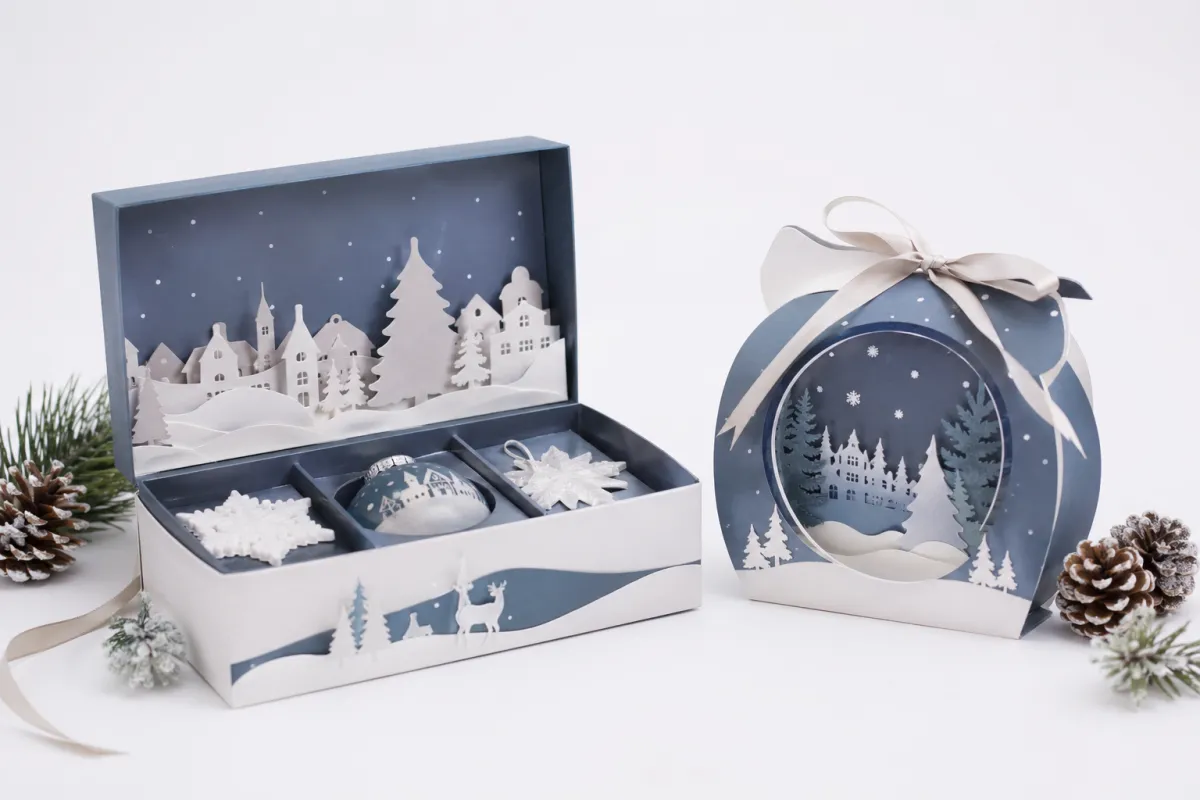
Retail moves fast during the holidays. Packaging has to do more than hold a product in place. When brands buy winter holiday die cut boxes, they are usually trying to solve three problems at once: visibility, presentation, and speed. A sharp die cut shape grabs attention in a way a plain carton rarely does. On a shelf crowded with red, silver, and green, structure becomes the first signal. The shopper reads the shape before the copy. That is kind of brutal, but it is true.
Die Cut Packaging also cuts friction. A window, a thumb notch, or a lift tab can turn a basic unboxing into something that feels intentional instead of clumsy. That helps with limited-edition gifts, bakery assortments, candles, apparel accessories, ornament sets, and promotional bundles. If the customer can see the product, understand the contents, and open the box without wrestling it, the packaging has already earned part of its keep.
From a buyer's point of view, the business case is pretty plain. Better shelf presence can improve conversion. Cleaner presentation can lift perceived value. A stronger box can reduce damage claims and repacks. None of that is abstract. A seasonal item that looks worth $24.99 instead of $19.99 because the packaging feels finished can pay back the design work faster than most teams expect.
The best reason to buy winter holiday die cut boxes is fit. Not hype. Not buzz. Fit. Seasonal products need packaging that matches the moment. A candle line with pine and clove notes, a pastry box for holiday assortments, or a gift set with socks and accessories all need a carton that feels deliberate rather than generic. Structure, print, and board choice deserve attention before the artwork gets too far ahead of the product.
Storage matters too. Flat-packed die cut cartons are efficient for warehouses and back rooms, especially when compared with bulky assembled gift containers. If a brand wants seasonal flair without stacking on extra packaging layers, buy winter holiday die cut boxes is often the cleanest route. The structure can carry the theme right on the carton, which means fewer inserts, fewer outer wraps, and less waste during pack-out.
A holiday box that looks great in a mockup and fails a drop test is not a win. It is a rework line item with ribbon on top.
The decision should start with the product, not the artwork. Once the form factor is right, design can actually do its job. Brands that buy winter holiday die cut boxes with that mindset usually end up with packaging that looks seasonal, ships cleanly, and holds up through the last mile.
For teams comparing options, measurable beats vague every time: board strength, print coverage, closure style, and the number of handling steps in fulfillment. A carton that saves 8 to 12 seconds per pack can matter more than a flashy finish that slows assembly. During a holiday rush, those seconds pile up fast. The math is boring. The savings are not.
Seasonal packaging also needs to match the channel. A display box for retail, a mailer for ecommerce, and a gift set for direct-to-consumer all have different stress points. If the box is wrong for the channel, it is wrong, full stop. That is why brands that buy winter holiday die cut boxes early usually make better choices and avoid the last-minute scramble that turns smart decisions into rushed guesses.
Product Details: Structures, Styles, and Holiday Use Cases
Buyers who want to buy winter holiday die cut boxes should start by matching the structure to the product. A tuck-top carton works well for light retail goods and gift sets. A sleeve format gives a polished reveal and fits well when the inner tray should stay visible. Gable styles are useful for food gifts and assortments because the built-in handle makes them easy to carry. Display-front boxes do more for shelf presentation, while mailer formats make more sense when the box itself has to survive parcel shipping.
Die cut windows can change the entire feel of a seasonal pack. A snowflake opening gives a subtle holiday cue. An ornament-shaped window frames the product and makes it feel gift-ready without crowding the panel. Ribbon slots, thumb cuts, and locking tabs improve usability, especially when the carton will be opened and closed more than once. Custom inserts matter just as much. A molded pulp tray, paperboard divider, or corrugated spacer keeps products from shifting and makes the pack look more expensive than it actually is.
Seasonal artwork should support the structure, not fight it. Full-coverage festive graphics can work on a display box, but a dense design still needs room for the logo to breathe. Metallic accents, foil lines, and spot UV can add contrast, but only if they land where fingers naturally touch and where the eye already wants to go. When brands buy winter holiday die cut boxes, the better designs usually keep one side busy and another side calmer so the product does not disappear under decoration.
Different products need different construction. Fragile ornaments benefit from tighter tolerances, a secure insert, and a closure that keeps the contents centered. Candle jars usually need more crush resistance and a board that can handle weight without bowing. Knit accessories and small apparel bundles can use lighter paperboard, but the box still needs enough rigidity to stack cleanly on shelf. Heavier gift sets are better suited to stronger board grades or corrugated stock with reinforced corners.
Decoration and performance are not the same thing. A carton can look festive and still be a weak shipping box if the board is too light or the closure is flimsy. The reverse is true too. A strong box can feel flat if the print system is lazy. The sweet spot is a structure that supports the product and a graphic system that supports the season. Experienced buyers usually buy winter holiday die cut boxes only after they have settled the use case, channel, and handling method. That order saves a lot of back-and-forth later.
For teams with mixed product lines, a shared die line can reduce complexity. If three SKUs fit into the same footprint with only small insert changes, the run becomes easier to manage and the holiday assortment looks more coherent. That usually beats designing three unrelated boxes that fight each other on shelf.
Useful structure choices often include:
- Tuck-top cartons for lightweight retail items and small gift sets.
- Sleeve-and-tray boxes for premium reveals and layered presentation.
- Gable boxes for carry-friendly food gifts and seasonal bundles.
- Mailer boxes for ecommerce orders that need stronger transit performance.
- Display-front boxes for shelf-facing products with clear product visibility.
When the product is fragile, expensive, or highly giftable, the box should make that obvious in the first second. Buyers who buy winter holiday die cut boxes for those categories are usually paying for clarity as much as decoration. That is not a flaw. It is the job.
Specifications: Materials, Print Options, and Fit
If you want to buy winter holiday die cut boxes that actually perform, start with the board. Lightweight retail cartons often use paperboard in the 14 pt to 24 pt range, depending on product weight and print coverage. Corrugated stock is better when shipping strength matters, especially for ecommerce or wholesale packs that will move through several touchpoints. Premium rigid setups make more sense for higher-end gift programs, where the box itself needs to feel substantial.
Finish selection changes both appearance and durability. Matte coatings soften bright holiday artwork and cut glare on shelf. Gloss adds punch to reds, greens, golds, and metallic accents. Soft-touch lamination can make a carton feel more premium, though it may show scuffing more readily than a harder coating if the pack gets handled roughly. Foil stamping and embossing can elevate a logo or seasonal motif, while spot UV works best when the design has strong contrast. For food-related packaging, ask about food-safe coatings and inks that fit the application. Do not assume a finish is food compliant just because the color looks clean on screen.
Fit is where a lot of custom orders go sideways. A box that is 2 mm too loose can feel cheap and may let the product shift. A box that is too tight slows pack-out and can crush corners. Before you buy winter holiday die cut boxes, confirm the product dimensions, insert depth, closure overlap, and any clearance needed for sleeves, dividers, or interior wraps. If the item has a zipper pouch, a candle lid, or a hanging hook, measure those details before the die line is finalized.
Print method matters too. CMYK is usually the practical choice for seasonal graphics with gradients, photography, and multiple tones. PMS spot colors make sense when a logo has to match an existing brand palette exactly. Dark holiday backgrounds can swallow small text, so the logo and legal copy need enough contrast to stay readable after coating. If the artwork is busy, leaving one panel quieter can improve legibility and keep the box from feeling crowded. Restraint usually looks smarter than stuffing every surface with something loud.
There are also performance standards worth asking about. For shipping-heavy programs, request testing aligned with ISTA transport test methods, especially if the box will travel by parcel rather than pallet. For fiber sourcing, ask whether the board can be supplied with FSC certification. Those details do not make the box flashy by themselves, but they do strengthen the buying decision and help the packaging team defend material choices internally.
Practical fit questions to answer before approval:
- What are the product's exact width, depth, and height with any accessories attached?
- Will the carton hold one item or a bundled set?
- Does the design need an insert, window, or carry handle?
- Is the package going to shelf, mailer, or both?
- How much clearance is needed for assembly and closing speed?
Buyers who buy winter holiday die cut boxes with those answers in hand usually avoid the usual rework: artwork edits after the die line is locked, or a box that looks right on screen but refuses to behave in production. That is where the budget gets weird, fast.
One more detail matters more than many teams expect. Coating and print coverage affect how the carton feels during handling. Heavy dark ink on thin board can show cracking at score lines if the structure is forced. That is not a theoretical problem. It shows up the moment the box is folded, shipped, and opened at scale. If a supplier shrugs at that risk, keep asking questions.
Pricing and MOQ for Buy Winter Holiday Die Cut Boxes
Price is rarely a single number. If you want to buy winter holiday die cut boxes, the unit cost will depend on box size, board grade, print coverage, finishing, insert complexity, and whether a unique die line is needed. A simple two-color carton at volume can price very differently from a rigid holiday gift box with foil and a custom insert. That is normal. Compare like with like or the numbers will lie to you.
Quantity changes the math fast. Larger runs spread setup and tooling costs across more pieces, which usually lowers the per-box price. Shorter runs are useful for test launches, limited-edition assortments, and market-specific promotions, but they carry a higher unit cost. If a buyer plans to buy winter holiday die cut boxes for a narrow campaign, a 1,000-piece run might be smarter than overcommitting to 10,000 boxes that will sit in storage after the season ends.
MOQ is tied to process. Simple foldable retail cartons can often support lower minimums than Premium Rigid Boxes or structures with complex cutouts, multiple inserts, or specialty finishing. If the design uses foil, embossing, or a new window tool, expect the entry quantity to rise. That is not a supplier trick. It is production reality. Tooling, setup, and waste have to land somewhere.
| Tier | Typical Structure | Approx. Unit Price | Best Use | Notes |
|---|---|---|---|---|
| Economy | Paperboard tuck-top with 4-color print | $0.45-$0.85 at 5,000 pieces | Retail accessories, light gifts, bakery sleeves | Good for tight budgets; keep finishes simple |
| Mid-range | Die cut carton with window, insert, and coating | $0.80-$1.45 at 2,500 pieces | Branded holiday sets, candles, gift bundles | Balanced presentation and transit performance |
| Premium | Rigid or reinforced presentation box | $1.80-$4.50 at 1,000 pieces | High-end gifts, VIP mailers, seasonal launches | Foil, embossing, and custom inserts push price up |
These ranges are directional, not a quote. Still, they help buyers see where the money goes. If someone wants to buy winter holiday die cut boxes at the lowest landed cost, the simplest path is usually a standard structure, limited finishing, and a quantity that makes setup efficient. If the goal is premium shelf impact, the budget should stretch for better board, tighter color control, and a finish that survives handling.
When requesting quotes, ask for the same specification set from every supplier. That should include dimensions, board thickness, print sides, coating, insert requirements, packing style, and delivery location. Without that information, comparisons are mostly noise. A cheaper quote may just be missing the costs another supplier already included.
Useful quote variables include:
- Dimensions and product weight.
- Material grade and board thickness.
- Print coverage on the outside and inside.
- Finish type such as matte, gloss, foil, or soft-touch.
- Insert and window requirements.
- Delivery destination and freight method.
Brands that buy winter holiday die cut boxes on a budget often get better results by simplifying the structure before cutting quality. A cleaner die line and a smarter print layout can beat an overworked design that tries to do everything at once. The box does not need to shout from every panel to feel seasonal.
Process and Timeline for Holiday Box Orders
The order process should feel predictable. If you want to buy winter holiday die cut boxes, the usual sequence is brief, structural recommendation, artwork prep, proof review, sampling if needed, production, and shipping. Buyers who understand that flow make decisions earlier and avoid the bottlenecks that show up when a team waits too long to approve a proof.
Timeline depends on complexity. A straightforward printed carton can move through production faster than a box with a new die line, custom insert, foil, embossing, or multi-SKU color matching. Standard holiday cartons often need around 12-15 business days after proof approval, but specialty builds can stretch longer once tooling, finishing, and pack-out are included. If freight is part of the plan, that adds another layer. A holiday order can be finished and still miss the launch window because nobody booked transport early enough.
For seasonal programs, the safest planning rule is simple: the earlier you buy winter holiday die cut boxes, the more options stay open. Early orders give the team more room to choose board grades, reserve finishing capacity, and schedule freight without panic. Late orders force compromises. Sometimes those compromises are fine. Sometimes they are expensive. I have seen both. The expensive one is usually the one people remember.
The most common delays are not mysterious. They are usually caused by incomplete artwork, late approvals, unclear dimensions, and revision requests after the proof is signed off. A packaging buyer can save days by sending a complete brief the first time. Better yet, share a product sample and the intended shipping method before the structure is finalized. That lets the die line be built around the real object, not a guess.
The best holiday packaging schedule leaves room for one correction and no room for a scramble.
If a program includes multiple SKUs, it makes sense to lock the shared structure first and then vary the graphics. That keeps the line efficient and the launch looking unified. Buyers who buy winter holiday die cut boxes for assortment programs usually gain more from consistency than from designing every carton as if it were a separate campaign.
A practical planning window looks like this:
- 6-10 weeks before launch: finalize size, structure, and quote.
- 4-8 weeks before launch: approve artwork and proof.
- 2-6 weeks before launch: complete production and sampling.
- 1-3 weeks before launch: ship, receive, and stage inventory.
That window can shrink for simple orders, and it can grow for premium builds. Still, it is a better starting point than pretending the project can be done on the fly. Buyers who buy winter holiday die cut boxes with a realistic timeline usually get better results and fewer emergency fees.
Why Choose Us for Custom Holiday Die Cut Packaging
At Custom Logo Things, the packaging conversation should start with operations. If you want to buy winter holiday die cut boxes that fold correctly, show up clean, and support the product, the right partner is one that thinks about die cutting, registration, and pack-out before the artwork gets called final. A lot of seasonal projects are won or lost right there.
Design support matters because fit mistakes are expensive. A packaging partner should help confirm product dimensions, Choose the Right structure, and balance visual impact against shipping durability. That matters even more for holiday programs, where the box often carries more branding load than the product label. If the structure is off by even a small amount, the whole order can feel less polished. Buyers who buy winter holiday die cut boxes with structural guidance up front usually avoid the awkward middle stage where the artwork is approved but the carton still does not pack cleanly.
Quality control should not be vague. It should include board inspection, sample approval, color checks, die alignment checks, and final pack-out verification. Those checkpoints matter because seasonal boxes are handled by multiple people in a short time. A box that slips through one weak QC point can still become a problem on the packing table or in the warehouse. If the product is going to wholesale, ecommerce, or retail distribution, the production team needs to think past print and into assembly.
That production mindset separates a useful packaging supplier from a decorative printer. The right team considers storage, palletization, closure strength, and how the final box behaves once the line starts running at speed. In practice, better suppliers help buyers buy winter holiday die cut boxes with fewer surprises because they anticipate how the order will be used, not just how it will look in a PDF.
Our role is straightforward: deliver packaging that supports the sale and does not create extra work for the buyer. That means accurate sizing, realistic finishing choices, and communication tied to measurable details. No mystery. No inflated claims. Just packaging that fits the job.
Why that matters now:
- Cleaner folding reduces pack-out friction.
- Consistent print registration keeps branding sharp across the run.
- Controlled tolerances help the box feel custom instead of improvised.
- Practical assembly lowers labor time at fulfillment.
- Reliable freight planning helps the boxes arrive when the launch needs them.
For buyers who want to review more structures, the Custom Packaging Products page is a good place to compare formats and narrow down the right fit. If the program includes multiple packaging types, it is usually smarter to line up the box style first and then refine the holiday artwork.
That is the real reason to buy winter holiday die cut boxes from a partner that understands production. The box should support the product, the schedule, and the sales channel at the same time.
What Should You Check Before You Buy Winter Holiday Die Cut Boxes?
Start with the product, not the artwork. That is the part people skip, and it is why they end up fixing avoidable problems later. Before you buy winter holiday die cut boxes, check the size, weight, closure style, insert need, and shipping method. If the carton is going to retail, ecommerce, or wholesale, those channel differences matter more than a pretty mockup.
Then confirm the finish. Matte, gloss, foil, embossing, and soft-touch all look different on screen and under real store lighting. A finish that looks rich in a design file can look loud in person. A finish that seems subtle in a sample may be exactly what the shelf needs. That is why structural approval should happen before anyone gets emotionally attached to the artwork. I know that sounds obvious, but teams still do it every week.
It also helps to Choose the Right timing. If the order is tied to a holiday launch, work backward from the ship date, not the design date. Buyers who buy winter holiday die cut boxes late usually pay more for fewer options. Buyers who plan early can choose better board grades, cleaner print setups, and more reliable freight windows.
Finally, ask for one sample or proof path that confirms fit. A printed proof checks color and layout. A structural sample checks whether the product actually fits and closes correctly. If the box needs to survive the last mile, testing is not optional. It is the difference between a box that looks good on paper and one that works in the real world.
Before you request a quote, make sure you have:
- Product dimensions and weight
- Target quantity and backup quantity
- Board preference and finish preference
- Need for window, insert, or handle
- Print sides and color requirements
- Shipping destination and required delivery date
If the project is being built for a holiday shelf reset, prioritize structure and delivery first, then artwork polish. That order of operations keeps the order grounded. It also gives the packaging team enough information to recommend the right materials instead of forcing a one-size-fits-all answer.
For a clean path forward, send the brief, ask for a structural recommendation, review the proof carefully, and confirm freight early. That is the simplest way to buy winter holiday die cut boxes without losing momentum in the middle of the season.
When the details are ready, the next step is straightforward: request a quote with the exact box size, quantity, finish, and destination. If you want to buy winter holiday die cut boxes that look polished and ship well, those four details are the fastest route from interest to production. Everything else is just noise.
FAQ
Where can I buy winter holiday die cut boxes in bulk?
Look for a supplier that can handle custom sizing, print support, and finishing in one place. If you want to buy winter holiday die cut boxes in bulk, ask for MOQ details, sample options, and a production schedule before you commit. It also helps to compare total landed cost, not just unit price, because freight and finishing can change the final number. A cheap quote with weak specs is not a bargain. It is a trap with nice typography.
How much do winter holiday die cut boxes cost per unit?
Pricing depends on size, board thickness, print coverage, and whether you add specialty finishes or inserts. A buyer who wants to buy winter holiday die cut boxes should request quotes with identical specifications so the comparison is fair. Larger quantities usually lower unit cost, while short runs are better for test launches or limited seasonal assortments. If the quote changes a lot after a spec call, that usually means the first number was too loose to trust.
What is the typical MOQ for custom holiday die cut boxes?
MOQ varies by structure complexity, print method, and finishing needs, so there is no single universal number. Simple retail cartons often support lower minimums than premium rigid formats. If you need a smaller launch, ask whether a standard structure can lower the entry quantity before you buy winter holiday die cut boxes. Sometimes a slight design adjustment saves you from paying for capacity you do not need.
How long does production take for winter holiday die cut boxes?
Timeline depends on proof approval, material availability, and whether the job needs a new die line or inserts. Straightforward cartons may move faster than premium builds with foil, embossing, or multiple revisions. If you plan to buy winter holiday die cut boxes for a specific launch date, build in extra time so shipping does not become the bottleneck. Holiday freight has a way of turning a good plan into a rush order if you leave it too late.
Can I get branded winter holiday die cut boxes with windows or inserts?
Yes. Die cut windows and inserts are common because they improve display and product protection at the same time. The right insert material depends on weight, fragility, and how the product should sit inside the box. Ask for a structural recommendation before artwork is finalized so the opening, insert, and graphics work together cleanly when you buy winter holiday die cut boxes.
What should I send for the fastest quote?
Send product dimensions, quantity, finish preference, print side details, and the required delivery location. If possible, include photos of the product and any retail or shipping constraints. The more complete the brief, the easier it is to buy winter holiday die cut boxes without delays or revision loops. A good brief saves more time than a dozen follow-up emails ever will.
If the goal is to buy winter holiday die cut boxes that bring more order to the shelf, more polish to the unboxing, and fewer problems in transit, start with the dimensions, the finish, and the timeline. Those three choices usually decide whether the packaging feels seasonal, practical, and worth the spend. Measure the product, lock the structure, and ask for a sample before the art gets too precious. That is the cleanest path to a box That Actually Works.


