Buyer Fit Snapshot
| Best fit | Corrugated Boxes Wholesale projects where brand print, material claims, artwork control, MOQ, and repeat-order consistency need to be specified before quoting. |
|---|---|
| Quote inputs | Share finished size, material target, print colors, finish, packing count, annual reorder estimate, ship-to region, and any compliance wording. |
| Proofing check | Approve dieline scale, logo placement, barcode or warning zones, color tolerance, closure strength, and carton packing before bulk production. |
| Main risk | Vague material claims, crowded artwork, missing packing details, or unclear freight terms can make a low unit price expensive after revisions. |
Fast answer: Corrugated Boxes Wholesale: Pricing, Specs, and Ordering should be specified like a repeatable production item. The safest quote records material, print method, finish, artwork proof, packing count, and reorder notes in one written spec.
Production checks before approval
Compare the actual filled-product size with the drawing, then confirm tolerance on folds, seals, hang holes, label areas, and retail display edges. Reserve space for logos, QR codes, warning copy, and material claims before decorative graphics fill the panel.
Quote comparison points
Review material grade, print process, finish, sampling route, tooling charges, carton quantity, and freight assumptions side by side. A quote is only useful when the supplier can repeat the same color, closure quality, and packing count on the next order.
One crushed corner can turn a clean shipment into a messy return. That is why Corrugated Boxes Wholesale stays a smart move for brands that care about protection, pack-out speed, and a landed cost that does not drift every month. If you ship hundreds or thousands of units, the goal is not chasing the cheapest carton on paper. It is keeping damage down, keeping labor moving, and matching the box to the abuse it is actually going to take.
The box is doing more than holding a product. It is carrying stack pressure in the warehouse, absorbing vibration in transit, protecting corners during parcel handling, and shaping the first impression when the package lands on a desk, porch, or retail shelf. That is a lot of work for something customers usually ignore unless it fails. Buying in volume gives teams more control over those variables instead of forcing them to settle for a random size that fits nothing well. A good corrugated carton is quiet. That should be the point.
I have seen a lot of packaging programs fall apart for one boring reason: the box was treated like an afterthought. A product gets a custom insert, a nice label, maybe even a fancy brand story, then it ships in a carton that is half an inch too big and a little too soft. Guess what happens next. The product rattles, the seam starts to split, and somebody in customer service gets to explain why the "premium" order arrived looking beat up.
Why Wholesale Corrugated Boxes Still Win for Shipping
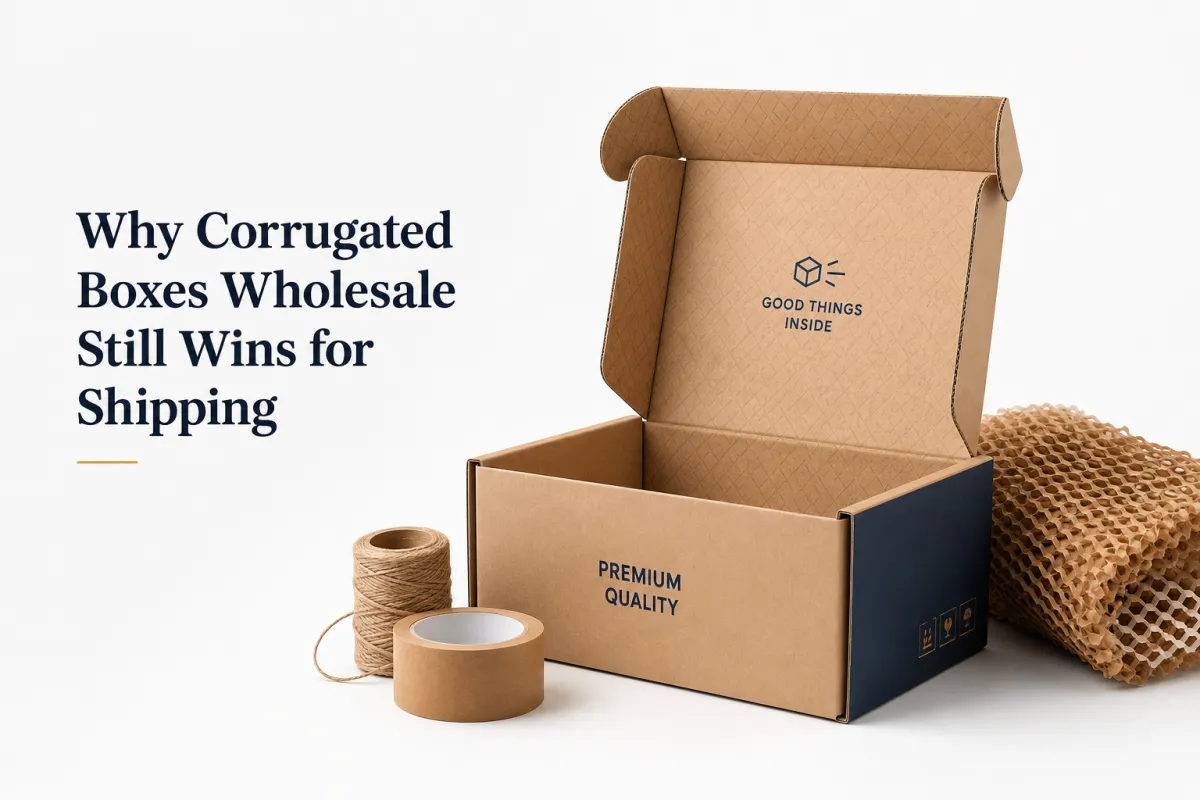
Shipping managers tend to think in numbers, not slogans. A slightly better carton can cut void fill, reduce damage claims, and speed up pick-and-pack because the crew is not fighting oversized packaging all day. corrugated boxes wholesale works in that environment because the cost curve improves as volume rises, while the spec stays stable from the first pallet to the last.
Buying box by box sounds flexible until the bill lands. Unit pricing is higher, lead times wander, and the line slows down every time a mismatched size shows up. Wholesale corrugated cartons fix that by giving brands a steady supply of boxes with the right footprint, the right board strength, and the right pallet pattern for storage and shipping. Parcel networks, regional freight, and retail replenishment all punish sloppy packaging. A decent box saves you from paying for that lesson twice.
Product integrity matters too. Overpacked cartons bulge, crush at the corners, or split along the seam. Loose cartons let the product move around and wear itself down. A well-managed box program lets a buyer dial in dimensions, flute profile, and board grade so the carton behaves like a tool instead of a random container. The savings are not just in carton price. They show up in fewer claims, fewer reships, and fewer hours wasted fixing problems that should have been avoided in the first place.
There is also a boring little efficiency gain that matters more than people admit. A box that is sized correctly is faster to tape, easier to stack, and less annoying to handle. That does not sound glamorous, because it is not. But on a busy packing table, "less annoying" translates to real throughput. Small improvements add up fast when the same motion gets repeated all day.
"If the box does not fit the product, the packaging budget starts leaking in the warehouse, on the truck, and at customer service."
Experienced buyers compare carton programs by landed cost and throughput, not just the headline price per unit. A box that costs a few cents more but reduces filler, fits better on a pallet, and survives a real transit test can be the cheaper choice over the full order cycle. For brands that ship regularly, that consistency is where the real value lives. And yes, that is the part that gets missed when somebody only looks at the lowest quote.
Corrugated Box Product Details and Box Styles
The first decision is usually the box format. Buyers often start with regular slotted cartons, or RSCs, because they are efficient to produce, easy to tape, and flexible enough for a wide range of products. From there, the spec may move to die-cut mailers for a tighter fit, custom insert-ready boxes for fragile kits, or display cartons that need cleaner graphics and tighter folding control. corrugated boxes wholesale is less about picking a generic carton and more about choosing the structure that matches the job.
Single-wall, double-wall, and triple-wall constructions serve different jobs. A single-wall box with the right ECT rating can handle light to moderate parcel shipping, especially for apparel, accessories, small consumer goods, and boxed sets. Double-wall construction is usually the safer choice for heavier items, denser contents, or longer freight routes where stack pressure starts to matter. Triple-wall cartons are less common in everyday e-commerce, but they still earn their keep for industrial parts, bulk loads, and high-compression environments. The goal is not to buy the thickest board on the shelf. It is to choose the structure that matches the load and the transit stress.
Flute selection matters as well. The flute gives the board cushioning and crush resistance, and each profile has a tradeoff. Larger flutes can improve stacking strength and shock absorption. Smaller flutes can support sharper print detail and tighter die-cut tolerances. Buyers comparing corrugated cartons often look at B flute, C flute, E flute, or combinations like BC double-wall, depending on whether the priority is protection, print quality, or faster pack-out. There is no magic answer here. The right choice depends on product weight, artwork, and how the box gets handled after it leaves the packing table.
Printing and finishing change the buyer experience too. Flexographic printing is common for large runs and simple branding. Litho-lam or high-quality printed liners make sense when the carton needs stronger shelf appeal or more detailed graphics. Coatings can help with scuff resistance, light moisture exposure, or cleaner handling in fulfillment centers. A plain brown shipper and a printed retail-ready carton are both corrugated solutions, but they solve different problems. corrugated boxes wholesale should be specified with that difference in mind, not treated like one generic carton purchase.
Common uses include:
- E-commerce shipments that need standard sizes, fast assembly, and dependable parcel performance.
- Retail replenishment cartons that must stack neatly and survive repeated handling.
- Subscription kits that benefit from insert pockets, clean presentation, and a controlled unboxing sequence.
- Industrial and replacement parts that need stronger board, a tighter fit, or custom partitions.
- Warehouse shipping programs where pallet efficiency and repeatable pack-out matter more than decorative graphics.
For buyers comparing styles, the best question is blunt: what happens to this carton after it leaves the production floor? If it will be stacked, tossed, displayed, or opened by a customer, those conditions should shape the structure from the start. That is the difference between a box that merely holds a product and a box that actually supports the operation. It is also how you keep the packaging spec grounded in reality instead of wishful thinking.
Specifications to Review Before Ordering
The fastest way to get a bad quote is to give vague specs. corrugated boxes wholesale orders should start with inside dimensions, not outside dimensions, because the inside measurement decides whether the product fits with enough room for inserts, tissue, bubble wrap, or a molded tray. A quarter inch can matter on a tight shipper. If the product rattles, the box is too large. If the contents bind or distort the carton, the box is too small.
Board grade comes next. Many buyers know burst strength and ECT ratings, but the right spec depends on how the box will be used. Burst strength can help in some mixed-material shipments. Edge crush value usually tells a better story for stacking performance in distribution. A 32 ECT single-wall carton may be fine for lightweight retail goods, while a 44 ECT or double-wall spec may be the smarter call for denser products or routes with longer dwell times. Asking for the load and shipping method is more useful than asking for the "strongest" carton.
Dimension tolerances are not a footnote. A box can be correct on paper and still create problems if the tolerance window is too loose for the product line or the packing equipment. If the cartons need to run on automated or semi-automated lines, the manufacturer should know the speed, folding sequence, and case-sealing method before production begins. That keeps Wholesale Corrugated Packaging from turning into workflow headaches after delivery.
Flute profile deserves a look at the same time. A bigger flute can improve cushioning and compression resistance, but it may soften print sharpness on fine graphics. A smaller flute can sharpen print detail and help with tight fit, but it may not be ideal for heavy stacking. Buyers who review specs early can balance appearance, protection, and line efficiency instead of solving those tradeoffs after the first sample shows up.
One thing that gets skipped too often is the environment the box will live in before it ships. A carton stored in a humid warehouse behaves differently than one stored in a dry facility. That sounds obvious, but people still act surprised when paperboard takes on moisture and loses some stiffness. If the product sits for weeks before use, you should factor that into the board choice instead of pretending climate is not part of the equation.
Other items that should be confirmed up front:
- Print area and whether graphics need to wrap, repeat, or stay on one panel.
- Bundle counts per pack so warehouse handling matches receiving needs.
- Pallet configuration so freight cube and storage footprint are known before shipment.
- Coatings or liners if the box needs scuff resistance or better moisture tolerance.
- Special features such as perforations, tear strips, partitions, or insert pockets.
For product testing, ISTA procedures are a practical benchmark because they simulate drop, vibration, and distribution stress in a structured way. If the carton will support a retail or fulfillment program with real damage risk, ask how the structure relates to those test conditions and review the relevant ISTA test standards. If sustainability paperwork matters, ask whether the paperboard components are sourced through FSC certification so the documentation matches the procurement requirement. Those details belong in the spec, not buried in a note nobody reads.
Clean quotes usually come from buyers who send all the numbers at once: inside dimensions, product weight, print needs, target quantity, and destination region. That gives a supplier something useful to work with and cuts down on back-and-forth. It also reduces the chance that the first sample exposes a fit problem that should have been caught before the order was placed. The more precise the brief, the less expensive the mistake.
Pricing, MOQ, and Unit Cost Drivers
Pricing in corrugated boxes wholesale depends on more variables than most buyers expect. Board grade, box size, print coverage, tooling, shipping distance, and quantity all move the number. A small box with limited print and a standard dieline can be economical even at moderate volume. A large printed carton with custom inserts can carry a much higher setup and material cost. The useful way to read a quote is to compare the same spec across suppliers, not just the lowest line item.
Minimum order quantity matters because setup and production efficiency need to be spread across the run. A 1,000-piece order usually costs more per box than a 5,000-piece order, and a 10,000-piece order can drive unit cost lower still if the design is stable and the artwork is already approved. For many wholesale packaging buyers, the sweet spot sits between inventory comfort and production efficiency. Ordering too little pushes up the unit cost. Ordering too much ties up warehouse space and cash.
Typical price ranges can vary widely, but a useful planning frame looks like this for common custom runs:
| Box Type | Common Use | Typical MOQ | Indicative Unit Range | Notes |
|---|---|---|---|---|
| Standard RSC, single-wall | Parcel shipping, general fulfillment | 1,000-5,000 | $0.28-$0.65 | Depends on size, board, and print coverage |
| Die-cut mailer | E-commerce presentation, tighter fit | 1,000-5,000 | $0.42-$0.95 | Tooling and folding complexity can raise cost |
| Double-wall shipper | Heavier products, stackable freight | 1,000-5,000 | $0.78-$1.60 | Board thickness and dimensions drive pricing |
| Printed retail-ready carton | Brand display, shelf presentation | 2,500-10,000 | $0.85-$2.25+ | Higher print coverage and finishing increase cost |
Those ranges are planning figures, not promises. Freight, board market conditions, and tooling can move the final number. Still, they help set a realistic budget. If a quote lands far below those bands, buyers should confirm whether the board grade, print method, and dimensional tolerance actually match the need. A cheap carton that fails in transit is not cheap. It is just delayed regret.
Custom sizing is another big driver. A stock size may carry a lower tooling burden, but if the dimensions force extra void fill, a larger freight cube, or more corner damage, the total landed cost can climb fast. A custom size often costs more at the carton level, yet it can lower the full system cost by improving palletization and reducing filler material. That is one reason experienced buyers treat packaging procurement as engineering, not just purchasing.
Shipping and pallet configuration matter too. Cartons are bulky by nature, so freight can become a serious part of the spend, especially on lower-density boxes. A run that ships efficiently on full pallets may cost less overall than a smaller order that breaks into partial freight loads. The landed cost picture should include the carton, freight, pallet pattern, and receiving labor needed to handle the shipment.
It also helps to compare the same thing against the same thing. If one supplier quotes 32 ECT single-wall and another quotes 44 ECT double-wall, the lower number is not a fair comparison. The same goes for print area, coating, insert count, and bundle packaging. Smart buyers ask for a spec sheet next to the price sheet, then compare both line by line.
In many programs, a small improvement in fit saves more money than a discount on the carton itself. Less void fill, fewer returns, and cleaner cube utilization improve the whole shipping equation. That is the real reason this category keeps attracting growing brands: the box becomes part of the supply chain math, not a throwaway line on an expense report.
Process and Timeline
The ordering process is usually simple, but the timeline moves faster when the buyer sends complete information early. A typical corrugated boxes wholesale order starts with an inquiry that includes box dimensions, product weight, print requirements, quantity, destination ZIP or freight region, and any special handling instructions. With that information in hand, the supplier can quote a structure that reflects actual use instead of a guess dressed up as a quote.
After the first quote comes spec review. That is the stage where the buyer and packaging partner confirm board grade, flute profile, print method, and any structural details such as tuck flaps, partitions, or tear features. If the carton is meant for retail presentation or a new product launch, dielines and artwork placement should be checked carefully before anything goes into production. A clean approval path keeps the job from getting stuck halfway through the process.
If the structure is custom, samples or pre-production proofs are usually worth it. A blank sample can confirm fit, insert clearance, and closure behavior. A printed proof can confirm layout and color expectations before the full run starts. For high-value or fragile products, that step pays for itself quickly. A few test cartons cost far less than a warehouse full of boxes that need to be reworked. Good teams do not gamble on a production run and hope the math works out later.
There is a speed trap here, and it is a common one. Teams feel pressure to move fast, so they skip the sample. Then the first production lot shows up, and suddenly everyone is debating whether the flap length is a problem or the artwork is off by a bit. That kind of drama is totally avoidable. If the box is new, test it once Before You Buy a pile of it.
- Inquiry - Send dimensions, quantity, product weight, and shipment destination.
- Quote - Review pricing against the exact board grade and print spec.
- Spec check - Confirm dieline, tolerances, and pack-out method.
- Artwork approval - Sign off on placement, bleed, and any copy details.
- Production - Material is converted, printed, cut, and finished.
- Shipment - Pallets are wrapped, labeled, and routed to the receiving dock.
Lead time depends on complexity. A simple run of wholesale corrugated cartons may move faster than a custom printed die-cut box with multiple color passes and inserts. Material availability, press schedule, tooling, and freight method all affect the calendar. A common planning window for custom printed work is often 12-18 business days after art approval, but that can stretch or shrink depending on the job and the shipping lane. Buyers should treat that as a planning range, not a guarantee.
Communication keeps the schedule intact. If the buyer changes the artwork after approval, shifts the carton size, or adds a structural feature midstream, the timeline will move. The same is true if freight needs rerouting or the receiving dock has a narrow window. A disciplined process gives everyone fewer surprises, and fewer surprises usually mean fewer charges, fewer delays, and fewer headaches.
For launch timing, the safest move is to work backward from the required arrival date and leave room for approvals. That matters even more for seasonal programs, inventory replenishment cycles, and rebranding projects. In practical terms, the packaging plan should be locked before the production clock starts, not after the order is already moving. Waiting until the last minute is not a strategy. It is a stress test nobody asked for.
Why Choose Us for Wholesale Box Orders
Custom Logo Things is a good fit for buyers who want packaging advice grounded in what the carton actually does, not just how the artwork looks on a screen. The value is practical: fit, function, repeatability, and a clear path from spec to production. For corrugated boxes wholesale orders, that matters because the best carton is the one that protects the product, supports the workflow, and shows up ready to run.
We focus on the details that drive results: board grade selection, flute choice, print method, closure style, and dimensional accuracy. That makes the quoting process more useful because the conversation starts with what the box has to do. A buyer can bring product dimensions, target quantity, and shipping method, and the spec can be built around those facts. That is a much better starting point for packaging procurement than guessing and cleaning up the mess later.
For brands that need broader packaging support, it helps to work with a partner that can coordinate related components. Our Custom Shipping Boxes options can align with the carton spec, while our Wholesale Programs are useful for buyers who need repeat orders and predictable replenishment. If the packaging program includes inserts, labels, or other components, our Custom Packaging Products catalog gives teams a cleaner way to build the full pack-out system.
Strong packaging support should cut uncertainty, not add to it. That means straightforward communication on minimums, realistic timelines, and what the carton can and cannot do on a shipping line. It also means being honest about tradeoffs. A thicker board may improve compression strength, but it can also raise material cost and change folding behavior. A higher-end print finish may look better, but it may not matter for a carton that never leaves the warehouse. That kind of guidance is what makes a wholesale program smarter.
From a buyer's point of view, the best supplier is the one that helps you avoid overbuying strength you do not need and underbuying protection you cannot afford to lose. That is the standard we aim for. The result should be a carton that fits the product, fits the budget, and fits the rhythm of your team. That is the real mark of a useful packaging partner.
I will be blunt here: a packaging vendor should not make you decode every quote like it is a mystery novel. If the spec is clear, the numbers should be clear too. If they are not, something is off. A good quoting process is supposed to make decisions easier, not add another layer of paperwork and guesswork.
"A good box is quiet. It disappears into the process, holds its shape, and keeps the product moving without causing drama."
What Should You Check Before Ordering Corrugated Boxes Wholesale?
If you are planning a new order, start with three pieces of information: product dimensions, target quantity, and shipping method. Those three inputs are enough to begin a meaningful corrugated boxes wholesale quote because they drive the size, strength, and freight profile of the carton. If the product is irregular, fragile, or intended for retail display, add photos or a sample so the fit can be checked before production begins.
It also makes sense to request a sample or a dieline if the box is custom. A sample helps confirm closure, insert fit, and stack behavior. A dieline helps the artwork team understand print placement and panel layout. For many buyers, that small extra step prevents the more expensive mistake of approving a box that looks fine on a screen and fails in the hand.
One more thing: do not let the quote anchor you to the wrong decision. If a stock box fits well and keeps the whole system efficient, that can be the better answer. If a custom carton cuts filler, reduces breakage, and improves pallet use, that may be worth the setup cost. The right call is the one that protects the product and the budget at the same time. Simple, not easy. That is kinda the job.
- Compare two specs - one baseline carton and one optimized version to see whether size or board changes reduce total cost.
- Confirm artwork early - make sure the print area, copy, and color expectations are locked before production.
- Review reorder needs - decide whether the first run should support a single launch or ongoing replenishment.
- Check freight impact - ask how pallet count and shipping region affect the landed cost.
One of the easiest ways to improve the outcome is to compare total landed cost instead of only the per-box quote. A carton that costs a little more but ships more efficiently, stacks better, and cuts damage risk can save money over the full cycle. That is why this category works best when the buyer is thinking about product protection, warehouse flow, and customer experience at the same time.
For teams that want a clean path forward, the best next move is to gather the specs, confirm the artwork, and align the timeline with inventory needs before the first run starts. That gives the supplier room to build the right carton and gives your team a better chance of avoiding delays or rework. The smartest orders are the boring ones. Clear data. Realistic schedule. No drama.
Final takeaway: if you are buying corrugated boxes wholesale, stop starting with the price. Start with fit, board strength, and the way the box will be handled after packing. The quote gets better when the spec is real, and the shipping problems get smaller when the carton is built for the job instead of for a spreadsheet.
What should I know before ordering corrugated boxes wholesale?
Confirm the inside dimensions, product weight, and shipping method before you request pricing. Then decide whether the load calls for single-wall, double-wall, or a heavier construction based on the transit path and stacking conditions. Ask about minimum order quantity, lead time, and freight so the total landed cost is clear before the order is placed.
How do corrugated boxes wholesale prices usually get calculated?
Pricing is driven by board grade, box size, print coverage, quantity, tooling, and finishing. Larger quantities usually lower the unit cost because setup and material purchasing become more efficient. Freight and palletization can change the final number, so the landed cost matters more than the carton price alone.
What is the best box style for corrugated boxes wholesale orders?
Regular slotted cartons are often the most practical choice for shipping because they are efficient to produce and easy to seal. Die-cut mailers and insert-ready styles are better when presentation, self-locking assembly, or a tighter product fit matters. The best style depends on fragility, pack-out speed, and whether the box must support stacking.
How long does a corrugated boxes wholesale order take?
Timing depends on whether the box is standard or custom, along with the complexity of print and structure. Sample approval, artwork sign-off, tooling, and material availability all affect the schedule. Freight method and destination also influence when the order arrives at your facility.
Can I order corrugated boxes wholesale with custom printing?
Yes, custom printing is common for branding, product identification, and retail presentation. Artwork should be reviewed early so the print area, color expectations, and registration are clear before production. For most buyers, corrugated boxes wholesale works best with printed cartons when the layout is planned well, the spec is locked before the run, and the box supports both protection and a professional customer experience.


