Buyer Fit Snapshot
| Best fit | cannabis packaging boxes custom for packaging buyers comparing material specs, print proof, MOQ, unit cost, freight, and repeat-order risk where brand print, material, artwork control, and repeat-order consistency matter. |
|---|---|
| Quote inputs | Share finished size, material target, print colors, finish, packing count, annual reorder estimate, and delivery region. |
| Proofing check | Approve dieline scale, logo placement, barcode or warning zones, color tolerance, and any recyclable or compostable wording before bulk production. |
| Main risk | Vague material claims, crowded artwork, or missing packing details can create delays even when the unit price looks attractive. |
Fast answer: Cannabis Packaging Boxes Custom: Materials, Costs, and Fit should be specified like a repeatable production item. The safest quote includes material, print method, finish, artwork proof, carton packing, and reorder notes in one written spec.
What to confirm before approving the packaging proof
Check the product dimensions against the actual filled item, not only the sales mockup. Ask for tolerance on folds, seals, hang holes, label areas, and retail display edges. If the package carries a logo, QR code, warning copy, or legal claim, reserve that space before decorative graphics fill the panel.
How to compare quotes without losing quality
Compare board or film grade, print process, finish, sampling route, tooling charges, carton quantity, and freight assumptions side by side. A lower quote is only useful if the supplier can repeat the same color, closure quality, and packing count on the next order.
Cannabis Packaging Boxes Custom do a lot more than hold a product upright and look pretty on a shelf. They protect the contents, carry the compliance copy, and quietly tell a buyer whether the brand knew what it was doing or kind of winged it. That difference shows up fast. If the box is too loose, too flimsy, or too loud for the product inside, everything downstream gets harder.
I have seen well-designed products stumble because the carton was off by a few millimeters. I have also seen plain boxes save a launch because they packed cleanly, met the rules, and arrived without drama. That is the real job here: cannabis Packaging Boxes Custom need to fit the product, satisfy the market, and survive the trip from production to shelf. Anything less is just an expensive headache with a logo on it.
For buyers comparing options, the smartest move is to look beyond the unit price. Structure, material, compliance, print method, and total landed cost all matter. Cheap boxes have a weird way of becoming expensive later, especially once you add reprints, delays, or rejected shipments. Yeah, that part is never fun.
What Are Cannabis Packaging Boxes Custom?
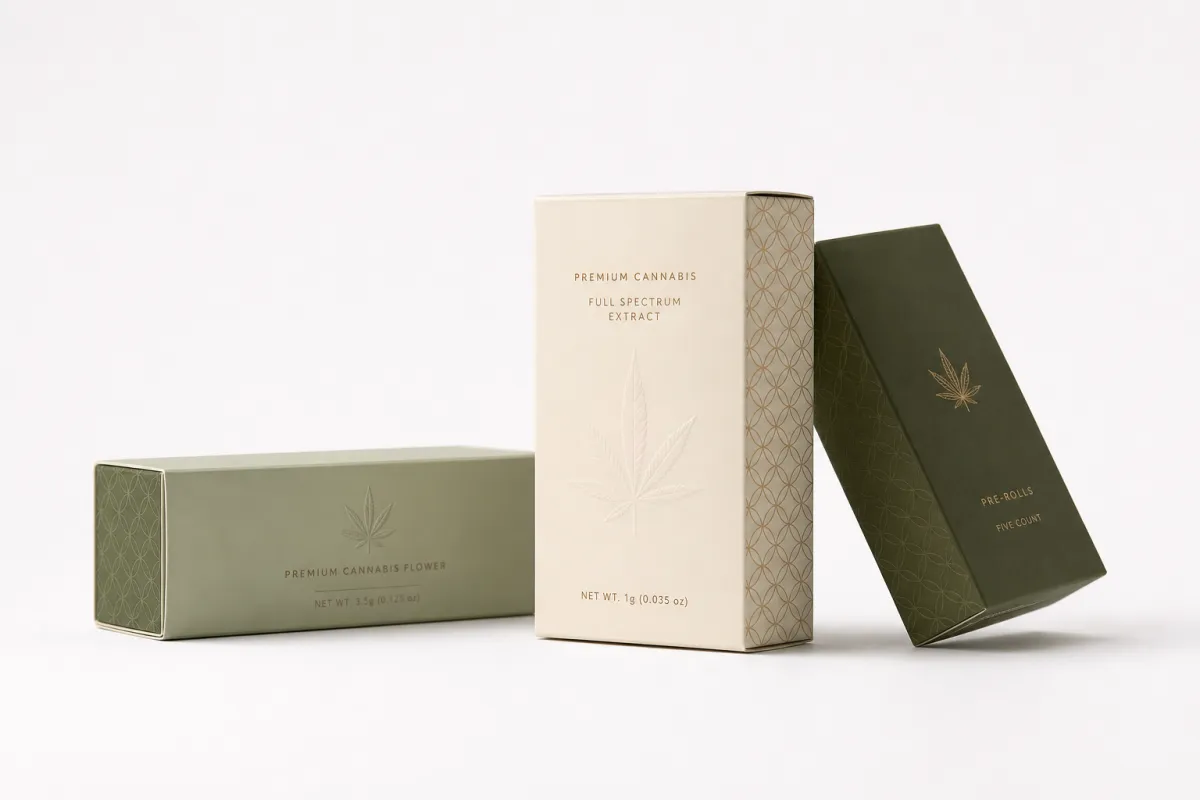
Cannabis Packaging Boxes Custom are cartons, sleeves, mailers, or rigid presentation boxes built for a specific product, a specific set of rules, and a specific brand. Instead of pulling a generic size from a warehouse shelf, the package is designed around the item itself. That might sound obvious. Plenty of projects still skip that step and then act surprised when the box does not fit the bottle, jar, or insert they were planning to use all along.
These boxes show up across the category: flower jars, pre-rolls, vape accessories, tinctures, topicals, edibles, and multi-unit retail sets. Each one has different requirements. A pre-roll sleeve needs a different internal fit than a jar carton. An edible box needs more room for dosage, ingredients, and warning text. Cannabis Packaging Boxes Custom are built for those real-world demands, not for a vague idea of what packaging should be.
There is also a branding layer here. Packaging often gets the first shot at consumer attention, and sometimes the only shot before someone moves on. Strong packaging does not shout over the product; it frames it. Clean typography, disciplined color, and a structure that feels deliberate do more for credibility than a pile of effects ever will. A box can be memorable without acting like it drank three espressos.
One thing I tell teams early: the best box is not the most decorated box. It is the one that packs cleanly, survives transit, passes legal review, and still looks like it belongs on shelf. Cannabis Packaging Boxes Custom have to do all of that at once. If they do, great. If not, the pretty rendering was just a very expensive sketch.
Structure matters too. A simple tuck box may be perfect for a light retail item. A heavier glass bottle may need a stiffer base or an insert. A premium kit may call for rigid board with a tray and lid. Cannabis Packaging Boxes custom are part carton engineering, part compliance planning, and part brand presentation. The good ones make all three look easy. The bad ones make everyone in operations sigh.
One more practical point: size the box around the finished packed product, not just the primary container. Add the cap, seal, shrink band, child-resistant closure, or insert. Those details are not tiny. They decide whether the carton slides, scuffs, crushes, or hangs up on the line. A few millimeters off is enough to cause a real mess later.
How Cannabis Packaging Boxes Custom Are Built
The build process usually starts with accurate measurements. The buyer confirms the product dimensions, closure style, and any secondary parts such as trays or inserts. Then the supplier builds a dieline that maps folds, glue areas, panel sizes, and print zones. Cannabis packaging boxes custom work best when this step is treated like engineering, because that is what it is. The art only works if the structure works first.
After measurements, the structure gets chosen. Tuck-end cartons are common for lighter retail products. Sleeve-and-tray builds work well for pre-rolls and accessory sets because they keep the contents centered and reduce movement. Mailer-style cartons make sense for direct-to-consumer shipping. Auto-lock bottoms can add support for heavier items. If the product needs more control, inserts, partitions, or locking features can be added. Nothing glamorous about that. It just has to work.
Printing comes next. Digital printing is useful for shorter runs and faster art changes. Offset printing tends to make more sense at scale when the artwork is stable. Flexographic printing can be efficient for simpler graphics and some carton formats. Once the ink is on the board, finishing starts: aqueous coating, matte or gloss lamination, soft-touch film, foil, embossing, spot UV. Those choices change shelf presence, but they also affect durability and budget. For cannabis packaging boxes custom, the finish should make sense for how the box will actually be handled, not just how it looks in a render.
Compliance is part of the build too. Depending on the market, the box may need child-resistant features, tamper evidence, opaque panels, warning language, or reserved spaces for batch data and lot codes. That means design, operations, and legal review all have to talk to each other. If the artwork leaves no room for the required copy, the box is not finished. It is just early.
Practical packaging rule: if a carton cannot be packed cleanly by hand, cannot pass basic transit handling, or cannot hold the required compliance copy without crowding, it is not ready for production. Pretty artwork does not fix a weak structure.
For shipping-oriented projects, transit standards are worth a look. ISTA testing gives a useful framework for thinking about drop, vibration, and compression risk, even when a full lab program is not part of the job. Industry groups like ISTA and the educational resources at packaging.org help fill in the technical gaps. Cannabis packaging boxes custom do not exist in a vacuum; they sit inside a larger packaging system that has to print well, move well, and comply with local rules.
There are some build details that sound boring until they fail. Glue flaps need enough room to bond properly. Reverse folds need to keep the artwork aligned. Window cuts, if they are used at all, cannot interfere with warning panels or opacity rules. Inserts should be tested with the actual product, not guessed from a drawing. That is how cannabis packaging boxes custom stay practical instead of turning into sample-room art projects.
Materials, Compliance, and Branding Choices
Material choice is one of the biggest drivers of performance and price in cannabis packaging boxes custom. SBS paperboard is popular because it prints cleanly and delivers sharp color. Kraft board gives a more natural, earthy look, though it handles color differently than coated white stock. E-flute corrugated board adds protection. Rigid chipboard works well for premium presentations or heavier products that need to feel substantial in the hand.
Thickness matters just as much as the board family. A 16 pt or 18 pt carton can be enough for lighter items, but fragile glass, metal tins, or multi-unit assortments often need a more stable build. For cannabis packaging boxes custom, the board has to match product weight, shipping conditions, and the chance of corner crush. A carton can feel elegant on a tabletop and still fail in a courier network. Packaging is rude like that.
Compliance narrows the options even more. Some markets need opaque construction. Others require exact placement for warning text, symbols, or ingredient data. Child-resistant performance can affect the closure style, which means the structure has to be decided before the artwork is locked. Cannabis packaging boxes custom are often subject to state-by-state rules, so there is no honest shortcut. The packaging has to fit the market it will live in, not the market someone hopes it will live in.
This is where branding and regulation have to cooperate. If the typography is too small, the legal copy becomes hard to read and the brand looks weak. If the branding is too loud, the required copy gets crowded out. Strong package design gives both sides room. Good cannabis packaging boxes custom usually keep the front panel simple, use strong contrast, and reserve the side or back for the long-form compliance text while still holding a premium look through finish and layout discipline.
A few combinations show up a lot in this category:
- SBS with aqueous coating for crisp retail cartons that need fast production and solid print clarity.
- Kraft board with matte varnish for natural-looking branding with a softer shelf presence.
- E-flute corrugated with full-color print for ship-ready cartons that need more structure.
- Rigid chipboard with soft-touch wrap for premium cannabis presentation boxes and gift-style kits.
There is also a sustainability angle that buyers ask about more often now. FSC-certified paper can support sourcing goals, and recycled content may be a fit for some programs. But claims need to be real and documented. Check the certification path directly at FSC and confirm what the paper mill, converter, and printer can actually support. Cannabis packaging boxes custom can be built with a lower-impact material strategy, but only if the supply chain is aligned from day one.
Finishes deserve the same honesty. Foil stamping can add premium value, but too much foil makes a panel harder to read. Spot UV adds contrast, but it can also show fingerprints if the box is handled a lot. Soft-touch lamination feels rich, though it can scuff in rough transit. For cannabis packaging boxes custom, the finish should solve a branding problem, not create a maintenance problem. Fancy is nice. Functional is nicer.
Color control matters too. Deep greens, black systems, warm neutrals, and high-contrast accent colors need to stay consistent across reorders. If a brand is growing into multiple SKUs, ask early how the supplier handles proofing, press checks, and repeat-order matching. A strong Custom Printed Boxes program should look like one family even when the products are different.
| Option | Typical Use | Approx. Cost at 5,000 Units | Notes |
|---|---|---|---|
| 16-18 pt SBS tuck box | Flower jars, pre-rolls, small retail items | $0.18-$0.32 each | Good print clarity; lower structural protection |
| Kraft paperboard carton | Natural-style product packaging | $0.20-$0.35 each | Earthy look; color reproduction is softer |
| E-flute corrugated mailer | Ship-ready retail packaging | $0.42-$0.78 each | Better protection; larger shipping footprint |
| Rigid chipboard set-up box | Premium kits and gifting | $0.95-$2.40 each | Higher perceived value; higher labor and material cost |
Those numbers are a working range, not a promise. Cannabis packaging boxes custom can move up or down quickly based on board thickness, print coverage, inserts, foil, and order quantity. A large run with simple graphics may cost less than a small run with heavy coverage and multiple finishes. The reverse can happen too if the structure is unusually complex. That is why the material conversation should happen before the artwork is locked.
What Cannabis Packaging Boxes Custom Cost
Pricing for cannabis packaging boxes custom breaks into a few predictable buckets: board selection, size, print method, finish complexity, insert count, and order volume. If you understand those buckets, quote comparison gets much easier. A buyer who only scans the unit price often misses the actual cost picture, because the cheapest quote on paper may hide setup charges, sampling fees, or freight that shows up later.
Setup cost is a big deal in short runs. Plates, dies, prepress work, proofing, and press make-ready all have to be paid somehow, so a 500-unit order will usually carry a much higher per-unit price than a 5,000-unit order. That does not make small runs a bad idea. It just means cannabis packaging boxes custom should be planned with volume in mind. If the product is still being tested, a short run makes sense. If the SKU is stable, a larger run usually pulls the cost down in a way you can actually feel.
Here is a practical way to think about the pricing levers:
- Material - thicker board and premium substrates cost more.
- Print method - digital is flexible, offset is efficient at scale, and flexo can be cost-effective for simpler work.
- Finish - lamination, foil, embossing, and spot UV add labor and sometimes extra tooling.
- Structure - a standard tuck carton is simpler than a rigid set-up box with tray components.
- Compliance features - child-resistant closures, tamper evidence, and special panel layouts can increase cost.
Rush timing can change the quote too. When a project needs a condensed schedule, vendors may need to rearrange production, expedite materials, or move a job to a different press window. That affects cost, and it affects risk. Cannabis packaging boxes custom that are rushed through art and proofing are more likely to need correction later. Speed is fine. Sloppy speed is where things get dumb.
There are hidden cost drivers that catch first-time buyers off guard. Special coatings can require extra passes. Complex die cuts can slow finishing. Strict color matching may call for more proof cycles. Inserts add both material and assembly labor. If the box has to fit an unusual bottle, jar, or multi-piece set, structural development time may be higher than expected. Cannabis packaging boxes custom are not expensive because someone woke up and chose chaos. They get expensive when the design asks the line to do more work.
That is why itemized quotes matter. Ask for the board spec, print process, finish list, quantity break, freight assumptions, and whether sampling is included. If a supplier can explain where each dollar goes, the proposal is easier to trust. If the quote is vague, the final bill may be too. For cannabis packaging boxes custom, transparency is not a bonus feature. It is how buyers avoid surprises.
The lowest price is not always the lowest total cost. A carton that arrives scuffed, printed off-color, or undersized can eat margin through rework, delayed launches, or rejected shipments. A better-built box may cost a few cents more but save money in operations. That is especially true for cannabis packaging boxes custom, where retail presentation and regulated labeling have to coexist without drama.
If you are comparing suppliers, the useful question is not “What is the cheapest box?” The useful question is “Which option gives me the right balance of structure, print quality, compliance support, and lead time for this product?” That question usually leads to better decisions, especially for brands building a repeatable custom printed boxes program across multiple SKUs.
Step-by-Step Ordering and Timeline for Cannabis Packaging Boxes Custom
The cleanest ordering process starts with a complete brief. Before anyone draws a dieline, gather the finished product dimensions, expected order quantity, target market, compliance requirements, branding goals, and shipping conditions. Cannabis packaging boxes custom move faster when the supplier is not chasing missing information halfway through the job. A solid brief can prevent a week of back-and-forth later. Maybe more if the team likes email tennis.
After the brief, the supplier usually recommends a structure and board spec, then develops a dieline. That is where the internal fit gets locked in. If the product is fragile, tall, oddly shaped, or packed with inserts, ask for a physical mockup or prototype early. A simple white sample can reveal whether the fold lines are right, whether the closure is secure, and whether the box opens the way the team expected. Cannabis packaging boxes custom should be tested before full production, not after.
A realistic timeline often looks like this:
- Day 1-3 - gather specs, define compliance needs, and choose the carton style.
- Day 3-7 - create or revise the dieline and place artwork.
- Day 7-10 - review proofs, check color, and approve the layout.
- Day 10-18 - print, finish, die-cut, and convert the cartons.
- Final step - pack, inspect, and ship to the destination.
Those ranges can stretch if the box is complex, but they are a useful starting point. Cannabis packaging boxes custom with simple structures and ready artwork can move fairly quickly, while projects that need inserts, specialty finishes, or multiple approval rounds take longer. The biggest time saver is usually the same thing every time: have the artwork final, the dimensions final, and the compliance text final before production starts.
Another way to keep the schedule under control is to keep revisions focused. A small color correction is manageable. A late structural change is not. Once the dieline is approved, changing the carton size can ripple into the print file, the folding panels, the insert dimensions, and sometimes the shipping carton plan. Cannabis packaging boxes custom are easiest to execute when the team treats each decision as part of one connected build, not as separate tasks that can be shuffled around later.
Production also needs a practical approval path. Someone should sign off on the structure, someone should review the legal copy, and someone should compare the artwork against the brand standard. If those roles are unclear, revisions can circle for days. For cannabis packaging boxes custom, the fastest projects are usually the ones where every approver knows exactly what they are responsible for and when they need to respond.
Packaging testing can also be part of the timeline. Transit-oriented cartons may benefit from rough handling checks, compression checks, or drop testing that reflects real shipping conditions. The ISTA test methods are a useful reference point for that kind of thinking, even if your product does not need a formal lab program. Cannabis packaging boxes custom that will be shipped directly to consumers deserve more scrutiny than a plain retail sleeve sitting in a controlled display environment.
If you are ordering from a broader catalog, it can help to review the supplier’s Custom Packaging Products early so the team can see what structures and finishes are already available. That often shortens the discovery phase and reduces the chance of asking for a structure that is awkward to produce efficiently. Cannabis packaging boxes custom do not have to be reinvented every time. Sometimes the smarter move is to start from a proven base and tailor the details.
Common Mistakes That Slow Approval or Raise Cost
The first mistake is basic sizing trouble. Teams measure the primary container but forget the cap, seal, shrink band, or insert, and the result is a carton that fits only in theory. Cannabis packaging boxes custom should always be measured from the finished packed product, because that is what the line will handle. Even a small mismatch can create slowdowns during packing or force the box to open too tightly for comfortable use.
The second mistake is overbuilding the package. It is easy to assume that more finishes, more layers, and more special effects automatically make the product better. In reality, extra foil, extra coatings, or a more complex structure may not add much value if the product is already premium on its own. Cannabis packaging boxes custom should support the offer, not hide it under decoration. Good product packaging is usually clear, sturdy, and repeatable.
The third mistake is compliance drift. Missing warning copy, incorrect panel placement, or a layout that leaves no room for required information can trigger rework at the worst possible moment. Cannabis packaging boxes custom need legal review before print, not after. I have seen otherwise solid jobs stall because one panel was too small for the required text or because the brand team assumed the same copy could be reused in every market. That assumption is how people buy trouble.
Here are the issues that most often cause delays or added cost:
- Ordering before the sample is approved.
- Changing dimensions after the dieline is signed off.
- Trying to use one carton for multiple SKUs with different closures.
- Adding a finish late in the process without checking cost impact.
- Forgetting how the box will be shipped, stacked, or displayed once it leaves the plant.
The last point matters more than people think. A carton can look perfect in a proof and still perform badly in a warehouse, on a retail shelf, or inside a corrugated shipper. That is why cannabis packaging boxes custom should be judged across the full life of the package, from filling to freight to end-user opening. The box has to survive the whole trip, not just the photo shoot.
Another common miss is assuming one supplier can fix every issue after the fact. Good converters can solve a lot, but they cannot rescue unclear artwork, a wrong-size insert, or a compliance panel that was never designed into the layout. If you want the best result, start with the right structure, not the most complicated art. That advice sounds basic, but it saves real money. Cannabis packaging boxes custom are often won or lost in the first round of planning, not in the final press run.
Finally, do not ignore storage and handling. A box that sits in a humid back room needs different consideration than one that ships in a climate-controlled parcel network. Material choice, coating, and glue performance all matter there. Cannabis packaging boxes custom can absolutely be built for those conditions, but the supplier needs to know the conditions up front. Otherwise everyone gets to learn the hard way, which is a terrible curriculum.
Expert Tips and Next Steps Before You Order
If you want the ordering process to go smoothly, build a short packaging brief before you request quotes. Keep it simple: product dimensions, target quantity, exact compliance copy, shipping method, desired finish, and the brand look you want to protect. Cannabis packaging boxes custom become much easier to price and produce once the basic facts are in one place.
Ask for a sample or prototype if the product is heavy, fragile, or unusually shaped. That is one of the cheapest ways to avoid expensive surprises. A physical check can reveal fit problems, opening resistance, or weak panel folds that a digital render will not show. Cannabis packaging boxes custom should feel right in the hand before they go to print, especially if the box has to carry both retail presence and handling strength.
It also pays to compare suppliers on support, not only on quote value. The best partner is not always the cheapest one, and the difference often shows up in the details: dieline guidance, color consistency, turnaround discipline, finish advice, and responsiveness during proofing. For buyers who need branded packaging across more than one SKU, that support can be worth more than a small price difference on the front end.
Before you place the order, check these items one more time:
- Exact product dimensions and insert sizes.
- Final label copy and warning text.
- Approved carton structure and opening style.
- Material choice matched to weight and shipping needs.
- Expected lead time and freight plan.
That checklist sounds basic, but it prevents the most common mistakes. It also gives your team a clearer path to approval, which matters if the box is part of a larger launch calendar. Cannabis packaging boxes custom are easier to manage when everyone knows what is locked and what is still open. The same is true whether you are ordering a small run or scaling into a broader packaging program.
For brands expanding into multiple formats, think in families rather than one-off cartons. A shared board spec, a coordinated print system, and consistent panel logic can make future reorders easier. That is one reason custom printed boxes often perform better across a line than disconnected packaging choices. Cannabis packaging boxes custom can become a repeatable system if the first order is built with the next three in mind.
My practical advice is simple: do not overcomplicate the box, but do not underplan it either. The carton should fit the product, support the market’s compliance demands, and look credible on shelf without making production harder than it needs to be. If you keep those three goals in balance, cannabis packaging boxes custom can be a very efficient part of your launch plan.
The real takeaway is this: start with the finished packed product, confirm the compliance copy early, and choose the material based on how the box will actually be used. Do that, and cannabis packaging boxes custom stop being a guessing game and start behaving like a system.
FAQ
How do I choose the right size for cannabis packaging boxes custom?
Measure the finished product, not just the container body, and include caps, closures, inserts, seals, and any protective space needed for packing. Leave enough tolerance for material thickness so the item slides in without scraping or rattling. If the shape is unusual, ask for a dieline or sample before full production. Cannabis packaging boxes custom are much easier to get right when the dimensions come from the actual packed product.
What materials work best for cannabis packaging boxes custom?
Paperboard works well for lighter retail cartons, while corrugated or rigid board is better for protection, premium presentation, or shipping strength. Kraft can support a natural look, but coated white board usually gives sharper print and more predictable color. The best material depends on product weight, shelf expectations, transit conditions, and compliance requirements. Cannabis packaging boxes custom should be matched to the use case, not picked by appearance alone.
How much do cannabis packaging boxes custom usually cost?
Cost depends on size, material, print method, quantity, finishing, and whether the box needs inserts or special closures. Smaller runs usually have higher per-unit pricing because setup costs are spread across fewer boxes. Ask for an itemized quote so you can compare material, print, finishing, sampling, and freight separately. That makes cannabis packaging boxes custom much easier to evaluate honestly.
How long does it take to produce cannabis packaging boxes custom?
Timeline is usually driven by artwork readiness, proof approval, and the complexity of the structure or finish. Simple cartons move faster than boxes that need specialty coatings, custom inserts, or multiple review cycles. A clean brief and fast signoff on the dieline can save days or even weeks. Cannabis packaging boxes custom are at their best when the approvals are tight and the file is complete.
What compliance details should I check before ordering cannabis packaging boxes custom?
Confirm the required warning statements, panel placement, and any age or safety language in your market. Check whether the package needs child-resistant features, tamper evidence, or opaque construction. Review the final artwork with a compliance-minded reviewer before production starts, not after. Cannabis packaging boxes custom should be treated as regulated packaging first and branding second, even though both matter.