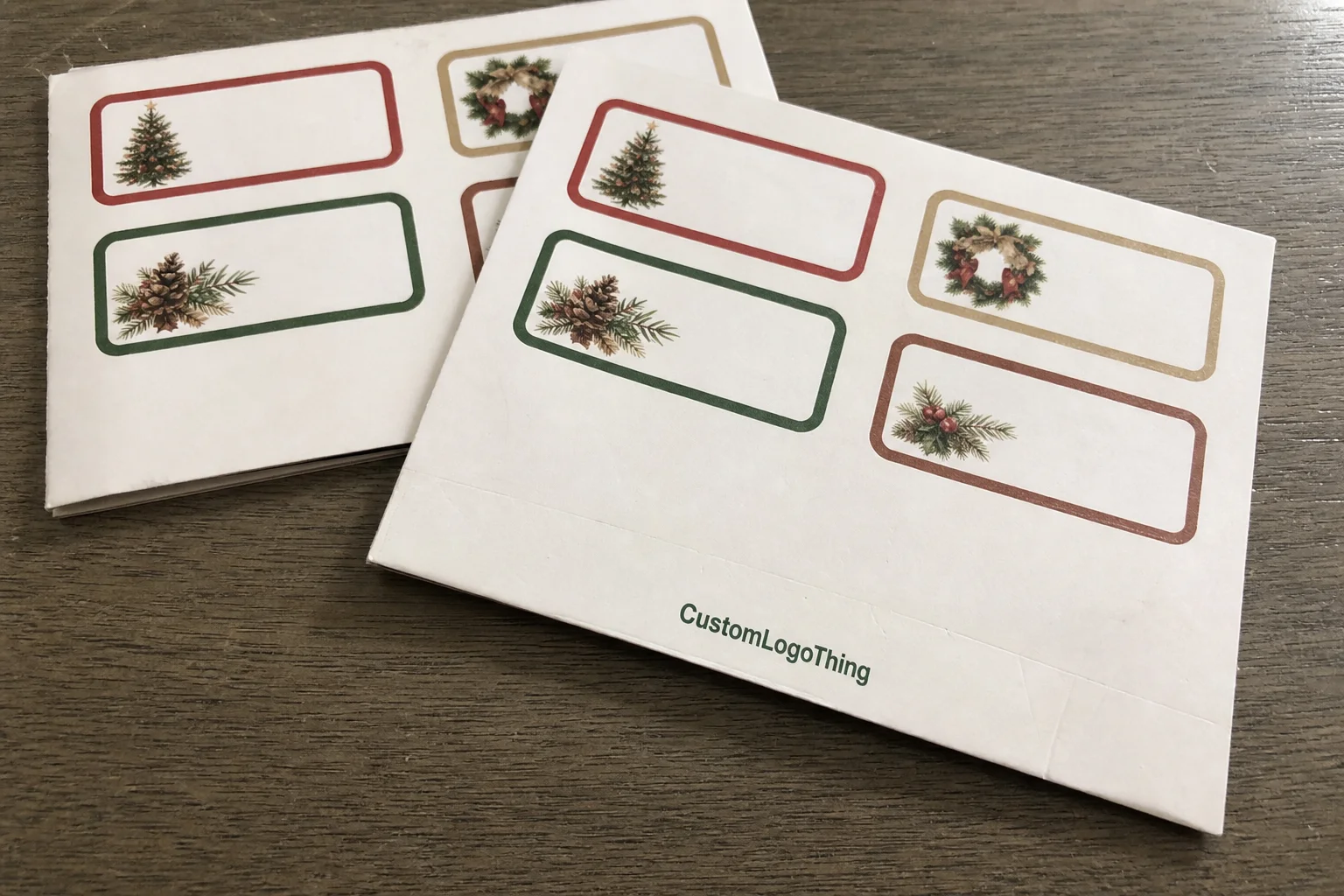
Christmas Address Labels personalized are not glamorous. They are useful, which is better. Once holiday mail starts stacking up, the difference between handwriting every envelope and using a clean, preformatted label is the difference between a manageable evening and a slow, annoying pile of corrections. The value is practical: fewer spelling mistakes, cleaner presentation, and less time spent rewriting the same return address over and over.
Holiday mailing gets messy fast. One list includes couples with different last names, another has an apartment line that needs to stay on its own row, and a few addresses still use old abbreviations nobody notices until the proof is already built. A well-made label keeps that chaos in line without turning the process into a project.
That is why buyers keep coming back to address labels during the season. They are small, but they solve a real operational problem. You are not buying decoration. You are buying speed, consistency, and a better chance that the envelope looks intentional instead of rushed.
Why christmas address labels personalized save time on holiday mail
The main gain is repetition control. Writing 40, 80, or 150 addresses by hand sounds harmless until the list includes long names, stacked apartment lines, and a few house names that need to fit on one label without turning into a crossword puzzle. A printed label cuts that work down to data cleanup, proof approval, and application. That is a better use of time.
Consistency matters too. The same spelling, spacing, punctuation, and return address appear on every envelope. That keeps the mailing cleaner and reduces the kind of errors that are easy to miss in a rush. One missing suite number can slow a delivery. One typo in a return address can make a whole batch look careless.
There is also the presentation factor. A crisp label reads better than hurried handwriting, especially on glossy or dark envelopes where pen ink can look thin or uneven. On textured paper, handwriting can look even messier. A label gives the envelope a finished look without adding extra work to each piece.
For larger lists, labels also act as a control point. Household names can be standardized, business addresses can be formatted the same way every time, and return addresses can stay fixed across the whole run. That matters for family holiday cards, client greetings, and any mailing where the sender wants the pieces to look like they belong to the same set.
There is a practical side that gets ignored in a lot of holiday copy. Good labels do not need to be elaborate. They need to be readable, adhesive enough to stay put, and sized correctly for the envelope. If those three things are right, the design has already done its job.
How personalized address labels work
The workflow is simple. You provide the addresses, choose the size and style, review a proof, approve the layout, and move into production. Most suppliers can work from a spreadsheet, CSV file, or typed list. Clean data helps more than fancy design ever will. Fewer corrections means a faster proof and a cleaner final sheet.
The key feature is variable data printing. That means each label can carry different recipient information without anyone typing addresses one by one. A household can be formatted as one line or split across two. A business card can include a company name and suite number. A return address can stay locked across the whole order.
The smartest setup is the boring one. Separate columns for first name, last name, household name, address line 1, address line 2, city, state, ZIP, and return address. That structure makes review easier and keeps awkward formatting decisions from showing up in the proof. It also saves time if the list gets reused next year.
One issue shows up all the time: bad data does not disappear because the layout looks nice. If the spreadsheet has outdated ZIP codes, missing apartment numbers, or mixed abbreviations, the proof will expose it. Labels are not a cleanup service. They are a delivery system for data that is already organized.
Production rule: the label can only print what the file gives it. If the list is messy, the proof will be messy too.
If the order also includes matching seal stickers or branded packaging elements, keeping the artwork family consistent helps the whole set feel deliberate. A label, a tag, and a card should not look like they came from three different jobs. That kind of mismatch is easy to spot and hard to ignore.
Process and turnaround timeline
Holiday work lives or dies by timing. A simple label order can move quickly after proof approval, but the actual turnaround depends on how clean the file is, how many corrections the proof needs, and whether the job includes specialty stock or finishing. For a straightforward digital run, a few business days after approval is realistic. A more customized order can take 7 to 15 business days before it ships.
The process usually follows the same sequence:
- Clean the address list and remove duplicates.
- Choose the label size, shape, and finish.
- Review the digital proof for spelling, spacing, and line breaks.
- Approve the proof or send corrections.
- Print, finish, pack, and ship.
Lead time gets stretched by preventable things. Mixed abbreviations, inconsistent household naming, and stray punctuation all force extra proof changes. Seasonal demand also plays a part. As the holiday mailing window narrows, even a normal job can sit in queue longer than expected. Early approval matters more than most people want to admit.
The practical way to plan is to work backward from the mailing date. If the order needs custom formatting or if the list still needs cleanup, leave at least two to three weeks of buffer. That is not excessive. It is just enough room to absorb a revision, a stock substitution, or a shipping delay without wrecking the schedule.
For buyers comparing print work across labels and packaging, the same principle holds up across the board: clean data, clear specs, and fast proof approval move the order faster than last-minute rush logic. Industry references such as Packaging and Packaging Professionals and ISTA both emphasize that small spec choices can have a big effect on performance and handling.
Pricing, MOQ, and unit cost
Pricing usually comes down to quantity, material, finish, artwork complexity, proofing, and any setup required for a custom size. A simple one-color label on standard stock will sit at the lower end. Add foil, layered colors, specialty adhesive, or a custom die shape, and the cost rises quickly. That is not a mystery. It is production math.
Minimum order quantities vary, but holiday buyers often see practical MOQs in the 250 to 500 piece range for smaller digital runs. Orders of 1,000 pieces or more make more sense if the design is reusable or if the finish is standard. Unit cost usually falls as quantity rises. Total spend goes up, but the per-label cost gets better.
| Option | Best For | Typical Unit Cost | Notes |
|---|---|---|---|
| Matte paper label | Standard holiday envelopes and simple address replacement | $0.08-$0.14 at higher quantities | Readable, economical, and easy to print cleanly |
| Premium coated label | Client mailers, polished family cards, or presentation-focused pieces | $0.12-$0.22 | Sharper color appearance, though glare can be an issue under bright light |
| Synthetic or weather-resistant label | Mailers exposed to moisture, cold handling, or package use | $0.18-$0.35 | Better durability and moisture resistance, with a higher base cost |
If the budget is tight, the cheapest-looking option is not always the cheapest order. A standard size, a simpler layout, and fewer revision cycles often save more money than chasing a lower sticker price on a flimsy spec. One clean proof is cheaper than two rounds of corrections. That is where the real waste lives.
Reusable art can also improve value. A return-address label that works for holiday cards, thank-you notes, small parcels, and branded inserts gets more use than a one-off seasonal design. That is one reason Custom Labels & Tags can make sense as a companion piece if the visual system needs to carry beyond December.
Materials and design details that matter
Material choice affects both appearance and performance. A standard matte paper face stock works well for most holiday envelopes because it prints cleanly and keeps the address easy to read. Coated stock can make colors feel richer, but it may pick up glare under indoor lighting. Synthetic film, usually around 2 to 3 mil, adds moisture resistance and better scuff protection, which matters more on packages or rougher surfaces.
The adhesive matters just as much. A permanent acrylic adhesive is common because it bonds well to smooth paper and holds up through sorting and handling. If the envelope is recycled, textured, cold, or lightly coated, a sample test is smart. Adhesive behavior is not identical across every substrate, and holiday mail gets handled more than people think.
Design hierarchy should stay simple. Recipient name first. Street address second. City, state, ZIP last. On smaller labels, two or three lines are usually enough. Cramming too much into a small format makes the label feel busy and hurts readability. The point is not to decorate the address. The point is to make it easy to scan.
Typography deserves the same restraint. Font sizes around 8 to 10 points usually work for address lines, but the real answer depends on the label size and the typeface. Decorative scripts can work for a name line if they stay out of the way of the address. If the ZIP code has to fight the font, the design has already gone too far.
Contrast is not optional. Dark text on white or light cream stock is still the easiest combination to read quickly. Seasonal borders, small icons, or a touch of color are fine if they do not crowd the address. A label can have personality. It just should not make the postal line harder to read.
For buyers who care about sourcing, FSC is a useful reference for paper-based material claims. That does not mean every holiday label needs to advertise environmental credentials. It does mean there is a difference between a real material choice and a vague marketing line with no substance behind it.
The closer the label sits to a glossy, textured, or dark envelope, the more important stock choice and adhesive strength become. Fancy artwork will not fix poor adhesion or weak contrast. Good print work is usually about removing friction, not adding embellishment for its own sake.
Common mistakes that lead to reprints
Most reprints start with data problems, not print problems. Missing apartment numbers, stale ZIP codes, duplicate households, and inconsistent abbreviations are the usual suspects. A bad address hidden in a large spreadsheet is easy to miss until the proof exposes it. That is exactly why the proof exists.
- Mixing “Street,” “St.”, and “ST” across the same file.
- Leaving out apartment, suite, or floor information.
- Combining two households into one record by mistake.
- Using a decorative font that hurts readability on long names.
- Approving the proof without checking the return address and ZIP code.
Another common issue is crowding. A label can only hold so much before it starts to look compressed. If the recipient name, street line, and return address all compete for space, the design loses the clean look that made it useful in the first place. A larger format or a simpler layout usually solves that faster than squeezing harder.
Proofing errors are the last big source of trouble. Skipping the address review, ignoring margin guidance, or approving too quickly because the mailing deadline feels close can all produce avoidable waste. The fix is plain: read the proof line by line, compare it against the master list, and check the details that are easiest to miss. The small stuff is what causes the expensive reprint.
There is a point where aesthetics need to step back and legibility needs to win. That is not boring. That is competent production. If the label cannot be read at a glance, it missed its job.
Expert tips and next steps
The cleanest orders usually start before design begins. If the address list is organized, the proof moves faster, the layout looks better, and the final labels are easier to apply. A few hours spent cleaning data can save a day of back-and-forth later. That trade is worth making every time.
Before placing an order, check the list against this short list:
- Standardize abbreviations and capitalization.
- Confirm every apartment, suite, and floor number.
- Choose a label size that leaves the address room to breathe.
- Decide whether the labels are for envelopes, gift packaging, or both.
- Test one sample on the final envelope stock if possible.
- Approve the proof only after checking names, ZIP codes, and return address details.
If the labels are being used for a larger family list, a small business mailing, or a mix of personal and client cards, think beyond the holiday window. A flexible design can carry into thank-you notes, event mailers, package seals, and branded inserts. That gives the order more value than a layout that only works for one short season.
Material choice, adhesive strength, and layout all matter, but the real benefit is operational. A good label keeps the mailing process simple enough that someone can work through a long list without handwriting every envelope from scratch. That is why christmas Address Labels Personalized still make sense for holiday mail. They cut friction, keep the presentation tight, and avoid the kind of tiny errors that turn into unnecessary rework.
Are christmas address labels personalized worth it for small holiday mailings?
Yes. Even a modest batch benefits from less handwriting and more consistent formatting. They are especially useful if you want family cards, client mailers, or neighborhood greetings to look polished instead of improvised.
How long do personalized Christmas address labels usually take to produce?
Simple runs can move quickly after proof approval, but timing depends on quantity, revisions, stock, and the production queue. A few business days is possible for straightforward orders. Custom sizing or specialty finishes can push that much longer.
What information should go on custom holiday address labels?
Use the recipient name, street address, city, state, and ZIP. Add a return address if the label is replacing handwriting on the envelope. Keep the layout clean and do not crowd in extra text that makes the address harder to scan.
Do personalized Christmas address labels stick well on envelopes and packages?
They usually perform best on smooth, clean surfaces with firm pressure during application. If the surface is textured, recycled, or cold, test a sample first so you know the adhesive is holding properly.
Can I order a small quantity of christmas address labels personalized?
Often yes, although the per-label cost is usually higher on small runs because setup and proofing are spread across fewer pieces. If you only need a seasonal batch, compare that total against a larger order that can carry into other mailings or next year.