The Clothing Labels Unit Cost for ecommerce can look simple at first glance, then change once folding, packing, SKU separation, and fulfillment handling are added to the job. A label is only truly economical if it stays predictable through production, inspection, and warehouse use, not just at the first price line on the quote.
That matters because apparel brands rarely buy labels in isolation. A neck label may need to match a size tab, a care label, and the way the garment is packed for direct-to-consumer shipping. If one piece of that system is off, the real cost shows up later as rework, receiving delays, or a weaker presentation at the customer’s doorstep.
The lowest per-piece quote is not the lowest landed cost if the labels arrive in the wrong format, need rework, or slow down the packing line.
How Clothing Labels Unit Cost for Ecommerce Orders Is Built
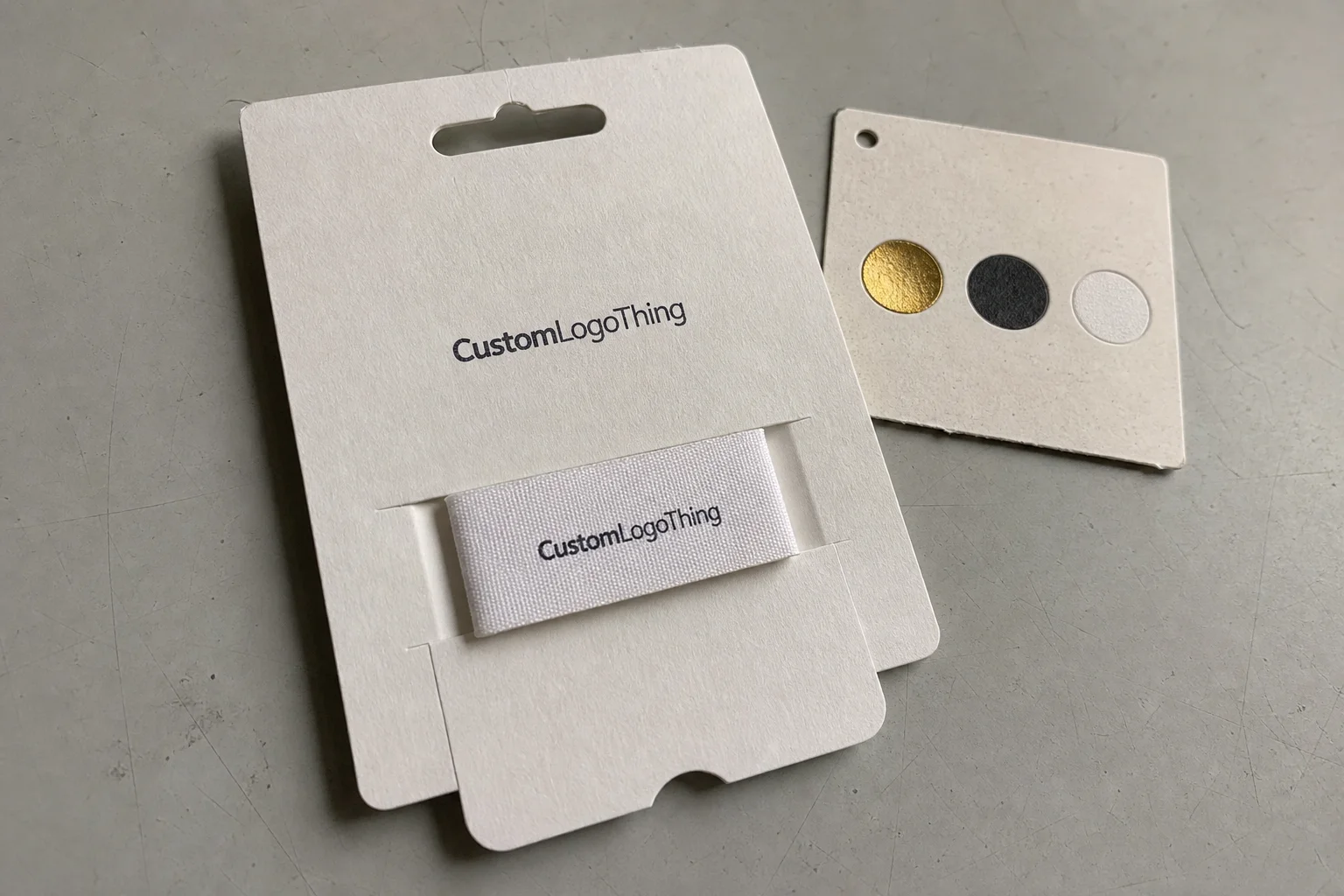
For apparel brands, unit cost is a blend of material, construction, finishing, and order handling. A woven label may look inexpensive until the order is split across several sizes or colors, packed into separate bundles, and sorted by SKU for warehouse pickup. That is why the Clothing Labels Unit Cost for ecommerce should be quoted as a production number, not a loose per-piece estimate pulled from a catalog.
The fastest cost drivers are usually the material, the size, the amount of color or print coverage, and the minimum order quantity. Folding and cutting matter too. If the label needs a center fold, end fold, loop fold, or cut-and-fold finish, the labor and setup time increase. Roll delivery, individual bagging, and carton labeling for fulfillment can also change the landed cost more than the substrate itself.
One more piece often gets overlooked: the order structure. A single style in one color is easier to produce and pack than a program spread across several SKUs, each with its own size run and replenishment schedule. Even if the label artwork is unchanged, the operational handling is different. That difference shows up in the quote.
Buyers usually care about three outcomes:
- Margin protection so the label does not quietly erode product profitability.
- Repeatability so the next reorder matches the first run in size, color, and feel.
- Warehouse efficiency so cartons, bundles, and SKUs are easy to receive and distribute.
There is also a difference between unit price and landed cost. Unit price tells you what one label costs at a given quantity. Landed cost includes freight, special packing, inspection, and, in some cases, duties or import handling if the order is coming from offshore production. Buyers who compare only the printed unit price usually miss the real cost until the cartons arrive.
That is the practical divide between a generic estimate and a quote built around the real job. The first may look attractive. The second is the one that holds up through production and fulfillment.
Choose the Right Label Type for Your Product Mix
The label type should match the garment, the brand position, and how the product is sold online. A basic tee sold on volume does not need the same finish as a boutique knitwear piece that a customer will inspect at arm’s length. The material choice should support the product mix before anyone talks about bulk pricing.
Each label family behaves differently in production and in use. Woven labels tend to hold detail well and feel premium, but they take more setup than a simple print. Printed satin is often a good fit for care labels and larger basic programs because it is faster to produce and easier to read. Cotton works well for natural-fiber brands and soft, understated branding, but the texture can make small text harder to read if the artwork is crowded. Heat transfer moves the branding directly onto the garment and removes the physical tag, which helps comfort, but the artwork and application process have to be managed carefully.
| Label Type | Typical Unit Cost at Mid-Volume | Best Fit | What Buyers Should Watch |
|---|---|---|---|
| Woven damask | $0.06-$0.22 each | Premium apparel, soft hand-feel, durable branding | Thread density, fold style, and color count affect cost per piece |
| Printed satin | $0.03-$0.14 each | Fast-moving ecommerce basics, care labels, private label programs | Print coverage and edge finish can change the quoted number quickly |
| Cotton label | $0.05-$0.18 each | Natural-fiber brands, understated presentation, craft-led products | Texture is attractive, but the label must still read clearly after washing |
| Heat transfer | $0.04-$0.20 each | Minimalist branding, no-tag comfort, activewear, kidswear | Artwork detail and application requirements matter more than the raw material price |
Woven labels usually justify a higher unit price because they deliver a cleaner appearance and solid wash performance. Printed satin and cotton can be more economical for larger ecommerce programs, especially where care content is standardized and the brand wants a softer profile. Heat transfer sits in a different lane: the front-end cost can be modest, but the artwork must be prepared properly so the application behaves the way the garment needs.
There is no universal best choice. A label that saves two cents per piece can still be the wrong choice if it creates extra handling, confusion at pack-out, or a less polished customer impression. For brands shipping Direct To Consumer, the label is part of the unboxing experience. If that experience matters, the lowest spec is not automatically the best value.
If you need a broader view of branding components, our Custom Labels & Tags category is a good starting point for comparing label families before you request pricing.
Specifications That Influence Fit, Feel, and Reorders
Specifications are where the quote gets real. Size, fold style, edge finish, thread density, print coverage, and artwork complexity all shape the final number. Two labels can look nearly identical in a mockup and still price very differently once the production details are locked.
The most common spec choices that affect Clothing Labels Unit Cost for ecommerce are straightforward:
- Finished size because more surface area usually means more material and more production time.
- Fold style because center fold, end fold, loop fold, or straight cut changes finishing labor.
- Color count because more yarn colors or print passes increase complexity.
- Edge finish because a clean cut, heat seal, or woven edge can change the setup path.
- Artwork detail because fine lines, small text, and dense logos require tighter control.
For woven labels, thread density matters because it affects legibility. If the design carries very small type or a fine logo outline, the weave has to support that detail without turning it into a blurred patch. For printed labels, the ink coverage and the base fabric matter more than buyers expect. A dense print on a smooth satin stock will behave differently than the same artwork on a softer or more textured surface. Heat transfer labels have their own constraints: the garment fabric, application temperature, and press time all have to be compatible, or the finish can fail during wear or washing.
Care content, country-of-origin text, size identification, and branding marks can all be built into the label without turning the spec into a mess. The real win is consistency. If a brand uses the same logo on tees, hoodies, and accessories, the label should feel like one system, not three unrelated parts. That is where repeat orders become easier to manage and where the warehouse team stops wasting time checking whether each SKU is actually the same.
Locking specs early matters more than many buyers expect. It reduces proof rounds, keeps restocks aligned with the original order, and avoids small deviations that become visible once the product is in circulation. A 1 to 2 mm size shift or a slight color mismatch may not seem serious on screen, but it is visible in a packed garment. The same is true for edge fray, crooked fold lines, or text that sits too close to the cut edge.
For brands that run recurring programs, a disciplined spec sheet usually saves more money than chasing a slightly lower starting quote. The fewer placeholders in the request, the fewer surprises in production.
Cost, Pricing, MOQ, and Quote Drivers to Compare
Cost, MOQ, and price are related, but they are not the same thing. A quoted unit price tells you what one label costs at a given quantity, while the true landed cost includes freight, sorting, finishing, and any special packing required for ecommerce. If the job needs roll format, individual size bundles, or a pack-out arranged for third-party fulfillment, the quote should reflect that from the start.
There are also one-time charges to understand. Some jobs carry setup charges, and woven or specialty label programs can involve tooling fees or plate costs depending on the production method. Those charges may be small compared with a full run, but they matter on short orders because they get spread across fewer pieces. That is why a 500-piece order almost never carries the same cost per piece as a 5,000-piece order, even if the label design is unchanged.
The bulk pricing curve is usually steepest at the low end. Once the order crosses the point where setup is absorbed, the unit cost begins to settle. That does not mean the largest quantity is automatically the right choice. A brand that carries slow-moving SKUs can tie up cash and storage space by overbuying labels that will not be used for months. The best quantity is the one that matches sell-through, reorder cadence, and warehouse capacity.
| Quantity | Woven Label | Printed Satin | Heat Transfer |
|---|---|---|---|
| 500 pieces | $0.18-$0.45 each | $0.10-$0.28 each | $0.14-$0.35 each |
| 5,000 pieces | $0.04-$0.12 each | $0.03-$0.08 each | $0.05-$0.14 each |
| 10,000+ pieces | $0.03-$0.09 each | $0.02-$0.06 each | $0.04-$0.11 each |
Those ranges are indicative, not fixed. A dense woven damask with several colors and a narrow fold will price differently from a simple printed satin care label. The same is true for roll format versus cut pieces, or for labels that need to be packed in a way that makes warehouse pick-and-pack faster. If the supplier is not quoting the same spec, the same quantity, and the same pack format, the quotes are not comparable.
From a buyer’s point of view, the real question is not “Which number is lowest?” It is “Which number gives me a clean, repeatable supply program without hidden handling costs?” That is the lens that protects margin.
A quote should show the unit price, the MOQ, the pack format, and any one-time setup charges. If one of those pieces is missing, the comparison is incomplete.
Production Steps, Turnaround, and Lead Time
A clean production path is usually simple: artwork review, spec confirmation, proof approval, manufacturing, quality check, and shipment. If any of those steps is unclear, lead time stretches. Missing artwork files, inconsistent size charts, or last-minute wording changes can add days fast, especially on orders with multiple SKUs.
Typical turnaround depends on the construction. Simple printed labels can move relatively quickly once the proof is approved, while woven labels or heat transfer programs with multiple color layers usually take longer. A realistic schedule for many orders is often 10-15 business days after approval for straightforward work, and 12-20 business days for more detailed or multi-SKU programs, not counting transit time. If the order needs a custom pack-out, allow more time for sorting and inspection.
Quality control is not just a quick visual check. A proper label run should be checked for color accuracy, registration, cut consistency, fold accuracy, and legibility of all required text. If the label is part of a care-compliance system, the wording should be confirmed before production starts, not after the first cartons are packed. Small errors on a label are expensive because they tend to repeat across the whole batch.
Shipping method also affects the calendar. Air freight shortens transit but increases landed cost; ocean freight lowers transport expense but adds time and more planning. For brands with seasonal launches, that tradeoff matters. A label arriving a week late can hold up the garment program if the factory or warehouse will not release product without it.
For programs that travel with outer packaging or retail-ready inserts, broader packaging standards can matter too. The International Safe Transit Association publishes testing protocols that help define how packaging should hold up in shipment, and the Forest Stewardship Council is relevant if paper components such as hang tags, inserts, or backing cards need traceable fiber sourcing. Those references do not replace product specs, but they give buyers a stronger framework for procurement decisions.
ASTM textile test methods may also come into the conversation when brands validate fabrics or garment performance, especially if the label program needs to align with a larger quality system. The point is simple: production runs go smoother when the documentation is complete before the first sample is approved.
If you want lead times to stay predictable, the fastest path is to approve the exact label build before scheduling starts. Placeholder instructions create back-and-forth. Final specs create a clean production window.
How We Keep Ecommerce Label Programs Consistent Across SKUs
Repeatability is where ecommerce label programs either stay efficient or drift into noise. A brand might launch a tee, a hoodie, and a cap in the same season, then discover that each label version looks slightly different because the size, finish, or placement was not controlled tightly. That is preventable.
The production discipline that matters most is consistency across runs:
- Color control so the logo looks the same from one reorder to the next.
- Measurement checks so the finished size stays within the approved tolerance.
- Print inspection so small text, care symbols, and edge details remain legible.
- Packing verification so the correct SKU counts go to the correct cartons or bundles.
That last point is not cosmetic. Ecommerce teams depend on accurate receiving, and warehouse staff need labels that are easy to identify and distribute. If a reorder is supposed to match an original run, it should match in a way that is visible in the hand, not just in a PDF. That kind of repeatability protects brand perception because customers compare products side by side more often than many suppliers assume.
Another practical point is version control. If a label file gets updated for one garment and the revision is not tracked, the next reorder can drift in a way that is hard to catch until inventory is already mixed. Good programs keep one master spec per label family, then map that spec to each SKU with only the necessary changes. That makes receiving easier and prevents the kind of small inconsistency that becomes a recurring support issue.
Honestly, the most effective label programs are the least dramatic. They arrive on time, they fit the garment, they match the approved proof, and they do not create cleanup work for operations. That is a reliability benefit, not a vague promise, and it is usually worth more than saving a cent or two on the first order.
For recurring apparel programs, it also helps to standardize the label family early. If a brand can keep the same fold, the same placement, and the same basic construction across multiple SKUs, the reorder process becomes simpler and the unit cost tends to stabilize.
What to Send for a Fast, Accurate Quote
If you want a quote that reflects the real job, send the exact inputs. The better the request, the less time is lost on revisions and assumptions. For Clothing Labels Unit Cost for ecommerce, the key is to quote the label as part of the product flow, not as an isolated item.
Send these details:
- Label type such as woven, printed satin, cotton, or heat transfer.
- Finished size including any fold style or cut dimension.
- Artwork in a usable file format, plus the exact text that must appear.
- Quantity by SKU so the MOQ and pricing tier are clear.
- Care or compliance text including fiber content, origin, or size markers if needed.
- Preferred delivery window so the production plan matches your receiving schedule.
If you have garment photos, a tech pack, or an existing sample, send those too. They help anchor the quote to the actual application instead of a guess. Placement matters. A label that works on a heavyweight hoodie may be wrong for a lightweight tee, even if the logo itself is identical. The more context the supplier has, the less likely you are to receive a quote that looks good on paper but fails during production.
If the order is part of a broader trim or branding refresh, it is often smarter to quote the label set together, especially if you also need coordinating neck labels, size tabs, or hang tags through our Custom Labels & Tags range. Bundling related items can simplify approval and keep the visual system consistent across the line.
Ask for a unit-cost breakdown by quantity tier. That shows where the pricing band changes, where the best bulk pricing starts, and whether it makes sense to increase the run slightly to improve cost per piece. If a supplier can show the difference between 500, 5,000, and 10,000 pieces clearly, you can make a cleaner purchasing decision.
For most brands, the right move is simple: submit the specs, confirm the MOQ, approve the proof, and move into production with a clear schedule. That is the most reliable way to keep Clothing Labels Unit Cost for ecommerce under control while still protecting presentation, consistency, and margin.
FAQ
What affects clothing labels unit cost for ecommerce orders the most?
Material choice, finished size, color count, and finishing method usually have the biggest impact. MOQ and pack-out requirements can move the price up or down just as much, especially on short runs. Artwork complexity, version control, and special handling also change the final quote. If the order has multiple SKUs, the packing structure can matter as much as the label itself.
How do I lower clothing labels unit cost without hurting quality?
Standardize size and fold across SKUs where possible, and keep the artwork simple if the brand position allows it. Choosing a label type that fits the garment correctly matters more than chasing the absolute cheapest material. Higher order quantities usually improve unit pricing, so ordering with reorder cadence in mind helps. In many cases, reducing extra finishing steps is a better savings move than changing the label stock.
What MOQ should I expect for ecommerce clothing labels?
MOQ depends on label type, size, and production method. A lower MOQ usually costs more per label because setup charges are spread across fewer pieces, while higher quantities improve the cost per piece. The best quote compares MOQ against your storage space and reorder frequency. If you run seasonal product drops, it can be smarter to keep MOQs modest and reorder more often.
How long does production usually take after approval?
Lead time depends on order size, label construction, and current production load. Final artwork approval is the main trigger for scheduling, so clean files and complete specs shorten turnaround. Straightforward runs are often faster than orders with multiple label types or special pack-out requirements. Transit time still needs to be added on top of production, especially for imported orders.
What should I send to get an accurate ecommerce label quote?
Send finished size, label type, quantity, artwork, and any care or compliance text. Include garment photos or a tech pack if you have one, since that helps match the label to the real application. Add your target delivery window so the quote reflects the right production plan. If the labels must arrive packed by SKU or cartoned a certain way, include that too so the landed cost is accurate.


