Buyer Fit Snapshot
| Best fit | Compare Biodegradable vs Polyethylene Mailers Options projects where brand print, material claims, artwork control, MOQ, and repeat-order consistency need to be specified before quoting. |
|---|---|
| Quote inputs | Share finished size, material target, print colors, finish, packing count, annual reorder estimate, ship-to region, and any compliance wording. |
| Proofing check | Approve dieline scale, logo placement, barcode or warning zones, color tolerance, closure strength, and carton packing before bulk production. |
| Main risk | Vague material claims, crowded artwork, missing packing details, or unclear freight terms can make a low unit price expensive after revisions. |
Fast answer: Compare Biodegradable vs Polyethylene Mailers Options should be specified like a repeatable production item. The safest quote records material, print method, finish, artwork proof, packing count, and reorder notes in one written spec.
Production checks before approval
Compare the actual filled-product size with the drawing, then confirm tolerance on folds, seals, hang holes, label areas, and retail display edges. Reserve space for logos, QR codes, warning copy, and material claims before decorative graphics fill the panel.
Quote comparison points
Review material grade, print process, finish, sampling route, tooling charges, carton quantity, and freight assumptions side by side. A quote is only useful when the supplier can repeat the same color, closure quality, and packing count on the next order.
Compare biodegradable vs polyethylene mailers with a warehouse mindset, not a slogan, because the real answer shows up in seal strength, transit damage, print quality, and what happens after the package lands on a porch or in a back room. A mailer can sound eco-friendly on a spec sheet and still be the wrong choice if it splits under pressure, absorbs moisture too easily, or creates avoidable replacement shipments for a customer service team to clean up.
Most buyers need a practical answer more than a moral verdict: compare biodegradable vs polyethylene mailers by how they behave in your actual packing flow, on your actual shipping lanes, and with your actual disposal expectations. That means looking at the material itself, the finished feel, the cost at your order volume, and the claims you can responsibly print on the outer bag. I have watched teams fall in love with the greener-sounding option, only to find out that the stock room runs colder than expected and the film gets a little fussy. That kind of thing matters.
A mailer that looks polished in a sales deck but fails in transit is not sustainable in any practical sense.
If you are building a packaging program for e-commerce apparel, soft goods, or flat merchandise, compare biodegradable vs polyethylene mailers the same way a good plant manager would compare two film rolls: by consistency, line speed, failure rate, and total landed cost. For broader packaging needs, it also helps to review your full mix of Custom Packaging Products before you lock in one material for every SKU.
Quick Answer: Compare Biodegradable vs Polyethylene Mailers in Real Use
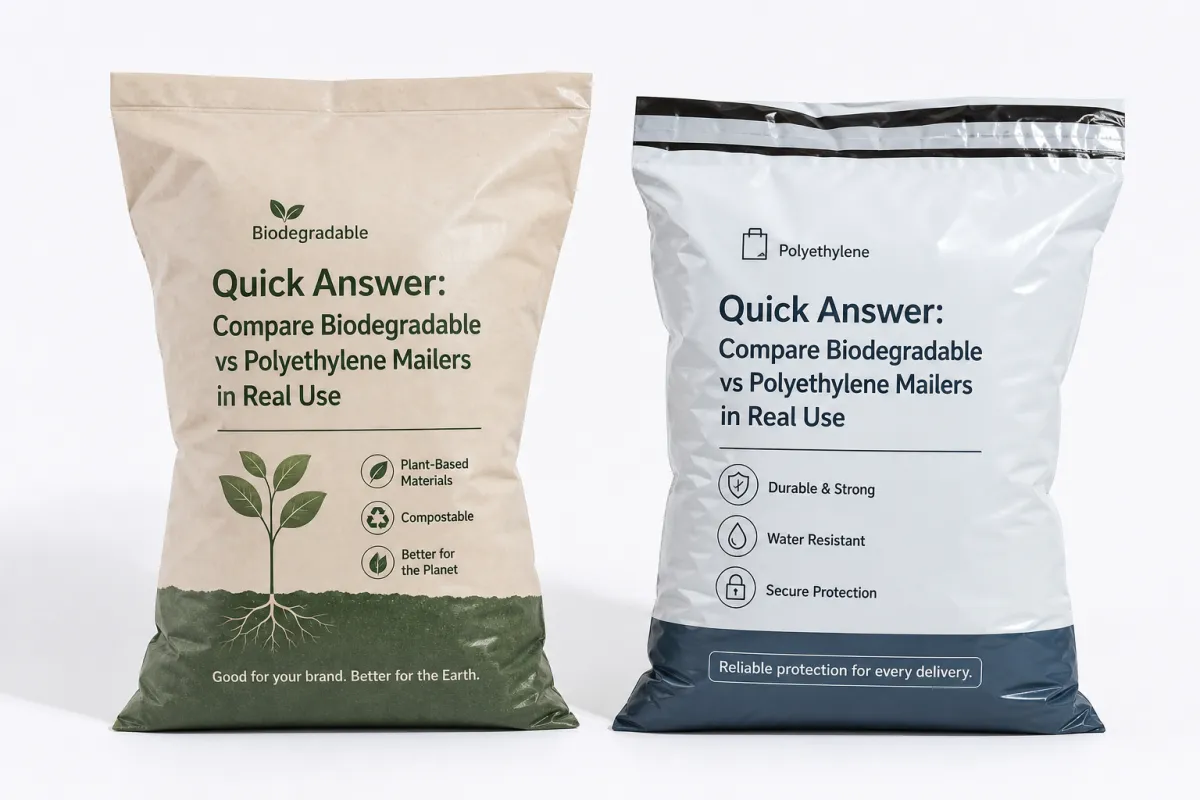
If you need the short version, compare biodegradable vs polyethylene mailers this way: polyethylene usually wins on price, durability, and predictability, while biodegradable mailers win when the brand story, customer expectation, and disposal path justify the higher cost and tighter material controls. That is the buyer’s split in plain terms, and it holds up once the first few thousand orders start moving.
Biodegradable does not automatically mean better. In a landfill, oxygen and heat can be limited, and that slows down many breakdown pathways dramatically. So when you compare biodegradable vs polyethylene mailers, separate the label from the real disposal environment. If the package is likely to be tossed into general waste, the environmental benefit may be far smaller than the marketing copy suggests.
Polyethylene, on the other hand, is a known quantity. It has decades of shipping history behind it, and that matters. When you compare biodegradable vs polyethylene mailers for moisture, abrasion, seal integrity, and conveyor handling, polyethylene is usually the safer default for most e-commerce shipments. It tends to stretch before it tears, hold up better against scuffing, and keep its shape more consistently through storage and transit.
Biodegradable mailers can still make sense, especially if your customer base expects lower-impact packaging and your disposal claims are well supported. Just do not buy them on sentiment alone. Compare biodegradable vs polyethylene mailers by asking one practical question: which one protects the product, supports the brand, and fits the way customers actually dispose of packaging?
- Choose polyethylene if your top priorities are cost control, packing consistency, and damage resistance.
- Choose biodegradable if sustainability positioning is part of the product value and the disposal path is realistic.
- Test both if your parcels face rough handling, variable weather, or long shipping distances.
For shipping performance, I also like to keep the testing language tied to recognized methods. The International Safe Transit Association offers useful context on distribution testing, and the EPA recycling guidance is a solid reference when you are sorting disposal claims from actual recycling behavior. That kind of outside check helps keep a compare biodegradable vs polyethylene mailers decision grounded in reality rather than wishful thinking.
Compare biodegradable vs polyethylene mailers with your shipping environment in mind, and the “best” choice becomes much clearer once you stop treating all parcels as if they travel the same way.
Top Ways to Compare Biodegradable vs Polyethylene Mailers
The cleanest way to compare biodegradable vs polyethylene mailers is to split the decision into five parts: material behavior, protection, print performance, storage stability, and disposal language. If you only compare price, you miss the cost of failure. If you only compare environmental claims, you miss the realities of packing speed and transit abuse.
Biodegradable mailers are often made from blended resins designed to break down under specific conditions. That sounds simple, but in practice the behavior depends on the formulation, the storage environment, and the disposal stream. Polyethylene mailers are built around a very familiar plastic film, usually LDPE or a related structure, and that is one reason so many buyers compare biodegradable vs polyethylene mailers and end up staying with polyethylene for day-to-day fulfillment. It is proven, available, and generally easier to spec.
Protection is where the gap usually becomes obvious. Polyethylene mailers typically offer better puncture resistance, better stretch, and better resistance to moisture. Biodegradable mailers can be perfectly usable, but they may feel softer, less slick, or more sensitive to heat and storage conditions. When you compare biodegradable vs polyethylene mailers side by side, the polyethylene bag often feels like the one built for rougher handling, while the biodegradable option feels more specialized.
Print is another practical divider. Both can be custom printed, but polyethylene usually gives steadier results and more supplier options. On many jobs, that means cleaner color consistency, easier proof approval, and fewer surprises at press match time. When buyers compare biodegradable vs polyethylene mailers for branding, they sometimes overlook how much easier it is to get predictable artwork on a standard film than on a more sensitive blend.
Storage matters more than people think. Polyethylene mailers tend to sit in inventory with fewer surprises. Biodegradable mailers may need more careful warehouse conditions so they do not pick up brittleness, curl, or sealing trouble over time. If your stock cycles slowly, that difference matters a lot. I have seen buyers compare biodegradable vs polyethylene mailers on paper and then discover that warehouse temperature swings change the way the biodegradable film behaves at the pack station.
Then there is the disposal language, which is where many packaging conversations get sloppy. “Biodegradable” is not the same as “compostable,” and “compostable” is not automatically backyard compostable. If you are going to print an environmental claim, verify the certification language and the disposal conditions first. A buyer who truly wants to compare biodegradable vs polyethylene mailers fairly needs to know whether the bag is meant for industrial composting, municipal collection, or some other controlled pathway. ASTM D6400, ASTM D6868, and similar standards matter because they define claims much more carefully than marketing copy does.
In plain terms, compare biodegradable vs polyethylene mailers by asking which one survives the line, the truck, the sorting hub, and the customer’s disposal reality. That is a better test than any single sentence on a spec sheet.
Detailed Reviews: What Each Mailer Type Feels Like on the Line
Here is the part that matters to people actually stuffing parcels all day: when you compare biodegradable vs polyethylene mailers in hand, the difference is usually obvious. Biodegradable mailers often have a slightly different feel, sometimes softer or less slick, sometimes with a little more drag when you slide product in. Polyethylene mailers usually feel more uniform. That consistency is not flashy, but it makes packing easier to teach and easier to repeat.
Seal behavior is one of the first things I check. A self-seal strip is only useful if it stays closed through pressure in a tote, vibration in transit, and repeated handling at the hub. If a seal edge lifts even a little, the whole package becomes a problem. When buyers compare biodegradable vs polyethylene mailers on the line, the polyethylene option usually gives a more forgiving seal window and a cleaner closure feel. Biodegradable mailers can seal well too, but they may require a more careful press, cleaner surfaces, or tighter temperature control.
Fit is another area where practical judgment matters. For apparel, soft goods, and other light e-commerce parcels, both materials can work. But if the item has corners, zippers, hardware, or a heavier folded edge, the bag needs more puncture resistance and better stretch. That is where many teams end up leaning back toward polyethylene after they compare biodegradable vs polyethylene mailers with real samples. The film usually tolerates a bit more abuse before it gives up.
Customers notice the outer experience, even if they never mention it directly. A mailer that arrives scuffed, torn, or oddly flimsy can undercut a strong brand presentation. I would rather see a plain-looking mailer that arrives intact than a beautifully branded one that looks tired after two conveyor belts and a wet dock door. That is not a theoretical point. It is exactly why people compare biodegradable vs polyethylene mailers in the first place: the outer pack is part of the perceived product quality.
One more thing that gets overlooked: line workers tend to spot the better material long before finance does. They notice if the film curls awkwardly, if the adhesive grabs too hard, or if the opening wants to close up before the product is fully seated. Those tiny friction points slow a team down in a way that never shows up in a glossy presentation. I have seen a mailer look perfect on paper and still drive packers a little nuts because it was just a touch less forgiving than the old one.
Here is a simple testing sequence I like to use before approving either type:
- Drop test a packed sample from waist height onto a hard floor at least three times.
- Check seal lift after the sample sits under weight for 15 to 30 minutes.
- Rub the surface lightly to see whether print scuffs or inks mark easily.
- Expose to light moisture and see how quickly the film or closure changes.
- Run a short warehouse trial with actual staff, actual labels, and actual SKUs.
That short list is enough to reveal a lot. When you compare biodegradable vs polyethylene mailers this way, the answer tends to move from opinion to evidence very quickly. A sample that looks fine in a photo can behave very differently once it is packed, stacked, dropped, and sorted.
There is also the question of label adhesion. On some films, especially if the surface treatment is different from what your team is used to, labels can lift at the corners or wrinkle slightly during shipping. That is the kind of small operational issue that later becomes a big customer service issue. So when you compare biodegradable vs polyethylene mailers, do not stop at the outside appearance. Check how labels, barcodes, and print zones behave under real handling.
My honest view is simple: if the package has to survive a lot of movement, moisture, or rough sortation, polyethylene is usually the easier field choice. If the brand has the testing discipline, the disposal story, and the budget room, biodegradable can work well. But I would still compare biodegradable vs polyethylene mailers in a live packout before I made it the standard across a catalog.
Price Comparison: What You Actually Pay for Each Option
Price is where many buyers start, and for good reason. If you compare biodegradable vs polyethylene mailers at small volumes, biodegradable mailers commonly cost more per piece. That premium is not always huge, but it is real, and it often becomes more visible when custom printing or special sizing enters the picture. Polyethylene mailers usually give you the lowest unit cost at scale because the material is common, widely sourced, and easier for suppliers to standardize.
The real mistake is looking at sticker price alone. A mailer that costs two cents less but fails one percent of the time may end up costing much more once you count reships, rework, customer complaints, and lost trust. That is why I tell buyers to compare biodegradable vs polyethylene mailers using total landed cost, not just quote price. Freight, minimum order quantities, warehousing, spoilage, and print setup all belong in the same column.
| Cost Factor | Biodegradable Mailers | Polyethylene Mailers |
|---|---|---|
| Typical unit cost at 5,000 pcs | $0.19-$0.32 each, depending on size and print coverage | $0.08-$0.18 each, depending on size and print coverage |
| Small-run pricing | Usually higher due to material sourcing and setup | Usually lower because supply is more standardized |
| Print setup | May require more proofing and tighter material review | Often easier to quote and repeat |
| Failure cost exposure | Higher if the film is more sensitive to handling or storage | Lower in most standard shipping scenarios |
| Inventory risk | Can be more sensitive to warehouse conditions and shelf time | Usually easier to store and rotate |
If you are comparing custom work, the difference can widen or narrow based on artwork coverage, color count, bag size, and overall order quantity. A clean one-color print on a standard polyethylene mailer may come in very competitively, while a more specialized biodegradable construction can need more attention from prepress, production, and quality control. That is why the smartest teams compare biodegradable vs polyethylene mailers with a complete quote sheet, not a single line item.
There are hidden costs too. If a biodegradable bag has a slightly narrower sealing window, your packing team may need more time to get it right. If a polyethylene bag is more forgiving, the line moves faster and the error rate drops. Labor is money. Rework is money. So when you compare biodegradable vs polyethylene mailers, do not forget the cost of all the hands touching the package.
If you want to explore a broader range of structures before choosing, review Custom Poly Mailers alongside your eco options. That side-by-side look usually makes the pricing story much clearer. One of the biggest benefits of a standard polyethylene program is that it gives you more supplier competition, and more competition usually means better negotiating room on both print and freight.
My buyer’s rule of thumb is straightforward: compare biodegradable vs polyethylene mailers on the full cost of ownership. Pay the biodegradable premium when the environmental positioning is part of the product promise and the numbers still work. Choose polyethylene when margin protection, predictable replenishment, and fewer shipping failures matter more.
How to Choose Between Biodegradable vs Polyethylene Mailers
Start with the product, not the packaging trend. Lightweight apparel, flat textiles, and non-fragile goods can fit either category, but anything with sharp edges, heavier folds, moisture sensitivity, or a high replacement cost often points toward polyethylene. That is the practical way to compare biodegradable vs polyethylene mailers: the contents tell you more than the marketing brochure does.
Then look at the brand promise. If the customer expects a lower-impact package and the sustainability claim is part of the reason they buy from you, biodegradable mailers can support that message in a visible way. If the brand promise is fast, dependable delivery with minimal damage, polyethylene may be the better fit because it is more forgiving. That is why people compare biodegradable vs polyethylene mailers and still end up choosing different answers for different product lines.
Disposal reality is the next filter. If your customers do not have access to the right composting stream, or if local collection programs cannot handle the material, the environmental upside becomes harder to realize. A lot of teams say “biodegradable” and mean well, but the end-of-life path is where those claims live or die. Before You Print anything onto the bag, confirm what the material actually is and what environment it needs to break down. That is a big part of responsibly trying to compare biodegradable vs polyethylene mailers.
There is also a compliance angle. Environmental claims should be specific, not vague. If a mailer is compostable, say what standard backs that claim and under what conditions. If it is recyclable, explain what kind of recycling stream accepts it. If you cannot explain the condition clearly, the claim probably needs more work. This is where disciplined packaging teams separate themselves from loose ones when they compare biodegradable vs polyethylene mailers.
A simple decision framework usually works best:
- Choose biodegradable for brand-led sustainability programs with tested supply support and clear disposal language.
- Choose polyethylene for high-volume shipping where cost, inventory stability, and transit durability matter most.
- Test both if your product has sharp corners, shipping exposure to moisture, or a premium presentation requirement.
If the result is still unclear, I tell buyers to compare biodegradable vs polyethylene mailers against three real questions: Will it protect the product? Will the customer understand the disposal claim? Will the finance team approve the full cost? That usually gets you to the right answer faster than a long debate about materials alone.
There is no single winner for every brand. There is only the best fit for your volume, your customer, your route, and your claim strategy. That is the cleanest way to compare biodegradable vs polyethylene mailers without getting trapped in packaging mythology.
Process and Timeline: From Sample to Shipping
The process should always begin with samples. If you are serious about trying to compare biodegradable vs polyethylene mailers, order a few constructions, pack them with your actual products, and let the people on the floor handle them the way they normally would. That means real tape pressure, real labels, real packing speed, and a short shipment test to see what happens after handoff.
Timeline matters because custom packaging does not move in a vacuum. Biodegradable mailers may require more proofing, more material verification, and more claim review. Polyethylene mailers are often faster to source because the film and size specs are more standardized. When buyers compare biodegradable vs polyethylene mailers, they sometimes forget that a slightly easier sourcing path can matter just as much as the final appearance.
A normal production sequence usually includes artwork approval, material confirmation, sealing specification review, proofing, production, quality check, and freight booking. If one of those steps gets delayed, the whole launch slips. That is why I recommend using a simple checklist any time you compare biodegradable vs polyethylene mailers for a new program:
- Confirm bag size, gauge, and closure type.
- Approve artwork against the actual print surface.
- Test seal strength with your team.
- Review any environmental claim language carefully.
- Plan freight and inbound receiving before production starts.
Inventory planning is just as important as sample testing. If you are switching materials, you do not want the old stock and the new stock mixed in a way that confuses packers or creates inconsistent customer experiences. A clean phaseout window helps the team adjust. That is especially true when you compare biodegradable vs polyethylene mailers across multiple SKUs, because one depot or ship-from site can finish the old stock faster than another.
There is another practical point here: lead times are only useful if they fit your reorder rhythm. A biodegradable option that looks great but requires longer approval and more careful replenishment can be a headache if your inventory turns quickly. A polyethylene option that is easier to reorder may keep service levels steadier. So when you compare biodegradable vs polyethylene mailers, include replenishment speed in the decision, not just first-order lead time.
The best comparison is not just which mailer performs better on paper, but which one can be tested, approved, and replenished without interrupting shipping. That is what keeps a packaging change from becoming an operations problem.
Our Recommendation and Next Steps
For most e-commerce shipping, polyethylene is the safer operational default. It is consistent, resilient, easier to source, and usually kinder to budget. If you compare biodegradable vs polyethylene mailers across the whole shipment chain, polyethylene tends to win more often than not because it tolerates the practical messiness of fulfillment better.
Biodegradable mailers still have a real place. I would choose them when the sustainability story is part of the brand value, the product fits the film well, and the disposal path is realistic rather than aspirational. If that is your lane, then compare biodegradable vs polyethylene mailers with a few sample builds, a short warehouse trial, and a clear claim review before you place a larger order.
Here is the next step I would recommend, in order:
- Order two or three sample constructions in the sizes you actually use.
- Run them through packout, seal checks, drop testing, and moisture exposure.
- Compare unit price, freight, print setup, and replacement risk on one sheet.
- Review claim language so the sustainability message matches the material.
That process keeps the decision grounded. It also helps your team compare biodegradable vs polyethylene mailers without drifting into vague talk about “better packaging” that never survives contact with a shipping dock. Honest testing gives you real evidence. That is worth far more than a polished presentation.
If you want to keep the decision practical, start with the product and the lane, then work outward to branding and disposal. That is the approach I trust most. In the end, the right way to compare biodegradable vs polyethylene mailers is to choose the one that protects the parcel, supports the business, and fits what your customers can actually do with the packaging after delivery. If that answer still feels close, go with the material that is less likely to create rework, because a package that arrives intact is usually the greener choice in practice, kinda no matter how nice the label sounds.
Which is stronger when I compare biodegradable vs polyethylene mailers for shipping?
Polyethylene mailers usually offer better puncture resistance, stretch, and moisture protection in everyday shipping. Biodegradable mailers can work well for lighter goods, but they should be tested with your exact product weight, seal type, and shipping route before you commit to them.
Are biodegradable mailers actually compostable after shipping?
Only if the material is certified for the right disposal environment and the customer has access to that system. Many products need industrial composting conditions, so they will not break down the same way in a backyard pile or a landfill. Always verify the claim language before printing it on the bag.
How much more do biodegradable mailers cost than polyethylene mailers?
Biodegradable mailers often carry a higher unit price, especially on small or custom runs. The real cost gap depends on MOQ, freight, print setup, and how much inventory you need to hold. A low unit price is not a win if the mailer fails and creates replacement shipments.
How long does it take to switch from polyethylene to biodegradable mailers?
Plan for sample testing, artwork approval, proofing, production, and freight before you switch inventory. Biodegradable options may need a little more lead time because material specs and certification review can be more involved. A clean transition usually needs a phaseout plan so existing stock does not interrupt fulfillment.
Can I recycle polyethylene mailers if they are printed?
Sometimes yes, if the film is clean and your local film recycling program accepts it. Printed mailers are often still recyclable if contamination is removed, but local rules vary a lot. Check the disposal instructions for your region instead of assuming every facility handles the same film.
What should I document before I choose one material over the other?
Keep a short record of the sample test results, the confirmed material spec, the print proof, the claim language, and the disposal guidance you plan to publish. That paper trail makes it easier to compare biodegradable vs polyethylene mailers later if shipping conditions, customer feedback, or costs shift.