Buyer Fit Snapshot
| Best fit | Herb Packaging Bags Custom projects where brand print, material claims, artwork control, MOQ, and repeat-order consistency need to be specified before quoting. |
|---|---|
| Quote inputs | Share finished size, material target, print colors, finish, packing count, annual reorder estimate, ship-to region, and any compliance wording. |
| Proofing check | Approve dieline scale, logo placement, barcode or warning zones, color tolerance, closure strength, and carton packing before bulk production. |
| Main risk | Vague material claims, crowded artwork, missing packing details, or unclear freight terms can make a low unit price expensive after revisions. |
Fast answer: Herb Packaging Bags Custom: Production Spec, Color Control, and Delivery Risk should be specified like a repeatable production item. The safest quote records material, print method, finish, artwork proof, packing count, and reorder notes in one written spec.
Production checks before approval
Compare the actual filled-product size with the drawing, then confirm tolerance on folds, seals, hang holes, label areas, and retail display edges. Reserve space for logos, QR codes, warning copy, and material claims before decorative graphics fill the panel.
Quote comparison points
Review material grade, print process, finish, sampling route, tooling charges, carton quantity, and freight assumptions side by side. A quote is only useful when the supplier can repeat the same color, closure quality, and packing count on the next order.
Herb Packaging Bags Custom: What to Know Before You Print
Herb products can look finished and retail-ready on day one, then lose aroma, color, and character long before the pouch shows any visible wear. That is why herb Packaging Bags Custom starts with oxygen, moisture, and light control, not with artwork. From the buyer's side, the pouch still has to run cleanly on the packing line, fit the shelf, protect the fill, and communicate the brand in a few quick seconds at retail. If one of those pieces is off, the whole package kinda stops earning its keep.
The real value of herb packaging bags custom comes from matching the structure to the product, the fill weight, the closure, the channel, and the shelf-life target. A fine-cut seasoning blend, a loose dried leaf herb, and a premium whole-herb mix can all call for different films, different seal behavior, and different panel layout, even if they sit beside each other in the same aisle. A mockup that looks polished on screen is only the starting point, not the finish line.
In a working packaging program, herb packaging bags custom does two jobs at once. It protects the herb from the warehouse, the truck, and the shelf by keeping moisture and oxygen under control. It also carries the brand, the product details, and the visual language that help a shopper understand what is inside without guessing. That second job matters more than people admit, because a shopper often decides in a blink whether the bag feels fresh, credible, or forgettable.
That makes the decision more technical than it first appears. A good bag can slow quality loss, lower returns, and make replenishment easier for the team handling the product. A weak one can look expensive in a proof and still disappoint after a few warm weeks on a store shelf. When I talk through herb packaging bags custom with a buyer, the first question is always about the herb itself, because the package should follow the product instead of forcing the product to fit the package. That is the part people sometimes skip when they are in a hurry, and then they end up fixing problems later that should have been handled up front.
Herb Packaging Bags Custom: What They Are and Why They Matter
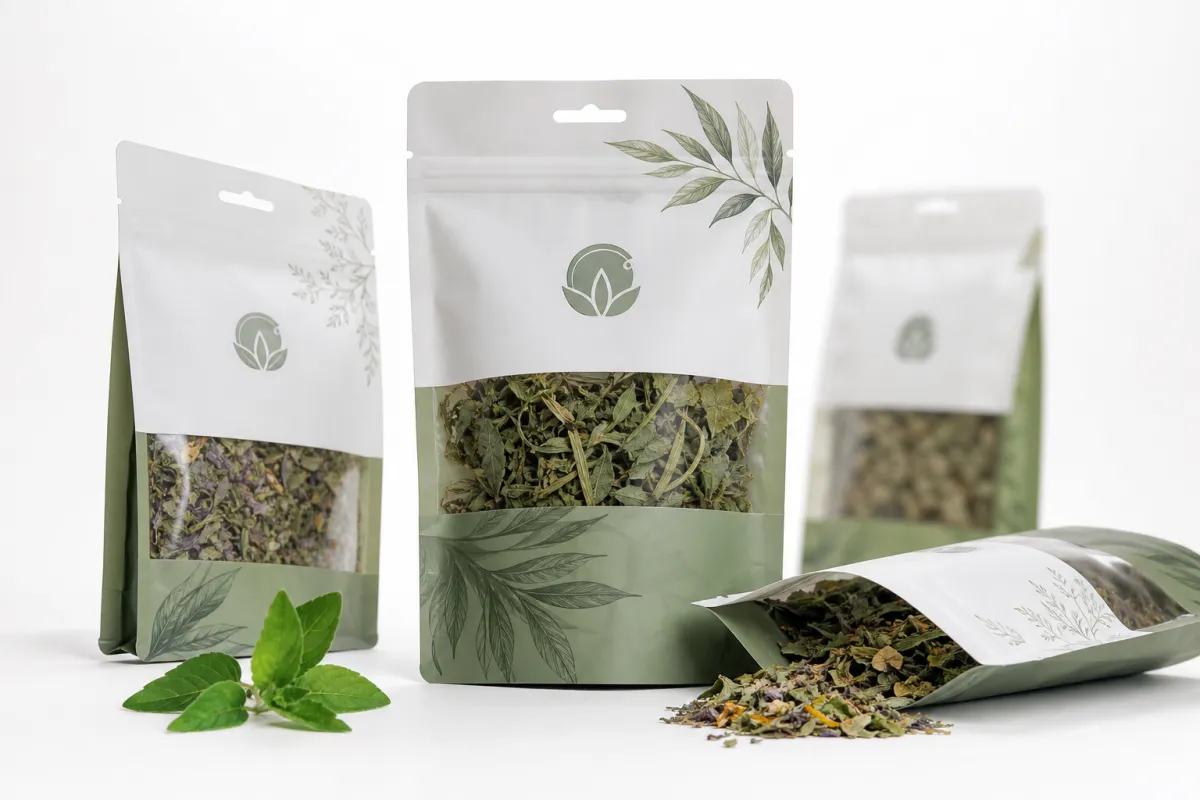
herb packaging bags custom usually means a pouch or bag made for one herb line instead of a generic stock format. It might be a stand-up pouch, a flat pouch, a side-gusset bag, or a specialty shape for a specific use case, but the point stays the same: the size, closure, print layout, and barrier layer are chosen for a single product family. That is much more exact than buying a standard bag and hoping the contents will settle into it nicely.
Herbs do not all behave the same once they are filled and sealed. Some crumble easily, some carry more natural oil, some are blended with salt or seasoning ingredients that absorb moisture, and some are packed to preserve a fresh-cut profile. herb packaging bags custom needs to account for those differences. A lightweight pouch that works well for a snack can be too weak for a product that needs tighter oxygen control or a more dependable heat seal.
The shelf moment matters just as much. A shopper gives the bag only a few seconds before deciding whether it feels fresh, premium, practical, or forgettable. That is where herb packaging bags custom becomes part of packaging design rather than just production. The panel hierarchy, finish, window placement, and zipper style all shape how quickly the product reads on shelf.
Most packaging mistakes in this category start when technical and visual choices are handled as separate tasks. Teams treat the structure like a warehouse item and the artwork like a brand item, even though the two depend on each other. A solid herb packaging bags custom plan keeps retail appeal, line speed, storage conditions, and shelf-life goals in the same conversation.
If the pouch protects the herb for the full shelf life but slows the packing line to a crawl, it is the wrong pouch. If it fills fast but lets aroma bleed out early, it is also the wrong pouch.
That balance explains why experienced buyers ask about barrier levels, seal compatibility, and shipping conditions before they talk about metallic effects or matte finishes. herb packaging bags custom is not about overbuilding every order; it is about selecting the right film for the product and the channel. A farm market pouch, a specialty retail pouch, and an e-commerce pouch may each need a different construction.
For teams building out a full product line, Custom Packaging Products can help keep the packaging system consistent across flavors, sizes, and secondary packaging. That kind of consistency matters because shoppers usually read the brand first and the specific variety second.
How Herb Packaging Bags Custom Work: Materials, Barriers, and Seals
The core of herb packaging bags custom is the material structure. Most pouches are laminations made from two or more films, selected to combine printability, stiffness, puncture resistance, sealability, and barrier performance. A common setup might be PET/PE, BOPP/PE, metallized BOPP/PE, or PET/VMPET/PE, while premium applications may use foil laminations where aroma retention and light blocking matter more than cost. The outer layer carries the print and surface finish; the inner layer must seal consistently and protect the contents.
Barrier is the part that usually decides whether a herb keeps its character or fades early. Oxygen transmission rate, water vapor transmission rate, and light exposure all influence how quickly a dried herb changes. If the product is sensitive, herb packaging bags custom may call for a metallized or foil layer, especially when the herb carries volatile oils or the brand promises longer freshness. The more useful question is often not "How thick is the film?" but "What barrier does it actually deliver?" That difference saves time and prevents expensive guesswork.
Seal design matters just as much as the film stack. A top seal, side seal, or heat-seal fin has to match the filling method and the way the pouch will be handled downstream. Zippers add convenience, and they also add cost and setup sensitivity if the equipment is not tuned for them. Tear notches make opening easier, but only when the user can find and use them cleanly. In herb packaging bags custom, the best seal is the one that closes reliably on the line and stays closed through distribution.
Here is the sequence the bag goes through in the real world: it gets printed or converted, filled, sealed, shipped, stored, opened, and reclosed. At every step, the structure can help the product or get in its way. A pouch that looks excellent in a design proof can still fail if the seal area is too narrow, if the film is too slick for the zipper, or if the shape does not stand well on shelf. That is why herb packaging bags custom should always be tested in conditions that resemble the actual launch. If a sample only behaves well in ideal conditions, it is not really a sample of the final package.
If the team wants a broader reference point for transport testing, the ISTA test methods are worth reviewing because vibration, drop, and compression performance matter when herb bags are boxed, palletized, and moved through distribution. Packaging is not only about the film structure; it is also about the package surviving the route from production to retail.
For products that need a paper component, recycled content, or forest-certified fibers in a secondary carton or display wrap, the FSC certification framework gives buyers a clear standard to ask about. herb packaging bags custom may not always use paper, but the larger packaging system often does, and sourcing decisions should stay aligned across formats.
Some buyers ask whether a clear window makes sense. Sometimes it does, especially when the herb itself has strong visual appeal and the brand wants to show texture or cut size. In other cases, a window weakens the barrier or eats into the cleanest print space. That is why herb packaging bags custom should be judged as a system instead of a single feature. A package that looks elegant on a render but invites avoidable quality loss is not a win.
Key Factors That Shape Performance
When a buyer asks what drives success in herb packaging bags custom, product characteristics usually come first. Herb format matters more than many teams expect. Whole leaf, cut leaf, crumbled blends, and oil-rich herbs all behave differently in a pouch. So do products with added salt, citrus notes, or other ingredients that pull in moisture. A delicate herb needs less rough handling and careful headspace control; a bulky product needs enough room for fill and closure without stressing the seal.
Size is another decision that shapes both branding and operations. Oversized packaging can make a small fill look weak, which is a shelf problem as much as a logistics problem. Too little room can create seal issues and make the pouch look cramped. With herb packaging bags custom, the right dimensions should come from actual fill weight, product density, and the amount of headspace the machine needs for a clean seal. A 50 g product does not always need the same bag as another 50 g product, because density and texture change the volume.
Visual hierarchy matters too. Good packaging design does not load everything onto the front panel at once. It arranges the message so the shopper sees the brand, the product type, the flavor or variety, and the key proof points in a clean order. herb packaging bags custom works best when the brand voice is clear and the technical information still remains easy to read. That means strong contrast, sensible type size, and enough open space for the eye to rest. Matte finishes can feel more premium; gloss can feel brighter; soft-touch can create a more tactile cue. Each choice should fit the positioning rather than the designer's preference alone.
Compliance and operations also need room at the table. Ingredient statements, net weight, lot coding, barcode placement, and any required usage or storage copy all need space. If the bag is going through an automatic line, the closure style and film coefficient of friction can matter. If it is packed by hand, the structure may tolerate a little more flexibility. Either way, herb packaging bags custom should fit the real workflow, not an idealized one. A package spec that ignores the line is a pretty drawing, not a production-ready tool.
Secondary packaging is easy to overlook. If the herb pouch goes into a carton, case, or display tray, the outer packaging has to support it. That is where our custom packaging products can help connect the pouch, the display box, and the retail presentation into one coherent system. When the inner and outer packages are designed together, the line feels more deliberate from production to shelf.
A few practical questions are worth answering before any artwork is finalized:
- How dry is the herb at fill?
- Does the product need a one-way freshness feature or only a simple heat seal?
- Will the pouch sit on a shelf, hang on a peg, or ship in a mailer?
- Is the product positioned as a premium item or a high-volume commodity?
- How much handling will the bag see between filling and opening?
Once those answers are clear, herb packaging bags custom becomes easier to specify and harder to get wrong. That front-end work saves reprints, delays, and line headaches later.
Cost and Pricing Factors
Pricing for herb packaging bags custom usually comes down to a handful of predictable drivers: material construction, print method, size, closure options, finish, and order quantity. A simple two-layer pouch with standard printing will cost less than a foil laminate with a zipper, matte surface, and a high-coverage design. That does not mean the cheaper option is better; it means the quote reflects how much material and processing is built into the bag.
Order volume changes the unit cost in a very direct way. Setup costs, cylinders, plates, or other tooling are spread across the run, so short quantities tend to carry a higher per-bag price. That is common in herb packaging bags custom, especially for brands testing a new flavor or launching into a limited retail channel. A larger run can lower the unit cost, but only if the structure, copy, and size are already locked in with confidence.
Hidden costs can pull a project off course. Freight, sample revisions, rush production, and design changes after proof approval all move the budget. If the pouch dimensions are off, the packing line may need adjustment, which adds time and expense that never showed up in the original quote. With herb packaging bags custom, the quote should be read as part price and part risk assessment. The lowest number is not always the lowest total cost, especially once delays and scrap enter the picture.
I like to line up options side by side and ask the same three questions about each one: how does it protect the herb, how does it run in production, and how does it present on shelf? That keeps the decision grounded in performance instead of only in a polished render. It also keeps the conversation honest, which is usually where a good packaging decision starts.
| Structure | Typical Use | Barrier Level | Typical Unit Range at 5,000 Units | Notes |
|---|---|---|---|---|
| PET/PE | Basic dried herb lines with moderate shelf-life needs | Moderate | $0.16-$0.26 | Good printability and cost control, but not ideal for highly aromatic products |
| BOPP/PE | Retail-facing pouches with bright graphics | Moderate | $0.18-$0.29 | Often used when clarity, stiffness, and smooth sealing matter |
| Metallized BOPP/PE | Products needing better light and odor protection | High | $0.22-$0.34 | Popular choice for stronger shelf appeal and stronger barrier performance |
| PET/VMPET/PE with zipper | Premium retail or recurring-use products | High | $0.28-$0.44 | Costs more, but often supports a better consumer experience and stronger brand position |
| Foil laminate | Very aroma-sensitive herbs and premium launches | Very high | $0.32-$0.55 | Best for tighter protection needs, especially when shelf life matters more than price |
Those numbers are broad ranges, not promises, because print coverage, finish, zipper style, and quantity all shift the final quote. Still, they are useful because they show how herb packaging bags custom moves from basic to premium as barrier and convenience features are added. A buyer should compare the quote against the product's actual shelf-life target, not just another supplier's headline number.
One more way to save money is to keep the design stable after proof approval. Artwork changes late in the process often trigger new plates, new proofs, or new delays. The cheapest herb packaging bags custom order is usually the one where the specs are locked before production starts.
Herb Packaging Bags Custom Process and Timeline
A clean herb packaging bags custom project usually begins with product specs, not artwork. The supplier needs the fill weight, product format, shelf-life target, closure preference, bag style, and any storage conditions that matter. From there, the material and structure can be recommended. If the product is sensitive to oxygen or moisture, the barrier may need to be upgraded before the design even enters the conversation.
After that comes structural selection and proof prep. The team should confirm dimensions, seal area, artwork placement, and any regulatory text. Good suppliers will ask about the line type because machine-packed and hand-packed bags do not always need the same details. With herb packaging bags custom, the proof stage is where size problems, legibility issues, and closure concerns can be caught before a run is committed.
Sampling is where many projects either build confidence or expose issues early. A printed comp or blank sample can show color, fit, and feel in a way that a screen never can. In a practical workflow, sample approval and proof review often move faster than selecting the correct barrier structure, because the structural choice affects product life while artwork changes usually affect appearance. Still, both matter. A strong herb packaging bags custom plan leaves room for each step.
As a rule of thumb, once artwork is clean and specs are agreed, production can move on a fairly predictable timeline. Many projects land in the 12-15 business day range after proof approval for standard runs, although that changes with complexity, volume, and production method. If a bag needs special finishes, custom die lines, or more complex inspection steps, add time. The best way to protect the launch date is to leave margin for proof revisions and sample changes.
For brands that need to coordinate with a carton, display box, or other paper component, this is also the point where secondary packaging should be finalized. Aligning the pouch and the outer pack keeps the brand story consistent and reduces last-minute fixes. That is where Custom Packaging Products can keep the handoff between formats much cleaner.
There are a few common delays worth calling out:
- Missing final dimensions or fill weight
- Compliance text that is still under review
- Multiple stakeholders approving artwork one at a time
- Late changes to closure style or finish
- Waiting to test the pouch on the actual filling line
Those delays are frustrating, but they are predictable. The best herb packaging bags custom projects are the ones where the team treats packaging as part of the launch schedule rather than the last task before shipping. That mindset keeps costs under control and launch dates realistic, which is a lot easier to say than to recover from after the fact.
Common Mistakes to Avoid with Herb Packaging Bags Custom
The biggest mistake in herb packaging bags custom is choosing the bag for appearance alone. A pouch can look premium in a render and still fail the real job if it does not protect aroma, resist moisture, or seal reliably. I have seen brands fall in love with a finish or a window placement, then discover later that the product needs stronger barrier performance than the chosen structure can deliver. That kind of miss usually starts with a visual decision being treated like a technical one.
Closure mismatch is another common problem. A zipper might sound convenient, but it can slow down packing if the line is not set up for it. A film can look perfect on paper and still seal inconsistently if the equipment temperature, dwell time, or pressure are not right. With herb packaging bags custom, the pouch has to fit the machine, not just the marketing plan. If the machine and the package are out of step, the whole order pays for it.
Skipping samples is risky too. Print color, surface feel, and seal behavior often look different in hand than they do in a digital proof. The same is true for matte and gloss finishes, which can shift the perceived color and contrast. If the team cares about the final appearance, then herb packaging bags custom deserves a real sample check before the full order is locked. A sample may not answer every question, but it answers enough to keep you from guessing blind.
Copy mistakes can be just as damaging. Cluttered panels make it harder for shoppers to understand the product. Tiny ingredient text creates compliance risk and frustrates customers. Claims that are vague or hard to support can damage trust quickly. Clean, readable packaging design usually sells better than a crowded one, even when the crowded version looks more "designed" in a mockup. That is a lesson many retail packaging teams learn the hard way.
The pouch should answer the shopper's basic questions in a few seconds: what it is, why it is good, how to use it, and how it stays fresh.
There is also a tendency to forget the distribution route. A product that moves well in a boutique may face different handling in e-commerce or wholesale. Compression in cartons, vibration on pallets, and repeated handling by store staff all change the demands on the package. That is why herb packaging bags custom should be evaluated as part of the whole shipping chain, not in isolation. If the packaging needs more protection, or if the brand wants a tighter system across formats, a broader view of custom packaging products can help align the pouch with shipping cartons and display needs.
Finally, do not assume that a higher price automatically means better performance. Some expensive bags are expensive because they are overdesigned for the product. Others are worth every cent because they prevent spoilage, reduce returns, and improve shelf presence. The point is to match the package to the actual job, which is exactly what herb packaging bags custom is meant to do.
Expert Tips and Next Steps for Herb Packaging Bags Custom
The best way to begin herb packaging bags custom is to start with the product and the operating conditions, not the artwork. Gather the fill weight, herb form, shelf-life target, storage temperature, and distribution model before you request a quote. If that information is clear, the supplier can recommend a pouch structure that fits the real use case instead of guessing from a photo or a rough idea.
Ask for material samples and printed comps whenever possible. A film sample can reveal the feel of the substrate, the strength of the seal area, and the way the finish reacts under store lighting. A print comp can show whether the contrast works, whether the logo sits correctly, and whether the bag still feels premium once the actual colors are applied. In herb packaging bags custom, this small step often prevents larger problems later.
It also helps to prepare a spec sheet before you ask for pricing. Include dimensions, closure needs, fill weight, print area, required text, target quantity, and any line constraints. The cleaner the spec sheet, the more accurate the quote. That is especially true if you are comparing several pouch structures for herb packaging bags custom and want the numbers to reflect something real instead of a list of low, medium, and high prices.
If your team is not sure which structure to shortlist first, begin with three questions: how fragile is the herb, how long does it need to stay fresh, and where will it sit after filling? Those answers usually point toward the right barrier level, the right closure style, and the right finish. A high-moisture environment may justify a stronger laminate. A premium shelf product may justify a better tactile finish. A fast-moving line may need a simpler seal system. That is the kind of thinking that keeps herb packaging bags custom practical.
From there, the path is straightforward: shortlist the structure, request a sample or proof, confirm timeline and price, and then tighten the artwork so the final order is production-ready. If you want the packaging system to stay consistent across multiple SKUs, it is smart to think about the pouch, the label, the carton, and the display together. That is where branded packaging starts to pull its weight.
Herb packaging bags custom is worth doing well because the package is part of the product experience, not just the container. If you get the barrier right, the seal right, and the layout right, the herb can hold its character longer and the brand can present itself more clearly. The practical takeaway is simple: lock the product specs first, validate the structure with a real sample, and only then finalize artwork. That order keeps the launch grounded in what the herb actually needs, which is the safest way to avoid expensive do-overs.
What should I look for in custom herb packaging bags?
Choose a pouch with the right barrier for moisture, oxygen, and light based on the herb's sensitivity, because herb packaging bags custom only works when the material matches the product. Confirm the size, closure style, and seal compatibility with your filling process, and make sure the front and back panels leave room for the required product and compliance information.
How do I know which material is best for herb packaging bags custom?
Match the material to the herb's aroma level, shelf-life target, and storage environment instead of judging by thickness alone. Ask for barrier details such as oxygen and moisture performance, then review whether the film can be printed cleanly and sealed reliably on your equipment. That is the most practical way to compare herb packaging bags custom options.
What affects herb packaging bags custom pricing the most?
Order quantity, material structure, and print complexity usually have the biggest impact on price. Special features such as zippers, windows, and premium finishes raise the unit cost, and rush timing, freight, or proof revisions can also change the final number. herb packaging bags custom pricing is shaped by both the bag specification and the production schedule.
How long does the herb packaging bags custom process usually take?
Lead time depends on artwork readiness, sample approval, and the production method used, but many standard projects move in roughly 12-15 business days after proof approval. The timeline can stretch if dimensions, compliance copy, or finish choices need revision. Planning ahead for proofs and samples is the best way to keep herb packaging bags custom launches on schedule.
Can herb packaging bags custom work for small batch orders?
Yes, but short runs usually carry a higher unit cost because setup is spread over fewer bags. Small batches are a good fit when you are testing a product, design, or retail channel, and they can still make sense if the packaging needs to prove itself before a larger run. Ask early about minimum order quantities so herb packaging bags custom lines up with your production scale.


