Buyer Fit Snapshot
| Best fit | compare corrugated boxes vs cartons use cases for packaging buyers comparing material specs, print proof, MOQ, unit cost, freight, and repeat-order risk where brand print, material, artwork control, and repeat-order consistency matter. |
|---|---|
| Quote inputs | Share finished size, material target, print colors, finish, packing count, annual reorder estimate, and delivery region. |
| Proofing check | Approve dieline scale, logo placement, barcode or warning zones, color tolerance, and any recyclable or compostable wording before bulk production. |
| Main risk | Vague material claims, crowded artwork, or missing packing details can create delays even when the unit price looks attractive. |
Fast answer: Compare Corrugated Boxes vs Cartons Use Cases: Dieline, Finish, Proof, and Buyer Review should be specified like a repeatable production item. The safest quote includes material, print method, finish, artwork proof, carton packing, and reorder notes in one written spec.
What to confirm before approving the packaging proof
Check the product dimensions against the actual filled item, not only the sales mockup. Ask for tolerance on folds, seals, hang holes, label areas, and retail display edges. If the package carries a logo, QR code, warning copy, or legal claim, reserve that space before decorative graphics fill the panel.
How to compare quotes without losing quality
Compare board or film grade, print process, finish, sampling route, tooling charges, carton quantity, and freight assumptions side by side. A lower quote is only useful if the supplier can repeat the same color, closure quality, and packing count on the next order.
Compare Corrugated Boxes vs Cartons: Best Use Cases
People use the word carton for almost anything with four walls and a flap, but if you compare corrugated boxes vs cartons the way a packaging buyer actually has to, the differences show up fast in structure, performance, print behavior, and damage risk. A package is never just a container. It has to survive filling, sealing, storage, transit, shelf handling, and opening, and each step can push the spec in a different direction.
If I had to give one practical rule, I would keep it simple: choose corrugated when the package has to protect product through parcel shipping, pallet stacking, or warehouse handling, and choose cartons when the priority is shelf presentation, light product containment, or a cleaner retail look. That is why teams keep trying to compare corrugated boxes vs cartons even when the samples sitting on the table look pretty similar at first glance.
A candle brand makes the difference easy to see. A folding carton can look refined around a jar candle on a retail shelf, but send that same item through a courier network and the carton usually needs a corrugated shipper around it, because the outer package has to absorb impacts the carton was never built to handle alone. Pick the wrong structure and the outcome is familiar: chipped corners, cracked glass, crushed edges, or extra padding that quietly eats margin.
I like to keep this conversation grounded in the stuff buyers deal with every day. Product weight, fragility, route length, print finish, assembly time, and landed cost matter more than a quote pulled out of context. That is the useful way to compare corrugated boxes vs cartons, because the cheap-looking option can turn expensive once returns, repacking labor, or a second production run show up.
No single structure wins every time. The better answer depends on how the package will be treated from the fill line to the customer’s hands, and that is exactly why buyers need to compare corrugated boxes vs cartons with the real channel in mind rather than with the sample alone. Packaging decisions get a lot clearer once the route is honest.
Quick Answer: compare corrugated boxes vs cartons in real shipping
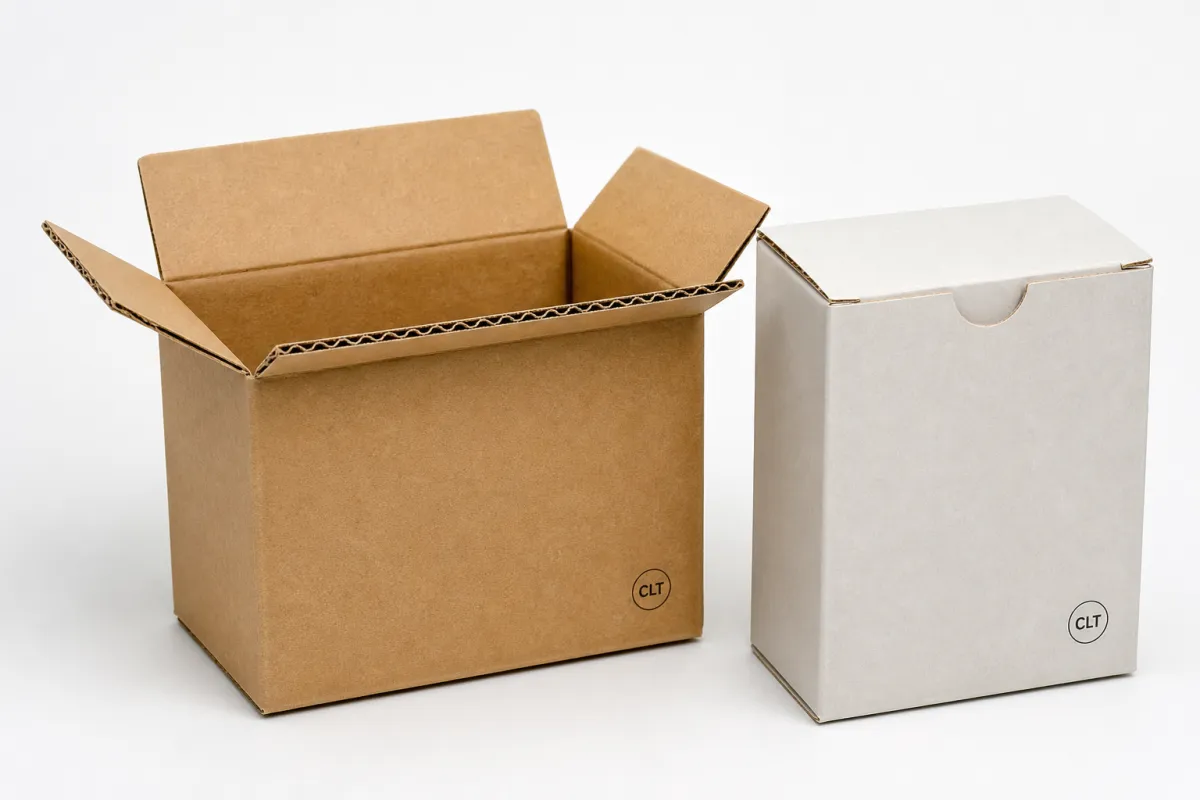
When buyers compare corrugated boxes vs cartons for shipping, the first surprise is usually that the terms are not interchangeable in a packaging department, even if they are used that way casually on the shop floor. A folding carton is typically paperboard, built for lighter products and cleaner print presentation. Corrugated board adds a fluted medium between liners, which gives the package stiffness, cushioning, and a much better chance of surviving impact, vibration, and stacking pressure.
The short version is straightforward. If the package has to protect a product through parcel shipping, pallet moves, or warehouse stacking, corrugated is usually the safer choice. If the package mainly holds a lighter item, supports shelf appeal, or creates a polished unboxing moment, cartons often fit better. That is why you have to compare corrugated boxes vs cartons based on the real handling path, not just the look of the sample.
Here is a buyer scenario that comes up often. A cosmetic brand wants a premium folding carton because the graphics look sharp and the paperboard feels refined in the hand. Then the same product gets shipped individually through ecommerce, and it arrives with scuffed corners or crushed edges because the carton was asked to serve as the outer transit package. In that case, the package was doing two jobs at once, and compare corrugated boxes vs cartons becomes less about aesthetics and more about whether the structure can survive the route.
That is where many teams get caught. They judge a package by how it looks on the table instead of how it behaves under load, in a truck, or at the bottom of a stacked pallet. A better question is simple: what is the package supposed to do from the moment it is filled to the moment it is opened? Once that answer is clear, compare corrugated boxes vs cartons with the right criteria, and the decision usually sharpens fast.
“If the product ships in it, spec the structure for transit first; if it sits on a shelf, spec the structure for presentation first.”
For most teams, the decision comes down to six things: product weight, fragility, shipping distance, print finish, assembly speed, and total landed cost. Those are the practical filters I use when I compare corrugated boxes vs cartons for buyers who want fewer surprises after launch. It sounds basic, but in packaging work the basics are usually what keep the budget and the damage rate under control.
Top options compared: compare corrugated boxes vs cartons by application
It helps to separate the category names before making a purchase. A shipping carton, a folding carton, a corrugated mailer, a retail display carton, and a heavy-duty Corrugated Shipping Box can all be called “boxes” in casual conversation, yet their constructions are very different. When you compare corrugated boxes vs cartons by application, the fog clears quickly because the right structure depends on whether the pack is carrying, displaying, or protecting the product.
For ecommerce parcels, corrugated usually leads. The parcel network is rougher than most buyers expect, and packages can face drops, belt transfers, corner impacts, stacking pressure, and vibration across several handoffs. That is why many brands compare corrugated boxes vs cartons and then land on corrugated mailers or shippers for DTC orders, even if they still use cartons inside the package for branding or product presentation.
For retail shelves, cartons often win. They offer a smoother print surface, cleaner folds, and a more refined presentation for cosmetics, supplements, confectionery, candles, and small consumer goods. If the pack is mainly there to present the item and carry graphics, I usually expect cartons to be the stronger fit. That said, if the retailer wants shelf-ready stacking or the product needs extra crush resistance, the buyer still has to compare corrugated boxes vs cartons with the full supply chain in mind.
Food service and industrial parts are a little different. Food service may favor cartons for smaller, lighter items, while industrial parts often need corrugated because the contents are heavier, irregularly shaped, or packed in larger volumes. Subscription kits sit in the middle. Some look best in a carton-style presentation box, but many still need a corrugated outer shipper. If you only compare the printed sample and ignore the transit path, you can end up paying for the wrong structure twice.
A common mistake is choosing on sample appearance alone. A folding carton can look more polished on a table, and a corrugated sample can look plain if it is not printed or finished properly. Yet packaging is not bought for the sample table. It is bought for the route. That is the point of compare corrugated boxes vs cartons in a commercial setting: match the pack to the way it will actually be handled.
| Application | Usually Better Fit | Why It Wins | Buyer Watchout |
|---|---|---|---|
| E-commerce shipping | Corrugated box | Better crush resistance and transit protection | Watch shipping volume and dimensional weight |
| Retail shelf display | Folding carton | Smoother print surface and cleaner presentation | May need a secondary shipper for transport |
| Subscription kits | Depends on channel | Carton for reveal, corrugated for shipping | Do not let one pack do two jobs badly |
| Heavy or fragile goods | Corrugated box | Better support, inserts, and stack performance | Test fit and drop performance before launch |
| Light luxury items | Folding carton | Premium feel, print detail, easier shelf merchandising | Confirm that the carton is not taking transit abuse |
For brands building out a larger packaging mix, it often helps to think in layers. A product might live in a folding carton, then ship in a corrugated mailer, then arrive inside a branded corrugated outer shipper for warehouse handling. If you need that structure, take a look at Custom Packaging Products and choose the format that matches each handling step instead of forcing one design to cover everything.
Detailed Reviews: where corrugated boxes win and where cartons win
The structural difference is the heart of the matter. Corrugated board uses a fluted medium between liners, and that flute behaves like a tiny beam system. It resists compression, absorbs energy, and gives the package a much better chance of surviving rough handling. Cartons are usually made from paperboard, which is flatter, smoother, and better for print detail, but not built to take the same level of abuse. That is the technical reason people compare corrugated boxes vs cartons so often once damage rates begin to rise.
Corrugated wins on crush resistance, stack strength, and flexibility. It can be designed with single-wall, double-wall, or heavier constructions depending on weight and handling. It also accepts inserts and dividers well, which matters when the contents are glass, electronics, or multiple units in one pack. In practice, corrugated gives the buyer more margin for handling mistakes, and that matters because real distribution is rarely gentle. If you need to compare corrugated boxes vs cartons for shipping performance, corrugated usually comes out ahead as soon as the package stops being purely decorative.
Cartons win on presentation, print quality, and shelf-ready appearance. A well-made folding carton can carry fine typography, rich color, and specialty finishes like soft-touch coating, foil, embossing, or spot UV. That makes cartons a strong choice for cosmetics, confectionery, supplements, and premium retail kits. If the pack is touched, held, and admired before it is discarded, the carton can create a stronger brand moment. This is one of the reasons buyers compare corrugated boxes vs cartons not just by strength, but by the signal each structure sends.
There are tradeoffs. Corrugated can feel bulkier, and if the design is oversized, it can drive up dimensional freight cost. Cartons can look elegant, but they dent, scuff, and crease more easily if the route is rough or the product is heavier than expected. That is where a lot of people get into trouble: they choose the prettier structure and then try to add protection after the fact. The smarter move is to compare corrugated boxes vs cartons around the real handling risk and then add print, finish, and inserts where needed.
For buyers, a good decision matrix is pretty straightforward. Rate the options on protection, print quality, packing speed, cost, and channel fit. A carton may score highest on print and shelf appeal, while a corrugated box may score highest on protection and packing speed. If one option wins four categories and the other wins the category that actually matters most, that should tell you something. You do not need a perfect package; you need the right one for the route.
Here is the practical rule I use: if the pack is a protector first and a brand canvas second, go corrugated. If it is a brand canvas first and a lighter product carrier second, go carton. That is the simplest way to compare corrugated boxes vs cartons without getting buried in packaging jargon. It keeps the conversation honest, which usually saves time later.
Process and lead time: production steps from dieline to delivery
Production starts the same way for both formats: size the product, build the dieline, select the board grade or paperboard caliper, prepare the artwork, and approve the first proof before the run starts. That sounds basic, yet a surprising number of problems come from rushing one of those steps. When buyers compare corrugated boxes vs cartons and skip the tooling or proof stage, the order can look fine on paper and still miss the product in real life. Packaging is unforgiving that way.
Corrugated projects usually need more attention to compression and fit. If the product is heavy, the board grade and flute choice matter. If the pack is going to be stacked, panel sizing matters. If inserts are involved, the tolerances matter. Carton projects, by contrast, can move faster when the structure is straightforward and the print setup is already established. Even then, a simple dieline mistake can ruin the run. That is another reason teams should compare corrugated boxes vs cartons using the full production path, not just the design mockup.
Lead time is driven by a handful of real variables: custom tooling, print method, structural testing, revisions to the dieline, coatings, windowing, inserts, and overprint complexity. A simple stock-size run can move relatively quickly, while a highly customized pack with specialty finishes can stretch the schedule. In practical terms, I would rather see a buyer spend a few extra days on fit and sample approval than lose weeks correcting a bad spec after production starts.
For many jobs, a straightforward custom run might take 12 to 15 business days from proof approval, while more complex constructions can take longer depending on the factory queue and finishing steps. The exact schedule will vary, but one thing stays true: the more you revise after approval, the slower the job gets. If you want to compare corrugated boxes vs cartons fairly, compare not only the unit cost but also the time it takes to get to a production-ready spec.
Testing is where weak specs show themselves. For shipping packs, I like to see some mix of drop, vibration, and compression thinking, even if the formal test plan is lightweight. Teams often rely on informal trials, but that should still be disciplined. Standards from groups like ISTA are useful because they give you a repeatable way to think about transit hazards, and that is better than guessing. If your packaging also has a sustainability target, paper sourcing standards from FSC help keep the material story credible.
Cost and pricing: unit cost, quote, and MOQ differences
Price is not just the box price. Material, print coverage, size, inserts, coatings, tooling, and quantity all shape the quote, and freight can matter just as much as the print line. When buyers compare corrugated boxes vs cartons only by the sample price, they miss the real landed cost picture, which is usually where the budget gets decided. The PO line is only one piece of the story.
As a general pattern, cartons can look cheaper for light retail packs because the board is thinner and the construction is simpler. Corrugated can look more expensive at first, especially when the dimensions are large or the print needs extra setup. Corrugated often becomes the better value when it prevents breakage, reduces returns, or eliminates a second outer shipper. That is the part that gets forgotten when teams compare corrugated boxes vs cartons from a narrow purchase-order view.
Minimum order quantities vary with print method and setup. Digital or short-run carton work may start at a few hundred units, while offset and litho-laminated jobs often need much more. Corrugated can also have MOQs based on board size, print style, and cutting requirements. If you are planning a launch, ask about minimums early, because a low quoted unit price may only apply once volume crosses a threshold. The more honest way to compare corrugated boxes vs cartons is to ask for pricing at your actual forecast, not an ideal order size you may never hit.
Read the quote line by line. Does it include freight? Plates? Proofs? Coatings? Inserts? Overage? A nice-looking number can turn ugly fast if those items sit outside the base price. And if a supplier is comparing different board grades or different finishing methods, make sure the spec is truly the same before you sign. Apples-to-apples is the only honest way to compare corrugated boxes vs cartons in a commercial buying process.
| Cost Factor | Corrugated Box | Carton | Practical Buyer View |
|---|---|---|---|
| Material cost | Often higher per unit on heavy builds | Often lower for light products | Check the actual board spec, not the category name |
| Print finish | Good for bold graphics and durable branding | Stronger for fine detail and premium finishes | Choose based on the shelf or shipping role |
| Shipping cost | Can rise with size and dimensional weight | Usually lighter, but may need a shipper | Freight can erase the apparent savings |
| Damage risk | Lower when used as the transit package | Higher if used as the outer shipper | Damage cost often outweighs material savings |
| MOQ behavior | Setup dependent | Setup dependent | Always ask for the run size that matches your forecast |
Budget traps show up when a cheaper package forces extra labor, more void fill, or a second shipper. I have seen teams save a few cents on the box and spend far more on repacking and claims. If the package needs to travel safely, those hidden costs matter. That is why seasoned buyers compare corrugated boxes vs cartons using total cost, not the headline unit price. The material price alone can be kinda misleading.
How to choose: a practical decision framework for packaging buyers
Start with the product itself. Weight, fragility, temperature sensitivity, and shape should drive the decision before graphics ever enter the conversation. A heavy glass item, a rigid gift set, and a lightweight folded garment do not belong in the same structure. If you compare corrugated boxes vs cartons from the product outward, you will make a better choice than if you start with a catalog image or a favorite finish.
Channel comes second. Direct-to-consumer shipping is rougher than retail shelf display. Warehouse distribution is rougher than boutique handoff. Club store and retail replenishment bring stacking and handling concerns that many smaller brands underestimate. That is why a package that looks perfect in a retail environment may fail in ecommerce. The buyer has to compare corrugated boxes vs cartons against the channel, not just the brand mood board.
Branding matters, but it should never erase protection. If the box is part of the reveal, carton structure and print finish may deserve priority. If the package is mostly a protector, corrugated is usually the safer start. A lot of packaging arguments sound creative on the surface but become expensive once returns start coming in. The better question is not which box looks nicer; it is which box keeps the product and the margin intact.
Sustainability deserves a careful answer, not a slogan. Both formats can be designed responsibly, and both can be overbuilt if the spec is lazy. The efficient option is the one that uses the right amount of fiber, reduces damage, and avoids unnecessary secondary packaging. If a lighter carton needs a second corrugated shipper anyway, that is not automatically greener. Sometimes the most responsible answer is the simpler pack with fewer failure points.
If you need a quick scoring method inside your team, use a 1-to-5 rating for each option on protection, print quality, speed, cost, and channel fit. A carton might score high on print and presentation but lower on protection. Corrugated might score high on protection and packing speed but lower on shelf elegance. That kind of matrix takes emotion out of the decision and helps you compare corrugated boxes vs cartons in a way operations, finance, and marketing can all read the same way.
- Rate the product on weight and fragility.
- Rate the channel on handling severity.
- Rate each structure on protection and presentation.
- Check the quote against freight and labor.
- Test one sample of each before approving volume.
If you are building a broader packaging lineup, Custom Shipping Boxes are often the best starting point for transit protection, while cartons can handle the retail-facing side of the brand. That layered approach is usually smarter than forcing one package to do every job poorly. It is also the easiest way to compare corrugated boxes vs cartons without losing sight of the end use.
Our Recommendation: next steps to test samples and approve specs
My practical recommendation is simple. If the package ships to a customer or warehouse, start with corrugated. If it mainly presents the product on shelf or in hand, start with a carton and confirm whether a secondary shipper is needed. That is the cleanest way to compare corrugated boxes vs cartons without overcomplicating the decision on day one.
Do not stop at one sample. Request two constructions, fit the actual product into both, and test the pack for drop, crush, and shelf presentation before you approve volume production. A sample that looks great but ships badly is not a good sample; it is a future headache. Teams often discover that they need a tighter insert, a different flute, a heavier caliper, or a stronger closure than the first mockup suggested.
Once the structure is chosen, document the final spec carefully. Include size, board grade, print method, finish, inserts, and acceptable tolerances. That makes future quotes faster and keeps reorders consistent. It also protects you from supplier drift, which happens more often than people think when a spec is described loosely. The more exact the spec, the easier it is to compare corrugated boxes vs cartons on future projects without starting from scratch.
I also recommend a short internal review before signoff. Operations should confirm protection and packing speed. Marketing should confirm print and presentation. Finance should compare total landed cost. If all three groups sign off on the same spec, the odds of a clean launch go up a lot. Packaging usually goes wrong when one department wins the argument and the others inherit the consequences.
The plain takeaway is this: compare corrugated boxes vs cartons by function first, then by price, then by finish. Corrugated is usually the smarter buy for shipping and protection, while cartons are usually the better fit for lighter retail presentation. Once you make that split clearly, the rest of the packaging decision becomes much easier and a lot less guessy.
When should I compare corrugated boxes vs cartons for shipping?
Compare them any time the package has to do more than hold the product, especially if it will travel through parcel carriers, palletized freight, or repeated warehouse handling. Use corrugated when protection and crush resistance matter most, and use cartons when the package is mainly a retail or presentation layer around a lighter product. If you are unsure, test the actual product in both structures before buying in volume, because the right answer often shows up in damage rates and packing speed. That is the most reliable way to compare corrugated boxes vs cartons without relying on guesswork.
Which is usually cheaper: corrugated boxes vs cartons?
Cartons often have a lower unit price for light products, but that is only part of the cost picture. Corrugated can be the better value when it prevents damage, reduces returns, or replaces extra outer packaging and void fill. Always compare freight, labor, and minimum order quantity along with the printed box price so you see the real landed cost. If the goal is to compare corrugated boxes vs cartons fairly, the cheapest quote is not always the cheapest outcome.
Can cartons replace corrugated boxes for e-commerce orders?
Sometimes, but only if the product is light, sturdy, and protected by another shipper or by very controlled handling. For most direct-to-consumer shipments, corrugated is safer because parcel networks create more drop, crush, and vibration risk than retail display does. A carton can still work as an inner retail package if a corrugated mailer or shipping box handles transit protection. That layered approach is usually the smartest way to compare corrugated boxes vs cartons for ecommerce.
Do corrugated boxes or cartons print better for premium branding?
Cartons usually offer the smoother, more premium print surface, so they are often the better choice for high-detail graphics and retail shelf appeal. Corrugated still prints well, especially with the right print method, but the fluted structure can make it better suited to bold branding than ultra-fine detail. If branding is critical, ask for printed samples on the actual board before approving the final look. That is the most practical way to compare corrugated boxes vs cartons when the visual standard is high.
How do I decide if I need a folding carton or a corrugated box?
Start with the product's weight, fragility, and how far it needs to travel. Choose a folding carton for lighter, shelf-facing products and a corrugated box for shipping, stacking, or higher protection needs. If the choice is still unclear, compare corrugated boxes vs cartons using sample packs, then judge protection, presentation, and packing efficiency side by side. That direct comparison usually exposes the right structure faster than any spec sheet alone.