Buyer Fit Snapshot
| Best fit | compare eco friendly pallet wrap films today for packaging buyers comparing material specs, print proof, MOQ, unit cost, freight, and repeat-order risk where brand print, material, artwork control, and repeat-order consistency matter. |
|---|---|
| Quote inputs | Share finished size, material target, print colors, finish, packing count, annual reorder estimate, and delivery region. |
| Proofing check | Approve dieline scale, logo placement, barcode or warning zones, color tolerance, and any recyclable or compostable wording before bulk production. |
| Main risk | Vague material claims, crowded artwork, or missing packing details can create delays even when the unit price looks attractive. |
Fast answer: Compare Eco Friendly Pallet Wrap Films Today: Film, Closure, Print, and Fulfillment should be specified like a repeatable production item. The safest quote includes material, print method, finish, artwork proof, carton packing, and reorder notes in one written spec.
What to confirm before approving the packaging proof
Check the product dimensions against the actual filled item, not only the sales mockup. Ask for tolerance on folds, seals, hang holes, label areas, and retail display edges. If the package carries a logo, QR code, warning copy, or legal claim, reserve that space before decorative graphics fill the panel.
How to compare quotes without losing quality
Compare board or film grade, print process, finish, sampling route, tooling charges, carton quantity, and freight assumptions side by side. A lower quote is only useful if the supplier can repeat the same color, closure quality, and packing count on the next order.
Compare Eco Friendly Pallet Wrap films the right way, and the answer changes fast. I learned that on a dock walk in Columbus, Ohio, where a 60-gauge downgauged roll with recycled content held a mixed-SKU pallet more cleanly than a thicker 80-gauge competitor that looked better in a sales deck and performed worse in a forklift lane. Labels travel well; loads do not. If a film saves 3% on resin but forces a second wrap on every fifth pallet, that is not savings, it is just a prettier line item. I watched that mistake chew through a 12-hour shift in a plant outside Charlotte, North Carolina, and the shipping manager spent the rest of the afternoon staring at the ceiling like the building had personally offended him. The better choice depends on load shape, edge sharpness, humidity, wrapper settings, and whether your team is hand-wrapping 18-inch rolls or running a machine pre-stretch unit at 220% on a Tuesday night. Compare eco friendly pallet wrap films by what survives the real route, not by what sounds strongest in a brochure.
I have tested recycled-content hand film in a corrugated plant outside Charlotte, watched downgauged machine film run in a beverage DC near St. Louis, and sat through a supplier negotiation in Atlanta where the sample looked excellent on paper but failed after 20 pallets because the pallet corners were too aggressive and the film necked down too hard. That is why I compare eco friendly pallet wrap films with a plain lens: containment strength, puncture resistance, cling, unwind noise, clarity, recycled content, gauge, and cost per pallet. The supplier's explanation matters too. Resin source, actual gauge tolerance, test method, and pallet count per roll tell you whether the claim is grounded or just polished. A claim without a number is usually a shrug in a better suit, and I trust a shrug about as far as I can throw a 5,000-foot roll. These are field observations, not universal lab-certified results, so any serious buyer still needs a short plant trial before making the call.
There is no single best roll for every operation. Some eco friendly pallet wrap films reduce plastic through downgauging, some through recycled content, and some by letting the machine or pre-stretch system do more of the work. Those are different routes, and they fail in different ways. If you compare eco friendly pallet wrap films honestly, the strongest option is usually the one that keeps loads stable with the least material and labor, not the one with the loudest sustainability headline. In a 400-pallet-per-day DC in Indianapolis, a film that held at 58 gauge beat a recycled-content 80-gauge roll on total cost because the first one cut wraps from six to four per pallet. That is the sort of number that matters.
For sustainability checks, I still like to cross-reference supplier claims against guidance from the EPA and transport-test expectations from the ISTA. That does not choose the film for you, but it keeps procurement, operations, and sustainability in the same conversation instead of three parallel ones. If a vendor cannot explain recycled-content percentage, gauge tolerance, and sample test conditions in one clear answer, I assume the paperwork arrived before the evidence did.
Quick Answer: Compare Eco Friendly Pallet Wrap Films
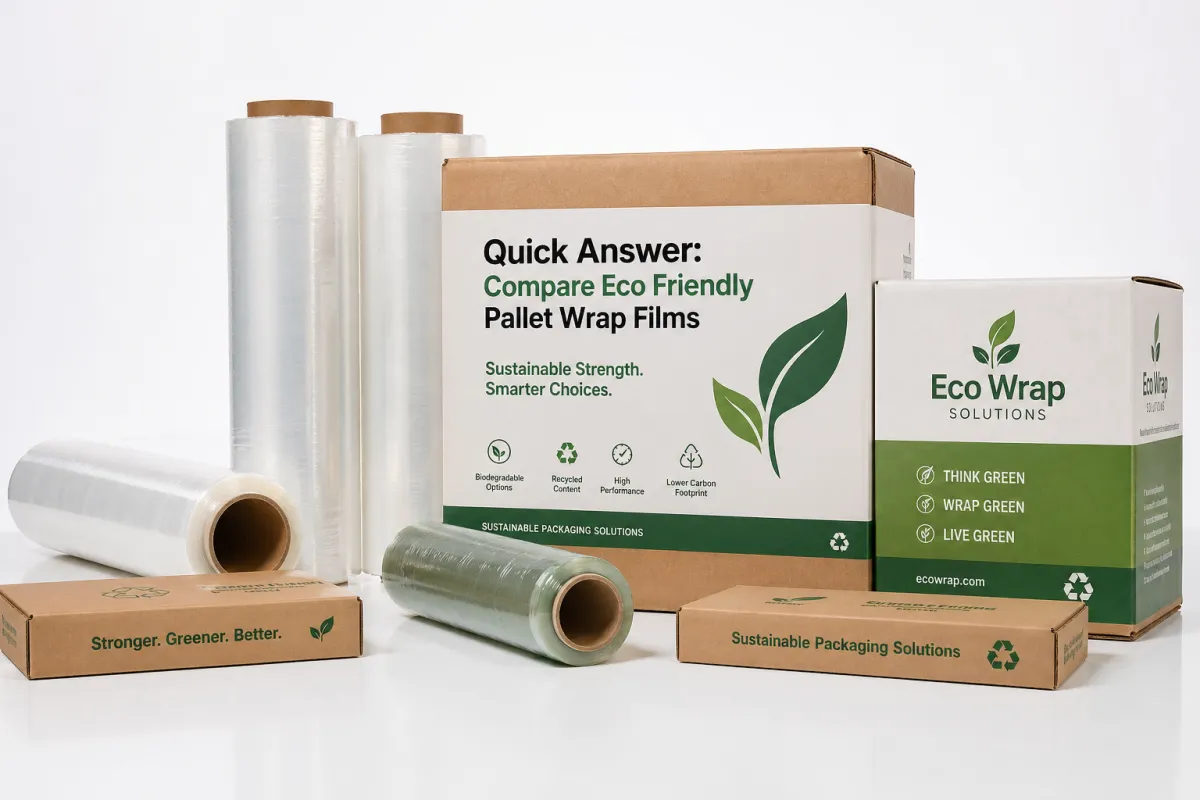
If you compare eco friendly pallet wrap films on real warehouse loads, the biggest win often comes from stretch control, not the thickest gauge. I have seen 70-gauge film outperform a heavier roll simply because the machine pre-stretch was dialed in at 220% instead of 180%, and that change cut material use by 14% on a mixed-carton pallet line in Louisville, Kentucky. On the floor, that matters more than a polished spec sheet because containment is what keeps a pallet upright after three trailer touches and one tight corner turn. The forklift does not care about your brochure. It cares about physics, pallet height, and whether the corners are clean at 1,200 pounds.
The plain-English verdict is simple: choose the film that matches the load, the wrapper, and the people using it. A hand-applied roll with 30% post-consumer recycled content may be the right answer for a 20-pallet-per-day operation in Des Moines, while a downgauged machine film may be the better fit for a high-throughput DC moving 500 pallets in a shift outside Dallas. If you compare eco friendly pallet wrap films without separating hand use from machine use, the results get muddy fast, and muddy decisions are how people end up buying a case of regret and a stack of overtime hours.
Here is the testing lens I use before I recommend anything to a buyer: containment force, puncture resistance, cling, unwind noise, clarity, recycled content, and cost per pallet. A roll can look excellent on a spec sheet and still fail on a load with cut corners, dusty corrugate, or chilled product at 38 F. I learned that in a frozen-food cross-dock near Toronto, Ontario, where one film held neatly on clean cartons but slipped on frost-dusted outer cases by the third layer. The operator gave me the look, too, which is a universal language in warehouses and does not need translation.
The mistake I see most often is comparing eco friendly pallet wrap films by price per roll instead of what each pallet actually costs to secure. A $48 roll that wraps 18 pallets is usually better than a $39 roll that wraps 12 and needs rework, yet that reality gets ignored in too many purchasing meetings. The greenest label is not always the best performer, and the strongest film is not always the most responsible one if it wastes resin through overwrap. I have watched a buyer celebrate a lower unit price while the dock quietly paid the bill in extra labor and two product claims worth $680 each. That is not savings. That is theater.
My shorthand is this: if your loads are stable and regular, eco friendly downgauged film can be a smart move; if your pallets are irregular, recycled-content film with strong cling may give you fewer headaches; and if your team is tired from hand wrapping, pre-stretched film can reduce strain while trimming film use. Compare eco friendly pallet wrap films on the pallet you actually ship, not on a clean showroom stack that nobody would trust on a truck at 4:30 p.m. I have never seen a showroom pallet get bounced around by a driver who has already made six stops and missed lunch.
Top Options Compared: Compare Eco Friendly Pallet Wrap Films Side by Side
When I compare eco friendly pallet wrap films side by side, I group them by how they are built and how they behave on a dock. Recycled-content stretch film usually has a percentage of post-consumer or post-industrial resin blended into the base. Downgauged high-performance film uses less material at a thinner gauge. Pre-stretched hand film is pulled thin before it reaches the operator. Machine film is tuned for wrapper settings that squeeze more coverage from each foot. Those paths can overlap, but they are not interchangeable in daily use. Procurement loves to lump them together; the dock absolutely does not, especially when a load is leaving a plant in Columbus at 6:00 a.m.
The main difference operators feel first is not sustainability language; it is the first 30 seconds of wrapping. Does the roll start cleanly? Does the film cling to dusty cartons? Does it neck down so hard that corners stay exposed? I watched a picker on a night shift in Memphis toss aside a recycled-content roll because the unwind tension was too jumpy, even though the material test score looked fine in the lab. That is why I compare eco friendly pallet wrap films with operator feedback, not only tensile data. A lab chart can be beautiful and still be useless when a tired person has gloves on and five pallets waiting at 11:20 p.m.
For mixed-SKU retail pallets, I usually favor a film with stronger cling and good puncture resistance, because gaps between cartons are where weak films fail. For beverage loads, film memory and stretch recovery matter more, since the load is dense but often tall and heavy. For bagged goods like pet food or seed, edge protection is the critical point because the bag corners are sharp and the stack can settle after the first mile. If you compare eco friendly pallet wrap films without matching them to the load type, you can easily buy the wrong solution twice. I have seen that movie in St. Louis, and it does not get a better sequel.
I also look at sustainability claims in a very practical way. Recycled content is one path, but it is not the only one. A film that drops from 80 gauge to 60 gauge while maintaining containment can reduce resin use more than a thicker recycled-content roll that still needs extra wraps. A good supplier should be able to tell you the recycled content percentage, the resin source, the gauge, the wrap count per pallet, and whether the film was blown in the Midwest or cast in a plant near Monterrey, Nuevo Leon. If they cannot, that tells me enough. It tells me they are hoping I will stop asking questions, which is not really my favorite sport.
| Film Type | Typical Spec | Main Eco Benefit | Best For | Rough Cost Per Pallet |
|---|---|---|---|---|
| Recycled-content hand film | 18 in. x 1,500 ft, 80 gauge, 30% PCR | Resin recovery with familiar handling | Small teams, mixed pallets, low volume | $1.55-$2.40 |
| Downgauged machine film | 20 in. x 5,000 ft, 55-60 gauge | Less plastic per pallet | High-volume DCs, stable loads | $0.90-$1.45 |
| Pre-stretched hand film | 12-15 in. x 1,000 ft, light roll | Lower labor strain, less material used | Teams with repetitive hand wrapping | $1.10-$1.85 |
| Low-noise machine film | 55-70 gauge, tuned unwind | Better operator comfort and throughput | Noisy fulfillment floors, night shifts | $0.95-$1.60 |
The table above is a working range, not a promise. It reflects the kind of numbers I saw during dock trials and supplier bids in Ohio, Illinois, and Ontario. If you compare eco friendly pallet wrap films with those numbers in mind, remember that freight, order size, and wrapper tuning can move the real cost by 10% to 25% very quickly. A case price that looks excellent at 500 rolls can turn average after pallet freight, 7-day warehouse storage, and damage claims are added. I have had more than one buyer discover that "cheap" was only cheap if you ignored everything that actually mattered, which is a bold strategy in a warehouse and a terrible one in accounting.
One supplier meeting in Greenville, South Carolina, still sticks with me. The rep brought a recycled-content film that looked promising, but the first skid of dusty cartons showed me two things within five minutes: cling was marginal on the side wall, and the roll screamed loud enough that two operators started wrapping looser just to avoid the noise. That is why I compare eco friendly pallet wrap films on the floor, not in a conference room with a projector, a coffee urn, and a smile that says the sample has already passed. The projector does not have to live with the consequences.
Detailed Reviews of the Leading Eco-Friendly Film Types
If you compare eco friendly pallet wrap films like a field tester instead of a salesperson, the first category to review is recycled-content hand film. I like it for smaller operations because it lets a team make a sustainability improvement without replacing every wrapper on the floor. A 30% PCR roll at 80 gauge can work well on mixed-SKU pallets, especially if the cartons are clean and the operators use a consistent overlap pattern. The catch is operator discipline: one person wraps tight, one person wraps loose, and the load performance changes before lunch. That sounds dramatic, but I have seen it happen in a 14-dock plant in Richmond, Virginia, and the variance showed up by 10:30 a.m.
I saw that exact problem in a mid-sized print plant outside Richmond. The shipping lead liked the recycled-content claim, but two new hires were pulling the film too wide at the corners, which reduced containment on tall loads by the second week. Once we added a simple training sheet with three wrap points per layer and a note about hand position, pallet stability improved enough to reduce rewraps from 1 in 18 pallets to 1 in 46. That is the real story behind compare eco friendly pallet wrap films: the material matters, but the human process matters almost as much. Sometimes more. The dock is not sentimental, and it never has been.
Machine-applied downgauged film is the category I trust most in high-throughput environments. A 55-gauge film running on a properly tuned pre-stretch unit can reduce resin use without forcing the operator to fight the wrap. That said, the wrapper has to be set correctly. If pre-stretch is too aggressive, the film can thin out at the corners and fail on a sharp corrugate edge. If it is too soft, you lose the material savings that made the switch worthwhile in the first place. Compare eco friendly pallet wrap films at the machine settings you actually run in your Cincinnati or Dallas site, not on a default setting borrowed from another building. Borrowed settings are like borrowed shoes: they look fine until you walk in them for eight hours.
Pre-stretched hand film deserves its own lane because it solves a different problem. It lowers the effort needed from the operator, and that can be a meaningful safety and productivity gain on a crew that wraps 40 or 50 pallets a day by hand. I have seen it cut wrist fatigue on a frozen-food dock in Winnipeg and lower stretch waste in a building where two people were wrapping in the same lane all evening. It is not magic, though. On sharp edges, tall corners, and unstable stacks, pre-stretched film can be too light unless the wrap pattern is disciplined and the load is otherwise well built. That is the kind of detail that gets ignored until somebody is rewrapping a pallet at 7:15 p.m. and muttering under their breath while the dock clock keeps ticking.
Low-noise options are worth calling out because warehouse life is loud enough already. In a fulfillment center with 18 dock doors near Newark, New Jersey, I watched a low-noise film improve morale more than anybody expected, simply because the machine stopped screeching at 2 a.m. That sounds small, but operators who are less annoyed tend to pay better attention, and better attention means fewer broken tails and fewer hurried rewraps. If you compare eco friendly pallet wrap films on pure material savings alone, you can miss these comfort gains that show up in labor consistency. A quieter dock is not a trivial luxury; it is sometimes the difference between focus and chaos.
"The film with the cleanest spec sheet is not always the film that keeps a pallet together after the fourth stop and a rough transfer onto the trailer."
That line came from a shipping supervisor I worked with near Columbus, and he was right. I have also seen the reverse: a thicker, more familiar film burned through more plastic than needed simply because nobody wanted to risk a slip. The better answer is usually found in the middle, with a film that holds the load, reduces waste, and fits the wrapper the team already knows. Compare eco friendly pallet wrap films by failure mode, because punctures, tail slippage, and poor cling are what create hidden costs. If the tail flies loose once, the whole room remembers, and the nightly damage report usually does too.
My honest read is that recycled-content film works best when you want a quick sustainability step without changing the whole process, downgauged machine film works best when throughput is high and the equipment is maintained, and pre-stretched film works best when labor strain is a bigger concern than absolute wrapper speed. Compare eco friendly pallet wrap films by those realities, and the right answer usually becomes obvious after one shift of testing instead of one glossy pitch deck. I would rather trust a pallet after a sweaty Thursday afternoon in July than a perfect spreadsheet on a Tuesday morning with the air conditioning set to 68 F.
Price Comparison and Cost Per Pallet
Price gets messy fast, which is why I compare eco friendly pallet wrap films by cost per pallet rather than sticker price per roll. A roll that costs $12 less can still be more expensive if it wraps fewer pallets, breaks more often, or adds 3 minutes of rework to every tenth skid. On the floor, that labor adds up with ugly speed, especially on a shift where two people are already covering inbound and outbound at the same time. I have seen that math wipe out a "good deal" before the ink on the PO dried in a plant outside Milwaukee.
Here is the number set I usually use in internal conversations. A standard hand film might run $1.55 to $2.40 per pallet at modest volume, while a tuned downgauged machine film might land between $0.90 and $1.45 per pallet on a stable line. Pre-stretched hand film usually sits somewhere in the middle, often $1.10 to $1.85 per pallet, depending on wrap count and labor rate. Those are working ranges, not guarantees, but they are much more useful than a vague "cost effective" claim when procurement asks why the invoice changed. Vague claims are great for marketing decks and useless for actual buying decisions in Cincinnati or Boise.
I once reviewed a bid for a frozen-food client in Quebec City where the recycled-content option was 11% higher on the roll price, and the buyer almost rejected it on sight. Then we calculated the actual pallet cost using 14 wraps per load, a 2.7 minute average wrap time, and a 4% lower damage rate because the film clung better in cold air. The total landed savings were modest, but they were real. Compare eco friendly pallet wrap films that way and the argument becomes about throughput and spoilage, not just resin price. That is a conversation I can work with, because it reflects how the building actually runs at 4:00 a.m.
Freight and order size matter more than most people expect. Sample rolls often ship at a premium, case quantities can hide a better unit rate, and full-pallet buys can lower the price again if the supplier is not eating too much warehouse cost. I have seen a $0.07 per foot savings disappear once a buyer added LTL freight from the West Coast to a Midwest plant. If you compare eco friendly pallet wrap films without freight, the math can fool you by a wide margin. Shipping a bargain across half the country is a funny way to spend more money, especially when the dock is in Cleveland and the truck starts in Riverside, California.
The strongest purchasing case is simple: cost per pallet beats cost per roll every time. That is the number operations understands, procurement can defend, and sustainability teams can use in reporting because it ties material use directly to output. A film that reduces plastic by 9% and labor by 6% may justify a slightly higher roll price if it cuts rewraps and gives you steadier line speed. Compare eco friendly pallet wrap films on those combined numbers, and the best answer usually stops looking like a guess. It starts looking like a measured choice, which is what everyone wanted anyway, even if they did not say it out loud.
One more detail matters: storage. If rolls sit in a hot mezzanine or a cold staging area for too long, cling and unwind can change enough to alter the total cost. I have seen a pallet of film stored too close to a dock door lose performance in winter air in Omaha, Nebraska, which led the night shift to add extra wraps and erase the savings. Compare eco friendly pallet wrap films with a storage plan in mind, because humidity, dust, and temperature are part of the bill whether accounting wants them there or not. The film does not care about your spreadsheet; it cares about the room it is stored in and the hour it is pulled.
For buyers defending the purchase internally, I would frame the discussion around three numbers: pallets per roll, minutes per pallet, and damage claims per 1,000 loads. Those three figures tell a better story than "our film is greener" ever will. When I compare eco friendly pallet wrap films for a client, I ask for those numbers before I look at anything else. If someone cannot answer them, that usually tells me more than the sample does, and it usually tells me enough to ask for a second trial.
How do you compare eco friendly pallet wrap films for your load and line?
The right choice starts with the load, not the brochure. I tell teams to write down five things before they compare eco friendly pallet wrap films: load profile, edge sharpness, pallet height, storage temperature, and travel distance. If a load rides a short transfer inside one building, the film needs are different from a pallet that rides three hours on rough regional roads. A load of uniform cartons on a perfect pallet can tolerate more downgauging than a bagged-goods stack with soft corners and voids. That may sound obvious, but obvious things get skipped all the time when everybody is in a hurry and the shipping office is down to one person after lunch.
I keep a simple rule in mind: stronger film is better than greener-sounding film only when the load actually needs the strength. A 72-inch-tall stack of mixed cartons with voids may need high cling and better puncture resistance, even if that means using a slightly heavier film. But on a clean, stable beverage pallet with tight stacking, a thinner machine film can often do the job with less resin and less labor. Compare eco friendly pallet wrap films by the load's weak spot, not by the cleanest part of the pallet. Nobody gets a medal for wrapping the easy side beautifully while the ugly side falls apart on mile 42.
My trial checklist is short because most warehouses do not have time for a six-week research project. I ask teams to run one known-good pallet, one difficult pallet, and one real production pallet; then I compare hold, film breakage, tail behavior, and operator comments. If the difficult pallet passes, the rest of the test is usually about tuning rather than choice. If the real production pallet fails, I do not care what the lab data says, because the dock has already spoken. The dock is brutally honest, which is one of the few nice things about it.
Compliance and sustainability review points also deserve a hard look. Ask whether the supplier can document recycled content, source of resin, and any downgauging claim with a real test method. If the film is being presented as part of a broader sustainability report, check whether the company can back the numbers in a way that stands up during procurement review. I have seen too many inflated claims collapse once a plant manager asks for the test standard or the audit trail. Compare eco friendly pallet wrap films with the same seriousness you would use for a food-contact or shipping-spec signoff. If the paperwork falls apart, the claim probably does too.
My honest opinion is that the best film is the one that keeps loads stable with the least material and labor, full stop. That might be a recycled-content hand film in a 15-pallet-a-day operation, a downgauged machine film on a fully tuned wrapper, or a pre-stretched option where worker fatigue is the main pain point. The decision gets easier once you stop asking which product sounds most eco-friendly and start asking which one actually reduces waste across the whole line. That shift in question changes the whole conversation, usually by $0.10 to $0.40 per pallet.
There is also a human side to the decision. If the operators hate the feel of the roll, or the film tears in their hands every third pallet, the line will quietly invent workarounds that erase savings. I watched that happen in a client meeting in Dayton, Ohio, where the best-looking sample ended up with loose tails because the crew did not trust the tear behavior. Compare eco friendly pallet wrap films with operator feedback in the room, and you will avoid a lot of polite bad news later. People rarely say "this is bad" on the first day; they just work around it until the numbers go sideways.
Process and Timeline: From Samples to Full Rollout
A careful rollout starts with samples, not a purchase order. I like to request two or three candidate films, then test them on one wrapper model and three real pallet types over at least one full shift. That gives enough time to catch the obvious issues: tail breakage, cling on dusty cartons, machine chatter, and whether the film performs differently after the first 20 loads. If you compare eco friendly pallet wrap films in a lab only, you will miss the messier parts of production that matter most. Labs are tidy. Warehouses are not, especially not the ones running from 5:00 a.m. to 9:00 p.m.
Week one usually tells you a lot. The sample arrives, operators need a short training touchpoint, the pre-stretch setting gets nudged twice, and somebody on the floor notices whether the roll starts cleanly or fights back. I always ask for notes on clarity, unwind noise, and any change in wrap count because those small details predict whether the plant will accept the new film or quietly keep a backup pallet of the old one. Compare eco friendly pallet wrap films with the people who actually touch them, and the truth comes out faster. Operators have a way of spotting problems before the report does, usually with a 30-second glance.
The middle stage is the most valuable because it mixes controlled testing with actual throughput. Use one easy load, one awkward load, and one real production load. Then track breakage, rewraps, and any slowdown in the wrapping station. At a beverage facility in St. Louis, Missouri, a downgauged machine film looked average on the first pallet but beat the old film by the end of the shift because the machine held tension better on repeat cycles. That is the kind of result that matters, and it only shows up once the wrapper and the load both settle into a rhythm. Real production has a pulse; a short demo usually does not.
Small warehouses may finish a rollout in a few days if the wrapper is simple and the team is trained. Larger distribution centers often need several days of calibration, signoff, and procurement review, especially if the change affects sustainability reporting. I have seen a site spend 3 days on the film itself and another 2 days on the paperwork, which is normal enough that nobody should be surprised. Compare eco friendly pallet wrap films with that timeline in mind so the switch does not stall in approvals. The paperwork delay is annoying, but it beats explaining a run of damaged pallets later, or a chargeback from a retailer in Atlanta.
My biggest warning is about temperature and dust. A film that behaves well in a clean, climate-controlled test bay can slip, haze, or break differently in a real dock with cardboard dust, cold air, and forklift vibration. Extend the trial if the weather changes sharply or if your staging area sits near an exterior door. That caution has saved more budgets than any fancy presentation ever did, because the best time to find a flaw is before 1,500 rolls are already in the building. Once the rolls are on site, everybody suddenly develops opinions, usually after the first issue and before the first solution.
If you have a procurement and sustainability team both watching the rollout, document the three things they will ask for later: the sample specs, the results from the side-by-side trial, and the final cost per pallet. That packet makes the decision easier to defend and makes the next renewal simpler too. I compare eco friendly pallet wrap films with a paper trail in mind because a good result on the dock still needs to survive a budget meeting. The dock wins the truth; finance wins the signature, and the buyer usually gets both headaches at once.
Our Recommendation and Next Steps
My recommendation is simple: choose the film that gives you the best load stability at the lowest practical material use, then prove it with a short side-by-side trial. If you compare eco friendly pallet wrap films and the results are close, pick the one that is easier for operators to trust, because trust usually wins over a 6 a.m. shipping shift and a tired crew. A material that looks slightly better on paper but causes more handling mistakes is not the better buy. I have enough gray hairs from those decisions already, and a few of them came from a plant in Toledo.
For smaller teams, pre-stretched hand film is often the easiest entry point because it reduces effort and usually requires very little change management. For high-volume lines, a downgauged machine film is often the strongest candidate if the wrapper is maintained and the settings are documented. For balanced sustainability goals, recycled-content film can be the best middle ground as long as it still holds on dusty cartons and sharp edges. Compare eco friendly pallet wrap films using those three lanes, and the shortlist usually becomes manageable in one meeting. If it does not, somebody is probably overthinking the label and underthinking the load.
My practical next step is always the same: pull two or three samples, wrap the same pallet three ways, record damage and usage, then compare the cost per pallet after one week. Keep the pallet loads real, keep the environment real, and keep the operators honest about what they feel. In a factory, the film that wins the test is the one that protects product without making the crew fight the process. I have yet to see a pallet appreciate being treated like an abstract idea, especially one sitting in a humid dock in August.
If you need to justify the choice internally, document the result in a one-page note for procurement and sustainability reporting. Include the gauge, recycled content percentage if there is one, wrapper setting, pallets per roll, and the observed damage rate. That makes renewals easier and keeps the conversation anchored in numbers rather than opinions. I compare eco friendly pallet wrap films that way because it turns a subjective debate into a clear operational decision. It also saves me from hearing the same debate six months later, which I admit is a personal win after enough of these meetings.
My final read, after enough dock hours to lose count, is that you should compare eco friendly pallet wrap films with real pallets, real operators, and real cost per pallet numbers, then pick the option that keeps loads intact while trimming resin use and rework. The best film is not the one that sounds the greenest in a brochure; it is the one that stays put, fits the line, and does not create drama at shift change. Pull the samples, test them under your actual conditions, and choose the roll that protects product with the fewest wraps and the least rework over one full week. That is the cleanest answer, and it is usually the right one.
What should I look for when I compare eco friendly pallet wrap films?
Start with load containment, puncture resistance, cling, and how much material the film uses per pallet. Check whether the eco claim comes from recycled content, downgauging, or both, because those are not the same thing. Test on the actual pallets you ship, since dusty cartons, uneven stacks, and cold storage can change performance fast. If you compare eco friendly pallet wrap films on a clean demo load only, you can miss the problem that shows up on the third trailer of the day. And yes, that third trailer is usually the one that makes everyone grumpy at 5:30 p.m.
Are recycled-content pallet wrap films strong enough for mixed-SKU loads?
Often yes, but only if the film has enough stretch recovery and cling for the load shape. Mixed-SKU pallets usually need a trial run because unstable corners and gaps expose weak films quickly. A stronger machine setting or a better wrap pattern can matter as much as the resin itself. I compare eco friendly pallet wrap films for mixed loads by looking at corner punctures first, because that is where trouble usually starts. Corners are rude like that, especially on cartons with 32 ECT board and sharp tape seams.
How much do eco friendly pallet wrap films usually cost per pallet?
The right number is cost per pallet, not roll price, because cheaper film can waste more material or create rewraps. Higher-performance films may cost more upfront but reduce labor, downtime, and product damage. Ask suppliers for usage estimates based on your actual pallet height and wrap count. If you compare eco friendly pallet wrap films only by case price, you may miss a 10% to 20% labor swing that is hiding in the background. That hidden swing is where the budget usually gets poked in the ribs, and sometimes in the freight line too.
Do eco friendly pallet wrap films work on both hand and machine wrappers?
Yes, but the film has to match the application method or the results will be inconsistent. Hand film needs good roll balance and easy tear behavior, while machine film depends on correct pre-stretch settings. Always test on the exact wrapper model you use in production. I compare eco friendly pallet wrap films this way because a great machine film can feel terrible in a hand lane, and the reverse is true as well. The wrapper type is not a footnote; it is half the story, and on some lines it is the louder half.
How long does it take to test and switch pallet wrap films?
A basic sample trial can start in a day, but a reliable comparison usually needs several shifts. Plan extra time if you need machine tuning, operator training, or approval from procurement and sustainability teams. A careful rollout is faster than fixing damaged loads after a rushed switch. If you compare eco friendly pallet wrap films with one full shift of notes, you usually save time later because the first purchase is closer to right. That is the part people forget while they are chasing the lowest unit price, usually at 4:00 p.m. on a Thursday.
Related packaging resources
Use these related guides to compare specs, costs, quality checks, and buyer decisions before making the final call.
- Shipping Carton MOQ for Startups: Pricing and Lead Times
- Wholesale Box Dividers for Glassware: Specs and Pricing
- Branded Void Fill Kraft Paper: Smarter Shipping Basics
- Zipper Pouches with Logo: Shipping Packaging Guide