Buyer Fit Snapshot
| Best fit | Eco Friendly Packaging for Small Business projects where brand print, material claims, artwork control, MOQ, and repeat-order consistency need to be specified before quoting. |
|---|---|
| Quote inputs | Share finished size, material target, print colors, finish, packing count, annual reorder estimate, ship-to region, and any compliance wording. |
| Proofing check | Approve dieline scale, logo placement, barcode or warning zones, color tolerance, closure strength, and carton packing before bulk production. |
| Main risk | Vague material claims, crowded artwork, missing packing details, or unclear freight terms can make a low unit price expensive after revisions. |
Fast answer: Eco Friendly Packaging for Small Business: Artwork Proof, Packing Count, and Landed Cost should be specified like a repeatable production item. The safest quote records material, print method, finish, artwork proof, packing count, and reorder notes in one written spec.
Production checks before approval
Compare the actual filled-product size with the drawing, then confirm tolerance on folds, seals, hang holes, label areas, and retail display edges. Reserve space for logos, QR codes, warning copy, and material claims before decorative graphics fill the panel.
Quote comparison points
Review material grade, print process, finish, sampling route, tooling charges, carton quantity, and freight assumptions side by side. A quote is only useful when the supplier can repeat the same color, closure quality, and packing count on the next order.
Eco Friendly Packaging for Small Business: Smart Picks
Many brands hear Eco Friendly Packaging for small business and picture the plainest brown box they can find. That image is tidy, but it misses the part that actually affects profit. A box can look natural and still waste space, trigger dimensional charges, and arrive with too much filler. The better question is whether the packaging protects the product, keeps labor sane, and still represents the brand well enough to earn a repeat order.
If you are trying to make eco friendly Packaging for Small business work without draining margin, the goal is not moral theater. The goal is packaging that ships efficiently, cuts unnecessary waste, supports your package branding, and does not turn your packing table into a daily complaint department.
For Custom Logo Things, the smartest route is usually the one that fits the product, the shipping method, and the budget in the same plan. That sounds obvious. In practice, a lot of branded packaging is built backward: style first, function later, then damage control after the return rate starts rising.
A package is sustainable if it uses less material, ships safely, and avoids damage. Brown is not a strategy.
What Is Eco Friendly Packaging for Small Business?
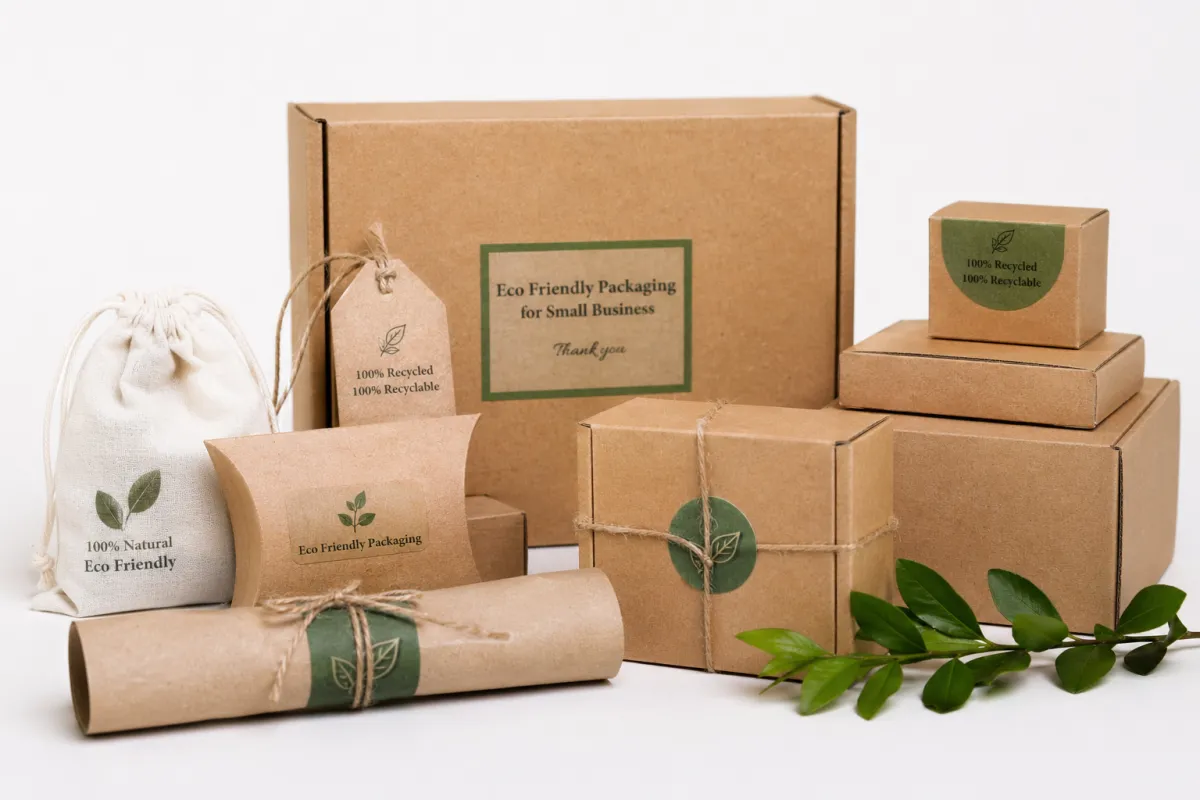
Eco Friendly Packaging for small business is not one material and not one label. It is a system of choices that lower waste across the full pack-and-ship chain. That includes the box, the insert, the tape, the label, the ink, and the amount of empty space you send through a carrier network that already charges by volume in many lanes. Shipping air is not a sustainability win. It is a line item.
The strongest eco friendly Packaging for Small Business usually does four things at once: it uses less raw material, includes recycled or responsibly sourced content, stays easy to recycle or compost where possible, and protects the item without overbuilding the shipper. Miss one of those and the system starts leaking money. That is why sustainable packaging should be measured in outcomes, not just in color or texture.
Packaging language creates confusion, and confusion creates bad buying decisions. The short version looks like this:
- Recyclable means the material can usually reenter a recycling stream if the local program accepts it.
- Recycled-content means the package contains recovered fiber or plastic, often post-consumer recycled (PCR) material.
- Compostable means it can break down under specific composting conditions, not in a backyard pile because the art direction feels earthy.
- Biodegradable is vague unless the claim includes a standard and a defined environment.
- Reusable means the package can survive a second life, which works only when the product and fulfillment model support that kind of reuse.
For eco friendly Packaging for Small Business, the claim matters almost as much as the material. A mailer that is technically recyclable but wrapped in a laminated film nobody can separate is not a clean story. A label, adhesive, and inner fill that all fight the recycling stream turn the package into decoration with a conscience costume. Good recycled packaging keeps the message simple enough that customers can act on it.
The same logic applies to sustainability and presentation. A lot of founders assume they must choose between polished unboxing and responsible packaging. They do not. Good packaging design can deliver both if the structure stays simple, the print coverage is controlled, and the materials are honest about what they are.
A useful rule: build the package from the inside out. Start with product protection, then right-size the shipper, then choose the material family, then decide how much package branding the surface actually needs. That order saves money in ways that a third insert never will, and it is the same logic behind most high-performing custom packaging systems.
How Eco Friendly Packaging for Small Business Works
Eco friendly Packaging for Small business works best when you treat it as a lifecycle, not a one-time purchase. The lifecycle starts with raw material sourcing, moves through manufacturing and printing, then into fulfillment, transport, customer use, and end-of-life. Every step carries cost, labor, and waste. Ignore a step and the whole package gets more expensive than it needed to be. That lifecycle view is also where sustainable packaging decisions become easier to compare.
Right-sizing is the easiest place to win. A carton that trims half an inch on each side can reduce dimensional shipping charges, especially on parcels billed by size instead of weight. Send hundreds or thousands of units and those fractions stop being fractions. Eco friendly Packaging for Small business often gets cheaper here, because a smaller box needs less board, less filler, and less tape.
The material families most small brands use are familiar for a reason:
- Kraft paper for mailers, wraps, and simple branded packaging.
- Recycled corrugated for shippers that need stacking strength.
- Molded fiber for trays, inserts, and protective holds.
- Paper mailers for soft goods and lightweight ecommerce orders.
- Plant-based fillers for cushioning, though they are not always the cheapest option.
- Minimal-plastic options where moisture or barrier needs make paper-only unrealistic.
Material behavior changes in transit. Corrugated board handles compression well, but a thin paper mailer can wrinkle or tear if the product has corners or the route gets rough treatment in a hub. Molded fiber gives structure and nesting, but it needs a certain mold size before it becomes economical. Eco friendly Packaging for Small business is about fit, not just virtue.
Design choices matter more than many buyers want to admit. Heavy lamination, foil-heavy decoration, mixed-material sleeves, and too many glued parts make recycling harder. They also slow production. If you want a package to read as premium, you do not need ten finishing steps. A clean one-color print on a strong substrate often does more for retail packaging than a pile of shiny extras.
For shipping-based brands, I usually look at four variables first:
- Fragility - Does the product chip, dent, crush, or leak?
- Weight - Heavier units need stronger board and better inserts.
- Moisture exposure - Paper-only packs can struggle in humid routes or damp warehousing.
- Brand positioning - A premium candle line may justify a better printed carton than a commodity refill pack.
If you ship parcel orders, ask for transit testing that resembles real carrier abuse. Standards like ISTA and ASTM exist for a reason. The International Safe Transit Association publishes useful guidance for pack testing, and that beats guessing. A package that survives structured drop and vibration tests usually beats a render that only looks good on screen. For eco friendly packaging for small business, testing is what keeps the greener choice from becoming the more expensive mistake.
Eco friendly packaging for small business gets stronger when you think about the destination too. If a customer can flatten the carton, remove a paper label, and place it in curbside recycling, that is a real end-of-life advantage. If they need a knife, three tabs, and a small engineering degree, they are not gonna feel better about your “sustainable” story.
One more practical detail: if the package is used by a team of humans, assembly time matters. A design that saves three cents on board but adds 20 seconds of folding and taping may cost more in labor than it saves in material. That is the kind of math that gets ignored until the warehouse manager starts doing it for you.
In one packaging review I did, a client had already spent money on recycled board, but the insert was so overbuilt that it doubled pack time. The material looked great on a sample table. In the warehouse, it was a headache. That mismatch is common.
If you are still comparing formats, our custom printed boxes and mailers can help you see how a simple size change affects material use, print area, and fulfillment speed. For a lot of eco friendly packaging for small business projects, that comparison is where the real savings show up.
Key Factors: Cost, Materials, and Brand Fit
Eco friendly packaging for small business needs to earn its place on the P&L. A lot of people focus only on unit price, which is a tidy way to miss the larger cost picture. You have to compare unit price, shipping weight, damage rate, minimum order quantity, storage space, and labor time. A cheaper box that arrives crushed is not cheaper. It is a future return label. That is true for recycled packaging, too; the material still has to survive the trip.
The best value often lives in the middle, not at the cheapest point. Recycled paper mailers can be very low cost for soft goods. Custom printed boxes with premium finishing are usually more expensive. Molded fiber often sits in the middle as a protective insert or structured pack component. Eco friendly packaging for small business is rarely about chasing the lowest sticker price. It is about the lowest total cost that still works in the real world.
| Option | Typical Unit Cost | Best Use | Sustainability Notes | Main Tradeoff |
|---|---|---|---|---|
| Stock kraft mailer | $0.10-$0.28 | Soft goods, lightweight ecommerce orders | Often paper-based and recyclable where accepted | Limited branding, lower protection |
| Recycled corrugated mailer | $0.35-$0.85 | Fragile or higher-value parcels | Good recycled-content story, strong curbside recycling profile | Higher board usage than a mailer |
| Custom printed folding carton | $0.18-$0.45 | Retail packaging, gifts, subscription inserts | Can be FSC-certified paperboard with water-based inks | Print setup and minimums can raise spend |
| Molded fiber insert | $0.22-$0.60 | Protection for bottles, jars, and electronics | Often made from recovered fiber and easy to separate | Tooling and fit need upfront planning |
| Paper void fill | $0.05-$0.18 per pack | Filling gaps in shippers | Paper-based and commonly recyclable | Uses more space if overfilled |
Those ranges are not fixed truths. They move with size, board grade, print coverage, and order volume. At 500 units, pricing looks different than at 5,000. Even so, the table gives you a working frame for eco friendly packaging for small business decisions without pretending every supplier quotes from the same universe.
Brand fit matters too. A handmade candle line, a clean beauty brand, and a specialty snack company do not need the same look or construction. Branded packaging for a premium gift item may justify a sturdier carton and a better print finish. A basic replenishment item may be better off with a simple recyclable shipper and a strong label system. Good package branding should support the product story, not drown it in production costs.
There is also a compliance side to this. Do not stamp green language on a box unless the claims are defensible. “Recyclable” means something specific in many markets. “Compostable” means even more. If the package is paper with a plastic window, customers should not need a decoding guide to figure out disposal. That is a packaging problem, not a branding problem.
A smart approach for eco friendly packaging for small business is to keep the structure simple and put the savings where they count. One-color print can look sharp. Standard sizes are usually cheaper than custom footprints. A strong natural finish often looks more expensive than it is. Fewer components can make the unboxing feel cleaner, not cheaper.
If you want to compare stock and custom structures, start with Custom Packaging Products and narrow by size, material, and print method before you fall in love with a mockup that would be annoying to pack at 9 p.m. on a Friday.
Step-by-Step Process and Timeline for Eco Friendly Packaging for Small Business
The process for eco friendly packaging for small business should be methodical, not chaotic. Too many brands jump from “we want something greener” to “send me a quote” without a basic spec. That creates delays, wrong samples, and a thread of emails nobody wants to reread.
Start with an audit. List what you are using now, what is failing, and where waste shows up. Are you shipping too much air? Are boxes crushing? Are inserts overbuilt? Are labels hard to remove? Once you know the problem, the right solution usually gets obvious fast. Eco friendly packaging for small business is easier to improve when you know whether you are fixing waste, cost, branding, or all three.
A realistic workflow looks like this:
- Review current packaging - Measure sizes, weight, damage rates, and pack time.
- Define goals - Lower material use, improve recyclability, reduce shipping cost, or improve presentation.
- Choose a material family - Kraft, corrugate, molded fiber, or a mixed system with paper and minimal plastic.
- Prototype - Order samples or short runs and check fit.
- Test - Drop tests, transit checks, moisture checks, and assembly checks.
- Approve art and spec - Lock size, print coverage, finishes, and insert style.
- Place production order - Confirm MOQ, lead time, and delivery terms.
- Train fulfillment - Make sure the pack sequence is fast and repeatable.
Timelines vary more than most people expect. Stock packaging changes can happen quickly, sometimes in a few business days if inventory is ready. Sampling often takes 5-15 business days, depending on the material and print complexity. Custom tooling or a new mold can add 2-4 weeks. Full production for eco friendly packaging for small business often lands in the 12-20 business day range after proof approval, though that can stretch when you are ordering specialty materials or a supplier is buried in peak volume. If your launch date is fixed, the calendar can matter as much as the box.
What should you send a supplier? Do not make them guess. Give them the product dimensions, weight, fragility level, how the item is packed today, where it ships, and the target budget per unit. If the product needs protection in transit, say so. If the customer opens the package on camera, say that too. Good packaging design starts with honest inputs, not a mood board and hope.
Testing is the step people skip, then complain about later. A sample should be checked for fit, closing force, shelf appearance, and real transport abuse. If the item is fragile, ask about drop and vibration standards. If you want a cleaner process, ask for test methods aligned to common parcel expectations such as ISTA 3A or ASTM D4169. Your supplier should be able to explain those methods without sounding like they are reading from a parking ticket.
Moisture and packing-table reality matter too. Paper-based solutions can be excellent, but some need better humidity control than a random storage corner offers. A packaging structure that assembles in 12 seconds instead of 30 can save hours over a large order. That is the kind of boring number that quietly improves margins.
If you are still comparing formats, our custom printed boxes and mailers can help you see how a simple size change affects material use, print area, and fulfillment speed. For a lot of eco friendly packaging for small business projects, that comparison is where the real savings show up.
Common Mistakes When Choosing Eco Friendly Packaging for Small Business
The biggest mistake is greenwashing by texture. Brown paper is not automatically sustainable. Matte is not automatically ethical. Leaf graphics are not a recycling program. If the structure is wasteful, the color cannot rescue it. Eco friendly packaging for small business needs substance, not costume design.
Another common error is choosing a material that sounds good but fails in transit. I have seen brands swap to a lighter shipper, celebrate the lower board cost, and then eat damage claims because the package could not survive normal parcel handling. That is a bad trade. If a box or mailer fails, the total waste increases because product, packaging, and freight are all gone at once.
Mixed materials are another trap. A paper sleeve with a plastic window, a carton with a heavy film laminate, or an insert glued together from multiple hard-to-separate layers can make end-of-life sorting annoying for customers. If you want curbside recycling to make sense, the package needs to be easy to understand without a doctoral thesis. Eco friendly packaging for small business works better when the material story is clean.
Overordering is a cash-flow problem dressed up as a volume discount. A lot of brands want to lock in a huge custom run before they have tested fit, demand, or sell-through. Then they sit on pallets for months, pay storage, and discover the design should have been 1/4 inch shorter. Not exactly a romantic outcome for retail packaging.
Labor time is the hidden cost nobody wants to talk about because it sounds unglamorous. A slightly cheaper carton is not cheaper if it takes longer to fold, line up, and tape. If your team packs 300 orders a day, 10 extra seconds per order adds up fast. That is why eco friendly packaging for small business should be judged as a system, not as a catalog line item.
Do not ignore the recycling claim itself. The EPA recycling guidance is a useful reminder that local programs vary. A package that works in one city may not be accepted in another. If your supplier says a carton is recyclable, ask what makes that claim true, and ask what the customer needs to remove first, if anything.
Finally, many teams overcomplicate the unboxing. Extra inserts, tissue, stickers, and bands can look nice in mockups, but every additional component adds cost, assembly time, and a disposal decision for the customer. If a detail does not protect the product or strengthen the story, cut it. That is not being cheap. That is being disciplined.
Expert Tips to Lower Cost Without Losing Sustainability
If you want eco friendly packaging for small business to stay affordable, start with standard sizes. Standard dimensions usually cost less, quote faster, and reduce the risk of design delays. Custom sizes are worth it when the product truly needs a tighter fit, but standard first is the sane default. No one is gonna hand out a trophy for inventing a custom box that could have been 10 percent cheaper as a stock size.
Reduce print coverage before you reduce protection. A strong one-color mark on a natural substrate can look intentional and clean. Heavy ink coverage, complex artwork, and multiple print hits raise cost without necessarily making the package better. For many brands, the material texture does more visual work than extra decoration. That is especially true in branded packaging for direct-to-consumer orders.
Consolidate SKUs wherever you can. If three box sizes cover 90 percent of your orders, you probably do not need five. Fewer packaging SKUs mean simpler purchasing, less warehouse confusion, and better reorder discipline. That matters more than many founders expect. Eco friendly packaging for small business gets easier to scale when the supply chain is not a junk drawer.
Spend on protection where failure is expensive. A fragile item needs better inserts, better board, or better void fill. Save on decorative extras that do not improve function. A customer would rather receive a safe, clean package than a fancy one with a cracked product inside. That sounds obvious, yet it keeps happening.
If you are shopping suppliers, ask direct questions. No poetry. No fluff. Just facts:
- What is the recycled content percentage, and is it PCR or pre-consumer?
- Is the paper FSC-certified or sourced from another documented chain of custody?
- What is the MOQ by size and by print version?
- Can you quote stock and custom sizes side by side?
- What print method is being used, and how many colors are included?
- What is the lead time from proof approval to shipment?
Those questions expose real value fast. They also help you compare proposals that otherwise look similar on paper. A quote that is $0.03 cheaper but requires a 10,000-unit commitment and a six-week wait may not be better for a small business that reorders in smaller batches.
For paper-based solutions, ask for responsibly sourced fiber and look for FSC documentation if that claim matters to your brand story. For molded fiber, ask whether the part is made from recovered paper and whether the shape can be nested to reduce freight. For corrugate, ask about board grade, recycled content, and how much print coverage is actually necessary. Eco friendly packaging for small business is often won in these boring details, not in dramatic design concepts.
If you want a fast way to compare practical options, our branded packaging options make it easier to sort by material, size, and finishing level before you commit to a custom route. That keeps the conversation grounded in what can actually be produced, shipped, and packed without drama.
Next Steps: Build Your Eco Friendly Packaging Plan
Do not try to redesign every package at once. Pick one product line, one pain point, and one target outcome. Maybe you want lower shipping cost. Maybe you want less waste. Maybe you want a better unboxing for repeat buyers. Start there. A focused rollout for eco friendly packaging for small business is faster, cheaper, and easier to measure than a full-company overhaul. It also gives you cleaner data for the next round of packaging decisions.
Here is the practical next-step checklist:
- Audit current packaging and note size, weight, damage rate, and pack time.
- Choose one priority such as waste reduction, shipping efficiency, or presentation.
- Request quotes for stock and custom options with the same product dimensions.
- Order samples before you approve production, even if the sample fee feels annoying.
- Test with real products, real tape, and real packing staff.
- Document the spec so future reorders stay consistent.
When you compare vendors, keep the quote sheet simple: material, MOQ, print method, lead time, sample cost, shipping cost, and any setup charges. That makes comparisons faster and prevents you from buying the prettiest sentence in the email instead of the best package. Eco friendly packaging for small business should be repeatable, not a one-off hero project that nobody can reorder cleanly.
It also helps to save the final spec sheet next to your order history. The first run is where people make decisions. The second run is where they discover the inbox got messy and half the details drifted. Keep a clean file on hand so your package branding, material choice, and size stay locked for the next buy.
If you are building this out now, use the packaging decision itself as a record. Note why you chose the material, what the test results showed, and what you expect the reorder cadence to be. That habit makes procurement easier, reduces guesswork, and stops the usual “why did we change this again?” conversation from eating another afternoon.
For most small brands, eco friendly packaging for small business is not about choosing the fanciest eco label. It is about using the right material, in the right size, with the right amount of brand presence, so the package protects the product and keeps costs under control. That is the kind of sustainable packaging that survives real business pressure. In other words, eco friendly packaging for small business should save waste, save time, and still look like you know what you are doing. Done well, it can even make a modest order feel more thoughtful than a bigger, sloppier one. If you only change one thing this week, right-size the package before you chase specialty materials; that one move usually gives the cleanest mix of lower waste, fewer charges, and fewer packing headaches.
What is the cheapest eco friendly packaging for a small business?
Usually stock kraft mailers, recycled corrugated boxes, and Paper Void Fill come in at the lowest price points. The cheapest eco friendly packaging for small business is still the one that fits correctly, because a damaged product wipes out the savings fast. In practice, the best low-cost option is often the one that balances recycled packaging, protection, and labor time.
Is eco friendly packaging for small business always more expensive?
No. Right-sizing, lighter materials, and fewer components can reduce shipping and labor enough to offset the material spend. Eco friendly packaging for small business can cost more upfront in some cases, but the total cost often drops once waste and damage are under control.
Which materials work best for eco friendly packaging for a small business?
Recycled paperboard, corrugated cardboard, molded fiber, and paper mailers are the best starting points for most brands. The right choice for eco friendly packaging for small business depends on product weight, fragility, moisture exposure, and whether the package needs curbside recyclability or another end-of-life path.
How do I know if packaging is truly sustainable?
Check the material makeup, recycled content, and end-of-life claim instead of trusting a green graphic or vague label. Real eco friendly packaging for small business should come with supplier documentation, clear claims, and a construction that customers can actually sort or recycle.
How long does it take to switch to eco friendly packaging for a small business?
Simple stock changes can happen quickly, while custom printed or custom-sized solutions usually take longer because of sampling and production. A typical eco friendly packaging for small business change should allow time for testing, approvals, and a clean transition so inventory does not get tangled halfway through the swap.


