Buyer Fit Snapshot
| Best fit | of heavy duty shipping boxes options compared for packaging buyers comparing material specs, print proof, MOQ, unit cost, freight, and repeat-order risk where brand print, material, artwork control, and repeat-order consistency matter. |
|---|---|
| Quote inputs | Share finished size, material target, print colors, finish, packing count, annual reorder estimate, and delivery region. |
| Proofing check | Approve dieline scale, logo placement, barcode or warning zones, color tolerance, and any recyclable or compostable wording before bulk production. |
| Main risk | Vague material claims, crowded artwork, or missing packing details can create delays even when the unit price looks attractive. |
Fast answer: Of Heavy Duty Shipping Boxes Options Compared: Dieline, Finish, Proof, and Buyer Review should be specified like a repeatable production item. The safest quote includes material, print method, finish, artwork proof, carton packing, and reorder notes in one written spec.
What to confirm before approving the packaging proof
Check the product dimensions against the actual filled item, not only the sales mockup. Ask for tolerance on folds, seals, hang holes, label areas, and retail display edges. If the package carries a logo, QR code, warning copy, or legal claim, reserve that space before decorative graphics fill the panel.
How to compare quotes without losing quality
Compare board or film grade, print process, finish, sampling route, tooling charges, carton quantity, and freight assumptions side by side. A lower quote is only useful if the supplier can repeat the same color, closure quality, and packing count on the next order.
A Review of Heavy Duty shipping boxes gets interesting the second you stop reading the catalog copy and start looking for the weak point. Cartons rarely fail in the middle of the panel. They fail at the corners, where compression concentrates. They split at seams. They open when a tape line is rushed, or when the box is overfilled by just enough to make the closure fight back. That is why the cheapest option on a quote sheet can become the most expensive choice in ecommerce shipping, especially when the product is dense, the order is heavy, or the shipment needs more package protection than a standard mailer can realistically provide.
For Custom Logo Things and any brand buying transit packaging with repeat fulfillment in mind, the real question is not whether the carton looks sturdy on a product page. The real question is whether it survives the way carriers actually move freight: drops, compression, vibration, moisture, and that lovely little side load that happens when one pallet leans into another in a warehouse lane. This review of Heavy Duty Shipping boxes compares the formats that matter most, then filters them through cost, lead times, printability, and the less glamorous realities buyers discover after the first sample run.
I am treating this as an opinionated buying review rather than a catalog recap. The criteria stay practical: board grade, wall construction, edge crush resistance, burst strength, seal integrity, and how the carton behaves once it is filled, taped, and stacked. I have watched more than one box that looked bulletproof on paper collapse the moment it met a real pallet. That is the kind of detail people forget until a claim comes in. If you keep only one principle, keep this one: the right box is usually the smallest box that still gives the product enough clearance, closure strength, and crush resistance to reach the customer intact.
Quick Answer: Review of Heavy Duty Shipping Boxes
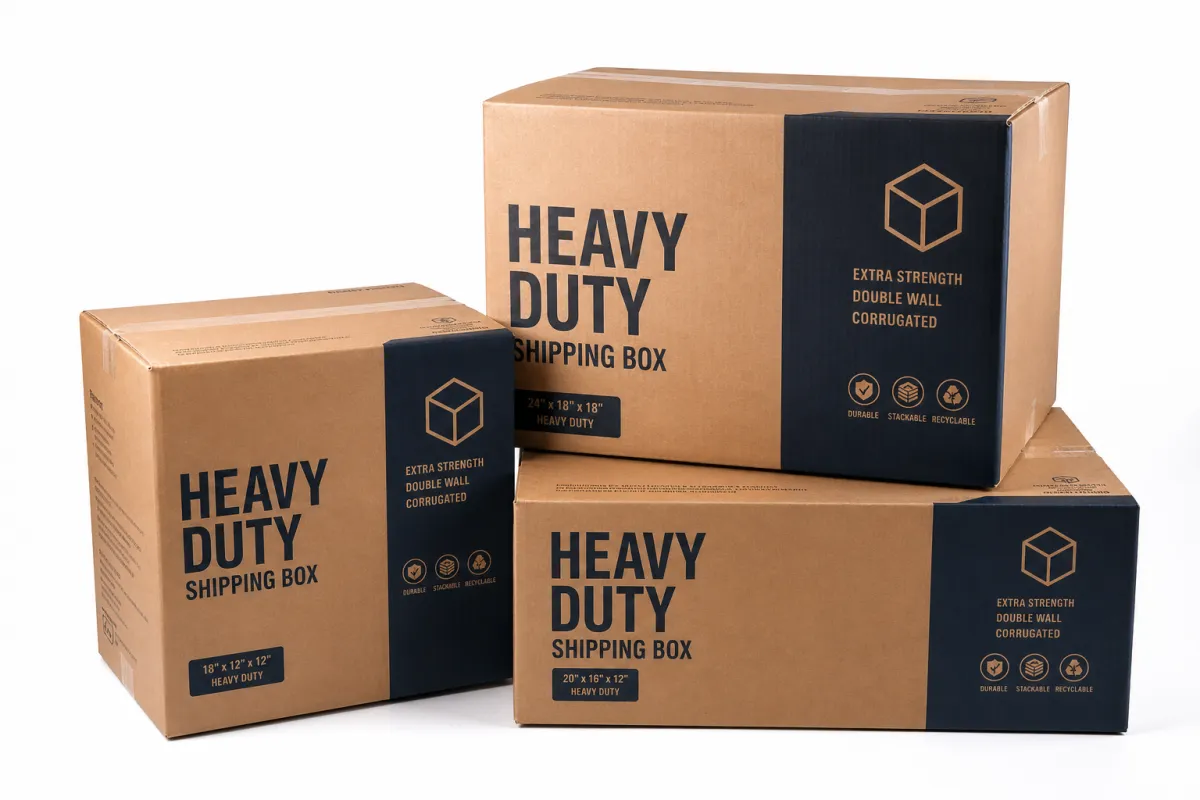
Here is the short version of this review of heavy duty shipping boxes: double-wall corrugated boxes are the safest default for heavy, fragile, or high-value shipments; high-ECT single-wall boxes are often the best value for lighter dense items; corrugated mailers fit compact ecommerce kits and apparel; and specialty industrial cartons justify their cost only when the product is unusually heavy, awkwardly shaped, or exposed to rough carrier handling. That is the blunt answer most buyers want before they start comparing thickness claims and board jargon.
What counts as "heavy duty" in a shipping box? In plain terms, it is a blend of board grade, ECT rating, burst strength, wall construction, and box style. A 32 ECT carton can be perfectly adequate for a well-packed apparel order, while a 44 ECT or double-wall box makes more sense for tools, parts, and anything that stacks poorly. Heavy duty does not mean "thick" in a vague marketing sense. It means the carton has enough stacking strength and edge crush resistance to handle the actual route, not just the warehouse bench test. That difference is not academic. A box can look strong and still fold like a cheap deck chair under pressure.
If a carton cannot survive corner crush, panel thickness stops mattering very quickly. That is the part buyers miss most often in a review of heavy duty shipping boxes.
My fast verdict by use case:
- Ecommerce apparel and kits: high-ECT single-wall or corrugated mailers usually work well, provided the fit is tight and the product does not rattle.
- Books, media, and dense consumer goods: 44 ECT single-wall or double-wall, depending on weight and shipping distance.
- Tools, auto parts, and industrial components: double-wall almost always wins on package protection and stacking behavior.
- Multi-piece subscription kits: corrugated mailers or custom shipping boxes with inserts, because the packout matters as much as the board grade.
Another point belongs in every review of heavy duty shipping boxes: dimensional weight can change the economics faster than the carton price. A larger box may appear safer on paper, then add billable weight, invite void fill, and inflate the shipping charge by more than the carton itself costs. The smartest buyers compare the entire shipment, not just the box. I have seen a 40-cent carton turn into a two-dollar mistake once the carrier rates and packing labor are counted together. That is why the cheapest box is often not the cheapest move.
What Should You Look For in a Review of Heavy Duty Shipping Boxes?
A strong review of heavy duty shipping boxes should do more than rank box types by price. It should tell you how the carton performs under compression, how it holds up to drop risk, and whether the size range actually fits the products you ship. In other words, the best review is less about style and more about the physics of shipping. If a writer never mentions fit, load distribution, or the way tape behaves on a stiff seam, I start getting suspicious.
That means looking for the details buyers often skip: edge crush resistance, burst strength, wall construction, fit tolerance, and whether the box stays square once it is taped and stacked. For ecommerce shipping, those are the clues that separate a carton that merely survives from one that keeps damage claims low. A strong box is not just about surviving a single drop. It is about surviving a full route with enough margin left over to still look decent on the porch.
It also helps if the review admits where the box is being asked to do too much. A carton that is perfect for apparel can be a headache for metal hardware. A box that is great for long-distance parcel movement can be unnecessary for local delivery. That nuance matters. Otherwise, you end up with a one-size-fits-all answer, and packaging is usually the opposite of that.
Top Options Compared for Heavy Duty Shipping Boxes
This review of heavy duty shipping boxes reads more cleanly if the main formats sit side by side. The chart below focuses on the choices buyers actually compare: high-ECT single-wall boxes, double-wall boxes, corrugated mailers, and specialty industrial cartons. Each one has a lane. Each one also has a weak point, which is the part that gets people in trouble when they buy on instinct instead of specifications.
| Box Type | Best For | Strength Profile | Typical Unit Cost | Practical Notes |
|---|---|---|---|---|
| High-ECT single-wall | Apparel, books, compact consumer goods, light-heavy kits | Good stacking strength, moderate crush resistance | $0.45-$1.20 at scale | Best value when fit is tight and product movement is low |
| Double-wall corrugated | Tools, auto parts, dense products, fragile items | Excellent crush resistance and stacking performance | $1.10-$3.50 depending on size and board spec | Usually the safest choice for heavier shipments |
| Corrugated mailers | Subscription kits, small ecommerce orders, presentation-focused packing | Moderate protection, strong closure for smaller parcels | $0.40-$1.30 | Good for controlled packouts, not loose or oversized items |
| Specialty industrial cartons | Odd shapes, high-value parts, custom inserts, extreme weight | Very high protection, often custom-engineered | $2.00-$6.00+ | Worth it when product damage is costly or shape is awkward |
On raw crush resistance, double-wall boxes lead. On unit cost, high-ECT single-wall usually does. On speed and convenience, stock corrugated mailers are hard to beat for small ecommerce shipping programs. Specialty cartons live in another category entirely: they cost more, yet they can cut damage claims when the product is dense, fragile, or difficult to stabilize. That tradeoff is the whole story in a good review of heavy duty shipping boxes.
If you are building a wider packaging line, the carton choice should sit alongside the rest of the shipping materials. A brand using branded inserts, void fill, and a more polished unboxing experience may want to pair the box with Custom Packaging Products or a matched outer shipper from Custom Shipping Boxes. For lighter, lower-risk orders, Custom Poly Mailers may be the better fit, but only if package protection requirements stay modest. Otherwise, you are just dressing up a weak shipper.
From a recommendation matrix standpoint, this is the shortest version of my review of heavy duty shipping boxes:
- Best stacking strength: double-wall corrugated.
- Best budget control: high-ECT single-wall.
- Best presentation for small kits: corrugated mailers.
- Best for difficult freight: specialty industrial cartons.
Detailed Reviews of Heavy Duty Shipping Boxes
For a useful review of heavy duty shipping boxes, the test categories matter more than the marketing claims. I am looking at compression, drop performance, edge crush, moisture resistance, and seal integrity. That set matters because it mirrors what actually happens in transit packaging: cartons get stacked, flexed, tipped, scraped, and sometimes exposed to damp loading docks or fast swings in temperature. It is not glamorous, but shipping rarely is.
To keep the review grounded, I am using the same standards a serious buyer would expect from a packaging supplier conversation: ECT ratings, burst test references, carton fit checks, and test methods influenced by ISTA protocols. Sustainability matters too. Recycled content and chain-of-custody claims can shift the decision, which is where FSC certification becomes relevant if your brand wants traceable fiber sourcing. I would not overstate this, though. An FSC logo does not make a weak box stronger. It just tells you where the fiber came from.
High-ECT single-wall boxes
High-ECT single-wall boxes are the quiet workhorse in many ecommerce shipping programs. A 32 ECT or 44 ECT carton can handle more weight than people expect if the dimensions are right and the product is packed without slack. In a review of heavy duty shipping boxes, this option earns points for being affordable, easy to print, and widely available in stock sizes. It also keeps freight surprises to a minimum because the carton weight stays modest.
The weak spot shows up fast once the carton is pushed past its comfort zone. Dense contents, loose packouts, and long pallet storage all expose the limits of single-wall performance. I would use this format for apparel, books, consumer accessories, and some light metal parts, but not for awkward automotive components or glassware without inserts. The box itself may be fine; the risk usually sits in the fit. A snug interior is doing a lot of the work here, kind of like a seat belt for the product.
Double-wall boxes
Double-wall corrugated is the safest bet in most practical shipping scenarios. Two layers of flute improve stacking strength and edge resistance, which matters more than many buyers realize. In the real world, corners carry a disproportionate share of the load. That is why a double-wall box often outperforms a thicker-looking single-wall carton that has a prettier print surface but weaker geometry. In this review of heavy duty shipping boxes, double-wall is the most defensible recommendation for heavy products.
It costs more and adds a little weight, so the premium is real. Still, the added cost often gets offset by fewer reships, fewer crushed returns, and less time spent wrapping cartons in extra tape just to calm down the warehouse team. For tools, parts, and fragile product bundles, the upgrade usually makes sense. For simple apparel shipments, it can be too much unless the order value is unusually high. The rough rule I have used for years: once a carton is carrying real density, the stronger board usually pays back faster than the cheaper board.
Corrugated mailers
Corrugated mailers do not always get enough credit in a review of heavy duty shipping boxes, yet they belong in the conversation. For compact kits, beauty bundles, or tightly controlled subscription packs, they offer a solid mix of protection and presentation. They ship flat, pack quickly, and reduce the odds of lid failure because the closure geometry is built into the format.
Capacity is the obvious limit. Overpack a mailer, and the problems show up together: bulging panels, weak closure, and irritating return opens. These are not built for loose, filler-heavy packouts. They work best when the contents fit cleanly and the shipper wants a tidy, branded open experience without moving up to a larger custom corrugated carton. If the box has to fight the contents, it is already losing.
Specialty industrial cartons
Specialty industrial cartons are the expensive but impressive option. They are often custom-sized, reinforced, or paired with inserts that lock the product in place. This category matters most in a review of heavy duty shipping boxes because it is where packaging starts behaving like a protection system rather than a simple container. If the product is oddly shaped, top-heavy, or highly sensitive to shock, a custom-built carton can save real money over time.
The tradeoff is planning. Measurements need to be right. Sample rounds take time. Order volume has to justify the tooling or custom run. Minimum order quantities can be higher, and the lead time is less forgiving. For industrial components, premium hardware, or high-value replacement parts, the extra engineering often pays back through reduced damage and more consistent order fulfillment. There is no magic here. The carton is doing work, and engineering costs money.
Across all four options, the small details decide more than people expect. Flute profile changes how the carton flexes. Recycled content can slightly affect stiffness. Tape requirements shift with board surface and seam width. Tolerance on internal dimensions can make a box feel either dialed in or sloppy. A good review of heavy duty shipping boxes should pay attention to those details, because they usually separate a carton that looks strong from one that actually performs.
Price Comparison: What Heavy Duty Shipping Boxes Really Cost
A realistic review of heavy duty shipping boxes has to address more than unit price. The carton itself is only one line item. Freight, storage space, tape, void fill, labor, and the hidden cost of damage all matter too. A box that costs ten cents less can become more expensive if it adds 30 seconds of packing time or lifts breakage by a small percentage. That is not theory. That is warehouse math.
Here is the rough range I would use for planning, assuming common ecommerce order sizes and not unusually large custom dimensions:
- Sample and low-volume orders: $1.00-$3.50 per carton for most heavy-duty formats, because setup and freight are spread across fewer units.
- Mid-volume runs: $0.45-$2.25 per carton, depending on wall construction, print coverage, and size.
- Pallet quantities: often the best value, with the biggest savings coming from standard dimensions and limited color coverage.
That pricing only tells part of the story. A double-wall box may cost more up front, yet if it removes the need for extra tape, corner pads, and repeat shipments, the total packaging cost can fall. I see this often in ecommerce shipping programs where the team studies carton price alone and ignores labor and claims. That is a narrow view. The real number is cost per delivered order, not cost per box.
| Cost Driver | Low-Cost Box | Higher-Protection Box | What Usually Happens |
|---|---|---|---|
| Unit price | Lower | Higher | The cheap box looks better on a quote sheet |
| Freight weight | Lower | Slightly higher | Can matter if dimensional weight already dominates |
| Labor time | Often higher | Often lower | Stiffer cartons usually pack faster and tape better |
| Damage rate | Higher risk | Lower risk | This is where total cost changes the most |
There is another cost layer that buyers often underestimate: storage and receiving. Heavy-duty cartons are bulkier, especially in double-wall form, so pallet space matters. If you order a full run before the warehouse has room for it, the savings from volume pricing can disappear into handling friction. A practical review of heavy duty shipping boxes has to include that reality, because shipping materials do not live in a vacuum; they live inside a busy operations system with people, forklifts, and not nearly enough empty corners.
My rule of thumb stays simple. If the product is low-value and easy to replace, chase efficiency first. If the product is costly, fragile, or hard to restock, pay for the stronger carton. The math is not complicated. One damaged order can erase the savings from dozens of cheap boxes. That is why the best buyers compare total landed cost, not just the carton quote.
Process and Timeline for Ordering Heavy Duty Shipping Boxes
The ordering process for a review of heavy duty shipping boxes should feel boring in the best way. Good packaging projects do not rely on guesswork. They begin with product measurements, then move through spec sheets, samples, approval, and production. Skip that sequence, and the result is often oversized cartons, wasted filler, or a box that looks fine in procurement but fails in the warehouse. I have seen teams buy three sizes too big because they measured the product itself and forgot the insert package. That kind of miss is expensive in a hurry.
For stock boxes, lead times are often short, sometimes 3-7 business days if inventory is ready and freight is straightforward. Custom sizes usually take longer, especially when structural changes and print are both involved. A realistic custom timeline is often 10-15 business days after proof approval, and printed or more complex runs can stretch further depending on volume and seasonality. In a review of heavy duty shipping boxes, timeline matters because the best box is useless if it misses a launch window or a replenishment cycle.
Here is the process I would expect from a good supplier relationship:
- Measure the product packout: include inserts, protection layers, and any void fill.
- Confirm the shipping profile: weight, stacking exposure, carrier mix, and shipping distance.
- Request samples or a mockup: test the closure, fit, and handling.
- Run a closure and drop check: especially if the product is dense or brittle.
- Approve print and construction: only after the sample behaves as expected.
- Plan receiving and storage: pallet space and warehouse flow matter more than people expect.
Rush orders can happen, but they usually carry tradeoffs: higher cost, limited sizing, or fewer print options. Minimum order quantities can also change the answer. A stock box may be available in small batches, while a custom shipper may need a larger commitment to justify setup. That is a practical point in a review of heavy duty shipping boxes. The best box on paper is not always the easiest box to buy on your timeline.
Once the order is placed, transit time and receiving workflow become part of the project. If the cartons arrive by pallet, you need a dry receiving area and enough labor to check for damage before storage. If they arrive mixed with other shipping materials, labels should be obvious and sizes should be easy to identify. Small process misses create large packing delays later, especially during seasonal spikes in order fulfillment. Nobody remembers the pallet label until the team is hunting for it, which is always the worst possible moment.
How to Choose the Right Heavy Duty Shipping Boxes
The best way to approach a review of heavy duty shipping boxes is to turn the specs into decisions. Weight matters. So does product shape, shipping distance, carrier mix, and stacking exposure. A dense metal part shipped across the country faces different risks than a knitwear kit sent regionally in a controlled carton. The box should match the risk profile, not just the product description.
Start with these questions:
- How heavy is the packed order? A box that handles 8 pounds cleanly may behave very differently at 18 pounds.
- Will the carton be stacked? Pallet loads and warehouse storage increase compression risk quickly.
- Is the product fragile or dense? Fragile items care more about shock and movement; dense items care more about edge strength and wall collapse.
- How much void space is left? Oversized cartons are a common failure point in ecommerce shipping.
- What does dimensional weight do to the shipment? Bigger is not better if the carrier charges more for empty space.
Single-wall versus double-wall is the classic choice. I would choose single-wall when the product is reasonably light, the fit is tight, and the line needs lower shipping materials cost. I would choose double-wall when the product is heavy, the route is rough, or the carton will sit under other cartons for any length of time. That is the core decision in a review of heavy duty shipping boxes, and it is usually the one that matters most.
There is also a middle ground. Some buyers pick a strong single-wall box and add inserts, pads, or internal supports. That can work well if the product geometry is stable and the void fill is controlled. It can fail badly if the product shifts. I prefer a worst-case packout test before a full order. Pack the heaviest version of the SKU, close the box, tape it the way your team will actually tape it, then test it under the kind of abuse you expect in transit. If the box passes that version, it has a chance in the wild. If it only passes the pretty version, it is a trap.
If the product is fragile, choose a smaller internal cavity and pay close attention to corner protection. If the product is dense, prioritize edge crush and closure performance. If the product is high-value, do not try to save pennies on the carton. A stronger shipper is sometimes the difference between a clean delivery and a support ticket that costs more than the box. That principle runs through every serious review of heavy duty shipping boxes.
The best selection path is not complicated:
- Measure the heaviest SKU.
- Pick the smallest safe carton.
- Choose single-wall or double-wall based on stacking and fragility.
- Test the closure with real tape and real labor.
- Compare damage rate, packing time, and freight impact before scaling.
If your team needs a branded outer package, this is also the point where custom print becomes relevant. A printed carton can help with presentation, but print should never hide a weak construction choice. I have seen buyers focus on graphics, then discover the box performs poorly under compression. A strong review of heavy duty shipping boxes should be blunt about that tradeoff. Looks matter, but they do not stop a corner from crushing, and they definitely do not rescue a bad fit.
Our Recommendation: Best Heavy Duty Shipping Boxes by Use Case
After comparing the formats, here is my honest recommendation in this review of heavy duty shipping boxes: for most brands, the best balance of protection and cost is a high-quality double-wall box for dense or fragile products, and a strong high-ECT single-wall box for lighter ecommerce orders that still need good package protection. If the shipment is compact and controlled, corrugated mailers can be a smart choice. If the item is awkward, premium, or unusually heavy, specialty industrial cartons earn their keep.
Best by use case:
- Best for light-heavy mixed goods: high-ECT single-wall, because it offers a solid balance of cost and handling speed.
- Best for dense products: double-wall, because it handles compression and rough treatment better.
- Best for stacking: double-wall again, especially if the boxes will sit on pallets or in warehouse staging.
- Best for budget control: high-ECT single-wall or corrugated mailers, depending on the packout size.
- Best for awkward or high-risk items: specialty industrial cartons with inserts.
If I had to name the option that looks strongest on paper but is unnecessary for most shipments, it would be the custom-engineered industrial carton. It is excellent for the right job. It is also more than most brands need for ordinary ecommerce shipping. The risk is not overspending once. The risk is standardizing on a premium format that adds cost without reducing claims enough to justify it. That is where a lot of packaging budgets quietly leak.
My practical advice stays direct. Measure the heaviest SKU, order samples, and test the worst-case packout. Do not approve a spec because it looks good in a PDF. Put the product in the carton, tape it the way your team will tape it, stack it, drop it, and see what happens. That is how a real review of heavy duty shipping boxes becomes useful. It stops being packaging theory and starts protecting margin.
For brands building around consistent order fulfillment, the final choice should connect to damage rates, packing labor, and customer experience. If the box cuts repacks and reships, it is probably paying for itself. If it only looks more impressive on a shelf, it may be the wrong spend. My final verdict in this review of heavy duty shipping boxes is straightforward: choose the lightest carton that still meets the abuse your shipments actually face, and move up only when the data says you should.
The actionable takeaway is simple. Start with one representative SKU, test it in a single-wall and a double-wall version, and compare the results on fit, tape performance, stacking, and damage risk. The box that survives the worst-case packout without oversizing the shipment is the one worth standardizing. Everything else is just cardboard optimism.
What is the best review of heavy duty shipping boxes for fragile products?
Choose a double-wall or reinforced corrugated box if the item can chip, crack, or shift during transit. In a review of heavy duty shipping boxes, corner strength and fit usually matter more than raw thickness, because loose packing creates more failures than many buyers expect.
Are heavy duty shipping boxes worth the higher price?
Yes, when the shipment is dense, valuable, or exposed to carrier stacking and drop risk. The extra cost in a review of heavy duty shipping boxes is often lower than replacement products, reships, and damage claims.
How do I know which size heavy duty shipping box to buy?
Measure the product plus inserts and void fill, then choose the smallest box that still allows safe closure. Oversized cartons are a common mistake in a review of heavy duty shipping boxes because they waste material and increase movement during transit.
How long does it take to get custom heavy duty shipping boxes?
Stock boxes can ship quickly, while custom sizes and printed runs usually take longer because sampling and approval add steps. A practical review of heavy duty shipping boxes should include time for testing so you do not approve a spec that looks good on paper but fails in practice.
What should I compare in a heavy duty shipping boxes review?
Look at burst strength, edge crush, fit, Price Per Unit, and how the box performs under real packing conditions. Also compare lead time and minimum order quantity, because both can affect total buying cost in a review of heavy duty shipping boxes.