Buyer Fit Snapshot
| Best fit | compare bamboo fiber packaging trays for packaging buyers comparing material specs, print proof, MOQ, unit cost, freight, and repeat-order risk where brand print, material, artwork control, and repeat-order consistency matter. |
|---|---|
| Quote inputs | Share finished size, material target, print colors, finish, packing count, annual reorder estimate, and delivery region. |
| Proofing check | Approve dieline scale, logo placement, barcode or warning zones, color tolerance, and any recyclable or compostable wording before bulk production. |
| Main risk | Vague material claims, crowded artwork, or missing packing details can create delays even when the unit price looks attractive. |
Fast answer: Compare Bamboo Fiber Packaging Trays: Material, Print, MOQ, and Cost should be specified like a repeatable production item. The safest quote includes material, print method, finish, artwork proof, carton packing, and reorder notes in one written spec.
What to confirm before approving the packaging proof
Check the product dimensions against the actual filled item, not only the sales mockup. Ask for tolerance on folds, seals, hang holes, label areas, and retail display edges. If the package carries a logo, QR code, warning copy, or legal claim, reserve that space before decorative graphics fill the panel.
How to compare quotes without losing quality
Compare board or film grade, print process, finish, sampling route, tooling charges, carton quantity, and freight assumptions side by side. A lower quote is only useful if the supplier can repeat the same color, closure quality, and packing count on the next order.
Compare Bamboo Fiber Packaging Trays: Best Picks & Tips
Compare bamboo fiber packaging trays with a skeptical eye, because the sample that looks polished on a table can still twist under lid pressure, pick up moisture from warm food, or lose its shape after a few minutes in packing and transit. That gap between first impression and real performance is where a lot of buying decisions go sideways. The best bamboo fiber packaging trays are rarely the thickest or the most expensive. They are the ones that hold their shape, nest cleanly, stay presentable after handling, and land at a cost that makes sense for the product and the route it takes to market.
I look at these trays the way a packaging buyer on a live line would: as working parts of product packaging, not as a trend piece. They have to move through filling, stacking, shipping, shelf display, and sometimes repacking without becoming a headache. If the tray sits inside branded packaging, it also has to support the look and structure of the whole system without adding unnecessary weight or slowing assembly. That connection matters more than most spec sheets admit, which is why you should compare bamboo fiber packaging trays against the full pack, not the tray alone.
The short answer is simple. The strongest bamboo fiber packaging trays feel rigid in hand, keep their edge under load, release from stacks without sticking, and look tidy after contact. Thicker trays often feel more premium, yet they can push up unit cost and increase carton volume. Those two variables ripple outward into freight, warehouse space, and handling time. So yes, compare bamboo fiber packaging trays by appearance, but let performance lead the decision. If you compare bamboo fiber packaging trays only by price, the numbers can look better than the outcome.
I prefer to judge them by behavior, not by marketing copy. Warm food, oily surfaces, wet produce, retail display, and transit vibration tell the truth fast. A tray can look excellent in a catalog and still fail when a stack of ten gets compressed on a bench or slides during a transfer. That is the test that matters, and it is the same test I use when I compare bamboo fiber packaging trays for food service trays, retail packaging, or shipping inserts.
A bamboo fiber tray earns its place by protecting the product, holding its shape, and staying presentable after handling, not by looking polished while empty.
The comparison below focuses on the variables that actually change a purchase decision: stiffness, nesting behavior, mold quality, moisture response, and total cost to deliver the tray to the customer. That is the lens I use whenever I compare bamboo fiber packaging trays for food service, retail display, or shipping inserts. It also helps to compare bamboo fiber packaging trays against molded pulp trays when buyers are weighing presentation against utility.
How Do You Compare Bamboo Fiber Packaging Trays Quickly?
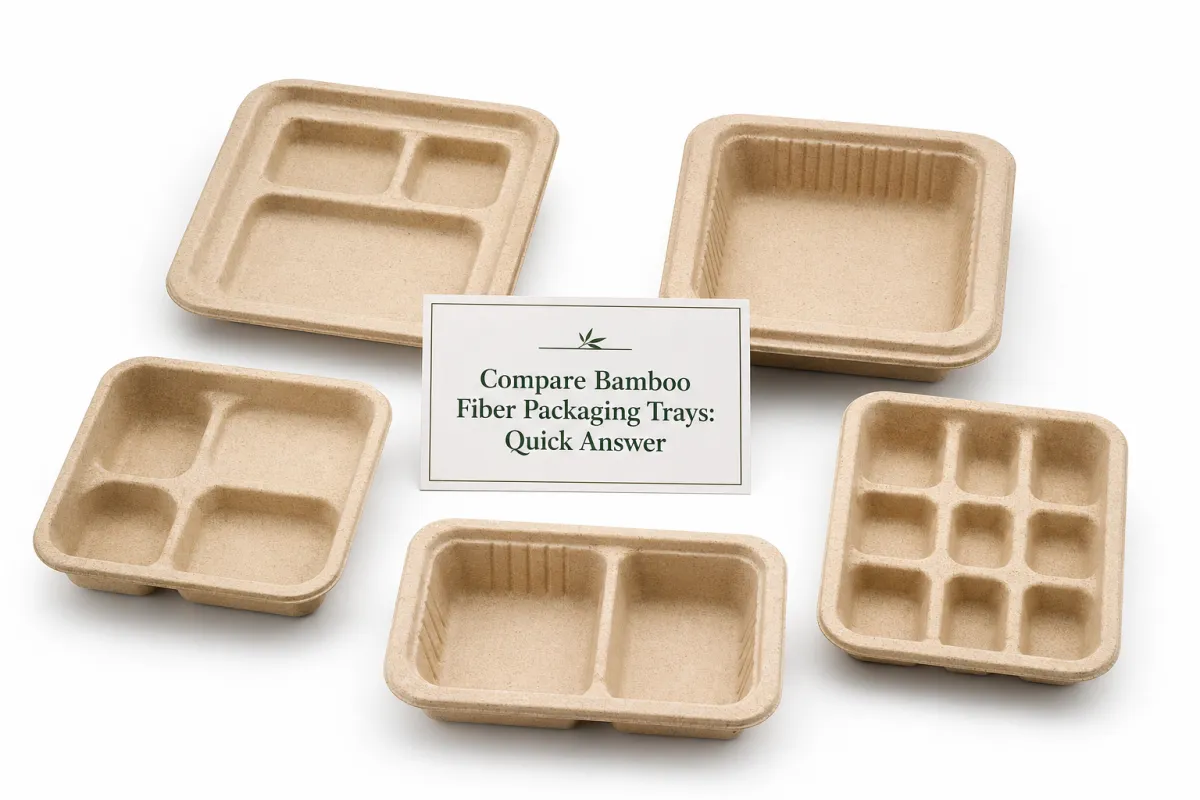
If you need the shortest answer, start here: the best bamboo fiber packaging trays are the ones that fit the product, not the ones that merely sound sustainable. A shallow presentation tray works well for bakery pieces, produce, and retail sets that need a neat shelf look. A compartment tray suits prepared meals or snack assortments that need separation. A deeper carry tray is usually the safer choice for heavier contents or any pack that will take lid pressure.
In practice, compare bamboo fiber packaging trays using four checks before you price them. Does the rim stay rigid? Does the surface resist dampness for the full hold time? Does the tray nest cleanly without excessive friction? Does the shape protect the product during stack pressure? If a tray clears those four checks, it deserves a serious quote review. If it fails two of them, the cheapest quote in the inbox can become the most expensive mistake on the floor. That is especially true for food service trays, where moisture and heat reveal weak structure fast.
Many buyers begin with wall thickness. I would not. Thickness matters, yet it sits behind mold precision, fiber distribution, drying quality, and edge consistency. Two trays that look nearly identical on a spec sheet can behave very differently if one was pressed evenly and the other came out with thin corners or density swings. That is why samples matter. If possible, compare bamboo fiber packaging trays in hand, not just on paper, and do it alongside molded pulp trays if your team is debating material options.
For food service and retail packs, the best value often sits in the middle of the cost curve rather than at the top. A cleaner mold finish and a steadier rim can save far more than the price difference suggests by cutting crush damage, repacking, and rejects. A tray that costs two cents more can still be the cheaper choice if it saves labor and reduces failures. That is one reason buyers compare bamboo fiber packaging trays again after the first sample round.
There is another tradeoff that shows up only after ordering. A tray that looks more premium may stack a little taller, fit fewer units per carton, or demand more careful handling. That is not a reason to avoid it. It is a reason to run the numbers honestly. When I compare bamboo fiber packaging trays, I want the material story, the production story, and the logistics story to line up. If they do, the tray usually performs well in branded packaging systems too.
Top Bamboo Fiber Packaging Trays Compared
The most common bamboo fiber tray formats fall into four groups, and each behaves differently once it is used in the real world. The right choice depends on whether the tray is carrying a dry pastry, a saucy meal, a display-ready retail item, or an ecommerce insert that has to survive transit without collapsing. To compare bamboo fiber packaging trays properly, judge them by task instead of by category name alone. The best tray for shelf presentation is not always the best tray for food service trays or shipping protection.
- Shallow presentation trays work best for bakery items, fruit sets, small gift packs, and shelf-friendly retail packaging. They usually look the cleanest, though they can be less forgiving with moisture or weight.
- Compartment trays fit meal kits, lunch packs, tasting assortments, and mixed snacks. They help with portion separation and package branding, but the internal ribs and dividers need clean molding to avoid weak points.
- Deep carry trays suit heavier products, stackable food service packs, and cartons that will be handled several times. They are often the safer choice for preserving shape under load.
- Custom insert trays are useful for ecommerce, cosmetics, or premium sets that need product protection more than food display. These can be tuned for cavity fit, though custom shaping can raise tooling cost.
Surface texture is one of the first clues about quality. A well-made tray feels even, with a smooth but not glossy surface, and the edges do not shed fiber dust. Lesser trays often show rough corners, uneven color, or thin spots around the lip. Those flaws matter because they affect both appearance and edge strength. If the rim crushes too easily, the tray will never feel premium in actual packing conditions. That is one of the fastest ways to compare bamboo fiber packaging trays in a live sample review.
Nesting behavior is another place where the differences become obvious. Good trays release from stacks with moderate resistance, which keeps line speed steady. Poor stacks either stick together or slide apart too easily and create handling messes. I have watched crews lose more time fighting stacked trays than they save by buying the cheapest option. That is why I always tell buyers to compare bamboo fiber packaging trays with a quick stacking test before approval. It is a small check with an outsized payoff.
For retail display, shallow and compartment trays usually look more intentional on shelf because they frame the product and keep the presentation orderly. For utility-driven applications, the deeper carry styles win because they protect better and tolerate rougher handling. If the tray sits inside custom printed boxes or a similar custom printed boxes system, fit and flatness matter as much as the material itself. The tray should complement the box rather than fight it.
The basic rule is straightforward: the tray style, the product, and the route to market need to match. Bamboo fiber packaging trays can perform very well, but only if the molded geometry fits the job. A tray built for a light bakery set will not behave like a tray made for chilled meals, and a carton insert does not need the same finish level as a shelf-facing food tray. Compare bamboo fiber packaging trays by use case first, then by finish and price.
Detailed Reviews of Each Tray Type
Shallow presentation trays are the most visual of the group. They usually work best with low-profile products because the product sits close to the rim and the pack feels deliberate. In real use, they perform well with dry or lightly moist items. Load them with something steaming hot or heavily sauced and the surface can soften faster than buyers expect. I like these trays for bakery assortments, produce, and premium retail packaging, but only when the product stays fairly dry. If you compare bamboo fiber packaging trays for shelf appeal, these are often the first samples to test.
Compartment trays are where design detail matters most. Divider walls need enough thickness to resist bending, but not so much bulk that they steal too much space from the cavities. When these trays are molded cleanly, they make mixed-item packs look neat and controlled. When they are molded poorly, residue collects in the inner corners and the dividers feel weak. For prepared meals, this style can be a very strong fit, especially with a proper lid or sleeve. It is also a common point of comparison with molded pulp trays because the use case overlaps.
Deep carry trays are the workhorses. They usually offer the best chance of surviving a rougher supply chain because the taller walls and stronger corners give the structure more resistance. They are useful for chilled products, stacked handling, and heavier loads. The tradeoff is bulk. They can take more carton space and sometimes need more careful pack-out. If freight density matters, this style may cost more in logistics even when the unit price looks acceptable. That makes it especially important to compare bamboo fiber packaging trays using landed cost, not just the quote line.
Custom insert trays solve a different problem. Their job is often not to display the product, but to hold it securely in place. That means cavity accuracy and repeatability matter more than appearance alone. When I review this style, I check whether the product seats fully, whether the tray flexes during insertion, and whether the molded lip protects corners during shipping. For ecommerce sets and secondary packaging, these trays can be highly effective. They are also where packaging design and packaging structure matter more than raw material hype.
Moisture response is one of the most important checks across all tray types. Bamboo fiber packaging trays can tolerate light dampness, but they are not magic. Steam, condensation, and oily product surfaces reveal weak points quickly. A tray that handles room-temperature dry goods beautifully can still lose rigidity after fifteen minutes under hot food. That is why I recommend testing with the real product, the real hold time, and the real pack environment. If you compare bamboo fiber packaging trays in a dry showroom only, you may miss the failure point entirely.
Heat and grease deserve their own test. Some trays hold up well with warm food, while others show surface softening or stain pickup almost immediately. That does not automatically make the tray poor. It does mean the buyer needs to know the use case. For direct food contact, check whether the supplier can document the finish, the material blend, and any coating used. For shipping or secondary packaging, the requirements may be less strict, but the tray still needs enough rigidity to protect the contents. This is where compostable packaging claims should stay tied to actual performance, not slogans.
Buyers should inspect a few quality cues every time they sample. Look for even fiber density, consistent color, clean cut edges, uniform lip thickness, and corners that do not crush when squeezed between thumb and forefinger. If you see bright white stress lines, rough burrs, or obvious thickness changes from one side to the other, the mold or pressing process may be inconsistent. That kind of flaw often comes back later during production. The pattern is easy to miss unless you compare bamboo fiber packaging trays side by side.
One practical rule helps here. If the product will face vibration, drops, and stacked cartons, ask for an ISTA-style transit check instead of trusting a desk sample alone. The International Safe Transit Association has useful guidance on packaging test methods and transit simulation at ista.org. That testing tells you far more about real performance than a polished product photo ever will. It is one of the best ways to compare bamboo fiber packaging trays against molded pulp trays under real shipping stress.
If you need a quick review summary, it looks like this: shallow trays win on presentation, compartment trays win on organization, deep trays win on handling tolerance, and inserts win on product restraint. None of them is automatically best. You still need to compare bamboo fiber packaging trays against moisture, pressure, and stack tests before final approval. For many buyers, that final test is also where the environmental claim becomes secondary to the actual job the tray must do.
Compare Bamboo Fiber Packaging Trays: Price Breakdown
Pricing is where many projects get distorted by wishful thinking. Buyers often compare only the unit quote and miss the larger picture: mold complexity, wall thickness, order size, finishing work, packing density, and damage risk. To compare bamboo fiber packaging trays fairly, think in landed cost, not just factory price. That is the only way to see whether a tray is truly affordable or merely inexpensive on paper.
In general, a simple shallow tray costs less than a deep or highly compartmentalized tray. Custom cavities, embossed logos, tighter dimensional tolerances, and special finish requirements all add cost. Order volume matters too. A run of 3,000 pieces can look very different from 20,000 pieces because setup work gets spread across more units. That is why the same tray can feel expensive in one project and very reasonable in another. When teams compare bamboo fiber packaging trays, this is usually the first place the math changes.
| Tray Style | Typical Unit Price | Usual MOQ | Best Fit | Main Watch-Out |
|---|---|---|---|---|
| Shallow presentation tray | $0.10-$0.22 | 3,000-10,000 pcs | Bakery, produce, shelf-ready retail packaging | Lower moisture tolerance if the load is warm or damp |
| Compartment food tray | $0.16-$0.38 | 5,000-15,000 pcs | Prepared meals, tasting sets, snack assortments | Divider strength and corner consistency matter a lot |
| Deep carry tray | $0.22-$0.55 | 5,000-20,000 pcs | Heavier foods, stacked handling, transit-heavy programs | More carton volume and freight cost |
| Custom insert tray | $0.18-$0.42 | 3,000-10,000 pcs | Ecommerce, cosmetics, specialty sets | Tooling and cavity accuracy can raise setup cost |
Tooling deserves respect. Depending on cavity count and mold complexity, a one-time tooling charge can range from a modest setup fee to a few thousand dollars. That is not unusual. What matters is whether the tool produces stable, repeatable trays that hold their shape. If the mold saves a few cents on paper but creates an endless stream of rejects, the project is not cheaper. It becomes a lesson in how to compare bamboo fiber packaging trays too narrowly.
Printing, embossing, and surface treatment can change the price quickly. Even simple logo embossing creates a different tool requirement than a plain flat tray. If the tray needs an oil-resistant finish or a more refined appearance for retail packaging, that can raise cost too. Buyers sometimes expect the tray to behave like a plain molded insert while also looking like premium package branding. Those goals can work together, but they are not free. You should compare bamboo fiber packaging trays with those extras in view, not after the quote arrives.
Freight deserves its own line. Bamboo fiber packaging trays are light, but they are bulky. If nesting is poor, carton pack-out becomes inefficient and landed cost climbs quickly. A tray that ships efficiently can save more than a cheaper unit that eats pallet space. That is one reason I compare tray options with both unit price and cubic efficiency in view. In some programs, the freight delta is larger than the price gap.
There is also a sustainability claim that should stay honest. If a supplier says compostable or recyclable, ask what the local waste stream actually accepts. The EPA has practical public information on recycling and composting realities at epa.gov. I trust that kind of guidance far more than a sales brochure that makes every fiber product sound universally accepted. This is especially relevant when teams compare bamboo fiber packaging trays to molded pulp trays and assume the end-of-life rules are identical.
So yes, compare bamboo fiber packaging trays by unit price. Compare the full picture too: mold cost, freight volume, pack-out efficiency, defect rate, and the chance of customer complaints. In many projects, the slightly higher quote turns out to be the better buy because it lowers the total cost of ownership. That is often the line between a tray that looks cheap and one that is cheap enough to keep.
Process and Timeline for Custom Tray Orders
Custom tray work follows a predictable path, yet the timing stretches fast if the buyer skips details early. The first step is the brief. A supplier needs tray dimensions, cavity layout, target product weight, whether the tray touches food directly, and how the tray will be packed or nested. If those inputs are vague, the quote will be vague too. That slows everything down, and it makes it harder to compare bamboo fiber packaging trays on equal terms.
Once the brief is clear, the supplier usually prepares a sample or pilot version. For a straightforward tray, sampling can take roughly 5-10 business days. If the design needs mold changes or special finish work, it can take longer. I treat sampling as a decision point, not a formality. You need to inspect fit, stackability, and surface finish in hand because that is where the real problems show up. Sampling is also the moment when many buyers compare bamboo fiber packaging trays with the previous material they used.
For full production, a normal timeline is often 12-20 business days after proof approval, though that can stretch with complex molds, queue time, or very large order volumes. Shipping adds its own timing. Air freight is faster but expensive; sea freight makes more sense for larger orders, especially if the trays are bulk packed. If the launch date matters, build in buffer time for one revision round.
One step speeds the whole process up: give the factory a spec sheet that is actually usable. Include exact outer dimensions, inside cavity depth, desired wall thickness, target temperature range if the tray will hold warm food, and whether the tray needs to nest tightly or separate cleanly. For retail packaging, include the outer carton size and the display requirements. For ecommerce, include drop risk and insertion method. Those details save days and make it easier to compare bamboo fiber packaging trays without redoing the brief later.
The most efficient projects usually move in this sequence:
- Share product dimensions, quantity, and end use.
- Review tray options and narrow the field to two or three candidates.
- Approve a sample after fit and finish testing.
- Confirm print, embossing, or surface treatment if needed.
- Lock production, inspect pre-shipment samples, and finalize freight.
That process is simple, and it works. It also gives you a better way to compare bamboo fiber packaging trays because each sample has already been tested against the real workload. If the tray sits inside a larger branded packaging rollout, this is the point where you should also compare it against the rest of the packaging system, including sleeves, cartons, and inserts from Custom Packaging Products. For teams working across multiple SKUs, that broader view prevents mismatched packaging design decisions.
One thing I tell buyers often: do not approve a tray from photos alone. Even a strong photo hides rim flex, edge crush, and nesting friction. If you can, request a physical sample and run a short internal test with moisture, heat, and transit conditions. A sample that survives a real-use test is much more valuable than a nice render. That is especially true if you compare bamboo fiber packaging trays for food service trays, where heat and steam expose flaws quickly.
For teams managing launch timing, a realistic schedule beats an optimistic one. If the order needs new tooling, fit testing, or retailer approval, add extra time. That buffer protects the launch calendar and keeps your team from paying rush freight simply because the sample arrived a few days later than planned. Compare bamboo fiber packaging trays early enough that the schedule can absorb a revision if needed.
How to Choose the Right Bamboo Fiber Tray
The right tray starts with the product, not the material story. A dry bakery item can live happily in a lighter presentation tray, while a sauced meal or chilled produce pack needs more structure and moisture resistance. If the tray is part of a retail launch, the appearance needs to support the shelf story. If it is mainly for shipping protection, durability and pack-out efficiency should lead the decision. That is the practical lens I use when I compare bamboo fiber packaging trays for clients.
To compare bamboo fiber packaging trays intelligently, ask five questions before choosing anything:
- Does the product create steam, condensation, oil, or surface moisture?
- How much stack pressure will the tray see in storage and transit?
- Does the package need to look premium on shelf or simply protect the product?
- Will the tray nest tightly for storage, or does it need easy separation on a packing line?
- Does the tray need to work with lids, wraps, sleeves, or secondary cartons?
If you answer those questions honestly, the right tray type usually becomes obvious. A premium retail gift pack often benefits from a shallow tray with clean edges and a refined surface. A prepared meal pack usually needs a compartment tray or a deeper carry tray that can hold shape under heat and handling. A shipping insert may need a custom cavity layout more than any special finish. This is where buyers compare bamboo fiber packaging trays against the actual job instead of the catalog image.
Compatibility matters more than many buyers expect. A tray that looks perfect on its own can become awkward once you pair it with a lid, belly band, or outer carton. That is where good packaging design helps. The tray should sit naturally within the full package, not fight it. If you are building a broader product packaging system, keep the tray, the printed carton, and any insert or sleeve in the same design conversation. That keeps custom printed boxes and trays aligned rather than competing for space.
There is also a clear difference between what a tray can do and what your operation needs it to do. A tray with excellent presentation may be less efficient in storage. A tray with great rigidity may cost too much for a low-margin line. A tray with a natural look may be wrong for oily or hot food. I would rather see a practical compromise than an over-specified tray that looks impressive and drives up total cost. Compare bamboo fiber packaging trays by fit and function first, then decide how much premium finish the project can support.
Look for these selection cues during sampling:
- Drop resistance for shipping or handling-heavy programs.
- Heat tolerance if the product is filled warm or served hot.
- Stack behavior so storage does not become a labor problem.
- Edge strength to keep corners from crushing in transit.
- Finish consistency so the tray matches the rest of the branding.
If you are torn between appearance and cost, start with product risk. A tray failure usually costs more than the small difference between two sample prices. In my experience, the most expensive tray is not the one with the higher quote; it is the one that creates repacking, damaged product, or customer dissatisfaction. That is especially true when the tray sits inside branded packaging that is supposed to feel polished and dependable. When teams compare bamboo fiber packaging trays this way, they usually make a calmer choice.
It also helps to sanity-check any environmental claim. If you plan to talk about compostability or recycling, verify the tray structure, coating, and local disposal options before making the claim public. A tray can be made from plant-based fiber and still be unsuitable for some recovery streams. That is a packaging reality, not a marketing flaw. The same caution applies when comparing bamboo fiber packaging trays with molded pulp trays or other fiber-based formats.
For buyers who want a broader packaging lineup, the tray should be reviewed alongside the rest of the system. A matching carton, sleeve, or insert from our custom packaging products can make the finished pack feel more coherent and easier to scale. That is especially useful if you are building a line of retail packaging that needs to look consistent across multiple SKUs. Compare bamboo fiber packaging trays with the carton and insert system together, not separately.
So the decision rule is straightforward: compare bamboo fiber packaging trays by fit, durability, shelf look, and logistics, then choose the one that protects the product without overbuilding the package. That keeps the tray useful instead of merely decorative. It also keeps the tray aligned with the rest of the branded packaging system.
Our Recommendation and Next Steps
If I had to choose the safest starting point by use case, I would keep it simple. For shelf-facing bakery, produce, or gift items, a shallow presentation tray is usually the best visual fit. For prepared foods or mixed snack assortments, a compartment tray is often the most practical choice. For heavier products or rougher transit, a deep carry tray gives you more margin. For ecommerce or premium sets, a custom insert tray is often the better answer because it protects the product inside the outer carton. That is the easiest way to compare bamboo fiber packaging trays without getting lost in details too early.
That said, the “best” tray is never universal. The correct tray is the one that survives your actual use case without making the package hard to fill, expensive to ship, or awkward to display. That is why I still recommend sampling two or three versions whenever the order is important. Then run the sample against moisture, heat, and handling before you commit.
A good next-step workflow looks like this:
- Shortlist two or three tray styles that fit the product geometry.
- Request samples with the exact cavity size and finish you expect to use.
- Test with the real product, real packing crew, and real hold time.
- Compare unit price, freight, carton count, and defect risk together.
- Approve only after the tray proves it can handle the job consistently.
Ask suppliers for the details that matter: fiber blend, wall thickness range, mold method, finish treatment, nesting behavior, and lead times for both sampling and production. If they can answer those questions clearly, you are probably dealing with a supplier who understands real packaging work. If the answers stay vague, the tray is probably not ready for a serious launch. That is the point where many teams compare bamboo fiber packaging trays one last time before signing off.
A tray that saves two cents but creates a repack problem is not savings. It is a hidden cost.
For teams building a broader line, the tray should support the overall package story without dragging down efficiency. That means the right fit, the right finish, and the right performance profile for the product and channel. If you are building branded packaging across multiple formats, keep the tray aligned with the outer box, labels, and insert system so the presentation feels deliberate from shelf to shipment. Compare bamboo fiber packaging trays with the whole package in view, not as an isolated component.
My honest recommendation is to compare bamboo fiber packaging trays using a real sample test and a landed-cost review, not just a quote comparison. That is the difference between a tray that looks good on paper and a tray That Actually Works in production. Once you do that, the decision usually gets much clearer. If you also compare bamboo fiber packaging trays against molded pulp trays, the material choice becomes even easier to defend internally.
For Custom Logo Things, the smartest path is to choose the tray that balances presentation, protection, and cost in the same package. If you compare bamboo fiber packaging trays that way, you will usually land on a format That Feels Premium, packs efficiently, and holds up where it matters most.
How do I compare bamboo fiber packaging trays with molded pulp trays?
Start with stiffness, surface finish, and moisture behavior. Bamboo fiber trays often feel smoother and more premium in hand, while molded pulp can be a better fit for very cost-sensitive utility packaging. If the tray needs retail appeal, the bamboo fiber option usually makes a stronger first impression. If the goal is basic protection and the budget is tight, molded pulp may be enough. Compare bamboo fiber packaging trays against molded pulp trays using the same product, the same hold time, and the same handling test.
Are bamboo fiber packaging trays good for oily or hot foods?
They can be, but only if the tray design is strong enough and the finish handles heat and grease without softening too quickly. I would never trust a spec sheet alone on this point. Test the tray with the actual food, temperature, and hold time you plan to use, then check for warping, stain pickup, or rim collapse. That test tells you far more than a brochure. If you compare bamboo fiber packaging trays in a hot-food setting, the real use case will show the limits fast.
What affects the price of bamboo fiber packaging trays the most?
Mold complexity, wall thickness, order volume, and any special finish or print treatment are the biggest drivers. Freight and pack-out efficiency also matter because bulky trays can raise landed cost fast. When you compare bamboo fiber packaging trays, remember that a tray with a slightly higher unit price can still cost less overall if it ships more efficiently and fails less often. The same logic applies when comparing bamboo fiber packaging trays to molded pulp trays or other fiber-based packaging.
How long does sampling and production usually take for custom trays?
Sampling is often faster than full production, but both depend on whether the mold needs changes and how busy the factory is. A simple sample may take about 5-10 business days, while production often runs 12-20 business days after approval. Add extra time if you need fit testing, transit testing, or retailer review before launch. Compare bamboo fiber packaging trays early enough that the schedule can handle one revision without stress.
Can bamboo fiber packaging trays be composted or recycled?
That depends on the exact blend, any coatings, and the waste system in your area. Do not assume every fiber tray will be accepted everywhere. Check the local composting or recycling rules before making a sustainability claim, and verify whether the tray is truly accepted in that stream. The EPA’s public recycling guidance is a useful place to start, but local facilities still make the final call. That caution is useful whenever you compare bamboo fiber packaging trays for a public-facing launch.


