Buyer Fit Snapshot
| Best fit | Compare Hemp Packaging vs Kraft Paper projects where brand print, material claims, artwork control, MOQ, and repeat-order consistency need to be specified before quoting. |
|---|---|
| Quote inputs | Share finished size, material target, print colors, finish, packing count, annual reorder estimate, ship-to region, and any compliance wording. |
| Proofing check | Approve dieline scale, logo placement, barcode or warning zones, color tolerance, closure strength, and carton packing before bulk production. |
| Main risk | Vague material claims, crowded artwork, missing packing details, or unclear freight terms can make a low unit price expensive after revisions. |
Fast answer: Compare Hemp Packaging vs Kraft Paper: Quote Scope, Sample Proof, MOQ, and Lead Time should be specified like a repeatable production item. The safest quote records material, print method, finish, artwork proof, packing count, and reorder notes in one written spec.
Production checks before approval
Compare the actual filled-product size with the drawing, then confirm tolerance on folds, seals, hang holes, label areas, and retail display edges. Reserve space for logos, QR codes, warning copy, and material claims before decorative graphics fill the panel.
Quote comparison points
Review material grade, print process, finish, sampling route, tooling charges, carton quantity, and freight assumptions side by side. A quote is only useful when the supplier can repeat the same color, closure quality, and packing count on the next order.
Compare Hemp Packaging vs Kraft Paper: What Wins?
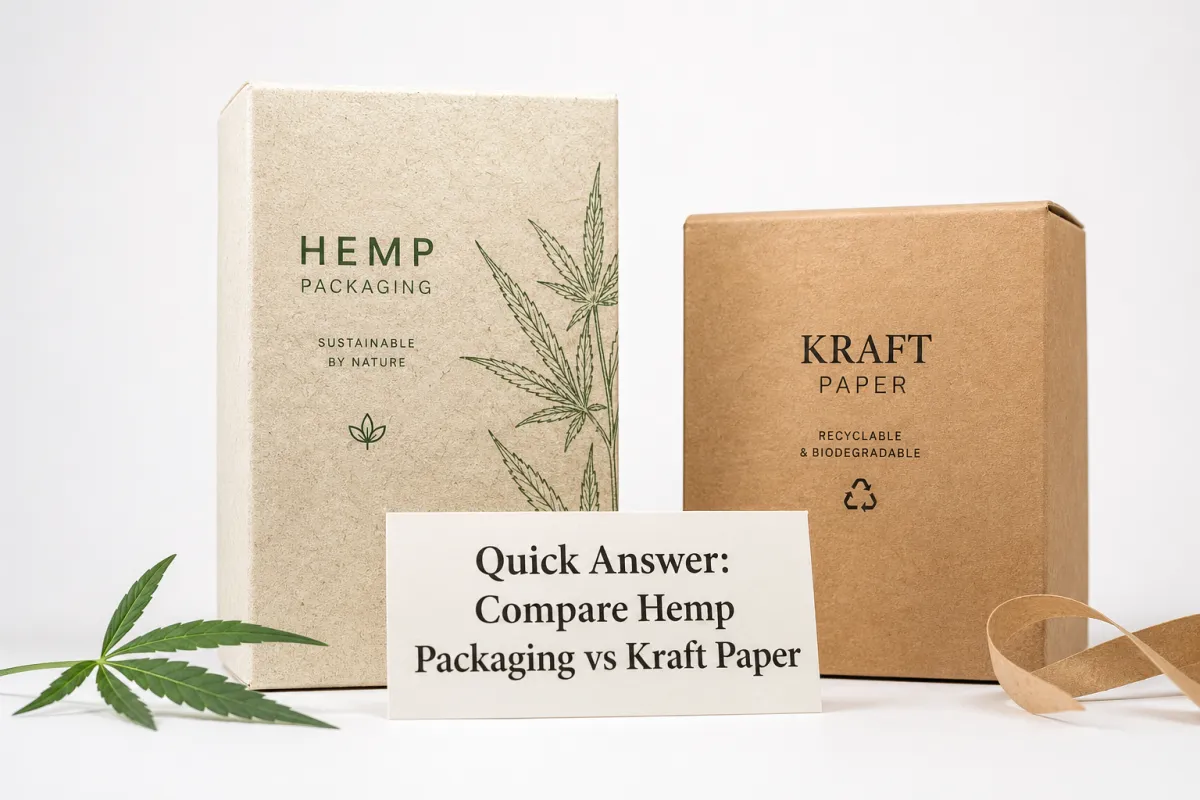
Can one substrate save a launch, or bury it under reprints, rush freight, and weak seams nobody caught during sampling?
That question sounds dramatic until you have lived through it. I have watched a clean-looking sample win approval on a Friday, then fall apart in a humid warehouse by Tuesday. So, if you compare hemp packaging vs kraft paper under identical load, print, and distribution conditions, the answer rarely belongs in a deck. It belongs in production logs: returns, breakage rates, supplier delays, and the late-afternoon chain of emails that starts with “can we still ship on Friday?” A packaging buyer does not pay for a fiber story first. The buyer pays for a package that survives the route, stays inside budget, and does not turn the launch calendar into a hostage note. To compare hemp packaging vs kraft paper properly, you have to measure what happens after the sample looks good and before the shipment lands.
For teams planning Custom Packaging Products, I am comparing hemp packaging vs kraft paper the way a commercial buyer should: performance, cost, schedule, and what happens after samples leave the table and enter the real world. If the goal is stronger packaging design and fewer surprises, the material choice has to fit the distribution model, not just the mood board.
For brands that need to narrow format, finish, or structure first, browsing Custom Packaging Products can help translate the material choice into a practical build. That matters because the best substrate still needs the right box style, insert, or mailer configuration to perform well.
For practical context, I also rely on packaging references from sources such as EPA's materials and recycling references and ISTA shipping test guidance when discussing reliability and compliance. Those sources do not pick winners for you, and honestly, that is a good thing.
Quick Answer: compare hemp packaging vs kraft paper
The blunt answer
If we skip the marketing language and look at production risk, kraft paper usually wins first on availability, cost control, and stable converting in standard mailers, sleeves, wraps, cartons, and inserts. Not because kraft is perfect in every situation, but because it is easier to source, easier to print, and easier to schedule across multiple mills. That combination keeps a lot of brands in a safer shipping lane.
Stopping there would miss the interesting part. Compare hemp packaging vs kraft paper from a brand standpoint, and hemp can win in niches where texture, story, and perceived authenticity carry real weight. A subscription coffee line, a premium supplement brand, or a direct-to-consumer retail launch can use a hemp look and feel to lift perceived value and sharpen retention, as long as coating, print tolerance, and supply consistency are handled with care. In that kind of comparison, the better-looking option is not always the better-performing one.
There is also a middle ground that gets ignored too often. A hemp blend can give you enough tactile difference to matter, while a kraft structure underneath keeps the line running on time. That middle ground is where a lot of sane decisions live.
What this comparison actually measures
Many teams ask only, “Which is stronger?” and leave it there. That question is too small. The useful lens is broader:
- tear and burst resistance
- fold endurance and crease durability
- surface smoothness and ink holdout
- scuff resistance during mail handling
- moisture response after printing and coating
- recyclability, compostability, and claim support
- turnaround and conversion compatibility
If a material clears your own test protocol, it clears the campaign. If it fails one part of the route, the sample may look beautiful while the live run quietly bleeds margin. That is why compare hemp packaging vs kraft paper as an operations question first and a style question second. I have seen a buyer fall in love with a textured hemp sheet, then lose two weeks because the glue line behaved badly at higher humidity. Pretty is nice. Shipable is better.
Why the commercial buyer cares
Picture a brand that wants a compostable-looking mailer for a product with modest margins, maybe a beauty pouch or accessory insert. The obvious question is whether a premium look can survive stacking, shipping, and returns handling without turning into a claim-driven failure.
The hidden cost is where compare hemp packaging vs kraft paper gets expensive. A 0.03 inch split seam after drop testing can trigger 1,500 customer claims. A delayed conversion slot can add 3% to logistics cost. A weak print match can force reprints. On a 20,000-unit run, that is not theory. That is a margin event.
My practical rule is simple: compare hemp packaging vs kraft paper by total landed impact, not by fiber glamour. The “right” choice is the one that cuts preventable failures and launch risk without eroding margin.
If you are selecting branded packaging at a volume where every percentage matters, the first move is a side-by-side test, not an endless debate over material identity. Premium aesthetics can come later, after the logistics are proven.
Top Options Compared: compare hemp packaging vs kraft paper
Hemp family options people actually buy
Very few brands buy pure hemp sheets for every format, so the market usually settles into three practical categories:
- Hemp fiber paper used for wraps, mailer faces, and insert sleeves
- Hemp-blended stocks mixed with wood fiber to steady performance
- Hemp-paper composites with bio-based barriers or thin liners
In most commercial jobs, hemp fiber papers sit around 120–180 gsm for mailers and 170–260 gsm for premium insert sleeves. Coating choice changes behavior more than the fiber name itself. A 160 gsm uncoated hemp sheet can look striking, yet it can become unpredictable under aggressive flex if lamination or sizing is not planned early. That is one reason teams compare hemp packaging vs kraft paper with a prototype in hand, not a spec sheet in isolation.
One more thing: a lot of “hemp packaging” on the market is really hemp-content paper, not 100% hemp fiber. That is not a flaw. It is just how commercial paper supply works. Purity sounds tidy; blend performance usually matters more.
Kraft family options that dominate commercial volume
Kraft paper comes in a wide set of conversion-ready forms:
- Unbleached kraft, common for cartons, pouches, and sleeves
- Recycled kraft, built from post-consumer and post-industrial blends
- Water-based coated kraft for cleaner print response
- Lined kraft, often with PE-free barrier film options for moisture sensitivity
- Corrugated kraft-based boards for stronger structural formats
Kraft used in mailing applications often lands between 90 and 140 gsm for thin pouches and 220–400 gsm equivalent for structured wraps and reinforced inserts. That range matters. Compare hemp packaging vs kraft paper without discussing basis weight, and you are comparing labels, not performance. The difference between a thin kraft mailer and a rigid insert is the difference between a brochure and a shipping system.
“A buyer saved 12% on landed cost in a second pilot because they stopped arguing about the fiber name and standardized caliper, coating, and fold specs first.”
How each option feels after converting
Hemp announces itself the moment you touch it. The fiber texture shows, especially in lower basis-weight blends. In branding terms, that tactile cue can beat glossy kraft in subscription unboxing. In production terms, that same texture can become a liability if die-cut tension and glue lines are not tuned correctly.
Kraft often behaves more neutrally in die-cut and scoring. A 2 to 3 mm score tolerance, paired with a 5 to 6 mm glue overlap and controlled humidity, can deliver repeatable fold results. For brands shipping nationally, that repeatability matters more than most creative teams want to admit. It is not glamorous, but it keeps customers from getting half-open mailers on a rainy Thursday.
Compare hemp packaging vs kraft paper with one hard truth in mind: hemp can deliver stronger storytelling, while kraft often gives better predictability at scale because the converter ecosystem is larger and quality bands are tighter. That is especially true for kraft mailers and repeat replenishment orders.
Reality check: claims versus behavior
Both materials get oversold. Hemp labels can imply “more sustainable” without disclosing process water, chemical finishing, logistics footprint, or recycling pathway. Kraft labels can imply “cheap and green” even when heavy coatings weaken paper recovery in local streams.
The honest approach is to compare hemp packaging vs kraft paper on fiber mix, moisture content, coating stack, and conversion path. Run the same package through the same printer and the same glue station, and the results are often less dramatic than the ad copy suggests. In practice, the difference usually comes down to FSC-certified sourcing, finish selection, and how much risk your team can tolerate during launch.
Detailed Reviews: compare hemp packaging vs kraft paper on performance
Strength and durability: what survives daily handling
In many tests, compare hemp packaging vs kraft paper looks close until fold count and edge stress enter the picture. Packaging is not just stretched in transit. It is folded, refolded, rubbed, dropped, and compressed. Fold endurance often predicts failure better than burst alone.
For ordinary logistics exposure, I see these patterns again and again:
- Hemp blends can feel tougher in hand and more premium in dry conditions.
- Kraft usually delivers more predictable edge strength over large batches.
- Heavily coated kraft can outperform raw hemp in scuff zones by a wide margin.
Precision matters here. If a package needs repeated folds at a 180-degree accordion line, basis weight and fold-line quality matter more than the fiber label. For light wraps, I still recommend a minimum of 120 gsm. For higher-stress shipping layers, 200+ gsm is the safer floor, whether the sheet is hemp or kraft. If you compare hemp packaging vs kraft paper in a drop test, the result is often shaped by the seam, not the sheet.
On one apparel project, a hemp blend made it through the first round of testing with flying colors, then started fraying at the corners after the second round. Kraft with a better score line did not look as romantic, but it held up. That is the sort of trade-off teams only understand after they have patched a few failure reports together at midnight.
Print quality and color control
Commercial printing workflows often look cleaner on kraft. The reason is plain enough: surface uniformity. Many kraft lines are better controlled at scale, and color build is easier to standardize. That matters for product packaging where brand color libraries need repeatability. If your approval process tolerates one shade drift, you have room. If the color lock is strict, make-good costs can climb fast.
Hemp can still look excellent in packaging design. I have seen it work best when teams accept natural color variation and choose less saturated hues. It fits earthy palettes and tactile premium positioning, though hard Pantone matching becomes harder. A hemp sheet with a water-based barrier coating can reduce that gap, but the extra process step adds cost and lead time.
For Custom Printed Boxes and retail-facing SKU fronts, compare hemp packaging vs kraft paper by color consistency goals. If the campaign depends on exact brand color across 20,000 units and future reorders, kraft is usually the safer lane. If the visual language depends on natural texture and restrained inks, hemp can still earn its place.
Moisture, coatings, and real-world behavior
Many assumptions go wrong here. Neither material is automatically moisture-proof. The coating strategy matters more than the fiber selection. Wax alternatives, water-based barrier coatings, and thin liners all change performance in meaningful ways.
In humid climates, kraft with a matte water-based barrier can stay stable with less absorbency. Hemp often needs heavier or more carefully designed finishing to reach the same score. In a humid warehouse, that difference becomes practical very quickly.
If the item is food-adjacent, ask for explicit compliance and hygiene documents at quote stage: intended food-contact or non-food-contact claims, migration or barrier assumptions, and which finishes your QA team accepts. Those answers can differ by region and by converter. I would rather be mildly annoying on the front end than explain a failure to a customer six weeks later.
Sustainability: this part is about systems, not labels
People often treat sustainability like a checkbox. It is not. Compare hemp packaging vs kraft paper by cradle-to-door conditions: sourcing, waste streams, coating chemistry, recycling acceptance, and transport distance. If the buyer base is inland and industrial composting is limited, a compostability claim may sound impressive while doing very little in practice.
Hemp does have a strong narrative as a fast-growing, lower-input crop. Kraft can match it when sourced with FSC oversight, high recycled content, and solid deinking pathways. FSC chain-of-custody documentation is not decoration. It is the audit trail.
The sustainability check should include end-of-life reality: Will customers place it in paper recycling? Do adhesives contaminate recovery? Is there a take-back or reverse logistics loop? If the answer is unclear, compare hemp packaging vs kraft paper with that uncertainty built into the decision, not brushed aside. In many regions, recycled content and clean fiber recovery matter more than a headline claim.
Use-case side-by-side comparisons
Subscription mailers: For recurring monthly drops at scale, kraft often wins because suppliers and converters are tuned for this volume. Hemp can work, but sample-to-production consistency tends to be harder.
Product wraps: Hemp can create a naturally differentiated shelf look for artisan categories; kraft gives cleaner graphics for campaigns with strict color fidelity.
Retail bags: If the bag needs to survive rough store handling, kraft with reinforced seams and anti-scratch surfaces usually performs better under real stress.
Apparel inserts: Hemp’s texture supports premium positioning; kraft with tissue liners can lower moisture risk and lower cost.
Food-adjacent packaging: Both can work when barriers are correct, but lead-time risk often pushes practical buyers toward familiar kraft supply chains.
Protective shipping layers: Kraft with selected corrugated and cushioning add-ons is generally safer and cheaper than an equivalent hemp-heavy system. Compare hemp packaging vs kraft paper against crush resistance and fill ratio, not against brand language.
Bottom line here: for retail packaging reliability, predictability often matters more than novelty. For category-level differentiation, hemp can still be a credible edge.
Price Comparison: compare hemp packaging vs kraft paper costs
Why sheet price is only the starting line
If you only compare unit price, you miss most of the economics. A proper cost model includes:
- material cost by gsm and finish
- minimum order quantity (MOQ), often 500–2,000 for niche hemp runs and 250–1,000 for kraft depending on format
- die and tooling cost
- printing complexity, from one color to CMYK and spot varnish
- freight by pallet count and volumetric weight
- reject and rework risk from first-article and pre-production tests
Typical range patterns
In current supplier landscapes, compare hemp packaging vs kraft paper often looks like this for small-batch runs. Your numbers will vary by region, ink, and finish, so treat these as working ranges rather than promises:
- Simple kraft sleeves, 120–150 gsm, uncoated, 5,000 pcs: roughly $0.48–$0.95 each depending on print and finish.
- Simple kraft mailers with light barrier options: roughly $0.62–$1.30.
- Hemp or high hemp-content substitutes in equivalent formats: roughly $0.75–$1.55, sometimes more depending on MOQ and feedstock.
- Premium hemp showcase sleeves or hand-feel blends with special coating: often $1.20–$2.10 at similar volumes.
These ranges are not promises. They are practical guardrails, and they explain why hemp often enters the conversation as a premium choice rather than a universal replacement. If you compare hemp packaging vs kraft paper only on sheet price, you undercount the finishing steps that make the difference visible.
Format changes the math
Raw comparisons are misleading if you do not normalize format. A kraft mailer at scale may be cheaper than a hemp insert, but a hemp display sleeve on a high-ticket line can outperform a cheaper kraft alternative in conversion if it lifts retention or average order value. The useful formula is margin impact, not sheet cost alone.
| Use Case | Typical Substrate | Typical Unit Cost (5,000 pcs) | Lead Time Signal | Primary Risk | Best Fit |
|---|---|---|---|---|---|
| Standard e-com mailer (small SKU) | 120–140 gsm kraft, light coating | $0.55–$0.95 | 10–16 business days | Print color drift at high volume | Most volume brands and repeat launches |
| Premium mailer for skincare or supplements | Hemp blend with matte top coat | $0.90–$1.60 | 12–20 business days | Color consistency and seam yield | Story-led launches, higher margin products |
| Retail display insert sleeve | 200–260 gsm kraft or hemp blend | $0.70–$1.40 | 14–22 business days | Die-cut tolerance and crease set | Campaign packs, impulse SKUs |
| Protective product wrap | Corrugated-backed kraft | $0.45–$1.10 | 8–15 business days | Compression and edge crushing | Logistics-heavy shipping and storage chains |
| Custom printed box insert | 300 gsm custom stock, either material | $1.30–$2.60 | 12–18 business days | Rework due to alignment and registration | Branded packaging with higher premium intent |
Where compare hemp packaging vs kraft paper usually fails in budgets
The budget trap is timing. Hemp suppliers sometimes book out, which forces a choice between a delayed launch and expedited freight. The expensive line item is then not the raw sheet but the schedule shift and the inventory risk. If holding costs run at 8–12% annualized, a 3-week delay on 10,000 prebooked units becomes a finance issue, not a footnote.
That is why, in commercial planning, compare hemp packaging vs kraft paper like this:
- Use a base landed-cost estimate at planned volume.
- Add a contingency line for sample iteration and first-article rework.
- Add a contingency for freight volatility when MOQs force full-load shipping.
- Only then compare “cheap vs premium.”
With that model in place, kraft usually remains the more budget-friendly core. Hemp can still make sense when package message and margin strategy fit together, especially if it lowers returns or increases conversion enough to offset the unit price. That is the point where compare hemp packaging vs kraft paper stops being abstract and starts affecting gross margin.
Production Process and Timeline: Hemp Packaging vs Kraft Paper
Typical workflow from quote to shipment
Most commercial jobs move through these stages whether you pick hemp or kraft:
- Specification and supplier qualification
- Sample request with exact dimensions, fold style, and printing method
- Lab and press checks, including color and adhesion
- Structural proof on production die-line
- Approval and pre-production sample sign-off
- Full converting run, finishing, and batch QC
- Packing, documentation, and dispatch
That sounds standard, yet compare hemp packaging vs kraft paper and every stage bends under feedstock familiarity. Converters who run millions of kraft units may still need extra setup for hemp blends, especially around glue behavior and coating consistency.
Why timelines diverge
Kraft has broader supplier redundancy and larger production windows. It is often possible to line up two or three viable sources at once. That reduces schedule risk and gives buyers backup options if a coating line fails.
Hemp can be excellent, but many teams face a narrower pool of prequalified mills and printers. That can stretch sample iteration by 3 to 7 business days, sometimes longer when paper lots vary. If launch day is fixed, that is not a minor technical detail. It is a planning constraint.
In my experience, the fastest projects are the ones where the buyer hands the converter a clean, locked spec and does not keep changing the finish every other day. Sounds basic, I know, but that discipline saves more time than any fancy sourcing trick.
Approvals and documents that slow the clock
Any material comparison falls apart when approvals are rushed. The major gates are usually:
- Color matching tolerance against approved brand values
- Structural fit with closures, tape systems, and inserts
- Coating compatibility and dry-down times
- Sustainability claims evidence for marketing language
- Food-contact and retail compliance packets where applicable
For shipping products, ask the supplier to share the applicable transport test criteria. Even if they mention ISTA and ASTM references, request the exact protocol and pass/fail boundaries. That is not paperwork for the sake of paperwork. It is the guardrail against warehouse surprises.
Planning advice for fixed launch windows
If the campaign has a fixed day-zero with little slack, build three questions into the RFQ:
- “What is your current stock availability for this gsm and finish?”
- “Can you provide sample lead time, first proof, and full production lead time in the same quote?”
- “What are your rush options and what triggers expedited fees?”
Compare hemp packaging vs kraft paper under that lens, and the greener label is not always the launch winner. The lower-risk launch winner can matter more than an extra marketing claim.
How do you compare hemp packaging vs kraft paper?
Decision framework by product category
Use this practical filter:
- Premium or artisan positioning: choose hemp when package experience and narrative are strategic.
- High-volume e-commerce and repeat fulfillment: choose kraft when consistency and throughput dominate.
- Complex fulfillment points such as multiple carriers and long transit: choose kraft unless hemp finishing proves superior in your own drop and crush tests.
- Luxury retail with controlled handling: evaluate hemp for brand storytelling if cost and lead time support it.
Match to customer promise, not to trend
A common mistake in package branding is choosing a material because it sounds different. The package then underperforms and weakens trust. The material should reinforce the promise you already make:
- If rugged utility and repeatable execution are the claim, kraft usually aligns more cleanly.
- If natural differentiation and handcrafted cues are strategic, hemp can support that image directly.
- If both matter, test a kraft structure with hemp-like finish treatments and keep the baseline process stable.
Checklist for buyers before sign-off
Here is the checklist I recommend before locking an order:
- What is your target budget after freight and rework?
- What MOQ is feasible for the first run?
- Can the supplier deliver inside your launch timeline for samples, proofs, and approval?
- Do you need verified compliance for food-contact, retail, or recycling claims?
- Will the package face humid, hot, or rough shipping conditions?
When comparing hemp packaging vs kraft paper, the answers to those five questions usually narrow the decision by 80%. Do not add a sixth until you discover your logistics team, not your designer, is the one choosing.
Sustainability versus execution: the trade-off is real
From a sustainability point of view, I keep hearing two camps. Camp A chooses the fiber with the strongest story. Camp B chooses the option that reduces failed stock and transportation waste. The second camp is usually the more complete strategy. If hemp or kraft works better in your current facility, print profile, and distribution model, that is often the lower-environmental option too.
So be direct: compare hemp packaging vs kraft paper with your current supply chain, your printer list, and your packaging design requirements fully mapped. If your distribution route is short-haul and your customers recycle responsibly, the decision can tilt one way. If not, the lane changes.
Our Recommendation: Next Steps after you compare hemp packaging vs kraft paper
Action plan before first big order
Do not keep arguing. Run side-by-side trials. The most reliable method is straightforward: request samples of both materials for the exact product weight, closure style, artwork, and mailing configuration. Compare hemp packaging vs kraft paper under identical finishing and the same printer. If possible, include moisture simulation and a 48-hour warehouse soak-rinse scenario.
For teams selling through channels with strict presentation controls, I suggest a scoring model with six criteria, each scored 1–5:
- Material cost and total landed cost
- Print consistency and color reliability
- Surface feel and package unboxing quality
- Shipping durability and seam integrity
- Sustainability evidence quality
- Lead-time risk and vendor resilience
Do not let brand copy outrun practical performance. Compare hemp packaging vs kraft paper until the weighted score is clear. That takes an afternoon and can spare months of damage. If the score is close, the safer choice often wins by default because fewer exceptions means fewer costs later.
What suppliers should prove before you approve
Ask for concise proof points. Not marketing PDFs. Real evidence.
- Conformance sheets with tear, moisture, and fold specs
- Conversion recommendations for scoring, gluing, and corner reinforcement
- Coating and lamination compatibility notes
- Recycling, composting, and disposal guidance where claims are made
- Samples from similar production runs, ideally with the same print process
If your business carries legal exposure, ask legal and sustainability teams to review claims language before file lock. The words “compostable,” “biodegradable,” and “earth-friendly” need substantiation, not generic language. A vague claim can come back harder than a bad seam.
Run a pilot, not a moonshot
My strongest practical recommendation is a controlled pilot before commitment. Run 500 to 1,000 pieces if possible, then measure exactly what failed and what passed. For many products, that reveals more than any supplier deck. It turns compare hemp packaging vs kraft paper from a procurement guess into an operating decision.
If the outcome is close, optimize one dimension at a time, usually print or coating first, not material. One more direct point: if your packaging volume is stable, you can often lower risk with a kraft baseline and reserve hemp for short, high-margin campaigns. If your brand promise is highly differentiated, set aside budget for a hemp showcase where it earns a real return.
To keep the process moving, most teams do the same three things next: review the pilot scorecard, align with finance on landed cost, and place the order only after those two lines up. That is the commercial-safe way to compare hemp packaging vs kraft paper without buying hype or panic. And yes, it is a little less exciting than a shiny concept board. It also works.
Final call: compare hemp packaging vs kraft paper by what your operation can execute without exceptions. The winning material protects the product, keeps the schedule realistic, and does not quietly add failure cost.
FAQs
Is hemp packaging better than kraft paper for shipping boxes?
Not automatically. For shipping volume and broad format compatibility, kraft is usually easier to source and convert. Hemp can still work well if the premium feel matters and the supplier can meet your test standards.
Which is more cost-effective when you compare hemp packaging vs kraft paper?
Across most commercial runs, kraft is usually the more scalable and lower-cost baseline. Hemp often becomes more expensive once you include finishing, sourcing, and lead-time risk, though it can still make sense for selective premium SKUs.
Does hemp packaging print better than kraft paper?
Kraft usually gives more predictable print consistency in repeat runs. Hemp can look more distinctive and premium, but it often needs more prepress and approval cycles for strict color reliability.
What lasts longer in real packaging use: hemp or kraft?
Durability depends on GSM, coating stack, die-cut quality, and conversion discipline more than the fiber label. Kraft often performs more consistently in common packaging formats, especially in high-volume production.
How do I choose between hemp packaging and kraft paper for my brand?
Choose hemp if the brand story, tactile character, and premium positioning justify the higher cost. Choose kraft if you need stable sourcing, tighter budgets, and faster production with lower schedule risk.


