Buyer Fit Snapshot
| Best fit | Compare Custom Rigid Box Versus Folding Carton Options projects where brand print, material claims, artwork control, MOQ, and repeat-order consistency need to be specified before quoting. |
|---|---|
| Quote inputs | Share finished size, material target, print colors, finish, packing count, annual reorder estimate, ship-to region, and any compliance wording. |
| Proofing check | Approve dieline scale, logo placement, barcode or warning zones, color tolerance, closure strength, and carton packing before bulk production. |
| Main risk | Vague material claims, crowded artwork, missing packing details, or unclear freight terms can make a low unit price expensive after revisions. |
Fast answer: Compare Custom Rigid Box Versus Folding Carton Options should be specified like a repeatable production item. The safest quote records material, print method, finish, artwork proof, packing count, and reorder notes in one written spec.
Production checks before approval
Compare the actual filled-product size with the drawing, then confirm tolerance on folds, seals, hang holes, label areas, and retail display edges. Reserve space for logos, QR codes, warning copy, and material claims before decorative graphics fill the panel.
Quote comparison points
Review material grade, print process, finish, sampling route, tooling charges, carton quantity, and freight assumptions side by side. A quote is only useful when the supplier can repeat the same color, closure quality, and packing count on the next order.
Compare Custom Rigid Box versus folding carton options and the spreadsheet can look deceptively tidy until the first freight quote lands. Then the math stops being polite. I still remember a candle project out of Shenzhen where the rigid sample looked gorgeous in hand, but the carton version cut pallet count, freight, and warehouse headaches in one shot. The sample room lied a little. The shipping lane told the truth. If you care about how a package presents the product, protects it, stores it, and survives the trip from factory to customer, you have to compare custom rigid box versus folding carton with the final destination in mind, not just the mockup table.
I have spent enough time in factories in Guangdong to know the pattern. A rigid box feels premium in a way a carton rarely does, at least on first touch. A folding carton feels efficient because it is. Neither one is automatically better. The right structure depends on the product, the margin, the retail channel, and how much punishment the box is going to take before it reaches the buyer. That is why a smart team compares custom rigid box versus folding carton using landed cost, storage, assembly, and brand perception together. Looking at just one of those columns is kinda how people end up spending too much on packaging and then wondering where the margin went.
Compare Custom Rigid Box Versus Folding Carton: Quick Answer
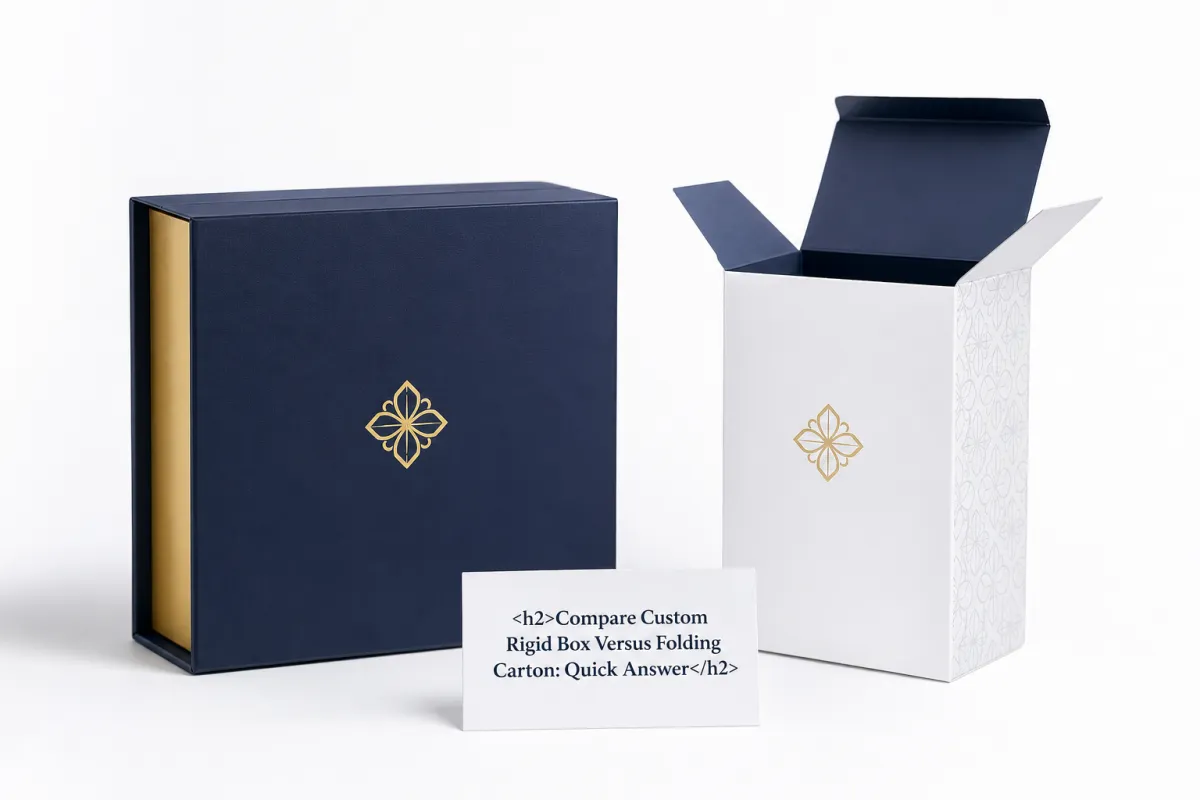
The short version is straightforward. When you compare custom rigid box versus folding carton, rigid boxes usually win on perceived value, giftability, and shelf presence. Folding cartons usually win on unit cost, freight efficiency, and reorder speed. That is the honest answer, not the brochure version with glossy adjectives pasted over the numbers. On a 3,000-piece premium candle launch I reviewed in Guangzhou, a magnetic rigid box came in at $1.42 per unit before freight, while an 18pt C1S folding carton with matte varnish and a paper insert landed at $0.39 per unit. That gap was enough to fund photography, sampling, or a small paid media push. Compare custom rigid box versus folding carton on landed cost, and the choice often gets clearer in one worksheet.
My commercial takeaway is simple. If the package needs to help justify a higher price, elevate the unboxing, or make the product feel like a gift, rigid often earns its keep. If the box mainly needs to protect, inform, and travel through retail or e-commerce without drama, carton is usually the smarter spend. I have seen finance teams go silent for a few seconds after seeing a rigid quote, and that pause usually says more than the deck does. Compare custom rigid box versus folding carton with the customer journey in mind, and the stronger option often reveals itself before production starts.
“I can make either box look good. What matters is which one still makes sense after freight, storage, and labor are added. On a container out of Shenzhen, that difference can be the thing that saves or sinks the margin.”
One practical rule: ask suppliers to quote both structures against the same product dimensions, print coverage, and finish level. If they refuse to do that cleanly, they are not really helping you compare custom rigid box versus folding carton. They are steering you toward the pricier structure, which is convenient for them and not especially helpful for you. I usually ask for a side-by-side based on a 110 x 85 x 30 mm product with matching 4-color print, foil logo, and the same delivery window. The truth shows up fast when the spec is identical. Compare custom rigid box versus folding carton on the same sheet, and you can tell whether the premium is buying real value or just a nicer-looking quote.
Top Differences When You Compare Custom Rigid Box Versus Folding Carton
The biggest difference is structure. Rigid boxes use thick chipboard, usually around 2mm to 3mm, wrapped in printed paper or specialty stock. Folding cartons use paperboard, often 14pt to 24pt depending on the product, and ship flat until they are formed. A 2.5mm grayboard wrapped in 157gsm art paper behaves very differently from an 18pt C1S carton board, and that one difference changes almost everything when you compare custom rigid box versus folding carton across storage, freight, and assembly.
Feel is next, and procurement teams sometimes underestimate it until a buyer lifts two samples at a trade show. A rigid box has weight in the hand. It feels deliberate. A folding carton can still look sharp with good print and a disciplined dieline, but it usually does not trigger the same luxury signal on first touch. I watched a buyer in Guangzhou spend just a few seconds with each sample before pointing at the rigid version because it felt like it could support a higher retail price. That happens more often than brands admit. The human brain is easy to impress with a clean corner and a little heft. Compare custom rigid box versus folding carton for perceived value, and the hand test often changes the conversation before the numbers do.
Protection splits the field too. Rigid boxes handle heavier items, fragile items, and gift sets better because the shell stays square and the insert can be engineered around the product. Folding cartons work well for lighter products and controlled handling. A 120g skincare jar is one thing. A 500ml glass serum bottle with a dropper is another. When you compare custom rigid box versus folding carton for those two cases, the answer should not be the same. A carton built from 350gsm C1S will not behave like a two-piece rigid shell with an EVA insert. Compare custom rigid box versus folding carton again after the product weight is known, and the sturdier structure usually makes more sense for the heavier item.
Supply chain impact is where the practical people usually win. Rigid boxes take more warehouse space, more freight per unit, and more hand assembly. Folding cartons ship flat, stack better on pallets, and are easier to store by the case. I once had a client in Los Angeles cut inbound freight by roughly 28% by switching from a 2.5mm rigid setup to a folding carton with a better insert design. Same product. Same print. Different physics. A 1,000-piece rigid order can fill two pallets; the carton version may fit on one. The warehouse manager sent me a thank-you note, which was a first and probably a sign the old setup had been driving everyone a little mad. Compare custom rigid box versus folding carton in warehousing terms, and the flat-pack option usually pays off before the goods even leave port.
Decoration shifts the equation too. Foil stamping, embossing, debossing, soft-touch lamination, and hidden magnets push rigid boxes further into premium territory. Folding cartons rely more on print quality, structural clarity, and selective finishes like aqueous coating or spot UV. Both can be branded packaging. They just tell different stories. One says gift. The other says efficient and polished. On a 12,000-unit cosmetics run out of Dongguan, I saw a rigid box with gold foil and a deep emboss sit next to a folding carton with spot UV and a clean die cut; both looked good, but only one could justify the higher packaging budget. I have a soft spot for both, but not in the same conversation with finance. Compare custom rigid box versus folding carton for finish options, and ask whether the finish is helping the product or just filling surface area.
For a grounded view on sustainability and fiber sourcing, the basics matter here. If you are checking FSC-certified paper or recycled content, start with the standards on FSC and packaging waste guidance from the EPA. A folding carton made from recycled board can still beat a rigid box made from virgin chipboard on material efficiency. That does not choose the box style for you, but it keeps the decision tied to material facts instead of marketing language. Compare custom rigid box versus folding carton with recycled board in mind, and the lower-material option often has the cleaner environmental profile too.
People compare custom rigid box versus folding carton and then stare at the prettiest sample while ignoring the production reality. That is backwards. A sample with a velvet tray and foil logo can hide extra labor, extra scrap, and extra freight. I have seen one procurement team approve a rigid design on looks alone, then scramble when the warehouse manager asked where 8,000 assembled boxes were supposed to live in a 1,200-square-foot storage room. Not glamorous. Very expensive. Useful lesson, though. Compare custom rigid box versus folding carton with the warehouse floor in view, and the prettier option becomes less persuasive if the storage math breaks.
Detailed Review: When a Custom Rigid Box Wins
A custom rigid box wins when the packaging is part of the product experience. Cosmetics sets, candles, premium food gifts, jewelry, headphones, launch kits, and influencer mailers all benefit from the heavier structure. When you compare custom rigid box versus folding carton for those categories, rigid usually delivers the stronger first impression and the better unboxing moment. A two-piece lid-and-base box with 2mm grayboard, 157gsm art paper wrap, and a black EVA insert can make a $38 serum set look closer to a gift item than a commodity. Compare custom rigid box versus folding carton for premium launches, and rigid often carries more of the story with less explanation from sales.
I remember a cosmetics client in Shenzhen who moved from a folding carton to a two-piece rigid lid-and-base box with matte black wrap and a foil logo. The formula did not change. The shelf reaction did. Sell-through improved because the box looked more like a gift and less like an everyday carton. That is not magic. It is packaging doing its job. The first reorder was 6,000 units, and the client approved the next run in 11 days because the packaging had already done half the selling. Compare custom rigid box versus folding carton in that situation, and the rigid format wins because it helps the brand sell, not just ship.
Rigid boxes also earn their keep when the product gets handled more than once. A sample kit for an electronics distributor, for example, might get opened, repacked, shipped, and opened again across several sales meetings. A flimsy structure looks tired after two rounds. A rigid shell holds shape longer, keeps inserts seated, and resists corner crush better. If the box will be seen in meetings, on shelves, and on camera, compare custom rigid box versus folding carton with durability in mind. A 2.5mm shell from Dongguan will take more abuse than a 16pt carton from the same line, even if the artwork is identical.
Luxury brands keep paying for rigid structures for a reason. The box can support higher perceived value, which helps wholesale presentation, retail pricing, and review content. People photograph good packaging. They do not post a picture of a generic carton unless something has gone sideways. I have sat through enough buyer meetings in Hong Kong and Los Angeles to know that box quality can become a conversation about brand seriousness in under a minute. Sometimes that conversation is flattering. Sometimes it is awkward. Sometimes the same buyer asks for a sample of each, then chooses the one with the ribbon pull because it feels like a gift. Compare custom rigid box versus folding carton at the buyer table, and rigid is usually the format that earns the extra pause.
Still, rigid is not the answer every time. I reviewed a quote for a $12 accessory line where the client wanted a magnetic rigid box with a molded insert, and packaging alone would have eaten almost 18% of gross margin. That is not premium. That is vanity dressed up as strategy. When you compare custom rigid box versus folding carton, make sure the packaging supports the economics, not just the mood board. A rigid box costing $1.08 at 5,000 pieces is hard to defend if the product itself only leaves $4.20 in contribution margin. Compare custom rigid box versus folding carton in margin terms, and the rigid option needs a clear commercial reason to stay in the plan.
- Best fit: premium skincare, candles, jewelry, electronics accessories, gift sets, and launch kits.
- Typical board: 2mm to 3mm chipboard wrapped with 157gsm art paper or specialty stock.
- Finish options: foil stamping, embossing, soft-touch lamination, magnetic closure, ribbon pull.
- Business case: stronger perceived value, better shelf impact, better unboxing content.
If you want to see how formats compare across a wider set of product packaging options, our Custom Packaging Products page is a good place to start. I also point teams to our custom printed boxes line when they need to see what different structures do to the budget before they commit, especially on 3,000 to 10,000-piece orders. Compare custom rigid box versus folding carton alongside other custom printed boxes, and it becomes easier to see which format fits the brand promise.
Detailed Review: When a Folding Carton Wins
A folding carton wins when the box needs to be efficient, scalable, and easy to move. Supplements, lightweight skincare, pharmaceuticals, snacks, apparel accessories, and high-volume retail items usually fit this format well. When you compare custom rigid box versus folding carton for those categories, carton often gives you enough presentation without paying for structural overkill. A 350gsm SBS or 18pt C1S carton can hold a 90g lip balm set, a 120g supplement bottle, or a 45g tea tin without draining the budget. Compare custom rigid box versus folding carton for routine retail inventory, and the carton usually keeps the economics cleaner.
The biggest advantage is flat shipping. A folding carton can arrive as sheets, take up less warehouse space, and get assembled only when needed. That matters on repeated orders and seasonal launches. I have watched clients shave meaningful storage costs simply by stopping the habit of storing assembled boxes like they were display pieces in a museum. In one case, a supplement brand in Texas cut pallet count by more than half after moving to folding cartons with a clean tuck-end design. The operations team was thrilled, and the old boxes finally stopped occupying half the room like unwanted relatives. Compare custom rigid box versus folding carton on storage and pallet use, and the flat carton wins with less drama.
Speed is another strong point. Folding cartons are generally faster to manufacture because the workflow is simpler. Once the artwork, dieline, and print plates are approved, production moves quickly. Rigid boxes involve wrapping, corner work, assembly, and more hands on the line. When demand spikes, folding cartons are easier to scale without turning the warehouse into a cardboard traffic jam. On a standard order from proof approval, a folding carton run can typically ship in 12-15 business days, while a rigid box line may need 18-25 business days once inserts and wrapping are included. Compare custom rigid box versus folding carton on lead time, and the carton often has the schedule advantage too.
Design flexibility still exists. A smart folding carton with strong typography, accurate die-cutting, spot UV, and a well-planned insert can look far better than people expect. I visited a facility in Dongguan where an 18pt carton with embossed logo and a white-on-black print finish was holding its own next to much pricier boxes. The brand did not need rigid to look credible. It needed clean graphics and discipline. The carton used 350gsm C1S artboard, a 0.5mm paper insert, and a matte aqueous coating that kept fingerprints off the panel in humid weather. That is what separates Packaging That Feels thought-through from packaging that just feels expensive for no reason. Compare custom rigid box versus folding carton for visual polish, and a disciplined carton can still carry the brand story well.
The limit is obvious. If the product is heavy, fragile, or meant to feel like a gift, carton may save money up front and cost you on customer experience. I do not like pretending otherwise. When you compare custom rigid box versus folding carton, the carton usually wins on operational efficiency, but not every item should be optimized only for pallet math. Humans buy with their eyes first and their calculators later, which is inconvenient but true. A folding carton at $0.23 per unit for 10,000 pieces is excellent if the product is a 60g tea sampler; it is a poor fit if the item is a 600g glass candle. Compare custom rigid box versus folding carton with the product weight and breakability in view, and the lighter structure wins only when the item is actually light.
- Best fit: supplements, lightweight skincare, snacks, pharma, apparel accessories, and mass retail.
- Typical board: 14pt to 24pt paperboard, often C1S, C2S, or kraft depending on the brand.
- Finish options: matte varnish, aqueous coating, spot UV, foil accents, window patching.
- Business case: lower freight, less storage, faster production, easier reorder cycles.
Price Comparison: Custom Rigid Box Versus Folding Carton Costs
Let us talk money, because that is where the conversation usually gets real. When you compare custom rigid box versus folding carton, the rigid option usually costs several times more per unit. That comes from chipboard, wrap paper, assembly labor, insert work, and heavier freight. Folding cartons are cheaper because they use less material, ship flat, and are easier to run at scale. On a 5,000-piece order, the difference between a $0.15-per-unit carton and a $1.08-per-unit rigid box can be large enough to fund a full product photography day in Shanghai or a second pre-launch sampling round. Compare custom rigid box versus folding carton on pricing alone, and the carton almost always starts ahead.
Here is a practical side-by-side based on real quote ranges I have seen on mid-volume projects. These are not universal prices. A black magnetic box for a cosmetics set will not cost the same as a white drawer box for a pen. The spread is still realistic enough to make the choice less abstract, especially when the same project ships from Shenzhen to Chicago in the same week. Compare custom rigid box versus folding carton with this kind of table in hand, and the cost structure becomes easier to explain to finance, sales, and operations.
| Factor | Custom Rigid Box | Folding Carton |
|---|---|---|
| Typical unit cost at 3,000 pieces | $0.95 to $1.80, depending on finish and insert | $0.18 to $0.55, depending on board and print |
| Storage requirement | High, because boxes arrive assembled or semi-assembled | Low, because cartons ship flat |
| Freight impact | Higher due to bulk and weight | Lower due to flat packing |
| Setup complexity | Higher, with more sample approval steps | Lower, with faster prepress and conversion |
| Perceived value | Very high | Moderate to high, depending on print quality |
Setup costs matter too. Dielines, plates, sample boxes, finish upgrades, and insert tooling can move a quote fast. I once negotiated with a Shenzhen supplier who wanted an extra $260 for a foam insert mold on a small run of 2,500 pieces. I told them flatly that the client was not building a spaceship. We changed the insert spec, saved $0.11 per unit, and kept the margin alive. That is the sort of thing that happens every week when you compare custom rigid box versus folding carton honestly instead of emotionally. A simple paperboard insert from Xiamen often does the job just as well as a custom EVA tray from Foshan if the product weighs under 180g. Compare custom rigid box versus folding carton on insert complexity, and the cheapest insert is often the one that fits the product without overbuilding it.
Hidden costs are what catch people. Rigid boxes need more shelf space, more handling, and more labor on final pack-out. Folding cartons often save money every time you ship them flat, then save again when your warehouse team is not chasing loose lids and trays. On a 10,000-unit order, that difference can easily add up to hundreds or even thousands of dollars once storage and labor are counted. I have seen otherwise smart teams miss that part because the sample looked too good to question. A 48 x 40 inch pallet loaded with rigid boxes can cost more to move than the box itself on some lanes. Compare custom rigid box versus folding carton with storage and labor included, and the flat structure often protects the budget better than the sample quote suggests.
MOQ also changes the math. At lower quantities, rigid boxes feel expensive very quickly because the setup and labor are spread over fewer units. At higher quantities, folding cartons usually stay the cheaper route by a wide margin. If a supplier gives you one quote for a rigid box and one for a carton, compare custom rigid box versus folding carton on landed cost, not just factory price. Freight to your warehouse can turn a small difference into a very expensive surprise. A $0.22 carton can look fine until a 6-cubic-meter rigid shipment from Ningbo adds another $380 in ocean charges and destination handling. Compare custom rigid box versus folding carton at the MOQ you actually plan to order, and the break-even point gets easier to see.
My rule is blunt. If the packaging is a visible part of why the customer buys, the extra spend on rigid can be worth it. If the box is just a container, use carton and keep your money in the product, the ad budget, or the packaging program that actually moves units. That sounds plain because it is plain, but packaging budgets have a funny way of disappearing if nobody says the quiet part out loud. On a $24 candle line, $0.30 saved per unit across 20,000 units is $6,000, and that is a real line item, not an abstract principle. Compare custom rigid box versus folding carton against the budget line, and the savings can be large enough to change the launch plan.
Process and Timeline: How Each Packaging Type Gets Made
The production workflow looks similar on paper, but the timing is not. Brief, dieline, artwork, prototype, approval, production, inspection, and shipping happen for both formats. The difference is that rigid boxes need more manual work and more sample scrutiny. Folding cartons are simpler to convert and usually move faster through the line. In a standard factory schedule, a carton project can move from proof approval to finished goods in 12-15 business days, while a rigid project often runs 18-25 business days because of wrapping, corner work, and insert assembly. Compare custom rigid box versus folding carton on schedule risk, and rigid usually asks for a wider buffer.
For folding cartons, the sample loop can be short if the artwork is clean and the structure is settled. I have seen a carton sample approved in four business days after one digital proof and one physical mock-up. For rigid boxes, I have also seen a sample bounce back three times because the wrap paper lined up 1.5mm off on the corner fold. That tiny misalignment matters when the client is paying for premium. The box does not get to look “almost right.” On a 5,000-unit makeup launch from Dongguan, a 0.8mm shift in foil placement delayed approval by five business days and pushed the ship date into the next freight window. Compare custom rigid box versus folding carton during sample review, and the carton often reaches approval with less back-and-forth.
Rigid boxes also suffer more from finish-related delays. Foil stamping, embossing, soft-touch lamination, ribbon pull insertion, and custom inserts can all slow the line. Folding cartons are not immune to delays, but the bottleneck is often less dramatic. If you are trying to hit a retail launch date, compare custom rigid box versus folding carton with the production calendar visible, not hidden. A campaign targeting a March 15 shelf date in the United States should account for an extra 7-10 days if the rigid box has a magnet closure and a cotton-finished wrap. Compare custom rigid box versus folding carton on launch timing, and a carton can save a campaign that has a tight retail window.
One factory-floor lesson I learned the hard way: ask exactly how the boxes are packed for shipment. A supplier once told me “cartons in master cartons” like that explained anything. It did not. I wanted carton count per outer, outer carton dimensions, stack height, and whether they used corner protection. The answer changed the freight quote by $480 on a mid-size order. That kind of detail is not glamorous, but it decides whether the project stays on budget. It also keeps you from discovering, too late, that the clean quote was missing the one line item that matters most. A 6.5kg master carton with 100 flat folding cartons behaves very differently from 20 assembled rigid boxes in a double-wall shipper. Compare custom rigid box versus folding carton with pack-out specs included, and you remove a lot of preventable surprises.
For procurement, this is the checklist I use with both Custom Printed Boxes and luxury rigid packaging vendors:
- Confirm exact dimensions, insert style, and material grade.
- Ask for sample lead time and mass-production lead time in business days.
- Confirm whether freight, duties, and packaging labor are included.
- Ask for finish options and whether each one changes MOQ.
- Request a landed-cost quote, not just a factory quote.
Standards matter as well. If the product will ship through multiple distribution points, ask whether the box is being tested against a relevant transport protocol such as ISTA procedures. I have seen beautiful boxes fail because the outer shipper was underbuilt, especially on a long lane with two transloads. Packaging design should be judged in the real chain, not only on a conference table. A carton that survives a 1.2-meter drop test is more useful than a rigid sample that only survives a photo shoot. Compare custom rigid box versus folding carton with transit testing in mind, and the choice often becomes more practical than decorative.
How Do You Compare Custom Rigid Box Versus Folding Carton?
If you want the short version, here it is. Choose rigid when premium perception, gifting, and product protection are the priorities. Choose folding carton when speed, savings, and flat-shipping efficiency matter more. That is the core of compare custom rigid box versus folding carton, and it stays true across most product categories. A $7 lip treatment in a 2mm rigid box and a $7 supplement bottle in an 18pt carton are not trying to do the same job, even if the images sit side by side on the same Shopify page. Compare custom rigid box versus folding carton by asking what the package must do on day one, then ask what it will cost on day thirty.
My recommendation is not to guess. Order one prototype of each format, put the actual product inside, and compare landed cost with the same freight assumptions. I have seen a beautiful rigid sample lose the argument the second someone added shipping and fulfillment labor. I have also seen a folding carton look ordinary on paper and then perform well because the print, finish, and structure were disciplined. I am biased toward evidence here, mostly because packaging has a bad habit of flattering people who do not run the numbers. On a 1,000-piece test, that evidence can be as simple as a $0.92 rigid sample versus a $0.24 carton sample and a 14-minute pack-out comparison in the warehouse. Compare custom rigid box versus folding carton with a real product inside, and the right choice often becomes obvious after one packing session.
Ask the supplier the questions that expose the real numbers: chipboard thickness, paperboard grade, insert material, finish options, MOQ, sample cost, and whether the quote includes freight or only factory price. If they cannot answer cleanly, they are not ready to help you compare custom rigid box versus folding carton. They are ready to quote you a surprise. I usually want the numbers in writing, with the city of origin, such as Shenzhen, Dongguan, or Ningbo, and the promised proof-to-production timeline in business days. Compare custom rigid box versus folding carton on the same written assumptions, and you remove most of the noise from the decision.
When clients ask where to start, I tell them to build a side-by-side spec sheet and send it to two suppliers. One should price a rigid version. One should price a carton version. Use the same dimensions, same print coverage, same insert requirements, and same delivery destination. That is the only way to compare custom rigid box versus folding carton without fooling yourself. A 120 x 90 x 35 mm tray box quoted from Guangzhou and a carton quoted from Xiamen can only be judged fairly if freight, duties, and assembly are visible on the same sheet. Compare custom rigid box versus folding carton at the same destination, and the quotes become a decision tool instead of a guessing game.
If you need a broader look at retail packaging formats, our Custom Packaging Products page shows how different constructions change cost and appearance. It is also a useful sanity check before you approve a package direction that looks expensive but ships like a brick. I have seen a 2.8mm rigid sample weigh 180g before product insertion, and that kind of number tells you a lot before the first pallet moves. Compare custom rigid box versus folding carton with that weight difference in mind, and the lighter package often wins on logistics before design even enters the discussion.
My final verdict is plain. Compare custom rigid box versus folding carton by asking what the box has to do for the product, not what looks best in a render. If the packaging must sell the item, support a premium story, and create a real unboxing moment, rigid is usually the better spend. If the packaging must protect, inform, and move efficiently through the supply chain, carton is usually the smarter choice. That is the answer I give after factory visits in Shenzhen and Dongguan, supplier negotiations in Guangzhou, and more sample revisions than I care to count. The right box is the one that still makes sense after the 3,000-piece quote, the freight bill, and the warehouse tally are all sitting in front of you. Compare custom rigid box versus folding carton one last time on those three numbers, and the better path usually stops being a debate.
Is custom rigid box versus folding carton better for premium products?
Rigid boxes are usually better when the package has to feel luxurious, collectible, or giftable. Folding cartons can still look premium, but they need stronger print, better structure, and tighter finishing to get there. If shelf impact and unboxing matter more than cost, rigid is usually the safer choice. On a 5,000-piece gift set out of Shenzhen, a 2mm rigid shell with 157gsm wrap will usually read more premium than an 18pt C1S carton with spot UV. Compare custom rigid box versus folding carton for premium products, and rigid usually wins the first impression test.
Which costs less in custom rigid box versus folding carton orders?
Folding cartons almost always cost less per unit and usually cost less to ship. Rigid boxes have higher material, labor, and freight costs because they do not ship flat. The gap grows fast when the order volume is low, especially under 5,000 pieces. I have seen a carton price at $0.21 per unit for 5,000 pieces versus a rigid quote at $1.12 per unit for the same product size, before ocean freight from Ningbo was added. Compare custom rigid box versus folding carton on total landed cost, and the carton is usually the lower-cost path.
How long does custom rigid box versus folding carton production usually take?
Folding cartons are typically faster because the structure is simpler and the boxes ship flat. Rigid boxes usually take longer because of wrapping, assembly, and more detailed sample approval. Specialty finishes and custom inserts can extend both timelines by several business days. A common cycle is 12-15 business days from proof approval for folding cartons and 18-25 business days for rigid boxes, not counting freight from China to the destination port. Compare custom rigid box versus folding carton on lead time alone, and the carton usually gives you more breathing room.
Which option protects products better, custom rigid box versus folding carton?
Rigid boxes generally protect fragile or heavier products better because of the thicker structure. Folding cartons work well for lighter products when the internal fit is tight and the shipment is controlled. For shipping damage concerns, the insert and outer mailer matter almost as much as the box style. A 2.5mm rigid box with an EVA insert from Dongguan will usually outperform a 350gsm folding carton for a glass bottle over 300g. Compare custom rigid box versus folding carton for protection, and rigid is usually the better choice for heavier or breakable items.
What should I ask a supplier before I compare custom rigid box versus folding carton quotes?
Ask for the same dimensions, same print coverage, and same finish level in both quotes. Request sample cost, MOQ, lead time, freight assumptions, and whether inserts are included. Make sure the supplier prices the quote on landed cost, not just factory price, or you are comparing fiction. I also ask for the manufacturing city, such as Shenzhen or Guangzhou, because a 10-day road-freight move inside China can change the timing before ocean freight ever starts. Compare custom rigid box versus folding carton with that data in front of you, and the supplier conversation becomes much more direct.
Can folding cartons still feel premium?
Yes, if the print, structure, and finish are disciplined. A folding carton with strong typography, clean die lines, good board selection, and a restrained finish can look far more upscale than a busy rigid box that is trying too hard. I have seen a matte black carton with white ink and spot UV beat a clumsy rigid sample on shelf appeal. It is not the usual outcome, but it happens. Compare custom rigid box versus folding carton with actual print samples in hand, and the carton sometimes surprises people in a good way.