Buyer Fit Snapshot
| Best fit | Compare Folding Carton vs Rigid Box projects where brand print, material claims, artwork control, MOQ, and repeat-order consistency need to be specified before quoting. |
|---|---|
| Quote inputs | Share finished size, material target, print colors, finish, packing count, annual reorder estimate, ship-to region, and any compliance wording. |
| Proofing check | Approve dieline scale, logo placement, barcode or warning zones, color tolerance, closure strength, and carton packing before bulk production. |
| Main risk | Vague material claims, crowded artwork, missing packing details, or unclear freight terms can make a low unit price expensive after revisions. |
Fast answer: Compare Folding Carton vs Rigid Box: Board, Finish, Dieline, and Unit Cost should be specified like a repeatable production item. The safest quote records material, print method, finish, artwork proof, packing count, and reorder notes in one written spec.
Production checks before approval
Compare the actual filled-product size with the drawing, then confirm tolerance on folds, seals, hang holes, label areas, and retail display edges. Reserve space for logos, QR codes, warning copy, and material claims before decorative graphics fill the panel.
Quote comparison points
Review material grade, print process, finish, sampling route, tooling charges, carton quantity, and freight assumptions side by side. A quote is only useful when the supplier can repeat the same color, closure quality, and packing count on the next order.
The first time I had to compare folding carton vs rigid box for a skincare launch in Dongguan, the rigid sample came off the bench with 2 mm chipboard, a black soft-touch wrap, and a magnetic flap that snapped shut with a very satisfying pull. It looked like a $35 gift set before we had printed a single logo. That is exactly how packaging seduces people before the spreadsheet gets a turn.
I was standing in the sample room under 4,000K lights, trying not to grin, and thinking, "Well, there goes the budget if nobody does the math." That feeling has followed me through enough factory visits to know it is not a one-off. It happens again and again, especially when a beautiful rigid sample lands in front of a brand team that has already fallen in love with the finish.
My blunt take is simple. Folding cartons usually win on price, speed, storage, and freight efficiency, especially on runs of 5,000 to 20,000 pieces. Rigid boxes win on hand feel, shelf presence, and perceived value, particularly when the customer opens the package in a boutique in Seoul, Singapore, or San Francisco. The ugly part sits inside the quote sheet: a box that looks inexpensive on screen can become the expensive choice once you add hand assembly, EVA foam or paperboard inserts, sample rounds, and cubic-volume shipping. Honestly, that is where a lot of packaging decisions go sideways. People fall in love with the render and forget the pallet count, and that is why I still compare folding carton vs rigid box with landed cost before anyone starts talking about foil, embossing, or ribbon colors.
I have stood on factory floors in Dongguan and Huizhou while a line lead held up a rigid box with a 0.5 mm corner bow and told me, very politely, that the brand team wanted "luxury" but had budgeted like a grocery SKU. I have also sat in client meetings in Los Angeles where a $0.28 folding carton saved a launch because the product margin was only $4.10. That is why I review packaging like a buyer, not a brochure writer. I have been burned enough times to keep one eye on the spreadsheet and the other on the sample table, which is the only sane way to compare folding carton vs rigid box when a freight quote from Shenzhen shows up in a different email.
How do you compare folding carton vs rigid box?
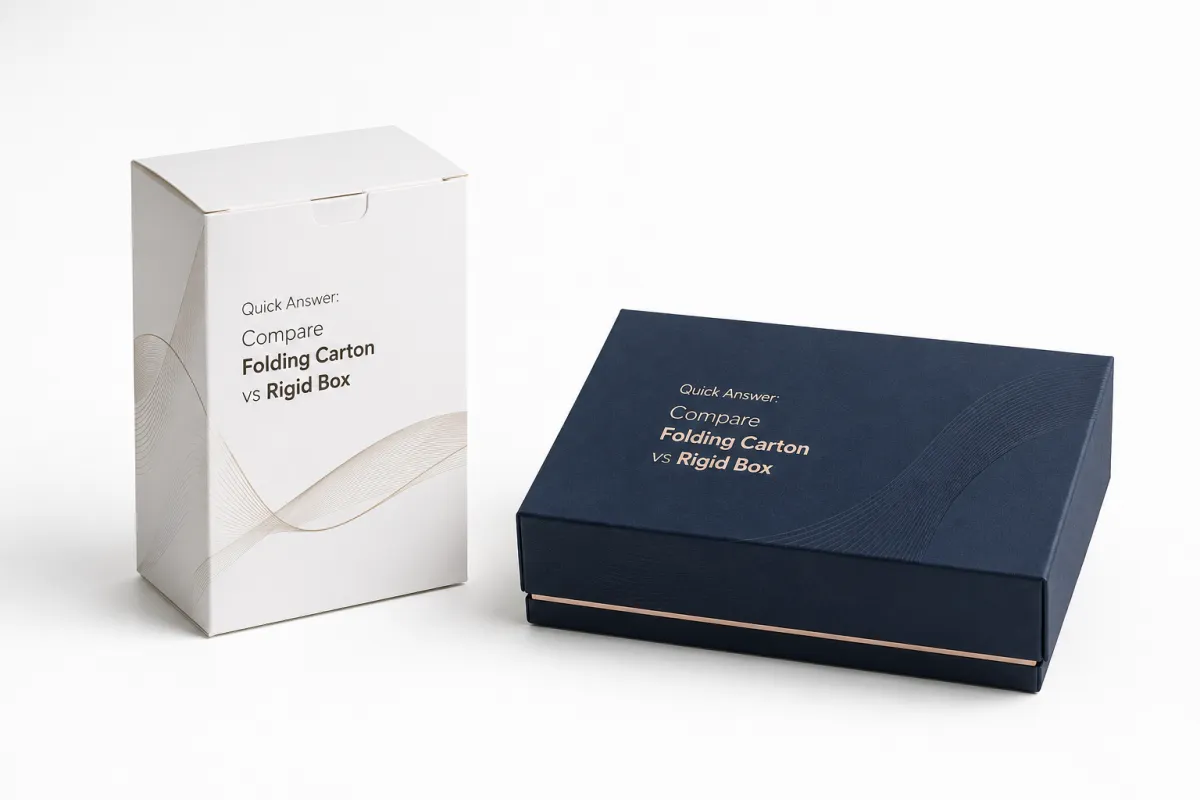
If you need the short version, judge the job the packaging has to do, not the render. Folding cartons are the workhorse. They are lighter, easier to ship flat, and usually much cheaper to produce at scale, especially on 350 gsm C1S artboard or 400 gsm SBS with aqueous coating. Rigid boxes are the showpiece. They cost more, take more labor, and deliver a premium feel that people notice the second they pick them up. I know that sounds obvious, but I have watched too many teams miss it because the rigid sample looked gorgeous under studio lights in Guangzhou.
On a recent quote set I reviewed, a 5,000-piece folding carton run in 350 gsm C1S with matte aqueous coating came in at $0.15 per unit from a supplier in Ningbo, rising to $0.34 per unit when we added foil stamping and a two-piece paperboard insert. A similar quantity of rigid boxes, built with 1.5 mm chipboard, full-wrap printed paper, and a magnetic closure, started at $1.35 per unit and climbed to $2.10 once the insert changed from paperboard to die-cut EVA foam. That gap is not a rounding error. It can decide whether a launch makes money or turns into a very expensive lesson with pretty packaging. Paper markets, board thickness, labor rates, and currency all move those numbers around, so I treat any quote as a snapshot, not a promise.
Here is the part I wish more brand teams would say out loud: the better box is the one that supports your product economics. If the product retails at $18 and the packaging is $2.10 before freight, the math starts to wobble, especially once a 3% warehouse damage allowance is added. If the product retails at $120 and the packaging adds real gift value, the rigid box may earn its keep. I have had clients try to justify the box first and the margin second. That order of operations usually ends with a long silence in the finance meeting and a revised PO from accounting three days later. When I compare folding carton vs rigid box for an early quote, I start here because everything else depends on this answer.
"We switched from a rigid box to a folding carton with a molded pulp insert and saved $11,800 on the first order of 8,000 units. The customer still thought it felt premium because the print, spot UV, and board stiffness were right."
I have seen that exact result more than once, including a haircare launch in Toronto and a tea set shipped through a fulfillment center in Phoenix. Fancy structure gets attention, sure. Print quality, stock choice, and fit do a surprising amount of heavy lifting in a lot of categories. That is why I always compare folding carton vs rigid box with landed cost, shipping method, and perceived value on the same sheet of paper, usually a simple spreadsheet with freight by pallet and a separate line for sample charges. Not vibes. Numbers. And yes, I say that with a straight face even when somebody in the room is trying to sell me on "premium energy" as if that were a cost line item.
Top Options Compared: Compare Folding Carton vs Rigid Box by Use Case
When I compare folding carton vs rigid box for a real client, I start with use case. Ecommerce, retail shelf, gifting, subscriptions, and promotions each punish packaging in different ways, and those differences show up in transit tests, warehouse cube, and retail labor. A box that survives a boutique shelf in Milan does not always survive a parcel sortation line in Dallas. A box that looks elegant in a gift bag can turn into wasted space in a corrugated mailer if it has too much air around the product. I have seen the same design look smart in one channel and absurd in another, and nobody enjoys paying for the wrong version.
Ecommerce Orders
For ecommerce, folding cartons usually win unless the packaging itself is part of the sale. They ship flat, stack neatly, and give you more units per pallet, which matters when a 40-foot container is already packed to the roof on a Shenzhen-to-Los Angeles lane. That matters when a fulfillment center charges storage by cubic foot and the freight bill is already ugly. If the SKU is a serum, supplement, candle, or accessory under 1 lb, a folding carton with a snug insert is often the smarter move. I have watched ops teams breathe a visible sigh of relief when the carton stack fits cleanly on a pallet without turning the warehouse into a Tetris disaster. When I compare folding carton vs rigid box for ecommerce, dimensional weight usually settles the argument before anyone opens a sample.
Rigid boxes can work for DTC brands, but only when the unboxing video is worth more than the extra freight. I once watched a cosmetics brand spend $0.92 on a folding carton and box-fill strategy versus $2.80 on a rigid setup for 12,000 units. The rigid version looked better on camera in New York, but the folding carton improved contribution margin by 7.4 points and cut outbound cube by 18%. The finance team cheered. The creative team grumbled. That felt about right. Packaging meetings are funny that way: one side celebrates the margin, the other mourns the lid reveal.
Retail Shelf Display
For retail, compare folding carton vs rigid box by shelf time and shelf distance. If the box sits behind glass or on a premium gondola in Tokyo, rigid can justify the cost. If the product moves fast through mass retail in Chicago or Manila, folding cartons make more sense because they are easier to replenish and easier to display in quantity. A strong carton with foil, embossing, or spot UV can still win attention from 6 feet away. I have seen a modest carton outsell a pricey rigid package just because the carton face was cleaner and easier to read from across the aisle at a 10-foot sightline.
I learned that the hard way with a tea brand in Melbourne that wanted a rigid box for every flavor. The packaging looked beautiful, but the retail buyer kept asking why a $9.99 tea set needed a $1.90 box plus a molded insert. We changed to a folding carton with a 400 gsm board, textured paper, and soft-touch lamination. Sell-through improved because the price felt more in line with the shelf story, and the line could be replenished by one associate instead of two. That one stung a little for the design team, but the sell-through numbers were hard to argue with.
Luxury Gifting
Rigid boxes shine in gifting. Jewelry, watches, premium cosmetics, limited-edition spirits, and influencer kits all benefit from the extra weight and structure. People often read that weight as quality. It is a little irrational, but it works. The hand feel of a rigid box changes the first three seconds of interaction, and those three seconds matter more than most print decks admit. I remember opening a fragrance sample in a rigid drawer box in Paris and thinking, before I even saw the bottle, that the brand had spent money in the right place. When I compare folding carton vs rigid box in a gifting category, the product's first touch matters as much as the artwork.
Still, I do not hand out rigid boxes like candy. If the product is consumable, low-margin, or disposable, the premium can look forced. A rigid box for a $14 gadget accessory can feel like wearing a tuxedo to a warehouse pickup in Suzhou. You can do it. You probably should not. Honestly, I have seen that mismatch enough times to know that "luxury" and "overbuilt" are not the same thing, even if a sales rep tries very hard to blur the line.
Subscription Kits and Promo Launches
Subscription kits are where compare folding carton vs rigid box gets a little messy. Some brands need monthly efficiency, which points to folding cartons. Others need a seasonal reveal, which points to rigid. If the kit changes contents every quarter, folding cartons keep your tooling pain lower and your reprint cycle shorter. If the box becomes part of the unboxing ritual and gets reused by the customer, rigid starts to make more sense. I have seen a subscription beauty brand in Seoul keep a rigid outer shell for three months, then swap internal cartons for the rotating product mix. That hybrid model can be very smart if the customer actually keeps the shell.
Promo launches sit in the middle. A one-time influencer box with 400 units can justify a rigid construction because the campaign is short and the exposure is high. A six-month retail promo at 80,000 units usually cannot. That is the kind of distinction that saves real money. It also saves people from pretending every campaign deserves the same level of drama, which is refreshing, especially when a launch calendar in Q4 already has three competing deadlines and a freight booking from Shenzhen to Long Beach.
- Choose folding cartons for lightweight goods, high volume, fast replenishment, and tighter margins.
- Choose rigid boxes for gifting, prestige launches, and products where unboxing is part of the value.
- Question both if the product is low price, disposable, or likely to ship in heavy outer cartons anyway.
If I had to make one rule, it would be this: compare folding carton vs rigid box against product value, not brand ego. The market does not care how proud the design team felt on Monday morning in the sample room. It cares whether the package supports the item inside without turning the economics into a headache.
Folding Carton Review: Strengths, Weak Spots, Best Uses
Folding cartons are built from paperboard, usually SBS, CCNB, or kraft, and they win because they are simple without being flimsy. A good folding carton can use 300 gsm to 400 gsm board, an aqueous coating, matte lamination, gloss varnish, or spot UV, and still stay practical for production in factories around Dongguan, Ningbo, or Wenzhou. I have had buyers push for foil on everything, but a well-printed carton with good ink density often beats a shiny mess that looks overworked. There is a sweet spot where the carton feels intentional instead of noisy, and that is usually where the better brands live. If you need a practical structure that still looks polished, this is usually where I start when I compare folding carton vs rigid box.
The real strength is efficiency. Folding cartons ship flat. That reduces warehouse space, lowers inbound freight, and makes replenishment easier for the brand and the co-packer. If you compare folding carton vs rigid box on a pallet basis, the folding carton usually wins by a mile. Ten thousand flat cartons can ride in far less space than the same number of assembled rigid boxes, and a 48 x 40 x 42 inch pallet can hold far more flat stock than wrapped shells. That sounds boring until your freight quote lands and your CFO asks why the pallet count doubled. Then it becomes the most exciting document in the room, which is not the kind of excitement I recommend chasing.
I also like folding cartons because the production path is cleaner. Dieline, art, stock choice, print, die-cut, score, fold, pack. Fewer moving parts means fewer ways to make a mistake. That said, the box is not forgiving. I once saw a 350 gsm coated carton crack at the score because the artwork team moved a fold line 2 mm to make a logo "feel centered" on a print run in Shenzhen. That tiny change forced a rerun and added four days to the schedule. Pretty design, expensive lesson. I still think about that job whenever someone says, "Can we just nudge the panel a little?"
Where Folding Cartons Win
They win for supplements, cosmetics, candles, devices under 2 lb, accessories, and anything that needs to inform more than impress. A folding carton can carry ingredients, compliance copy, barcodes, QR codes, and retailer requirements without turning into a structural science project. If you need panel space for UPCs, warnings, and multi-language copy in English, French, and Spanish, the carton gives you more freedom than people expect. That extra surface area is not glamorous, but it keeps regulatory people calm, which is its own kind of victory when a launch in Canada or the EU needs perfect copy by Friday at 3 p.m. When I compare folding carton vs rigid box for regulated categories, that real estate on the panels often tips the scale.
They also win when you need inserts but not a luxury shell. Paperboard inserts, formed pulp trays, and simple partitions can stop movement without blowing up cost. I have seen this work beautifully on lip care sets, small electronics, and travel kits produced in Guangzhou and packed in Ontario. The product stays put, the box stays light, and the landed cost stays sane. In practice, that combination is a lifesaver, especially when a launch calendar is already too tight for anyone's comfort.
Where Folding Cartons Fall Short
The weak spot is premium perception. A folding carton can look expensive, but it still reads as a carton. If the product is $80 and the packaging is a plain tuck-end box, people notice. Crush resistance is another issue. You can improve performance with thicker board, better structural design, and secondary packaging, but a folding carton will never feel like a dense rigid box with 2 mm board and a wrapped seam. There is a physical honesty to that, which I respect, even when the marketing team does not.
It also has a ceiling on "luxury." You can throw foil, embossing, and soft-touch coating at it, but if the box shape and product price do not match, the result can feel theatrical in a bad way. I think that mismatch is one of the biggest mistakes in packaging buying. People spend $0.60 to look like they spent $6.00, then wonder why the shelf test feels fake. The customer can smell that disconnect a mile away, even if they cannot name it. That is why I still tell clients to compare folding carton vs rigid box before they start stacking finishes on a design that cannot support them.
Materials and Finish Choices
In practice, I see the best folding cartons use one of three lanes: plain SBS for clean print and sharp whites, kraft for earthy and natural positioning, or CCNB for cost control on high-volume runs. Add matte lamination, aqueous coating, embossing, debossing, and spot UV carefully. Every finish changes cost, but it also changes how the box survives handling. A shiny coat can hide scuffs better. A matte coat can look elegant, but it may mark more easily in rough transit from a warehouse in Dallas to a retailer in Atlanta. I have had one carton look flawless in the studio and arrive with fingerprints all over it because the finish was too soft for the shipping route. Painful. Totally fixable, but painful.
For brand owners trying to compare folding carton vs rigid box, I usually say this: if your product needs clarity, speed, and practical protection, start with the carton. If your product needs ceremony, consider the rigid box. That is the clean split, and it has saved me from a lot of pointless sample loops. Also, it keeps everyone from arguing about a shape that the customer may never even notice.
Rigid Box Review: Strengths, Weak Spots, Best Uses
Rigid boxes are built differently. The structure uses chipboard, often 1.5 mm to 3 mm thick, then gets wrapped in printed paper, specialty paper, leatherette, or textured stock. Some versions use magnetic closures, ribbon pulls, shoulder-and-neck construction, or lift-off lids. The result feels substantial. Pick one up in a sample room in Shenzhen and you know immediately that somebody spent more money here. That is part of the appeal, and I will admit, it works on me too when the execution is right. It is one reason buyers keep asking me to compare folding carton vs rigid box even after they already know the answer.
The premium effect is real. A rigid box adds weight, stiffness, and a cleaner reveal when the lid comes off. That matters for jewelry, fragrance, luxury cosmetics, gadgets, and gift sets. It also matters in retail where the box itself is part of the product story. I have watched customers touch a rigid box, pause for half a second, and assume the contents are better before they even see them. Packaging bias is alive and well. If that bias helps a premium brand close the sale, fine. If it props up a weak product, the customer eventually figures it out.
There is no free lunch here. Rigid boxes cost more because the board is heavier, the wraps are more involved, and the assembly often requires more hand labor in factories around Dongguan or Foshan. I once negotiated with a supplier who wanted to charge an extra $0.22 per unit just to switch from a plain white wrap to a textured black paper with a silver foil logo on a 10,000-unit order. The math was fair, but the brand had not budgeted for it. That happens all the time. The premium is not only material. It is labor, yield loss, and patience. Packaging people do not say this enough: rigid boxes tend to punish vague briefs, and that becomes obvious the moment you compare folding carton vs rigid box on an actual quote.
Where Rigid Boxes Win
Rigid boxes win where the unboxing experience drives conversion, social content, and repeat purchases. Influencer kits are a classic example. A beauty brand can mail 300 rigid boxes and get more content value than a plain carton because the reveal feels special on camera in a 45-second TikTok. Premium gift sets are another obvious fit. If the packaging is part of the gift, the rigid box earns its place. I have seen an entire campaign rescued because the box made creators want to film it. That is not a universal truth, but it is real enough to matter. When I compare folding carton vs rigid box for a premium launch, this is the point where the rigid structure usually earns its keep.
They also win for products that need protection and presentation at once. A watch box, for example, often needs to protect a delicate product, hold a molded insert, and signal value in one shot. A rigid structure handles that better than a basic folding carton. The shell does not have to work as hard, and the customer sees that strength immediately. There is a certain confidence in that kind of packaging that a carton can mimic only with real effort and a lot of finish upgrades.
Where Rigid Boxes Miss the Mark
Rigid boxes miss badly when the product cannot support the packaging cost. If a product retails at $22 and the box costs $1.80 before freight, margin gets ugly fast. I have seen teams try to justify that by calling the package "brand-building." Nice phrase. Wrong math. If the product has low repeat value or sits in a price-sensitive category, the rigid box can feel indulgent instead of strategic. It can even make the product seem overpriced before a customer has had a chance to try it, which is not the kind of first impression anyone wants.
Another risk is overdesign. Magnetic closures, ribbon pulls, EVA inserts, full-bleed wraps, and foil can all look great on a sample. They also add failure points. If one magnet is misaligned by 1.5 mm, the lid closes crooked. If the wrap stock scuffs during assembly, the box looks tired before it reaches the customer. That is why I compare folding carton vs rigid box with actual sample validation, not just mood boards. Mood boards are useful for direction; they are terrible at telling you whether a lid will sit square.
Construction Details That Matter
Pay attention to board thickness, wrap quality, and adhesive behavior. A 2 mm chipboard box with a tight wrap and a clean inside liner can feel far better than a thicker box with sloppy corners. Check seam placement too. On the factory floor, I have seen a seam land right where a customer's thumb rests, and that tiny mistake made a beautiful box feel unfinished. Details like that are the difference between premium and pretentious. I know that sounds harsh, but packaging is merciless about small mistakes.
For brands asking whether to compare folding carton vs rigid box at the drawing stage or the sample stage, I say both. Structure choices change everything: cost, freight, shelf feel, and customer perception. Ignore that, and you end up paying for a box that only looks good in one photo taken under a ring light. I have had more than one client bring me a gorgeous render and ask why the sample felt off. The answer is usually hidden in the corners, the lining, or the way the closure meets under pressure.
Price Comparison: What Folding Carton vs Rigid Box Really Costs
Unit price is the headline, but landed cost is the story. When I compare folding carton vs rigid box, I look at the quoted unit, the tooling, the sample rounds, the freight, and the labor needed to assemble or pack out the finished goods. A folding carton quote may look cheap at first glance, yet extra inserts, specialty coating, and a complicated dieline can push it up. A rigid box may look expensive from the start, then magnets, sleeves, and hand assembly push it higher again. The sticker price is usually only the first surprise.
| Cost Factor | Folding Carton | Rigid Box |
|---|---|---|
| Typical unit price at 5,000 pcs | $0.18 to $0.45 | $1.10 to $3.80 |
| Tooling and setup | Usually lower, often a basic die and print prep | Higher, especially with wrapped sleeves and custom inserts |
| Freight efficiency | Strong, ships flat and stacks tightly | Weaker, assembled boxes consume more cubic volume |
| Assembly labor | Low to moderate, depending on inserts | Moderate to high, often more manual work |
| Premium perception | Moderate, can be improved with finishes | High, even before graphics do much work |
Those numbers are not fantasy. I have seen folding cartons come in at $0.15 per unit on a 5,000-piece run in 350 gsm C1S with aqueous coating, and I have seen rigid boxes hit $2.95 because the client wanted a magnetic closure, a satin ribbon, and a foam insert cut to a weird contour for a launch in London. The weird contour was the killer. Custom foam rarely stays cheap for long, especially when the die line needs a second revision and the insert material comes from a separate vendor in Shenzhen. I have yet to meet a foam quote that did not get more irritating as the drawings got more specific. That is why I keep telling brands to compare folding carton vs rigid box with real samples instead of chasing a polished estimate.
Hidden costs matter more than people think. Sample rounds can run $60 to $150 each, and rigid boxes often need more than one because fit problems show up late. Storage matters too. Ten thousand flat folding cartons might fit in four pallets. Ten thousand assembled rigid boxes can eat a 26-foot truck. Freight by cubic volume is where the math gets rude. I have seen a logistics manager look at a warehouse plan in Los Angeles and mutter, "Nope, not on my watch," which honestly felt like the correct response.
I also watch cost relative to product value. If the product retails under $25, I get cautious once packaging crosses 8% to 10% of retail. If the product retails above $60 and the box supports gifting, I am comfortable stretching higher. That is not a law. It is a practical boundary. The margin must survive the box. If it does not, the nicest packaging in the room is still a mistake.
One more thing people forget when they compare folding carton vs rigid box: shipping damage. A flimsy box that crushes in transit costs money twice, once in replacement and again in customer trust. For direct-to-consumer shipments, I like to test against basic drop and compression expectations using ISTA test plans and, where relevant, keep an eye on recycled-content and sourcing claims through FSC. Standards are not flashy, but claims and transit failures get expensive quickly.
If you want the simplest break-even question, ask this: does the rigid box create enough perceived value to justify the extra $0.80 to $3.00 per unit, plus freight? If the answer is no, stop pretending. A folding carton does the job with less drama. I say that with affection for the craft, because the craft is excellent, but the math still has to win.
Process and Timeline: From Dieline to Delivery
The process changes the answer almost as much as price does. A folding carton job usually follows a straightforward path: dieline review, artwork setup, stock selection, proof, sample, production, and packout. If the art is clean and the design team respects bleed and safe zones, a good carton order can move quickly. I have seen simple runs finish in 12 to 15 business days from proof approval when the plant had open press time in Dongguan and the board was already in stock. That is one of the reasons buyers like cartons: fewer surprises, fewer delays, fewer moments where everybody pretends a two-week slip is "still fine." When I compare folding carton vs rigid box on timeline alone, the carton usually wins before lunch is over.
Rigid boxes take longer because more steps are manual. You need structure approval, board sourcing, wrap selection, insert validation, glue checks, corner wrapping checks, and a final assembly review. If the box has magnets or a custom tray, add more time. A normal rigid project can run 20 to 30 business days from structure signoff, and that is before anyone asks for a revised foil color or a different ribbon width. Those little changes are the ones that quietly reset the clock. I have watched a launch slide because someone changed the ribbon from satin to grosgrain after approval in Shanghai. Pretty ribbon, expensive delay.
Where Delays Usually Start
Artwork changes are the most common delay. Somebody moves a logo 3 mm, changes a spot UV zone, or adds a compliance line after approval. Then the proof has to be redone. Another common issue is fit. A product that looks fine in CAD can rattle in the sample if the insert tolerance is off by 1 or 2 mm. That is why I never trust a render alone when I compare folding carton vs rigid box. Renders are useful. They are not proof of life.
Rigid boxes are especially sensitive to finish mismatches. A paper that looks charcoal on screen may read green under factory lighting. A textured wrap can absorb more ink than expected. I have seen one supplier lose two weeks because the black wrap and the black print were different blacks. Sounds ridiculous. Happens constantly. And yes, every person in the room will say they "thought it would be close enough" right up until the sample shows up looking wrong.
How I Plan the Schedule
For folding cartons, I build in a modest buffer and keep a tight art approval chain. For rigid boxes, I build a larger buffer, usually 1 to 2 extra weeks depending on assembly complexity and whether the factory is in Dongguan, Huizhou, or Quanzhou. If the launch date is fixed, I would rather finish early and store inventory than gamble on a last-minute sample change. Marketing always wants the impossible. Packaging still has to obey physics. I have said that sentence so many times that it should probably be printed on a mug.
That is also where standards help. If the packaging has to survive ecommerce distribution, I want the team thinking about drop, compression, and vibration from the beginning, not after the first customer complaint. A nice-looking box that fails in transit is a very expensive decoration. I have had to explain that to more than one executive, usually with a strained smile and a freight bill from Long Beach in my hand.
How to Choose When You Compare Folding Carton vs Rigid Box
Here is the decision framework I use when brands ask me to compare folding carton vs rigid box without wasting a month on design theater. First, look at product value. Second, look at shipping method. Third, look at how much the box contributes to the story. A low-margin product moving through retail distribution usually wants the carton. A premium product sold as a gift or an experience often wants the rigid box. That split is not fancy, but it is dependable.
Then ask the blunt questions. Does the packaging protect the product, or does it sell the product? Does the customer keep the box after opening? Does the box travel flat in your warehouse or sit assembled in a fulfillment line? If the answer leans toward efficiency, choose folding carton. If the answer leans toward ceremony, choose rigid. I like simple tests because they expose the truth fast, and because people tend to get very creative when they are trying to justify a more expensive option.
- Choose folding carton if your SKU is high-volume, cost-sensitive, lightweight, or replenished often.
- Choose rigid box if your SKU is premium, giftable, influencer-friendly, or sold on perceived value.
- Request both if you are unsure, because a sample tells the truth faster than a spreadsheet full of opinions.
I also recommend testing the packaging inside the real outer shipper. Put the folding carton or rigid box into the actual master carton, seal it with the actual tape, and move it through the actual warehouse process. I have watched beautiful packaging fail because nobody checked how it fit in a 16 x 12 x 8 corrugate. That is a silly place to lose money, and yet brands do it all the time. It is one of those mistakes that feels avoidable in hindsight and somehow impossible in the meeting.
If you are still deciding, ask for a side-by-side sample set, a landed-cost quote, and a shipping estimate based on pallet count and dimensional weight. Then compare folding carton vs rigid box on three things only: total cost, brand impact, and failure risk. That is enough. Everything else is decoration. Useful decoration, maybe, but still decoration.
My final recommendation is simple. Use folding cartons for efficiency and control. Use Rigid Boxes for Premium feel and presentation. If you try to force a rigid box onto a product that cannot support it, the budget will punish you. If you cheap out on a carton for a high-value item, the customer will feel that too. The right answer is not mystical. It is economic, and it should be. Packaging can be beautiful and practical at the same time, but it does not get to ignore the math.
If you need a working shortcut after a sample round, use this: compare folding carton vs rigid box by landed cost, shelf effect, and unboxing value, then pick the structure that makes the product easier to sell, easier to ship, and harder to regret.
When I compare folding carton vs rigid box, which is better for ecommerce shipping?
Folding cartons usually win because they ship flat, take less warehouse space, and Reduce Dimensional Weight on routes from Shenzhen to Chicago or Rotterdam. Rigid boxes make sense only if the unboxing experience is a major sales driver and the product margin can absorb the extra freight. I have seen rigid boxes work well in ecommerce, but only when the customer expectation is already premium and the outer shipper is sized carefully.
Is a rigid box worth the extra cost for small luxury products?
Yes, if the product is high-margin, giftable, or heavily influenced by perceived value at first touch. No, if the product is low-price or disposable, because the packaging can cost more than the story it is trying to sell. I would rather see a tight folding carton with a 350 gsm board, foil, and embossing than a rigid box that drains the launch budget for no clear reason. That is usually the better way to compare folding carton vs rigid box for smaller luxury items.
How long does it take to compare folding carton vs rigid box in samples and production?
Folding cartons are usually faster because the structure is simpler and production is easier to scale. Rigid boxes take longer because they often need more fit checks, more manual work, and more sample revisions. In practice, that can mean 12 to 15 business days from proof approval for a carton and 20 to 30 business days for a rigid box, depending on finishes and insert complexity.
Can I use the same artwork design for both folding carton and rigid box?
You can reuse the brand system, but the dieline and layout will need adjustments for structure, bleed, and panel placement. Rigid boxes usually need more planning for wraps, seams, and closure areas than folding cartons do. The logo can stay the same, but the mechanics underneath need their own attention, especially if the carton is a tuck-end and the rigid box uses a shoulder-and-neck build. If you plan to compare folding carton vs rigid box in one review, check the mechanics first and the styling second.
What is the biggest mistake people make when they compare folding carton vs rigid box?
They compare unit price only and ignore freight, assembly, storage, and failure rate. They also pick rigid boxes for products that do not need a premium presentation, which burns margin for no real gain. I see that mistake constantly, and it usually starts with someone saying the rigid sample "just feels better" without asking whether the customer will pay for that feeling. If you compare folding carton vs rigid box with landed cost in mind, the answer gets clearer very quickly.