Buyer Fit Snapshot
| Best fit | Compare Minimal Versus Maximalist Packaging projects where brand print, material claims, artwork control, MOQ, and repeat-order consistency need to be specified before quoting. |
|---|---|
| Quote inputs | Share finished size, material target, print colors, finish, packing count, annual reorder estimate, ship-to region, and any compliance wording. |
| Proofing check | Approve dieline scale, logo placement, barcode or warning zones, color tolerance, closure strength, and carton packing before bulk production. |
| Main risk | Vague material claims, crowded artwork, missing packing details, or unclear freight terms can make a low unit price expensive after revisions. |
Fast answer: Compare Minimal Versus Maximalist Packaging: Real Tradeoffs should be specified like a repeatable production item. The safest quote records material, print method, finish, artwork proof, packing count, and reorder notes in one written spec.
Production checks before approval
Compare the actual filled-product size with the drawing, then confirm tolerance on folds, seals, hang holes, label areas, and retail display edges. Reserve space for logos, QR codes, warning copy, and material claims before decorative graphics fill the panel.
Quote comparison points
Review material grade, print process, finish, sampling route, tooling charges, carton quantity, and freight assumptions side by side. A quote is only useful when the supplier can repeat the same color, closure quality, and packing count on the next order.
People still treat compare minimal versus maximalist packaging like a design personality test, as if style alone decides whether a launch wins. In practice, it is usually a systems decision shaped by channel, margin pressure, and what customers expect when they open the box. I keep seeing teams debate the wrong thing first: typography, foil, embossing, and all the “wow” bits, then wonder why fulfillment tanks. The right conversation starts with product behavior and sales mechanics.
Here is one example from a skincare brand I worked with in 2023. We launched a 25-dollar serum refill in a clean kraft cart with strong label hierarchy, controlled color, and consistent stock. It sold out in a three-week window. Two months later, we shifted the same brand into a richer gift-size variant for holiday bundles and added magnetic closure, nested insert, and two additional wraps. The same category, same ingredients, same claims, totally different purchase triggers. That made the design contrast hard to ignore: one was routine utility, the other was emotional ritual.
That experience is why I keep saying compare minimal versus maximalist packaging against the business model, not against another brand’s mood board. Minimal packaging generally wins on speed, waste profile, and operating cost. Maximalist packaging usually wins on perceived ceremony, gifting value, and occasion moments. Hybrid sits in the middle, and for many growing brands it becomes the only practical option once order volume and review feedback are real and not theoretical.
Compare minimal versus maximalist packaging: the quick answer
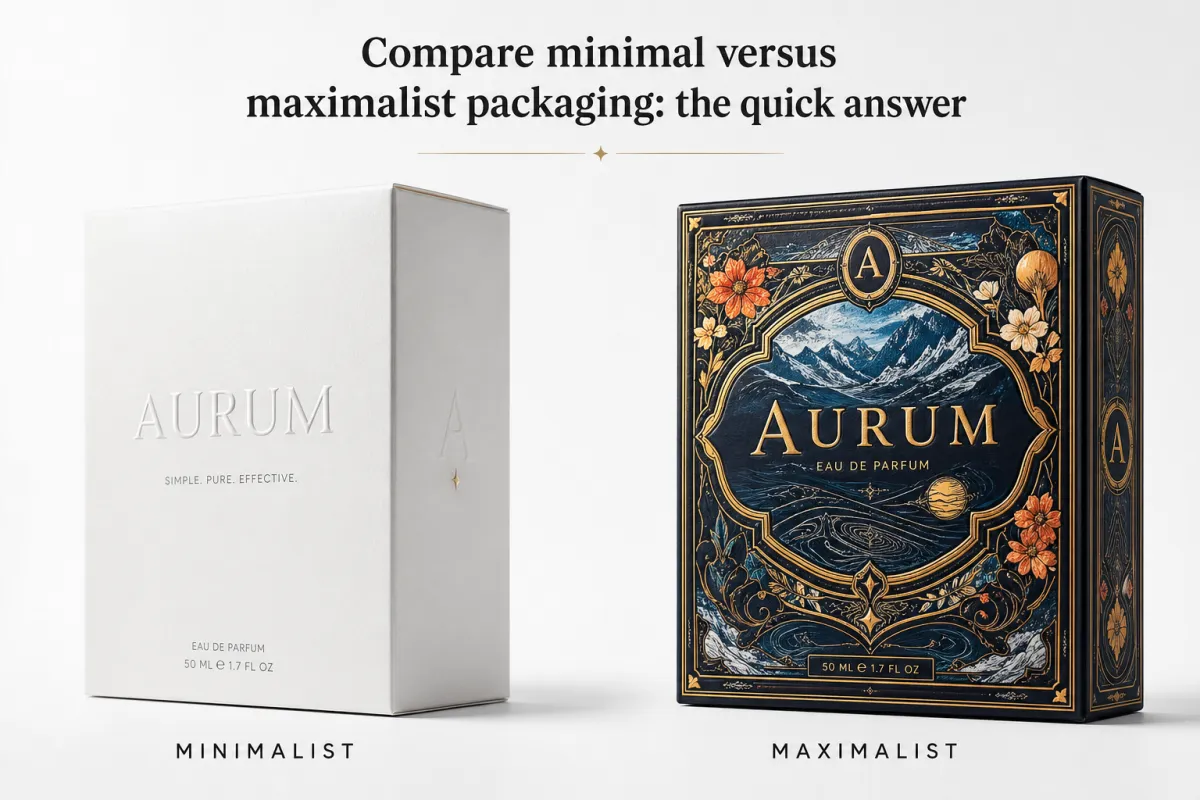
Here is the unvarnished answer: choose minimal when the product already demonstrates value through the formula, performance, reputation, or price point; choose maximalist when the package itself must create desire before purchase. This is not a taste-only debate. It is a value-delivery debate.
For supplements, refill skincare, and daily-use home products, minimal is usually the stronger default because buyers return for function and trust, not ceremony. For launch gifts, premium collections, and social-shareable drops, maximalist packaging often carries part of the premium promise, especially in first-contact moments. In other words, start with the role of the package: signal, shield, or both.
Think about this field test I use in workshops:
- Choose minimal when reorder behavior is frequent, price sensitivity is real, or inventory velocity is high.
- Choose maximalist when the purchase event includes gifting, gifting intent, or “I want to open this now” behavior.
- Choose hybrid when the category can support one meaningful premium touch without turning fulfillment into a mini assembly line.
Minimalist shells can look deliberate when tolerance, print control, and stock quality are solid. You can use plain kraft plus a disciplined structure and still feel premium if the edges line up and the text hierarchy is crisp. The same shell can feel flat if the paper is soft, the ink is inconsistent, or spacing is not controlled. Compare minimal versus maximalist packaging as a controlled system, not a decorative preference.
A lot of teams ask if minimal always means lower margin risk. Not always. If a category’s promise depends on ceremony, a pure minimal route can actually suppress price tolerance. But if the SKU is bought for utility, every decorative pass has a cost tax. Most buyers want premium feelings without paying for premium inefficiency, and that mismatch breaks budgets.
Channel mix matters. DTC replenishment needs throughput, low-touch replenishment, and reduced variability at ship. Retail gift-facing channels prioritize first-touch recognition and shelf differentiation in seconds. Those two job requirements do not pull in the same direction, so compare minimal versus maximalist packaging with channel first, then style second.
Top options compared: minimalist, maximalist, and hybrid packaging
When teams compare the two packaging styles properly, they stop arguing about art and start comparing outcomes. In this framework there are three practical lanes: minimalist, maximalist, and hybrid. The middle lane is boring to some clients, but boring wins when teams want to scale.
Minimalist packaging tends to use tuck boxes, sleeves, folding cartons, or clean mailers with restrained graphics. The big upside is operational: fewer components, simpler die lines, lower setup complexity, and less manual intervention. The output can still carry premium tone if print registration is clean and material selection is intentional. Minimal does not mean empty; it means selective.
Maximalist packaging stacks visual and tactile cues across structure and finishing: rigid formats, inserts, soft-touch, spot UV, foil, embossing, ribbons, and nested openings. It can be thrilling in the first touch, but the complexity also raises consistency risk. One gorgeous sample that never reaches production repeatability is a false economy.
Hybrid packaging keeps the base architecture lean and adds one high-confidence cue: a matte soft-touch panel, a precise insert, a subtle foil stamp, or a more rigid closure. I like this because it gives marketers a narrative hook while giving ops a stable line. One strong cue often beats five random cues that compete with each other.
For real-world references to what these structures look like in different categories, browse Custom Packaging Products. The point is not copycat styling. The point is picking an architecture that aligns with your SKU logic and margin envelope.
Use this table when comparing minimal versus maximalist packaging in a planning deck:
| Packaging style | Typical structure | Best use case | Tradeoff | Relative cost |
|---|---|---|---|---|
| Minimalist | Tuck box, mailer, sleeve, folding carton | Refills, DTC staples, repeat purchase items | Can feel too plain if design and QC are weak | Lowest to moderate |
| Hybrid | Simple structure plus one finish or insert | Most launch products, premium everyday offerings | Needs ruthless discipline to avoid creeping complexity | Moderate |
| Maximalist | Rigid box, magnetic closure, layered inserts, special finishes | Gifts, limited editions, luxury retail-ready launches | More labor, more weight, more inspection steps | Highest |
In shelf language, minimalist packaging usually reads as honesty, efficiency, and modern clarity. Maximalist packaging reads as occasion, ritual, and status. Hybrid can do both if the visual hierarchy is strict. Too often, failure has little to do with style itself and a lot to do with mismatch between promise and packaging reality.
Supply chain effects are where the gap becomes obvious. Minimal builds often require less training at the pack-out station and fewer touchpoints to break. Maximalist formats introduce multiple quality gates: placement alignment, finish integrity, insert fit, and finishing defects. I’ve seen teams lose two days of fulfillment time on what should have been one-hour packaging checks because of one extra decorative layer. That is not design excellence. It is process drag.
Detailed reviews: where each packaging style actually works
Once compare minimal versus maximalist packaging by category, the “which one is better” question gets less philosophical and more structural. Minimal usually wins where clarity, compliance, and repeat behavior drive trust. Maximalist usually wins where the box carries symbolic value and purchase emotion.
Minimalist packaging works best for:
- Supplements and wellness refills, where ingredient trust, dosage clarity, and compliance cues matter most.
- Skincare and haircare systems whose branding and product system already communicate premium cues.
- Direct-to-consumer products with strict pack-out windows and frequent repeat shipping.
- Modern food, beverage, tea, coffee, and fragrance categories that rely on calm visual authority.
In those categories, compare minimal versus maximalist packaging with repeat frequency in mind. If a buyer sees the package weekly, making every order feel like a premium event can backfire; it normalizes costs that were never justified. I have seen this happen in subscription programs where “special occasion” packaging ended up being what customers now call “loud normal.”
Maximalist packaging works best for:
- Gift boxes and seasonal drops where unboxing and social value are conversion drivers.
- Luxury beauty, accessories, and fashion-adjacent launches with margin flexibility.
- Influencer kits, PR drops, and collateral-heavy campaigns that rely on visual shareability.
- Limited editions where scarcity supports higher-cost experiences.
In those use cases, compare minimal versus maximalist packaging as a perceived value lever. A premium shell can absolutely elevate willingness to pay if it remains coherent and durable. But one weak batch of finish issues can reset trust fast, and trust resets slower than anyone’s ad campaign budget can cover.
Minimalist failures are usually execution failures, not design failures. Bad kerning, low-density board, muddy color, and random white space feel accidental instead of intentional. Consumers usually call that “cheap” long before they call it “minimalist.”
Maximalist failures are usually process failures, not art failures. Overly theatrical details that do not improve protection, tactile pacing, or emotional clarity become dead cost. An extra 10-second opening step in fulfillment can change delight into friction, especially when volumes scale. You notice this only after the first batch leaves the line.
To me, the cleanest split from this section is practical: minimalist is often the default architecture, maximalist is the event mode, and hybrid is the growth-mode compromise when the team is ready for more sophistication than basic packaging and less chaos than full showpiece builds.
For shipping-heavy categories, this gets even sharper. Fewer seams and fewer components survive abuse better, period. At the same time, rigid systems with tuned inserts can outperform simple cartons on fragile protection if geometry and cushioning are designed properly. Again, it is design quality, not decoration count, that determines outcomes.
“A premium box that fails in fulfillment is not premium. It is a design idea with too much production risk.”
That sentence says it better than any framework: packaging must protect margin and confidence equally. If your mockups are gorgeous but your return center is full of crushed corners, compare minimal versus maximalist packaging by lifecycle, not by mood.
Compare minimal versus maximalist packaging costs and price tradeoffs
Cost is where compare minimal versus maximalist packaging becomes less intuitive and more financial engineering. Unit price is just one number, and not always the decisive one. Landed cost is the real metric: material, printing, finishing, labor, transit, storage, damage, and rework.
Minimal structures generally start with lower material and process load because they have fewer print stations and fewer assembly steps. A typical folding carton setup might use 300–400gsm board, a limited color pass, and streamlined die-cutting. At 1,000 to 5,000 units, these formats often keep cost curves predictable when artwork remains stable. Smaller runs can still be expensive, but often less chaotic than fully decorated alternatives.
Maximalist packaging increases cost through rigid board selection, premium wraps, insert complexity, closures, specialty inks, and touchpoint labor. A multi-component rigid stack can jump by cost tiers quickly in low runs; many teams do not include fulfillment variance in the early model, which is a huge blind spot. If you compare minimal versus maximalist packaging at scale, the spread increases when packaging cannot absorb operational friction.
Use this cost map while deciding:
- Material thickness: thicker board increases tactile quality, but also freight cost, dimensional weight, and sometimes reject risk if tooling tolerances are off.
- Special finishes: foil, embossing, soft touch, and UV add touch and depth, then add handling and inspection requirements.
- Insert choice: paperboard inserts often cost less than custom foam or molded structures, yet tooling and setup can close the gap if quantities rise.
- Labor time: each fold, tie-off, and hand-fit step compounds across order volume.
- Shipping: larger formats lower cube efficiency and can increase both damage exposure and warehouse strain.
Some expenses do not show in the first PO. Storage footprint increases with rigid designs. Wastage grows when rejects climb from misaligned edges or scratched coatings. Sample churn can burn weeks if you keep changing artwork with every new “idea of the day.” Compare minimal versus maximalist packaging with operations finance, not design finance only.
The only honest pricing rule I use is simple and boring:
- Budget-constrained brands should prioritize board stability and print consistency.
- Mid-tier brands should choose one signature cue and stop before clutter begins.
- Premium brands can scale into complexity only when margin and repeat purchase justify the extra labor and freight burden.
That sounds obvious until teams push five effects on a low-margin line. If sustainability matters, compare minimal versus maximalist packaging against actual material flow and not against a “green” screenshot. EPA source-reduction guidance is a practical starting point for waste outcomes at epa.gov. If responsible sourcing is part of your policy, use FSC as a hard benchmark, not a logo-only narrative.
Gross margin is your north star here. A 70% gross-margin line can support complexity that a 35% line cannot survive. The arithmetic is cruel, but clear: packaging spend is a percentage of margin, not a decoration budget.
If you want one quick reality check, run the scenario two times: one with 95% of orders in month one and one with a realistic seasonality curve. Maximalist packages look manageable on a single-week launch spike and ugly once repurchase cadence turns real. I keep seeing teams fall for this in Q3 and regret it in Q4 reorders.
Process and timeline: how each packaging style gets made
Compare minimal versus maximalist packaging through process sequencing and timing becomes easier. Minimal systems usually follow a shorter loop: dieline, artwork lock, proof, sample approval, production release. Fewer components mean fewer unknown dependencies. That tends to produce better schedule reliability.
For brands replenishing weekly or daily, this predictability is often the real reason to stay minimal. We can often produce a straightforward structure within 12 to 15 business days for standard runs, depending on queue and print complexity. The minute you add multi-part assemblies and finish-sensitive elements, timeline uncertainty grows fast.
Maximalist timelines add more checkpoints: structural prototypes, finish approvals, insert drop tests, hand assembly trials, and revision cycles. A render that looks flawless can still fail at production if die tolerances drift by 0.5 mm across the sheet. Tiny tolerances are cheap in CAD, expensive in a 10,000-unit run.
Map delay risk when comparing minimal versus maximalist packaging:
- Special coatings can stall schedules if cure windows or environmental conditions are delayed.
- Custom inserts often require separate tooling review and extra sample approvals.
- Manual assembly lowers line speed unless workforce and instruction design are mature.
- Cross-border components can hold up the whole run if one piece arrives late.
Minimal packaging normally handles compressed launch windows better because each component has fewer possible failure modes. Maximalist designs need slack, and they need a stronger quality gate structure. That is not a weakness. It is a planning requirement.
For durability, use transit testing and not render-only assumptions. ISTA standards are still a practical frame for stress conditions where vibration and handling matter, and details are here: ISTA. In lab-like handling, the “wow” details do not disappear as fast as in design review meetings, which is exactly why this matters.
Prototype reviews should happen before finalizing cost. Compare minimal versus maximalist packaging by physical testing: closure repeatability, insert resilience, stack behavior, and consistency after one full handling cycle. A rigid shell that sags after one box-in-box test can kill confidence and campaign momentum at once.
One practical habit we run repeatedly: shot-to-shot photo checks in both retail and home lighting, using the same surface and camera settings every time. Render files flatten gloss and texture and can over-sell a finish. Real light reveals whether your choice is elegant, excessive, or merely expensive plastic with a clean finish.
How do you compare minimal versus maximalist packaging for your brand?
Decision quality improves the moment you compare minimal versus maximalist packaging from brand meaning outward. Start with positioning language. If your core promise is clarity, transparency, efficacy, or utility-first design, minimal typically matches that tone. If your brand is about ritual, prestige, ritual gifting, or celebration moments, maximalist cues can make strategic sense.
Next step: channel and purchase context. Retail usually needs instant signal on shelf. E-commerce prioritizes speed and pack-out logic. Gifting prioritizes emotional charge and post-purchase recall. You can blend these goals, but blending them all into one SKU usually causes both overdesign and underperformance. I prefer clean category lanes, then design accents, not the other way around.
The sequence I use in client reviews is short on purpose:
- Check margin first. If packaging cost is eroding gross profit, simplify the structure before adding any effects.
- Check purchase pattern. Repeat behavior and reorder frequency usually reward minimal consistency.
- Check value signal. If first-touch perception influences price acceptance, add value where it changes willingness to pay.
- Check fulfillment reality. If your team is already stretched, avoid heavy manual assembly paths.
- Check category norm. Match peers where needed, but do so with measured differences, not random novelty.
Once those are set, compare minimal versus maximalist packaging with physical A/B prototypes under identical lighting, price, and messaging. Keep the SKU, copy, and imaging constant. Ask existing buyers which one better fits trust, perceived quality, and expected value. You get less room for internal bias, and more useful signal from actual users.
The practical playbook for many teams is this: keep architecture stable, then add one premium layer that directly supports your promise. Maybe matte laminate, maybe a clean foil stamp, maybe a better stock and fold profile. One intentional detail usually outperforms scattered embellishments. Compare minimal versus maximalist packaging and execution quality, and this becomes a lot clearer.
For portfolio-level planning, avoid one-off hero packaging exceptions on every SKU. A system with coherent visual language and adjustable finish intensity by tier tends to build trust better over time. New launches should feel like the same family with different levels of ceremony, not a random cabinet of curiosities.
If your team is ready to review structures, the packaging options page gives a practical entry point. But whatever you pick there, lock design specs early, keep tolerance notes versioned, and treat sample approvals as a workflow, not a formality.
Our recommendation and next steps: test before you commit
My recommendation is simple and pretty stubborn: begin with the minimal package that still sounds and feels credible, then introduce one premium cue only when margin and category behavior support it. That usually protects teams from emotional overspending and keeps momentum during scale-up. Compare minimal versus maximalist packaging by outcomes, not adjectives.
Here is the test sequence that consistently sharpens decisions:
- Build one minimalist and one maximalist prototype with identical inner dimensions and comparable materials availability.
- Photograph both under neutral studio light and under realistic shopper or shelf-like light.
- Run a shipping stress loop to track abrasion, crush resistance, and damage incidence.
- Measure pack-out speed with live fulfillment staff under real order pressure.
- Run a buyer panel using the same price, product claim, and photography, then compare trust and perceived fairness.
Four numbers block this decision for me every time: perceived value, damage rate, assembly time, and total landed cost per unit. If two styles land close on those, pick the one that keeps team stress lower and quality higher. Compare minimal versus maximalist packaging with those metrics open, and opinion usually steps back.
Refills and subscription SKUs usually reward minimal packaging because buyers prioritize reliability. Gift-ready lines usually justify maximalist packaging when the package contributes to social and emotional meaning. This is not about whether maximalist feels glamorous. It is about whether the spending creates durable margin and not just first-week applause.
Hybrid packaging is often the practical winner over time. It allows brands to scale with one premium promise and without turning every shipment into artisanal labor. Compare minimal versus maximalist packaging over multiple cycles and the hybrid lane becomes a strategy, not a compromise.
For your next move, map your portfolio into two groups: replenishment and launch. Assign minimal or maximalist intent at SKU level, then define production rules for consistency, QC checkpoints, and finish thresholds. If you are still debating, the Custom Packaging Products section is a practical place to test combinations quickly. The bottom line is simple: trust the framework, test both versions, and keep the structure boring enough to survive volume.
Is minimal packaging always cheaper than maximalist packaging?
Usually total landed cost is lower with minimal packaging, but not always. Heavy board, dense color, or recurring insert complexity can erase that advantage quickly. Maximalist formats often become expensive fast when labor intensity, finish control, and shipping weight rise together.
Does maximalist packaging improve conversion enough to justify the cost?
It can, especially when the category promise depends on ceremony and gifting intent. The biggest gains are usually in limited drops, seasonal campaigns, and premium beauty accessory launches. In refill-heavy or highly price-sensitive categories, extra surface treatment often returns less than expected.
Which is better for shipping damage, minimal or maximalist packaging?
Neither one is automatically better. Minimal builds often handle logistics better because they have fewer seams and components to fail. A well-engineered maximalist build with tuned inserts can protect fragile SKUs effectively, but design quality and QA discipline must be stronger.
Can I mix minimal and maximalist packaging in one product line?
Yes, and teams do it successfully. Many brands use minimal for core SKUs and maximalist treatment for launch, seasonality, or gift editions. Keep color, typography, and messaging logic aligned so the line still feels intentional rather than improvised.
How do I test compare minimal versus maximalist packaging before production?
Start with two prototypes under identical dimensions, pricing assumption, and photo conditions. Compare unboxing feel, damage resistance, and photo realism in real light. Then ask real buyers which version feels trustworthy and fairly priced. That process gives the clearest basis for compare minimal versus maximalist packaging before scaling production.