Buyer Fit Snapshot
| Best fit | compare scented poly mailers for beauty decision review for packaging buyers comparing material specs, print proof, MOQ, unit cost, freight, and repeat-order risk where brand print, material, artwork control, and repeat-order consistency matter. |
|---|---|
| Quote inputs | Share finished size, material target, print colors, finish, packing count, annual reorder estimate, and delivery region. |
| Proofing check | Approve dieline scale, logo placement, barcode or warning zones, color tolerance, and any recyclable or compostable wording before bulk production. |
| Main risk | Vague material claims, crowded artwork, or missing packing details can create delays even when the unit price looks attractive. |
Fast answer: Compare Scented Poly Mailers for Beauty Decision Review: Film, Closure, Print, and Fulfillment should be specified like a repeatable production item. The safest quote includes material, print method, finish, artwork proof, carton packing, and reorder notes in one written spec.
What to confirm before approving the packaging proof
Check the product dimensions against the actual filled item, not only the sales mockup. Ask for tolerance on folds, seals, hang holes, label areas, and retail display edges. If the package carries a logo, QR code, warning copy, or legal claim, reserve that space before decorative graphics fill the panel.
How to compare quotes without losing quality
Compare board or film grade, print process, finish, sampling route, tooling charges, carton quantity, and freight assumptions side by side. A lower quote is only useful if the supplier can repeat the same color, closure quality, and packing count on the next order.
Compare scented poly Mailers for Beauty and you quickly find out that packaging does not fail in dramatic ways. It fails quietly. One week the mailer feels elevated, the next week it smells flat, the adhesive lifts at the corner, or the finish looks cheaper than the product inside. That is the kind of slip that costs a beauty brand trust, and trust is a lot harder to rebuild than a shipping quote.
Beauty shipping is a strange mix of material science and first impressions. I have watched teams obsess over ribbon color while ignoring the seal strip, then wonder why their unboxing videos feel off. The better question is not whether the mailer looks pretty on a sample table. The better question is whether it still feels deliberate after a week in transit, a day in storage, and a rough handoff from one courier to another.
If you need a working framework, start here: compare scented poly mailers for beauty by scent profile, film thickness, seal strength, print quality, and how the bag behaves under real shipping stress. That order matters. Fragrance alone is a cosmetic detail; performance is what keeps the package from becoming an apology.
Quick Answer: Compare Scented Poly Mailers for Beauty
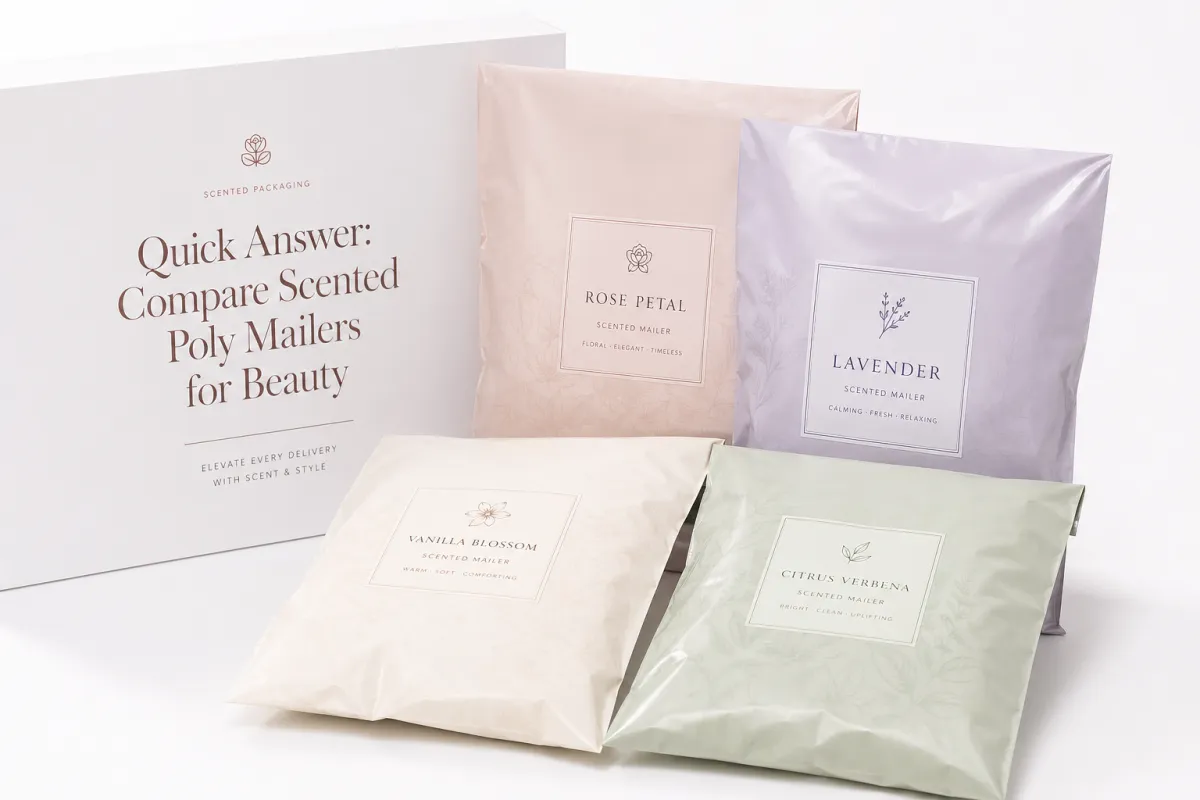
The first-impression problem
Most beauty founders assume scent should be the loudest part of the mailer. It usually should not. A subtle note can make the brand feel intentional and premium; a heavy one can feel synthetic, fussy, or weirdly disconnected from the formula inside. That mismatch is easy to miss in a proof sample and hard to ignore once 3,000 parcels are already moving through fulfillment.
The practical rule is simple. The right mailer pairs a controlled fragrance, a dependable seal, and enough opacity to protect the brand presentation. If any one of those pieces is weak, the premium experience falls apart before the customer even opens the package. And once that happens, the logo is doing all the work, which is a bad place to be.
So if you are going to compare scented poly mailers for beauty, compare them as a system. Score each option on scent profile, scent persistence, seal integrity, print finish, and delivery reliability. A mailer that only excels in one area is not a winner; it is just a pretty sample.
The tradeoff that matters most
More fragrance can create a stronger first impression, and yes, it can help the package show up better in unboxing content. But stronger is not always better. For skincare, clean beauty, and clinical brands, too much scent can feel like a contradiction. A lavender-heavy mailer attached to a retinol serum is not subtle. It is a signal that the packaging brief was written before the product strategy was finished.
That is why compare scented poly mailers for beauty should never mean “which one smells nicest.” It means matching the fragrance to the product, the audience, and the shipping route. A domestic two-day shipment and a cross-country fulfillment run do not behave the same way. If your comparison ignores that, you are basically guessing with a nicer spreadsheet.
If a scented bag still feels premium after a week on a shelf and a courier ride, it belongs in the shortlist. If it smells sharp, fades fast, or feels flimsy, it does not.
The smartest buyers use a short scorecard, then test the scent, then approve the print. Too many teams reverse that sequence and discover the mistake after the order is locked. I have seen it happen more than once, and it is never a fun conversation.
Top Options Compared: Compare Scented Poly Mailers for Beauty
1) Lightly scented stock mailers
This is where most brands should begin. These mailers are pre-formulated by the supplier, usually offered in standard colors and sizes, and finished with a light to moderate fragrance level. Think of them as the baseline for anyone who wants to compare scented poly mailers for beauty without taking on a long development cycle. They are steady, easy to reorder, and usually kinder to cash flow.
In practice, stock mailers often land around 1.8 to 2.4 mil film thickness and use standard pressure-sensitive adhesive strips. That is enough for sample kits, light apparel-like inserts, and small-to-medium beauty items that are already protected inside. They tend to work best for creams, serums, and smaller bottles when the inner packaging is doing its job.
- Best fit: clean skincare, replenishment orders, subscriptions, and lower-risk launches.
- Typical downside: limited scent control and less brand distinction.
- Brand signal: practical, neat, and reliable.
For buyers comparing scented poly mailers for beauty, the main upside here is speed. Inventory is easier to secure and lead times are usually shorter. The downside is sameness. If your brand needs a recognizable sensory signature, stock mailers can drift into “fine” territory pretty quickly, and fine is not the same thing as memorable.
2) Custom-scented branded mailers
This is the category that most serious beauty brands end up considering once they know their volume and audience. You define the scent profile, usually by note family such as soft linen, white tea, warm vanilla, or something more herbal, and then align that with the print, size, and finish. The result costs more, but it also feels more like the brand rather than the supplier.
Custom programs usually give you tighter control over fragrance intensity and visual identity. Print options often range from one to four colors, with matte or gloss treatments depending on budget and supplier capability. Film thickness often moves into the 2.2 to 3.0 mil range for better durability. For teams that compare scented poly mailers for beauty across launches, subscriptions, and influencer drops, this is the category where the difference becomes obvious in hand.
One caution: “custom scent” does not always mean every unit smells identical. Some suppliers apply fragrance in batches, and variance can show up from lot to lot. Ask for production notes, confirm the lot number, and request samples from the same run before approving bulk. If they get vague at this stage, that is not a detail. It is a warning.
3) Premium decorative mailers with fragrance as a feature
These are the thicker, more decorative mailers where fragrance supports the experience instead of leading it. Expect stronger tactile presence, denser print, and finishes such as foil, soft-touch, or embossed-style effects. Beauty gifting, seasonal drops, and influencer kits are the obvious use cases.
In this category, it is easy to compare scented poly mailers for beauty the wrong way. Buyers chase the fragrance and forget the structure. Gusset width, seam strength, and edge durability matter more than scent when the package is stacked, tossed, and re-handled. A decorative mailer with weak seams is still a weak mailer, no matter how expensive it smells.
The usual profile sits around 2.8 to 3.5 mil film, with tighter size tolerances and cleaner print registration. Fragrance stays in the light-to-medium range for most beauty programs. Push it too high and the package starts to feel theatrical, which can work for holiday gifting but feels out of step with minimalist or clinical skincare.
Gloss and fragrance do not rescue a mailer that opens in transit. The packaging still has to survive the courier network first.
The recurring failure points are pretty predictable:
- Fragrance that turns chemical after 24 to 48 hours.
- Peel-and-seal adhesive that loosens under movement and vibration.
- Thin film that wrinkles once it sits under stacked weight.
- Print that looks rich on screen and dull in the hand.
None of that is mysterious. It usually comes down to rushed approvals, weak QA standards, or both. If the scent breaks down quickly, the issue is not creativity. It is control.
Detailed Reviews of the Best Scented Poly Mailers for Beauty
Review framework I use before telling anyone to order 5,000
I look at the same five things every time. Who is the mailer for? How is the scent controlled? How does the seal hold after repeated handling? Does the film resist moisture and abrasion? Can it carry premium brand imagery without trying too hard? Then I leave it sealed in ambient conditions for three days, and again for a week, to catch odor drift and seam stress.
The process is not ceremonial. It mirrors what fulfillment actually does: open, pack, close, toss, stack, pause, then handle again. If you are trying to compare scented poly mailers for beauty and the sample cannot survive that sequence, the colorway does not matter. The job already failed.
Option A: Lightly scented stock
Who it is for: small and mid-size skincare labels, early launches, and monthly sample clubs.
What it does well: low minimums, predictable lead times, stable costs, and easy reorder cycles. Teams that need to ship consistently tend to like this option because it behaves without requiring much supervision. That matters more than people want to admit.
Where it falls short: the scent identity is limited. The profile often lands in broad, safe territory. For a brand built on sensory storytelling, that can feel generic. For clinical skincare, though, that restraint can be exactly right.
Does scent improve brand experience? Usually yes, but gently. The best description is “pleasant reinforcement,” not “the whole brand in a bag.” If your product is a face oil with bright botanical notes, this category can support the tone without shouting over it.
For handling and durability, standard models at 1.9 to 2.2 mil with ordinary adhesive can pass medium drop and sorting tests. They are not my first choice for heavy makeup sets unless the internal packaging is doing the heavy lifting.
Option B: Custom-scented branded mailers
Who it is for: premium skincare, beauty subscription brands, and cosmetic companies with steady campaign schedules.
What it does well: tighter control over brand identity, stronger differentiation, and better alignment with campaign goals. If you want a memory cue attached to the unboxing, this category can do that without turning the whole thing into a perfume ad.
Where it falls short: higher minimums, more samples, and longer approval cycles. Scent matching gets subjective fast unless both sides use a scoring sheet and acceptance threshold. Define “too strong,” “too floral,” and “too medicinal” before proofing starts, or you are gonna spend a lot of time circling the same feedback.
Does scent improve brand experience? Usually yes, as long as intensity stays balanced. For teams that compare scented poly mailers for beauty, the strongest results tend to show up in the low-to-moderate range, roughly 2/5 to 3/5 on a simple internal scale.
In handling tests, these mailers often outperform stock if they are built around 2.4 to 2.8 mil film with reinforced seams and better adhesive. They also tend to hold up better in humidity, which matters when creams, serums, and glass bottles move through cold-weather routes or back-and-forth distribution networks.
They feel less templated, which is the point. The cost of that benefit is discipline. A brand can waste a lot of money by changing scent, color, and print every time the campaign changes.
Option C: Premium decorative scented mailers
Who it is for: fragrance boxes, makeup gift kits, influencer launch batches, and holiday bundles.
What it does well: high visual impact, strong tactile cues, and a presence that reads well in editorial and social settings. Thicker film and premium print treatment help the package feel intentional from the second it is picked up.
Where it falls short: price and timing. This category carries the highest landed cost and the greatest risk of mismatched expectations. Understated luxury can get drowned out if the fragrance is too bold for the audience.
Does scent improve experience? For gifting and seasonal programs, yes, if the fragrance stays controlled. For replenishment skincare, not always. Buying emotional packaging for a routine product can be a mismatch, even when the materials are gorgeous.
Shipping tests should include a full-load simulation. A heavier film in the 3.0 to 3.5 mil range with strong adhesive can perform well, but only if the print finish stays intact over time. Gloss at thin corners can crack or peel. Matte finishes usually age better on long routes, which is one of those boring details that saves you later.
Use-case notes across sample drops and full-size orders
- Sample drops: Use stock or custom-scented options, not the heaviest decorative class. The economics get ugly fast.
- Full-size skincare: prioritize low odor carryover and seam stability; scent should support, not dominate.
- Makeup sets: choose thicker films and test corner strength; powders and palettes create friction wear quickly.
- Influencer PR kits: stronger print and stronger identity help, but the fragrance still needs restraint if contents vary.
- Seasonal limited editions: decorative tiers make sense, especially when unboxing is part of the campaign itself.
There is no universal winner in compare scented poly mailers for beauty. The best choice shifts by campaign type, reorder rhythm, and how much risk a brand can tolerate in lead times. A budget brand that ships every day may be better served by lighter custom-scented runs than by luxury-looking mailers that crush margin every month.
Safety matters too. Fragrance treatment should stay on the outer film and never contact open product surfaces. That point becomes even more important for sensitive formulas and eye-care lines. For near-clinical skincare, even a mild residual odor can trigger support tickets, complaints, or returns that cost more than the packaging upgrade ever added.
Price Comparison for Scented Poly Mailers for Beauty
Realistic cost ranges and what drives them
There is no single price for a scented mailer, despite what some quotes imply. In practice, the market splits into stock scented, semi-custom, and full custom. Fragrance treatment and print complexity are the biggest pricing multipliers after quantity. The bigger the variation, the more the quote tries to hide in the footnotes.
| Option | Who buys it | Typical Film / Finish | Indicative Unit Cost (for medium run) | Lead Time Profile |
|---|---|---|---|---|
| Stock lightly scented | Routine replenishment, starter beauty brands | 1.8-2.4 mil, standard adhesive, no custom fragrance development | $0.12 - $0.22 above plain poly baseline | 3-7 business days if in stock |
| Semi-custom scented | Recurring launches, branded drops, subscription boxes | 2.0-2.8 mil, custom scent profile, print customization | $0.28 - $0.60 depending on quantity and coverage | 10-18 business days |
| Premium decorative custom | Gifting, PR kits, luxury fragrance tie-ins | 2.8-3.5 mil, enhanced print, controlled scent matching | $0.65 - $1.35 for strong feature spec | 12-22 business days |
Those ranges are broad on purpose. A 500-piece test run can look expensive because setup costs are spread thin. A 10,000-piece order behaves more like a real production run. If you are trying to compare scented poly mailers for beauty honestly, the quote has to include setup, proofs, sample shipping, color approvals, and reprints. Leave those out and you are not looking at the budget. You are looking at a partial story.
Where budget leaks happen
What usually pushes cost up:
- Scent matching sessions beyond one round. Each extra round adds time and money.
- Heavier films with premium print finishes. Material and process costs rise together.
- Custom sizing outside common 6 x 9, 8 x 11, or similar standard zones.
- Very low minimums on custom runs. Setup fees are fixed, so tiny runs absorb them badly.
- Express shipping and split shipments. Consolidation usually beats panic freight.
A “discounted” unit often hides an expensive setup line. If a CFO only sees the per-piece number, the budget sheet is incomplete. A $0.18 increase on 5,000 units looks harmless until it gets joined by a $220 setup charge, a $180 proof review, and $90 per sample-shipping cycle. That is how small packaging choices become expensive surprises.
For performance benchmarks, standards are more useful than adjectives. ISTA test references give a useful framework for package performance, while industry packaging guidance helps put handling expectations into context. Both are better than a supplier saying the mailer is “luxury” and hoping the word does the heavy lifting.
Use landed cost rather than sticker cost. A $0.24 unit can end up at $0.33 after shipping, samples, and rejects, while a $0.28 option lands at $0.30 because the run is cleaner and consolidation is better. Price and value do not stay aligned for long unless you force them to.
Landed-cost thinking you can use tomorrow
Use this simple formula:
Total landed cost per unit = (material + print + scent + setup + sample + freight + rework + expected rejects) / shipped units.
Any model that ignores rejects is pretending packaging never fails. In scented programs, smell complaints and seam failures usually sit near the top of return reasons. A cheaper mailer that triggers more rework can become the expensive option very quickly. That part is boring on paper and brutal in real life.
Which Scented Poly Mailers Work Best for Beauty Brands?
Start with product profile, not brand mood boards
People choose scent first and regret it later because they begin with identity and ignore physics. Product type does most of the work in compare scented poly mailers for beauty. Skincare and body care usually need restraint. Fragrance lines and candle-adjacent offers can handle stronger scent accents. Makeup kits sit in the middle if cushioning is solid and the fragrance does not clash with the formulas inside.
Use these practical scent bands as a starting point:
- Clean skincare / sensitive formulas: light to moderate scent, roughly 1/5 to 2.5/5.
- Gifting / playful launches: moderate scent, roughly 2/5 to 4/5, if it matches the campaign copy.
- Luxury or clinical visual brand: low to light scent, roughly 1/5 to 2/5, with more attention on texture and print tone.
If your brand promises trust, restraint, or ingredient transparency, a heavy fragrance note can undercut the message in one unboxing. That tension matters more than many teams expect. Customers may not say it out loud, but they notice when the packaging tells a different story from the product.
Never skip physical performance checks
Seal strength, opacity, and tear resistance still outweigh scent. A mailer can smell elegant and still arrive split open. Use a strict rule: if it cannot close cleanly with your standard sealing equipment and hold that seal after 50 open-close cycles, it is not ready for production.
For teams that compare scented poly mailers for beauty in high-touch categories, I often recommend a basic in-house weather test. Leave unopened mailers in a sealed container at room temperature for 48 hours, then open and check odor migration. Repeat with a humidity bump if you can. A solvent-like shift in aroma is reason enough to reject the sample.
Photos are not enough. Request raw samples and physical cuts. A real test should include:
- Drop test simulation from desk height and a short fall distance.
- Stacking test with 20 to 30 units piled on top of each other.
- Moisture rub test around the seal strip after 24 hours.
- Print rub-off test after light movement in carton handling.
Practical fitting by size and form factor
Fit causes most returns in this niche. Too large feels expensive but empty. Too tight creates seam stress and tears. For most beauty brands, choose a size that leaves 10 to 20 percent headroom around the product, with enough air for tissue or inserts. Many teams pick based on outer dimensions and forget the actual in-box reality.
If your line includes odd-shaped glass containers, custom sizes usually outperform standard sizes even when the unit cost is higher. Better fit reduces crush movement and keeps fragile items cleaner in transit.
For teams using Custom Poly Mailers and broader fulfillment design support, pair physical tests with the wider packaging view from Custom Packaging Products. A matching sleeve, header card, or seal tab can solve tactile and visual problems for less money than pushing the fragrance stronger.
Sample plan that actually works
Step one: order three samples from two suppliers in the same dimensions and colorway. Step two: run open, pack, drop, and leave-sealed tests. Step three: score smell, seal, print, and after-week feel. Step four: choose only after seeing how each sample behaves with your actual product mix.
That is the point where compare scented poly mailers for beauty stops being a matter of taste and starts being a decision. It also saves you from the kind of reordering mistake that eats a quarter of a launch budget before anyone notices.
Ask for compatibility language too: whether the material meets relevant requirements and whether the adhesive stays low-odor during transport for sensitive categories. Suppliers who cannot speak clearly about testing usually cannot support a serious program.
Process and Timeline for Scented Poly Mailers for Beauty
From sample request to production
The process itself is not difficult. Delays usually come from changing the brief too often. The path is straightforward: request brief, sample approval, scent matching, print proof, pre-production review, production, shipment.
- Day 0-2: internal spec and order brief, including size, scent intensity, print, and quantity.
- Day 3-7: sample generation for stock or the first custom batch.
- Day 8-14: sample testing and approval rounds.
- Day 15-25: production depending on complexity and capacity.
- Day 26 onward: inspection, packing, and freight handoff.
Those ranges widen or shrink depending on whether materials are in stock and how many corrections you request. Launch dates expose wishful thinking fast. A quote that looks fast on Monday can become a slower project by Friday if the art files are not ready.
What slows projects, repeatedly
Four things cause most delays. First, artwork back-and-forth because files are not print-ready. Second, scent mismatch rounds because one team says “fresh linen” and the other smells “laundry detergent.” Third, proof approvals stall when branding changes midstream. Fourth, capacity spikes during peak season for popular finishes and sizes.
If you are comparing scented poly mailers for beauty for a seasonal event, leave room in the schedule. One extra proof round and one extra sample cycle should be treated as normal, not exceptional. Without that buffer, any correction turns into panic freight and rushed rework, and nobody enjoys paying extra to be late.
Stock scented options usually move the fastest because they avoid custom fragrance development. Semi-custom orders still fit within a workable window, but custom scent and full image revisions lengthen the path. Many delays disappear once a scent ceiling is agreed on and treated as fixed after first approval.
Planning rules that prevent missed launch windows
For a launch tied to a campaign date, set a no-change point. If the schedule is tight, treat fragrance and design as fixed after sample acceptance. I have seen teams do better with one controlled scent choice on time than with a theoretically perfect version that misses the launch entirely.
Strict fragrance controls deserve their own compliance review. For medical-adjacent product lines, include odor transfer and allergen concern checks in the procurement checklist. It is better to over-validate than to explain complaints after the parcels are already moving.
Strong teams handling compare scented poly mailers for beauty planning usually lock a kickoff date, proof deadline, and approval cutoff. Clear dates reduce confusion and keep launch prep from turning into daily negotiation. That kind of structure sounds dull, but it saves a lot of money.
Material science still has a say. If shipping routes involve high heat, ask whether the film and adhesive can tolerate thermal stress. A packaging claim that ignores that test is a branding risk first and a logistics risk second.
Our Recommendation: What to Order Next
Which option fits which brand
Here is the practical answer, without padding:
Subtle scented stock mailers: best for small beauty shops, high-volume routine SKUs, lower-budget runs, and operations that need speed. This is the safest entry point into scented mailers.
Custom scented mailers: best for premium launches and campaigns where signature scent and visual alignment are part of the brand strategy. This is usually the best middle step.
Premium decorative scented mailers: best for repeat gift programs, influencer drops, and limited editions where unboxing impact affects conversion.
Do not buy by personal taste alone. Buy by behavior under stress. A brand can survive a weaker scent and survive a stronger structure, but not the reverse. If the mailer fails mechanically, the fragrance cannot rescue it.
Side-by-side sample protocol before bulk
Order three versions: light stock, custom fragrance, and premium look. Test them on real products, in real routes, with real people. Evaluate smell, seal, print, and feel after a week in storage. A beautiful sample does not deserve the order unless it survives one week and two handling loops.
- Open and smell first, for brand consistency.
- Pack a mock order and close with your normal sealing method.
- Drop-test from common handling heights and stack pressure.
- Leave one sealed for a week; inspect odor, seam wear, and print quality.
That is the minimum standard for honest compare scented poly mailers for beauty decisions.
Simple decision rule
Pick the option that does three things at once:
- Protects the product and survives courier handling.
- Matches your brand tone in the first 10 seconds and after 10 minutes.
- Keeps landed cost below what sales can absorb without cutting margin.
If a mailer passes those three checks, it is probably the right one.
One point gets ignored too often: there is no forever winner. Beauty changes quickly, shipping conditions change faster, and formulas shift with the rest of the line. Revisit your compare scented poly mailers for beauty stack every few launches. It is not flashy work, but it is usually the reason some brands scale while others drown in support tickets.
Before any bulk order, run three final checks: confirm sample approvals, confirm launch timing, and confirm landed cost. Then lock quantity and print. If those are clean, place the order and move on. If not, leave the batch in draft and fix the weak point now rather than after it reaches a warehouse. That is the cleanest takeaway here, and the one that saves the most money.
How do I compare scented poly mailers for beauty brands without guessing?
Use a scorecard and two-supplier sampling. Compare scent strength, seal quality, print clarity, film thickness, and size fit with your actual products. If one mailer smells pleasant but tears or leaks in handling, it loses, no matter how good it looks in photos.
What scent level works best for beauty mailers?
Most beauty teams do best with light to moderate scent because it feels intentional without overpowering the product. Stronger fragrance can work for gift-led drops, but it often clashes with skincare and perfume products. If the scent lingers aggressively after opening, that is usually a warning sign.
Are scented poly mailers safe for skincare and cosmetics shipments?
Yes, when fragrance is applied only to the outer mailer material and compatibility is validated. Use sealed inner packaging, proper storage, and stable materials to limit transfer. For clinical or sensitive positioning, subtle scent or no scent is usually the safer route.
How much more do scented poly mailers for beauty usually cost?
Stock scented options usually add a premium above plain poly, though it is often modest. Custom branded and fragrance-specific options cost more and can include setup and sample charges. Always compare landed cost, since freight, sample rounds, and rework can move the real price quickly.
What is the production timeline for custom scented beauty mailers?
Stock options can move quickly if inventory exists. Custom scented options take longer because of approval loops, proofing, scent matching, and occasional corrections. For launch-linked orders, budget time for at least one extra sampling and revision cycle. If your scope includes new scent profiles or custom dimensions, build in more lead time.