Buyer Fit Snapshot
| Best fit | Compare Paperboard vs Corrugated Sleeves projects where brand print, material claims, artwork control, MOQ, and repeat-order consistency need to be specified before quoting. |
|---|---|
| Quote inputs | Share finished size, material target, print colors, finish, packing count, annual reorder estimate, ship-to region, and any compliance wording. |
| Proofing check | Approve dieline scale, logo placement, barcode or warning zones, color tolerance, closure strength, and carton packing before bulk production. |
| Main risk | Vague material claims, crowded artwork, missing packing details, or unclear freight terms can make a low unit price expensive after revisions. |
Fast answer: Compare Paperboard vs Corrugated Sleeves: Board, Finish, Dieline, and Unit Cost should be specified like a repeatable production item. The safest quote records material, print method, finish, artwork proof, packing count, and reorder notes in one written spec.
Production checks before approval
Compare the actual filled-product size with the drawing, then confirm tolerance on folds, seals, hang holes, label areas, and retail display edges. Reserve space for logos, QR codes, warning copy, and material claims before decorative graphics fill the panel.
Quote comparison points
Review material grade, print process, finish, sampling route, tooling charges, carton quantity, and freight assumptions side by side. A quote is only useful when the supplier can repeat the same color, closure quality, and packing count on the next order.
Compare Paperboard vs Corrugated sleeves: which wins? The answer changes fast once you count damage, reprints, and freight. The sleeve that looks cheaper on the quote can turn into the pricey one after it rides a conveyor, a parcel network, or a warehouse floor. I treat compare paperboard vs corrugated sleeves as a systems decision, not a material beauty contest. If you compare paperboard vs corrugated sleeves the right way, the numbers usually tell the story before the argument gets noisy.
For retail-only products, paperboard usually wins on sharp print, clean edges, and a more polished shelf read. For shipped goods, heavier items, or packs that get tossed into mixed freight, corrugated usually earns its place through better crush resistance and fewer returns. That split is the real story, which is why I tell teams to compare paperboard vs corrugated sleeves by look, protection, cost, speed, and distribution channel instead of board thickness alone. Compare paperboard vs corrugated sleeves by the job they need to do, not by the material name on a spec sheet.
Quick Answer: Compare Paperboard vs Corrugated Sleeves
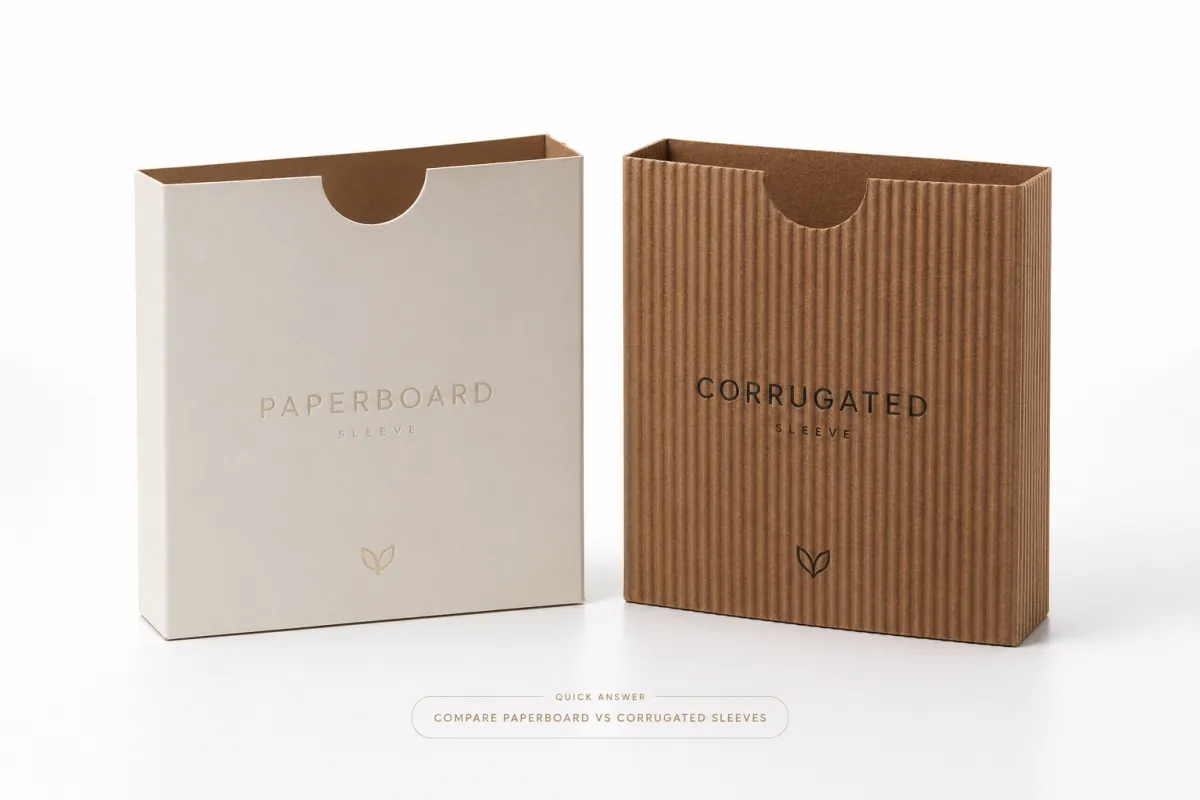
If you need the short answer, here it is: paperboard usually wins on shelf appeal, image quality, and premium finishing; corrugated wins on protection, stack strength, and parcel survival. That is the practical split I see most often when brands compare paperboard vs corrugated sleeves for a launch that may live in two channels at once. When teams compare paperboard vs corrugated sleeves early, they avoid the usual panic buy after the first damage report lands.
One packaging truth gets ignored too often: a sleeve that saves $0.05 to $0.08 per unit can become the expensive choice if it creates even a small number of reprints, replacements, or customer service tickets. A 2% damage rate on a tight-margin item can burn through savings fast. A 5,000-unit order makes that math hard to miss.
A sleeve that looks 10% better but breaks 2% more often is not premium. It is just expensive in a nicer font.
The cleanest way to think about the decision is this. Lightweight retail products, gift sets, cosmetics, apparel accessories, and influencer kits usually favor paperboard because the customer sees the print first and the product may not need much structural help. E-commerce, heavier goods, bottle packs, subscription shipments, and rough handling usually favor corrugated because the sleeve has to survive more than one touchpoint. If you compare paperboard vs corrugated sleeves only by caliper or flute size, you miss the actual job the sleeve is doing. Compare paperboard vs corrugated sleeves by how the pack travels, not just how it photographs.
The core takeaway is simple: choose paperboard if the sleeve is part of the brand theater; choose corrugated if the sleeve is part of the shipping insurance policy. That is the lens used from top to bottom here, because compare paperboard vs corrugated sleeves honestly and the better answer shows up sooner. It is a boring conclusion, which is usually how good packaging decisions feel.
Top Options Compared: Paperboard vs Corrugated Sleeves
Paperboard sleeves are not one thing. The usual lineup includes SBS or coated paperboard sleeves, printed folding sleeves, die-cut wraps, and premium finishes such as aqueous coating, matte lamination, gloss varnish, or soft-touch film. Common stock ranges sit around 14 pt to 24 pt, or roughly 250-400 gsm depending on the board construction. For clean graphics, fine linework, and accurate brand color, paperboard is the smoother canvas. When you compare paperboard vs corrugated sleeves for premium retail, the print surface is one of the first differences that shows up.
Corrugated sleeves are broader than many buyers expect. The most common choices are E-flute sleeves, micro-corrugated wraps, kraft corrugated sleeves, and printed outer sleeves used around shipping boxes or bundled kits. E-flute shows up a lot because it keeps a lean profile while adding better compressive strength than plain board. Micro-corrugated options can sit closer to premium presentation without giving up too much structure. If the pack will be stacked, tucked into pallets, or shoved through parcel lanes, corrugated starts to make more sense. When you compare paperboard vs corrugated sleeves for stacked storage, the flute structure matters more than the artwork mockup.
The first thing customers notice is usually surface quality. Paperboard has a smoother face, tighter edge finish, and better ink fidelity. It also tends to take embossing, foil stamping, and spot varnish more cleanly. Corrugated can still print well, especially with modern preprint or high-resolution digital methods, but its flute structure creates a visual rhythm that reads more functional than luxurious. That texture is not a flaw. Sometimes it is the point. Still, compare paperboard vs corrugated sleeves with the customer journey in mind, because the same texture that feels honest on a shipping carton can feel too industrial on a premium serum box. Compare paperboard vs corrugated sleeves with the end user standing at the center of the decision, not the procurement spreadsheet.
There are tradeoffs buyers rarely hear spelled out. Corrugated often hides handling marks better, which matters once cartons start rubbing together in a fulfillment center. Paperboard looks sharper on a retail shelf, but it shows corner wear, scuffing, and crush marks sooner. If the sleeve has to photograph well for e-commerce, paperboard usually gives the cleaner result. If the sleeve has to survive a warehouse and still look respectable at delivery, corrugated usually holds up better.
- Paperboard strengths: crisp color, fine type, smoother touch, premium lamination options.
- Corrugated strengths: better impact resistance, better stack performance, better parcel durability.
- Best paperboard use cases: cosmetics, apparel accessories, retail kits, sample packs, gift packaging.
- Best corrugated use cases: subscription boxes, bottle packs, shipping sleeves, heavier bundles, rough handling.
Detailed Reviews: Where Each Sleeve Actually Performs
Paperboard is the better merchandising tool. That is the honest version. On a shelf, in a display tray, or in a photographed product listing, paperboard gives you the sharper image, cleaner color blocks, and more refined feel. It works especially well for products where the sleeve has to communicate value in one glance. A 16 pt C1S or C2S build with aqueous coating can look far more expensive than its material cost suggests, especially if the artwork uses restrained type, strong contrast, and a controlled finish. If you compare paperboard vs corrugated sleeves for shelf appeal, paperboard usually makes the stronger first impression.
Paperboard is also easier to tune for tight presentation tolerances. Sleeves for lip balms, candles, sample kits, and small accessories can be die-cut to hug the product without adding much bulk. That helps with merchandising, because the pack reads neat rather than overbuilt. The downside is obvious: paperboard is less forgiving. A corner rub, a poor stack pattern, or a damp warehouse can turn a polished sleeve into a tired-looking one quickly. That is why I would compare paperboard vs corrugated sleeves not only by aesthetics, but by the conditions your team actually controls. Compare paperboard vs corrugated sleeves in the same loading dock, not in a perfect render.
Corrugated is the protection-first format. It absorbs impact better, spreads pressure across a larger surface, and stacks more reliably when the carton count rises. For products that ship through parcel carriers or sit in mixed freight, that matters more than it sounds. The sleeve may be the first thing a customer sees, but it is also the thing that takes the first hit. In an ISTA-style drop sequence or a rough warehouse transfer, corrugated usually survives with less visible damage. That is one reason many DTC brands settle on corrugated for shipping and paperboard for retail, even when both options cost almost the same on paper. For testing language, the ISTA framework is a better reference than guesswork.
Sustainability claims need careful handling, because both materials can be recyclable and both can fail the test depending on coatings, inks, and local collection rules. A heavily laminated paperboard sleeve may be harder to recycle than a simpler corrugated sleeve with water-based inks. On the other hand, a lightweight paperboard sleeve can use less fiber overall if the structure is efficient and the product does not need extra crush resistance. The EPA’s paper recycling guidance is a useful baseline for the broader category: EPA paper and paperboard recycling guidance. The practical lesson is blunt: do not print an eco claim just because the board came from paper fiber. Compare paperboard vs corrugated sleeves on real recyclability, not on a nice-sounding label.
Assembly also changes the experience. Paperboard sleeves usually fold faster, stay flatter before use, and are easier to keep snug on slim products. Corrugated sleeves can need more tuning around tuck depth, score quality, and fit because the flute adds stiffness and dimensional lift. That extra lift can be useful. It can also create fit issues if artwork or die lines were built from a flat mockup rather than a measured sample. If the sleeve is part of the unboxing story, paperboard often feels nicer in hand. If it is part of the route from warehouse to doorstep, corrugated often pays for itself.
Here is the most practical comparison I can give:
- Paperboard: best for visual detail, higher-end shelf positioning, and controlled handling.
- Corrugated: best for transport, stacking, impact resistance, and rough distribution.
- Mixed-channel brands: often need one structure for retail and another for shipping, which is why a product team sometimes ends up with both.
That is also where Custom Shipping Boxes can enter the plan. A sleeve that looks beautiful may still need a protective shipper around it, and that outer layer changes the economics fast. If the product travels, the sleeve and the shipper should be designed together, not treated as separate purchases made by separate people. When teams compare paperboard vs corrugated sleeves without looking at the outer pack, they often miss the real source of breakage.
Price Comparison: Compare Paperboard vs Corrugated Sleeves
Raw unit price is the easiest number to quote and the least useful number to trust. A paperboard sleeve may look cheaper on the invoice, but the full cost stack includes die tooling, print method, coating choice, board grade, folding complexity, freight, and the hidden cost of damage. That is why I always tell buyers to compare paperboard vs corrugated sleeves using landed cost per sellable unit, not material price alone. Compare paperboard vs corrugated sleeves the way finance actually sees them: total cost, not just purchase cost.
For a 5,000-piece order, a straightforward paperboard sleeve might land somewhere around $0.12-$0.28 per unit, depending on print coverage, coating, and whether the job is offset, digital, or short-run flexo. A corrugated sleeve of similar size might land closer to $0.18-$0.45 per unit, especially if the flute, print quality, and finishing need extra setup. Those ranges move with board availability and region, but they are realistic enough to guide an early quote review.
| Factor | Paperboard Sleeves | Corrugated Sleeves |
|---|---|---|
| Typical build | 14-24 pt SBS, C1S/C2S, die-cut wrap or folding sleeve | E-flute, micro-corrugated, kraft or printed outer sleeve |
| Typical unit cost at 5,000 | $0.12-$0.28 | $0.18-$0.45 |
| Visual presentation | Smoother, sharper, better for fine type and rich color | More textured, more utilitarian, still attractive with the right print style |
| Protection level | Light to moderate | Moderate to high |
| Best use case | Retail, gifting, premium shelf display | Shipping, stacked storage, heavier or fragile goods |
| Common risk | Scuffing, corner wear, crush marks | Bulkier look, slightly less refined print surface |
Now the hidden cost drivers. A custom die can add setup expense. Metallic foil, soft-touch film, or heavy flood coatings can change both Price and Lead time. Minimum order quantity matters too; a supplier may quote a prettier paperboard number for 10,000 units while the corrugated quote stays steadier at 1,000 because the run is more conventional. If the product is fragile, returns may also tilt the economics. A sleeve that reduces breakage by just a handful of units per 1,000 can pay back a higher purchase price quickly. That is why people compare paperboard vs corrugated sleeves too late and end up surprised by the landed cost.
There is a second calculation that teams skip: labor. A sleeve that folds cleanly and slips on in one motion saves time in packing. A design that needs adjustment at the line can eat more labor than it saves in material. That is why compare paperboard vs corrugated sleeves with a stopwatch and not just a spreadsheet. Thirty seconds per unit sounds small until it hits thousands of pieces.
If the product ships through parcel and the sleeve is exposed, corrugated often wins on total cost because fewer units need replacement. If the product stays in retail or inside another shipping container, paperboard often wins because the structure is lighter and the print cost can be more efficient. The trick is to cost the system correctly. Sleeve price is only one line in the spreadsheet.
Process and Timeline: What Changes the Lead Time
The production path is usually the same on both materials: sizing, structural spec, artwork proofing, sample approval, printing, cutting, finishing, and final packing. The order of those steps does not change much. What changes is the number of variables inside each step. That is where people underestimate how quickly a small decision can add days. If you compare paperboard vs corrugated sleeves with a launch deadline in mind, the safest option is usually the structure that needs the fewest revisions before approval. Compare paperboard vs corrugated sleeves early, and lead time becomes a planning variable instead of a fire drill.
Paperboard can move faster when the design is simple. A clean straight-wrap sleeve with standard board, one or two inks, and a straightforward die line often samples quickly and enters production without much drama. In practical terms, simple paperboard jobs may move from proof approval to finished goods in roughly 10-15 business days, sometimes faster if the supplier already has the stock and tooling on hand. Add lamination, foil, or multiple proof rounds, and the clock stretches.
Corrugated can be either quicker or slower. If the board grade is standard and the flute choice is already set, production can move smoothly. If the job needs custom board sourcing, a specific flute, or print adjustments for texture, the schedule can lengthen. For many corrugated sleeves, a realistic window is 12-18 business days after approval, with more time needed if there is a structural change or if the outer print requires special handling. The range is wider because corrugated jobs are often tied to transit performance, and transit performance tends to invite testing. When you compare paperboard vs corrugated sleeves for a tight launch, the version with fewer proof cycles usually wins on timeline.
Ask suppliers for five checkpoints, not one vague promise:
- Sample delivery date.
- Proof approval date.
- Production start date.
- Packing completion date.
- Freight window to your site or 3PL.
Those checkpoints expose the real bottleneck. A supplier might say “two weeks,” but that can hide a five-day proof loop and a seven-day freight leg. If the launch is fixed, the sleeve that can sample and scale without redesign is usually the better buy, even if the print finish is slightly less glamorous. That is a hard lesson, but a useful one.
One more thing. Rush charges often show up only after someone says the date cannot move. If the vendor has to divert press time, change glue schedules, or re-slot a die line, the premium can jump quickly. This is why teams that compare paperboard vs corrugated sleeves early usually save more than teams that wait for the artwork to be “done.” Early structural decisions shrink the chance of late-stage cost surprises.
How do you compare paperboard vs corrugated sleeves for your product?
Start with weight and fragility. That filter clears away a lot of noise. If the product is lightweight, rigid, and protected inside the pack, paperboard is often enough. If the product is crush-prone, heavier, or likely to ride in parcel carriers, corrugated is the safer default. A sleeve cannot defy physics, and a lot of packaging mistakes begin with a product team acting like it can.
Second, look at the sales channel. Shelf-only retail, gift packaging, and influencer kits usually favor paperboard because presentation matters most. Direct-to-consumer shipping, subscription programs, and wholesale fulfillment often favor corrugated because handling is harsher. Many brands run both: a retail sleeve for display and a shipper-friendly version for online orders. That approach costs more at first, but it can make more sense than forcing one sleeve to do two jobs badly. If you compare paperboard vs corrugated sleeves without separating channel needs, you can end up optimizing for the wrong touchpoint.
Third, define the brand position honestly. Premium and minimalist brands usually want the crisp print surface of paperboard. Rugged, outdoor, technical, or eco-industrial brands may welcome the texture and honesty of corrugated. Neither is automatically superior. The material has to support the story the product is already telling. If you compare paperboard vs corrugated sleeves and ignore brand tone, you can end up with a functional sleeve that looks emotionally wrong. Compare paperboard vs corrugated sleeves with the product story, because the story usually gets read before the spec sheet.
Fourth, price the whole system. That means the sleeve, packing labor, freight, breakage, and replacement. A simple scoring matrix helps:
- Visual impact: paperboard usually scores higher.
- Protection: corrugated usually scores higher.
- Assembly speed: paperboard often wins for slim, simple designs.
- Transit durability: corrugated usually wins.
- Premium hand feel: paperboard usually wins unless texture is part of the brand language.
Fifth, test the fit before you order at scale. A sleeve that looks perfect in a PDF can bow, pinch, or loosen once it is built. I would rather see a buyer compare two physical samples than debate ten renderings. If the sleeve feels loose, it will look cheap. If it is too tight, production slows. That simple.
Here is the practical rule I use. If the product stays near the point of sale, start with paperboard. If the product travels, start with corrugated. Then compare paperboard vs corrugated sleeves in real samples, because the one that wins on paper is not always the one that wins in the hand.
For teams planning larger distribution, it can also make sense to pair the sleeve decision with the outer shipper decision. A sleeve and a shipper should be treated like one packaging system. That is where shipping boxes built for heavier kits can reduce the pressure on the sleeve itself and protect the customer experience end to end. Compare paperboard vs corrugated sleeves alongside the outer box, and the whole pack stops fighting itself.
Next Steps: Compare Paperboard vs Corrugated Sleeves in a Pilot Run
The smartest next move is not a full production order. It is a pilot run with two versions built to the same footprint, the same artwork, and the same handling assumptions. That is how you get a clean answer when you compare paperboard vs corrugated sleeves without letting the result get distorted by different sizes or different print treatments. A pilot also shows you whether the pretty option still behaves like a real package.
Use the same outer dimensions where possible. Keep the product weight identical. Ask the supplier to quote the same quantity, the same finish, and the same freight lane. Then run both versions through the route the product will actually take: warehouse receiving, stack storage, pick-and-pack, parcel drop, and a short handling test by your own team. If the sleeve cannot survive normal use, the lab sample does not matter much. Compare paperboard vs corrugated sleeves under the same abuse, and you will learn more in an afternoon than in a week of debating render files.
Score the two versions across five categories:
- Visual impact at first glance.
- Protection after handling or transit.
- Assembly speed on the packing line.
- Unit cost and total landed cost.
- Damage rate after a small shipping trial.
A scorecard does two useful things. First, it keeps the loudest opinion in the room from winning by default. Second, it shows where the real tradeoff lives. A sleeve may look slightly better but cost more to pack. Another may cost more on the quote but save so much in damage that the total is lower. That is the actual decision surface, and it is why compare paperboard vs corrugated sleeves with physical evidence instead of branding instincts alone. Compare paperboard vs corrugated sleeves in a pilot, then let the data make the call.
Ask each supplier for the same quote structure so the comparison stays clean:
- Board grade or flute specification.
- Print method.
- Finishing and coating.
- MOQ.
- Sample time.
- Production lead time.
- Freight estimate.
If the numbers still look close, let the distribution channel decide. Shelf-first products usually start with paperboard. Shipment-first products usually start with corrugated. That is not a perfect rule, but it is a useful one. In packaging, a useful rule beats a pretty theory more often than people admit. Compare paperboard vs corrugated sleeves with the channel in mind, and the answer gets much less fuzzy.
My honest recommendation is this: if the sleeve lives in retail, start with paperboard; if it lives in transit, start with corrugated; then compare paperboard vs corrugated sleeves in a pilot run before you commit to scale.
When should I compare paperboard vs corrugated sleeves for a product launch?
Compare them before artwork is locked so the structure, print area, and finishes are designed around the right material. If the product will ship, do the comparison early; protection changes the total cost model more than most teams expect. Compare paperboard vs corrugated sleeves before the visual direction gets too far ahead of the physical pack.
Are paperboard sleeves cheaper than corrugated sleeves for small orders?
Often yes on the invoice, especially when the sleeve is mainly decorative and the run is short. But small corrugated orders can still win overall if damage risk is high or if the product moves through parcel carriers and returns are expensive. A cheap sleeve is not cheap if it keeps coming back in pieces.
Which is better for premium branding: paperboard or corrugated sleeves?
Paperboard usually gives cleaner print detail, sharper color, and a smoother finish for premium retail presentation. Corrugated can still look upscale, but it tends to work better when texture and durability are part of the brand story. If you compare paperboard vs corrugated sleeves for a luxury shelf display, paperboard usually takes the lead.
How do I compare lead times for paperboard vs corrugated sleeves?
Ask for sample time, proof time, production time, and freight time separately so you can see where delays may happen. Do not assume paperboard is always faster; the simpler design, supplier capacity, and finishing steps matter more than the material alone. Compare paperboard vs corrugated sleeves by the slowest step, because that step is the one that blows up the schedule.
What should I test before choosing paperboard or corrugated sleeves?
Test fit, scuff resistance, drop performance, assembly time, and how the sleeve looks after normal handling. If the product ships, add a short parcel trial so you can compare paperboard vs corrugated sleeves under real stress, not just on a desk. Real handling is where the truth shows up.
Bottom line: compare paperboard vs corrugated sleeves with real samples, real handling, and a real cost model. That is how you avoid paying for a prettier sleeve that fails in transit, or a stronger sleeve that overbuilds the customer experience. For Custom Logo Things, the winning choice is the one that fits the product, the channel, and the budget at the same time. Compare paperboard vs corrugated sleeves the smart way, and the right answer stops looking complicated. The next decision should be a pilot, not a guess.