Buyer Fit Snapshot
| Best fit | Compare Mailer Boxes vs Shipping Boxes projects where brand print, material claims, artwork control, MOQ, and repeat-order consistency need to be specified before quoting. |
|---|---|
| Quote inputs | Share finished size, material target, print colors, finish, packing count, annual reorder estimate, ship-to region, and any compliance wording. |
| Proofing check | Approve dieline scale, logo placement, barcode or warning zones, color tolerance, closure strength, and carton packing before bulk production. |
| Main risk | Vague material claims, crowded artwork, missing packing details, or unclear freight terms can make a low unit price expensive after revisions. |
Fast answer: Compare Mailer Boxes vs Shipping Boxes: Board, Finish, Dieline, and Unit Cost should be specified like a repeatable production item. The safest quote records material, print method, finish, artwork proof, packing count, and reorder notes in one written spec.
Production checks before approval
Compare the actual filled-product size with the drawing, then confirm tolerance on folds, seals, hang holes, label areas, and retail display edges. Reserve space for logos, QR codes, warning copy, and material claims before decorative graphics fill the panel.
Quote comparison points
Review material grade, print process, finish, sampling route, tooling charges, carton quantity, and freight assumptions side by side. A quote is only useful when the supplier can repeat the same color, closure quality, and packing count on the next order.
If you need the blunt version, compare mailer boxes vs shipping boxes like this: mailer boxes usually win on presentation, packing speed, and lighter products, while shipping boxes win on brute strength, rough handling, and lower damage risk. Simple answer. Messy reality. The wrong carton choice quietly drains margin through dimensional weight, extra inserts, tape, void fill, and claims. Pretty box, ugly invoice. I see that mistake all the time.
This is not a fight where one box type wins every round. It is a fit problem. A mailer box that looks premium on a shelf can turn into a headache for heavier items. A shipping box that looks plain can save money on ecommerce shipping, package protection, and labor. If you run fulfillment for apparel, beauty, accessories, kits, books, or fragile goods, the answer changes fast once product weight, carrier abuse, and unboxing expectations enter the chat.
For custom packaging buyers, the smart move is to compare mailer boxes vs shipping boxes through total landed cost, not the quote sheet alone. That means looking at board grade, closure style, print coverage, assembly time, storage footprint, and how often the box shows up dented or crushed. If you want a broader view of carton formats, start with Custom Packaging Products, then narrow down based on what the product actually needs.
Which is better: compare mailer boxes vs shipping boxes for your product?
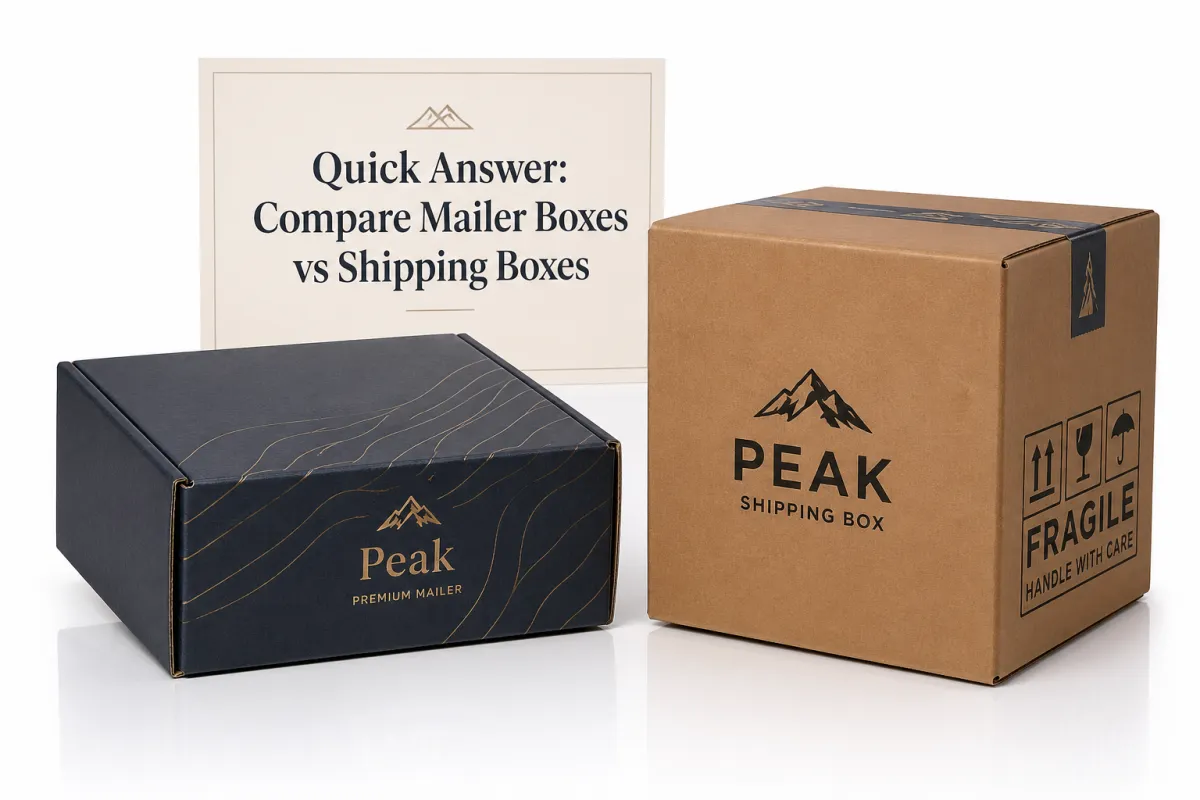
The short answer is that the better box depends on what the package has to do. If the shipment needs to look polished, pack quickly, and keep a light or medium-weight item snug, compare mailer boxes vs shipping boxes and you will usually land on a mailer. If the shipment needs to survive stacking, rough transit, and a heavier load, the shipping box usually wins.
The real decision is not about which carton looks nicer on a desk. It is about which format protects the product, controls labor, and keeps the total shipping cost under control. That is why compare mailer boxes vs shipping boxes works best as a business question, not a style preference.
Compare Mailer Boxes vs Shipping Boxes: Quick Answer
Here is the fast answer, no fluff. If the item is light, compact, and presentation matters, compare mailer boxes vs shipping boxes and you will usually land on mailer boxes. If the item is heavy, oddly shaped, stackable, or likely to take abuse in transit, shipping boxes are the safer pick. That is the real split. Not "which one is nicer," but which one survives the trip and still makes financial sense.
Mailer boxes are usually self-locking, often made from E-flute or B-flute corrugated board, and they are built for a cleaner opening moment. Shipping boxes are usually regular slotted cartons or similar transport-first designs, taped shut and optimized for load-bearing strength. One is designed to feel intentional. The other is designed to take a beating and keep moving.
Here is the packaging reality people miss: the wrong box type can cost more in dimensional weight, inserts, and damage claims than the box itself. A box that is too large bumps freight pricing. A box that is too weak invites returns. A box that needs too much filler slows pack-out. Suddenly the "cheaper" choice is expensive in three different directions. Packaging has a way of doing that. Quietly, then all at once.
In practice, the common split looks like this:
- Mailer boxes for DTC brands, subscription kits, apparel, cosmetics, small electronics, and giftable items.
- Shipping boxes for books, heavier bundles, industrial parts, glass, ceramics, and products that need more package protection.
- Hybrid setups for brands that want a branded outer mailer or carton plus internal protection for the product.
If you are torn between presentation and survival, use this shortcut: choose the format that matches the worst part of the journey, not the prettiest part. If the box is part of the brand story, compare mailer boxes vs shipping boxes with the opening experience in mind. If the box is just transit packaging, compare mailer boxes vs shipping boxes with stack strength and damage resistance in mind.
Bottom line: mailer boxes win for light, brand-forward shipments. Shipping boxes win for heavier, rougher, more cost-sensitive shipments. That sounds obvious, but obvious is often where packaging buyers stop thinking. Then they pay for it later.
Top Options Compared in Real Use
To compare mailer boxes vs shipping boxes properly, you need more than a glossy sample on a desk. You need to see how they behave in real use: how fast they build, how they stack, how they print, and how they handle the chaos of ecommerce shipping. A good carton is not just a container. It is a working part of your operations.
| Factor | Mailer Boxes | Shipping Boxes |
|---|---|---|
| Strength | Good for light to medium products when fit is tight | Better for heavier loads and stacking pressure |
| Printability | Excellent exterior branding and full-surface print | Usually simpler print, though custom branding is possible |
| Assembly speed | Fast for curated kits; self-locking closure helps | Often needs tape and more packing steps |
| Storage footprint | Usually ships flat and stores efficiently | Also ships flat, but size mix can take more warehouse space |
| Void fill | Less needed when the fit is dialed in | Often needed for stabilization and package protection |
| Transit risk | Moderate if product is snug and not too heavy | Lower for rough handling, crush, and repacking |
| Best use | Premium DTC, gift sets, apparel, beauty | Bulkier, heavier, fragile, or warehouse-heavy shipments |
Mailer boxes can perform well for apparel, beauty, and small accessory shipments. A 1.5 mm to 2.0 mm corrugated mailer with a tight internal fit can hold up better than people expect, especially when the product does not slide around. If you are shipping a folded tee, a candle with a snug insert, or a kit with predictable contents, mailer boxes can be both efficient and attractive. They also make pack-out easier because the closure is built into the box.
Shipping boxes pull ahead when the product is heavier, the shape is awkward, or the shipment will be stacked, tossed, or repacked by multiple handlers. A standard RSC carton with the right board grade, often 32 ECT for lighter shipments or 44 ECT for more demanding ones, gives you more confidence in transit. If the product is going to hit the carrier network hard, shipping boxes are usually the safer bet.
There is also a labor story here. Mailer boxes often reduce tape usage and look cleaner at the packing bench. Shipping boxes may cost less per unit, but once you add tape, internal padding, and the extra seconds needed to seal everything properly, the savings can shrink. That is why you should compare mailer boxes vs shipping boxes with the full pack flow in mind, not just carton price.
The decision rule I use is simple: if the item needs a premium reveal, start with a mailer. If it needs survival, start with a shipping box. I know. Not exactly poetry. It also saves money.
A box that arrives crushed does not feel premium. It feels like someone mailed disappointment in corrugated board.
For brands planning custom structural work, it helps to compare mailer boxes vs shipping boxes alongside insert options, print finish, and order fulfillment speed. If you need rigid, presentation-led cartons, Custom Shipping Boxes can still support branded graphics, while mailer formats often make sense for more visible shelf-ready presentation. If you are still in the research stage, compare samples side by side before you commit. Paper specs on a quote sheet do not tell the whole story.
Compare Mailer Boxes vs Shipping Boxes for Brand Experience
Brand experience is where mailer boxes usually win the first round of compare mailer boxes vs shipping boxes. A mailer opens cleanly, often with a flap that feels deliberate instead of purely functional. That matters because the first five seconds after delivery can color the whole product experience. If the outer package feels polished, the customer expects care inside too. If it looks battered and generic, the product has to work harder to impress.
Mailer boxes also take print well. Large exterior panels let you use full bleed artwork, product messaging, or a restrained one-color design that still feels premium. A good soft-touch lamination or matte aqueous finish can make the box feel more expensive than the contents, which is either brilliant or risky depending on the SKU. For subscription kits, cosmetics, and branded gifts, that opening moment is part of the purchase. In those cases, compare mailer boxes vs shipping Boxes with Customer perception in mind, not just protection.
Shipping boxes are more utilitarian. That is not a flaw. It is a choice. They can still be branded with labels, stamps, one-color print, or even a full outer design, but the overall feel is usually more warehouse than boutique. That can work well for customers who care about reliability more than theatrics. A sturdy outer carton can signal that the brand respects the product enough to protect it properly. Some buyers read that as professionalism, not blandness.
The hidden cost is labor. Mailer boxes can speed up pack-out for curated shipments because the structure is easier to assemble and close. Shipping boxes often need tape, an insert, and a few extra seconds of setup. Multiply that by 500 orders a day and you are talking about real labor money. People love talking about carton price. They are less enthusiastic about labor cost because it does not arrive in a neat sample box.
Here is the part most people get wrong: a premium-looking box that dents easily can hurt brand perception more than a plain but sturdy carton. A customer may forgive simple packaging if the product arrives clean and intact. They are less forgiving when the box feels luxurious and shows up crushed. I watched one cosmetics brand learn that the hard way. Their mailer looked gorgeous in photos, but the lane from warehouse to customer was rough enough that the corners came back bent. The redesign was not glamorous. It was a thicker board, tighter fit, and less decorative nonsense. Sales improved because complaints dropped.
If presentation is the main selling point, use mailer boxes and make the opening clean, tight, and consistent. If your audience values reliability and repeat ordering more than theatrics, shipping boxes are often the better commercial choice. If you want a softer outer appearance for lightweight goods, Custom Poly Mailers can also be part of the mix, but they solve a different problem than corrugated cartons.
Compare Mailer Boxes vs Shipping Boxes for Protection
Protection is where the conversation gets real. To compare mailer boxes vs shipping boxes honestly, you need to think about crush resistance, corner performance, drop behavior, and how much the product can move inside the carton. This is package protection, not packaging theater. If the item survives, the box did its job. If it does not, the design failed, no matter how pretty the print was.
Mailer boxes can provide enough protection for many moderate-risk shipments when the fit is tight and the product is not too heavy. A well-sized mailer with an insert can hold items in place and reduce internal movement. For example, a beauty kit with molded pulp or paperboard inserts can travel well in a mailer because the contents are locked in. The box is doing more than closing. It is controlling motion.
Shipping boxes are stronger when the shipment will see real abuse. They generally handle stacking better, especially if you Choose the Right board grade and keep the product centered. They also make it easier to add void fill, cushioning, or double-wall construction if needed. For fragile items like glass jars, ceramic mugs, or electronics with sensitive corners, shipping boxes are usually the safer move. A little more cardboard is cheap insurance compared with a refund and reship.
Common failure points are easy to predict. A flimsy mailer made with weak flute strength will crush under load. A shipping box with too much empty space will let the product slam into the sides. Bad insert planning is its own special mess. I have seen brands choose a beautiful mailer, then stuff the product with paper because the dimensions were off by half an inch. That is not elegant. That is a workaround with a pretty face.
For serious comparisons, look at standards and test methods instead of just intuition. ISTA procedures like 3A help model parcel environments, and ASTM methods are used throughout packaging testing to evaluate compression and material performance. You do not need to become a lab nerd, but you should know that actual test data beats guesswork. The ISTA and ASTM ecosystems exist for a reason: package performance is measurable, and guessing is expensive.
When brands ask me to compare mailer boxes vs shipping boxes for fragile products, I usually push them toward a simple test plan: pack real product, ship ten units through the actual carrier, inspect damage, and compare the results. Not the mockups. The real cartons. The real tape. The real handling. That is the only comparison that matters if you want trustworthy transit packaging decisions. Everything else is a sketch, not a test.
Price Comparison and Production Timeline
Price is where people get tricked by the spreadsheet. To compare mailer boxes vs shipping boxes properly, you need to look beyond unit cost and include tape, void fill, inserts, labor, freight class, and damage rate. A box that looks cheaper can cost more by the time it reaches the customer. That is the packaging version of a cheap suit with bad stitching.
As a rough working range, Custom Printed Mailer boxes often land around $0.45 to $1.25 per unit at mid-size volumes like 3,000 to 5,000 pieces, depending on size, board grade, print coverage, and finish. Shipping boxes can sit lower on the carton itself, sometimes around $0.28 to $0.95 per unit for similar volumes, because the structure is simpler. But then you add tape, labels, fillers, and packing labor. Once that happens, the total cost gap can narrow fast. These numbers are ballpark only. Board grade, print process, and region will swing them around.
The labor side matters more than most buyers admit. A mailer box with a tuck closure can save several seconds per order. That is not dramatic on one shipment. It becomes dramatic at 10,000 shipments. Shipping boxes may need one or two strips of tape, edge protection, and void fill, especially if the product does not fit tightly. Those extra steps can add up to real money in order fulfillment. Small seconds become payroll.
| Cost Driver | Mailer Boxes | Shipping Boxes |
|---|---|---|
| Carton price | Often higher with full print and specialty finishes | Often lower for simple brown or one-color cartons |
| Extra materials | Usually fewer inserts, less tape, less fill | More likely to need tape, fill, or cushioning |
| Labor | Faster pack-out for curated SKUs | More pack steps in many workflows |
| Freight impact | Can be efficient if the carton is tightly sized | Can rise with oversized cartons and dimensional weight |
| Damage cost | Lower when fit is tight and contents are light | Usually lower for tough or fragile shipments |
Order economics also matter. Larger runs often reduce the per-unit price, but inventory risk rises if you change a product size or redesign the artwork later. That is especially true for Custom Mailer Boxes with a specific dieline, finish, or window cutout. Shipping boxes are often easier to standardize across several SKUs, which can reduce waste and simplify forecasting. If you are building a core packaging lineup, that is worth real money.
Production timelines are usually another hidden cost. Custom packaging typically needs dieline approval, structural sample review, print proofing, and then production. A standard stock size may move quicker, but a fully custom mailer or Custom Shipping Carton with heavy graphics can still take weeks. In practical terms, custom box production often runs 12 to 18 business days after proof approval, and special finishes or insert programs can stretch that. If you are planning a launch, do not wait until the last second and then act surprised when corrugated does not appear by magic. It will not.
Buying advice, plain and simple: compare mailer boxes vs shipping boxes on landed cost, not quote price. If a mailer box saves one minute of labor per dozen orders and cuts damage, it can justify a higher carton price quickly. If a shipping box prevents breakage on heavy goods, the cheaper carton pays for itself the first time a claim does not happen. That is how serious buyers think.
How to Choose the Right Box for Your Product
The best way to compare mailer boxes vs shipping boxes is to start with the product, not the packaging catalog. What is the weight? How fragile is it? How much movement can you allow? Does the customer need a premium reveal, or do they mostly need a clean delivery and nothing else? These questions decide more than brand preference does.
Here is the practical split I use. Mailer boxes fit best when the product is light to medium weight, the dimensions are stable, and the unboxing experience matters. Shipping boxes fit best when the item is heavier, more fragile, or likely to be stacked with other freight. If you are still unsure, choose the format that gives more room for package protection without making the carton oversized. Oversized packaging wastes money and invites damage because the item can rattle around like it owns the place.
Good mailer box candidates:
- Apparel and folded textiles
- Subscription kits and sample sets
- Cosmetics and skincare collections
- Small electronics with snug inserts
- Giftable direct-to-consumer orders
Good shipping box candidates:
- Books and bulk bundles
- Glass, ceramics, and fragile home goods
- Heavy hardware or industrial parts
- Mixed-SKU orders that need void fill
- Anything with awkward geometry or sharp edges
Board grade matters too. A typical light-duty mailer may use E-flute or B-flute corrugated with a nice print surface, while shipping boxes often rely on 32 ECT or 44 ECT single-wall construction, with double-wall reserved for tougher jobs. If you are shipping long distances, through rough carrier networks, or into retail back rooms, that extra structure is not luxury. It is risk control. Compare mailer boxes vs shipping boxes with those realities in mind, not with the fantasy that all cartons are interchangeable.
Storage and workflow matter as much as the carton spec. A gorgeous box that takes up too much shelf space is still a problem. A shipping box that needs five packing steps may be the right choice for protection but the wrong choice for a tiny team. Your warehouse, not your mood board, should help decide. If your business is scaling fast, it helps to standardize around a few sizes and keep the pack process boring. Boring is efficient. Efficient is profitable.
It also helps to think about compliance and sustainability. Recycled content, FSC-certified paperboard, and right-sized packaging all matter to buyers and operations teams alike. If you are building around sustainability claims, confirm the board source and printing finish before you order volume. For broader environmental context, the EPA recycling resources are useful for understanding how material choices connect to downstream recovery. If sustainability is part of your positioning, use actual certified materials and do not wing it with vague green language.
If you want to compare mailer boxes vs shipping boxes one more time, here is the shortest version I can give you: use mailers for presentation, speed, and lighter products; use shipping boxes for strength, stacking, and rough transit. If neither category fits cleanly, build a hybrid with inserts, a stronger board grade, or a different outer shipper altogether. There is no prize for forcing the wrong carton into the job.
Our Recommendation and Next Steps
My recommendation is straightforward. Choose mailer boxes when the package should sell the brand. Choose shipping boxes when the package must survive abuse first. If you are stuck between the two, compare mailer boxes vs shipping boxes using three tests: product weight, shipment distance, and unpacking expectations. Those three factors usually reveal the answer faster than any sales pitch.
The smartest next step is to order samples and test them with the actual product. Not a foam dummy. Not a cardboard filler block. The real item. Pack two or three size options, ship them through the real carrier, and inspect what comes back. Check the corners, the closure, the print finish, the dent resistance, and whether the customer would feel happy opening it. That beats arguing from theory every time. Honestly, it is not even close.
If you need a broader packaging lineup while you test, review the material mix across Custom Packaging Products, then compare a branded mailer against a standard carton and a stronger shipper. You can also narrow the search with Custom Shipping Boxes if protection is the priority, or look at Custom Poly Mailers for lightweight shipments that do not need corrugated structure. Different tools, different jobs. That is the boring truth and the useful one.
For buyers running a serious launch, I would build the process like this:
- Define the product weight, dimensions, and fragility rating.
- Choose the shipping lane and carrier assumptions.
- Pick two mailer formats and two shipping box formats for sample testing.
- Review fit, closure, print finish, and actual damage after transit.
- Order volume only after the carton passes real-world checks.
If you compare mailer boxes vs shipping boxes this way, you stop buying packaging by vibe and start buying it like a business decision. That is how margins stay intact. That is also how customers stop receiving damaged goods wrapped in regret. So the actionable takeaway is simple: test both formats with the real product, the real carrier, and the real packing workflow, then choose the one that wins on total landed cost and damage rate, not just the prettier sample.
How do I compare mailer boxes vs shipping boxes for ecommerce?
Start with product weight, fragility, and the unboxing experience you want to deliver. Use mailer boxes for lighter, presentation-led products and shipping boxes for heavier or more fragile items. Then compare total landed cost, not just the carton price, because tape, inserts, void fill, and damage rates change the math fast.
Are mailer boxes strong enough for shipping?
Yes, for many lightweight products, but only when the fit is tight and the board strength is appropriate. They are a weaker choice for heavy items, loose contents, or shipments that may be stacked hard. If the product can move inside the carton, upgrade the structure or add inserts.
Do shipping boxes cost less than mailer boxes?
Not always. Shipping boxes can look cheaper per unit, but they often need tape, void fill, and more labor. Mailer boxes can cost more upfront when fully printed, yet save time in fulfillment and improve presentation. The real answer depends on your product size, pack process, and damage rate.
Which box is better for branded unboxing?
Mailer boxes usually win because they open cleanly and hold print well across the exterior surfaces. Shipping boxes can still be branded, but they are usually more utilitarian. If repeat buyers care about the reveal, mailer boxes usually deliver the stronger experience.
How long does custom box production usually take?
Custom packaging typically needs proofing, sample approval, and production time before shipping. Standard sizes move faster than fully custom structures or heavy print coverage. Build extra time into the schedule if you need inserts, special finishes, or multiple size tests.
If you want the simplest buying rule, compare mailer boxes vs shipping boxes by asking one final question: does the package need to impress first or survive first? Mailer boxes usually win the first job. Shipping boxes usually win the second. Pick the one that matches the product, the carrier, and the customer expectation, and you will make a better packaging decision than most brands do on their first try.

