Buyer Fit Snapshot
| Best fit | compare poly mailer adhesives for shipping buyer review for packaging buyers comparing material specs, print proof, MOQ, unit cost, freight, and repeat-order risk where brand print, material, artwork control, and repeat-order consistency matter. |
|---|---|
| Quote inputs | Share finished size, material target, print colors, finish, packing count, annual reorder estimate, and delivery region. |
| Proofing check | Approve dieline scale, logo placement, barcode or warning zones, color tolerance, and any recyclable or compostable wording before bulk production. |
| Main risk | Vague material claims, crowded artwork, or missing packing details can create delays even when the unit price looks attractive. |
Fast answer: Compare Poly Mailer Adhesives for Shipping Buyer Review: Film, Closure, Print, and Fulfillment should be specified like a repeatable production item. The safest quote includes material, print method, finish, artwork proof, carton packing, and reorder notes in one written spec.
What to confirm before approving the packaging proof
Check the product dimensions against the actual filled item, not only the sales mockup. Ask for tolerance on folds, seals, hang holes, label areas, and retail display edges. If the package carries a logo, QR code, warning copy, or legal claim, reserve that space before decorative graphics fill the panel.
How to compare quotes without losing quality
Compare board or film grade, print process, finish, sampling route, tooling charges, carton quantity, and freight assumptions side by side. A lower quote is only useful if the supplier can repeat the same color, closure quality, and packing count on the next order.
Compare Poly Mailer Adhesives for Shipping: Quick Answer
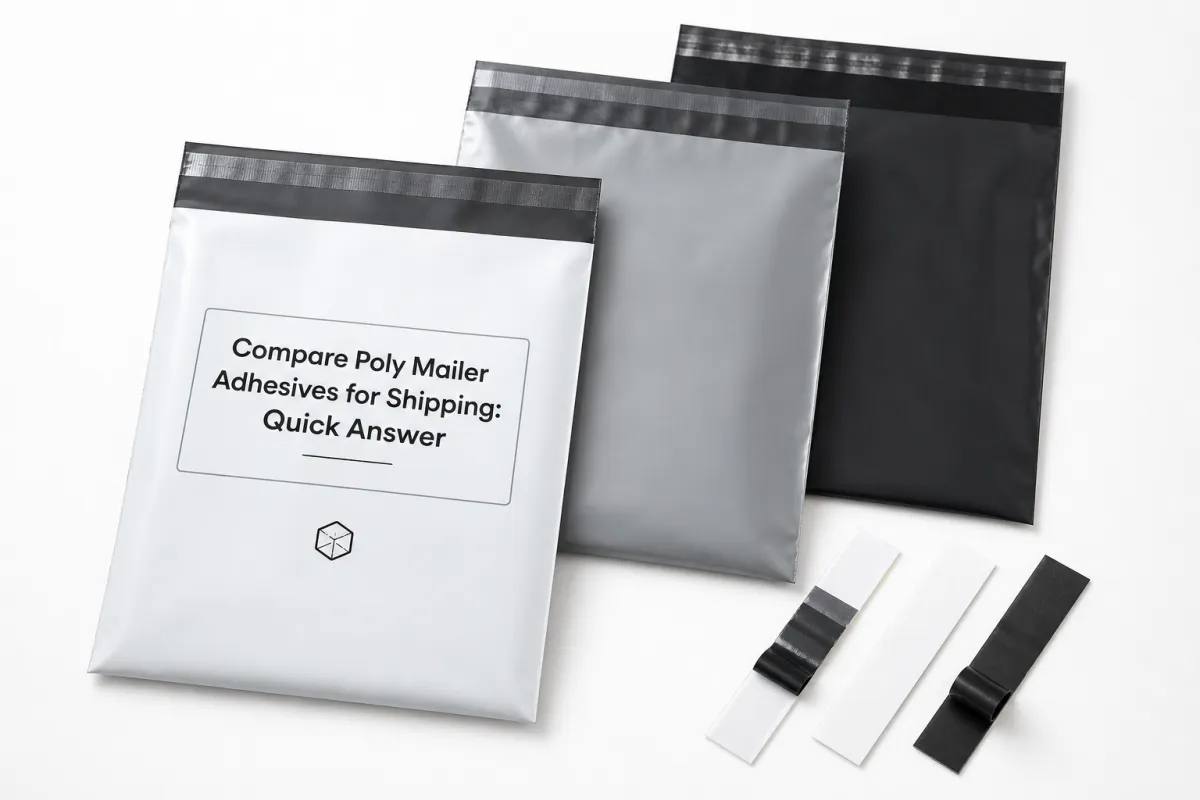
Compare poly mailer adhesives for shipping by starting with the conditions your package actually lives through, not the claims printed on the datasheet. A mailer that closes perfectly on a calm packing bench can still fail after it sits in a warm trailer, gets stacked under heavier cartons, or picks up dust and lint during a long shift. That mismatch is where a lot of packaging decisions go sideways. The adhesive that looks strongest on paper is not always the one that holds up in a real fulfillment lane.
Most buyers are trying to balance the same four things, even if they phrase it differently: fast closure, reliable hold, predictable performance across temperature swings, and a package that still opens cleanly for the customer. That balance is the real job. Compare poly mailer adhesives for shipping by how they behave in your packing flow, your climate, and your product mix, not by brand talk or one lab result stripped out of context. A seal that saves a second per order can be worth more than a bigger bond-strength claim if your team ships thousands of parcels a week.
The most useful comparison points are pretty straightforward. Initial tack tells you what happens the moment the flap closes. Peel strength after curing tells you what happens after the seal has had time to settle. Surface compatibility tells you whether the adhesive bonds well to the exact film you buy. Failure mode tells you how it gives up under stress, and that matters more than people usually expect. A seal that lifts at the edge, creeps under pressure, or tears the film before letting go behaves very differently from one that opens cleanly on demand. Those details shape returns, customer complaints, and replacement shipments.
There usually is not one universal winner. The right choice depends on product weight, warehouse conditions, climate, and shipping lane. Compare poly mailer adhesives for shipping through that lens and the choices start sorting themselves out pretty quickly.
Top Poly Mailer Adhesives Compared
Four closure styles show up over and over again in ecommerce shipping: pressure-sensitive peel-and-seal strips, hot-melt adhesive, acrylic-based closures, and resealable twin-strip systems. Each one has a place. Each one can also disappoint if the film, seal width, or packing method is off by even a little. Buyers who compare poly mailer adhesives for shipping often find out that the adhesive is only one piece of the puzzle. Film thickness, dust on the flap, overfill, and whether the bag is sealed by hand or by machine all change the result.
The short version is this. Pressure-sensitive peel-and-seal strips are quick and simple for hand packing, but they depend on clean surfaces and firm pressure. Hot-melt adhesive grabs fast and can feel very secure right away, though heat can change how it behaves in the field. Acrylic-based closures age well and often stay dependable in mixed climates or on longer routes. Resealable twin-strip systems cost more, but they solve a return problem and make the mailer easier to reuse if exchanges are part of the business model.
| Adhesive type | Typical strength profile | Best use case | Common drawback | Typical cost impact |
|---|---|---|---|---|
| Pressure-sensitive peel-and-seal | Fast initial tack, moderate long-term hold | General ecommerce shipping, lightweight goods | Can fail on dust, lint, or overfill | Low; often the default option |
| Hot-melt adhesive | Very aggressive grab, fast closure | High-volume fulfillment, tighter pack-out speed targets | Performance can shift in heat | Low to moderate |
| Acrylic-based closure | Strong aging, dependable peel resistance | Longer transit lanes, mixed climates | Can feel less immediate on the bench | Moderate |
| Resealable twin-strip system | Secure first seal plus return capability | Apparel, exchanges, subscription mailers | Higher unit cost and more pack-out steps | Highest of the four |
If you want a quick ranking, I usually start with pressure-sensitive strips for general use, acrylic for broader environmental stability, hot-melt for speed-focused operations, and twin-strip systems only when return handling is part of the packaging plan. That is not a purity ranking. It is a business ranking. The best closure is the one that reduces total friction, whether that friction shows up as labor time, seal failure, or a clumsy customer opening experience.
For teams that want a standards-based reference point, ASTM D3330 is commonly used to measure peel adhesion, and ISTA distribution testing gives a clearer view of how a sealed mailer handles vibration, drop, and compression. Those tests do not replace real-world trials, but they help keep the decision grounded. Buyers who want broader packaging context can also use industry resources from ISTA and PMMI. Neither source will tell you which adhesive is magically best for your operation, and that honesty is part of the value.
A closure that passes a bench test and fails in a hot trailer is not a good closure. It is just a surprise with a purchase order attached.
That is the heart of the decision. Compare poly mailer adhesives for shipping by what survives your actual route, your actual warehouse, and your actual handling pattern. Anything less tends to cost more later.
Detailed Reviews of Poly Mailer Adhesives
Pressure-sensitive peel-and-seal strips are the most common option because they are easy to live with. Peel the liner, fold the flap, press it down, and keep the line moving. In a clean packing area, they feel fast and dependable. The catch is that this closure type reveals warehouse discipline very quickly. A little lint, a little dust, and a little overfill can turn a good seal into an edge that lifts sooner than expected. If you compare poly mailer adhesives for shipping in apparel, accessories, or other light goods, this is often the first style teams try, and the learning curve is close to zero.
Hot-melt adhesive behaves differently. It tends to grab almost immediately, which is useful on high-speed pack stations where every second matters. That same quick grab can make it feel more aggressive than a standard peel-and-seal strip. Heat changes the story. I have seen hot-melt closures look excellent on a cool bench and then soften a bit after sitting near a warm loading area. That does not make them a poor choice. It means the buyer needs to weigh speed against environmental stability before using adhesive strength as the only filter when they compare poly mailer adhesives for shipping.
Acrylic-based closures are the steady performers in the group. They usually do not feel as snappy as hot-melt at the packing table, yet they often hold up well across more temperature ranges and longer transit periods. If mailers may sit before pickup, or if the route passes through mixed climates, acrylic deserves a close look. It often performs better after it has had time to settle, which is why the 24-hour window matters. A lot of teams underweight that part of the test. They should not.
Resealable twin-strip systems solve a different problem entirely. They are not only about security; they are about flexibility after delivery. Apparel, swimwear, subscription goods, and other categories with meaningful return activity benefit from a second strip that lets the customer reuse the package without tearing it apart. That feature adds cost and another packing step, so I would not choose it by default. In return-heavy categories, though, it can make the packaging feel thoughtful and practical instead of disposable. That kind of detail can matter more than a generic “premium” label on the spec sheet.
The failure patterns are consistent enough to predict. Edge lift is usually the first sign that something is wrong. After that, the seal starts peeling in a narrow line from one corner, especially if the flap was pressed over a dusty patch or a contaminated edge. Powder, lint, film residue, and slight overfill can all create a weak strip that looks fine from the outside. In warm storage, some adhesives creep or transfer under pressure, which is why stacked pallets and hot trailers matter. None of this is exotic. It is the ordinary reason buyers compare poly mailer adhesives for shipping and then switch suppliers after a few bad runs.
Product fit matters just as much as adhesive chemistry. Thin garments and soft flat goods usually work well with standard peel-and-seal or acrylic closures. Bulky soft goods, such as hoodies or bundled textiles, need more seal width and more forgiveness around shape. Small accessories, cosmetic kits, and sample packs need a closure that feels secure without becoming frustrating to open. If the customer has to attack the bag like a clamshell, the package may be technically secure but still fail the experience test.
Tamper evidence matters too. Some closures peel cleanly enough that a bag can be opened and resealed with little sign. Others tear the film in a way that clearly shows disturbance, though that same trait can make returns harder. Neither outcome is universally correct. A premium accessory brand may want a more obvious tamper signal. A subscription program may care more about easy opening and reuse. That is why I keep telling buyers to compare poly mailer adhesives for shipping by use case rather than by abstract bond numbers alone.
Two practical details come up often and get missed. Hand pressure matters more than many teams admit. A mediocre closure can improve a lot if the packer applies steady force across the full width of the seal. Storage matters just as much. Adhesives that look identical on day one can drift apart after sitting in a hot stockroom or a cool dock. Those are not unusual conditions. They are ordinary shipping conditions, and they deserve to be tested that way.
Compare Poly Mailer Adhesives for Shipping: Price and Process
Price matters, but only if you look at the full process. A cheaper adhesive can lose badly on total cost if it slows down packing, causes re-seals, or creates a transit failure that turns into a replacement order and a service ticket. That is why I prefer to compare poly mailer adhesives for shipping by total cost per shipped order rather than raw unit price. The lowest line item on the invoice is not always the least expensive option in the warehouse.
Start with the mailer, then add closure cost, labor time, and the cost of a failure. If a stronger seal prevents even one re-pack every couple hundred orders, the math changes quickly. A mailer might cost $0.12, the adhesive might add $0.02 to $0.06 depending on the style, and labor may run $18 to $28 per hour depending on region and shift structure. One extra minute of rework can erase any savings from the cheaper closure. In high-volume order fulfillment, that is a real number, not a theoretical one.
Set-up speed matters too. Some adhesives reach useful strength almost immediately after closure, while others behave better after a short dwell period or full curing window. If you ship the same day, you need to know whether the seal can survive stacking right away. If you batch pack for pickup later in the day, the 24-hour behavior may matter more than the first 10 seconds. Teams that compare poly mailer adhesives for shipping without tracking that timeline often choose a closure that looks excellent in the station and underperforms once the route begins.
Manual packing and automation do not reward the same adhesive. A closure that feels slow in a hand-packed station may be economical on a semi-automated line if it lowers rejects. A very aggressive adhesive may be great for speed, yet if the film is dusty or the line is inconsistent, it can create more waste than it saves. The right answer depends on the workflow. There is no hidden universal winner in the product catalog, and anybody claiming there is one is probably selling something.
Here is the practical way I think about pricing:
- Lowest sticker price: useful only if the seal performs consistently and does not create labor drag.
- Mid-priced acrylic: often the safest value choice for mixed conditions and longer shipping lanes.
- High-adhesion hot-melt: worth it when pack-out speed and immediate grab are the business priority.
- Twin-strip premium: justified when return rate, customer convenience, or reclose behavior has measurable value.
Dimensional weight still belongs in the conversation. It does not change the adhesive bond directly, yet it changes how hard teams push to reduce package size, compress contents, and ship with little margin. Overfilled poly mailers are far more likely to stress the closure, so a weak adhesive becomes obvious when dimensional weight pressure pushes operations to use the smallest possible bag. The shipping math and the seal choice are linked whether procurement wants that or not.
I also like to test after storage, not just right after sealing. A closure that holds at minute five may behave differently after 24 hours in warm conditions or after a night in cooler storage. If you want to compare poly mailer adhesives for shipping in a way that stands up to procurement review, measure failure rate, rework time, and staff comments during actual pack-out. That last one matters more than people expect. Packers know which seal feels annoying and which one slows them down, and they usually notice the problems before the dashboard does.
How to Choose the Right Seal for Your Mailers
The first decision variable is the product itself. Lightweight apparel, folded print materials, and soft accessories usually do fine with standard peel-and-seal closures. Heavier goods, awkward kits, and overfilled bags need more margin. If the seal has to resist film stress from a thick sweater or a rigid accessory box, I would not gamble on the lightest-duty option. Buyers who compare poly mailer adhesives for shipping usually start with item weight, and that is the right place to begin.
Route exposure comes next. A package that moves across a mild regional lane faces different risks than one that sits in a hot trailer, a cold dock, or a long cross-country route. Climate matters too. Some closures perform well at normal room temperature but lose confidence in heat, while others stay steady yet take longer to feel secure. If your warehouse sits near a loading bay with sharp temperature swings, test there. A lab bench does not simulate a dock very well, and it definitely does not simulate a busy one.
Surface compatibility is another place where buyers get burned. Certain adhesives behave beautifully on smooth film and disappoint on dusty, recycled, or textured surfaces. If your poly mailers use a rough exterior or matte finish, the closure may need a wider seal area or firmer pressure. In many real operations, the seal is not failing because the adhesive is weak. It is failing because the contact surface is inconsistent. That is why compare poly mailer adhesives for shipping should always include the exact mailer film you plan to order.
Use a simple operational checklist before scaling:
- Seal sample mailers with your actual product inside.
- Press them using the same hand force or machine setting you use in production.
- Leave some samples for 24 hours before checking edge lift or creep.
- Test a few packages when slightly overfilled.
- Shake, stack, and compress them to mimic shipment handling.
- Review whether the adhesive opens cleanly or tears unpredictably.
That checklist feels basic because it is. Basic is useful. The best packaging mistakes are the ones you prevent with three extra sample cartons and one afternoon of honest observation. If you want to compare poly mailer adhesives for shipping in a way that operations and finance can both accept, this is the kind of pilot that produces real answers.
Security and speed both matter, especially in peak season. Teams often think they must choose one and give up the other, but that is too neat for real fulfillment work. A seal can be fast enough and secure enough if the film, closure width, and pack-out method are aligned. The mistake is expecting the adhesive alone to rescue a poor process. It will not. It only exposes the weak spot faster.
One more practical point: if you are building a packaging standard across product lines, keep your testing notes in a simple log. Record the mailer size, closure type, room temperature, packer name or station, and the observed failure mode. The next time volume spikes, that record keeps procurement from starting over. Most buyers only learn that lesson after one disappointing shipment cycle, which is a fairly expensive way to collect the lesson.
Our Recommendation by Shipping Scenario
If I had to choose one default for most brands, I would start with a balanced pressure-sensitive peel-and-seal closure on a well-made poly mailer. It is easy to scale, it keeps pack-out simple, and it usually lands in the best place between cost and reliability for general ecommerce shipping. That said, a default is still only a starting point. You should still compare poly mailer adhesives for shipping against your exact product mix before placing a large order.
For high-volume fulfillment lines, hot-melt can be attractive when the team needs fast grab and minimal re-pressing. If the packing area stays climate-controlled and the mailers are clean, it can be very efficient. For heavier or mixed-environment routes, acrylic gets my vote more often than not because it stays predictable across a wider range of conditions. For apparel brands with heavy returns, twin-strip systems earn their place because they simplify exchanges and reduce customer friction.
Here is the short decision matrix I would use:
- Fastest: hot-melt, if temperature and surface cleanliness are controlled.
- Strongest practical balance: acrylic, especially for mixed climates.
- Cheapest usable option: standard peel-and-seal, when the pack line is disciplined.
- Most flexible for returns: resealable twin-strip systems.
For most brands, standard peel-and-seal stays the runner-up for good reason: it avoids unnecessary complexity. In operations where pack speed is a real bottleneck, hot-melt can move up the list fast. For Brands That Sell soft goods and process a high return rate, twin-strip can look expensive at purchase and still be inexpensive in total experience. That is the kind of tradeoff I want buyers to see clearly when they compare poly mailer adhesives for shipping.
One comparison I would not recommend is chasing the highest advertised bond strength without thinking about opening behavior. A seal that is too aggressive can frustrate customers and sometimes damage the bag in a way that makes returns harder. A seal that opens too easily can fail under load. The useful range is narrower than sales copy makes it sound. In practice, the best decisions are the boring ones that keep fulfillment moving and keep complaints down.
If you are already sourcing Custom Poly Mailers, this is the moment to align the adhesive with your print coverage, film thickness, and shipping method. If you are reworking the full shipping stack, it can help to review Custom Packaging Products as a set rather than treating the closure as an isolated spec. A mailer is only one piece of the system; the rest of your transit packaging still matters.
Next Steps: Test Before You Order at Scale
The best next step is not another spec sheet. It is a controlled sample test. Request two or three adhesive options, seal them with your actual products, and check performance after packing, storage, and a simple transit simulation. One perfect sample sealed in ideal conditions tells you very little. If your team ships in heat, cold, or dusty environments, test there. The warehouse usually tells the truth faster than a brochure.
For a pilot run, I would use at least two adhesive types and track three things: failure rate, pack speed, and staff feedback. Failure rate tells you how the seal behaves under stress. Pack speed tells you what the adhesive does to labor cost. Staff feedback tells you whether the closure feels easy enough to use day after day. Those three numbers are enough to compare poly mailer adhesives for shipping without turning the process into a project that drags on forever.
Document the winner. That sounds obvious, but many teams skip it and end up reopening the same decision during the next peak season. Write down the mailer size, closure style, pack-out method, and observed performance after 24 hours. If you ever need to change suppliers, that record saves time. It also makes it easier to keep shipping materials standardized across SKUs and channels.
For buyers who want one final practical rule, I would keep it simple: use the least expensive adhesive that survives your worst realistic shipping condition, not your best-case bench test. That sentence saves money more often than polished language does. It also keeps package protection aligned with the route rather than the sales pitch, which is usually where the real trouble starts.
So, compare poly mailer adhesives for shipping in a live test, choose the one that holds under your actual load and climate, then standardize the winner across the line. That path usually leads to fewer failures, faster packing, and better ecommerce shipping outcomes.
What is the best adhesive when you compare poly mailer adhesives for shipping?
The best option depends on product weight, shipping temperature, and packing speed, not just raw stickiness. For most general ecommerce shipping, a balanced pressure-sensitive or peel-and-seal closure is usually the most practical place to start. If you ship through hotter routes or need stronger tamper resistance, a more aggressive acrylic or hot-melt style may fit better.
How do I test poly mailer adhesives for shipping in my own warehouse?
Seal sample mailers with your actual product inside, then press them using your normal packing method. Leave samples for 24 hours, then check for edge lift, seal creep, and easy-peel failure. Run a small transit-style test by shaking, stacking, and storing the mailers in warm and cool spots. That gives you a much clearer answer than a spec sheet alone.
Which adhesive is fastest for high-volume packing lines?
The fastest option is usually the one that closes cleanly with the fewest re-presses or reseals. Look for an adhesive that grabs quickly and does not require long dwell time or extra hand pressure. Speed matters most when labor cost is high or peak-season throughput is tight, so test under realistic pack-out pressure.
Are stronger adhesives always better for poly mailers?
No. A stronger adhesive can create harder-to-open packages or add unnecessary cost. The right seal should match the product and shipping conditions, not just maximize bond strength. Overbuilt adhesive is wasted money if your goods are light and your route is low risk.
What should I compare besides adhesive strength?
Compare seal speed, temperature resistance, tamper evidence, labor impact, and failure rate. Also check how the adhesive behaves on your exact mailer film and whether it still holds when the bag is slightly overfilled. A small difference in pack-out time can matter as much as a small difference in adhesion, especially in high-volume order fulfillment.


