Buyer Fit Snapshot
| Best fit | Branded Poly Mailers for Subscription Brands projects where brand print, material claims, artwork control, MOQ, and repeat-order consistency need to be specified before quoting. |
|---|---|
| Quote inputs | Share finished size, material target, print colors, finish, packing count, annual reorder estimate, ship-to region, and any compliance wording. |
| Proofing check | Approve dieline scale, logo placement, barcode or warning zones, color tolerance, closure strength, and carton packing before bulk production. |
| Main risk | Vague material claims, crowded artwork, missing packing details, or unclear freight terms can make a low unit price expensive after revisions. |
Fast answer: Branded Poly Mailers for Subscription Brands: Film, Print, MOQ, and Carton Packing should be specified like a repeatable production item. The safest quote records material, print method, finish, artwork proof, packing count, and reorder notes in one written spec.
Production checks before approval
Compare the actual filled-product size with the drawing, then confirm tolerance on folds, seals, hang holes, label areas, and retail display edges. Reserve space for logos, QR codes, warning copy, and material claims before decorative graphics fill the panel.
Quote comparison points
Review material grade, print process, finish, sampling route, tooling charges, carton quantity, and freight assumptions side by side. A quote is only useful when the supplier can repeat the same color, closure quality, and packing count on the next order.
Branded Poly Mailers for subscription brands look small on a spec sheet. Then the first shipment lands on a doorstep and the whole thing stops being small. A mailer is often the first branded surface a customer touches in transit, and if it feels flimsy, awkwardly sized, or slapped together, the subscription starts on the wrong foot. That first impression is not decorative. It is doing actual work.
Branded Poly Mailers for Subscription brands are not just plastic bags with a logo. They protect the product, keep fulfillment moving, and give recurring shipments a consistent visual identity. If you ship every week or every month, those details stack up quickly. Miss them, and you pay for it in damaged goods, support tickets, or packaging that quietly makes the brand feel cheaper than it is.
The best Branded Poly Mailers for subscription brands do three jobs at once: they fit the product properly, survive normal carrier handling, and carry the brand in a way that feels intentional without blowing up the budget. That balance is the whole trick. Not flashy. Not precious. Just smart packaging that earns its keep.
What Branded Poly Mailers for Subscription Brands Actually Are
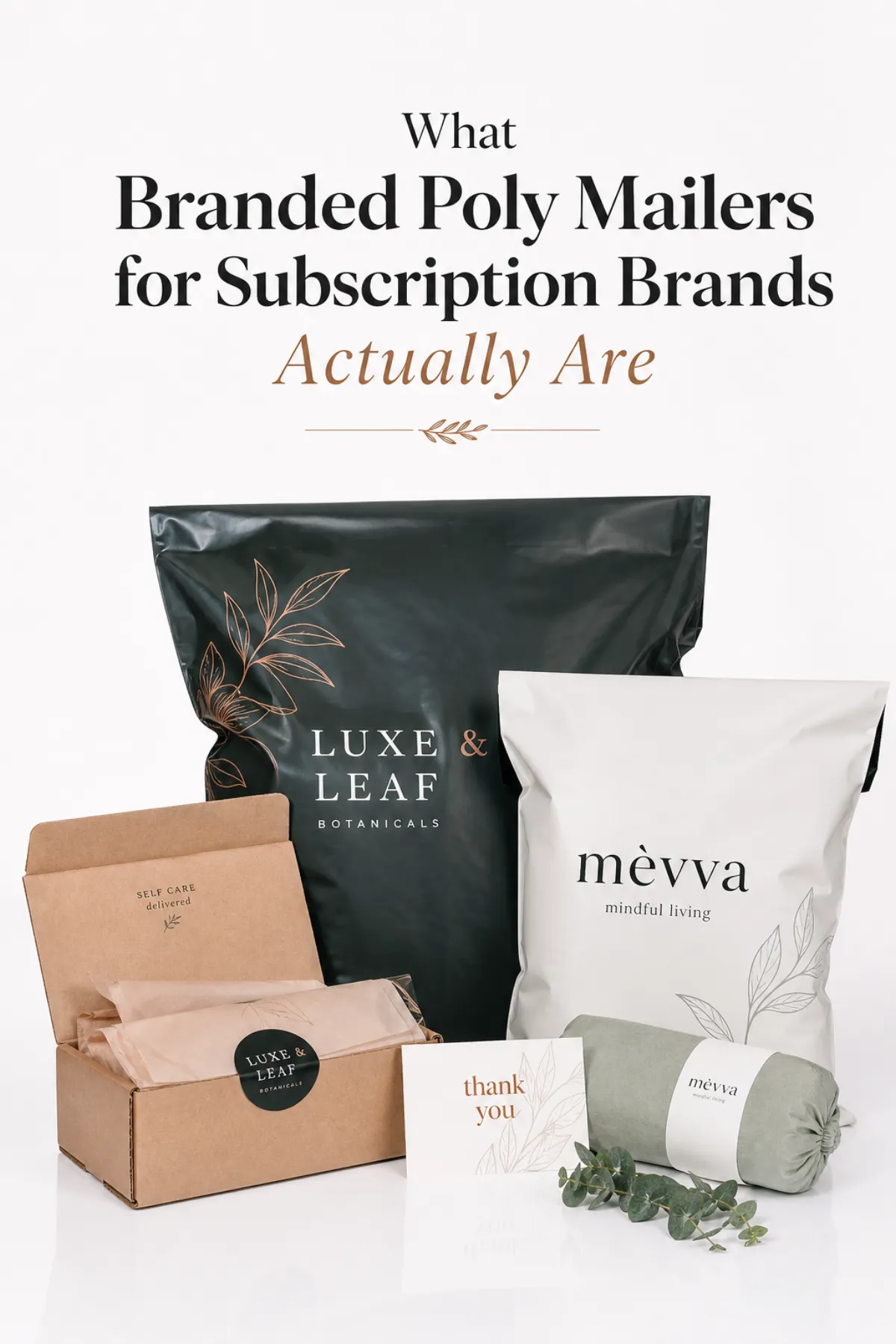
Most subscription businesses get remembered for what is inside the package, but the outer mailer is often the first real brand cue customers see while the order is still moving through the carrier network. Branded poly Mailers for Subscription brands are lightweight polyethylene shipping bags printed with a logo, color system, pattern, tagline, or interior message that turns a plain parcel into something recognizable. They are common for apparel, beauty, supplements, accessories, curated kits, and other products that do not need a rigid carton.
Plain version: a poly mailer is a thin plastic shipping bag, usually with a peel-and-seal strip. Add branding, and it stops being forgettable. That can mean a single-color logo on black or white film, a full-surface printed pattern, a matte finish, a soft-touch feel, or a louder visual treatment for brands that want the package to feel alive before it is opened. For branded poly mailers for subscription brands, the design should support the product and the promise. Not fight them. The mailbox is not the place to improvise.
The practical appeal is obvious. Poly mailers weigh less than boxes, which can reduce postage. They take up less storage space, which matters when a subscription company is staging hundreds or thousands of units for a monthly cycle. They also move faster on the packing line. Filling, sealing, labeling, and shipping a mailer takes fewer steps than building a carton, taping it shut, and stuffing in extras that do not need to be there. Boring on paper. Very useful in a real fulfillment room.
None of that makes branded poly mailers for subscription brands right for everything. They are a smart, cost-aware branding tool when the product, film thickness, and print method match the shipment. Put them around something rigid, breakable, or moisture-sensitive and the format starts to wobble fast. The useful question is not whether mailers are trendy. The useful question is whether the shipment belongs inside one without damage, complaints, or a brand impression that feels cheap by accident.
If you want to compare packaging formats beyond mailers, our Custom Packaging Products page is a good place to start. For examples of how structure can support both presentation and operations, the work in our Case Studies section shows what that looks like in practice.
How Branded Poly Mailers for Subscription Brands Work
The workflow for branded poly mailers for subscription brands is straightforward: load the product, seal the bag, add the shipping label, and send it out. The branding stays visible during storage, pack-out, and transit, not just at the moment of opening. That repeated exposure matters. Customers see the same visual cues month after month, and consistency is what turns a subscription into a familiar system instead of a random parcel.
A good mailer is more than a sheet of film. The outer layer carries the print. The closure strip seals the package. Some versions include a cushioned or bubble layer for extra protection, though that is a different structure from a basic flat mailer. The right choice depends on fragility, shipping distance, and how much abuse the parcel will face between the warehouse and the doorstep. Branded poly mailers for subscription brands should be judged on the whole stack, not just the artwork.
Print choices do more than decorate the bag. A simple one-color logo can look clean and cost-conscious. Full-color graphics can create a stronger presence in the mail stream, but they cost more and can drift in color if proofing is sloppy. Inside printing gives the customer a small surprise during unboxing. Flap printing can carry a thank-you line, a renewal note, or a seasonal message. For branded poly mailers for subscription brands, those details often matter more than trying to cover every inch with visual noise.
Fulfillment is the other half of the story. Fewer folds, less tape, and less box-building usually means faster packing. That becomes a real advantage during launch spikes, holiday volume, or billing cycles when orders stack up. A mailer that looks great but slows the line becomes a problem fast. Good packaging should fit the workflow instead of forcing the team to work around it.
The customer experience shifts too. A branded mailer starts the brand moment before the package is opened, which is exactly why branded poly mailers for subscription brands can work so well for recurring shipments. The outside says this came from a known brand. The inside product does the actual heavy lifting. That is a clean setup when the subscription promise depends on repeat recognition.
The tradeoff stays real. Poly mailers work best when protection needs are moderate and the contents can tolerate flex, compression, and normal carrier handling. For anything brittle, oversized, or likely to get crushed, a box may still be the right choice. Physics is rude like that. It does not care about brand guidelines.
Key Factors That Shape Branded Poly Mailer Choices
Choosing branded poly mailers for subscription brands starts with fit. The mailer should match the packed product, not the product alone. Leave enough room for a clean seal and a little internal movement, but not so much extra space that the shipment looks loose and careless. A bad fit creates a cheap impression before the parcel even leaves the warehouse, and it can also cause seal failures if the contents shift around too much.
Thickness matters next. Poly film is usually measured in mils, and the difference between a thin bag and a thicker one is not cosmetic. Thinner options cost less, but they puncture more easily and can feel flimsy in the hand. Thicker film improves puncture resistance and usually feels more substantial, which helps with perceived quality. For branded poly mailers for subscription brands, a thicker film often makes sense when the contents have corners, zippers, accessories, or any shape that likes to press against the wall of the bag.
Printing decisions affect both brand impact and budget. Spot color can be clean and economical. Full-color printing opens up more design freedom, but only if the design actually needs it. Outside print handles the main brand message; inside print can reward the open. Some brands want a repeating pattern across the surface. Others want restraint, with one strong logo and a narrow color palette. The right answer depends on how much visual memory you want the package to carry. Branded poly mailers for subscription brands do not need to be loud to be memorable. They need to be deliberate.
Pretty packaging that tears in transit is not premium. It is just a refund with better typography.
Closure style deserves attention too. A good peel-and-seal strip should close cleanly and resist accidental opening. Some brands want a reseal option, especially if returns are possible or the customer might reuse the mailer. Others care more about a crisp first-open feel. Tamper resistance is not paranoia. It is a basic way to keep the customer from wondering whether the parcel was opened somewhere along the way. For branded poly mailers for subscription brands, a strong, predictable seal is one of the easiest quality controls to buy.
Sustainability needs an honest conversation. Recycled content can help, and recyclable structures may be available depending on local recycling systems, but the claim has to match reality. Do not print a green badge on a bag just because it sounds nice. The EPA’s recycling guidance is a useful reality check on how those claims should be framed: EPA recycling guidance. If you want shipping performance benchmarks, the test frameworks from ISTA are more useful than vague promises about durability.
Fulfillment realities matter just as much. Does the mailer stack cleanly? Does it fit the label printer workflow? Does the pack station need special training to use it correctly? Does the film slide through the team’s hands, or does it cling and slow everything down? If a supplier sends a beautiful sample that falls apart in the real line environment, that sample is basically a mood board with shipping charges. Branded poly mailers for subscription brands only work when the spec respects storage, pack speed, and shipping abuse in the same breath.
| Mailer Type | Typical Use | Approx. Unit Cost Range | Main Advantage | Main Tradeoff |
|---|---|---|---|---|
| Plain poly mailer | Low-touch shipments, internal transfers, backup stock | $0.06-$0.14 | Lowest upfront cost | Weak brand presence |
| Simple branded poly mailer | Most apparel, beauty, and accessory subscriptions | $0.12-$0.24 | Good balance of cost and visibility | Requires decent artwork and proofing |
| Premium printed mailer | Higher-end subscriptions, giftable kits, launch campaigns | $0.20-$0.40+ | Stronger presentation and more design flexibility | Higher setup cost and more margin pressure |
Cost and Pricing for Branded Poly Mailers
Pricing for branded poly mailers for subscription brands usually breaks into a few pieces: quantity, thickness, size, print coverage, number of print colors, and any extras like special finishes or interior printing. Bigger runs usually lower the unit price. That sounds obvious until someone orders too little, pays more per bag, and then rushes a second order because stock ran out. That is not savings. That is expensive impatience.
Order size matters, but over-ordering can be a trap too. If you buy far more than your subscriber base can use in a reasonable window, you tie up cash and storage. A healthier target is often a quantity that covers a few shipment cycles with a modest buffer. For many subscription brands, that means planning around a 60- to 120-day usage window instead of trying to win on price by buying a mountain of stock. With branded poly mailers for subscription brands, cash flow is part of the packaging spec whether anyone likes that or not.
There are hidden costs people skip over. Freight can be meaningful, especially with large mailer runs. Setup charges, plates, proofs, and sample revisions all affect the real total. Rush fees show up when planning gets sloppy. If artwork changes after proof approval, that can push the timeline and the budget at the same time. A lower-looking quote is not always the cheaper order. The actual total for branded poly mailers for subscription brands should include landed cost, not just the printed-unit number.
The better way to compare is by total cost per shipped order, not by unit price alone. If a branded mailer costs a few cents more than a plain bag but cuts tape use, reduces pack time, and improves brand perception, the premium can make sense. If a mailer keeps you from moving every shipment into a box, the math can improve even more. If the product gets damaged because the film is too thin or the fit is wrong, the cheap mailer becomes expensive very quickly. Branded poly mailers for subscription brands make sense when the full system stays under control.
For a closer look at the format itself, our Custom Poly Mailers page shows the options in more detail. If you are comparing mailers with cartons and inserts at the same time, the broader Custom Packaging Products catalog makes the tradeoffs easier to see.
A simple buying rule usually saves money: keep the design restrained if you want the best price break. Fewer print colors, fewer special effects, and standard dimensions usually keep production cleaner. That does not mean boring. It means disciplined. I have seen brands save real money simply by trimming the design down to what the mailer actually needs to say. Branded poly mailers for subscription brands do best when the branding is strong enough to recognize at a glance and restrained enough to stay affordable across thousands of shipments.
Step-by-Step Process and Timeline for Ordering
The ordering process for branded poly mailers for subscription brands is easy enough if you respect the sequence. Start with the product itself. Measure the finished packed item, not the loose piece. Record weight, thickness, any sharp corners, inserts, sample cards, or promotional extras. The point is to base the mailer size on the actual shipment, not a hopeful guess. Guessing is how people end up with a beautiful mailer that is too tight to seal or so oversized that the parcel looks lazy.
Next, define the brand brief. Share logo files, color references, placement preferences, and the tone you want the packaging to carry. Premium, playful, minimal, bold, and editorial can all work, but they create very different results. If the brand lives on clean typography and muted colors, do not accidentally approve a loud design that looks like it wandered out of a discount bin. For branded poly mailers for subscription brands, the visual brief should be as practical as the size spec.
Then request samples and proofs. This is where smart buying separates from wishful thinking. Check film feel, seal strength, print clarity, and color accuracy. If you are choosing between two or three sizes, sample them with the actual product. Tape one, label one, pack one, and inspect how they behave on the line. Ask for a print proof that shows logo placement at real scale. If the supplier offers material test data, that helps too. Any shipment that needs stronger validation should be checked against the same basic distribution logic used in ISTA methods.
- Measure the product and finished pack-out.
- Choose size, film thickness, and print coverage.
- Review proofs and physical samples.
- Confirm freight, lead time, and reorder minimums.
- Test the mailer in your real fulfillment flow.
- Approve production only after the sample passes the practical check.
Timeline matters more than many subscription teams expect. Sampling, proof revisions, production, and shipping can easily stretch across several weeks. Simple runs move faster than large full-color orders with custom artwork on multiple surfaces. If you are planning a launch, seasonal drop, or rebrand, build in buffer time. A packaging delay can hold the whole shipment calendar hostage, and nobody wants to explain to subscribers that their order is late because the mailers were still on a truck somewhere.
Fulfillment coordination comes next. Confirm storage space, pack station workflow, label application, and how the mailers will be staged for recurring drops. Packing teams should not have to wrestle with the packaging every morning. If the mailers ship flat and stack neatly, they should feed the line without drama. If they curl, stick, or split at the seal, fix the spec before the full run arrives. That matters even more for branded poly mailers for subscription brands, because recurring shipments amplify every small annoyance.
Set a reorder threshold before stock gets low. Recurring brands should know the point that triggers the next order while there is still room to compare samples, confirm pricing, and keep the look consistent from one cycle to the next. A one- to two-cycle safety buffer usually beats panic ordering. Reorders are far less annoying when the team has time to plan instead of chase pallets.
Common Mistakes with Branded Poly Mailers
The most common mistake with branded poly mailers for subscription brands is choosing the wrong size. Too small, and the seal becomes awkward or unreliable. Too large, and the package wastes material, looks limp, and often needs extra handling. Buyers sometimes focus on the item dimensions and ignore the packed dimensions. That gap is where packaging errors hide.
Overdesign is another classic problem. Too many colors, too much text, too many competing elements, and the mailer stops reading as a brand touchpoint. It turns into visual clutter. A strong logo, a clear palette, and a bit of restraint usually do more than a crowded layout. The package does not need to explain the company’s entire worldview on the outside flap. It just needs to look intentional. Branded poly mailers for subscription brands usually benefit from editing, not stuffing.
Durability mistakes get expensive fast. Some mailers look great in a mockup and then fail under real shipping stress because the film is too thin, the seams are weak, or the adhesive strip is unreliable. That is why samples matter. So does a basic stress check. If the bag feels fragile once the actual contents are inside, trust your hands. They are often less polite than the sales sheet, which is useful.
Sustainability claims can go sideways just as quickly. A brand should not imply recyclability or eco-friendliness unless the material stream and local collection reality actually support it. A bag with recycled content is not automatically recyclable everywhere. A bag with leafy graphics is not a sustainability plan. For branded poly mailers for subscription brands, honesty beats green theater every time.
Another mistake is forgetting the fulfillment team. If the mailer is awkward to store, hard to fold, or incompatible with the labeling process, it slows packing and creates frustration. That usually gets missed because purchasing sees the mockup and operations sees the mess. Those two groups should talk before the order is placed. A supplier can have a nice print file and still be a poor fit for the warehouse.
Timeline mistakes round out the list. Production is not instant, freight is not magic, and rush orders usually cost more than expected. The fallback is often a generic mailer that weakens the brand story you were trying to build. Planning ahead avoids that mess. With branded poly mailers for subscription brands, lead time is part of the spec, not a footnote.
Expert Tips to Make Branded Poly Mailers Work Harder
One of the easiest upgrades for branded poly mailers for subscription brands is using the outside for recognition and the inside for delight. The outer surface should read clearly from a few feet away. The inner surface can carry a thank-you line, a pattern, a renewal reminder, or a short message that rewards opening the package. That split gives you more brand impact without forcing every inch of the mailer to do the same job.
Keep the design readable at a glance. Strong logo contrast, disciplined spacing, and a confident brand mark usually outperform crowded artwork. A mailer is not a poster. It is a shipping surface handled by carriers, loading dock staff, and customers with one hand while they manage everything else with the other. If the brand can be identified in a second or two, you are in good shape. That is exactly why branded poly mailers for subscription brands should be designed for quick recognition, not just for a pretty mockup screenshot.
The best packaging does not shout. It shows up on time, looks like it belongs, and does not create work for the warehouse.
Match the mailer vibe to the subscription promise. Premium skincare should not arrive in a flimsy bag that feels chosen because it was cheap. A high-trust health brand should not use a design that feels chaotic. An energetic lifestyle subscription can handle a bolder graphic system, but the structure still needs to feel controlled. For branded poly mailers for subscription brands, the visual tone needs to match the experience or the package starts arguing with the product.
Test a small batch before you scale. Check seam strength, print consistency, and customer response. Ask operations whether the mailer speeds up or slows down pack-out. Ask customer service whether people complain about opening, tearing, or damaged contents. A short test run is a cheap way to avoid a large mistake. You do not need 50,000 units to find out whether a mailer spec works. A smaller run usually tells you enough.
Plan reorder timing around shipment cycles. A subscription business that ships in predictable waves should never get surprised by packaging stock. Put the reorder date on a calendar before inventory gets thin. That gives the team time to compare samples, verify lead times, and lock in the next lot without scrambling. Consistency matters here. Branded poly mailers for subscription brands should feel stable from one cycle to the next, because recurring customers notice when the presentation suddenly changes.
If you want to compare formats before committing, our Custom Poly Mailers page is a practical starting point, and the broader Custom Packaging Products catalog helps you compare mailers with cartons, inserts, and other shipping structures. For brands that want to see how packaging decisions play out in the real world, the examples in Case Studies are a good reality check.
One last point: choose the smallest durable spec that still protects the shipment and supports the brand. Not the cheapest spec. Not the most expensive spec. The smallest one that does the job without creating damage, delays, or a weak first impression. That is the boring answer, which is usually the correct one. Branded poly mailers for subscription brands work best when they are treated as a business decision with a design layer, not the other way around.
Branded poly mailers for subscription brands can sharpen the unboxing moment, protect the shipment, and keep packaging costs under control if the size, thickness, print setup, and fulfillment process all line up. Choose the spec like you plan to use it 12 times a year, not once in a mood board. That is how branded poly mailers for subscription brands stay useful, recognizable, and profitable over the long run.
Are branded poly mailers for subscription brands strong enough for regular shipping?
Yes, if the product is lightweight or moderately fragile and the mailer thickness matches the shipment. A thicker film, a reliable adhesive seal, and the right size reduce punctures and split seams. If the item is truly breakable, do not force branded poly mailers for subscription brands to do a box’s job.
How much do branded poly mailers for subscription brands usually cost?
Pricing depends on size, thickness, print coverage, order quantity, and freight. Plain mailers are cheaper, but branded versions can still be cost-effective compared with moving every shipment into a carton. The biggest savings usually show up when branded poly mailers for subscription brands are ordered in larger runs with a simple print spec.
What size should branded poly mailers for subscription brands be for kits or subscription boxes?
Measure the finished packed product, not just the loose item. Leave enough room for a clean seal and a small amount of movement, but not so much that the package looks baggy. If you are between sizes, sample both and test them on the actual fulfillment line before approving branded poly mailers for subscription brands.
How long does it take to produce branded poly mailers for subscription brands?
Timeline usually includes proofing, sample approval, production, and shipping, so do not plan on instant turnaround. Simple designs and standard specs move faster than full-color, multi-side prints or special finishes. Build buffer time before a launch or seasonal drop so branded poly mailers for subscription brands do not become the bottleneck.
What should I ask a supplier before ordering branded poly mailers for subscription brands?
Ask about material thickness, print method, closure strength, and minimum order quantity. Request samples, proof details, freight estimates, and lead times before you approve the run. Confirm whether the mailer fits your fulfillment process and whether any sustainability claims on branded poly mailers for subscription brands are actually supportable.


