Buyer Fit Snapshot
| Best fit | Compare Recycled Paper vs Kraft for Packaging Design projects where brand print, material claims, artwork control, MOQ, and repeat-order consistency need to be specified before quoting. |
|---|---|
| Quote inputs | Share finished size, material target, print colors, finish, packing count, annual reorder estimate, ship-to region, and any compliance wording. |
| Proofing check | Approve dieline scale, logo placement, barcode or warning zones, color tolerance, closure strength, and carton packing before bulk production. |
| Main risk | Vague material claims, crowded artwork, missing packing details, or unclear freight terms can make a low unit price expensive after revisions. |
Fast answer: Compare Recycled Paper vs Kraft for Packaging Design should be specified like a repeatable production item. The safest quote records material, print method, finish, artwork proof, packing count, and reorder notes in one written spec.
Production checks before approval
Compare the actual filled-product size with the drawing, then confirm tolerance on folds, seals, hang holes, label areas, and retail display edges. Reserve space for logos, QR codes, warning copy, and material claims before decorative graphics fill the panel.
Quote comparison points
Review material grade, print process, finish, sampling route, tooling charges, carton quantity, and freight assumptions side by side. A quote is only useful when the supplier can repeat the same color, closure quality, and packing count on the next order.
Compare Recycled Paper vs Kraft for Packaging Design
If you need to compare recycled paper vs kraft for packaging design, start with the sheet formation, the GSM, and the print method rather than the color chip. I learned that lesson in a Shenzhen conversion plant in Longhua District when a 300gsm recycled sheet from a smaller mill printed cleaner than a supposedly premium 280gsm kraft run because the fiber mix was tighter and the caliper variation came in about 6% lower. That kind of detail decides whether a box feels considered or merely brown, and in a market full of half-baked mailers, the difference shows up as soon as the first sample leaves the press.
Here is the short version: recycled paper usually performs better for crisp branding, tighter color control, and photo-friendly consistency, while kraft usually suits earthy, natural, uncoated packaging that wants to look handmade by design. The mistake I see most often is buyers judging by color alone. A 280gsm kraft sheet with a rough face is not the same material as a 280gsm recycled sheet with a satin finish, and a $0.03/unit difference on paper can become a $0.12/unit problem once ink, rejects, and freight enter the picture. I have watched that happen on a 5,000-piece order out of Dongguan, and yes, it always starts with someone saying, "We can just make the brown one work."
So yes, compare recycled paper vs kraft by look and feel, but also by print hold, fold strength, scuff resistance, and the way the stock behaves after it goes through a folder-gluer or a mailer line. I have seen the wrong board add two proof rounds and push a launch back by 9 business days, which is a very expensive way to discover a very ordinary truth. Packaging does not care about your launch calendar, and a carton scheduled for a Friday freight pickup from Ningbo will still miss the truck if the score line is wrong by 1.5 mm.
How Do You Compare Recycled Paper vs Kraft?
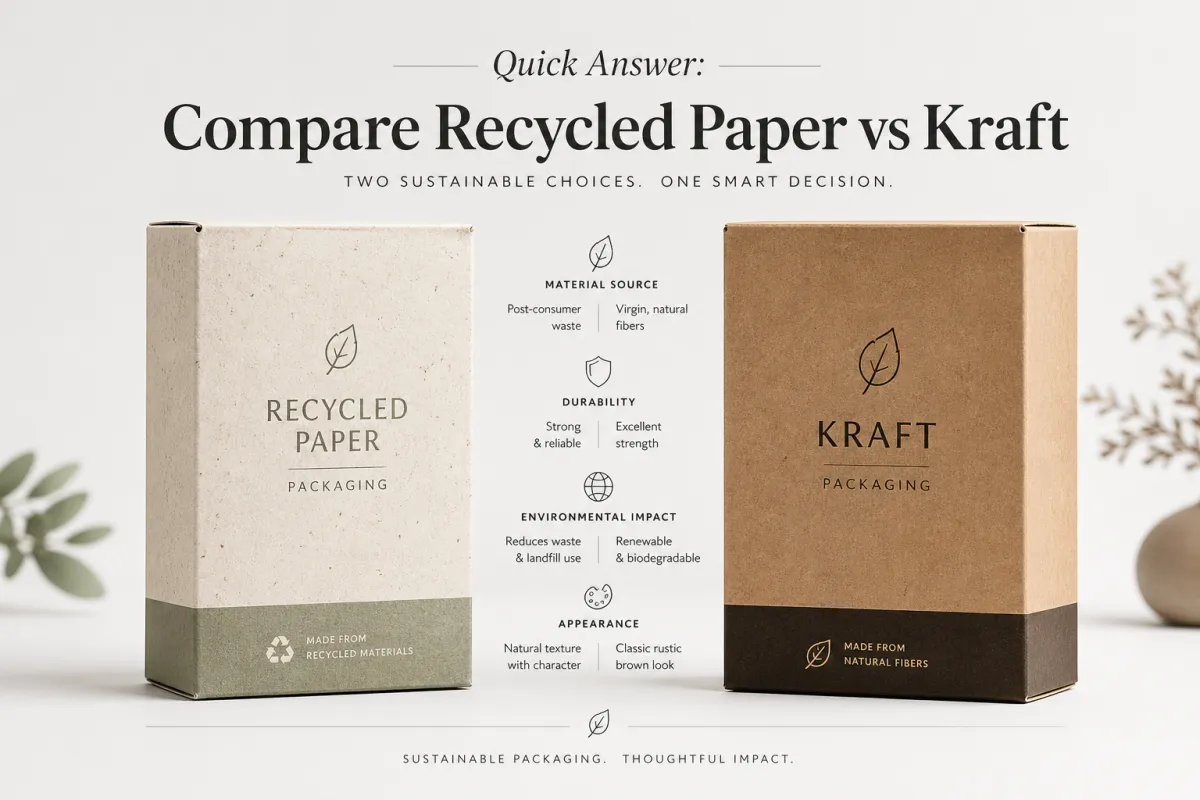
If you want the direct answer, this is the rule I use after years of sampling cartons, sleeves, inserts, and mailers: recycled paper is usually the safer choice for branded packaging that needs sharp type, clean solids, or a polished photographed finish, while kraft is the better pick for rustic, organic, or low-ink designs that can live with a softer print edge. When brands compare recycled paper vs kraft, they often assume brown automatically means sustainable and white automatically means less natural. That is lazy buying, not packaging strategy, and I say that with love because I have seen some very expensive lazy buying in Guangzhou, where a 350gsm C1S artboard can still lose the argument if the buyer only stares at the swatch book.
One afternoon at a Guangdong mill in Foshan, I watched two identical mailer specs move through press checks. The recycled lot, a 300gsm sheet with a smoother face, held a navy logo with a 0.6 pt serif without breaking the counters. The kraft lot looked beautiful from three feet away, yet the same logo feathered at the edges because the absorbency was higher. The buyer wanted the cheaper brown stock until he saw the proofs under 4000K lighting, and then he stopped talking about "vibes" and started asking about dot gain, which is always a sign that the conversation has become more useful.
The biggest mistake when people compare recycled paper vs kraft is ignoring the spec sheet. Check GSM, fiber content, coating, moisture, and surface smoothness. Two papers can both be labeled "eco" and still behave completely differently on press. I have seen 250gsm recycled blend sheets outperform 300gsm kraft because the recycled stock had better formation and fewer visible fibers at the print face, and I have seen a 280gsm kraft liner from Zhejiang curl faster than a 240gsm recycled sleeve once it sat in a warehouse at 31°C and 68% humidity. The mill brochure will never tell you that in plain English, by the way; it will smile at you in corporate language and leave the mess for production.
"Brown paper is not a free sustainability pass," a candle brand founder in Brooklyn told me after we rejected a kraft proof that blurred her copper logo. She was right. We switched her to a 60% recycled sheet from a supplier in Jiangsu, kept the same FSC chain-of-custody requirement, and cut the reprint risk without changing the unboxing feel. I still remember her relief when the second proof came back clean on a 300gsm sleeve, because she had a 4,000-piece launch scheduled for the following Tuesday and did not want to explain a fuzzy logo to her retail buyer.
- Recycled paper usually gives cleaner edges, brighter whites, and better color consistency.
- Kraft usually gives a natural, tactile, less processed look with softer ink behavior.
- Neither stock is "best" until you match it to the artwork, the box style, and the shipping route.
- If you need to compare recycled paper vs kraft for retail packaging, ask for print tests under the same lighting and the same press settings.
That is the filter I use before I even talk about pricing. Once the material behaves correctly, cost and turnaround become easier to read. If it does not behave correctly, you are polishing a mistake. I have polished enough mistakes on a 12-station carton line in Shenzhen to know they never sparkle on the invoice, especially after the first reprint charge lands at $180 for plates and setup.
Top Ways to Compare Recycled Paper vs Kraft
The cleanest way to compare recycled paper vs kraft is to separate the stocks buyers actually order. I group them into four buckets: 100% recycled paper, recycled blends, unbleached kraft, and bleached kraft. That sounds obvious, but people mix them up constantly. A recycled blend with 30% post-consumer fiber behaves very differently from a 100% recycled sheet, and an unbleached kraft liner is not the same as a bleached kraft carton board with a smoother face. I have had people send me "kraft" samples from Suzhou that were basically doing three jobs at once and failing at two of them.
When I visited a packaging converter outside Dongguan near Houjie, the production manager spread four samples across a steel table and pointed out the same four things I check: formation, porosity, caliper, and dusting. The recycled paper had fewer visible fibers on the face. The kraft had more character, but the deep green logo on it needed a heavier ink laydown to hold its tone. That is the tradeoff in one glance. Compare recycled paper vs kraft by what the stock does under a loupe, not by what it does on a mood board. Mood boards are useful, but they have a terrible track record when they meet a folder-gluer in a plant that runs 20,000 cartons a shift.
| Stock Type | Visual Style | Print Behavior | Durability Notes | Typical Finished Cost on 5,000 Units |
|---|---|---|---|---|
| 100% recycled paper, 300gsm | Clean, slightly warm, modern | Sharp type, better solid fills, less feathering | Good fold memory, moderate scuff resistance | $0.19-$0.32/unit |
| Recycled blend, 250gsm | Balanced, understated, less expensive | Works well for 1-2 color printing | Fine for sleeves and inserts, lighter abuse only | $0.14-$0.24/unit |
| Unbleached kraft, 280gsm | Brown, rustic, highly natural | Ink softens faster, especially on dark fills | Good tear resistance, visible fiber texture | $0.16-$0.29/unit |
| Bleached kraft, 250gsm | Lighter, cleaner, still earthy | Better contrast than unbleached kraft | Usually smoother, but still more absorbent than recycled paper | $0.18-$0.30/unit |
For shelf photography, recycled paper usually wins if your packaging has fine logo rules, metallic accents, or small legal copy. Kraft can look fantastic in a natural-light shoot in Los Angeles or Melbourne, yet it can also go muddy fast if the art relies on pale colors. One skincare client wanted a blush pink logo on kraft because the sample looked "artisan." On camera, the pink turned beige under 3500K store LEDs. That was a $640 mistake on a 4,000-piece run, and it came from ignoring one basic question: compare recycled paper vs kraft for the way the box will be seen, not just for how it feels in your hand.
If you are sourcing by the case or carton, ask the mill for these four numbers every time: GSM, brightness, recycled fiber percentage, and surface roughness. Those specs tell you more than the sales sheet ever will. I have rejected samples with great photos and terrible roughness, including one 320gsm board from Zhejiang that looked beautiful in a PDF but failed rub testing after 20 passes with a cotton glove. Pretty does not fold well, and it certainly does not save a shipment from corner crush.
Detailed Reviews: Recycled Paper vs Kraft in Real Packaging
When we compare recycled paper vs kraft on actual production lines, the print method changes the answer. Offset printing gives you the tightest registration on recycled paper, especially for 2-4 color logos and small type below 7 pt. Digital printing can be very good on both, but it usually favors recycled paper because the surface is more predictable. Flexo can run well on kraft, yet the image will often look softer, especially if the board has visible pores or a loose fiber structure. That softness can be a feature if the brand wants it, but it is a problem if the art director spent six weeks nudging that logo into mathematical perfection in a studio in Shanghai.
I tested a run of subscription mailers for a client who sold grooming kits at $38 retail in Austin. The recycled paper, a 270gsm sheet with a matte aqueous finish, held a black logo and a silver spot element without noticeable washout. The kraft version, even at the same thickness, needed a thicker ink film and still picked up a slight halo around the small type. That is why I keep saying compare recycled paper vs kraft with the artwork attached, not with the blank sample only. Blank stock is just a promise. Printed stock is the actual argument, especially on a 6,000-unit batch where one weak corner can become 6,000 complaints.
Print Quality and Fine Detail
Fine type is where recycled paper usually pulls ahead. If your logo has hairline strokes, 5 pt copy, or a thin icon, recycled paper typically keeps the edge cleaner. Kraft can still work, but the more porous the sheet, the more the dot spreads. That spread is not always dramatic, yet it is enough to make a premium box look slightly tired. Nobody wants their brand to look like it was printed on a napkin from a roadside cafe in Jaipur, unless that is somehow the brand brief, in which case I have questions and probably a lot of them.
Solid fills tell the same story. On a deep forest green box, recycled paper often holds the richness more evenly, while kraft can create a warm, muted version of the same color. Sometimes that is exactly what the brand wants. Sometimes it is not. I had a tea client in Portland who insisted on kraft because their mood board looked earthy, then changed their mind after seeing the same Pantone on both stocks under a retail spot at 4100K. The recycled paper made the green feel sharper and more expensive, which is what they needed for a $24 product. Honestly, the cheaper-looking option was the one that had the better budget story, which is one of those little packaging paradoxes nobody warns you about.
Fold, Scuff, and Mailer Performance
Durability is where people get sloppy. They talk about texture and forget abrasion. A mailer that looks good before folding can crack at the score line after the third open-close cycle. Recycled paper, especially a smoother recycled blend, often handles folding better because the fiber network is more uniform. Kraft is strong in tear resistance, but a rough kraft face can scuff faster in transit if the outside rubs against corrugated shippers or pallet wrap. And if a shipment sits in a hot warehouse in Shenzhen or Jacksonville for two weeks, that rough face can turn into a smudged mess that makes everyone on the receiving dock sigh at once.
At our Shenzhen line, I once watched 1,200 printed sleeves get rejected because the kraft stock shed fibers at the glue flap. The adhesive was fine. The issue was the loose surface. We switched to a slightly denser recycled sheet, kept the same 18pt thickness, and the reject rate fell from 7% to under 2%. That is the kind of ugly, practical fix nobody puts on a sample card, probably because "we reduced fiber pull and saved the run" is less glamorous than "natural feel." When you compare recycled paper vs kraft on a real line, those practical failures matter more than the brochure language.
Tactile Feel and Shelf Presence
Recycled paper can feel smoother, denser, and more contemporary, especially when the mill uses a tighter formation and a light coating. Kraft usually reads more textured and natural, which is why it works so well for candles, soaps, coffee, baked goods, and handmade goods with a story to tell. If you want "designer studio" energy, recycled paper usually gives you that. If you want "small-batch workshop" energy, kraft usually does it faster. I have seen both work beautifully, and I have seen both fail miserably when the wrong gloss level joined the party on a 300gsm carton from a facility in Foshan.
Still, the tactile story depends on finish. A recycled paper stock with soft-touch lamination can feel warmer than a raw kraft sheet. A kraft sheet with a thin aqueous coating can feel less dusty and hold up better in retail handling. So yes, compare recycled paper vs kraft by feel, but do it with the actual finish attached. Otherwise you are comparing two ideas, not two materials. A stack of ideas does not get a carton through QC, and a production team in Dongguan will tell you that in about eight seconds flat.
For transport abuse, I still like to test against common transit expectations from ISTA methods. A sample that survives one hand inspection can still fail after vibration, compression, and corner impact. The paper stock is only part of the story, but it is the part you can control first. I have spent too many afternoons staring at crushed corners in a warehouse near Qingdao to pretend otherwise.
Price Comparison: Recycled Paper vs Kraft
The honest way to compare recycled paper vs kraft on price is to look at landed cost, not raw sheet cost. Freight, MOQ, print setup, waste allowance, and proofing can change the real number quickly. I have seen a kraft quote look 12% cheaper on paper, then end up 9% more expensive after the printer added extra passes for a dark logo and a white underbase. Cheap stock is only cheap if it survives the press room, and the press room in Suzhou is not known for its mercy when a run goes sideways at 1,000 sheets per hour.
On a 5,000-unit order for a folding carton, I usually see recycled paper runs land around $0.18 to $0.32 per unit depending on GSM, coating, and print complexity. Kraft can sit in the $0.16 to $0.29 per unit range, but the lower figure is often tied to lighter print coverage and simpler finishing. If your art is a single-color logo with no foil or emboss, kraft can be economical. If your box needs four-color art and tight registration, the savings often disappear by the time the first proof is approved. I know that sounds annoying, because it is. Packaging pricing loves to dress up as simple, then quietly become a detective novel with a freight surcharge.
Here is the part buyers miss: a brown sheet may reduce ink coverage in some designs, but it can also force you to use heavier ink loads to reach the same contrast. That increases dry time, which can add a day or two to production. I have had a brand team in Minneapolis swear they were saving money with kraft, only to discover the quote climbed after the production manager priced in an extra 8% waste allowance because the first live sheet looked too dark. That is not a rare edge case. That is Tuesday.
One supplier negotiation still sticks in my head. A mill in Zhejiang offered a recycled stock at $1,120 per ton and a kraft alternative at $1,040 per ton. On paper, that looked like an easy win for kraft. But the recycled sheet needed one proof and the kraft needed two, plus the kraft art required a white ink base for legibility. By the time we added proofing, extra ink, and 4% more wastage, the kraft line was $460 more expensive on the full order. That is why I say compare recycled paper vs kraft at the finished-unit level, not the headline sheet price.
| Cost Factor | Recycled Paper | Kraft |
|---|---|---|
| Raw sheet price | Usually mid-range | Can be slightly lower on basic grades |
| Ink usage | Lower for bright, precise color work | Higher when contrast must be boosted |
| Proofing risk | Moderate | Higher if the design uses fine text or dark fills |
| Reject risk | Lower with a smoother stock | Higher if surface dusting or fiber pull is present |
| Landed cost on 5,000 units | $0.18-$0.32/unit | $0.16-$0.29/unit, sometimes higher after print adjustments |
Another hidden cost is lamination. If a kraft sample looks good only after a matte film or aqueous coating, that extra finish may erase any paper savings. Recycled paper can sometimes skip a protective layer if the print is stable enough, which saves both time and money. The cheap option is rarely the cheapest once the job gets real, which is why I trust actual production numbers more than cheerful quote sheets from a sales rep in Shanghai who has never watched a box fail at the crease line.
Process and Timeline: Recycled Paper vs Kraft Orders
Production timing matters as much as price when you compare recycled paper vs kraft. The standard path is spec sheet, sample, proof, production, inspection, then delivery. For a custom run, I usually budget 3 to 5 business days for sampling, 2 to 4 business days for proof approval, and 12 to 15 business days for production after approval, assuming the line is not backed up. If freight is involved, add another 5 to 18 days depending on air or ocean. That is the polite version. The less polite version is that a "simple" packaging job can still manage to eat a week if one measurement is off by a millimeter, and a plant in Dongguan will happily remind you of that at 7:30 a.m.
Recycled paper often needs a little more color checking because the shade can shift from lot to lot if the recovered fiber blend changes. Kraft usually needs more attention on ink absorption and finish consistency. That means recycled paper can add a review step, while kraft can add a press-control step. Either way, the schedule grows if the first sample misses the target by a mile. And somebody always says, "Can we just approve this one and sort it out later?" No. Later is how you pay for reprints, and reprints on a 6,000-piece launch can chew through a budget very fast.
I worked with a personal care brand in Los Angeles that had a launch date tied to a retail chain reset. They wanted to compare recycled paper vs kraft only after the product photos were done, which is backward. We moved the paper test ahead of the photo shoot, printed both stocks on the same day, and tested them under the same 3500K and 5000K lighting. That saved them from shooting 2,000 images with the wrong substrate. A studio day in Los Angeles can cost $1,500 before you blink, so that mistake would have been stupidly expensive.
For shipping and transit, I ask for an inspection route that reflects the real journey. A carton bound for a local warehouse in Suzhou needs a different check than a carton crossing the Pacific in a humid container. This is where packaging.org and the usual transit-testing standards are useful references, because the paper that looks perfect in a sample folder can still warp after 10 days in heat and humidity. The stock choice should account for that from day one, especially if the order is traveling from Guangzhou to Rotterdam or from Shenzhen to Los Angeles.
- Send the dieline and artwork at the same time, not separately.
- Request both paper options with the same GSM and finish notes.
- Approve printed samples under the actual shelf or unboxing lighting.
- Lock the quote after the proof, not before, if the ink coverage is high.
If you are working backward from a launch, leave a buffer of at least 7 business days between proof approval and your hard ship date. I have never regretted having a buffer. I have regretted skipping one. The delay usually shows up in the boring places: color correction, cutter calibration, or one stubborn crease line that opens 2 mm too far. Boring problems are the most expensive ones, which feels unfair but also very on-brand for packaging.
How to Choose Between Recycled Paper and Kraft
Use the brand-style test first. If your packaging needs to feel clean, modern, and design-led, recycled paper usually wins. If your brand leans earthy, handmade, or low-intervention, kraft can be the right story. That does not mean the brown option is always the greener option, and it does not mean white or off-white recycled stock is automatically more premium. Good packaging is not a color religion, even if the marketing deck in your conference room in Shanghai tries very hard to make it one.
Then match the stock to the product. Heavy glass bottles, subscription kits, and ecommerce shipping boxes usually need more scuff resistance and better fold recovery. Delicate retail sleeves, inserts, and lightweight cartons can prioritize print clarity and visual polish. When I visited a contract packer in Suzhou, they kept three stacks on the bench: 250gsm recycled blend, 280gsm kraft, and 300gsm bleached board. They picked the recycled blend for cosmetic cartons because the product names were tiny, and they picked the kraft only when the client wanted a deliberately rough, craft-first look. That was not a trend decision. It was a production decision, and I wish more teams would admit how much good packaging depends on boring production judgment.
Do not trust "eco-friendly" as a single label. Ask for the actual fiber breakdown, FSC chain-of-custody number, and whether the stock is virgin, recycled, or a blend. A kraft board can be virgin fiber. A recycled paper can still be sourced poorly. If the supplier cannot explain the difference in plain language, keep walking. Compare recycled paper vs kraft with the paperwork in front of you, not the sales pitch. If they start talking in circles, that is your cue to smile, thank them, and move toward a supplier who can answer a simple question without a 14-slide detour.
I also ask for opacity and finish details. Opacity matters if the box has inner printing, and finish affects everything from smudge resistance to the way a logo catches light. A 92 brightness recycled sheet may photograph cleaner than a 78 brightness kraft sheet, but that same kraft sheet may feel better in the hand. That is why I never choose by one metric. I choose by the full job, including the annoying parts that don't look sexy in a deck but do matter in a warehouse in Ningbo or a retail backroom in Chicago.
Here is the checklist I use before I approve a stock:
- What is the exact GSM and caliper?
- Is the stock 100% recycled, a recycled blend, or virgin kraft?
- What is the FSC claim and chain-of-custody number?
- How will the design look with 1 color, 2 colors, and full coverage?
- Does the sample survive fold, rub, and shipping tests without cracking or dusting?
- What is the quote per finished unit, including waste and freight?
If you want one outside reference for sourcing claims, check FSC. It will not pick your stock for you, but it will keep you honest about fiber claims. That matters when marketing wants to call everything "sustainable" because the box is brown and everybody suddenly becomes an expert in environmental science. I have sat through enough of those meetings in Guangzhou to know the room gets very quiet when someone asks for the actual certificate number.
I also like to keep one foot in print standards and one foot in consumer reality. The best stock is not the one that wins a spreadsheet contest. It is the one that holds up after the customer opens it, folds it back, and stuffs it into a tote bag on a subway platform in London or a parking lot in Dallas. That is the part nobody budgets for, and it is usually where the truth shows up. Customers are ruthless in the least dramatic way possible.
Our Recommendation: Compare Recycled Paper vs Kraft
If you need the recommendation right now, here it is: recycled paper is my default for sharper branding, wider print flexibility, and better color control. Kraft is my choice for rustic positioning, softer visuals, and brands that want the material to feel honest and understated. If I had to compare recycled paper vs kraft in one sentence, I would say recycled paper is usually the safer production choice and kraft is usually the stronger style choice. I know that sounds simple, but packaging decisions usually are simple right up until the first proof goes sideways in a plant outside Dongguan.
That said, there are exceptions. A bakery brand with hand-stamped artwork may look better on kraft even if recycled paper would print cleaner. A luxury accessory brand may look more expensive on a smooth recycled sheet even if the marketing team keeps calling brown paper "more sustainable." I have seen both happen. I have also seen a buyer insist on kraft for a premium serum box, only to switch to recycled paper after the gold foil lost contrast and the logo looked like it had been left in the rain during a monsoon week in Shenzhen. That proof had the energy of a bad weather report.
Here is the fast decision tree I use:
- If the design needs fine type, full color, or photo clarity, choose recycled paper.
- If the brand needs organic texture, muted color, and natural warmth, choose kraft.
- If the package will travel hard, pick the stock that passes rub and fold tests with the least visible wear.
- If the quote difference is under 8%, let print performance decide, not the raw sheet price.
Before you place the order, request two printed samples, not one. Print them under the same lighting. Fold them 10 times. Rub the corners with a denim sleeve or a rough shipping insert. Then compare the quotes line by line. That final step matters more than any marketing claim. I have saved clients from seven-figure annual waste by forcing that comparison early on a 10,000-unit seasonal run, and it is amazing how much money disappears once everyone stops guessing and starts touching the actual material. If you compare recycled paper vs kraft in this way, the answer tends to become obvious fast.
My last bit of advice is simple. Do not buy the stock that looks best on a supplier's desk. Buy the one that survives production, shipping, and shelf handling without drama. If you need to compare recycled paper vs kraft for a real packaging launch, test both, price both, and judge both under the same conditions. That is how you keep your brand looking intentional instead of improvised, and how you avoid the classic "it looked better on the sample table" regret that haunts packaging teams from Shenzhen to Chicago.
Is recycled paper better than kraft for printed packaging?
Usually yes if your design depends on sharp logos, fine text, or full-color art. Recycled paper tends to hold cleaner edges and more predictable color, while kraft often softens small details because the surface absorbs more ink. I usually reach for recycled paper first if the brand has even one tiny line that needs to stay crisp, especially on a 300gsm mailer or a 350gsm C1S artboard. When teams compare recycled paper vs kraft for print-heavy work, recycled paper usually gives the cleaner result. That said, a good kraft sheet can still shine when the art direction wants a softer, more organic finish and the press team has the time to dial it in.
Does kraft paper cost less than recycled paper?
Not always. Kraft can be cheaper on the raw sheet quote, but higher ink coverage, extra proofing, and more waste can push the finished unit cost above recycled paper. Ask for a landed price per finished box or sleeve, not just the paper price. A quote that starts at $0.15 per unit for 5,000 pieces can move fast once white ink, foil, or a second proof enters the job. If you compare recycled paper vs kraft only on sheet price, the real cost can surprise you, and usually not in a good way.
Which stock is more eco-friendly: recycled paper or kraft?
It depends on recycled content, sourcing, and whether the kraft is virgin or recycled blend. Check the FSC claim, fiber percentage, and mill documentation instead of assuming the brown option is automatically greener. I have seen both materials used responsibly in Jiangsu and Guangdong, and I have seen both used as marketing camouflage. To compare recycled paper vs kraft honestly, you need the fiber data, not just the color. If a supplier cannot show the paperwork, I would treat the sustainability claim as unverified.
How do recycled paper and kraft affect print quality?
Recycled paper usually gives cleaner detail and steadier color, especially on small type and solid fills. Kraft absorbs more ink, which creates a softer look that can be perfect for rustic branding but rough on precision artwork. If your logo has a thin serif, I would test recycled paper first without hesitation, ideally under 4000K lighting with the same press settings on both stocks. That is the most reliable way to compare recycled paper vs kraft for print quality, and it removes a lot of guesswork before production starts.
What should I test before choosing recycled paper vs kraft?
Run a print test, fold test, scuff test, and shipping test on both stocks. Compare them under the same retail lighting and in the actual box, mailer, or sleeve format you plan to sell. If possible, put the samples in the hands of someone who is not emotionally attached to the concept board; they tend to spot the obvious problems faster, especially after a 12-business-day production run and a proof from a plant in Dongguan. That side-by-side test is the simplest way to compare recycled paper vs kraft without guesswork. If the samples survive all four checks, you are probably on the right track.
My practical takeaway is straightforward: print both, handle both, and ship-test both before you sign off. The stock that looks a little prettier in a meeting is not always the stock that survives a real launch, and that is where the honest answer usually lives.
Related packaging resources
Use these related guides to compare specs, costs, quality checks, and buyer decisions before making the final call.


