Buyer Fit Snapshot
| Best fit | packaging for handmade soap options reviewed for packaging buyers comparing material specs, print proof, MOQ, unit cost, freight, and repeat-order risk where brand print, material, artwork control, and repeat-order consistency matter. |
|---|---|
| Quote inputs | Share finished size, material target, print colors, finish, packing count, annual reorder estimate, and delivery region. |
| Proofing check | Approve dieline scale, logo placement, barcode or warning zones, color tolerance, and any recyclable or compostable wording before bulk production. |
| Main risk | Vague material claims, crowded artwork, or missing packing details can create delays even when the unit price looks attractive. |
Fast answer: Packaging for Handmade Soap Options Reviewed: Material, Print, MOQ, and Cost should be specified like a repeatable production item. The safest quote includes material, print method, finish, artwork proof, carton packing, and reorder notes in one written spec.
What to confirm before approving the packaging proof
Check the product dimensions against the actual filled item, not only the sales mockup. Ask for tolerance on folds, seals, hang holes, label areas, and retail display edges. If the package carries a logo, QR code, warning copy, or legal claim, reserve that space before decorative graphics fill the panel.
How to compare quotes without losing quality
Compare board or film grade, print process, finish, sampling route, tooling charges, carton quantity, and freight assumptions side by side. A lower quote is only useful if the supplier can repeat the same color, closure quality, and packing count on the next order.
Best Packaging for Handmade Soap: Top Options Reviewed
I have watched a small soap line lose margin because the packaging looked refined on a render but behaved like a damp sponge in a 78% humidity stockroom. The bars were cured for 21 days, the fragrance blend was balanced at 4% essential oil load, and the branding was elegant, yet the rigid cartons bowed on a warehouse shelf in Austin while plain kraft sleeves beside them stayed flat, shipped at a lower carton cost, and still looked clean after a week of handling. That is why the best Packaging for Handmade soap is not the most ornate option in the sample set. It is the one that protects the bar, supports the brand, and does not turn a $6 soap into a $14 logistics problem.
I remember the first time I saw a soap maker wince at a freight invoice as if the pallet had personally offended her. Honestly, I understood the reaction. The product was beautiful, but the package had become a tiny, expensive project of its own, from the 350gsm board choice to the fold-and-glue labor in the finishing room. In my experience, the best Packaging for Handmade soap is usually a kraft tuck box or a paper sleeve for most bars, especially in runs of 2,500 to 10,000 units. Window boxes make sense when shelf appeal matters more than absolute efficiency, while wraps win on cost when you are selling at a Saturday market, testing three citrus scents, or moving volume with a tight gross margin. The real trick is matching the format to how the soap lives: fully cured or still drying, soft or firm, wrapped for shipping or handed across a market table in Nashville or Portland. That last detail matters more than most people want to admit.
If you want the blunt answer, start with the best Packaging for Handmade Soap that fits your bar size, scent strength, and sales channel, not the mood board or the Pinterest folder your cousin sent over after dinner. I have seen too many brands spend an extra $0.40 per unit to look premium, then lose $1.20 on freight and damaged inventory because nobody asked how the package would stack, fold, or survive a warm back room in Phoenix. That is how a polished idea becomes a very expensive lesson, usually by the second reorder.
What Is the Best Packaging for Handmade Soap?
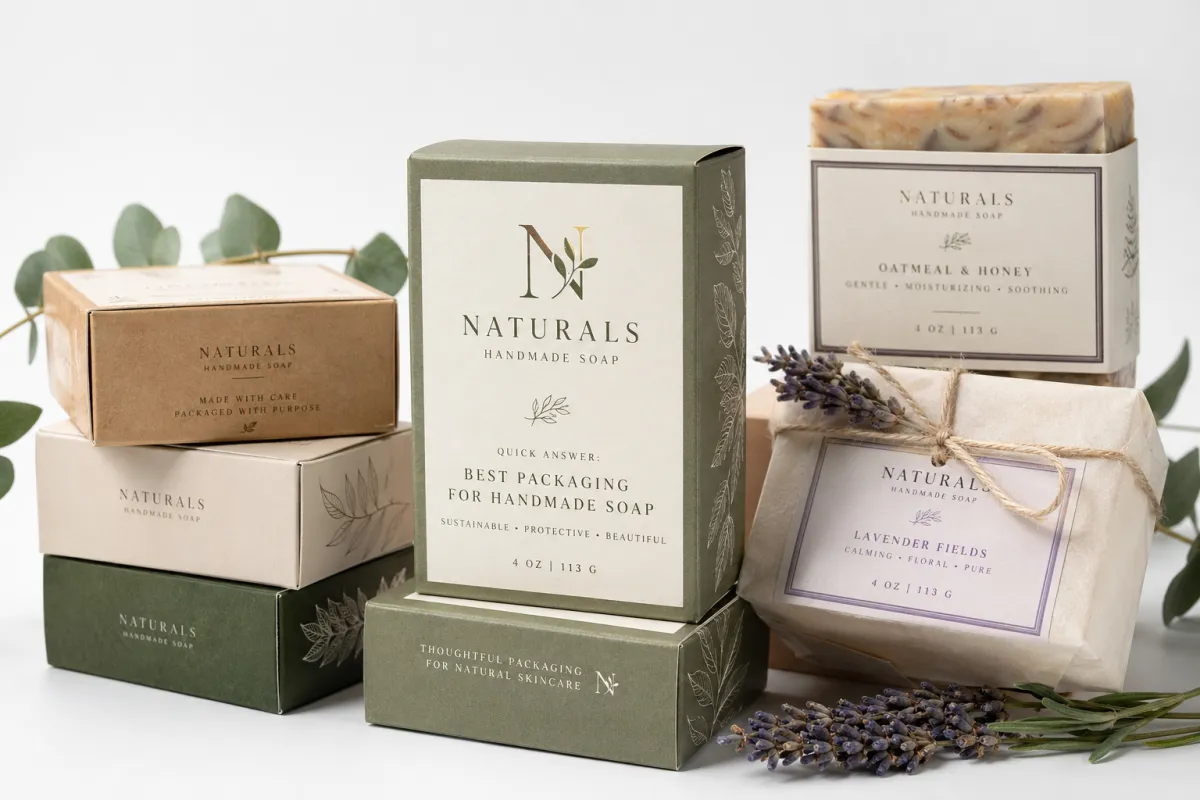
The best Packaging for Handmade soap for most brands is a kraft tuck box or a paper sleeve. That is the short version, and it usually holds up under actual production numbers. A kraft tuck box gives you structure, room for ingredients and branding, and enough protection for shipping and retail display. A sleeve is leaner, cheaper, and better if you want the soap itself to stay visible. If you are selling at craft fairs in Santa Fe or running small batches from a kitchen studio in Asheville, the best packaging for handmade soap is often the format that lets you pack fast, label cleanly, and stay within a sensible cost-per-bar target such as $0.25 to $0.40 all-in before freight.
For soap box packaging and custom soap labels, the same rule applies: choose the format that supports the bar, the brand, and the actual packing workflow rather than the prettiest proof on a screen. A well-built carton, a tidy sleeve, and clear label copy usually do more for sell-through than an overly ornate package that slows production and raises landed cost.
I once stood on a factory floor in Dongguan while a soap client tested three formats side by side: a rigid gift box, a kraft sleeve, and a window tuck box. The rigid box looked gorgeous, sure, but it also added $0.78 per unit, took more carton space, and picked up scuff marks during a rough transit test that included 24-inch drops and a 50 lb compression load. The sleeve held its shape, printed cleanly on 300gsm uncoated board, and gave the buyer enough brand story without overbuilding the package. That sample cart made the decision for them. The best Packaging for Handmade soap was not the most expensive one. It was the one that stayed honest about the product and the pallet count.
Use this decision rule:
- Choose a tuck box if you ship orders, want better shelf presence, or need room for ingredients, barcode, and compliance text such as net weight and INCI details.
- Choose a sleeve if your soap is cured, dry, and you want a lighter, lower-cost package with less board and faster folding.
- Choose a window box if the bar color, swirl pattern, or embed work is the selling point and the window can be cut from PET or paperboard without obscuring the product.
- Choose a wrap if price sensitivity is high and you need fast packing at a market table or in a 1,000-bar test run.
- Choose rigid packaging only if the soap is a luxury gift item, the retail price is $18 or higher, and the customer expects a box that feels closer to cosmetics or confectionery.
The best packaging for handmade soap also depends on a few practical details people skip during planning. Is the bar still curing? Then you need airflow, or at least a package that does not trap moisture against a 98% coconut oil formula. Is the fragrance strong? Then paper stock, coating, and storage temperature matter more than most people think. Is the soap sold online through Shopify or Etsy? Then stackability, shipping compression, and carton efficiency matter. Is it sold in boutiques from Brooklyn to Boise? Then package branding and shelf appeal probably matter more than a few cents of material cost. That sounds obvious, yet plenty of buyers still miss it and then wonder why the prettiest sample turned into the least practical product on the shelf.
For sourcing context, packaging buyers often start with industry references from Packaging Institute research and material guidance, then validate transit performance against ISTA testing standards. I like that sequence because it pushes people to treat product packaging as a system, not a decorative shell. A package that only works in a render on a MacBook Pro is not a package; it is a very charming headache with a production quote attached.
Best Packaging for Handmade Soap: Top Options Compared
Here is the part most buyers want: a straight comparison of the main formats. If you are trying to figure out the best packaging for handmade soap, do not compare a wrap to a rigid box and pretend they play the same game. They do not. One is built for speed and cost control, usually in the $0.07 to $0.20 range per unit. The other is built for premium presentation and higher perceived value, sometimes at $1.10 or more before freight. The right answer changes by channel, and pretending otherwise usually costs real money by the second or third production run.
| Packaging Format | Best Use | Typical Cost per Unit | Main Strength | Main Weakness |
|---|---|---|---|---|
| Kraft tuck box | Shipping, boutiques, gift sets | $0.22-$0.55 at 5,000 units | Balanced protection and presentation | More material than a sleeve |
| Paper sleeve | Markets, eco brands, lower budgets | $0.14-$0.32 at 5,000 units | Low cost and easy branding | Less protection on edges |
| Belly band | Minimalist artisan brands | $0.08-$0.18 at 5,000 units | Cheap, fast, light | Very little physical protection |
| Soap wrap | Fast packing, batch sales, sample bars | $0.07-$0.20 at 5,000 units | Lowest material usage | Can feel less premium |
| Window box | Retail shelves, color-driven soaps | $0.30-$0.80 at 5,000 units | Shows the bar directly | Higher cost and more assembly |
| Rigid gift box | Luxury gifting, spa sets | $1.10-$2.40 at 3,000 units | Premium feel | Heavy, expensive, bulky |
That table shows the economics, but not the story. The best packaging for handmade soap for shipping is usually the kraft tuck box because it adds structure without becoming a freight monster. The best packaging for handmade soap for a farmers market in Denver is often a sleeve or wrap because the buyer can see the bar, smell it, and make a quick decision. The best packaging for handmade soap for a spa counter in Miami is usually a window box or a refined tuck box with a clean print finish, a matte aqueous coat, and tight brand spacing.
My ranking by use case looks like this:
- Best for shipping: kraft tuck box with 300gsm to 350gsm board and a 1.5 mm fold tolerance
- Best for markets: paper sleeve or wrap with a single-color print and fast hand assembly
- Best for premium branding: window box or rigid box with foil, emboss, or specialty stock
- Best for eco positioning: recycled kraft tuck box or sleeve with soy ink and FSC-certified paperboard
- Best for tight budgets: belly band or simple paper wrap with a single die-cut size
One buyer in Chicago tried to force a rigid package for a $7 bar because she wanted it to feel like a boutique candle. Pretty idea. Bad math. Her packaging cost would have eaten nearly 20% of retail before labor and shipping, and the finished carton would have needed a larger master case than her warehouse shelving could handle. We switched her to a 350gsm kraft tuck box with a single-color black print and a 0.2 mm spot varnish only on the logo, and the whole line looked cleaner. The best packaging for handmade soap is the one that leaves room for your margin, your labor, and your sanity.
Detailed Reviews: Boxes, Wraps, Sleeves, and Labels
Kraft tuck boxes
Kraft tuck boxes are my default recommendation for the best packaging for handmade soap in most selling situations. They look natural, hold print well, and give you enough wall strength to protect the bar without making the package feel overbuilt. I like 300gsm to 350gsm kraft board for most soap bars, especially when the finished bar weighs 4.5 oz to 5 oz and measures close to 3.5 x 2.5 x 1.1 inches. If the bar is sharply cut or has a rough texture, I lean toward the thicker end. If the soap is softer or still curing, I use a box with decent venting or avoid a fully sealed interior liner. I learned that one the hard way after a batch of lavender bars arrived with a faint damp paper smell that nobody had budgeted for and nobody wanted to explain to the retailer in Raleigh.
The first time I toured a small converting line in Shenzhen, the owner showed me a run of tuck boxes printed with a heavy, glossy coating. They looked sharp for about two hours. Then the edges started picking up fingerprints, and the corners began to look tired after hand packing at roughly 400 units per hour. We changed the finish to a soft matte aqueous coat, and the problem basically disappeared. That is why the best packaging for handmade soap is not just about print design. It is about finish, handling, carton friction, and how the box ages in the real world after 12 or 15 touches on a retail floor. A package that looks good only before anyone touches it is kind of missing the point.
Use it if: you need shipping protection, a retail-ready look, and a place for ingredients, batch info, barcode, and net weight.
Skip it if: your absolute lowest cost matters more than presentation, or if you need near-zero assembly time on a 10,000-bar run.
Paper sleeves
Sleeves are one of the cleanest answers to the best packaging for handmade soap question when you want the bar to do most of the selling. They use less board, print nicely, and keep the soap tactile. I like sleeves for artisan bars that have marbling, embeds, or a textured top edge that buyers want to see, especially when the art direction leans toward botanicals or mineral pigments. A 250gsm to 300gsm stock usually works well. Add a little friction in the fold, and the sleeve stays put without chewing up the paper surface. It sounds like a tiny detail until a stack of sleeves starts drifting open in a hot booth in Atlanta, which is exactly the sort of thing that makes a person mutter at inanimate objects.
I once watched a soap maker lose sales because her fully boxed bars hid the swirl pattern that people loved at the sample table. We moved her to a sleeve with a small ingredient panel on the back, a recycled kraft stock, and black vegetable-based ink. Her sell-through improved because shoppers could actually see the bar, read the scent name, and still feel like they were buying something handmade. That is a classic example of how the best packaging for handmade soap is sometimes the format that stops trying so hard. Honestly, the soap did the selling once the packaging got out of its way.
Use it if: your soap is cured, attractive on its own, and you want lower packaging cost with a clear visual line.
Skip it if: the bar chips easily or you are shipping long distances without extra protection in a mailer or shipper box.
Soap wraps
Wraps are the budget workhorse. They are often the best packaging for handmade soap for new brands, market sellers, and anyone testing scents in a 500-bar or 1,000-bar pilot. A simple paper wrap can stay around $0.07 to $0.20 per unit at useful quantities, which leaves more room for formulation and marketing. The downside is clear: less protection, less structure, and a more handmade feel that can drift into cheap if the print is weak or the stock is too thin. A wrap can feel charming, but it can also feel like you ran out of packaging ideas halfway through the project. I say that with love and a little paper-cut exhaustion.
When I negotiated paper supply with a mill rep in Jiangsu, I asked for a lower price on a cream wrap stock. He offered me a $0.03 discount if I accepted a slightly rougher surface finish. I passed. Why? Because rough paper can scuff darker inks, mute subtle type, and make the soap look dusty after a week in a warm storeroom. That is the kind of detail that separates decent retail packaging from frustrating product packaging. The best packaging for handmade soap does not fight the product finish, and it definitely should not make a clean bar look like it lived under a delivery truck in July.
Use it if: you need low cost, fast packing, and a handcrafted look with minimal material use.
Skip it if: your bar has sharp edges, delicate embossing, or high shipping exposure across multiple distribution centers.
Belly bands
Belly bands are a smart compromise. They use very little material, they can be printed beautifully, and they let the soap stay visible from every side except the center. For minimalist branding, they can be the best packaging for handmade soap because they say exactly what they are: a clean band of information around a real artisan bar. The trade-off is obvious. They do not protect corners or preserve shape, so the soap still needs to be sturdy, well cured, and consistent in size within about 1 to 2 mm. If your bars are a little too soft, the band will just sit there politely while the soap gets on with falling apart.
If you are trying to make branded packaging feel restrained and modern, a belly band with 100% recycled kraft stock, one strong typeface, and a 12-point type size can look better than a cluttered box with five ink colors. I have seen premium brands overdesign themselves into looking expensive but confused. A simple band does the opposite. It helps package branding without pretending to be a gift set. Sometimes less paper really is more, which feels almost suspicious until you see it on the shelf in a Portland refill shop.
Use it if: your product already looks strong and you want a low-cost brand layer that can be applied in seconds.
Skip it if: you need moisture protection or transit protection from extra handling and long-distance shipping.
Window boxes
Window boxes are the visual merchandiser's favorite answer to the best packaging for handmade soap debate. They show the color, the texture, and the handcrafted shape. I like them for holiday collections, floral soap lines, and bars that rely on visual detail to sell. The clear window can be PET, PLA, or a paper cutout, depending on your sustainability goals and budget. A paper window cutout often feels more honest for an eco brand, though the visibility is not quite as strong. People like to say they want sustainability, then they pick the material with the shiniest window. Humans are complicated, what can I say?
The failure point here is not the window. It is overconfidence. If the soap off-gasses heavily or is still soft, the inside film can fog, and the corners can scuff during packing at a rate of 250 to 300 units per hour. I have seen buyers fall in love with the shelf look and forget the internal reality. The best packaging for handmade soap with a window is the one that still works after the fifth handoff, not just in the mockup. A lovely render is nice; a package that survives a hurried pack-out at 4:45 p.m. in a warehouse outside Nashville is better.
Use it if: the soap's color, shape, or embedded detail is a major selling point.
Skip it if: you want the lowest shipping volume or the most eco-minimal setup.
Rigid gift boxes
Rigid boxes are premium, full stop. They feel expensive, they stack beautifully in gift sets, and they can make a soap line look like a spa counter favorite in Beverly Hills or Charleston. But they are rarely the best packaging for handmade soap unless the retail price supports the cost. At low quantities, the unit cost climbs fast. Add a printed wrap, foam insert, or magnetic closure, and the numbers get ugly fast. I have quoted rigid soap packaging that landed at $1.80 to $2.40 per unit before freight. That is a lot of cardboard for one bar. Beautiful cardboard, yes. Still cardboard.
One client in a boutique meeting told me, "I want the unboxing to feel like jewelry." I get it. Soap is not jewelry. Soap gets wet, sits in bathrooms, and often ships in batches of 24 or 48 units. If you build it like a luxury watch, you may get a gorgeous shelf sample and a miserable margin. The best packaging for handmade soap in this tier is reserved for high-ticket gift bars, holiday sets, or corporate bundles where the packaging itself drives perceived value. Otherwise, you are paying for drama, and drama is expensive.
Use it if: the soap is part of a luxury gift or spa presentation and the retail price is $18 to $35 per bar or set.
Skip it if: you are price-sensitive, shipping widely, or still testing demand in a first production run.
Price Comparison: What Handmade Soap Packaging Really Costs
Pricing is where most people discover that the best packaging for handmade soap is not just a design choice. It is a business choice. The cost is not only paper and ink. It includes setup, tooling, proofing, packaging labor, and the cost of getting it wrong. A cheaper unit price can still become the expensive option if the format slows packing or increases damage. I have seen that movie enough times to know the ending, and it usually arrives with an extra invoice from freight, rework, or rush printing.
Here is the cost structure I usually see for the best packaging for handmade soap categories at typical custom production volumes:
| Cost Item | Low-Volume Range | What Drives the Cost |
|---|---|---|
| Wraps and labels | $0.07-$0.20 per bar | Paper stock, print color count, adhesive, cut size |
| Sleeves | $0.14-$0.32 per bar | Board weight, folding complexity, print coverage |
| Kraft tuck boxes | $0.22-$0.55 per bar | Dieline, board thickness, coating, finishing |
| Window boxes | $0.30-$0.80 per bar | Window film, labor, added assembly, finish |
| Rigid boxes | $1.10-$2.40 per bar | Greyboard, wrap paper, magnets, inserts, hand assembly |
The hidden costs matter more than buyers expect. Dieline setup can run $75 to $250 depending on complexity and whether the carton needs a 1 mm bleed adjustment or a custom insert. Sample making can cost $40 to $120, sometimes more if you want multiple finishes such as soft-touch lamination, foil stamping, or embossed logos. If you need Custom Printed Boxes with foil, embossing, or spot varnish, the setup bill climbs. Freight also matters. A flat-packed sleeve ships efficiently from a plant in Dongguan to a warehouse in Los Angeles. A rigid box ships like a tiny brick and can add 12 to 18% to the landed cost if pallet utilization drops.
I learned this the annoying way during a negotiation for a premium soap client. The unit price looked fine on paper, but the cartons were so bulky that the warehouse team could only fit half as many cases per pallet. That meant higher storage cost, higher inland freight, and more time unpacking. The supplier had offered a cheaper box and a more expensive logistics bill. Clever. Also irritating. The best packaging for handmade soap has to be measured per finished bar, not per carton quote or per thousand pieces on a factory spreadsheet.
There is also the cost of correction. If your measurement is off by 2 mm and the soap jams in the tuck flap, you might lose an entire run of 5,000 units. If the paper stock is too weak, the box crushes in transit during a 600-mile carrier route. If the label adhesive is too aggressive, it wrinkles the wrapper and leaves residue on the bar. One bad decision can cost more than the difference between a $0.18 sleeve and a $0.32 sleeve. That is why the best packaging for handmade soap is usually the one you have tested, not the one that merely looked good in a PDF.
For sustainability context, I like to compare options against the broader packaging waste conversation from the EPA and the materials guidance that brands use to keep sourcing honest. If you are chasing FSC-certified paperboard, ask for chain-of-custody documentation, not just a logo on the invoice. The same goes for recycled content claims. Nice words are cheap. Paper trails are better. If a supplier cannot explain the paper, the coating, or the sourcing chain clearly, I start trusting them a lot less, especially when the stock claims to be 100% recycled but the whiteness looks suspiciously like virgin pulp.
How to Choose the Right Packaging for Handmade Soap
If you want the best packaging for handmade soap, stop thinking only about aesthetics and start with the soap itself. Hard bar or soft bar? Fully cured or still losing moisture? Strong fragrance or subtle scent? Smooth surface or rough artisan cut? Those answers matter because packaging has to match product behavior. A soft, fresh bar in a sealed package can become a headache in 48 hours. A dry, firm bar in a simple sleeve can perform beautifully across 10,000 units. I know that sounds like common sense. Common sense, frustratingly, is not always common in packaging meetings in New York or Chicago.
I usually walk clients through a practical checklist:
- Bar condition: cured, semi-cured, or soft from production at the 14-day mark
- Scent strength: light botanical, medium fragrance, or strong aromatic blend with 3% to 5% oil load
- Sales channel: online, market stall, boutique, spa, or gift box
- Handling level: low-touch display or frequent customer contact
- Protection need: edge protection, scratch resistance, moisture resistance, or compression resistance
- Brand position: earthy artisan, luxury spa, minimalist clean, or seasonal gift
That checklist sounds boring until you see what happens when it is ignored. I once reviewed a soap line that smelled incredible but was packed in a tight sleeve with no airflow and a heavy gloss coat. The paper buckled slightly, the scent bled into the stack, and the buyer complained about tacky surfaces after a warm truck ride from Atlanta to Tampa. The best packaging for handmade soap for that product would have been a breathable tuck box with a matte finish, a 320gsm C1S artboard, and a simpler internal fit. Instead, everyone got a lesson in humidity, and none of us were thrilled.
Match the brand mood
Earthy artisan branding usually works best with kraft, recycled sleeves, and minimal ink coverage, often using one Pantone spot color and black type. Luxury spa branding usually needs cleaner typography, better print contrast, and more rigid structure with a matte laminate or soft-touch finish. Minimalist branding often loves a single-color sleeve or a white tuck box with a small logo and generous white space. Seasonal gift branding can handle window boxes, foil accents, and printed inserts with holiday copy. The best packaging for handmade soap depends on whether your package needs to whisper, shout, or simply stay out of the way on a shelf in a 400-square-foot boutique.
Think about storage and packing speed
Flat-pack efficiency gets ignored until the warehouse gets crowded. A sleeve or tuck box stores neatly in volume, often 500 to a case or 1,000 to a master carton. A rigid box takes up more room and creates more handling work. If your team applies labels by hand, count the seconds. I have timed lines where a simple wrap took 12 seconds per bar and a more complex box took 31 seconds per bar. That difference turns into real labor cost by the third pallet. The best packaging for handmade soap is often the one your team can assemble without getting bored, sloppy, or annoyed. And yes, the annoyed part matters. Tired people make crooked folds. Crooked folds make unhappy buyers and returned orders.
Plan for shipping abuse
Soap looks tough. Packaging can be fragile. If you ship direct to consumer, test with compression, drop handling, and corner rub. ISTA test methods are useful here because they force you to think beyond the box photo, especially for mailers that travel 1,200 miles through three distribution hubs. I am not saying every brand needs a full lab program in Ohio. I am saying you should not trust a first sample and a prayer. The best packaging for handmade soap should survive at least one bad day in transit, because packages do not get to choose gentle weather or polite delivery drivers.
Process and Timeline: From Dieline to Finished Soap Packaging
The process matters because good packaging is built in steps, not guessed in one shot. If you want the best packaging for handmade soap, you start with the bar dimensions, then the format, then the dieline, then the artwork, then the sample, then production. Skip a step and you usually pay for it later. Usually twice. I wish that were a joke, because the second production run always seems to find the first production's mistakes at the worst possible moment.
Here is the production flow I recommend:
- Measure the cured bar in millimeters, not with a vague estimate, and record length, width, and depth separately.
- Choose the format based on sales channel and brand position, then lock the target unit price.
- Build or review the dieline so the soap fits without tearing the flaps or compressing the edges.
- Check artwork placement for barcode, ingredients, batch code, and logo.
- Approve a physical sample before full production.
- Run production after final signoff, not before.
Timeline depends on the format. A simple label or wrap run can move fast, sometimes in 5 to 8 business days after proof approval if the print schedule is open in Guangzhou or Ningbo. Sleeves and tuck boxes usually need 10 to 15 business days, with typical factory turnaround landing around 12 to 15 business days from proof approval for standard board and one or two ink colors. Window boxes and specialty finishes can take longer because of the extra tooling and assembly. Rigid boxes are slower still. If the supplier is also handling inserts, custom tissue, or foil-stamped cartons, add another 3 to 5 business days. The best packaging for handmade soap is rarely the fastest, but it should be predictable. Predictable beats "maybe next week" every time.
Sampling is where people get impatient and make dumb decisions. I have been in client meetings where the marketing team wanted to skip sample approval because the render looked "basically right." Basically right is not good enough. Paper grain, fold memory, ink density, and fit all change in real life. One soap brand I worked with had a gorgeous box mockup that looked perfect on screen, then the actual soap sat 3 mm too proud and tore the flap every third pack-out. A $90 sample would have saved a full reprint on 8,000 units. That is the kind of math nobody likes, but everyone understands after the damage is done.
There are a few checkpoints that prevent disasters:
- Confirm the soap after cure because bars can shrink slightly as moisture leaves over 10 to 21 days.
- Test fold strength on the actual board stock, not a cheaper substitute or a thinner white sample.
- Verify color on real paper because kraft and coated white board do not behave the same under the same ink formula.
- Check barcode placement so the scanner can read it on the shelf at 2 to 4 inches per second.
- Review scent interaction if the packaging will sit for weeks in storage at 65% humidity.
One of the reasons I push people toward the best packaging for handmade soap that fits the product, not the fantasy, is that factories can only execute what the input file and spec sheet actually say. If you want a 320gsm board, a matte aqueous coat, a 1.5 mm tolerance, a 0.125-inch bleed, and a flat-pack carton count of 500 per case, write it down. Clearly. Sloppy specs create sloppy output. No supplier magically reads your mind, and if they say they can, I would still ask for the sample and the signed proof before paying the deposit.
Our Recommendation and Next Steps
Here is my recommendation, plain and simple. For most handmade soap brands, start with a kraft tuck box or a paper sleeve. That combination covers the widest range of needs, from boutique retail to online shipping, without pushing the landed cost into awkward territory. If shelf visibility is your main selling point, move to a window box. If your brand sells as a gift or spa item with a higher price point, consider rigid packaging. But do not start there unless the margin supports it. The best packaging for handmade soap is the one that fits the soap, the brand, and the money you actually have in the order budget.
If I were placing a first custom order today, I would do this:
- Pick one primary format and one backup format.
- Order two or three physical samples with different stock weights or finishes, such as 300gsm kraft and 350gsm C1S artboard.
- Test the soap in hand, on a shelf, and in a shipping carton.
- Compare the real landed cost per bar, not just the factory quote.
- Choose the version that protects the margin and still looks like your brand.
That approach is boring. It is also profitable. I have seen too many founders fall in love with a package that photographs well and operates poorly. The best brands do the opposite. They choose Packaging That Sells, packs efficiently, and survives real use. That is why the best packaging for handmade soap is not one universal answer. It is a decision you make with your bar size, sales channel, and budget in the same room, ideally with a sample on the table and a calculator next to it.
If you are ready to source, start with our Custom Packaging Products and narrow the field to one format that matches your soap line. Ask for a sample, check the board weight, confirm the dieline, and compare the quote against your target price point. If the supplier is in Shenzhen, Dongguan, or Xiamen, ask for the finish schedule and the carton count per pallet before you approve the run. That is how you find the best packaging for handmade soap without wasting a month and a box of money on the wrong spec.
One last thing: if your soap is still curing, do not trap it in a package that holds too much moisture. If your brand story is eco-first, do not hide behind plastic unless you truly need moisture control. If your retail buyer wants a shelf-ready line, give them packaging that looks deliberate, with accurate copy, a clean dieline, and a finish that can handle a humid July afternoon. The best packaging for handmade soap balances all three: the product, the presentation, and the price. When those three line up, the whole project feels calmer, and calm in packaging is worth protecting.
What is the best packaging for handmade soap if I ship orders?
A kraft tuck box usually gives the best balance of protection, presentation, and shipping efficiency. If the bar has sharp corners or a soft surface, add tissue, a paper wrap, or a small insert so the soap does not rub through the corners during transit, especially on routes longer than 500 miles.
Is soap wrap or a box cheaper for handmade soap packaging?
Soap wraps are usually cheaper per unit because they use less material and fewer folds. Boxes cost more, but they protect the bar better and usually feel more premium to buyers. If your retail price is under $8, the cost difference can matter a lot, especially once labor enters the picture and packing time crosses 15 seconds per bar.
Do I need plastic packaging for handmade soap?
Usually no, especially if you want an eco-friendly brand story or sell cured bars. Use plastic only if moisture protection or scent sealing is a real product requirement. If you do need it, make sure the material choice matches your brand and your waste story, and ask whether PET, PLA, or a paper window cutout fits the region where you manufacture.
How much should handmade soap packaging cost per bar?
Low-cost wraps and labels can stay very cheap per unit, while custom boxes and premium finishes push the price up fast. A practical target is to keep packaging aligned with your bar price, shipping cost, and the brand value the package adds in the customer's hands, with a common target of 3% to 8% of retail for smaller artisan lines.
How long does custom handmade soap packaging take to produce?
Plan for sample approval first, then production, then shipping. Simple print jobs move faster than specialty finishes, custom inserts, or complicated dielines. If you skip samples, you often end up paying for a second run, and most standard tuck boxes need about 12 to 15 business days from proof approval before the cartons are ready to ship.


