Buyer Fit Snapshot
| Best fit | packaging for skincare samples for packaging buyers comparing material specs, print proof, MOQ, unit cost, freight, and repeat-order risk where brand print, material, artwork control, and repeat-order consistency matter. |
|---|---|
| Quote inputs | Share finished size, material target, print colors, finish, packing count, annual reorder estimate, and delivery region. |
| Proofing check | Approve dieline scale, logo placement, barcode or warning zones, color tolerance, and any recyclable or compostable wording before bulk production. |
| Main risk | Vague material claims, crowded artwork, or missing packing details can create delays even when the unit price looks attractive. |
Fast answer: Packaging for Skincare Samples: Material, Print, MOQ, and Cost should be specified like a repeatable production item. The safest quote includes material, print method, finish, artwork proof, carton packing, and reorder notes in one written spec.
What to confirm before approving the packaging proof
Check the product dimensions against the actual filled item, not only the sales mockup. Ask for tolerance on folds, seals, hang holes, label areas, and retail display edges. If the package carries a logo, QR code, warning copy, or legal claim, reserve that space before decorative graphics fill the panel.
How to compare quotes without losing quality
Compare board or film grade, print process, finish, sampling route, tooling charges, carton quantity, and freight assumptions side by side. A lower quote is only useful if the supplier can repeat the same color, closure quality, and packing count on the next order.
If you are searching for the best Packaging for Skincare samples, my first answer is practical rather than glamorous: the prettiest format rarely survives the line at 2:00 p.m. in a filling room, especially if the cap torque is off by even 0.1 N-m or the liner is mismatched. I still remember holding a 5 mL sample vial beside a bench in Shenzhen, watching a seal test fail because the neck finish and induction seal were not aligned to the right spec, and that tiny mismatch turned a polished concept into a leak report. The best packaging for skincare samples is usually the one that keeps actives stable, ships flat or compact, and gives the customer enough product to judge texture, scent, and absorption without drama.
The Custom Logo Things team asked for a practical review, so I am using the same lens a production supervisor in Dongguan, a buyer in Los Angeles, and a brand manager in Milan would use after a long week on the floor: what leaks, what holds, what feels premium, what costs $0.15 per unit for 5,000 pieces versus what climbs to $0.62, and what actually helps a trial turn into a full-size sale. A sample is not a tiny toy; it is a tiny sales pitch that has to survive carton assembly, parcel transit, and a customer’s bathroom counter, often in 18 to 24 hours of rough handling before anyone even opens it.
There is no single winner for every formula, and the best packaging for skincare samples changes with the chemistry. A water-light toner that is stable at 25 degrees Celsius does not need the same protection as a vitamin C serum that starts discoloring after 48 hours of light exposure or a balm that softens at 35 degrees Celsius. In practice, the decision usually comes down to four things with real numbers attached: how sensitive the formula is, how many applications the customer needs, how premium the presentation should feel, and whether the budget is closer to $0.08 or $0.80 per unit. I have seen teams argue for three meetings over foil color on a 350gsm C1S artboard carton, only to discover the real failure point was a loose closure on the inner bottle. For many brands, the best packaging for skincare samples is less about decoration than it is about barrier protection, tamper evidence, and the right sample sachets or mini containers for the formula.
What Is the Best Packaging for Skincare Samples?
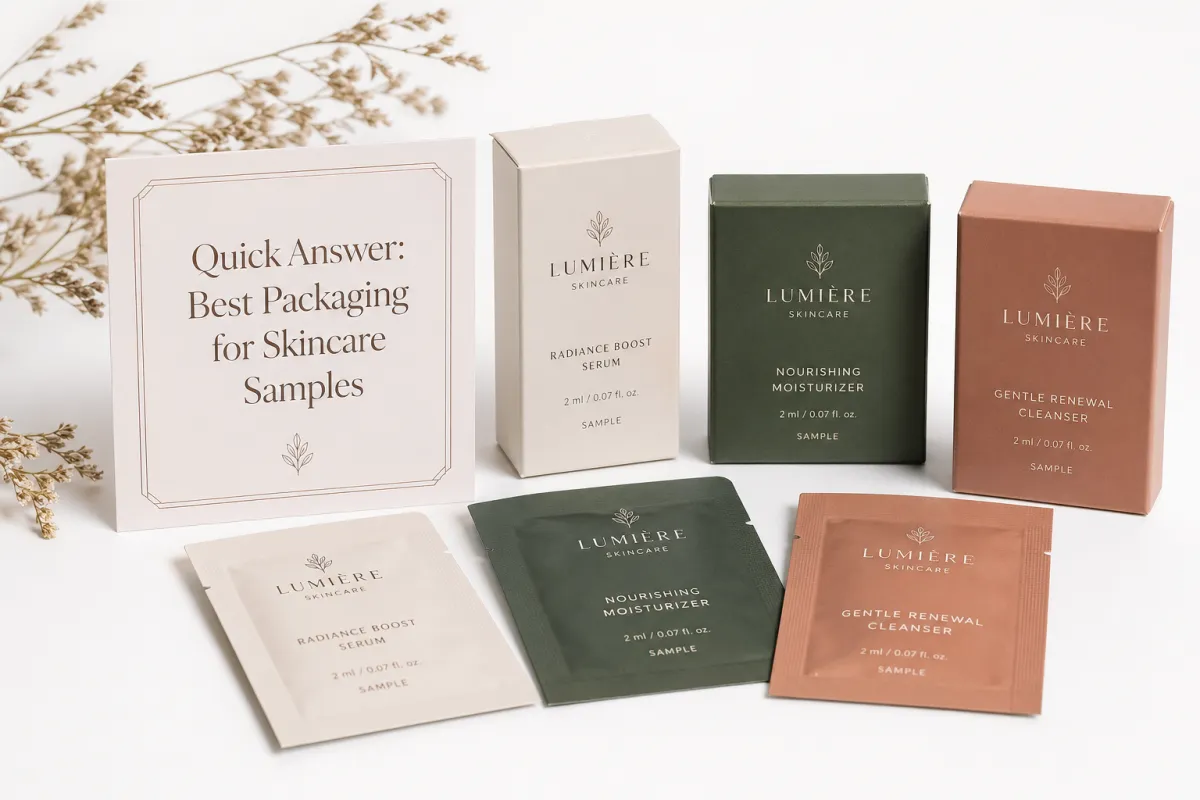
If you want the short version, here it is: the best packaging for skincare samples depends on the formula, but the practical winners are easy to name. Sachets are usually the best packaging for skincare samples when cost and volume matter most, because a PET/AL/PE laminate sachet can often be produced for about $0.03 to $0.10 per unit and shipped flat in a mailer with a 1 mm insert card. Airless minis are the best packaging for skincare samples for premium serums, because a 15 mL PP airless pump reduces oxygen exposure and gives the formula a more deliberate feel. Small jars are often the best packaging for skincare samples for creams and balms, as long as you accept that repeated finger contact can shorten the perceived shelf life. Sample cards and pouches are strong options for powders or dry formulas, especially when you need a moisture barrier and a compact format that stays light enough for a trade show handout in Chicago or Seoul.
I learned that lesson on a humid summer shift in a contract filling plant near Shenzhen, where a 5 mL serum looked beautiful in a custom carton but leaked during a 24-hour inversion test because the cap liner compressed unevenly against a neck finish that was off by 0.15 mm. The line operator swapped the fancy pack for a simpler molded bottle, added an induction seal, and checked cap torque at 0.45 N-m, and the leak rate dropped to nearly zero by the next production check. I still remember how annoyed the marketing team was when the cleaner-looking option lost to the plain one, but the plain one was the one that survived the courier route from Guangdong to the customer’s doorstep. That is why the best packaging for skincare samples is rarely about the flashiest outer shell; it is about the package doing its quiet work in a warehouse, on a delivery truck, and in a bathroom cabinet.
Here is the practical winner by use case: sachets for low-cost trial campaigns, airless minis for premium serums, small jars for creams and balms, and sample cards or pouches for powders and dry actives. If you are protecting sensitive ingredients, the best packaging for skincare samples is the one that limits oxygen, moisture, and light while still giving the customer enough product to evaluate spread, feel, and scent across at least two or three applications, which usually means 1.5 mL to 7 mL depending on viscosity. That last part matters because one rushed use tells very little; customers need enough product to see whether a formula fits their routine on Tuesday morning and Friday night, not just in a single five-second test.
Before you spend on embossing, foil stamping, or a fully custom outer sleeve, compare the sample format against six criteria: barrier protection, leak resistance, unboxing feel, sustainability, MOQ, and turnaround time. That is the fastest way to choose the best packaging for skincare samples without getting pulled toward visuals that look great in a mockup but fail during parcel vibration testing or a 1-meter drop. I say that as someone who has watched a team fall in love with a brushed-metal cap that scuffed badly after just one transit simulation from Ningbo to New Jersey.
Best Packaging for Skincare Samples Compared
When I compare the best packaging for skincare samples, I start with the formula instead of the format, because the chemistry decides the packaging more often than the render does. A sachet, a mini bottle, and a tube behave differently once filling starts, and the differences widen once you run them through cartoning, overboxing, and parcel drop testing. For liquids and thin gels, the best packaging for skincare samples usually leans toward airless minis, dropper vials with proper seals, or tightly controlled sample sachets with a 50-micron barrier film. For emulsions and thicker creams, tubes and small jars often win. For balms, you need a closure that stays clean and does not trap product in the threads. For powders, you want a moisture barrier with a reliable tear or peel feature that opens cleanly in one pull.
Presentation changes perception faster than most people expect, and I saw that firsthand at a trade show in Chicago where one brand handed out a 3 mL vitamin C serum in a thin, unlabeled vial and visitors treated it like a freebie. The same formula, moved into a frosted 10 mL airless mini with a matte label and a 300gsm printed outer card, suddenly felt closer to something a dermatologist might stock in a clinic. That is the strange truth behind the best packaging for skincare samples: the package is often the first signal of formula quality, even before anyone smells or applies it. People judge by the click of a cap and the weight in the hand, and I say that with affection because I do exactly the same thing.
On the buyer side, the best packaging for skincare samples also has to make dispensing control obvious. A consumer should be able to tell in three seconds whether the format is single-use, resealable, or refillable, and they should not need a second look to find the tear notch or peel tab. Tamper evidence matters too. If the closure loosens in transit or the seal looks disturbed, the whole package feels compromised, especially for premium packaging that needs to support a $32 full-size serum. I have seen people forgive a plain design faster than they forgive a sample that appears opened, because trust in a sample has a very short fuse.
| Format | Best For | Typical Unit Cost | Strengths | Weak Spots |
|---|---|---|---|---|
| Sachet | Low-cost trial, lotions, serums | $0.03-$0.10 | Flat shipping, single-use dosing, fast production | Less premium feel, tear risk, limited reclose |
| Stick pack | Liquid or gel spot trials | $0.05-$0.14 | Portable, controlled dosage, easy mail inserts | Not ideal for thick creams |
| Mini jar | Creams, balms, masks | $0.18-$0.55 | Good tactile feel, easy scooping, simple filling | Finger contamination, oxygen exposure |
| Airless pump | Premium serums, anti-aging formulas | $0.45-$1.40 | Excellent barrier, polished presentation, dosing control | Higher MOQ, more parts, higher fill cost |
| Dropper vial | Thin liquids, oils, actives | $0.20-$0.90 | Clear product visibility, controlled application | Leak risk if neck finish or liner is off |
| Sample tube | Lotions, cleansers, sunscreen samples | $0.12-$0.40 | Familiar, easy to squeeze, decent shelf appeal | Cap failure, panel scuffing in transit |
| Carded kit | Curated PR drops, multi-step regimens | $0.80-$3.50 | Strong retail packaging feel, great storytelling | More assembly labor, more freight volume |
If you want a quick rule of thumb, sachets and stick packs are best for scale, mini jars and tubes are best for creams, and airless pumps are best for premium liquids. The best packaging for skincare samples is the one that matches the formula’s behavior and the campaign’s purpose, not the one that looks best on a render or a mood board. For a brand selling through salons in Los Angeles, e-commerce in Texas, and subscription boxes in Toronto, I would often put the same serum into two formats: a sample sachet for broad trial and an airless mini for VIP customers or dermatology partners. That split strategy is ordinary on paper, but it performs well in real distribution.
For standards and testing, I always look for evidence of practical validation rather than vague claims. If a supplier says the pack has been tested for distribution hazards, ask whether they followed ISTA procedures or a similar protocol, and whether the closure survived drop, vibration, and compression checks over a 48-hour test window. The ISTA testing framework is a useful reference point, and for sustainability discussions, the FSC system matters when you want paper-based cartons with responsible sourcing and chain-of-custody paperwork. Those details do not create the best packaging for skincare samples by themselves, but they do separate serious suppliers in Guangdong or Zhejiang from optimistic ones who only speak in renderings.
Detailed Reviews of the Most Effective Sample Packs
When I review the best packaging for skincare samples, I think like a line mechanic first and a marketer second, because a sample that jams every third cycle on a form-fill-seal machine is not a good choice no matter how elegant the mockup looks. A mini bottle that requires six steps of hand assembly is also a bad fit if you need 50,000 units before a launch in 12 to 15 business days from proof approval. The best packaging for skincare samples has to survive filling, sealing, cartoning, bundling, palletizing, and parcel transit without leaving a pile of rejects at the end of the shift. You can have the nicest concept board in the studio, but if the line stops every twenty minutes, the romance disappears fast.
Sachets are usually the easiest place to start. They remain one of the best packaging for skincare samples when the campaign has a low unit budget and a wide audience, especially if you need a flat format that fits into a direct mail piece or a magazine insert. I have seen a contract packer in Dongguan run 120 sachets per minute on a stable laminate structure, and that throughput changes the economics very quickly. The downside is obvious: a sachet can feel disposable, and if the tear notch is weak or the fill volume is too small, the customer only gets one disappointing application. For a cleanser, toner, or lotion, though, a properly sealed sample sachet with a foil barrier can be excellent. For a luxury anti-aging serum, it often feels too basic unless the artwork, laminate finish, and secondary carton are handled with real care.
Mini jars are a different story. They are often among the best packaging for skincare samples for thicker creams, overnight masks, and balms because the customer can dip in, feel the texture, and understand immediately whether the formula suits their skin. The tradeoff is hygiene and oxygen exposure. A customer may open a jar three or four times before deciding, and that repeated exposure can change the product experience, especially for formulas with plant oils or probiotics. On one factory visit in New Jersey, I watched a jar sample run beautifully until the cap liner was over-compressed, after which the closure became unreliable after thermal cycling from 5 degrees Celsius to 40 degrees Celsius. That little issue cost the brand nearly two weeks of rework, which is why the best packaging for skincare samples is only as good as the weakest sealing surface.
Airless pumps are the format I reach for when the formula is valuable, sensitive, or positioned as premium. If you are working with peptides, stabilized vitamin C, or a brightening serum that should not spend time in open air, airless pumps often become the best packaging for skincare samples because they reduce backflow and protect the product between applications. They also feel more trustworthy in the hand, especially if the actuator has a consistent 1.2 mL stroke and a clean, matte finish. The catch is cost and complexity. Airless components usually carry higher MOQ, tighter tolerances, and more part variation, which means your supplier needs a sharper quality control process and a reliable factory in Shenzhen, Ningbo, or Taizhou. When a buyer tells me they want the best packaging for skincare samples and also wants the absolute lowest cost, I usually point them back to the formula and ask what they are protecting.
"I do not care how pretty the carton is if the cap wobbles," a cosmetics client told me during a final QC review, and honestly, he was right. We were looking at a glossy sample kit, but the cap pull-off force varied by nearly 20 percent across a 500-piece pilot run, so the whole batch had to be checked before release. The meeting ended with everyone quiet in that specific way people get when the spreadsheet stops helping and the gauge reading is the real boss in the room.
Dropper vials deserve a careful look. They can be some of the best packaging for skincare samples for oils, thin serums, and active treatments, especially when you want the consumer to feel like they are receiving a clinical, ingredient-led formula from a dermatology lab in Seoul or Basel. In practice, though, they are unforgiving. The neck finish, liner choice, and closure torque all have to be correct, usually within a narrow window such as 0.35 N-m to 0.50 N-m depending on the closure. I once watched a supplier negotiate a price down by $0.04 per unit on a 30,000-piece run, then lose that savings because the vial body had a slight variance that caused leakage after 48 hours in warm storage. That is the kind of detail that decides the best packaging for skincare samples in real life, not a spec sheet alone.
Carded sample kits are where packaging design and product packaging overlap more obviously. These are often the best packaging for skincare samples for PR campaigns, launch kits, and multi-step regimens because they tell a story, not just a dosage. A well-structured carded kit can hold a cleanser, serum, and moisturizer in one branded system, which gives the customer a routine rather than a single item. The downside is cost and assembly time. If your kit needs Custom Printed Boxes, inserts, or nested pouches, the labor can climb quickly, especially if the samples must be hand-inserted and sealed with tamper labels. Still, for clinical skincare and prestige beauty, the right carded kit can be the best packaging for skincare samples because it creates a memorable first touch.
Sample tubes sit in the middle. They are often the best packaging for skincare samples for lotions, sunscreens, cleansers, and lighter emulsions because customers understand how to use them instantly and can squeeze out a dose without a spatula. Tubes also travel better than many people expect, provided the cap design is solid and the seal is clean. In one retail packaging program I reviewed, the tube format cut breakage complaints by more than half compared with a rigid vial, mainly because the package tolerated small shifts in parcel handling and a 1-meter drop in the final delivery test. The tube is not glamorous, but it is reliable, and reliability is a serious virtue when you are trying to make the best packaging for skincare samples feel effortless for the consumer.
For brands with a natural or eco-led identity, material choice matters just as much as format. A paper sleeve, PCR content, mono-material body, or FSC-certified carton can help, but I always warn clients not to let sustainability claims outrun performance. If the sample leaks, the environmental message disappears with the return shipment, and the customer remembers the mess more than the recycled content. That is why the best packaging for skincare samples often balances source reduction, right-sizing, and practical protection before it chases a perfect sustainability story. The EPA's waste reduction guidance is useful as a broader reference when brands are thinking about shipping waste, overpacking, and disposal behavior.
Many marketers miss one plain fact: the best packaging for skincare samples has to work after the sample leaves the factory. The parcel may sit in a depot for two nights, ride in a van through 38-degree Celsius summer heat, and land on a bathroom shelf that is warmer than the lab stability room by 6 or 7 degrees. I like to run a simple in-house test: 24 hours upright, 24 hours inverted, one 1-meter drop on each face, and a short vibration cycle if the supplier can provide it. It is not fancy, yet it often catches the same problems that would show up during customer use. If you have ever opened a leaking box and muttered something unprintable, you already understand why this matters.
Price Comparison for Skincare Sample Packaging
The price conversation around the best packaging for skincare samples gets messy when people focus only on unit cost. I have sat in enough procurement meetings to know that a $0.06 sachet can be the cheapest line item and still become the most expensive choice if it fails the first round of QC or needs a second packing pass. The real cost includes material thickness, decoration, fill speed, overfill allowance, rejects, freight, and the labor needed to turn loose components into a finished sample. If you are buying the best packaging for skincare samples, you need to think about all of that, not just the quote from one supplier in Guangdong. Honestly, that is where a lot of otherwise smart teams go sideways: they optimize the quote and accidentally ignore the system.
Low-cost formats usually win on throughput and freight efficiency. Mid-range formats win on balance. Premium formats win on conversion, especially if a sample can lift full-size sales by even 2 percent over a 90-day window. I have seen a brand spend an extra $0.28 per unit on an airless mini and recover that cost in one retailer reorder cycle because the sample felt more credible and generated better review language. The customer was not buying plastic; they were buying trust, and trust has a real price even if finance hates hearing that out loud. For a 10,000-piece run, that extra $0.28 is $2,800, which is easier to justify if the campaign can pull in even 100 more conversions at retail.
| Format | Typical Price Band | Decorating Options | Best Use Case | Hidden Cost Risk |
|---|---|---|---|---|
| Sachet | $0.03-$0.10 | Flexo print, basic reverse print | Mass trial and mail inserts | Seal failures, product loss in transit |
| Tube sample | $0.12-$0.40 | Screen print, label, shrink band | Cleansers, lotions, sunscreen | Cap issues, dents, print scuffing |
| Mini jar | $0.18-$0.55 | Label, hot stamp, carton | Creams and balms | Higher labor and contamination risk |
| Dropper vial | $0.20-$0.90 | Label, frosted body, metalized cap | Thin serums and oils | Leakage, torque inconsistency |
| Airless mini | $0.45-$1.40 | Pad print, label, custom cap | Premium serum sampling | More parts, tighter tolerances |
| Carded kit | $0.80-$3.50 | Full custom print, inserts, foil accents | Influencer and launch kits | Assembly labor, freight volume, damage in transit |
The hidden cost that catches people most often is reject rate. If your fill line loses 4 percent of units to leakage, cap misalignment, or cosmetic defects, the real unit price climbs fast, especially on a 25,000-piece run. That is why the best packaging for skincare samples is often the one that minimizes rework, even if the quote is a little higher. A 10,000-piece run with a 1 percent reject rate is a very different business from a run with a 6 percent reject rate, particularly when the formula itself costs $3.00 a liter or more and the fill process requires clean-room discipline. The money leaks out faster than anyone expects, which is a terrible joke for a sample pack but a very real line item.
Shipping weight is another hidden cost. A rigid sample bottle with a heavy overcap and a custom insert can move a campaign into a higher freight band from Guangzhou to Dallas or from Rotterdam to Toronto. I have seen marketing teams fall in love with a sample concept until the freight invoice landed, especially when the carton used 450gsm board plus a molded pulp tray. That is why the best packaging for skincare samples often favors right-sized components, thinner cartons, and controlled void space. When you ask a supplier for a quote, ask for landed cost too, not just ex-factory pricing. If you are comparing options through Custom Packaging Products, make sure the sample format and the outer pack are costed together, because the pair is what the customer actually receives.
Decoration can be cheap or expensive depending on the substrate. A simple label on a clear mini tube may cost almost nothing compared with a custom molded body, but the wrong label stock can curl under cold-chain conditions or rub off in transit after 72 hours in a courier hub. That is where Custom Printed Boxes and branded packaging can help, provided they protect the sample instead of inflating the system without adding value. In a few programs I have reviewed, the best packaging for skincare samples was not the most decorated format, but the one that used one clean label, one reliable closure, and one well-fitted carton sleeve. Less fuss, fewer failures, better result.
How to Choose the Best Packaging for Skincare Samples
The easiest way to choose the best packaging for skincare samples is to start with formula compatibility. Thin serums, alcohol-heavy toners, creamy moisturizers, balms, exfoliating acids, and powders all behave differently when exposed to heat, light, and oxygen. A water-light formula that oxidizes quickly should not be treated like a stable lotion, and a balm that softens at 35 degrees Celsius should not sit in a loose jar with a cheap cap. If you test the formula first, the best packaging for skincare samples becomes much easier to identify. I know that sounds basic, but I have said it in more than one room full of confident people while holding a failed stability sheet from a 28-day test.
Channel matters next. Direct-to-consumer mailers are one thing, retail handouts are another, and influencer PR boxes are a third. A DTC insert can handle a flatter, lighter format like a sachet or carded pack. A retail handout may need something that feels more substantial in the hand, especially if the buyer is comparing it to competing branded packaging on a crowded shelf in Singapore or Austin. Influencer kits often need the strongest visual storytelling, and that is where package branding and secondary packaging can justify a larger budget. I have seen a small serum sample lift sharply once it was paired with a clean outer carton made from 350gsm C1S artboard and a short usage note that explained how to get three applications from the same pack.
Next, decide how much product the customer actually needs. This is where many teams overspend. If the goal is to let someone test texture and scent, a 1.5 mL sachet may be enough. If you need them to see results from an active formula over several uses, 5 mL to 10 mL is often more realistic. The best packaging for skincare samples is often the one that gives enough product for two or three honest applications, because one rushed use rarely tells the full story. I once worked with a moisturizer brand that moved from a 2 mL sample to a 7 mL airless mini, and the conversion rate improved simply because customers could compare the morning and evening feel over three days instead of one.
Before you order, ask your supplier direct questions. What is the MOQ? What is the lead time after proof approval? What closures are compatible with the fill line? Can the pack survive hot-fill, if needed, or should it be filled cold at 20 to 22 degrees Celsius? Does the decoration method handle alcohol-based formulas? Will you get pre-production samples, and how long does approval take? The best packaging for skincare samples is easier to secure when the supplier gives clear answers before tooling money is spent. If the answers are vague, the risk usually shows up later in the form of delays, overages, or a rushed substitution.
I also tell brands to test the sample in the real world, not only in the lab. Put it in a courier pouch. Shake it for five minutes. Leave it in a hot car for an hour if the formula allows it. Open it with wet hands. See whether the closure feels intuitive. That kind of simple use testing catches problems that do not show up in a spreadsheet, and it is one of the fastest ways to judge whether the best packaging for skincare samples will feel good to a real person, not just a packaging engineer in a conference room. You want a customer to think, "That makes sense," not, "Why am I fighting this tiny thing with my thumbs?"
For brands with a sustainability target, choose the lightest structure that still protects the formula. A mono-material body, a responsibly sourced carton, or a reduced-plastic insert can help, but only if the pack still survives transit. I have seen teams add compostable elements that were technically attractive but weak in the real supply chain, especially on routes through humid ports in Guangzhou and Los Angeles. The best packaging for skincare samples should support your environmental goals, yes, but it also has to hold the product and the promise together. A greener sample that arrives as a leaking mess is not really greener; it is just disappointing with better marketing copy.
If you need help translating those requirements into actual stock or custom options, a conversation around Custom Packaging Products can shorten the path from concept to sample approval. I would rather see a brand compare two or three serious formats than settle too early on a single idea that looks fine on paper but fails once filled. The best packaging for skincare samples usually emerges after a little honest comparison, not after one mood board gets too much authority.
Our Recommendation: Best Packaging for Skincare Samples by Use Case
After testing, comparing, and watching more samples than I can count go from line to parcel to customer hand, my recommendation is simple: pick the best packaging for skincare samples by use case, not by ego. If you need the lowest-cost option for mass trial, sachets are the safest bet. If you want the best packaging for skincare samples for premium serums, choose airless minis or tightly controlled dropper vials with proven seal integrity. If your formula is richer and thicker, small jars or short tubes are usually the most practical. If you are building a launch narrative or a VIP experience, a carded sample kit or custom printed box can make sense, as long as the inner packaging still protects the product.
My honest ranking looks like this. For mass trial and direct mail, sachets win on cost and speed. For premium skincare, airless minis win on feel and barrier protection. For creams and balms, small jars or tubes win on usability. For powder and dry actives, sample cards and pouches win on storage stability. The best packaging for skincare samples in each category is the one that balances customer experience with supply chain reality. That sounds plain, but plain is often what saves a launch. A brand can get very fancy right up until the customer is left holding something they cannot use properly.
If you are a clinical brand, I would bias toward formats that communicate dosage control and cleanliness. If you are a natural beauty brand, I would bias toward lighter structures with strong material transparency and FSC-certified paper elements where appropriate. If you are a luxury brand, I would spend more on the feel in hand, the closure action, and the quality of the print finish, because those cues shape trust. That is where package branding and product packaging meet: the sample has to tell the same story as the full-size SKU, whether it is produced in Jiangsu or assembled in Southern California. If it does not, customers notice, even if they do not say it out loud.
My strongest recommendation is to test two versions side by side before committing. One should be the most economical version you can live with, and the other should be the format you think will convert best. In many programs, the best packaging for skincare samples is not obvious until you hold both in your hand after transit and after one round of opening and closing. I have watched clients change their minds after a 30-second comparison because the cheaper option felt flimsy and the better option felt like the brand actually cared. That small moment can be surprisingly powerful.
So if you need a final act-now list, use this: sachets for volume, airless minis for premium trust, tubes for balanced everyday sampling, jars for thick formulas, and carded kits for curated launches. If you want one sentence that captures the whole review, it is this: the best packaging for skincare samples is the one that protects the formula, delivers the right dose, and still feels like it belongs to your brand when it arrives at the customer’s door.
Process, Timeline, and Next Steps for Skincare Sample Packaging
The development timeline for the best packaging for skincare samples usually starts with a brief, but a good brief is specific enough to save you two rounds of back-and-forth. I want to know the formula type, target fill volume, distribution channel, desired shelf life, and whether the sample needs to be single-use or multi-use. From there, a supplier can suggest stock or custom options, and the conversation becomes much more useful. If you are doing a custom run, expect dieline work, structural approval, artwork setup, and pre-production samples before the main run starts. A sloppy brief usually multiplies into a sloppy timeline, and nobody enjoys that sequel.
In a typical project, I would allow 3 to 5 business days for format selection, 5 to 10 business days for sample review and quote refinement, and 12 to 15 business days from proof approval to production on simpler stock-based formats. Custom tooling or complex print finishes can add another 10 to 20 business days, especially if the factory is in Zhejiang and the cartons are being printed separately in Shanghai. The best packaging for skincare samples is not just a packaging decision; it is a timing decision. A beautiful sample that misses a launch window by two weeks is not useful for long, especially if the campaign was tied to a retailer reset or a seasonal promotion.
The most useful next step is to shortlist two or three formats and ask for samples of each. Then fill them, seal them, and run basic checks: leak test, closure test, scuff test, and transit simulation. If the sample is for active ingredients, also check for light exposure and look for any product discoloration over several days at 25 degrees Celsius and 40 percent relative humidity. I have seen a formula look perfect on day one and noticeably dull by day four because the pack offered too much light exposure. That kind of result tells you more than a sales deck ever will.
After that, align the outer packaging with the inner sample. A sample insert inside a mailer may need a protective card. A mini bottle may need a snug tray. A sachet might need a printed carrier card if the brand wants a more premium feel. If you are working with Custom Packaging Products, ask how the inner and outer systems will nest together so the sample does not rattle, slide, or crush during shipping. The best packaging for skincare samples often succeeds because the whole system was designed as one unit. Separate parts are fine in theory, but the customer only experiences the assembled thing, so the assembled thing has to make sense.
My final advice is practical: document what worked. Save the torque setting, the fill volume, the carton style, the shipping results, and the customer feedback. The next time you order the best packaging for skincare samples, that record will save time, money, and a few headaches on the production floor. In packaging, the best lessons usually come from the samples that survived, not the ones that looked perfect in a mockup. I wish that were less true, but here we are.
One more thing before we close: do not assume the first sample idea is the right one. I have sat through enough supplier negotiations to know that a format can look brilliant in a sample room and fail once it meets real humidity, real logistics, and real customer handling. Choose the best packaging for skincare samples based on tested results, then scale what proves itself. That is the safest way to protect the formula, support the brand, and keep the rollout moving.
What is the best packaging for skincare samples if my formula is liquid?
Airless minis or tightly sealed dropper formats usually protect liquid formulas better than open-mouth jars, especially when the product contains actives that dislike oxygen and repeated air exposure. If the formula is thin, I would focus on leak resistance, UV protection, and closure torque before I worry about decoration, because the best packaging for skincare samples has to survive transit before it can win a beauty contest. I have seen gorgeous bottles fail because the cap was just slightly wrong, and that is the kind of avoidable headache nobody wants.
Are sachets the best packaging for skincare samples for low-cost campaigns?
Yes, sachets are usually the lowest-cost option and they work well for broad trial campaigns, direct mail inserts, and promotional handouts where you need flat shipping and single-use dosing. They are strongest when you need fast production and a clear cost target, which is why many teams still treat them as the best packaging for skincare samples when volume matters most. If the formula is stable and the branding is handled well, a sachet can do a lot more than people give it credit for.
How do I choose the best packaging for skincare samples for premium brands?
Choose formats that feel intentional in the hand, such as small airless pumps, mini bottles, or a custom kit presentation with a tidy outer carton and consistent graphics. Premium brands should test how the sample looks after transit, because scuffs, dents, and leaks can erase the luxury feel fast, even if the packaging design looked expensive on the screen. The best packaging for skincare samples in premium beauty is the one that keeps the promise intact from first touch to final use.
What packaging should I use for skincare samples with active ingredients?
Use barrier-focused materials and closures that reduce oxygen, light, and moisture exposure, and avoid formats that allow repeated air contact unless the formula is very stable. If the actives are sensitive, the best packaging for skincare samples is usually the one that keeps the product isolated until the moment of use and dispenses it consistently each time. In practice, that often means airless systems, well-sealed tubes, or a carefully designed sachet structure.
How long does it usually take to produce custom skincare sample packaging?
Lead time depends on whether you choose stock or custom formats, how complex the print is, and whether new tooling is required. A clear sample-and-approval process shortens delays because the filling and packaging line can be prepared before mass production starts, which is one reason the best packaging for skincare samples is often the one that has the cleanest approval path. When the approvals get messy, the calendar gets messy too, and that part is never charming.
If I had to leave you with one practical takeaway, it would be this: the best packaging for skincare samples is the format that protects the formula, respects the customer’s first impression, and survives the real shipping path without drama. I have seen simple sachets beat expensive kits, and I have seen premium airless minis justify every extra penny because they made the formula feel credible from the first touch. Choose the best packaging for skincare samples by testing, not guessing, and the right sample can do real selling work for you. Start with the formula, shortlist two formats, run a basic transit test, and pick the one that still looks and feels right after the box has done a little traveling. That is the part that makes the whole exercise worth it.


